| Event Category | Key Historical Details |
|---|---|
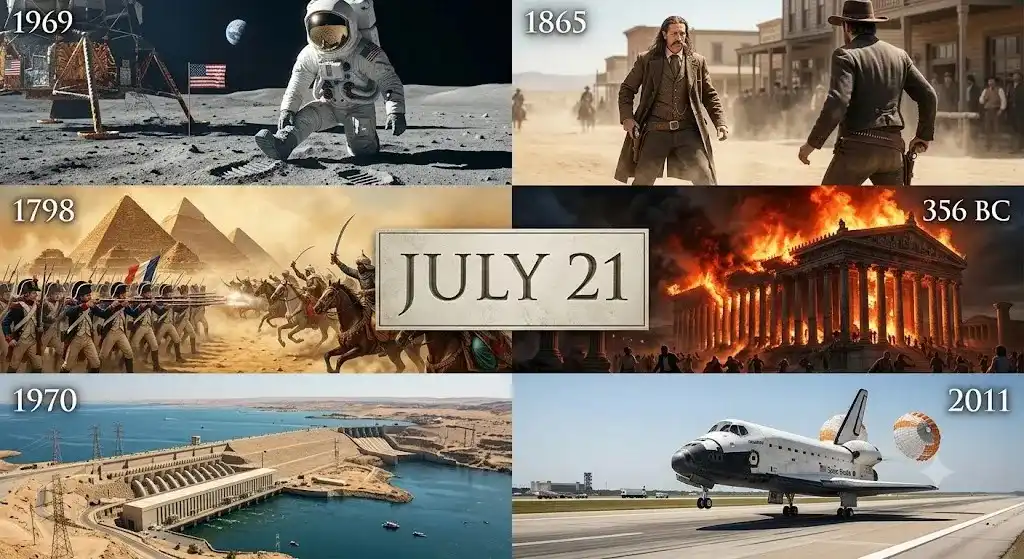
| Most Significant Event | Neil Armstrong and Buzz Aldrin walk on the Moon (1969) |
| Top 10 Key Events | Temple of Artemis burned (356 BC) • Battle of the Pyramids (1798) • Wild Bill Hickok shootout (1865) • First Jesse James train robbery (1873) • Scopes Trial verdict (1925) • First female Prime Minister elected (1960) • Aswan High Dam completed (1970) • Coldest temperature recorded on Earth (1983) • Final Space Shuttle lands (2011) • Joe Biden drops out of 2024 election (2024) |
| Key Battles | Battle of Taillebourg, Battle of Shrewsbury, Battle of Jemmingen, Battle of the Pyramids, First Battle of Bull Run, Battle of Guam |
| Key Figures Today | Neil Armstrong, Wild Bill Hickok, Sirimavo Bandaranaike, Emperor Wen of Sui, Anand Bakshi |
| Observances | Belgian National Day Liberation Day (Guam) Racial Harmony Day (Singapore) |
Story of the Day: The Gunfight That Created the American Wild West
Under a blistering Missouri sun on July 21, 1865, James Butler “Wild Bill” Hickok stood in the center of Springfield’s town square. Facing him seventy-five yards away was Davis Tutt, a former Confederate soldier demanding payment over a disputed gambling debt, holding Hickok’s prized pocket watch as collateral. When Tutt drew his pistol, Hickok rested his weapon across his left forearm, taking deliberate aim before firing a single, steady shot. Tutt took one step, gasped that he was hit, and collapsed dead onto the dirt. That single gunfight transformed a local dispute into legend, birthing the iconic quick-draw showdown format that defined Western lore for generations.
Important Events That Happened On July 21 In History
356 BC – Herostratus Destroys The Temple Of Artemis
Herostratus walked into the grand marble interior of the Temple of Artemis at Ephesus carrying a flame and a desperate desire for permanent fame. The massive structure, ranked among the Seven Wonders of the Ancient World, burned until only blackened pillars remained standing in the ash. Local authorities executed Herostratus and banned anyone from ever speaking his name under penalty of death. Their attempt at erased memory failed completely, as his action birthed the phrase “herostratic fame”—winning renown through pure destruction.
230 – Pontian Becomes Pope Before Historic Resignation
Pope Pontian stepped into his role as the leader of Rome’s Christian community during an era of persistent imperial persecution. Roman authorities eventually arrested him and exiled the church leader to the brutal labor conditions of the Sardinian mines. Realizing he would never return to lead his flock, Pontian formally stepped down from his spiritual post to allow a successor to guide the church. His historic sacrifice made him the very first pope in Christian history to resign his sacred office.
285 – Diocletian Appoints Maximian As Co-Ruler Of Rome
Emperor Diocletian recognized that the vast borders of the Roman Empire were growing far too wide for one man to defend alone. He summoned his trusted military officer Maximian and officially raised him to the rank of Caesar, splitting administrative authority. This crucial strategic choice laid the groundwork for the Tetrarchy, dividing the sprawling Mediterranean world into manageable administrative halves. The system temporarily stabilized a crumbling empire, delaying Rome’s collapse for generations.
365 – Mega-Tsunami Devastates Crete And The Mediterranean
A colossal tectonic rupture beneath the island of Crete shook the eastern Mediterranean with violent Mercalli XI forces. The massive seabed movement triggered a wall of water that swept across coastal cities, washing ships miles inland over Egyptian rooftops in Alexandria. Tens of thousands of people drowned along the shorelines of Greece, Libya, and Egypt in a matter of hours. The horrific destruction left deep scars on ancient societies, who recorded the tragedy for centuries as a day of cosmic ruin.
905 – King Berengar I Blinds His Royal Rival At Verona
King Berengar I led a joint Italian and Hungarian force through the streets of Verona, catching King Louis III completely off guard. Louis had broken his solemn oath to stay out of Italian political affairs, leaving himself vulnerable to Berengar’s wrathful counterattack. The victorious Berengar captured the Frankish ruler and ordered his guards to burn out Louis’s eyes with red-hot irons. Blinded and stripped of power, Louis was sent back to Provence, leaving Berengar as the undisputed ruler of northern Italy.
1242 – Louis IX Crushes English Forces At Taillebourg
King Louis IX of France lined up his royal forces near the Charente river to confront his rebellious vassal Hugh X and King Henry III of England. French troops surged across the narrow river bridge, breaking through the English lines with relentless heavy cavalry charges. Henry III realized his army was completely surrounded and fled the field under cover of darkness, abandoning his baggage trains behind. The victory shattered the noble uprising, cementing French royal control over contested western territories.
1403 – Henry IV Defeats Percy Rebels At Shrewsbury
King Henry IV assembled his royal army near Shropshire to halt a fierce rebellion led by his former ally, Henry “Hotspur” Percy. Thousands of longbowmen unleashed thick flights of arrows across the field, cutting down soldiers on both sides in horrific numbers. Hotspur was killed instantly when an arrow struck his face, sending his rebellious forces into a complete panic. Henry IV secured his fragile grip on the English throne, proving he could brutally crush internal threats to his royal lineage.
1545 – French Troops Land On The Isle Of Wight
French soldiers waded ashore on the beaches of the Isle of Wight, launching a direct amphibious assault against the English coast. The invasion force sought to pin down King Henry VIII’s defensive armies while their naval fleet controlled the Solent waters. English local militias scrambled quickly, fighting desperate skirmishes in the marshlands to halt the enemy’s advance toward coastal towns. The landing marked the deepest penetration of French forces onto English soil during the entire Anglo-French War.
1568 – Duke Of Alva Wipes Out Rebel Army At Jemmingen
Fernando Álvarez de Toledo, the Duke of Alva, cornered Louis of Nassau’s Dutch rebel army against the muddy banks of the Ems River. The Spanish commander baited the inexperienced rebels out of their fortified trenches before unleashing a devastating cavalry counterattack. Cut off from any escape route, thousands of Dutch soldiers drowned in the river or were cut down as they fled in panic. Alva’s ruthless victory effectively crushed early Protestant resistance in the northern provinces during the Eighty Years’ War.
1645 – Dorgon Issues The Queue Order In Qing China
Regent Dorgon issued a strict imperial decree commanding all Han Chinese men to shave their foreheads and wear Manchu-style braided queues. The Qing government made the cultural submission clear to every citizen: keep your hair and lose your head, or shave your head and keep your hair. Millions of men faced an agonizing choice between ancestral customs and immediate execution by imperial soldiers. The queue became a mandatory symbol of Manchu rule across China that lasted until the final fall of the dynasty.
1656 – English Fleet Raids Spanish Harbor At Málaga
English naval commander Robert Blake guided his war galleons directly into the heavily defended harbor of Málaga during the Anglo-Spanish War. His gunners opened up a relentless bombardment on Spanish shipping, sinking five galleons and setting fire to harbor dockyards. English landing parties rushed the shore batteries under heavy fire, spiking the heavy cannons before retreating back to their warships. The daring surprise attack struck a massive blow against Spanish trade routes in the Mediterranean Sea.
1674 – French Defenders Repel Dutch Fleet At Martinique
Admiral Michiel de Ruyter brought a massive Dutch fleet to the tropical shores of Martinique, expecting an easy victory over the outnumbered French garrison. Fortified inside Fort Royal, a tiny French force under Governor Sainte-Marthe held their positions against thousands of landing troops. Unexpected artillery crossfire and dense jungle terrain threw the Dutch assault into utter confusion, forcing a chaotic retreat to their ships. The tiny island garrison secured an unbelievable victory against the world’s premiere naval power.
1718 – Treaty Of Passarowitz Redraws Southeast Europe
Diplomats gathered in the Serbian town of Passarowitz to sign a historic peace agreement ending bitter conflict between the Ottoman Empire, Austria, and Venice. Austria gained massive swathes of land, including northern Serbia, the Banat, and Little Walachia, expanding its imperial footprint deep into the Balkans. The Ottomans lost key European footholds but maintained their dominance over Venetian holdings in the Peloponnese. The treaty fundamentally reshaped the geopolitical landscape of Southeastern Europe for decades.
1774 – Russo-Turkish War Ends With Treaty Of Küçük Kaynarca
Russian and Ottoman representatives signed the Treaty of Küçük Kaynarca after years of devastating military conflicts in the Black Sea region. The Ottoman Empire ceded crucial territory around the Dnieper River and officially recognized the independence of the Crimean Khanate. For the first time in history, an Ottoman Sultan surrendered land populated primarily by Muslims while separating his secular rule from his religious authority. Russia established itself as a formidable protector of Orthodox Christians living inside Ottoman borders.
1798 – Napoleon Defeats Mamluk Army At Battle Of The Pyramids
Napoleon Bonaparte arranged his French divisions into impenetrable infantry squares within sight of Cairo’s ancient stone monuments. Thousands of Mamluk horsemen charged forward on fine Arabian steeds, swinging swords directly into a wall of musket fire and fixed bayonets. The modern French tactics utterly shattered the medieval cavalry force, killing thousands of defenders and forcing the survivors to flee into the desert. Napoleon captured Cairo shortly after, securing short-lived dominance over Egypt.
1831 – Leopold I Sworn In As First King Of The Belgians
Leopold of Saxe-Coburg-Gotha took a solemn constitutional oath in Brussels, becoming the very first King of the Belgians. The new nation had just won its independence from the Netherlands and desperately needed a respected European royal to establish international credibility. Leopold pledged to uphold the liberal Belgian constitution, winning over the trust of both Catholic and liberal political factions. His ascension marked the formal birth of the modern Kingdom of Belgium as an independent state.
1832 – Treaty Of Constantinople Establishes Independent Greece
Diplomats from Britain, France, Russia, and the Ottoman Empire finalized the historic Treaty of Constantinople in the imperial capital. The agreement defined the formal land borders of the newly created Kingdom of Greece, ending a bloody decade-long war for Greek independence. The Ottoman Empire officially recognized Greek sovereignty in exchange for a substantial financial indemnity paid by European powers. Greece emerged onto the world stage as a free nation for the first time in over four centuries.
1861 – Confederates Win First Battle Of Bull Run
Union and Confederate armies clashed near Manassas Junction, Virginia, in the first major land battle of the American Civil War. Northerners had traveled from Washington with picnic baskets to watch what they assumed would be a quick Federal victory over rebel forces. Instead, General Thomas Jackson earned his nickname “Stonewall” by holding the defensive line, launching a fierce counterattack that panicked the Union lines. The chaotic retreat showed both sides that the war would be a long, bloody conflict.
1873 – Jesse James Executes First Western Train Robbery
Jesse James and the James-Younger Gang loosened a section of iron track near Adair, Iowa, waiting in bushes for the oncoming locomotive. The Rock Island express train derailed into the bank, killing the engineer as masked bandits swarmed the wooden passenger cars. The outlaw gang forced open the safe, robbing frightened passengers before riding off into the countryside with thousands of dollars in cash. This dangerous heist established the classic template for train robberies throughout Western history.
1877 – Pittsburgh Strike Escalates Into Violent Militia Clash
Striking Baltimore and Ohio Railroad workers rallied in Pittsburgh to protest wage cuts, shutting down local rail yards in solidarity with fallen Maryland workers. Pennsylvania state militia units arrived from Philadelphia and fired rifles directly into the crowd, killing twenty innocent people in seconds. Enraged mobs chased the troops into a roundhouse, setting fire to surrounding rail cars and burning down dozens of company buildings. The violent conflict forced the federal government to deploy armed troops to suppress labor protests nationwide.
1904 – Louis Rigolly Breaks 100 MPH Land Speed Barrier
French driver Louis Rigolly strapped himself into a massive 15-liter Gobron-Brillié racing car on a paved beach road in Ostend, Belgium. He floored the accelerator, pushing the roaring engine until the vehicle flew past the timing markers at an astonishing 103.55 mph. The dramatic run marked the first time a human being had officially traveled faster than 100 miles per hour on land. Rigolly’s achievement proved to the world that automobiles were capable of unprecedented speeds.
1907 – SS Columbia Sinks Off The Coast Of California
The passenger steamer SS Columbia plowed through thick fog off Shelter Cove, California, when it collided directly with the heavy wooden steam schooner San Pedro. The impact tore a massive hole below Columbia’s waterline, causing the metal ship to fill rapidly with cold ocean water. Panicked passengers rushed the wooden lifeboats as the vessel rolled over and sank into the ocean depths in under nine minutes. Eighty-eight people lost their lives in one of the worst maritime disasters in California history.
1919 – Wingfoot Air Express Crashes Into Chicago Bank
The blimp Wingfoot Air Express caught fire over downtown Chicago, sending flames ripping through its fabric envelope thousands of feet in the air. Gondola occupants scrambled to jump out with parachutes as the burning airship plunged directly toward the crowded streets below. The flaming wreckage crashed straight through the glass skylight of the Illinois Trust and Savings Building, smashing onto the bank floor below. Twelve people died, including workers at their desks, leading to strict regulations on city air traffic.
1920 – Expulsions Begin In The Belfast Pogrom
Loyalist mobs entered the shipyards and textile factories of Belfast, forcibly driving thousands of Catholic workers from their everyday jobs. The targeted violence rapidly spread across working-class neighborhoods, sparking two years of sectarian riots, home burnings, and deadly street clashes. Over four hundred people lost their lives in the surrounding violence as political tensions flared across Northern Ireland. The event marked a dark turning point in the partition era of Irish history.
1925 – John Scopes Convicted In Famous Evolution Trial
A Tennessee jury found high school biology teacher John T. Scopes guilty of breaking state law by teaching Charles Darwin’s theory of evolution. The week-long trial pitted celebrity lawyers Clarence Darrow and William Jennings Bryan against each other in a fiery national debate over science and religion. The judge ordered Scopes to pay a $100 fine, though the verdict was later overturned on a technicality by higher courts. The trial exposed deep cultural divisions in American society over education and religious tradition.
1925 – Malcolm Campbell Sets New World Speed Record
Malcolm Campbell sped across the damp sands of Pendine Sands in Wales inside his custom-built 350HP Sunbeam racing automobile. He smashed the accelerator over a measured two-way course, reaching a historic top average speed of 150.33 miles per hour. The thrilling run made Campbell the first driver in human history to cross the 150 mph threshold on land. His legendary speed record sparked a lifelong pursuit of land and water speed records that made him an international hero.
1936 – Anarchist Militias Take Control Of Catalonia
Antifascist groups formed the Central Committee of Antifascist Militias in Barcelona following the outbreak of the Spanish Civil War. Anarcho-syndicalist workers seized factories, collectivized farmland, and reorganized public transportation across the region of Catalonia without government interference. The spontaneous social revolution transformed the local economy overnight, placing working-class committees in complete control of daily operations. The movement created a unique social experiment in the middle of a brutal civil conflict.
1944 – American Troops Land On The Beaches Of Guam
United States Marines and Army soldiers charged out of landing craft into thick mortar fire on the tropical beaches of Guam. The military invasion aimed to reclaim the strategic American territory from occupying Imperial Japanese forces who had held it since 1941. Troops fought through dense jungle foliage and fortified cave systems in weeks of hand-to-hand combat to secure the island. The bloody campaign provided a vital airbase for future Allied bomber missions against the Japanese mainland.
1944 – Claus Von Stauffenberg Executed For Hitler Assassination Plot
Colonel Claus von Stauffenberg stood before a military firing squad in the courtyard of the Bendlerblock in Berlin shortly after midnight. Hours earlier, his brief-case bomb had detonated inside Hitler’s headquarters, but the dictator survived the blast with minor injuries. Nazi loyalists quickly crushed the coup attempt, arresting Stauffenberg and his core anti-Hitler co-conspirators before the night ended. Stauffenberg shouted his loyalty to a free Germany seconds before soldiers opened fire in the dim courtyard light.
1949 – US Senate Ratifies The North Atlantic Treaty
Senators voted decisively in Washington to ratify the North Atlantic Treaty, committing the United States to a permanent peacetime military alliance. The historic decision pledged American military protection to Western European allies against potential aggression from the Soviet Union. The vote marked a major departure from traditional American isolationism, establishing the foundation of NATO during the Cold War. The alliance permanently altered global diplomacy and strategic defense planning for decades.
1951 – Canadian Pacific Flight 3505 Disappears In Alaska
Canadian Pacific Air Lines Flight 3505 took off from Vancouver on a routine military transport route headed toward Tokyo, Japan. The DC-4 aircraft checked in with air traffic controllers over the stormy skies of Alaska before vanishing from radar screens without sending an emergency signal. Extensive military search planes combed thousands of miles of rugged mountains and ocean water for weeks, but found no trace of wreckage. All 37 passengers and crew members vanished, leaving behind one of aviation’s unsolved mysteries.
1952 – Massive Earthquake Hits Kern County California
A massive 7.3 magnitude earthquake rocked Southern California early in the morning, centered along the White Wolf fault line in Kern County. The violent shaking cracked reinforced concrete highways, twisted rail lines, and brought brick buildings crashing down in nearby communities. Twelve people lost their lives and hundreds suffered injuries as landslides blocked major mountain passes across the region. It remained the strongest earthquake to strike Southern California since the historic 1906 San Francisco quake.
1954 – Geneva Conference Splits Vietnam At 17th Parallel
Diplomats signed the Geneva Accords in Switzerland, formally ending the First Indochina War between communist Viet Minh forces and France. The agreement temporarily partitioned Vietnam at the 17th parallel into a communist North led by Ho Chi Minh and a pro-Western South. Nationwide elections were scheduled for two years later to unify the country, but political tensions prevented those elections from occurring. The division set the stage for direct American military involvement in the Vietnam War.
1959 – World’s First Nuclear Passenger Ship Launches
First Lady Mamie Eisenhower smashed a champagne bottle against the hull of the NS Savannah as the vessel slid into the water at Camden, New Jersey. The ship represented President Dwight D. Eisenhower’s “Atoms for Peace” initiative, designed to show peaceful applications of atomic energy. Built as a sleek cargo-passenger hybrid, the Savannah proved that nuclear reactors could safely power commercial merchant ships across open oceans. The vessel sailed millions of nautical miles as a roving technical ambassador for clean energy.
1959 – Pumpsie Green Integrates The Boston Red Sox
Pumpsie Green stepped onto the field at Comiskey Park as a pinch runner, making history as the first Black player for the Boston Red Sox. Boston had remained the very last franchise in Major League Baseball to integrate its roster, twelve full years after Jackie Robinson broke the color barrier. Green took over at shortstop for the remainder of the game, scoring a run despite the team losing 2–1 to the Chicago White Sox. His debut marked the final step in integrating all existing Major League teams.
1960 – World’s First Female Prime Minister Elected In Ceylon
Sirimavo Bandaranaike took the oath of office in Colombo, Ceylon, becoming the world’s first democratically elected female head of government. She stepped into the political arena following the assassination of her husband, leading the Sri Lanka Freedom Party to a decisive electoral victory. Bandaranaike enacted major socialist reforms, nationalized key private industries, and changed the island’s official language during her tenure. Her leadership shattered glass ceilings for female political figures around the world.
1961 – Liberty Bell 7 Sinks After Gus Grissom Spaceflight
Astronaut Gus Grissom splashed down safely in the Atlantic Ocean inside his Liberty Bell 7 capsule after completing a successful suborbital spaceflight. Seconds after landing, the explosive side hatch prematurely blew off, allowing seawater to pour rapidly into the small spacecraft. Grissom scrambled into the swelling ocean waves, swimming for his life as emergency helicopters struggled to lift the water-filled capsule. The astronaut was rescued safely, but his space capsule sank three miles down to the ocean floor.
1961 – Alaska Airlines Flight 779 Crashes At Shemya Base
Alaska Airlines Flight 779 approached the fog-shrouded runway at Shemya Air Force Base at the far tip of the Aleutian Islands. The military transport plane struck low-lying embankment terrain short of the runway threshold, breaking apart on impact near the airfield perimeter. Six crew members aboard the flight died in the fiery crash, which was blamed on poor runway lighting visibility during heavy fog. The tragic incident prompted immediate upgrades to landing guidance systems on remote northern airfields.
1962 – Racial Riots Break Out Across Singapore
Tensions boiled over on the streets of Singapore during a religious procession celebrating the Prophet Muhammad’s birthday, sparking violent racial clashes. Clashing groups threw rocks and bottles through commercial districts, destroying storefronts and burning private vehicles parked along roads. Authorities imposed strict military curfews as police units swept the island to restore public order over six weeks of unrest. The riots left 23 people dead and over four hundred injured, altering Singapore’s integration policies.
1969 – Neil Armstrong Takes First Human Steps On The Moon
Astronaut Neil Armstrong stepped down the ladder of the Apollo 11 Lunar Module and planted his boot firmly into the soft lunar soil. Over 600 million people watched the grainy television broadcast as he declared his famous words about a small step for man and a giant leap for mankind. Buzz Aldrin joined him minutes later, setting up scientific experiments and planting the American flag in the vacuum of space. The historic achievement marked humanity’s initial step onto another celestial body.
1970 – Aswan High Dam Completed In Egypt
Egyptian engineers completed final construction on the massive Aswan High Dam after eleven years of heavy labor and Soviet financial backing. The immense stone barrier tamed the unpredictable seasonal flooding of the Nile River, generating massive hydroelectric power for the entire nation. Construction required moving ancient stone monuments like Abu Simbel to higher ground to prevent them from drowning beneath Lake Nasser. The dam transformed Egyptian agriculture, providing a steady water supply for farmlands year-round.
1972 – Provisional IRA Detonates 22 Bombs On Bloody Friday
Provisional IRA operatives set off 22 hidden explosives across central Belfast in the span of just eighty chaotic minutes. The coordinated blasts destroyed bus stations, railway tracks, and shopping streets, catching unsuspecting civilians in open crossfire. Nine people died instantly and over one hundred suffered horrific injuries as emergency services were overwhelmed by constant explosion reports. The tragic afternoon became known as Bloody Friday, marking one of the darkest days of The Troubles in Northern Ireland.
1973 – Mossad Operatives Assassinate Innocent Man In Norway
Israeli Mossad agents gunned down Moroccan waiter Ahmed Bouchikhi in front of his pregnant wife as they walked home from a cinema in Lillehammer. The covert strike team mistakenly identified Bouchikhi as Ali Hassan Salameh, the mastermind behind the 1972 Munich Olympics Massacre. Norwegian authorities responded rapidly, arresting six Israeli agents and exposing the secret details of Israel’s covert assassination program to international press. The incident sparked global outrage and strained diplomatic ties between Norway and Israel.
1974 – British Ambassador Assassinated By IRA In Dublin
British Ambassador Christopher Ewart-Biggs got into his official sedan outside his residence in Sandyford, Dublin, heading toward his diplomatic office. An IRA landmine hidden inside a road culvert detonated directly beneath the vehicle, blasting the heavy car into the air. The explosion killed Ewart-Biggs and civil servant Judith Cook instantly, leaving two other passengers severely injured in the smoking crater. The brazen assassination forced both the British and Irish governments to dramatically step up anti-terror security measures.
1977 – Libyan and Egyptian Forces Clash In Border War
Border disputes flared into full-scale military conflict as Libyan artillery batteries opened fire on Egyptian positions along the border town of Musaid. Egyptian President Anwar Sadat retaliated swiftly, sending armored divisions and jet fighters across the border to strike Libyan airbases. Heavy skirmishes raged across the desert sands for four days as international diplomats scrambled to broker a cease-fire. The brief war ended with a complete military defeat for Libyan forces, cementing tensions between the neighbors.
1979 – Jay Silverheels Earns Hollywood Walk Of Fame Star
Mohawk actor Jay Silverheels pressed his hands into the pavement as he received a dedicated star on the world-famous Hollywood Walk of Fame. Best known for his iconic role as Tonto in The Lone Ranger television series, he spent decades carving out opportunities for Native performers in media. His induction marked the first time a Native American actor received a star along the legendary Hollywood sidewalk. The historic recognition honored his long career in film and his advocacy for indigenous actors in Western cinema.
1983 – Coldest Temperature Recorded At Vostok Station
Scientists at the Soviet Vostok Station in the heart of Antarctica checked their weather instruments to confirm an unbelievable environmental reading. The thermometer plummeted to a bone-chilling −89.2 °C (−128.6 °F), setting the record for the coldest natural temperature ever recorded on Earth’s surface. At these extreme temperatures, human breath freezes instantly into liquid crystals and skin freezes solid in seconds. The historic weather measurement provided key data for researchers studying extreme polar atmospheric dynamics.
1990 – Twenty-Five Immigrants Suffocate On Chinese Fishing Boat
Taiwanese military police forced dozens of illegal mainland immigrants into the sealed storage holds of the fishing vessel Min Ping Yu No. 5540. Authorities nailed shut the hatch covers, sending the boat back across the Taiwan Strait toward Fujian province without proper ventilation. When local Chinese fishermen finally pried open the wooden hatches, they found twenty-five men had died from carbon dioxide suffocation inside the sweltering compartment. The horrific tragedy caused massive outrage and forced changes in Taiwan’s repatriation protocols.
1995 – China Fires Missiles In Third Taiwan Strait Crisis
The Chinese People’s Liberation Army launched a series of tactical ballistic missiles into ocean waters off the northern coast of Taiwan. The military tests were meant to intimidate Taiwanese voters ahead of upcoming democratic presidential elections, signalling opposition to Taiwanese independence movements. The aggressive missile strikes caused global concern, prompting the United States to deploy aircraft carrier battle groups into the Taiwan Strait. The crisis marked the most dangerous military standoff in the region in decades.
1990 – Akashi Pedestrian Bridge Disaster Kills Eleven
Thousands of spectators crowded onto a narrow pedestrian footbridge in Akashi, Hyōgo, Japan, trying to exit the beach after a massive fireworks show. The dense crowd jammed tightly together on the stairs, causing a sudden surge that knocked people over like falling dominoes. Eleven people, including young children and elderly visitors, died from crush injuries, while over one hundred suffered severe trauma. The tragic structural disaster led to strict national laws governing public crowd safety management at events.
2005 – London Public Transit Targeted In Second Bomb Attack
Four suicide bombers attempted to detonate homemade explosives inside three London Underground trains and a double-decker bus. The improvised explosive devices failed to detonate fully, producing small pops that caused widespread panic across the city’s transit network. Commuters fled onto the subway tracks as armed police officers swarmed stations, launching a massive manhunt across the country. Coming two weeks after the deadly July 7 bombings, the failed attack put London on high alert.
2008 – Ram Baran Yadav Declared First President Of Nepal
Nepal’s newly elected Constituent Assembly cast ballots in Kathmandu, electing Ram Baran Yadav as the very first President of the country. His election formally closed the curtain on centuries of Hindu monarchy, completing Nepal’s peaceful transition into a federal democratic republic. Yadav pledged to draft a new secular constitution, bringing unified leadership to a nation emerging from years of civil war. His inauguration signaled a major political shift across the Himalayan region.
2010 – Obama Signs Dodd-Frank Wall Street Reform Act
President Barack Obama sat at a desk lined with historic pens in Washington, signing the Dodd-Frank Wall Street Reform Act into law. The landmark legislation overhauled federal financial regulations following the devastating subprime mortgage crisis and subsequent 2008 economic recession. The law created new consumer protection agencies, established strict oversight of large banks, and regulated risky derivative trading practices. It represented the most comprehensive financial regulatory reform since the Great Depression.
2011 – Space Shuttle Atlantis Lands, Ending NASA Shuttle Program
Space Shuttle Atlantis touched down smoothly on the sunlit runway at NASA’s Kennedy Space Center in Florida, completing mission STS-135. The successful landing brought a final close to the thirty-year Space Shuttle program, which had flown 135 missions and launched iconic satellites into orbit. Thousands of space agency workers lined the runway aprons to cheer the orbiter as its parachute deployed on the concrete strip. The touchdown marked the end of an era for American crewed space exploration.
2012 – Erden Eruç Completes Solo Human-Powered Circumnavigation
Turkish-American adventurer Erden Eruç rowed his custom ocean boat ashore at Bodega Bay, California, completing a historic solo voyage around the Earth. Over five years, Eruç traveled over 41,000 miles entirely under his own muscle power, using ocean rowboats, sea kayaks, bicycles, and walking on foot. He crossed three major oceans and conquered brutal weather, setting multiple endurance world records along his path. His arrival marked the first verified solo human-powered circumnavigation of the globe.
2019 – Triad Mob Attacks Commuters In Yuen Long Station
A gang of over a hundred men dressed in white shirts stormed the Yuen Long MTR station in Hong Kong carrying bamboo poles and metal rods. The mob beat pro-democracy protesters, journalists, and bystanders inside train cars and along platform corridors without discrimination. Police officers took nearly forty minutes to arrive at the scene, drawing heavy public criticism for their slow response to the violence. The terrifying incident marked a violent turning point in the 2019 Hong Kong anti-extradition protests.
2023 – Barbenheimer Double-Feature Shatters Box Office Records
Moviegoers packed theater lobbies worldwide as Greta Gerwig’s comedy Barbie and Christopher Nolan’s historical thriller Oppenheimer opened on the exact same day. Audiences embraced the stark tonal contrast, creating an organic social media trend where fans bought back-to-back double feature tickets. The cultural phenomenon generated hundreds of millions of dollars in opening weekend revenue, reviving global cinema attendance after years of slump. The day marked an unprecedented victory for theatrical cinema releases.
2024 – Joe Biden Ends Campaign And Endorses Kamala Harris
President Joe Biden released an official statement announcing he was stepping down from his 2024 re-election campaign. Following weeks of mounting pressure from party leaders and voters, Biden chose to end his bid, instantly endorsing Vice President Kamala Harris for the nomination. The sudden decision reshaped the American political environment overnight, marking the first time an incumbent president withdrew from a race so late in the cycle since 1968. Harris launched her campaign immediately, securing party support.
2025 – Military Jet Crashes Into School In Bangladesh
A Chengdu FT-7BGI trainer jet belonging to the Bangladesh Air Force suffered sudden engine failure shortly after taking off from Dhaka. The aircraft lost altitude rapidly, crashing directly into the crowded grounds of the Milestone School campus during morning classes. The impact destroyed multiple school buildings, killing 35 people—mostly young students—and injuring over 170 others on the ground. The tragedy prompted national mourning and immediate military investigations into aging training aircraft fleets.
Unearth more historical gems from our previous posts.
Famous People Born on July 21
| Name | Description | Dates |
|---|---|---|
| Emperor Wen of Sui | Founder and first emperor of China’s Sui dynasty | 541 – 604 |
| Pope Sixtus IV | Pope who commissioned the Sistine Chapel | 1414 – 1484 |
| Paul Reuter | German-English journalist; founder of Reuters | 1816 – 1899 |
| Lovis Corinth | Influential German painter | 1858 – 1925 |
| Milan Rastislav Štefánik | Slovak astronomer, general, and statesman | 1880 – 1919 |
| Hans Fallada | German novelist | 1893 – 1947 |
| Hart Crane | American poet | 1899 – 1932 |
| Ernest Hemingway | American novelist and Nobel Prize winner | 1899 – 1961 |
| Marshall McLuhan | Canadian media theorist | 1911 – 1980 |
| Isaac Stern | Russian-American violin virtuoso | 1920 – 2001 |
| Rudolph A. Marcus | Nobel Prize-winning chemist | 1923 – 2026 |
| Don Knotts | American comedian and actor | 1924 – 2006 |
| Norman Jewison | Canadian film director | 1926 – 2024 |
| Anand Bakshi | Legendary Indian lyricist and songwriter | 1930 – 2002 |
| Janet Reno | First female U.S. Attorney General | 1938 – 2016 |
| Mallikarjun Kharge | Indian politician and Congress president | 1942 – Present |
| Edward Herrmann | American actor | 1943 – 2014 |
| Cat Stevens (Yusuf Islam) | British singer-songwriter | 1948 – Present |
| Robin Williams | American actor and comedian | 1951 – 2014 |
| Michael Connelly | American crime novelist | 1956 – Present |
| Stefan Löfven | Former Prime Minister of Sweden | 1957 – Present |
| Jon Lovitz | American comedian and actor | 1957 – Present |
| Amar Singh Chamkila | Iconic Punjabi singer-songwriter | 1960 – 1988 |
| Sarah Waters | British novelist | 1966 – Present |
| Brandi Chastain | American World Cup-winning footballer | 1968 – Present |
| Josh Hartnett | American actor | 1978 – Present |
| Tamika Catchings | American Basketball Hall of Famer | 1979 – Present |
| Romeo Santos | American singer and “King of Bachata” | 1981 – Present |
| DeAndre Jordan | American NBA basketball player | 1988 – Present |
| Erling Haaland | Norwegian football superstar | 2000 – Present |
Famous People Who Died on July 21
| Name | Description | Dates |
|---|---|---|
| Manuel II Palaiologos | Byzantine emperor | 1350 – 1425 |
| Antonio de Mendoza | First Viceroy of New Spain | 1495 – 1552 |
| Robert Burns | Scotland’s national poet | 1759 – 1796 |
| Robert G. Ingersoll | American lawyer and renowned orator | 1833 – 1899 |
| Ellen Terry | Celebrated English stage actress | 1847 – 1928 |
| Claus von Stauffenberg | German officer who led the plot against Hitler | 1907 – 1944 |
| Arshile Gorky | Armenian-American painter | 1904 – 1948 |
| Jimmie Foxx | Baseball Hall of Fame player | 1907 – 1967 |
| Albert Lutuli | South African Nobel Peace Prize laureate | 1898 – 1967 |
| Basil Rathbone | British-American actor; famous as Sherlock Holmes | 1892 – 1967 |
| Jigme Dorji Wangchuck | Modernizing King of Bhutan | 1928 – 1972 |
| Lee Miller | American photographer and war correspondent | 1907 – 1977 |
| Alan Shepard | First American in space | 1923 – 1998 |
| Robert Young | American actor | 1907 – 1998 |
| Jerry Goldsmith | Academy Award-winning film composer | 1929 – 2004 |
| Edward B. Lewis | Nobel Prize-winning geneticist | 1918 – 2004 |
| Long John Baldry | English-Canadian blues singer | 1941 – 2005 |
| Mako Iwamatsu (Mako) | Japanese-American actor | 1933 – 2006 |
| Alexander Cockburn | Irish-American journalist | 1941 – 2012 |
| Andrea Antonelli | Italian motorcycle racer | 1988 – 2013 |
| E. L. Doctorow | American novelist | 1931 – 2015 |
| Dennis Green | American NFL coach | 1949 – 2016 |
| John Heard | American actor | 1946 – 2017 |
| Alene Duerk | First female admiral in the U.S. Navy | 1920 – 2018 |
| Annie Ross | Scottish-American jazz singer | 1930 – 2020 |
| Andrew Mlangeni | South African anti-apartheid activist | 1925 – 2020 |
| Tony Bennett | Legendary American singer | 1926 – 2023 |
| Dan Borislow | Entrepreneur; inventor of magicJack | 1961 – 2014 |
| Owen Wister | American author of The Virginian | 1860 – 1938 |
| Dave Garroway | American television pioneer and broadcaster | 1913 – 1982 |
Observances on July 21
- Belgian National Day (Belgium): Celebrates the formal inauguration of Leopold I as the nation’s first king in 1831, marked by military parades in Brussels and nationwide firework displays.
- Liberation Day (Guam): Commemorates the landing of United States forces on July 21, 1944, which liberated the native Chamorro population from Japanese military occupation during World War II.
- Racial Harmony Day (Singapore): Observed across schools and communities to promote racial and religious understanding, honoring the lessons learned from the tragic 1964 racial riots.
- Summer Kazanskaya (Russia): A traditional cultural feast day in Eastern Orthodox practice, celebrating the famous apparition of the Our Lady of Kazan icon.
🌕 Frequently Asked Questions — July 21 in History
On July 21, 1969, astronaut Neil Armstrong stepped out of the Apollo 11 lunar module onto the surface of the Moon, becoming the first human being to walk on an extraterrestrial body. He was joined shortly after by Buzz Aldrin as millions watched the live broadcast from Earth.
On July 21, 1861, Confederate and Union forces fought in the First Battle of Bull Run near Manassas Junction, Virginia. The battle ended in a decisive Confederate victory, shattering Northern hopes for a quick resolution to the American Civil War.
Emperor Wen of Sui, the visionary founder and first emperor of China’s Sui dynasty who unified the nation, shares this historical birth date. Legendary Indian lyricist and songwriter Anand Bakshi was also born on July 21, along with many other notable historical figures detailed above.
The Apollo 11 moonwalk in 1969 stands out as the most significant event on July 21, marking the first time humanity touched another world. The event fundamentally reshaped global science, technology, and space exploration capabilities forever.
Belgian National Day marks the official swearing-in of Leopold I as the first King of the Belgians on July 21, 1831. It celebrates the founding of modern Belgium as an independent, constitutional monarchy following its separation from the Netherlands.
On July 21, 2024, United States President Joe Biden ended his presidential re-election campaign and endorsed Vice President Kamala Harris. A year later, on July 21, 2025, a military jet crash on a school campus in Dhaka, Bangladesh, made international headlines.