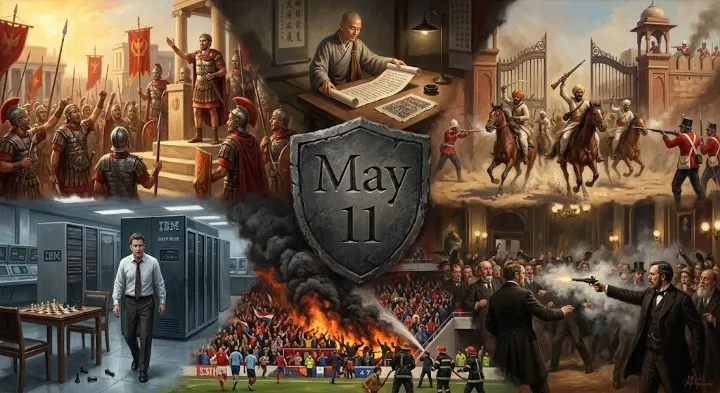
Emperor Bahadur Shah Zafar II looked out from his palace windows in the morning heat of May 11, 1857, as hundreds of dusty, rebellious sepoys crossed the Yamuna River into Delhi. They had mutinied against their British officers in Meerut the previous day, and now they demanded the elderly Mughal emperor lead their revolt. By sunset, the ancient city was fully in rebel hands, sparking an uprising that shook the British Empire to its core.
Centuries later on that exact calendar date, a very different kind of battle concluded when world chess champion Garry Kasparov stared in disbelief at a computer screen before walking away in defeat. Here is a look at what happened on May 11 in history.
🇮🇳 Quick Facts — May 11 in History
| 📌 Category | 📖 Event / Detail |
|---|---|
| 🌟 Most Significant Event | The Indian Rebellion of 1857 reaches Delhi, escalating into a massive war against British rule (1857) |
| 🏆 Top 10 Key Events | • 330 – Constantine the Great dedicates New Rome (Constantinople) • 868 – The Diamond Sūtra is printed in China, becoming the world’s oldest dated book • 973 – Edgar the Peaceful and Ælfthryth receive the first unified English coronation • 1812 – British Prime Minister Spencer Perceval is shot dead in Parliament • 1813 – Explorers discover a path across Australia’s Blue Mountains • 1858 – Minnesota joins the United States as the 32nd state • 1985 – The Bradford City stadium fire claims 56 lives in England • 1996 – ValuJet Flight 592 crashes into the Florida Everglades • 1997 – Deep Blue beats Garry Kasparov, a historic victory for AI • 2010 – David Cameron forms the UK’s first post-WWII coalition government |
| ⚔️ Key Battles | The Battle of Djerba (1560), where Ottoman naval forces crushed a major Spanish fleet}- |
| 👤 Key Figures | Emperor Constantine, Prime Minister Spencer Perceval, Grandmaster Garry Kasparov, Journalist Shireen Abu Akleh}- |
| 🌍 Observances | Christian feast days for Anthimus of Rome, Gangulphus of Burgundy, and Blessed John Rochester}- |
Story of the Day: The Day a Machine Broke a World Chess Champion
Garry Kasparov sat at the chessboard on May 11, 1997, his face a mask of intense concentration that slowly twisted into frustration. Across the table sat an IBM engineer, manually moving pieces on behalf of Deep Blue, a custom-built supercomputer capable of evaluating 200 million positions per second.
It was the sixth and final game of their highly publicised rematch, with the score tied. Kasparov made an early, uncharacteristic mistake in his opening defense, expecting the machine to play cautiously. Instead, Deep Blue executed a brilliant knight sacrifice that completely shattered the human champion’s position.
Kasparov resigned after just 19 moves, visibly shaken as he walked out of the New York tournament room. This marked the first time in human history that a reigning world champion lost a traditional match to artificial intelligence under classic tournament time controls. It shattered the long-held belief that creative intuition gave human minds a permanent edge over cold, calculation-driven machines.
Important Events That Happened On May 11 In History
330 – CONSTANTINOPLE IS DEDICATED
Emperor Constantine the Great stood before a cheering crowd to officially dedicate his magnificent new capital along the Bosphorus Strait. Shifting his imperial court away from Rome, he renamed the heavily expanded city of Byzantium to New Rome, though locals quickly dubbed it Constantinople. This massive administrative relocation secured the survival of Roman infrastructure in the east for another thousand years. The grand ceremony established a Christian-aligned capital that would dominate Mediterranean politics, trade, and culture throughout the Middle Ages.
868 – THE DIAMOND SŪTRA IS PRINTED
A workshop in Tang Dynasty China completed the block printing of a sacred Buddhist text known as the Diamond Sūtra. Commissioned by a man named Wang Jie on behalf of his parents, the text was pressed onto a fifteen-foot scroll using carved wooden panels. This document survived centuries hidden inside a sealed desert cave near Dunhuang. It remains the oldest known surviving example of a complete, dated printed book in human existence.
973 – EDGAR THE PEACEFUL CROWNED KING
Archbishop Dunstan led a grand procession into Bath Abbey to crown Edgar the Peaceful as the monarch of a unified England. This spectacular ceremony introduced a holy anointing ritual intentionally designed to mirror the coronation of imperial rulers across Europe. Alongside the king, his wife Ælfthryth was anointed as queen, setting the historic precedent for all future English consort coronations. The liturgical script used on this afternoon still forms the core framework for British royal coronations today.
1068 – MATILDA OF FLANDERS CROWNED QUEEN
Matilda of Flanders walked down the aisle of Westminster Abbey to be officially crowned Queen of England on Whitsunday. Her husband, William the Conqueror, had seized the throne two years prior but faced constant regional rebellions against his new Norman regime. By crowning Matilda in London, William aimed to project an image of domestic stability and dynastic legitimacy to his hostile Anglo-Saxon subjects. The lavish ceremony solidified the high political status of Norman women at the heart of the new royal court.
1258 – TREATY OF CORBEIL SIGNED
King Louis IX of France and King James I of Aragon put their seals to the Treaty of Corbeil, redrawing the geopolitical boundaries of southern Europe. Louis formally gave up all French feudal claims over the counties of Barcelona and Roussillon, ending centuries of theoretical Carolingian dominance. In return, James surrendered his own territorial claims to areas deep within southern France. This diplomatic separation permanently detached Catalan politics from French control, solidifying the Pyrenees as a natural national border.
1560 – THE BATTLE OF DJERBA
Ottoman admiral Piali Pasha ordered a sudden, aggressive assault against a combined Christian armada anchored off the Tunisian coast. The Spanish-led fleet, sent by King Philip II to reclaim Tripoli, was caught completely unprepared by the speed of the Turkish attack. Within hours, the Ottoman navy sank or captured half of the European vessels, securing a resounding victory. This triumph marked the absolute peak of Ottoman naval supremacy in the Mediterranean Sea, a dominance that remained unchallenged for years.
1713 – BURNING OF HELSINKI
Swedish and Finnish defenders watched Russian imperial troops advance toward their strategic positions along the Gulf of Finland. Realising they were heavily outnumbered and unable to hold the line, the retreating Swedish command made a drastic tactical decision. They set fire to the entire city of Helsinki, burning its homes, warehouses, and docks to the ground so the invading Russians could find no shelter. The desperate scorched-earth strategy left the coastal town in complete ruins throughout the remainder of the Great Northern War.
1812 – SPENCER PERCEVAL ASSASSINATED
Prime Minister Spencer Perceval walked into the bustling lobby of the British House of Commons just after five in the evening. Suddenly, a bankrupt merchant named John Bellingham stepped out from the crowd, drew a pistol, and shot Perceval directly in the chest. The Prime Minister collapsed onto the floorboards, uttering a few faint words before dying almost instantly inside the parliament building. Bellingham, furious over the government’s refusal to compensate him for a debt incurred in Russia, remains the only British Prime Minister ever assassinated.
1813 – BLUE MOUNTAINS CROSSING
Gregory Blaxland, William Lawson, and William Wentworth led a small expedition party up the steep, rugged slopes west of Sydney. For over two decades, the sheer sandstone cliffs of the Blue Mountains had trapped the early Australian colony along a narrow coastal strip. By cleverly following the high mountain ridges instead of the boulder-choked valleys, the trio successfully found a viable path across the range. Their trek revealed the vast, fertile pastoral lands of the interior, triggering a rapid westward expansion of colonial settlement.
1857 – REBELS SEIZE DELHI
Mutinous Indian sepoys marched into Delhi after a night of hard riding from their base in Meerut, where they had revolted against British officers. They quickly forced their way into the Red Palace, demanding that the reluctant, elderly Mughal Emperor Bahadur Shah Zafar II bless their rebellion. Local crowds joined the soldiers, hunting down British officials and taking control of the strategic city’s arsenals. This dramatic takeover transformed a regional military mutiny into a massive war of national resistance across northern India.
1858 – MINNESOTA BECOMES A STATE
President James Buchanan signed the congressional act that officially admitted Minnesota into the Union as the 32nd U.S. state. The vast northern territory had experienced a massive influx of German, Irish, and Scandinavian immigrants who built farms along its timberlands and prairies. This admission added significant political weight to the free northern states during a time of intense national tension over slavery. The newly formed state government quickly established its capital in St. Paul to manage the rapid economic growth along the Mississippi River.
1878 – HÖDEL ASSASSINATION ATTEMPT
Emperor Wilhelm I of Germany waved to crowds as he rode in an open carriage down the grand Unter den Linden boulevard in Berlin. Suddenly, a radical young anarchist named Max Hödel stepped forward from the pavement and fired several revolver shots directly at the monarch. The bullets missed the Emperor entirely, hitting bystanders instead before guards wrestled the gunman to the ground. Chancellor Otto von Bismarck used public anger over this radical attack to pass harsh new laws outlawing socialist organizations across Germany.
1880 – MUSSEL SLOUGH TRAGEDY
U.S. Marshals and Southern Pacific Railroad agents rode out to evict local settlers from a disputed plot of land in California’s San Joaquin Valley. The homesteaders, who had spent years farming the soil, fiercely resisted the railroad company’s attempts to inflate property prices and seize their homes. An argument quickly escalated into an absolute chaotic gun battle, leaving five settlers and two railroad supporters dead in the dirt. This bloody shootout exposed deep public resentment against the immense political monopoly held by nineteenth-century railroad barons.
1889 – WHAM PAYMASTER ROBBERY
Major Joseph Wham traveled along a lonely, isolated mountain road in Arizona Territory carrying a heavy iron army payroll box. Suddenly, a band of armed outlaws blocked the path with a massive boulder, opening fire on the military escort from the overlooking ridges. A fierce firefight erupted in the canyon, wounding multiple soldiers before the bandits successfully fled into the hills with over $28,000 in gold and silver coins. Two African-American Buffalo Soldiers received the Medal of Honor for their immense bravery while defending the ambushed wagon.
1894 – PULLMAN STRIKE BEGINS
Four thousand factory workers at the Pullman Palace Car Company near Chicago suddenly walked off the job in an unannounced wildcat strike. Their employer, George Pullman, had aggressively slashed worker wages due to an economic depression, but refused to lower the high rents he charged inside his corporate-owned town. This localized walkout quickly gained the backing of the American Railway Union, ballooning into a massive national labor conflict. The strike eventually paralyzed rail traffic across the western United States, forcing federal intervention.
1919 – URUGUAY SIGNS COPYRIGHT TREATY
Diplomats in Montevideo formally signed papers committing Uruguay to the comprehensive framework of the Buenos Aires Copyright Convention. This international agreement guaranteed that any author or artist who secured a copyright in one American nation would receive automatic protection across all other member states. By joining, Uruguay protected its domestic writers and artists from rampant literary piracy across South American borders. The signing marked an important step forward in establishing shared intellectual property laws across the Western Hemisphere.
1953 – WACO TORNADO DISASTER
A massive, dark F5 tornado touched down outside Waco, Texas, ripping through the heart of the city’s brick downtown district during a busy Monday afternoon. The destructive winds completely demolished multi-story brick buildings, trapping hundreds of workers and shoppers beneath heavy, collapsed masonry. The storm killed 114 people and injured hundreds more, making it the deadliest tornado in Texas history. This catastrophe directly inspired the development of a nationwide radar system designed to give earlier warnings for severe weather.
1970 – LUBBOCK TORNADO
A massive F5 tornado slammed into the city of Lubbock, Texas, just after dark, carving a path of destruction across fifteen square miles. The violent funnel tore apart steel industrial structures, flipped heavy vehicles, and completely leveled entire residential neighborhoods. The disaster claimed 26 lives and caused an estimated $250 million in property damage across the community. In the aftermath of this storm, structural engineers conducted extensive research that led to the creation of the Enhanced Fujita scale for rating tornado intensity.
1973 – DANIEL ELLSBERG CHARGES DISMISSED
A federal judge in Los Angeles took the bench and permanently dismissed all criminal charges against former military analyst Daniel Ellsberg. Ellsberg had faced decades in federal prison for leaking the top-secret Pentagon Papers, which exposed systemic government deception regarding the Vietnam War. The judge ruled that egregious government misconduct, including illegal wiretapping and a break-in at Ellsberg’s psychiatrist’s office by White House operatives, had completely tainted the case. This ruling dealt a massive blow to the Nixon administration amid the growing Watergate scandal.
1973 – AEROFLOT FLIGHT 6551 CRASHES
An Aeroflot Ilyushin Il-14 twin-engine airliner lifted off into the skies above the Kazakh Soviet Socialist Republic on a routine regional passenger flight. While cruising toward its destination in Semey, the aircraft suddenly suffered a catastrophic structural failure and plunged violently into the ground below. The high-impact crash killed all 63 passengers and crew members on board the flight. Soviet authorities kept details of the aviation disaster tightly restricted, standard practice for transport accidents during the Cold War era.
1885 – KLAUS BARBIE GOES ON TRIAL
Klaus Barbie, the notorious wartime Gestapo chief known as the “Butcher of Lyon,” sat behind a bulletproof glass screen in a packed French courtroom. After decades of hiding in South America under an assumed identity, he had finally been extradited to face justice for his actions during World War II. Prosecutors charged him with direct involvement in the deportation of thousands of French Jews and the torture of resistance fighters. The historic trial forced France to openly confront the painful realities of wartime collaboration.
1985 – BRADFORD CITY STADIUM FIRE
A small fire broke out under a wooden spectator stand at Valley Parade stadium during a celebratory afternoon soccer match for Bradford City. Fuelled by decades of accumulated litter beneath the floorboards and driven by a strong wind, a flashover occurred, trapping fans in seconds. The inferno swept through the entire main stand, killing 56 spectators and injuring more than 200 others. This horrific tragedy led to a total ban on wooden grandstands, transforming modern sports stadium safety standards across the United Kingdom.
1996 – VALUJET FLIGHT 592 CRASHES
ValuJet Airlines Flight 592 took off from Miami International Airport, climbing smoothly over the landscape before smoke began pouring into the passenger cabin. Outdated, improperly secured chemical oxygen generators in the cargo hold had accidentally ignited, starting an uncontrollable fire that quickly burned through the jet’s control cables. The Douglas DC-9 plunged into the Florida Everglades at high speed, instantly killing all 110 people on board. The tragedy led to a major overhaul of commercial cargo hold fire-detection regulations.
1998 – POKHRAN-II NUCLEAR TESTS
Prime Minister Atal Bihari Vajpayee stepped up to a microphone in New Delhi to announce that India had successfully detonated three underground nuclear devices in the Thar Desert. The secret tests, conducted at the remote Pokhran test range, caught global intelligence agencies completely off guard. This bold military display officially established India as a fully capable nuclear-armed power, drastically shifting the geopolitical balance of power across South Asia. The event triggered immediate international economic sanctions and prompted intense regional nuclear rivalries.
2000 – INGUSHETIA AMBUSH
A convoy of Russian paramilitary forces moved along a narrow road near the border of Chechnya in the Republic of Ingushetia. Suddenly, Chechen separatist fighters hidden along the hillsides detonated roadside explosives and opened fire with automatic weapons and rocket-propelled grenades. The ferocious ambush destroyed multiple military vehicles, killing 19 Russian soldiers and wounding many others before the insurgents retreated. This deadly encounter demonstrated the volatile nature of the Second Chechen War as fighting spilled over into neighboring regions.
2009 – CAMP LIBERTY SHOOTING
An American soldier walked calmly into a military counseling clinic at Camp Liberty, a massive U.S. base located near Baghdad International Airport. Without warning, the soldier pulled out an M16 rifle and opened fire on his fellow service members inside the facility, killing five US soldiers and wounding three others. The tragic incident stands out as one of the deadliest episodes of green-on-green fratricide during the Iraq War. It forced the military to re-examine the immense psychological strain placed on troops during prolonged combat deployments.
2009 – FINAL HUBBLE SERVICING MISSION
The Space Shuttle Atlantis roared off the launchpad at Kennedy Space Center, soaring into orbit on mission STS-125. This marked the final voyage to the Hubble Space Telescope, carrying a specialized crew tasked with performing complex manual upgrades in open orbit. Over several challenging spacewalks, the astronauts installed new cameras, replaced failing batteries, and repaired delicate scientific instruments. Their efforts extended the operational lifespan of the famous telescope, allowing it to continue capturing breathtaking images of the deep cosmos.
2010 – UK COALITION GOVERNMENT FORMS
David Cameron stood outside 10 Downing Street to announce his appointment as Prime Minister, ending days of intense political deadlock following a hung parliament. His Conservative Party joined forces with the Liberal Democrats to establish the United Kingdom’s first formal coalition government since World War II. The historic political alliance required both parties to compromise on core policies to manage a major national deficit. This power-sharing agreement fundamentally reshaped British political dynamics for the next five years.
2011 – LORCA EARTHQUAKE
A shallow 5.1 magnitude earthquake suddenly struck near the historic town of Lorca in southeastern Spain, sending violent tremors through the region. The shaking caused the collapse of old building facades, sent church bell towers crashing into public squares, and heavily damaged thousands of historic homes. The disaster claimed nine lives and injured nearly three hundred people, leaving thousands of local residents temporarily homeless. It was the most destructive earthquake to hit the nation of Spain in more than fifty years.
2011 – ISTANBUL CONVENTION SIGNED
Foreign ministers gathered at a summit in Istanbul, Turkey, to sign a landmark human rights treaty dedicated to combating domestic abuse. Officially known as the Istanbul Convention, the accord established legally binding standards for governments to prevent violence against women and prosecute offenders. It marked a major milestone in international law, creating a unified legal framework across Europe to protect vulnerable individuals. The signing ceremony opened a new chapter in global campaigns for gender equality and domestic safety.
2013 – REYHANLI BOMBINGS
Two car bombs packed with heavy explosives detonated minutes apart near the busy city hall and post office of Reyhanlı, a Turkish town near the Syrian border. The massive blasts tore through crowded streets, shattering storefronts, crushing vehicles, and killing 52 people while wounding over a hundred others. The tragic attack highlighted the growing danger of the Syrian Civil War spilling over into neighbouring countries. It triggered a sharp increase in security measures along Turkey’s southern border checkposts.
2014 – KINSHASA STADIUM STAMPEDE
A chaotic riot erupted in the closing minutes of a major soccer match at the Tata Raphaël Stadium in Kinshasa, Democratic Republic of the Congo. Seeking to restore order, police officers fired tear gas canisters directly into the packed spectator stands, triggering immediate panic among the crowd. Hundreds of fans rushed toward the exit gates, causing a massive, suffocating crush along the narrow corridors. The stampede killed fifteen spectators and left 46 others injured, prompting harsh public criticism of police crowd-control tactics.
2016 – BAGHDAD BOMBINGS
A suicide bomber detonated a pickup truck loaded with explosives in a crowded outdoor market in the Sadr City neighborhood of Baghdad. The devastating blast ripped through stalls of shoppers and vendors, killing 114 people and leaving scores of others wounded amidst the ruins. The Islamic State of Iraq and the Levant quickly claimed responsibility for the atrocity, which targeted busy civilian areas during morning rush hour. The horrific attack stood as one of the deadliest single bombings to strike the Iraqi capital in years.
2022 – MON TAING PIN MASSACRE
Soldiers from the Burmese military marched into the quiet village of Mon Taing Pin in the Sagaing Region, rounding up local residents during a counter-insurgency sweep. Over two days, troops detained, interrogated, and systematically executed at least 37 unarmed villagers before setting fire to their homes. The military junta initially denied reports of the atrocities, but leaked photographs taken by soldiers confirmed the scale of the civilian killings. The massacre drew widespread international condemnation for ongoing human rights abuses in Myanmar.
2022 – SHIREEN ABU AKLEH KILLED
Veteran Palestinian-American journalist Shireen Abu Akleh walked down a street in Jenin wearing a blue press vest to report on an ongoing military raid. Suddenly, a bullet struck her in the head, killing the prominent Al Jazeera reporter instantly. Israeli officials initially denied responsibility, claiming Palestinian gunmen were to blame for the shooting. Following independent forensic investigations and intense global pressure, Israel eventually admitted there was a high probability an Israeli soldier fired the fatal shot, offering an official apology.
2024 – EXTREME SOLAR STORMS
A series of massive solar flares erupted from a giant sunspot cluster, sending a barrage of charged particles racing directly toward Earth. The resulting geomagnetic storm was the most powerful to hit the planet since the historic Halloween storms of 2003, pushing the global power grid to its limits. The intense atmospheric disturbance created spectacular, vibrant aurora displays that were visible much further south than usual, lighting up night skies across Europe and North America.
2024 – EUROVISION HISTORY IN MALMÖ
Nemo stepped onto the stage in Malmö, Sweden, representing Switzerland in the Grand Final of the 68th Eurovision Song Contest. Delivering a powerful performance of their song “The Code,” Nemo won the iconic trophy following a dramatic vote count. The victory made history, marking the first time an openly non-binary artist won the famous international song competition. The groundbreaking win was celebrated worldwide as a landmark moment for LGBTQ+ visibility on the global stage.
Take a trip back in time to yesterday’s events right here.
Famous People Born On May 11
| Name | Description | Date |
|---|---|---|
| Francis I | Duke of Brittany (1442–50) | May 11, 1414 – July 19, 1450 |
| Henri Labrouste | French architect, early iron frame construction | May 11, 1801 – June 24, 1875 |
| Frédéric-Alfred-Pierre, count de Falloux | French politician, Falloux Laws on education | May 11, 1811 – January 6, 1886 |
| Fanny Cerrito | Italian ballerina and choreographer | May 11, 1817 – May 6, 1909 |
| Jean-Léon Gérôme | French academic painter and sculptor | May 11, 1824 – January 10, 1904 |
| Jean-Baptiste Carpeaux | French sculptor, leading sculptor of his time | May 11, 1827 – October 12, 1875 |
| Sister Irene Fitzgibbon | American Roman Catholic nun, welfare programs | May 11, 1823 – August 14, 1896 |
| Charles Warren Fairbanks | 26th vice president of the United States (1905–09) | May 11, 1852 – June 4, 1918 |
| Albion W. Small | American sociologist, first sociology professor in U.S. | May 11, 1854 – March 24, 1926 |
| Ottmar Mergenthaler | German-born inventor of Linotype machine | May 11, 1854 – October 28, 1899 |
| Anatoly Lyadov | Russian Romantic composer | May 11, 1855 – August 28, 1914 |
| Jan Hendrik Leopold | Dutch poet | May 11, 1865 – June 21, 1925 |
| Mariano Fortuny | Spanish-Italian fashion and textile designer | May 11, 1871 – May 3, 1949 |
| Frank Schlesinger | American astronomer, photography in mapping stars | May 11, 1871 – July 10, 1943 |
| David Davies, 1st Baron Davies | British promoter of League of Nations | May 11, 1880 – June 16, 1944 |
| Theodore von Kármán | Hungarian-born American aerospace engineer | May 11, 1881 – May 6, 1963 |
| Alma Gluck | Romanian-born American singer | May 11, 1884 – October 27, 1938 |
| Walter A. Haas | American business executive, Levi Strauss & Co. | May 11, 1889 – December 7, 1979 |
| Paul Nash | British painter and war artist | May 11, 1889 – July 11, 1946 |
| Dame Margaret Rutherford | British actress, eccentric roles | May 11, 1892 – May 22, 1972 |
| Roy Stryker | American photographer, FSA photography project | May 11, 1893 – September 26, 1975 |
| Jan Parandowski | Polish writer and essayist | May 11, 1895 – September 26, 1978 |
| George P. Murdock | American anthropologist, comparative ethnology | May 11, 1897 – March 29, 1985 |
| A.C. Ewing | British philosopher, Neo-Realist | May 11, 1899 – May 14, 1973 |
| Pridi Phanomyong | Thai political leader, 1932 constitutional revolution | May 11, 1900 – May 2, 1983 |
| Rubem Fonseca | Brazilian crime fiction writer | May 11, 1925 – April 15, 2020 |
| Gene Savoy | American explorer of Inca cities in Peru | May 11, 1927 – September 11, 2007 |
| Yaacov Agam | Israeli kinetic and optical artist | May 11, 1928 – Present |
| Edsger Dijkstra | Dutch computer scientist, structured programming | May 11, 1930 – August 6, 2002 |
| Kamau Brathwaite | Barbadian poet, Caribbean culture | May 11, 1930 – February 4, 2020 |
Famous People Died On May 11
| Name | Description | Date |
|---|---|---|
| Leo VI | Byzantine emperor (886–912) | September 19, 866 – May 11, 912 |
| Maḥmūd Ghāzān | Mongol Il-Khan ruler of Iran, converted to Islam | November 5, 1271 – May 11, 1304 |
| Johann Arndt | German Lutheran mystical theologian | December 27, 1555 – May 11, 1621 |
| Henri II d’Orléans, duke de Longueville | French rebel in the Fronde | April 27, 1595 – May 11, 1663 |
| Otto von Guericke | German physicist, invented air pump | November 20, 1602 – May 11, 1686 |
| Jules Hardouin-Mansart | French architect of Versailles | c.April 16, 1646 – May 11, 1708 |
| George Pigot, Baron Pigot | British colonial governor of Madras | May 4, 1719 – May 11, 1777 |
| William Pitt, the Elder | British prime minister, imperial expansion | November 15, 1708 – May 11, 1778 |
| Robert Treat Paine | Signer of Declaration of Independence | March 11, 1731 – May 11, 1814 |
| Spencer Perceval | British prime minister (1809–12), only assassinated PM | November 1, 1762 – May 11, 1812 |
| John Trumbull | American poet, Hartford Wits | April 24, 1750 – May 11, 1831 |
| Thomas Andrew Knight | British horticulturalist and botanist | August 12, 1759 – May 11, 1838 |
| Tom Cribb | English bare-knuckle boxing champion | July 8, 1781 – May 11, 1848 |
| Otto Nicolai | German composer, The Merry Wives of Windsor | June 9, 1810 – May 11, 1849 |
| John Crawfurd | Scottish Orientalist, East India Company | August 13, 1783 – May 11, 1868 |
| Samuel Chapman Armstrong | Union commander, founder of Hampton Institute | January 30, 1839 – May 11, 1893 |
| William Dean Howells | American novelist and critic, literary realism | March 1, 1837 – May 11, 1920 |
| James Colosimo | Chicago crime czar | 1877 – May 11, 1920 |
| Henry Martyn Robert | Author of Robert’s Rules of Order | May 2, 1837 – May 11, 1923 |
| Lorrin A. Thurston | Hawaiian leader, favored U.S. annexation | July 31, 1858 – May 11, 1931 |
| Edward Herbert Thompson | American archaeologist of Chichén Itzá | September 28, 1856 – May 11, 1935 |
| A. Mitchell Palmer | U.S. attorney general, “Red Scare” raids | May 4, 1872 – May 11, 1936 |
| Florine Stettheimer | American painter | August 29, 1871 – May 11, 1944 |
| John R. Commons | American economist, labour authority | October 13, 1862 – May 11, 1945 |
| Frederic W. Goudy | American typographer, designed 100+ typefaces | March 8, 1865 – May 11, 1947 |
| Sait Faik Abasıyanık | Turkish short-story writer | November 23, 1906 – May 11, 1954 |
| Walter Adams | American astronomer, spectroscopic studies | December 20, 1876 – May 11, 1956 |
| John D. Rockefeller, Jr. | American philanthropist, Rockefeller Center | January 29, 1874 – May 11, 1960 |
| Hans Luther | German chancellor of Weimar Republic | March 10, 1879 – May 11, 1962 |
| Herbert Spencer Gasser | American physiologist, Nobel Prize (1944) | July 5, 1888 – May 11, 1963 |
Observances on May 11
- Christian Feast of Saint Anthimus of Rome: Remembering a priest who was martyred in ancient Rome for refusing to sacrifice to pagan gods.
- Feast of Saint Gangulphus of Burgundy: Commemorating an eighth-century Burgundian knight known for his piety and tragic death.
- Feast of Blessed John Rochester: Honoring a Carthusian monk executed at York in 1537 for refusing to accept King Henry VIII as head of the Church.
🇮🇳 Frequently Asked Questions — May 11 in History
Mutinous Indian sepoys entered Delhi from Meerut, joining local crowds to seize the city from British authorities. They pressured the elderly Mughal Emperor Bahadur Shah Zafar II to lead them, turning a military mutiny into a massive war of national resistance.
The arrival of the Indian Rebellion in Delhi in 1857 stands out as a massive turning point, drastically altering the British Empire’s hold on India. Additionally, Deep Blue defeating chess champion Garry Kasparov in 1997 marked a historic moment for artificial intelligence.
Famous Spanish surrealist painter Salvador Dalí was born on this date in 1904. His eccentric style and iconic works, like The Persistence of Memory, completely transformed twentieth-century modern art.
The Ottoman navy won a major victory over a combined Christian fleet at the Battle of Djerba in 1560. This triumph secured Turkish naval dominance across the Mediterranean Sea for several years.
It is a traditional Christian feast day honoring an early Roman priest martyred for his faith around 303 AD. He is remembered for his steadfast refusal to abandon his beliefs during the Diocletianic Persecution.
Switzerland won the 2024 Eurovision Song Contest in Malmö, Sweden, with the artist Nemo. The victory marked the first time an openly non-binary performer won the international competition.