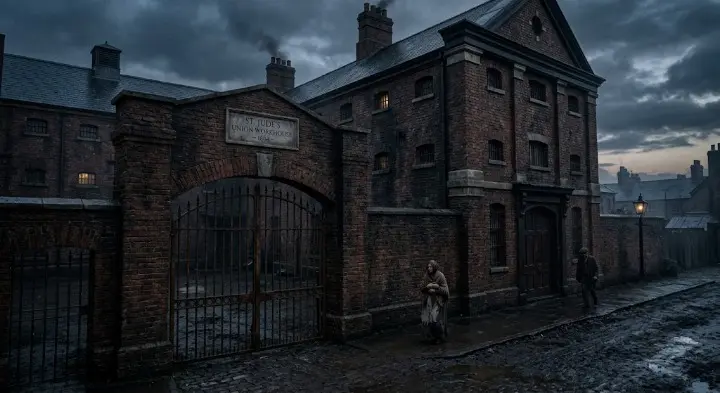
The heavy iron gate clangs shut behind you. A stranger takes your name, then leads your husband one way and your children another — perhaps forever. This was often the first taste of life in a Victorian workhouse, the last refuge for Britain’s poorest people. Today we have benefits, pensions, and shelters. Back then, the destitute faced a grim choice: starve on the street, or surrender their freedom inside. So what really happened behind those forbidding walls? The truth is bleaker, and stranger, than most people imagine.
Why Did People End Up in a Victorian Workhouse?
Nobody chose the workhouse. People arrived there because every other door had already slammed shut.
A widow with no income, a labourer crippled on the job, an elderly couple too frail to work — any of them could tumble into ruin within weeks. Victorian Britain had no state pension and no unemployment benefit. When the last savings ran dry, the workhouse was often the only roof left.
Orphaned children, unmarried mothers, the sick, and the mentally ill filled the wards too. A failed harvest or a factory closure could drive whole families to the gates at once.
Seasonal work made things worse. A bricklayer or dock labourer might earn well through the summer, then find no work at all once winter frosts set in. With no savings to fall back on, a single hard January could undo a lifetime of honest toil.
The shame was crushing. To “go on the parish” marked you as a failure in the eyes of respectable society, and many families would endure almost anything to avoid it.
So what happened once a person finally gave in and stepped through that door?
Life in a Victorian Workhouse Began the Moment You Walked In
Admission was designed to strip away your old self. A porter recorded your details, then sent you to be bathed, inspected, and issued a coarse uniform stamped with the workhouse name.
Your own clothes were taken away and stored until the day you left. From that moment you became an “inmate”, numbered and catalogued like a parcel.
Officials searched new arrivals for tobacco, drink, or anything forbidden. A medical officer decided whether you were fit for labour or bound straight for the infirmary.
The message landed before you’d eaten a single meal: your individuality ended at the gate. Under the New Poor Law, existence inside was meant to feel worse than the hardest life outside — a deliberate deterrent.
And the very first cruelty broke more hearts than hunger ever could.
Families Torn Apart: Men, Women, and Children Segregated
The hardest blow came within minutes of arrival. Husbands went one way, wives another, and children to a separate ward entirely.
A mother might catch only fleeting glimpses of her son across a crowded yard on a Sunday. Couples who had shared a bed for forty years now slept in different wings, and some never spoke again.
Workhouse architects built high walls between the sections on purpose. Authorities feared that families kept together might simply have more children for the parish to support.
Many of these youngsters were later sent out to labour in mills and mines — a fate we explore in our piece on why children worked in Victorian factories and mines.
Separation was only the beginning. Each day inside followed a rhythm as rigid and joyless as the walls themselves.
The Daily Routine: Bells, Gruel, and Back-Breaking Work
A bell shattered the silence before six each morning. Inmates rose, washed in cold water, and shuffled to prayers and a meagre breakfast.
Then came the work — long, punishing, and deliberately grinding. Men broke stones or crushed animal bones into fertiliser. Others picked oakum, unravelling old tarred rope until their fingertips bled.
Women scrubbed floors, toiled in the laundry, and cooked. Even the elderly were expected to earn their keep in some small way.
These tasks weren’t chosen because anyone needed them done. They existed to make the workhouse unbearable, so only the truly desperate would stay.
Refusing to work was not an option. Idle inmates could be brought before magistrates and even sentenced to prison, so the sick and the elderly laboured alongside everyone else until their bodies simply gave out.
You can still trace how these grim routines were organised through surviving workhouse records and building histories gathered by dedicated historians. But nothing shaped a day inside quite like the ringing of the meal bell.
The Food: Thin Gruel and the Famous “Please, Sir” Moment
If one thing defines the workhouse in our imagination, it’s the food — or the cruel lack of it.
Meals were monotonous and carefully measured: bread, cheese, thin broth, and gruel, a watery oatmeal that barely touched the stomach. Portions were weighed to the ounce so nobody got a crumb more than the rules allowed.
Charles Dickens seared this misery into public memory in Oliver Twist, published in 1838, when a starving boy dares to ask for more. That single scene shamed the system more than a hundred official reports ever managed.
Real hunger drove people to desperate acts. At the Andover workhouse in 1845, inmates were caught gnawing scraps of rotten meat from the very bones they had been set to crush.
Grim as the food was, it wasn’t the harshest tool the workhouse kept in reserve.
Punishment, Illness, and the Workhouse Infirmary
Break a rule and the response was swift. Talking during meals, refusing work, or smuggling in food could bring a diet of bread and water, solitary confinement, or worse for repeat offenders.
Disease spread easily through the crowded wards. Cramped rooms and poor sanitation let illnesses such as typhus and cholera tear through a workhouse in a matter of days.
The infirmary was where many inmates spent their final hours. Nursing often fell to other inmates with no training at all, and a bed in the sick ward was as likely to be a place to die as to recover.
Children suffered most of all in these conditions. Measles, whooping cough, and diarrhoea swept through the nurseries, and a weak or hungry child stood little chance once fever took hold. Burial in an unmarked pauper’s grave was a common end.
Over the decades, reformers pushed for better care, and some workhouse infirmaries eventually grew into the public hospitals we rely on today. Yet the system that built them followed a cold logic all its own.
The New Poor Law of 1834 and Why Workhouses Were So Cruel
The workhouse most people picture was born from a single law. The Poor Law Amendment Act of 1834 swept away older, gentler forms of parish relief and replaced them with a harsh new machine.
Its guiding idea was “less eligibility” — the principle that life inside the workhouse must always be worse than that of the poorest labourer outside. Misery, in other words, was the entire point.
Local Boards of Guardians ran each “union” workhouse, answerable to commissioners in London. The whole scheme was built to slash the cost of supporting the poor.
To see how deep these attitudes ran, it helps to trace the longer story of the English Poor Laws that shaped centuries of British thinking about poverty. Their shadow lingered far longer than you might expect.
A Day in the Workhouse: The Typical Timetable
Here’s roughly how a winter’s day was scheduled inside an English union workhouse.
| Time | Activity |
|---|---|
| 6:00 am | Rise, wash, and morning prayers |
| 6:30 am | Breakfast — bread and gruel |
| 7:00 am | Work begins (oakum picking, stone-breaking, laundry) |
| 12:00 pm | Dinner — broth, bread, or potatoes |
| 1:00 pm | Work resumes |
| 6:00 pm | Supper — bread and cheese |
| 8:00 pm | Bed in segregated dormitories |
🏛️ Frequently Asked Questions — Victorian Workhouses
A workhouse was a state-run institution where people with no other means could receive food and shelter in return for hard labour. Conditions were kept deliberately harsh to discourage all but the most desperate from entering.
The diet was plain and strictly rationed — mostly bread, cheese, thin broth, and gruel, a watery oatmeal. Meals were weighed by the ounce, and meat appeared only rarely.
In theory, inmates could discharge themselves, but leaving meant facing starvation outside with no income. In practice, the elderly, the sick, and orphaned children usually had nowhere else to go.
They split up families, demanded exhausting and often pointless work, and treated poverty itself as a moral failing. For many Victorians, entering the workhouse felt like a public admission of total defeat.
Often, yes. Admission registers, censuses, and Poor Law paperwork survive for many unions. You can search original Poor Law records held by The National Archives, as well as local county archives.
The Walls That Still Whisper
Many old workhouse buildings still stand today, quietly repurposed as flats, hospitals, or museums. Walk past one and you’d never guess how many tears soaked into its bricks. Behind those walls, ordinary people lost their families, their names, and often their lives, simply for the crime of being poor.
The system finally crumbled in the twentieth century, as the Local Government Act of 1929 began dismantling the old unions and a fledgling welfare state slowly took their place. What replaced the fear was, at long last, a measure of dignity.
If this glimpse behind the gates moved you, you’ll find the same unflinching history in our look at
Why Did Children Work in Victorian Times? The Harsh Reality of Child Labor