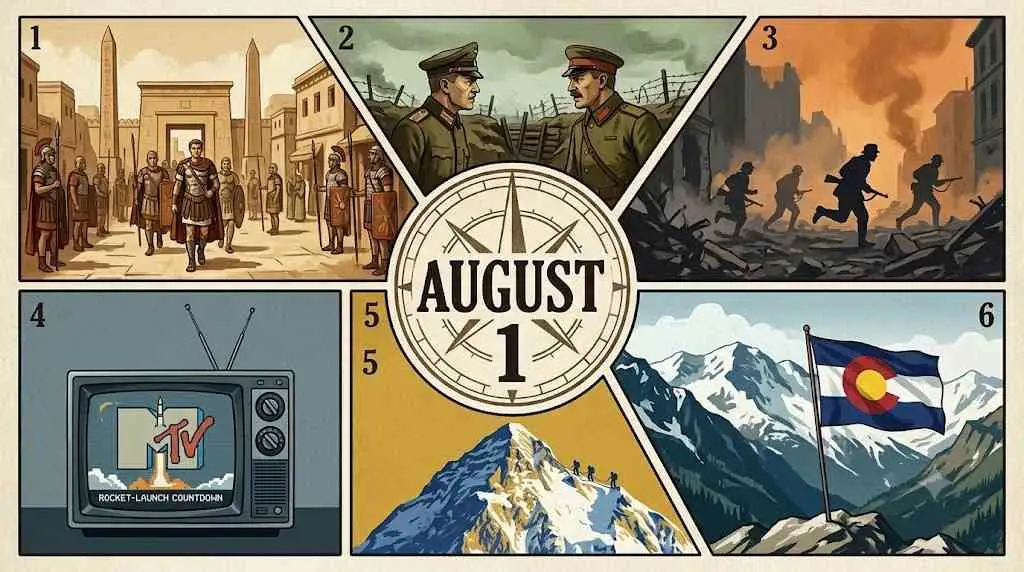
At one minute past midnight on August 1, 1981, a grainy rocket launch flickered onto American television screens, followed by five words that changed pop culture forever: “Ladies and gentlemen, rock and roll.” MTV had just gone live. That’s only one thread in this day in history August 1 — a date that also dragged Europe into the First World War, sent Warsaw’s underground army into the streets against Nazi occupation, and turned Colorado into a state. Few calendar dates carry this much weight.
Quick Facts — August 1 in History
| Category | Detail |
|---|---|
| Most Significant Event | Outbreak of general war between the German and Russian Empires (1914), pulling Europe into WWI |
| Top Key Events |
|
| Key Battles | Battle of Minden (1759), Battle of the Nile / Battle of Aboukir Bay (1798), Battle of Saint Gotthard (1664) |
| Key Figures | Octavian (Augustus), Patrick Pearse, George Harrison, Niki Lauda, Premchand (Indian novelist), Maximilian II (Holy Roman Emperor) |
| Observances | Swiss National Day, Yorkshire Day, Minden Day (UK), Armed Forces Day (China), Armed Forces Day (Lebanon), Victory Day (Cambodia, Laos, Vietnam), National Day of Benin, Statehood Day (Colorado, USA), Azerbaijani Language and Alphabet Day, Parents’ Day (DR Congo), World Scout Scarf Day |
Story of the Day: The Warsaw Uprising Begins
At exactly 5 p.m. on August 1, 1944, church bells across Warsaw rang out as the “W-hour” signal, and thousands of young Polish fighters pulled weapons from hidden caches and stepped into the open against their German occupiers. Nazi forces had ruled the city for five brutal years, and the underground Home Army gambled everything on a quick uprising before the advancing Red Army arrived. Soviet troops stopped on the far bank of the Vistula and watched. For 63 days the rebels held whole districts with smuggled rifles and homemade grenades, until German reprisals reduced most of Warsaw to rubble.
Important Events That Happened On August 1 In History
30 BC – Octavian Enters Alexandria
Octavian marches his army through the gates of Alexandria and takes the city without a real fight. He orders the execution of Marcus Antonius Antyllus, the eldest son of his rival Mark Antony. Egypt falls fully under Roman control within days. The conquest ends the Ptolemaic dynasty and sets Octavian on the path to becoming Emperor Augustus.
AD 69 – The Batavian Rebellion Erupts
Along the marshy banks of the Rhine, the Batavian chieftain Gaius Julius Civilis raises his tribesmen against Roman rule. Rome is distracted by its own civil war, and Civilis senses an opening few provincial leaders ever get. Roman garrisons along the frontier are overwhelmed within weeks. The revolt forces Rome to send seasoned legions north, exposing how fragile imperial control can become the moment attention turns elsewhere.
AD 314 – The First Synod of Arles Opens
Bishop Marinus of Arles opens a gathering of Christian bishops in southern Gaul, called at the request of Emperor Constantine himself. It’s an unusual scene: an emperor who has just legalized Christianity now wants the church to settle its own internal disputes. The synod issues rulings on clergy discipline and the Donatist schism. It becomes one of the earliest recorded councils shaping how the institutional church would govern itself.
527 – Justinian I Becomes Sole Byzantine Ruler
In Constantinople’s imperial palace, Justinian steps out from his uncle Justin I’s shadow to become sole ruler of the Byzantine Empire. He inherits a fractured court and an empire stretched thin. Within a few years he launches sweeping legal reforms and military campaigns to reclaim lost Roman territory. His reign ends up reshaping Byzantine law, architecture, and borders for centuries.
607 – Ono no Imoko Sails for the Sui Court
A Japanese envoy named Ono no Imoko boards a ship bound for China, carrying a diplomatic letter from Japan’s court to the Sui emperor. It’s a bold move — Japan is essentially introducing itself as an equal, not a subject state. The letter’s wording reportedly irritates the Chinese court. The mission still opens a channel of exchange that brings Chinese governance models and Buddhist texts flooding into Japan.
902 – Taormina Falls, Ending Byzantine Sicily
Aghlabid forces storm Taormina, the last fortress in Sicily still flying the Byzantine banner. The city has held out for decades as the rest of the island slipped away. Its capture closes nearly eight decades of grinding conquest. Sicily now enters more than a century and a half of Muslim rule, which reshapes its language, agriculture, and architecture for generations.
1203 – Alexios IV Is Crowned Amid the Fourth Crusade
Under pressure from the Crusader army camped outside Constantinople, the ailing Isaac II Angelos is forced to accept his son Alexios IV as co-emperor. It’s a coronation held at swordpoint, not by popular will. The crusaders had installed him in exchange for promised gold and troops that never materialize. The arrangement collapses within months, helping trigger the sack of Constantinople in 1204.
1291 – The Old Swiss Confederacy Is Born
In the meadow of Rütli, representatives of Uri, Schwyz, and Unterwalden put their seals to a federal charter, pledging mutual defense against outside lords. It’s a modest pact between mountain communities, not a grand nation-building moment. No one signing that day imagines a country will trace its founding to this document. Switzerland still marks August 1 as its national day because of it.
1469 – Louis XI Founds the Order of Saint Michael
At his château in Amboise, King Louis XI creates a new chivalric order to bind France’s most powerful nobles closer to the crown. Loyalty in medieval France is always for sale, and Louis knows it better than most. The order gives ambitious lords a prestigious title tied directly to royal favor. It becomes one of the enduring symbols of French monarchy for the next three centuries.
1498 – Columbus Reaches Venezuela
Sailing on his third voyage, Christopher Columbus sights the coastline of what is now Venezuela, becoming the first European to lay eyes on South American soil. He initially assumes he’s found another island, not a continent. The scale of the land mass only becomes clear as his ships explore further along the coast. The landing opens the door to Spanish colonization of an entire continent.
1571 – Famagusta Surrenders, Ending Ottoman Cyprus Campaign
After a siege that starves and bombards the city for nearly a year, the Venetian garrison at Famagusta finally surrenders to Ottoman forces. The defenders had been promised safe passage, a promise the Ottoman commander brutally breaks. Cyprus passes fully into Ottoman hands. The island stays under Ottoman rule for the next three centuries.
1620 – The Speedwell Sets Sail for America
At the Dutch port of Delfshaven, a small ship called the Speedwell loads religious separatists bound for a new life across the Atlantic. The plan is to meet a second ship, the Mayflower, in England before crossing together. The Speedwell later proves unseaworthy and has to turn back. Its passengers cram aboard the Mayflower instead, the ship that actually carries the Pilgrims into American history.
1664 – Austria Halts the Ottomans at Saint Gotthard
On the banks of the Raab River, an outnumbered Austrian-led army under Raimondo Montecuccoli breaks a major Ottoman offensive into Central Europe. The victory stuns observers who expected Ottoman momentum to continue unchecked. It forces the Ottomans to the negotiating table almost immediately. The resulting Peace of Vasvár buys the Habsburgs two decades of relative peace on their eastern frontier.
1714 – George I Becomes King of Great Britain
Word reaches Hanover that Queen Anne has died without a surviving heir, and under the Act of Settlement, the German-speaking Elector George becomes King of Great Britain. He barely speaks English and has never set foot in the country he now rules. His accession launches the Georgian era and shifts real political power toward Parliament and the office of prime minister.
1759 – Allied Forces Win the Battle of Minden
On a foggy field in Westphalia, British and German infantry advance in tight formation against French cavalry, a tactic that shouldn’t work and somehow does. The French army is routed in one of the more improbable infantry victories of the century. It becomes part of Britain’s celebrated “Year of Victories,” 1759. British regiments still mark Minden Day in the battle’s honor.
1774 – Joseph Priestley Discovers Oxygen
In his home laboratory, English chemist Joseph Priestley focuses sunlight through a lens onto mercuric oxide and collects a gas that makes a candle burn brighter than normal air. He doesn’t fully grasp what he’s isolated, but the experiment is unmistakably historic. German-Swedish chemist Carl Wilhelm Scheele had produced the same gas earlier without publishing. Priestley’s public account still helps kick off the chemical revolution that identifies oxygen.
1798 – The Battle of the Nile Begins
Under cover of approaching darkness, a British fleet under Horatio Nelson sails directly at anchored French warships in Aboukir Bay, attacking from both sides of their line at once. Night battles at sea are almost unheard of at this point. The French fleet is devastated by morning, stranding Napoleon’s army in Egypt. It’s one of the most lopsided naval victories in the age of sail.
1800 – The Acts of Union Create the United Kingdom
King George III gives Royal Assent to the Act of Union passed by the Irish Parliament, following similar passage in Great Britain. The legislation dissolves the separate Kingdom of Ireland and merges it into the United Kingdom, officially taking effect on January 1, 1801. The move follows a failed Irish rebellion two years earlier and tightens London’s political control.
1801 – The USS Enterprise Captures a Tripolitan Ship
Off the Libyan coast, the American schooner USS Enterprise engages the Tripolitan corsair Tripoli in a fierce single-ship duel during the First Barbary War. It’s one of the young United States Navy’s first real combat tests overseas. The American crew forces the Tripolitan vessel to strike its colors. The victory boosts American confidence in projecting naval power far from home shores.
1834 – Slavery Is Abolished Across the British Empire
As the Slavery Abolition Act takes effect, hundreds of thousands of enslaved people across British colonies are legally freed, though many are forced into unpaid “apprenticeships” for years afterward. The law doesn’t touch territories controlled by the East India Company, where slavery stays legal for nearly another decade. It’s celebrated across the Caribbean as Emancipation Day. The gap between the law’s promise and its reality shapes decades of continued struggle.
1834 – Construction Begins on the Wilberforce Monument
In Kingston Upon Hull, workers break ground on a towering column honoring William Wilberforce, the abolitionist who spent decades pushing slavery-abolition legislation through Parliament. The timing lines up almost exactly with the Slavery Abolition Act taking effect. The monument rises as a physical marker of a campaign that took nearly fifty years to succeed. It still stands over Hull’s skyline today.
1842 – The Lombard Street Riot Erupts in Philadelphia
Racial tensions boil over into violence as a mob attacks a Black temperance parade marching through Philadelphia’s streets. Homes, a church, and a meeting hall are burned before the unrest is contained. The riot exposes how fragile racial peace remains in a city that had abolished slavery decades earlier. It becomes one of several violent episodes that mark antebellum Philadelphia’s racial history.
1849 – The Joven Daniel Wrecks Off Chile
A merchant ship called the Joven Daniel runs aground on the Araucanía coast, and its wreck spirals into a controversy that outlasts the disaster itself. Survivors allege local Mapuche communities killed shipwrecked passengers and abducted a young woman, Elisa Bravo. The claims, contested ever since, are used to justify further Chilean military campaigns into Mapuche territory. The incident becomes a flashpoint in Chile’s long conflict with its indigenous peoples.
1855 – Climbers Complete the First Ascent of Monte Rosa
A team of mountaineers reaches the summit of Monte Rosa, the second-highest peak in the Alps after Mont Blanc. Alpine climbing is still a young, dangerous pursuit, with proper equipment barely standardized. Their success adds Monte Rosa to the short list of major Alpine peaks conquered. It helps fuel the golden age of alpinism that follows over the next two decades.
1863 – Finland Wins Language Rights for Finnish
Acting on a proposal from Senator J. V. Snellman and with Emperor Alexander II’s approval, a new regulation grants the Finnish language full official standing in the Grand Duchy of Finland. Swedish had dominated administration and education for centuries. The change gives Finnish speakers, the clear majority, a real path into government and schooling in their own tongue. It becomes a foundation stone of Finnish national identity.
1876 – Colorado Becomes the 38th U.S. State
A presidential proclamation formally admits Colorado into the Union, exactly a century after the Declaration of Independence, earning it the nickname “the Centennial State.” Its mountain territory had been booming with silver and gold prospectors for over a decade. Statehood gives Colorado full representation in Congress. The date is still marked every year as Colorado’s official Statehood Day.
1893 – Henry Perky Patents Shredded Wheat
Inventor Henry Perky secures a patent for a machine that shreds cooked wheat into thin strands, baked into a new kind of breakfast biscuit. Most people at the time still eat heavy cooked breakfasts, and the idea of a ready-made cereal biscuit seems strange. Perky’s shredded wheat catches on anyway. It helps launch the mass-market breakfast cereal industry that dominates grocery shelves today.
1894 – Japan and China Declare War
After a week of fighting over influence in Korea, the Empire of Japan and Qing China formally declare war on each other, opening the First Sino-Japanese War. China enters the conflict assuming its far larger population and older military tradition guarantee an advantage. Japan’s modernized forces prove devastatingly effective instead. China’s defeat exposes the Qing dynasty’s weakness and accelerates Japan’s rise as a regional power.
1907 – The First Scout Camp Opens on Brownsea Island
Robert Baden-Powell gathers twenty boys from different social backgrounds on a small English island for a week of camping, tracking, and teamwork exercises. It’s a deliberate experiment, mixing wealthy and working-class boys who’d never normally interact. The camp works better than Baden-Powell expects. It becomes the founding moment of the worldwide Scouting movement that now spans over 170 countries.
1911 – Harriet Quimby Earns Her Pilot’s Certificate
Harriet Quimby completes her flight test and becomes the first American woman licensed as a pilot by the Aero Club of America. Aviation is barely a decade old, and female pilots are almost unheard of. Quimby had trained in secret to avoid press attention until she passed. Within a year she becomes the first woman to fly solo across the English Channel.
1914 – Germany Declares War on Russia
Following Russia’s mobilization in support of Serbia, the German Empire formally declares war, turning a regional Balkan crisis into a continental catastrophe. Diplomats across Europe had spent weeks trying and failing to contain the escalation. Germany’s declaration triggers a cascade of alliance obligations within days. What begins as a dispute over an assassination in Sarajevo becomes the First World War.
1914 – The Swiss Army Mobilizes
As war explodes across its borders, Switzerland orders a full military mobilization to defend its neutrality. The country sits surrounded by powers now heading to war with each other. Swiss leaders know one wrong move could drag them into the fighting. The mobilization holds, and Switzerland spends the entire war maintaining its neutral status.
1915 – Patrick Pearse Delivers His Graveside Speech
Standing over the grave of veteran Irish nationalist O’Donovan Rossa in Dublin, Patrick Pearse delivers a fiery oration warning that “Ireland unfree shall never be at peace.” The funeral becomes a rallying point disguised as a memorial service. Pearse’s words spread quickly through nationalist circles. Less than a year later, he leads the Easter Rising against British rule.
1927 – The Nanchang Uprising Ignites the Chinese Civil War
Communist-aligned officers launch a coordinated assault on Kuomintang garrisons in Nanchang, marking the first open battle between the two former allies. The uprising itself is crushed within days. Its significance runs deeper than the immediate outcome. China commemorates this date as the founding anniversary of the People’s Liberation Army.
1933 – Nazi Germany Executes Four Anti-Fascist Activists
In Altona, near Hamburg, the new Nazi regime executes Bruno Tesch, Walter Möller, Karl Wolff, and August Lütgens for resisting Hitler’s rise. The men had been swept up after earlier street violence between Nazi and communist factions. Their trial offers little real due process. The executions signal how quickly Nazi Germany is willing to use capital punishment against political opponents.
1936 – The Berlin Olympics Open Under Hitler’s Gaze
Adolf Hitler presides over the opening ceremony of the Summer Olympics, intended as a showcase for Nazi ideology and German strength. Foreign governments had debated boycotting the games over Nazi persecution of Jews. The regime instead uses the spectacle for propaganda, dressing up its image for international cameras. American sprinter Jesse Owens’ performances at these games become a direct rebuke to Hitler’s racial claims.
1937 – Tito Reads the Manifesto of the Croatian Communist Congress
In woods near Samobor, Josip Broz Tito addresses a secret gathering of Croatian communists, reading out a resolution shaping the party’s direction. Communist organizing is illegal in the Kingdom of Yugoslavia at the time, forcing the meeting into hiding. Tito is still years from becoming Yugoslavia’s postwar leader. The clandestine congress marks an early step in his rise through party ranks.
1943 – Operation Tidal Wave Fails Over Romania
Low-flying American bombers roar toward Ploiești’s oil refineries in a daring daylight raid meant to cripple Nazi Germany’s fuel supply. Anti-aircraft defenses turn out to be far heavier than planners expected. Dozens of aircraft are shot down in what crews later call “Black Sunday.” The mission causes real damage but at a brutal cost, and the refineries are back at near-full output within weeks.
1944 – The Warsaw Uprising Erupts
Church bells across Warsaw signal “W-hour,” and the Polish Home Army launches a citywide revolt against German occupation just as Soviet troops reach the opposite riverbank. Fighters expect the uprising to last days before liberation. The Red Army instead halts and waits. The rebellion drags on for 63 brutal days before German forces crush it and level most of the city.
1946 – Russian Collaborators Are Executed in Moscow
Leaders of the Russian Liberation Army, Soviet prisoners of war who fought alongside Nazi Germany, are executed for treason in Moscow. Their choice to fight against their own country had been driven partly by desperate camp conditions and partly by anti-Stalinist conviction. Stalin’s government shows no mercy for the decision. The executions close a grim chapter of collaboration born out of the war’s brutal prisoner camps.
1950 – Guam Becomes a U.S. Territory
President Harry Truman signs the Guam Organic Act, formally organizing Guam as an unincorporated U.S. territory and granting its residents American citizenship. The island had been under direct naval administration since being retaken from Japanese occupation. The new law gives Guam its own civil government for the first time. It remains the legal foundation of Guam’s political status today.
1957 – The U.S. and Canada Form NORAD
American and Canadian officials agree to create the North American Aerospace Defense Command, a joint system for tracking threats to the continent’s airspace. Cold War fears of Soviet bomber attacks make coordinated air defense a shared priority. NORAD links radar networks and command structures across both countries. It remains active today, now also tracking missile threats and space debris.
1960 – Dahomey Declares Independence From France
Colonial rule ends as Dahomey, now known as Benin, formally declares independence from France. Decades of French administration had run the territory’s economy largely for export to Europe. Independence brings the country its own government, though political instability follows in the years ahead. The date is still marked every year as Benin’s National Day.
1960 – Islamabad Is Declared Pakistan’s Federal Capital
Pakistan’s government designates a newly planned site on the Potohar Plateau as the country’s federal capital, replacing Karachi. Officials want a capital built from scratch, closer to the military’s northern strongholds and away from Karachi’s coastal congestion. Construction of the new city begins soon after. Islamabad grows from open farmland into Pakistan’s seat of government within a decade.
1961 – The Defense Intelligence Agency Is Created
U.S. Defense Secretary Robert McNamara orders the establishment of the Defense Intelligence Agency, centralizing military intelligence that had previously been scattered across separate service branches. Cold War planners want faster, more coordinated threat assessments. The new agency reports directly through the Pentagon’s command structure. It becomes a core part of the American intelligence community for the decades that follow.
1964 – The Congo Is Renamed
The former Belgian Congo officially becomes the Democratic Republic of the Congo, a name change reflecting years of turmoil since independence four years earlier. The country had already cycled through crises, coups, and a breakaway secession by this point. The renaming is meant to mark a fresh political chapter. Instability continues regardless, and the country changes its name again decades later under a different regime.
1965 – Frank Herbert Publishes Dune
Frank Herbert’s sprawling science fiction novel Dune reaches bookstores after being rejected by more than twenty publishers. Its dense world-building around desert ecology, politics, and religion doesn’t fit typical genre fiction at the time. Readers respond anyway, and the novel slowly builds a devoted following. By 2003 it’s recognized as the best-selling science fiction novel ever published.
1966 – Charles Whitman Opens Fire From the UT Austin Tower
Armed with multiple rifles, Charles Whitman climbs to the observation deck of the University of Texas at Austin’s clock tower and opens fire on the campus below. He had killed his wife and mother earlier that morning. Police eventually storm the observation deck and kill him after a 96-minute siege. Sixteen people are killed during the attack, making it one of the first mass shootings to unfold live on American television news.
1966 – China Makes Purges Official Policy
As the Cultural Revolution formally begins, the Chinese Communist Party makes the purging of intellectuals and perceived counter-revolutionaries official state policy. Mao Zedong wants to eliminate rivals and reassert ideological control after earlier policy failures. Universities, schools, and government offices become targets almost overnight. The campaign spirals into a decade of violence and upheaval across the country.
1968 – Hassanal Bolkiah Is Crowned Sultan of Brunei
Hassanal Bolkiah, already ruling since his father’s abdication a year earlier, undergoes a formal coronation ceremony as the 29th Sultan of Brunei. The ceremony follows centuries of tradition tied to Brunei’s monarchy. He is still only in his early twenties at the time. Decades later, he remains one of the longest-reigning monarchs in the world.
1971 – The Concert for Bangladesh Takes the Stage
George Harrison walks onto the Madison Square Garden stage to open a benefit concert raising money and awareness for refugees fleeing the Bangladesh Liberation War. It’s one of the first major benefit concerts of its kind, featuring Bob Dylan, Ravi Shankar, and Eric Clapton. Organizing it on short notice is genuinely chaotic. The concert becomes the template for the celebrity benefit shows that follow for decades.
1974 – The UN Creates Cyprus’s Green Line
Following months of conflict on the island, the UN Security Council authorizes peacekeepers to establish a buffer zone dividing Cyprus into Greek and Turkish sectors. The line is meant as a temporary ceasefire measure. It hardens instead into one of the world’s most enduring political divides. Cyprus remains split along essentially this same line today.
1975 – The Helsinki Final Act Is Signed
Leaders from 35 nations, including the United States and Soviet Union, sign the Helsinki Final Act, committing to principles on borders, human rights, and cooperation across the Cold War divide. It isn’t a legally binding treaty, which lets both sides sign without fully committing. Dissidents inside the Soviet bloc still use its human rights language to challenge their own governments. The Helsinki process ends up quietly undermining the system it was meant to stabilize.
1976 – Niki Lauda Nearly Dies at the Nürburgring
During the German Grand Prix, Niki Lauda’s Ferrari crashes and bursts into flames on the notoriously dangerous Nürburgring circuit. Other drivers pull him from the wreckage while he’s still conscious and burning. His injuries are severe enough that a priest reads him last rites. Lauda returns to racing just six weeks later, badly scarred but determined to finish the season.
1980 – Vigdís Finnbogadóttir Makes History in Iceland
Icelandic voters elect Vigdís Finnbogadóttir as president, making her the world’s first democratically elected female head of state. She had run as a divorced single mother in a small, tightly-knit society, a background many assumed would work against her. Voters back her anyway. She goes on to serve four terms, becoming one of the longest-serving elected female leaders in history.
1980 – A Train Crash Kills 18 in County Cork
1980 – The Buttevant Rail Disaster Kills 18 in County Cork A high-speed Dublin-to-Cork express train derails at Buttevant railway station in County Cork, killing 18 people and injuring more than 170 others. Investigators trace the disaster to a manually operated track switch that directed the speeding train into a siding. It remains one of the deadliest rail accidents in modern Irish history and prompted sweeping upgrades to railway signaling systems nationwide.
1981 – MTV Begins Broadcasting
At 12:01 a.m., a new cable channel called MTV goes live with a countdown graphic and the words “Ladies and gentlemen, rock and roll,” playing “Video Killed the Radio Star” by The Buggles as its first video. Cable television is still a fairly new idea for most American households. Few executives expect a music-only channel to survive long. Instead it reshapes the entire music industry around visual image as much as sound.
1984 – Lindow Man Is Discovered in an English Bog
Commercial peat-cutters working at Lindow Moss in Cheshire uncover a startlingly well-preserved human body pulled straight from the bog. Bog chemistry has kept the remains intact for close to two thousand years. Archaeologists soon determine the man met a violent, possibly ritual death. Lindow Man becomes one of the most studied bog bodies ever found in Britain.
1988 – A Bombing Hits Inglis Barracks in London
An IRA bomb explodes at Inglis Barracks in north London, killing one British soldier. The attack is part of a long campaign of IRA violence targeting British military and government sites during the Troubles. Security around military installations across the UK tightens further afterward. The bombing adds to a grim toll of Troubles-era attacks on British soil.
1990 – A Plane Crash Kills 46 in the Karabakh Range
An aircraft crashes into the rugged Karabakh mountain range, killing all 46 people aboard. The remote, mountainous terrain complicates recovery efforts significantly. Details around the exact cause remain murky in public records. The crash adds to a difficult period for aviation safety in the region during those years.
1993 – The Great Mississippi and Missouri Rivers Flood Peaks
Floodwaters along the Mississippi and Missouri Rivers reach their highest levels of a catastrophic summer, submerging towns across the American Midwest. Weeks of relentless rain had overwhelmed levees built for far smaller floods. Tens of thousands of people are displaced from their homes. It becomes one of the costliest and most damaging river floods in U.S. history.
1998 – Puntland Is Established in Somalia
Tribal elders and political leaders meeting in Garowe agree to form Puntland as an autonomous state in northeastern Somalia. Somalia’s central government had effectively collapsed years earlier, leaving a power vacuum across the country. Puntland’s leaders opt for self-rule rather than waiting for national reunification. The self-declared state still functions as a semi-autonomous region within Somalia today.
2004 – A Supermarket Fire Kills Hundreds in Paraguay
A fire tears through a crowded supermarket in Asunción, Paraguay, killing 424 people after exits are reportedly locked to prevent shoplifting during the chaos. It becomes one of the deadliest building fires in modern history. Public outrage follows revelations about the blocked exits. The disaster leads to major reforms in Paraguayan fire safety and building codes.
2007 – The I-35W Bridge Collapses in Minneapolis
During the evening rush hour, the I-35W bridge spanning the Mississippi River suddenly gives way, plunging vehicles and commuters into the river below. Structural engineers later trace the failure to an undersized gusset plate that had gone unnoticed for decades. Thirteen people die and 145 are injured. The collapse triggers a nationwide reassessment of aging American bridge infrastructure.
2008 – The Beijing–Tianjin Intercity Railway Opens
China launches the Beijing–Tianjin Intercity Railway, instantly becoming the fastest commuter rail system in the world. It’s timed deliberately to open just before the Beijing Olympics begin. The high-speed line cuts a journey that once took over an hour down to about thirty minutes. It becomes a showcase for China’s rapidly expanding high-speed rail ambitions.
2008 – Eleven Climbers Die on K2
A collapsing ice serac and a chain of accidents strand climbers high on K2, the world’s second-highest and arguably most dangerous mountain. Multiple international expeditions had been attempting summits within the same narrow weather window. Falls, exposure, and a disastrous overnight stranding above 8,000 meters claim eleven lives. It remains the deadliest single incident in K2’s mountaineering history.
2017 – A Suicide Attack Hits a Mosque in Herat
A suicide bomber detonates inside a mosque in Herat, Afghanistan, during evening prayers, killing 20 people. Attacks on religious gatherings had become tragically frequent across the country by this point. No claim of responsibility resolves the attack’s exact origin with full certainty. The bombing adds to years of sectarian and militant violence targeting Afghan civilians at worship.
2023 – Donald Trump Is Indicted Over January 6
Federal prosecutors unveil an indictment against former President Donald Trump tied to his role in the January 6 attack on the U.S. Capitol. It’s his third criminal indictment within the same year, an unprecedented situation for any former American president. The charges center on efforts to overturn the 2020 election results. The case becomes one of the most closely watched legal battles in modern U.S. political history.
Explore our archive of past daily historical facts.
Famous People Born on July 31
| Name | Description | Dates |
|---|---|---|
| Emperor Nijō | Emperor of Japan | 1143–1165 |
| Philip III, Duke of Burgundy | Powerful Duke of Burgundy | 1396–1467 |
| Maximilian II | Holy Roman Emperor | 1527–1576 |
| Alessandro Algardi | Italian Baroque sculptor | 1598–1654 |
| Gabriel Cramer | Swiss mathematician, creator of Cramer’s Rule | 1704–1752 |
| Friedrich Wöhler | German chemist, pioneer of organic chemistry | 1800–1882 |
| John Ericsson | Swedish-American engineer and inventor | 1803–1889 |
| George Henry Thomas | American Civil War general | 1816–1870 |
| S. S. Kresge | American businessman, founder of Kmart | 1867–1966 |
| Premchand | Indian novelist and short-story writer | 1880–1936 |
| Jean Dubuffet | French painter and sculptor | 1901–1985 |
| Milton Friedman | American economist, Nobel Prize winner | 1912–2006 |
| Louis de Funès | Legendary French comic actor | 1914–1983 |
| Primo Levi | Italian author and Holocaust survivor | 1919–1987 |
| Peter Benenson | English lawyer, founder of Amnesty International | 1921–2005 |
| Ahmet Ertegun | Founder of Atlantic Records | 1923–2006 |
| Stephanie Kwolek | American chemist, inventor of Kevlar | 1923–2014 |
| John Searle | American philosopher | 1932–2025 |
| Geraldine Chaplin | American actress | 1944–Present |
| Mumtaz | Indian film actress | 1947–Present |
| Evonne Goolagong Cawley | Australian tennis champion | 1951–Present |
| Mark Cuban | American billionaire entrepreneur and investor | 1958–Present |
| Wesley Snipes | American actor | 1962–Present |
| Fatboy Slim (Norman Cook) | English DJ and music producer | 1963–Present |
| J. K. Rowling | British author of the Harry Potter series | 1965–Present |
| Antonio Conte | Italian football manager and former player | 1969–Present |
| Zac Brown | American country singer-songwriter | 1978–Present |
| Victoria Azarenka | Belarusian tennis champion | 1989–Present |
| Lil Uzi Vert | American rapper | 1995–Present |
| Rico Rodriguez | American actor | 1998–Present |
Famous People Who Died on July 31
| Name | Description | Dates |
|---|---|---|
| Ignatius of Loyola | Spanish priest, founder of the Jesuits | 1491–1556 |
| Denis Diderot | French Enlightenment philosopher and writer | 1713–1784 |
| Dheeran Chinnamalai | Indian freedom fighter | 1756–1805 |
| Andrew Johnson | 17th President of the United States | 1808–1875 |
| Franz Liszt | Hungarian composer and virtuoso pianist | 1811–1886 |
| Jean Jaurès | French socialist leader | 1859–1914 |
| Udham Singh | Indian revolutionary | 1899–1940 |
| Antoine de Saint-Exupéry | French author of The Little Prince | 1900–1944 |
| Jim Reeves | American country music singer | 1923–1964 |
| Mohammed Rafi | Legendary Indian playback singer | 1924–1980 |
| Paul-Henri Spaak | Belgian statesman and European Union pioneer | 1899–1972 |
| Omar Torrijos | Military leader of Panama | 1929–1981 |
| Chiune Sugihara | Japanese diplomat who saved thousands of Jews | 1900–1986 |
| Baudouin | King of Belgium | 1930–1993 |
| William Maxwell | American novelist and editor | 1908–2000 |
| Bobby Robson | English football manager | 1933–2009 |
| Gore Vidal | American novelist and essayist | 1925–2012 |
| Roddy Piper | Canadian professional wrestler and actor | 1954–2015 |
| Seymour Papert | South African mathematician and computer scientist | 1928–2016 |
| Jeanne Moreau | French actress | 1928–2017 |
| Harold Prince | Legendary Broadway producer and director | 1928–2019 |
| Alan Parker | English filmmaker | 1944–2020 |
| Fidel V. Ramos | 12th President of the Philippines | 1928–2022 |
| Bill Russell | NBA legend and basketball icon | 1934–2022 |
| Angus Cloud | American actor | 1998–2023 |
| Paul Bucha | U.S. Army Medal of Honor recipient | 1943–2024 |
| Ismail Haniyeh | Palestinian political leader | 1962/1963–2024 |
Observances on August 1
Swiss National Day — Commemorates the 1291 signing of the Federal Charter that founded the Old Swiss Confederacy.
Yorkshire Day — A regional celebration of Yorkshire’s history, dialect, and culture across England.
Minden Day — Marked by certain British Army regiments honoring their 1759 victory at the Battle of Minden.
Armed Forces Day (China) — Also marks the founding anniversary of the People’s Liberation Army, tied to the 1927 Nanchang Uprising.
Armed Forces Day (Lebanon) — Honors the Lebanese Armed Forces and their role in national defense.
Victory Day (Cambodia, Laos, Vietnam) — Commemorates shared wartime victories tied to the region’s twentieth-century conflicts.
National Day (Benin) — Celebrates Benin’s 1960 independence from France.
Statehood Day (Colorado) — Marks Colorado’s 1876 admission as the 38th U.S. state.
Azerbaijani Language and Alphabet Day — Honors the Azerbaijani language and its Latin-script alphabet.
Parents’ Day (Democratic Republic of the Congo) — A day set aside to honor mothers and fathers across the country.
World Scout Scarf Day — Celebrates Scouting’s neckerchief tradition, traced back to the first camp on Brownsea Island in 1907.