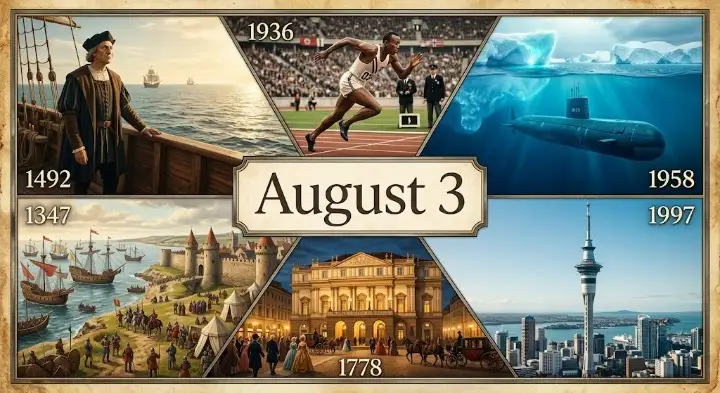
Jesse Owens stepped onto the cinder track in Berlin while Adolf Hitler watched from the high stands. The Nazi regime meant to use the 1936 Summer Games to showcase Aryan superiority, but Owens blew past his competitors in the 100-meter dash. Crossing the finish line in 10.3 seconds, he claimed gold and crushed the host nation’s propaganda campaign on live international radio. What happened on this day in history August 3 shaped global power, athletics, and deep human history for centuries to come.
Quick Facts — August 3 in History
| Category | Detail |
|---|---|
| Most Significant Event | Christopher Columbus sets sail from Spain seeking a western route to Asia (1492) |
| Top Key Events |
|
| Key Battles | Battle of Saucourt-en-Vimeu (881), Battle of Eisenach (908), Second Battle of Nördlingen (1645), Battle of Toski (1889) |
| Key Figures | Christopher Columbus, Jesse Owens, King Louis III, Elisha Otis, Regina Jonas |
| Observances | Independence Day (Niger), Armed Forces Day (Equatorial Guinea) |
Story of the Day: Christopher Columbus Sets Sail for the Unknown (1492)
Three wooden ships unmoored from Palos de la Frontera before dawn as morning fog lifted off the Rio Tinto. Christopher Columbus guided the Santa María alongside the Pinta and the Niña, steering straight into open Atlantic ocean currents. King Ferdinand and Queen Isabella financed the voyage after years of relentless pitching, hoping to open a direct sea route to Asian spice markets. No European crew had ever attempted to cross the uncharted western ocean so far south. Ninety men spent two months staring at empty horizons before hitting the Bahamas, changing global trade and human history forever.
Important Events That Happened On August 3 In History
8 AD – Tiberius Defeats the Dalmatae
Roman legions led by Tiberius trapped the Dalmatae rebels along the banks of the Bosna River. Years of brutal insurgency in the Illyrian provinces came to a sudden, crushing end under heavy infantry charges. The victory secured Rome’s northeastern frontier and consolidated imperial control over the Balkans. Rome established lasting provinces across the region, permanently shifting eastern European borders.
435 – Patriarch Nestorius Exiled to Egypt
Emperor Theodosius II issued a royal decree banishing deposed Patriarch Nestorius directly to a distant Egyptian monastery. Nestorius had ignited intense theological fury across Constantinople by arguing against calling Mary the Mother of God. The forced exile split the Eastern Church into fierce rival factions that lasted for generations. His controversial teachings laid the foundational rift for the Church of the East.
881 – Battle of Saucourt-en-Vimeu
King Louis III rallied West Frankish cavalry to charge thousands of Danish Vikings raiding northern villages. French forces caught the raiders flat-footed, killing roughly 8,000 raiders in a chaotic melee. The decisive win halted heavy Viking expansion into the interior of France for years. Poet-monks memorialized the royal triumph in the famous Old High German poem Ludwigslied.
908 – Battle of Eisenach
Invading Hungarian horse archers ambushed an East Frankish force under Duke Burchard near the Thuringian hills. Waves of mounted archers encircled the German troops before heavy armored knights could form defensive lines. Duke Burchard died on the field along with most of his high-ranking nobility. The Hungarian victory forced German rulers to pay heavy tribute to protect their eastern frontiers.
1031 – Olaf II Canonized as Saint Olaf
Grimketel, the English Bishop of Selsey, officially declared fallen King Olaf II a saint in Nidaros. Olaf had died fighting rival pagan chieftains at the Battle of Stiklestad a year prior. Converting his legacy into sainthood transformed his violent life into a unifying symbol for Scandinavian Christians. Saint Olaf quickly became the eternal king and national protector of Norway.
1057 – Pope Stephen IX Elected
Cardinals assembled in Rome to elect Frederick of Lorraine as the new leader of the Catholic Church. Taking the papal name Stephen IX, he immediately pushed aggressive reforms against church corruption and royal interference. His brief rule strengthened the papacy’s independence against secular European lords. The appointment signaled a hardline shift that fueled the medieval Investiture Controversy.
1342 – Siege of Algeciras Commences
Castilian forces under King Alfonso XI surrounded the strategic port city of Algeciras during the Spanish Reconquista. Blockading the harbor prevented Marinid forces from shipping North African reinforcements into southern Spain. European crusaders joined the coastal standoff as artillery pounded the city walls for nearly two years. Taking the stronghold effectively cut the primary invasion corridor into the Iberian Peninsula.
1347 – Siege of Calais Ends
Starving citizens of Calais surrendered their coastal gates to King Edward III after eleven months of blockade. English archers had cut off all land supplies while royal warships destroyed a French relief fleet in the Battle of Crotoy. Six prominent burghers walked out wearing nooses to spare the rest of the town from slaughter. The strategic port remained under English control for more than two centuries.
1492 – Columbus Sets Sail from Spain
Christopher Columbus led eighty-eight sailors out of Palos de la Frontera aboard three small wooden vessels. They aimed to find a direct sea route to Asia by sailing west across uncharted ocean waters. The expedition reached the Caribbean after two harrowing months, altering global geopolitics and trade networks forever.
1527 – First North American Letter Sent
English explorer John Rut dropped anchor at St. John’s, Newfoundland, and sat down to write a ship report. He drafted a detailed message to King Henry VIII describing icebergs, vast cod fisheries, and northern shorelines. A passing fishing vessel carried the written document back across the Atlantic Ocean. The missive stands as the earliest surviving letter sent by Europeans from North American soil.
1601 – Battle of Goroszló
Austrian troops commanded by Giorgio Basta clashed with Transylvanian forces in a muddy river valley. Habsburg commanders used coordinated artillery barrages to break through enemy lines and capture Transylvania. The victory re-established Imperial control over the contested eastern principality during the Long War. Local princes were forced into exile, leaving the territory under harsh military governance.
1645 – Second Battle of Nördlingen
French armies led by the Duke of Enghien slammed into Holy Roman Empire defenses near Nördlingen. Waves of cavalry charges left thousands dead, including the Imperial commander Franz von Mercy. French forces won a bloody victory, though both sides suffered catastrophic casualties that crippled their fighting strength. The battle dragged the Thirty Years’ War closer to its exhausted diplomatic conclusion.
1678 – Construction of Le Griffon Begins
French explorer Robert de La Salle laid the heavy wooden keel of Le Griffon along the Niagara River. Shipwrights labored in wilderness conditions to assemble the forty-five-ton armed brigantine. Launching the vessel gave Europeans their first commercial sailing ship on the upper Great Lakes. It opened vast inland waterways to the booming North American fur trade.
1692 – Battle of Steenkerque
King William III launched a surprise dawn assault against French defensive encampments outside Brussels. Duke of Luxembourg quickly rallied his French infantry, fighting off fierce bayonet charges in heavy brush and tight alleyways. Both armies fought to a bloody standstill, leaving over fifteen thousand dead and wounded in the mud. The inconclusive clash forced Allied forces to retreat, leaving French lines intact.
1778 – La Scala Opera House Opens
Musicians took their places in Milan as La Scala opened its doors to elite Italian theatergoers. Antonio Salieri conducted the premiere performance of his newly composed opera Europa riconosciuta to a packed house. The grand venue quickly became the premier global capital for opera music and world-class performances. It set the acoustic standard for classical theater design across Europe.
1795 – Treaty of Greenville Signed
Native American chiefs from twelve western tribes met with General Anthony Wayne to sign a peace pact. The treaty ended years of bitter fighting in the Northwest Indian War across the Ohio Country. Tribal leaders ceded vast swathes of present-day Ohio and Indiana to the expanding United States. Settlers flooded into the region, pushing native communities further west past new territorial lines.
1811 – First Ascent of the Jungfrau
Brothers Johann Rudolf and Hieronymus Meyer pushed through deep snowfields to reach the summit of the Jungfrau. The Swiss mountaineers navigated razor-thin ice ridges without modern climbing tools or safety gear. Reaching the 13,642-foot peak marked the third highest summit conquered in the Bernese Alps. Their feat launched the golden age of Alpine exploration and extreme mountain climbing.
1829 – Treaty of Lewistown Signed
United States commissioners met with Shawnee and Seneca leaders to finalize a forced land exchange contract. Tribal representatives signed away their ancestral homelands in western Ohio under intense government pressure. In return, the federal government granted them reservation tracts west of the Mississippi River. The agreement accelerated forced Native American displacement years before the Indian Removal Act.
1852 – First Harvard-Yale Boat Race
Eight-man rowing crews from Harvard and Yale dropped their oars into Lake Winnipesaukee for a two-mile sprint. Harvard swept across the finish line ahead of Yale to win the inaugural regatta before cheering spectators. The lake race went down in record books as the first American intercollegiate athletic event. It established a bitter, historic rivalry that shaped modern college sports culture.
1859 – American Dental Association Founded
Twenty-nine dentists gathered in Niagara Falls to establish a unified professional medical organization. They drafted official bylaws to establish ethical guidelines, scientific standards, and proper licensing across the country. The meeting created the American Dental Association, transforming routine tooth care from tradesman work into formal medicine. The group set high educational benchmarks that modern dental practices follow today.
1889 – Battle of Toski
An Anglo-Egyptian force commanded by Major-General Francis Grenfell intercepted an invading Mahdist-Sudanese army near the Nile. British artillery and disciplined rifle fire decimated the advancing Sudanese infantry lines in open desert terrain. Mahdist commander Wad al-Najumi died on the battlefield along with most of his frontline soldiers. The crushing defeat permanently halted the Mahdist invasion of Egypt.
1900 – Firestone Tire and Rubber Company Founded
Harvey Firestone opened a small factory in Akron, Ohio, with seventeen workers to produce solid rubber tires. He capitalized on early bicycle demand before pivoting to meet Henry Ford’s mass-produced automobile needs. The company pioneered pneumatic wagon tires and scaled operations to dominate global auto supply chains. Akron transformed overnight into the rubber manufacturing capital of the world.
1903 – Kruševo Republic Proclaimed
Macedonian insurgents seized municipal buildings in Kruševo and proclaimed an independent republic during the Ilinden Uprising. Rebel leaders published a progressive manifesto guaranteeing equal rights for all local ethnic groups. Ottoman Turkish forces surrounded the town ten days later, deploying heavy artillery to crush the uprising. Despite its short life, the republic became a foundational symbol for Macedonian independence movements.
1907 – Standard Oil Fined $29.4 Million
Federal Judge Kenesaw Mountain Landis levied a record $29.4 million fine against Standard Oil of Indiana. The court found the massive oil monopoly guilty of receiving illegal secret rebates from freight railroad lines. Though higher appellate courts later reversed the conviction, the bold verdict rocked corporate America. Public outrage over the trial fueled aggressive antitrust enforcement against predatory monopolies.
1914 – Germany Declares War on France
German diplomats handed a formal declaration of war to the French government as troops mobilized along borders. Kaiser Wilhelm II ordered his armies to strike west, breaking Belgian neutrality to bypass French fortresses. Romania simultaneously announced its official neutrality, refusing to join the Triple Alliance power block. The escalation pulled major European powers straight into the opening battles of World War I.
1921 – Black Sox Banned from Baseball
Major League Baseball Commissioner Kenesaw Mountain Landis issued a lifetime ban against eight Chicago White Sox players. The decision came just one day after a jury acquitted the athletes of fixing the 1919 World Series. Landis ignored the court verdict, declaring that no player who gambled would ever play professional baseball again. The lifetime ban permanently altered sports governance and restored public trust in the game.
1936 – Jesse Owens Wins 100m Gold
African American sprinter Jesse Owens exploded off the blocks to win the 100-meter dash at the Berlin Olympics. He crossed the finish line in 10.3 seconds, matching the world record while defeating teammate Ralph Metcalfe. Owens shattered Nazi propaganda about Aryan athletic superiority in front of Adolf Hitler and the global press corps. He went on to win four gold medals at the games, making sports history.
1936 – Kursha-2 Fire Disaster
A massive wildfire swept through dense pine forests surrounding the logging settlement of Kursha-2 in central Russia. A wooden train sent to evacuate residents filled its cars with lumber instead of families, blocking exit tracks. Trapped by a wall of wind-driven fire, 1,200 loggers and local villagers perished in minutes. Only twenty people survived the blaze, leaving behind one of Russia’s deadliest industrial fires.
1940 – Italy Invades British Somaliland
Italian forces crossed the border from Ethiopia with 25,000 troops, invading the lightly defended British Somaliland. Armored columns pressed toward the capital port of Berbera, outnumbering British defense garrisons five to one. Allied units conducted a fighting retreat to evacuate personnel by sea to Aden. The offensive gave Fascist Italy its brief, sole victory over British forces without German help.
1946 – Santa Claus Land Opens
Industrialist Louis J. Koch opened the gates to Santa Claus Land in the small town of Santa Claus, Indiana. The park featured themed rides, toy displays, and live reindeer long before Walt Disney built Disneyland. Thousands of families flooded the turnstiles, turning the site into the world’s first true themed amusement park. It proved that immersive story-driven parks could operate as lucrative tourist destinations.
1948 – Whittaker Chambers Accuses Alger Hiss
Former Soviet spy Whittaker Chambers testified before the House Un-American Activities Committee in Washington. He publicly accused former State Department official Alger Hiss of handing secret government documents to communist handlers. Hiss vehemently denied the claims, setting off a massive legal conflict that gripped the nation. The high-profile case launched Richard Nixon to national prominence and sparked Cold War Red Scares.
1949 – NBA Formed in Merger
Executives from the Basketball Association of America met with National Basketball League leaders in New York. They signed binding agreements to merge seventeen competing franchises into a single professional league named the NBA. The move combined large big-city arenas with talent-rich Midwestern rosters under one unified banner. The landmark deal created the modern professional basketball ecosystem known worldwide today.
1958 – USS Nautilus Crosses North Pole
The world’s first nuclear-powered submarine, USS Nautilus, submerged beneath Alaskan ice caps to begin a secret voyage. Commander William R. Anderson guided the vessel beneath the ice sheet, reaching the geographic North Pole completely underwater. The successful underwater transit shattered travel times between the Atlantic and Pacific Oceans. It proved nuclear submarines could operate undetected under polar ice during the Cold War.
1959 – Pidjiguiti Massacre in Guinea-Bissau
Agents from Portugal’s secret police force, PIDE, opened fire on striking dockworkers at the Port of Bissau. Striking longshoremen had organized to demand fair wages and safer working conditions along the docks. Security forces killed over fifty unarmed protesters and injured dozens more in the violent crackdown. The tragedy radicalized the independence movement, sparking the Guinea-Bissau War of Independence.
1960 – Niger Gains Independence from France
Hamani Diori stood before thousands in Niamey to officially proclaim the Republic of Niger an independent nation. France formally relinquished colonial rule over the West African territory after decades of administration. Diori assumed office as the newly sovereign nation’s first president, navigating complex economic ties with Paris. The event marked another major milestone in the decolonization of Africa.
1972 – US Senate Ratifies ABM Treaty
Senators voted 88 to 2 in Washington to ratify the historic Anti-Ballistic Missile Treaty with the Soviet Union. The landmark nuclear arms control pact restricted both superpowers from deploying nationwide missile defense shields. Leaders agreed that leaving both countries vulnerable to retaliation reduced the threat of a first-strike nuclear war. The strategic agreement anchored Cold War diplomacy for three decades.
1975 – Agadir Air Disaster
A chartered Royal Air Maroc Boeing 707 sliced through heavy morning fog while descending toward Agadir, Morocco. The airliner clipped a mountain peak at 2,400 feet, tearing off a wing before crashing into a deep ravine. All 188 passengers and crew members died instantly in the remote impact zone. The disaster remains the deadliest aviation accident in Moroccan history.
1977 – Tandy Unveils the TRS-80
Tandy Corporation executives held a press conference in New York to introduce the TRS-80 personal computer. Priced at $599, the system came bundled with a full keyboard, monitor, and tape recorder drive. Radio Shack stores sold out of inventory within days, surprising company officials who underestimated consumer demand. The computer joined Apple and Commodore in kickstarting the home computing revolution.
1981 – Antiimperialist Action Front Launched
Senegalese opposition leader Mamadou Dia rallied left-wing political groups to launch the Antiimperialist Action Front in Dakar. The coalition united various socialist and Pan-African political parties against foreign economic dominance. Members campaigned heavily for agrarian reform, national sovereignty, and local democratic controls across Senegal. The movement reshaped political discourse across West Africa throughout the 1980s.
1997 – Algerian Massacres Kill 116
Armed extremists attacked the isolated Algerian villages of Oued El-Had and Mezouara under cover of darkness. Attackers swept through homes, killing 40 villagers in Oued El-Had and 76 in Mezouara within hours. The horrific massacres shocked the international community during the bloodiest phase of the Algerian Civil War. Government troops reinforced rural outposts as civil security collapsed across the countryside.
1997 – Sky Tower Opens in Auckland
Auckland opened the doors to the Sky Tower after thirty months of heavy structural construction. Standing 1,076 feet tall, the needle-like building became the tallest free-standing structure in the Southern Hemisphere. Thousands of locals lined downtown streets to watch opening ceremonies and light shows. The iconic tower permanently reshaped New Zealand’s urban skyline and tourist economy.
2004 – Statue of Liberty Pedestal Reopens
Federal officials reopened the pedestal inside the Statue of Liberty to tourists after three years of security upgrades. The national landmark had closed completely following the September 11 terrorist attacks in New York. Visitors walked through new blast-resistant glass doors and reinforced security checkpoints to access the observation deck. The event marked a symbolic step forward in post-9/11 recovery efforts.
2005 – Mauritanian President Overthrown
Mauritanian military officers seized the national radio station and presidential palace in Nouakchott. Colonel Ely Ould Mohamed Vall led the bloodless coup while President Maaouya Ould Sid’Ahmed Taya attended a royal funeral abroad. The military council dissolved parliament and promised to transition the country toward free democratic elections. The sudden regime change ended Taya’s twenty-one-year authoritarian rule.
2007 – Pinochet Secret Police Chief Captured
Chilean police officers raided a safe house outside Santiago to arrest fugitive General Raúl Iturriaga. The former deputy director of Augusto Pinochet’s secret police had gone into hiding to escape a five-year kidnapping sentence. Human rights groups celebrated his capture as a major victory for justice after decades of state impunity. His arrest signaled a shift toward holding military junta leaders accountable.
2010 – Karachi Riots Kill 85
Gunmen assassinated prominent politician Raza Haider at a mosque, unleashing political violence across Karachi, Pakistan. Rival political factions set fire to hundreds of vehicles, gas stations, and commercial shops across the metropolis. Three days of rioting left at least 85 residents dead and caused about $200 million in property damage. Authorities deployed thousands of paramilitary troops to restore order.
2014 – Yunnan Earthquake Strikes China
A shallow magnitude 6.1 earthquake struck Ludian County in southwestern China’s Yunnan Province. Shockwaves collapsed thousands of brick homes, triggering massive landslides that buried entire rural villages and dammed rivers. Emergency rescue crews pulled survivors from the rubble as the death toll passed 600 people. The Chinese military mobilized thousands of troops to clear blocked mountain highways.
2014 – ISIL Commits Yazidi Genocide
ISIL militants stormed the Sinjar region of northern Iraq, launching a systematic genocide against the Yazidi population. Fighters executed thousands of men while capturing women and children into forced labor and human trafficking networks. Fifty thousand civilians fled to Mount Sinjar, facing dehydration and starvation under siege. The atrocity prompted international military intervention and humanitarian airdrops.
2018 – Afghan Mosque Suicide Attack
Two suicide bombers disguised in burkas forced their way into a packed Shia mosque in Gardez, Afghanistan. The attackers detonated explosive vests during Friday prayers, killing 29 worshippers and injuring 80 others. Emergency medical teams rushed victims through bloodstained halls to regional hospitals. The deadly assault highlighted growing sectarian violence targeting minority religious communities.
2019 – Moscow Election Protests
Russian riot police cracked down on thousands of pro-democracy protesters marching through central Moscow. Demonstration leaders, including prominent opposition activist Lyubov Sobol, were arrested before reaching the main streets. Officers detained more than 600 marchers for demanding fair access to upcoming municipal elections. The mass arrests sparked international condemnation over growing political repression.
2019 – El Paso Walmart Mass Shooting
A gunman opened fire with a semi-automatic rifle inside a crowded Walmart store in El Paso, Texas. The attacker killed 23 people and injured 22 others in an anti-immigrant attack. Local residents formed long lines outside blood banks as first responders rushed victims to trauma centers. The tragedy reignited national debates over domestic extremism and gun laws.
2023 – Slovenia Devastated by Floods
Torrential downpours dumped heavy rain across northern and central Slovenia, triggering the worst natural disaster in the country’s history. Overflowing rivers washed away bridges, destroyed highways, and submerged entire towns under floodwaters. Emergency crews evacuated thousands of trapped residents by helicopter as damages climbed into the billions of euros. Neighboring European nations dispatched emergency relief supplies and heavy equipment to assist.
Click here to navigate through our library of past historical tales.
Observances on August 3
- Independence Day (Niger): Marks the country’s full political liberation from French colonial rule in 1960.
- Armed Forces Day (Equatorial Guinea): Honors national military service and historical defence personnel across the country.
🏅 Frequently Asked Questions — August 3 in History
Jesse Owens won the 100-meter dash at the Berlin Olympics, defeating Ralph Metcalfe in front of Adolf Hitler. His victory smashed propaganda claims regarding Aryan superiority and earned him his first of four gold medals at the games.
Germany declared war against France on August 3, 1914, escalating diplomatic tensions into World War I. On the same day in 1940, Italian troops invaded British Somaliland during World War II.
Elisha Otis, the American inventor who founded the Otis Elevator Company and created safety elevators, was born on August 3, 1811. Regina Jonas, the world’s first woman ordained as a rabbi, was born on August 3, 1902. More historical figures born on this day are listed in the post above.
Christopher Columbus setting sail from Spain on August 3, 1492, remains the most far-reaching event of this date. His voyage across the Atlantic Ocean permanently reshaped global trade, geography, and human history.
Niger’s Independence Day marks the date in 1960 when the West African nation severed colonial ties with France. Citizens celebrate national sovereignty through official ceremonies, cultural events, and historical remembrances.
In 2023, catastrophic floods swept across Slovenia, causing unprecedented infrastructure damage. In 2019, a mass shooting in El Paso, Texas, took 23 lives at a local shopping center.