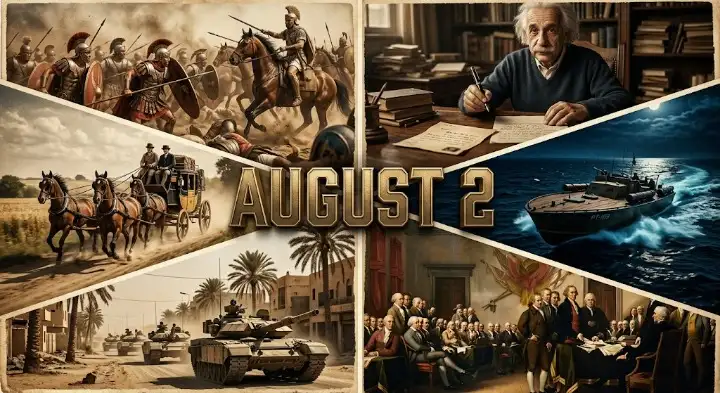
Albert Einstein sat at a wooden table in Long Island on August 2, 1939, penning a urgent warning to President Franklin D. Roosevelt about atomic power. That fateful letter sparked the Manhattan Project and changed global warfare forever. Knowing what happened on August 2 in history reveals how single moments reshape human destiny, from ancient battlefields in Cannae to modern conflicts in Kuwait. Looking back at this day in history August 2 offers a compelling window into our shared past.
Quick Facts — August 2 in History
| Category | Detail |
|---|---|
| Most Significant Event | Hannibal Barca annihilates eight Roman legions at the Battle of Cannae (216 BC) |
| Top Key Events |
|
| Key Battles | Chaeronea (338 BC), Cannae (216 BC), Ilerda (49 BC), Zela (47 BC), Pyana River (1377), The Nile (1798) |
| Key Figures | Hannibal Barca, Julius Caesar, Albert Einstein, John F. Kennedy, Calvin Coolidge |
| Observances | Roma Holocaust Memorial Day, Republic Day (North Macedonia), Paratroopers Day (Russia), Day of Azerbaijani Cinema, Our Lady of the Angels Day |
Story of the Day: The Invasion of Kuwait (1990)
Saddam Hussein ordered 100,000 Iraqi soldiers and 700 tanks across the border into Kuwait before dawn. Defense forces in Kuwait City fought bravely but found themselves overwhelmed within hours as Iraqi armored columns seized command centers and palace grounds. The sudden strike shattered regional stability and drew immediate condemnation from the United Nations. Within twelve hours, Iraq established a military puppet government over its neighbor’s rich oil fields. This bold aggressive move triggered international intervention, setting the stage for Operation Desert Storm six months later.
Important Events That Happened On August 2 In History
338 BC – Battle of Chaeronea: Philip II of Macedon charged his cavalry into the Greek ranks near Chaeronea, breaking the sacred band of Thebes. Athenian and Theban forces collapsed after hours of heavy hand-to-hand combat across the dusty plain. The victory established total Macedonian military dominance over the southern Greek city-states. Greece stood united under Philip’s control, clearing the path for his son Alexander to invade Persia.
216 BC – Battle of Cannae: Hannibal Barca drew Roman legions deep into a crescent-shaped trap in southeastern Italy before closing his cavalry around their rear. Surrounded on every side, roughly 50,000 Roman soldiers fell in a single afternoon of brutal close-quarters slaughter. It stands as Rome’s worst military disaster and a masterpiece of double-envelopment tactics. The defeat forced Rome to rewrite its grand military strategy to survive the Second Punic War.
49 BC – Battle of Ilerda Julius Caesar maneuvered his legions near the Ebro River, cutting off supplies to Pompey’s commanders Afranius and Petreius. Trapped without water or fresh provisions, the Pompeian army surrendered without a full battle taking place. Caesar secured control over the entire Iberian Peninsula in one swift campaign. His victory eliminated a massive threat to his rear before he turned eastward to confront Pompey himself.
47 BC – Battle of Zela Julius Caesar marched into Pontus and launched a fierce assault against King Pharnaces II near the hill town of Zela. The battle lasted just five hours before the Pontic army broke and fled in total disarray. Caesar famously summarized the lightning-quick victory to the Roman Senate with three words: Veni, vidi, vici. The regional rebellion died instantly, securing Rome’s eastern frontier.
461 – Emperor Majorian Deposed General Ricimer arrested Western Roman Emperor Majorian near Tortona as the ruler returned from military campaigns in Gaul. Ricimer stripped the emperor of his royal robes, beat him, and held him captive without public support. The military leader sought total political control over Rome’s puppet government. Majorian was executed five days later, removing one of the last capable emperors who tried to save the Western Empire.
932 – Siege of Toledo Ends Abd al-Rahman III accepted the unconditional surrender of Toledo after starving the fortified city during a grueling two-year siege. Umayyad forces marched into the fallen fortress town, ending decades of local rebellions in the Central March. The Umayyad Caliphate of Córdoba solidified its centralized authority across medieval Islamic Iberia. Toledo became a key stronghold under royal rule, stabilizing the region for generations.
1274 – Edward I Returns to England Edward I stepped ashore on English soil after spending years campaigning in the Holy Land during the Ninth Crusade. Crowds lined the roads as the prince traveled toward London to claim his inheritance following his father’s death. Seventeen days later, Westminster Abbey hosted his lavish royal coronation as King of England. His return marked the start of major legal reforms and campaigns across Wales and Scotland.
1343 – Jeanne de Clisson Vows Vengeance Jeanne de Clisson sold her ancestral estates and jewelry to purchase three warships painted black with red sails. French royal forces had executed her husband for treason, driving the noblewoman to launch a personal war at sea. She patrolled the English Channel, raiding French merchant ships and slaughtering royal crews for thirteen years. Her ruthless naval campaign earned her the nickname the “Lioness of Brittany.”
1377 – Battle on Pyana River Khan Arapsha of the Blue Horde ambushed a heavily intoxicated Russian army resting along the banks of the Pyana River. Russian commanders had left their armor stacked in supply wagons, completely unaware of approaching nomadic cavalry. The sudden attack turned into a total rout as thousands of Russian soldiers drowned or fell in battle. The defeat left the Principality of Nizhny Novgorod completely defenseless against incoming raids.
1415 – Execution of Sir Thomas Grey: Executioners brought Sir Thomas Grey to the block outside North Gate in Southampton for treason against King Henry V. Royal guards had uncovered the Southampton Plot, a conspiracy aimed at replacing Henry with the Earl of March. Grey died alongside his co-conspirators just days before the English fleet set sail for France. The swift executions secured Henry’s domestic control before his victory at Agincourt.
1492 – Alhambra Decree Expels Spanish Jews: Tens of thousands of Jewish families boarded ships or marched toward borders as the Alhambra Decree officially took full effect in Spain. King Ferdinand and Queen Isabella forced over 40,000 Jews to abandon their homes, wealth, and native land. Hearing of the tragedy, Sultan Bayezid II dispatched the Ottoman Navy to rescue refugees and bring them safely to imperial cities. The Sephardic Jewish diaspora reshaped cultural and economic centers in Salonica and İzmir for centuries.
1610 – Henry Hudson Enters Hudson Bay. Henry Hudson steered the Discovery through dangerous icy straits into the expansive, cold waters of modern-day Hudson Bay. He believed he had finally navigated through North America to reach the elusive Northwest Passage leading to Asia. The crew spent months trapped in frozen waters, eventually leading to a bloody mutiny the following spring. His voyage mapped thousands of miles of northern coastline for future Arctic trade.
1776 – Delegates Sign the Declaration of Independence Fifty-six delegates gathered in Philadelphia to apply their official signatures to the engrossed parchment copy of the Declaration of Independence. John Hancock wrote his bold signature first, leading representatives from all thirteen American colonies to follow suit. While independence was voted on July 2, this physical signing created the formal legal document sent across the globe. Members risked execution for high treason against Great Britain by signing their names.
1784 – First British Mail Coach Runs Driver John Palmer launched the first British mail coach service, departing Bristol with armed guards and making the journey to London. The heavily guarded carriage completed the trip in sixteen hours, far faster than traditional post riders on horseback. Regular schedules replaced slow postal delivery methods across the United Kingdom almost overnight. The system revolutionized national communications and laid the groundwork for modern public transport networks.
1790 – First United States Census Begins Federal marshals mounted horses and rode out across cities and rural frontier territories to conduct the first official United States Census. Enumerators counted households by hand, recording six basic questions to determine congressional representation and tax burdens. The six-month effort documented a national population of nearly four million people. It established a precedent for decennial population tracking required by the U.S. Constitution.
1798 – Battle of the Nile Ends Horatio Nelson destroyed or captured the majority of Napoleon’s fleet anchored at Aboukir Bay in Egypt, bringing the battle to a decisive end. British warships executed a daring maneuver by sailing between French ships and the shoreline, trapping them in crossfire. The destruction of French naval power left Napoleon’s army stranded without supplies in North Africa. The victory secured British naval dominance throughout the Mediterranean for years to come.
1830 – Abdication of Charles X King Charles X signed formal abdication papers at the Chateau de Rambouillet following three days of armed revolt in Paris during the July Revolution. Popular anger over royal censorship and autocratic decrees forced the monarch to give up his crown to his young grandson. Crowds refused to accept another Bourbon ruler, leading lawmakers to crown Louis-Philippe instead. The fall of Charles X ended the Bourbon Restoration and established the constitutional July Monarchy.
1858 – Government of India Act Passed Queen Victoria signed the Government of India Act 1858 into law, stripping the East India Company of its administrative powers. The British Crown took direct control over Indian territories, establishing the formal rule known as the British Raj. Widespread outrage following the Indian Rebellion of 1857 convinced Parliament that corporate rule was unsustainable. A cabinet minister and Viceroy took charge, dictating colonial policy directly from London.
1869 – Meiji Reform Abolishes Class System Japanese government officials formally abolished the feudal class structure, dissolving distinctions between samurai, peasants, artisans, and merchants. The radical decree stripped traditional samurai of their legal privileges, swords, and hereditary social status. Modernizing leaders aimed to build a centralized nation-state capable of competing with Western industrial powers. The reform transformed Japanese society and opened up equal civic roles across the country.
1870 – Tower Subway Opens in London Engineers opened the Tower Subway beneath the River Thames, welcoming passengers to the world’s first underground tube railway. A small steam-powered cable car pulled a tiny passenger car through a narrow iron-lined tunnel under the riverbed. While the cable system proved financially impractical and shut down within months, the iron tunnel design succeeded brilliantly. The project proved deep-level tube construction was viable, sparking the modern London Underground network.
1873 – First Cable Car Tested in San Francisco Andrew Smith Hallidie pulled the control lever on Clay Street, launching the world’s first operating cable car down San Francisco’s steep hills. The mechanical grip clamped onto an underground wire, hauling the wooden vehicle smoothly up the incline without horses. Spectators cheered as the system proved public transit could conquer dangerous urban slopes safely. Cable cars quickly became an iconic transportation symbol across the city.
1897 – Relief of Malakand Garrison Brigadier General Sir Bindon Blood led a British relief column into the Malakand Pass, breaking a brutal six-day siege by Pashtun tribal warriors. British and Indian troops fought house-to-house to clear surrounding ridge lines and rescue the exhausted garrison. Young Winston Churchill reported directly on the fierce mountain combat as a war correspondent. The victory secured British military posts along the perilous North-West Frontier of India.
1903 – Ilinden Uprising Begins Macedonian revolutionaries launched a massive coordinated revolt against Ottoman rule across the region of Macedonia and Thrace. Insurgents captured towns, disrupted telegraph lines, and declared the short-lived Kruševo Republic in mountain strongholds. Ottoman authorities responded by deploying over 100,000 troops to systematically crush the rebellion. The brutal suppression destroyed hundreds of villages but galvanized regional nationalist movements.
1909 – Tragic Week Protests End Spanish military forces cleared barricades from the streets of Barcelona, putting an end to a week of violent anti-war riots. Working-class citizens had revolted against prime minister conscription orders calling up reserves for colonial wars in Morocco. Protesters burned dozens of churches and clashed with police in bloody urban street battles. Over one hundred workers died during the crackdowns before order was restored.
1914 – Germany Occupies Luxembourg German troops crossed the border into neutral Luxembourg without declaring war, securing railway lines and strategic roads. Imperial commanders seized infrastructure to prepare for their planned invasion of Belgium and northern France under the Schlieffen Plan. Luxembourg’s government issued official protests but offered no armed resistance against the massive invading forces. The occupation lasted four years, marking the opening moves of World War I in Europe.
1916 – Sabotage Sinks the Leonardo da Vinci An explosion ripped through the hull of the Italian battleship Leonardo da Vinci while anchored in the harbor of Taranto. Austrian covert agents had smuggled explosives aboard, triggering a magazine blast that capsized the heavy warship within minutes. Twenty-one officers and 228 crewmen died as the ship sank into the harbor mud. Italian intelligence launched sweeping investigations that uncovered deep espionage networks across Mediterranean ports.
1918 – Vancouver Hosts First Canadian General Strike Thousands of dockworkers, streetcar drivers, and union members walked off their jobs in Vancouver, shutting down commerce across the city. Workers organized Canada’s first general strike to protest the murder of anti-conscription activist Ginger Goodwin by dominion police. The one-day work stoppage halted transportation, shipping, and industrial labor throughout British Columbia. It signaled growing postwar labor radicalism that culminated in the Winnipeg General Strike.
1922 – Shantou Typhoon Kills Thousands A powerful tropical cyclone made landfall directly over the coastal city of Shantou in Guangdong province, triggering catastrophic storm surges. Winds over 100 miles per hour swept sea water miles inland, wiping out coastal villages and crushing frail housing structures. Over 50,000 residents perished in a matter of hours during one of China’s deadliest natural disasters. Recovery efforts took years as international relief funds rushed to rebuild the port city.
1923 – Calvin Coolidge Sworn In as President Calvin Coolidge knelt by kerosene lamp light in his family home in Vermont as his father, a notary public, administered the presidential oath of office. News had just arrived over telegraph lines that President Warren G. Harding had died suddenly in San Francisco. Coolidge assumed the presidency without fanfare or public celebration in the middle of the night. His calm, quiet demeanor restored public confidence following recent White House corruption scandals.
1932 – Discovery of the Positron Physicist Carl D. Anderson photographed cloud chamber tracks at Caltech, capturing clear experimental evidence of a positively charged electron. The subatomic particle, named the positron, confirmed theoretical predictions about antimatter published years earlier by Paul Dirac. Anderson’s groundbreaking experimental work opened up entirely new fields of quantum physics research. He received the Nobel Prize in Physics four years later for proving antimatter actually exists.
1934 – Hitler Becomes Führer of Germany Adolf Hitler merged the offices of President and Chancellor following the death of President Paul von Hindenburg earlier that morning. German armed forces immediately took a new personal oath of loyalty directly to Hitler rather than the state constitution. The move eliminated the final constitutional check on Nazi political authority across the country. Hitler gained total dictator control over the German government and military machine.
1937 – Marihuana Tax Act Enacted President Franklin D. Roosevelt signed the Marihuana Tax Act into law, placing heavy tax burdens and license requirements on hemp products. Federal rules effectively criminalized the commercial sale, cultivation, and possession of cannabis across the United States. Harry Anslinger led public campaigns claiming the plant caused violent behavior and moral decay. The law marked the official beginning of federal prohibition policies regarding cannabis.
1939 – Einstein-Szilard Letter Written Albert Einstein signed a letter drafted by fellow physicist Leo Szilard at a summer cottage in Peconic, New York. The document warned President Franklin D. Roosevelt that German scientists might develop powerful atomic weapons using uranium. The letter urged America to secure uranium supplies and accelerate its own nuclear research programs. Roosevelt acted on the warning, initiating top-secret research projects that grew into the Manhattan Project.
1943 – Jewish Prisoners Revolt at Treblinka Armed Jewish captives inside the Treblinka extermination camp stole weapons from the camp armory and set fire to wooden barracks. Hundreds of prisoners fought guards with hand grenades and stolen rifles, tearing down razor-wire fences to escape into nearby forests. Around 300 inmates broke out, though Nazi SS guards hunted down and murdered most escapees in surrounding fields. The brave uprising forced camp commanders to dismantle the death facility months later.
1943 – JFK Saves PT-109 Crew Japanese destroyer Amagiri rammed and sliced through the wooden hull of patrol boat PT-109 in the dark waters of the Solomon Islands. Lieutenant John F. Kennedy gathered eleven survivors in the water, towing a severely burned crewman by a life jacket strap with his teeth. Kennedy swam for hours alongside his men to reach a small deserted island miles away from Japanese patrols. His courageous leadership kept his crew alive until native scouts organized a rescue mission.
1944 – Socialist Republic of Macedonia Founded Delegates gathered at the St. Prohor Pčinjski Monastery for the first session of the Anti-fascist Assembly for the National Liberation of Macedonia. Assembly leaders proclaimed the establishment of the Socialist Republic of Macedonia as a federal state within Yugoslavia. The historic meeting established modern Macedonian statehood and codified the standard Macedonian national language. The date remains celebrated annually as Republic Day across North Macedonia.
1944 – Largest Trade Convoy Arrives Safely Merchant ships and heavy naval escorts belonging to Convoy HX 300 dropped anchor in the Western Approaches after crossing the Atlantic. The massive fleet contained 167 merchant vessels loaded with food, fuel, and war supplies for Allied operations in Europe. German U-boat wolfpacks failed to sink a single ship during the entire trans-oceanic transit. It stood as the largest merchant convoy organized during the entire Second World War.
1945 – Potsdam Conference Concludes Harry S. Truman, Winston Churchill, Clement Attlee, and Joseph Stalin finalized peace protocols after two weeks of negotiations in occupied Potsdam. Allied leaders established occupation zones, border changes, and demilitarization programs for postwar defeated Germany. The conference issued the Potsdam Declaration, demanding unconditional surrender from the Empire of Japan under threat of total destruction. The agreements shaped cold war geopolitics across divided Europe for decades.
1947 – Star Dust Airliner Disappears A British South American Airways Lancastrian airliner named Star Dust transmitted a final cryptic Morse code message before vanishing over the Andes mountains. The plane carrying six passengers and five crew members crashed directly into a glacier during a heavy snowstorm. Search teams scoured mountain passes for weeks but found no trace of wreckage or survivors. Deep ice buried the wreckage until mountain climbers finally stumbled across engines and wreckage in 1998.
1968 – Casiguran Earthquake Strikes Philippines A powerful magnitude 7.6 earthquake struck the province of Aurora in the Philippines early in the morning. Severe ground shaking caused total collapse of the six-story Ruby Tower building in downtown Manila miles away. Over 270 people lost their lives and hundreds suffered severe injuries as rescue teams dug through concrete rubble. The disaster forced the government to rewrite national building codes to withstand seismic shocks.
1973 – Summerland Fire Tragedy A minor trash fire outside the Summerland leisure complex on the Isle of Man spread rapidly into decorative acrylic wall paneling. Flames engulfed the massive indoor amusement center, trapping over 3,000 tourists inside as power failed and emergency exits jammed. Fifty people died and scores suffered severe burns in one of Britain’s worst indoor fire disasters. The tragedy led to strict nationwide bans on flammable building materials in public venues.
1980 – Bologna Railway Station Bombing: A time bomb hidden inside an unattended suitcase exploded in the crowded waiting room of the Bologna Central station in Italy. The blast collapsed the station roof and destroyed nearby trains, killing 85 people and injuring over 200 travelers. Neo-fascist terrorist groups carried out the attack during peak summer holiday travel periods. It remains the deadliest act of domestic terrorism committed in modern Italian history.
1982 – Helsinki Metro Opens: City officials opened the Helsinki Metro to the public, launching Finland’s first underground rapid transit system. Electric trains carried passengers along an initial nine-station line connecting downtown Helsinki with eastern suburban districts. Riders enjoyed clean, efficient subterranean transit built to handle harsh Scandinavian winter conditions. The network expanded rapidly over following decades to become a core transit arterial.
1985 – Delta Flight 191 Crash: A Lockheed L-1011 microburst wind shear hit Delta Air Lines Flight 191 on final approach to Dallas/Fort Worth International Airport. The heavy airliner lost altitude rapidly, slamming into a highway and striking water tanks before bursting into flames near the runway. The crash claimed the lives of 137 passengers, crew members, and a driver on the ground. The disaster prompted global aviation authorities to install microburst detection radar at major airports.
1989 – Pakistan Re-admitted to Commonwealth Commonwealth leaders voted to readmit Pakistan as an official member state following seventeen years of diplomatic absence. Prime Minister Benazir Bhutto had restored democratic governance following military rule under General Zia-ul-Haq. Pakistan had originally withdrawn from the international body in 1972 over recognition of independent Bangladesh. Rejoining signaled international support for Pakistan’s newly elected democratic institutions.
1989 – Valvettithurai Massacre: Soldiers belonging to the Indian Peace Keeping Force carried out a door-to-door search operation in the town of Valvettithurai, Sri Lanka. Indian troops opened fire on unarmed civilians following a insurgent ambush on a nearby military patrol. The violent crackdown resulted in the deaths of 64 Tamil civilians and the destruction of over one hundred homes. The event drew international criticism and worsened ethnic tensions across northern regions.
1991 – Space Shuttle Atlantis Launches STS-43: Space Shuttle Atlantis thundered off launchpad 39A at Kennedy Space Center, heading into orbit on mission STS-43. Astronauts deployed the fifth Tracking and Data Relay Satellite to improve orbital communications for future space missions. The crew conducted medical experiments and tested new thermal heat pipe systems during the nine-day flight. Atlantis returned safely to Earth, landing smoothly at Kennedy Space Center.
1999 – Gaisal Train Disaster: Two passenger trains carrying over 2,500 people collided head-on at high speed at Gaisal station in West Bengal, India. Signal failure caused the express train to enter the same track occupied by another stationary passenger train. The impact shattered coaches, killing 285 people and injuring more than 300 passengers in the wreckage. It resulted in sweeping modernization efforts across Indian Railways signaling networks.
2005 – Air France Flight 358 Runway Excursion: Air France Flight 358 touched down at Toronto Pearson International Airport during severe thunderstorms and heavy rainfall. The Airbus A340 failed to stop before the end of the runway, plunging into a nearby ravine and bursting into flames. Emergency slides deployed quickly, allowing all 309 passengers and crew members to evacuate safely with only twelve minor injuries. Aviation experts hailed the crew’s emergency response as a miracle of modern safety engineering.
2014 – Kunshan Factory Explosion: An explosion tore through an auto parts polishing workshop in Kunshan, Jiangsu province, China. Highly combustible metal dust ignited inside unventilated workrooms, triggering a devastating blast that killed 146 workers and injured 114 others. Investigations revealed severe safety violations, poor ventilation systems, and lax corporate oversight. The tragedy prompted nationwide safety inspections across Chinese manufacturing plants.
Journey back to yesterday’s events by following this link.
Famous People Born on August 2
| Name | Description | Date |
|---|---|---|
| Kyawswa of Pagan | Last ruler of the Pagan Kingdom (Myanmar) | 1260 – 1299 |
| Mahmud I | Ottoman Sultan | 1696 – 1754 |
| Pierre Charles L’Enfant | French-American architect who designed Washington, D.C. | 1754 – 1825 |
| John Tyndall | Irish-English physicist known for the Tyndall effect | 1820 – 1893 |
| Frédéric Auguste Bartholdi | French sculptor who designed the Statue of Liberty | 1834 – 1904 |
| Elisha Gray | American inventor and co-founder of Western Electric | 1835 – 1901 |
| Prafulla Chandra Ray | Indian chemist and founder of modern chemical research in India | 1861 – 1944 |
| Pingali Venkayya | Designer of the Flag of India | 1876 – 1963 |
| Jack L. Warner | Co-founder of Warner Bros. Studios | 1892 – 1978 |
| Pope Cyril VI of Alexandria | Pope of the Coptic Orthodox Church | 1902 – 1971 |
| Myrna Loy | American film actress | 1905 – 1993 |
| Shimon Peres | 9th President and Prime Minister of Israel | 1923 – 2016 |
| James Baldwin | Influential American novelist and civil rights writer | 1924 – 1987 |
| Carroll O’Connor | American actor best known for All in the Family | 1924 – 2001 |
| Peter O’Toole | British-Irish Academy Award-nominated actor | 1932 – 2013 |
| Lamar Hunt | American businessman; founder of the AFL and MLS pioneer | 1932 – 2006 |
| Wes Craven | American horror film director (A Nightmare on Elm Street) | 1939 – 2015 |
| Jules A. Hoffmann | Nobel Prize-winning French biologist | 1941 – 2024 |
| Isabel Allende | Chilean-American bestselling novelist | 1942 – Present |
| Bunker Roy | Indian educator and founder of Barefoot College | 1945 – Present |
| Lawrence Wright | Pulitzer Prize-winning American journalist and author | 1947 – Present |
| Butch Vig | American music producer and drummer (Nirvana, Garbage) | 1955 – Present |
| Mary-Louise Parker | American Emmy and Golden Globe-winning actress | 1964 – Present |
| Chrystia Freeland | Canadian politician and journalist | 1968 – Present |
| Kevin Smith | American filmmaker and actor | 1970 – Present |
| Sam Worthington | Australian actor (Avatar) | 1976 – Present |
| JD Vance | 50th Vice President of the United States | 1984 – Present |
| Lily Gladstone | American Academy Award-nominated actress | 1986 – Present |
| Charli XCX | English pop singer-songwriter | 1992 – Present |
| Mohammed Kudus | Ghanaian professional footballer | 2000 – Present |
Famous People Who Died on August 2
| Name | Description | Date |
|---|---|---|
| Ahmad ibn Hanbal | Founder of the Hanbali school of Islamic jurisprudence | 780 – 855 |
| William II of England | King of England | 1056 – 1100 |
| Henry III of France | King of France | 1551 – 1589 |
| Francesco Borromini | Baroque architect of Rome | 1599 – 1667 |
| Thomas Gainsborough | English portrait and landscape painter | 1727 – 1788 |
| Jacques-Étienne Montgolfier | Co-inventor of the hot air balloon | 1745 – 1799 |
| Lazare Carnot | French mathematician, military engineer, and statesman | 1753 – 1823 |
| Muhammad Ali of Egypt | Founder of modern Egypt | 1769 – 1849 |
| Horace Mann | American education reformer | 1796 – 1859 |
| Wild Bill Hickok | Legendary American lawman and gunslinger | 1837 – 1876 |
| Enrico Caruso | Italian operatic tenor | 1873 – 1921 |
| Alexander Graham Bell | Inventor of the telephone | 1847 – 1922 |
| Warren G. Harding | 29th President of the United States | 1865 – 1923 |
| Paul von Hindenburg | President of Germany and World War I field marshal | 1847 – 1934 |
| Pietro Mascagni | Italian opera composer | 1863 – 1945 |
| Wallace Stevens | Pulitzer Prize-winning American poet | 1879 – 1955 |
| Jean-Pierre Melville | Influential French film director | 1917 – 1973 |
| Fritz Lang | Austrian-American filmmaker (Metropolis) | 1890 – 1976 |
| Carlos Chávez | Mexican composer and conductor | 1899 – 1978 |
| Thurman Munson | American baseball player and Yankees captain | 1947 – 1979 |
| James Jamerson | Legendary Motown bassist | 1936 – 1983 |
| Raymond Carver | American short story writer | 1938 – 1988 |
| William S. Burroughs | American Beat Generation novelist | 1914 – 1997 |
| Fela Kuti | Nigerian musician and creator of Afrobeat | 1938 – 1997 |
| Peter Safar | Pioneer of modern CPR | 1924 – 2003 |
| John Keegan | British military historian | 1934 – 2012 |
| Ahmed Zewail | Egyptian-American Nobel Prize-winning chemist | 1946 – 2016 |
| Judith Jones | Influential American cookbook editor | 1924 – 2017 |
| Vin Scully | Legendary American sports broadcaster | 1927 – 2022 |
| Nitin Chandrakant Desai | Indian film production designer and art director | 1965 – 2023 |
Observances on August 2
- Roma Holocaust Memorial Day: European nations honor the memory of over 500,000 Romani people murdered across occupied Europe during World War II.
- Republic Day (North Macedonia): Citizens commemorate the 1903 Ilinden Uprising and the 1944 establishment of modern Macedonian statehood.
- Paratroopers Day (Russia): Military veterans and airborne forces across Russia celebrate the anniversary of the first Soviet paratrooper drop in 1930.
- Day of Azerbaijani Cinema (Azerbaijan): Film directors and cinema lovers celebrate national film heritage marking the first public movie screening in Baku in 1898.
- Our Lady of the Angels Day (Costa Rica): Thousands of pilgrims walk to the Basilica in Cartago to honor Costa Rica’s patron saint.
📅 Frequently Asked Questions — August 2 in History
Iraqi military forces invaded neighboring Kuwait under orders from Saddam Hussein on August 2, 1990. The sudden assault overwhelmed local defense forces and led to the annexation of Kuwaiti territory. This aggression triggered widespread international outrage and directly caused the 1991 Gulf War.
The famous Battle of Cannae took place on August 2, 216 BC, where Carthaginian general Hannibal Barca destroyed a massive Roman army. Using brilliant double-envelopment tactics, Hannibal surrounded eight Roman legions in southeastern Italy. The defeat stands as one of the deadliest military clashes in ancient human history.
Historical figures born on August 2 include Kyawswa of Pagan, the last sovereign ruler of the Pagan Kingdom in medieval Myanmar. Italian professional footballer Marco Bonura was also born on this day in 1979. Additional notable births include famous inventor Elisha Gray and actor Sam Worthington.
Hannibal’s tactical masterpiece at the Battle of Cannae in 216 BC remains arguably the most influential single military event on August 2. The battle is still analyzed in modern military academies worldwide as the supreme example of army encirclement.
Roma Holocaust Memorial Day remembers the 500,000 Romani people murdered by the Nazi regime across Europe during World War II. August 2 specifically marks the night in 1944 when SS guards liquidated the “Gypsy family camp” at Auschwitz-Birkenau. The day ensures these historical atrocities are never forgotten by future generations.
A metal dust explosion tore through an auto parts manufacturing plant in Kunshan, China on August 2, 2014, killing 146 workers. In 2005, Air France Flight 358 ran off a stormy runway in Toronto and burst into flames, miraculously resulting in zero deaths due to a swift evacuation.