Lin Zexu stood on the shores of Humen, China, watching smoke rise from massive trenches filled with burning foreign opium. This bold destruction of British cargo would spark a global war. Decades later, this day in history June 3 continues to echo with massive geopolitical shifts, military collisions, and daring human triumphs that permanently reshaped our modern world.
👶 Quick Facts — June 3 in History
| 📌 Category | 📖 Event / Detail |
|---|---|
| 🌟 Most Significant Event | Beijing military units enter Tiananmen Square to end student protests (1989) |
| 🏆 Top 10 Key Events | • Crusaders capture Antioch (1098) • De Soto claims Florida (1539) • Lin Zexu destroys British opium (1839) • Great Auks go extinct (1844) • Lee begins Gettysburg Campaign (1863) • Grant suffers heavy losses at Cold Harbor (1864) • Duke of Windsor marries Wallis Simpson (1937) • French climbers summit Annapurna (1950) • Gemini 4 crew launches first US spacewalk (1965) • Mabo decision overturns terra nullius in Australia (1992) |
| ⚔️ Key Battles | Siege of Antioch, Battle of Sesimbra Bay, Battle of Lowestoft, Battle of Philippi, Battle of Cold Harbor |
| 👤 Key Figures | Lin Zexu, Robert E. Lee, Ulysses S. Grant, Ed White, Eddie Mabo |
| 🌍 Observances | World Bicycle Day, Mabo Day (Australia), Opium Suppression Movement Day (Taiwan), Economist Day (Argentina), Confederate Memorial Day (Kentucky/Tennessee, USA) |
Story of the Day: The Birth of American Spacewalking
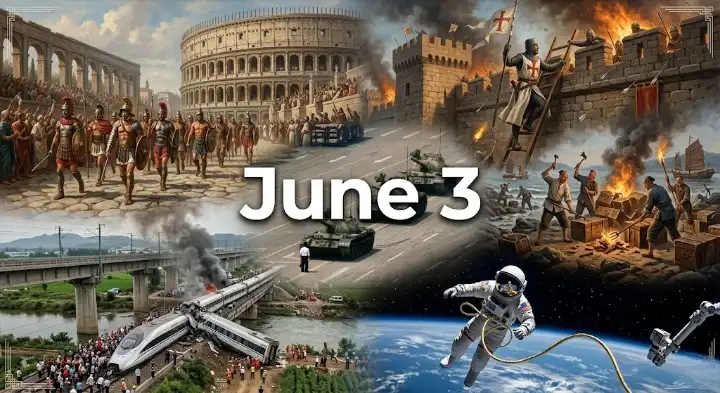
Ed White stepped out of the open hatch of the Gemini 4 spacecraft and floated into the absolute silence of Earth’s orbit. Anchored only by a golden tether, he used a hand-held maneuvering gun to guide his movements across twenty-one breathtaking minutes. His pilot companion, James McDivitt, snapped vibrant photographs from inside the capsule as White drifted over the Pacific Ocean. This high-stakes operation proved that American astronauts could survive outside a spacecraft, matching a Soviet achievement from months prior. When controllers finally ordered him back inside, White called his return to the cabin the saddest moment of his life.
Important Events That Happened On June 3 In History
350 – Nepotianus Proclaims Himself Roman Emperor
Nepotianus marched into the heart of Rome alongside a desperate band of armed gladiators. This bold challenger from the Constantinian dynasty took advantage of regional chaos to seize the title of emperor. His violent rule lasted just twenty-eight days before loyal troops of a rival commander crushed his forces. The swift execution of Nepotianus and his family served as a brutal warning to future imperial usurpers.
713 – Philippicus Is Blinded and Deposed
Conspirators from the Opsikion army cornered Byzantine Emperor Philippicus in a Thracian palace room. The rebellious soldiers gouged out his eyes before stripping him of his imperial authority and sending him into exile. Chaos gripped the empire until a competent administrator named Anastasios II took the crown to restore administrative control. Anastasios immediately began restructuring the military to defend Constantinople from looming foreign invasions.
1098 – Crusaders Seize Antioch After Long Siege
European knights scaled the fortified stone walls of Antioch under the cover of night. Five months of starvation, disease, and brutal warfare had broken the crusading army before a local betrayer opened a city gate. A frantic slaughter followed as the attackers overwhelmed the unsuspecting Turkish garrison inside. This bloody breakthrough cleared a direct marching path toward Jerusalem, securing a major victory for the First Crusade.
1140 – Peter Abelard Found Guilty of Heresy
French scholars and church authorities gathered at the Council of Sens to condemn Peter Abelard. The brilliant philosopher faced fierce accusations of heresy from his bitter intellectual rival, Bernard of Clairvaux. Church leaders banned Abelard’s writings and ordered him to cease teaching his controversial theological ideas. This high-profile trial exposed a deep rift between traditional faith and the rising tide of rational philosophy in medieval Europe.
1326 – Treaty of Novgorod Fixes Northern Borders
Russian and Norwegian envoys gathered in the trading post of Novgorod to sign a boundary agreement. Decades of violent skirmishes over the freezing wilderness of Finnmark pushed both sides to seek a permanent diplomatic settlement. The resulting treaty established a neutral border zone where both nations could safely collect taxes from the indigenous Sámi people. This foundational document brought stability to the Arctic frontier and regulated regional trade for centuries.
1539 – Hernando de Soto Claims Florida for Spain
Spanish soldiers plant their royal banners into the humid soil of Tampa Bay. Hernando de Soto declared the vast, uncharted wilderness of Florida the exclusive territory of the Spanish crown. His massive expeditionary force then marched inland, looking for gold and enslaving native communities along their path. This aggressive invasion brought devastating European diseases to the region, destroying countless indigenous societies across the American South.
1602 – English Fleet Triumphs at Sesimbra Bay
English warships launched a surprise assault on a fleet of Spanish galleys anchored in Portuguese waters. Admiral Richard Leveson directed heavy cannon fire against the coastal fortifications while his sailors boarded a massive Portuguese carrack loaded with treasure. The English force successfully captured the valuable vessel and sailed it away under the noses of the Spanish defenders. This striking naval victory disrupted Iberian merchant shipping and brought immense wealth to the English treasury.
1608 – Samuel de Champlain Lands at Tadoussac
Samuel de Champlain stepped off his wooden ship onto the rugged shores of Tadoussac, Quebec. This experienced French explorer immediate directed his crew to clear land and erect sturdy defensive fortifications against the harsh wilderness. This strategic encampment served as his base of operations during his third major voyage into New France. The temporary settlement laid the vital groundwork for his journey upriver to establish the permanent colony of Quebec City.
1621 – Dutch West India Company Receives Charter
Dutch states-general officials signed a comprehensive trade charter creating the Dutch West India Company. This powerful merchant enterprise received a total monopoly over lucrative trade routes spanning West Africa and the Americas. Directors quickly focused on establishing a colonial presence along the Hudson River, naming the territory New Netherland. This commercial venture drove the rapid growth of the global fur trade and fueled intense colonial rivalries.
1658 – François de Laval Appointed Vicar Apostolic
Pope Alexander VII signed a papal decree naming François de Laval the vicar apostolic of New France. This devout clergyman assumed absolute spiritual leadership over a massive, sparsely populated territory stretching across North America. Laval worked to build schools, organize parishes, and protect indigenous communities from the devastating effects of the colonial liquor trade. His spiritual leadership laid the institutional foundation for the Catholic Church throughout modern Canada.
1665 – Duke of York Defeats Dutch Fleet
James Stuart directed British warships into battle against a massive Dutch naval force off Lowestoft. Heavy artillery broadsides shattered wooden hulls, causing the Dutch flagship to explode in a spectacular burst of fire. The remaining Dutch vessels retreated in confusion, leaving control of the English Channel to the British navy. This initial clash established English naval dominance during the opening stages of the Second Anglo-Dutch War.
1700 – Academy of the Distrustful Founded in Barcelona
Catalan scholars gathered inside the grand library room of the Palau Dalmases to form an elite intellectual society. These thinkers dedicated their meetings to preserving local culture, discussing philosophy, and advancing scientific ideas. The academy became a vibrant center for regional enlightenment during a period of intense political transition. Their scholarly efforts kept Catalan identity alive as the War of the Spanish Succession approached.
1781 – Jack Jouett Begins Midnight Ride
Jack Jouett leaped onto his horse at the Cuckoo Tavern and dashed into the dark Virginia woods. The young captain spotted British cavalry moving quickly toward Charlottesville on a mission to capture state leaders. Jouett rode forty miles through scratched branches and thick mud to warn Governor Thomas Jefferson and local lawmakers before the raiders arrived. His exhausting midnight ride saved the leadership of the American Revolution from certain capture.
1839 – Lin Zexu Destroys Confiscated Opium
Chinese laborers poured tons of salt and lime into massive trenches filled with British opium chests. Commissioner Lin Zexu ordered the public destruction of over one million kilograms of the illegal narcotic to halt a devastating domestic addiction crisis. This aggressive seizure enraged British merchants who demanded a fierce military response from their home government. The destruction of the cargo provided Great Britain with the direct casus belli needed to launch the First Opium War.
1844 – Last Pair of Great Auks Killed
Three Icelandic fishermen hunted down the last known breeding pair of great auks on Eldey Island. The men strangled the flightless birds and accidentally crushed their single remaining egg under a heavy boot. Wealthy European museums had offered large cash rewards for specimens, driving collectors to wipe out the entire species. This final tragedy remains a haunting early example of human greed causing the absolute extinction of a bird.
1861 – Union Forces Rout Confederates at Philippi
Union troops launched a coordinated surprise attack on a Confederate camp in Barbour County, Virginia. The inexperienced southern soldiers retreated so quickly through the pouring rain that locals Mockingly called the battle the Philippi Races. This small engagement marked the first organized land battle of the American Civil War. The decisive Union victory secured control of the Baltimore and Ohio Railroad and boosted northern morale.
1863 – Robert E. Lee Invades the North
General Robert E. Lee ordered the Army of Northern Virginia to break camp and march northward. This strategic movement launched the Gettysburg Campaign, aiming to draw Union troops out of war-torn Virginia and threaten northern cities. Lee hoped a major victory on northern soil would force Washington to negotiate a peaceful end to the conflict. This fateful march set the stage for the bloodiest battle ever fought in North America.
1864 – Grant Sustains Heavy Losses at Cold Harbor
Ulysses S. Grant ordered a massive frontal assault against heavily fortified Confederate trenches at Cold Harbor. Confederate infantry opened fire with devastating accuracy, killing or wounding thousands of Union soldiers in less than an hour. Grant later expressed deep regret for ordering the attack, which failed to break the southern defensive lines. This brutal slaughter highlighted the changing nature of modern trench warfare and shocked the northern public.
1885 – Big Bear Escapes Mounted Police
Cree leader Big Bear slipped into the dense Canadian brush to evade pursuing North-West Mounted Police units. This engagement marked the final military conflict fought on Canadian soil following the Northwest Rebellion. While his followers surrendered or scattered, the aging chief survived in the wilderness for weeks before finally giving himself up. His capture marked the end of armed indigenous resistance to white settlement across the Canadian prairies.
1889 – First US Long-Distance Power Line Completed
Engineers flipped a switch at Willamette Falls, sending electric currents surging down a fourteen-mile wire. The high-voltage line carried power directly to downtown Portland, Oregon, to light up city streets and businesses. This technical breakthrough proved that electricity could travel long distances without losing its utility. The success of the project revolutionized the American energy industry, sparking rapid urban electrification nationwide.
1892 – Liverpool F.C. Official Foundation
John Houlding stood inside anfield stadium and signed the official corporate papers creating Liverpool F.C. The wealthy businessman needed a new football team to play on his land after a bitter rent dispute drove Everton F.C. away. Houlding built a squad of Scottish players who wore blue and white uniforms during their inaugural season. This localized real estate argument birthed one of the most successful and supported football clubs in global sports history.
1916 – National Defense Act Signed Into Law
President Woodrow Wilson signed a sweeping military expansion bill into law as war raged across Europe. The legislation expanded the United States Regular Army and increased the National Guard by over 450,000 men. It also created the Reserve Officers’ Training Corps to train college students for future military command positions. This major legislative shift prepared the neutral nation for its eventual entry into World War I.
1935 – On-to-Ottawa Trek Begins in Vancouver
Over one thousand unemployed Canadian workers climbed onto the roofs of freight cars leaving Vancouver. The men left their remote government relief camps to protest poor living conditions, meager pay, and a total lack of steady jobs. They planned to ride the rails across the country to confront Prime Minister R.B. Bennett directly in Ottawa. This mass movement galvanized working-class Canadians and forced a national debate over Great Depression policies.
1937 – Duke of Windsor Marries Wallis Simpson
Edward Windsor stood beside Wallis Simpson in a quiet French chateau to exchange marriage vows. The former King of England had abdicated his royal throne months earlier because the government refused to accept an American divorcee as queen. No members of the British royal family attended the private ceremony, and the couple spent the rest of their lives in comfortable European exile. Their controversial union permanently altered the line of British royal succession.
1940 – Luftwaffe Bombs Paris
German bomber formations flew through the clouds over Paris, dropping high-explosive munitions onto the French capital. The surprise aerial assault killed over two hundred civilians and destroyed numerous factories and residential neighborhoods. Nazi leaders ordered the raid to shatter French morale during the rapid collapse of the Allied defensive lines. The attack brought the grim reality of total world war directly to the streets of Paris.
1940 – Rademacher Proposes Madagascar Plan
Franz Rademacher drafted a secret Nazi foreign policy memorandum outlining the forced relocation of European Jews. The Madagascar Plan suggested deporting four million Jews to the island colony to live under strict SS police control. Nazi officials embraced the concept as a temporary solution before shifting toward systematic mass murder. This chilling document exposed the early bureaucratic planning behind what became the Holocaust.
1941 – Wehrmacht Razes Greek Village of Kandanos
German soldiers marched into the Cretan village of Kandanos with orders to destroy everything. The troops shot 180 local residents and burned every home to the ground in retaliation for local guerrilla resistance. Commanders erected wooden signs declaring that the village would never be rebuilt. This brutal war crime stood as one of the earliest mass atrocities committed during the Nazi occupation of Greece.
1942 – Japan Launches Aleutian Islands Campaign
Japanese carrier planes emerged from dense fog to bomb the US naval base at Dutch Harbor, Alaska. The sudden aerial assault set fuel tanks on fire and killed dozens of American soldiers stationed on Unalaska Island. This military operation aimed to divert US naval forces away from the critical battle developing near Midway Island. The raid initiated a grueling, year-long campaign fought across the freezing, wind-swept Aleutian chain.
1943 – White Sailors Attack Latinos in Zoot Suit Riots
Hundreds of white US Navy sailors and Marines marched into East Los Angeles carrying clubs and iron bars. The servicemen targeted Mexican-American youths wearing baggy, flamboyant zoot suits, beating them and tearing their clothes off in the streets. Local police officers stood by, arresting the injured victims rather than the military attackers. These violent riots exposed deep racial tensions tearing through wartime American society.
1950 – French Climbers Summit Annapurna
Maurice Herzog and Louis Lachenal crawled onto the wind-swept summit of Annapurna in the Himalayas. The French mountaineers braved extreme altitude sickness, frostbite, and fierce winds to conquer the 8,000-meter peak without supplemental oxygen. Both men lost their toes to severe frostbite during a harrowing descent through a blinding blizzard. Their historic achievement marked the first time human beings had ever summited an eight-thousand-meter mountain.
1962 – Air France Flight 007 Explodes at Orly Airport
Air France Flight 007 roared down the runway at Paris Orly Airport when the pilot suddenly attempted to abort takeoff. The massive Boeing 707 skidded off the tarmac, crashed through an airport fence, and exploded into a massive fireball. The disaster killed 130 people, including a large group of prominent civic and art leaders from Atlanta, Georgia. It stood as the worst single-aircraft disaster in aviation history up to that point.
1963 – South Vietnamese Troops Attack Buddhist Protesters
South Vietnamese soldiers opened fire and poured blistering chemicals onto protesting Buddhists in the city of Huế. The liquid tear gas caused severe skin burns and respiratory distress, sending sixty-seven victims to local hospitals. The violent crackdown sparked international outrage and turned the United States government against President Ngo Dinh Diem. This religious crisis severely weakened the South Vietnamese regime during a critical phase of the war.
1969 – Australian Aircraft Carrier Cuts US Destroyer in Half
The Australian aircraft carrier HMAS Melbourne collided with the American destroyer USS Frank E. Evans in the South China Sea. The massive carrier sliced the smaller destroyer completely in half during a series of nighttime naval maneuvers. The forward section of the American ship sank within minutes, killing seventy-four sailors. A joint military investigation later blamed confusion over steering commands for the tragic wartime accident.
1973 – Soviet Supersonic Concorde Competitor Crashes
A Soviet Tupolev Tu-144 exploded in mid-air and crashed into a French village during the Paris Air Show. The supersonic passenger jet broke apart during a violent low-altitude maneuver, killing all six crew members and eight people on the ground. This public disaster dealt a fatal blow to the Soviet Union’s aviation prestige and commercial ambitions. The crash permanently slowed the global development of supersonic commercial flight.
1974 – Australian Aboriginal Land Rights Recognized
The High Court of Australia delivered the historic Mabo v Queensland ruling, fundamentally altering national law. The court ruled in favor of Torres Strait Islander Eddie Mabo, declaring that indigenous people held native title over their ancestral lands. This landmark decision permanently overturned the long-held colonial legal doctrine of terra nullius, which claimed the continent belonged to no one before British settlement.
1979 – Ixtoc I Oil Well Blowout
A sudden high-pressure surge blew the top off the Ixtoc I exploratory oil well in the Gulf of Mexico. Millions of barrels of thick crude oil gushed into the ocean waters over the next nine months before engineers capped the leak. This massive environmental disaster poisoned coastal ecosystems, killed marine life, and coated Texas beaches in sludge. It remained the worst accidental oil spill in world history for over three decades.
1980 – Grand Island Tornado Outbreak Hits Nebraska
Seven distinct tornadoes tore through the city of Grand Island, Nebraska, over a single terrifying night. The slow-moving storms destroyed over five hundred homes, killed five residents, and caused hundreds of millions of dollars in property damage. Atmospheric scientists flocked to the area to document the unusual path and behavior of the multiple twisters. This extreme weather event forced cities across the Midwest to modernize their emergency warning systems.
1982 – Israeli Ambassador Shot in London
An Abu Nidal gunman stepped out of the shadows on a London street and shot Israeli Ambassador Shlomo Argov in the head. Argov survived the assassination attempt but spent the rest of his life completely paralyzed. The violent attack prompted Israel to launch a massive military invasion of Lebanon days later to crush Palestinian guerrilla bases. This single shooting sparked a wider regional war that destabilized the Middle East for years.
1984 – Operation Blue Star Launches at Golden Temple
Indian army units rolled into Amritsar to surround the Golden Temple, the holiest shrine in the Sikh religion. Prime Minister Indira Gandhi ordered the military offensive to remove armed Sikh separatists who had fortified themselves inside the complex. Heavy fighting damaged sacred buildings and killed thousands of people, including many innocent pilgrims caught in the crossfire. The controversial operation deeply alienated the global Sikh community and led to Gandhi’s assassination months later.
1989 – Chinese Troops Sent to Clear Tiananmen Square
Military units advanced through the streets of Beijing toward Tiananmen Square to crush a seven-week student democracy protest. Armored personnel carriers smashed through civilian barricades while soldiers fired live ammunition into crowds of unarmed demonstrators. The violent crackdown killed hundreds, possibly thousands, of citizens who stood their ground to defend the movement. This brutal assault shocked the international community and ushered in an era of intense political censorship across China.
1991 – Mount Unzen Erupts in Japan
A massive wall of superheated volcanic gas and rock roared down the slopes of Mount Unzen in Kyūshū, Japan. The violent pyroclastic flow swept over an observation post, instantly killing forty-three scientists, volcanologists, and journalists. The victims had gathered to document the mountain’s awakening after two centuries of quiet inactivity. This tragedy forced global authorities to establish stricter safety zones around active volcanoes worldwide.
1998 – Eschede High-Speed Train Derailment
An Intercity-Express train traveling at 120 miles per hour suffered a sudden wheel rim failure near Eschede, Germany. The derailed passenger cars smashed into a concrete bridge structure, causing the massive overpass to collapse onto the wreckage. This horrific accident killed 101 people and injured over one hundred others in the worst high-speed rail disaster in history. Investigations forced rail networks worldwide to replace multi-piece wheels with safer, single-cast steel designs.
2006 – Montenegro Declares Independence from Serbia
Lawmakers gathered in Podgorica to sign an official declaration breaking Montenegro’s historic union with Serbia. This political move followed a close national referendum where citizens voted to re-establish their country’s absolute sovereignty. The peaceful separation dissolved the final remaining fragment of the former Yugoslav state without triggering military conflict. Montenegro emerged as an independent nation, seeking integration into western European institutions.
2012 – Passenger Plane Crashes into Lagos Neighborhood
Dana Air Flight 992 suffered a dual engine failure while approaching the airport in Lagos, Nigeria. The commercial airliner crashed directly into a crowded, multi-story residential neighborhood, killing all 153 people on board and six citizens on the ground. Shoddy airline maintenance and poor regulatory oversight blamed for the fatal system failures. The tragedy prompted the Nigerian government to temporarily suspend the airline’s operating license and overhaul national aviation safety checks.
2012 – Diamond Jubilee Pageant on the River Thames
A spectacular fleet of one thousand vessels sailed down the River Thames to celebrate the Diamond Jubilee of Queen Elizabeth II. Millions of spectators stood along the riverbanks in the pouring rain to catch a glimpse of the royal family riding aboard a lavishly decorated spirit barge. This massive nautical procession marked sixty years of the Queen’s reign, matching a milestone achieved only by Queen Victoria. The historic display stood as the largest maritime parade seen in London for over three centuries.
2013 – Chelsea Manning Trial Begins
Military prosecutors opened their court case against US Army Private Chelsea Manning at Fort Meade, Maryland. The young intelligence analyst faced numerous serious charges, including aiding the enemy, for leaking hundreds of thousands of classified military and diplomatic documents to WikiLeaks. The trial exposed major security vulnerabilities within US military data networks and ignited a fierce global debate over government transparency versus national security.
2013 – Poultry Farm Fire Kills 119 in China
An electrical short-circuit triggered a massive fire inside a crowded poultry processing plant in Jilin Province, China. Toxic ammonia gas leaked from damaged cooling pipes, choking workers who found themselves trapped behind locked emergency exit doors. The fast-moving blaze killed 119 laborers and exposed widespread, dangerous violations of basic workplace safety laws across the region. Public outrage forced Chinese authorities to launch immediate safety inspections of industrial facilities nationwide.
2019 – Khartoum Massacre in Sudan
Sudanese security forces and heavily armed Janjaweed militiamen stormed a peaceful sit-in protest camp in Khartoum. The paramilitary units opened fire on unarmed demonstrators, burned tents, and threw bodies into the Nile River to conceal the scale of the violence. Over one hundred pro-democracy activists lost their lives during the brutal morning assault, which aimed to secure military control over the country. This atrocity drew fierce international condemnation and sparked a nationwide general strike.
2025 – Academy of the Distrustful Reconstituted in Barcelona
Cultural leaders gathered inside the Sala Dalmases of the Historical Archive of the City of Barcelona to officially re-establish the Academy of the Distrustful, exactly 325 years after its original founding, this modern revival aimed to promote Catalan literature, historical research, and philosophical dialogue for a new generation. Scholars pledged to use digital platforms to share their cultural heritage with global audiences while preserving regional academic traditions.
Need a history fix? Click here for our previous tales.
Famous People Born On June 3
| Name | Description | Date |
|---|---|---|
| James Hutton | Scottish geologist, founder of uniformitarianism | June 3, 1726 – March 26, 1797 |
| Sydney Smith | English preacher and reformer | June 3, 1771 – February 22, 1845 |
| William Hone | English radical journalist and satirist | June 3, 1780 – November 6, 1842 |
| Richard Cobden | British politician, free trade advocate, repealed Corn Laws | June 3, 1804 – April 2, 1865 |
| Robert Mallet | Irish geophysicist, “father of seismology” | June 3, 1810 – November 5, 1881 |
| Henry James | American philosophical theologian | June 3, 1811 – December 18, 1882 |
| Norman Macleod | Scottish Presbyterian minister | June 3, 1812 – June 16, 1872 |
| Louis Faidherbe | Governor of French Senegal, founded Dakar | June 3, 1818 – September 29, 1889 |
| Thomas Ball | American sculptor | June 3, 1819 – December 11, 1911 |
| Johan Barthold Jongkind | Dutch painter, influenced Impressionism | June 3, 1819 – February 9, 1891 |
| Charles Lecocq | French operetta composer | June 3, 1832 – October 24, 1918 |
| Frederick VIII | King of Denmark (1906–12) | June 3, 1843 – May 14, 1912 |
| Detlev, baron von Liliencron | German poet and writer | June 3, 1844 – July 22, 1909 |
| Garret A. Hobart | 24th vice president of the United States (1897–99) | June 3, 1844 – November 21, 1899 |
| Theodore Baker | American music scholar, lexicographer | June 3, 1851 – October 13, 1934 |
| Sir Flinders Petrie | British archaeologist and Egyptologist | June 3, 1853 – July 28, 1942 |
| Ransom Eli Olds | American inventor, Oldsmobile founder | June 3, 1864 – August 26, 1950 |
| Otto Erich Hartleben | German Naturalist dramatist | June 3, 1864 – February 11, 1905 |
| James Brown Scott | American jurist, international arbitration advocate | June 3, 1866 – June 25, 1943 |
| Lawrence Joseph Henderson | American biochemist, acid–base equilibria | June 3, 1878 – February 10, 1942 |
| Raoul Dufy | French Fauvist painter and designer | June 3, 1877 – March 23, 1953 |
| Alla Nazimova | Russian-born American actress | June 3, 1879 – July 13, 1945 |
| Raymond Pearl | American zoologist, biometry founder | June 3, 1879 – November 17, 1940 |
| Otto Loewi | German-American pharmacologist, Nobel Prize (1936) | June 3, 1873 – December 25, 1961 |
| Yakov Mikhaylovich Sverdlov | Soviet Communist Party leader | June 3, 1885 – March 16, 1919 |
| Kavalam Madhava Panikkar | Indian statesman and diplomat | June 3, 1895 – December 10, 1963 |
| Sir John Cotesworth Slessor | British RAF marshal, air strategist | June 3, 1897 – July 12, 1979 |
| Georg von Békésy | American physicist, Nobel Prize (1961) | June 3, 1899 – June 13, 1972 |
| Maurice Evans | British-American Shakespearean actor | June 3, 1901 – March 12, 1989 |
| Torsten Wiesel | Swedish neurobiologist, Nobel Prize (1981) | June 3, 1924 – Present |
Famous People Died On June 3
| Name | Description | Date |
|---|---|---|
| Saint Kevin | Patron saint of Dublin, founded Glendalough | – June 3, 618 |
| Saint Clotilda | Queen consort of Clovis I, queen of the Franks | – June 3, 548 |
| Jan Zamoyski | Polish adviser to kings, major political figure | March 19, 1542 – June 3, 1605 |
| John Aylmer | Anglican bishop of London under Elizabeth I | 1521 – June 3, 1594 |
| Morgan Llwyd | Welsh Puritan writer | 1619 – June 3, 1659 |
| Jean-Nicolas Billaud-Varenne | French Revolutionary, Committee of Public Safety | April 23, 1756 – June 3, 1819 |
| Thomas Hutchinson | Royal governor of Massachusetts, pre-Revolutionary | September 9, 1711 – June 3, 1780 |
| Nicolas Appert | French chef, invented food preservation | c.1749 – June 3, 1841 |
| Louis-Antoine de Bourbon, duke d’Angoulême | Last dauphin of France | August 6, 1775 – June 3, 1844 |
| Cesare, Count Balbo | First prime minister of Sardinia-Piedmont | November 27, 1789 – June 3, 1853 |
| Nikolay Mikhaylovich Karamzin | Russian historian and sentimentalist writer | December 12, 1766 – June 3, 1826 |
| John Cam Hobhouse, Baron Broughton | British politician | June 27, 1786 – June 3, 1869 |
| Ludwig, Ritter von Köchel | Austrian scholar, catalogued Mozart’s works | January 14, 1800 – June 3, 1877 |
| Elizabeth Fries Lummis Ellet | American historical writer | October 1812 – June 3, 1877 |
| James Thomson | Scottish poet, “The City of Dreadful Night” | November 23, 1834 – June 3, 1882 |
| Albert Carrier-Belleuse | French sculptor | June 12, 1824 – June 3, 1887 |
| Samuel Plimsoll | British politician, marine safety reformer | February 10, 1824 – June 3, 1898 |
| Alzina Parsons Stevens | American labor leader and child-welfare reformer | May 27, 1849 – June 3, 1900 |
| Mary Henrietta Kingsley | English traveler in Africa | October 13, 1862 – June 3, 1900 |
| Adolf Dygasiński | Polish Naturalist writer | March 7, 1839 – June 3, 1902 |
| Margaret Elizabeth Munson Sangster | American writer and editor | February 22, 1838 – June 3, 1912 |
| William Gilson Farlow | American mycologist and plant pathologist | December 17, 1844 – June 3, 1919 |
| Mary Virginia Hawes Terhune | American novelist, homemaking adviser | December 21, 1830 – June 3, 1922 |
| Li Yuanhong | President of Republic of China (1916–17, 1922–23) | October 19, 1864 – June 3, 1928 |
| William Muldoon | American wrestling champion and boxing trainer | May 25, 1852 – June 3, 1933 |
| Georges Bizet | French composer, Carmen | October 25, 1838 – June 3, 1875 |
| A.P. Giannini | American banker, founder of Bank of America | May 6, 1870 – June 3, 1949 |
| Ronald Duncan | British playwright and poet | August 6, 1914 – June 3, 1982 |
| Arthur Ransome | English children’s author, Swallows and Amazons | January 18, 1884 – June 3, 1967 |
| Arthur William Tedder, 1st Baron Tedder | British RAF marshal, deputy commander of Allied forces | July 11, 1890 – June 3, 1967 |
Observances on June 3
- World Bicycle Day: Established by the United Nations to promote the bicycle as a simple, affordable, and environmentally sustainable means of transportation that fosters health and well-being.
- Mabo Day (Australia): Celebrated primarily in the Torres Strait Islands to honor Eddie Mabo’s successful legal battle to recognize the land rights of Indigenous Australians.
- Opium Suppression Movement Day (Taiwan): Commemorates Lin Zexu’s historic destruction of British opium in 1839, serving as a reminder of anti-drug efforts and national sovereignty.
- Economist Day (Argentina): Recognizes the contributions of economic professionals in Buenos Aires and across the nation, marking the appointment of Manuel Belgrano as secretary of the commerce consulate in 1794.
- Confederate Memorial Day (Kentucky and Tennessee, USA): A regional holiday observed to remember southern soldiers who died during the American Civil War, deliberately aligned with the birthday of Confederate President Jefferson Davis.
🇨🇳 Frequently Asked Questions — June 3 in History
Chinese military forces entered Beijing with tanks and live ammunition to forcibly clear democracy protesters from Tiananmen Square. The troops fired into crowds of unarmed students and citizens, killing hundreds and ending weeks of peaceful protests.
The military crackdown in Tiananmen Square in 1989 remains the most significant event because it reshaped China’s political landscape and modern international relations. It established a precedent of absolute state control and internet censorship that defines Chinese governance today.
Jefferson Davis, the first and only president of the Confederate States of America, was born on this day in 1808. His leadership during the American Civil War permanently shaped the history of the American South.
General Robert E. Lee began his march toward the North on this day in 1863, initiating the high-stakes Gettysburg Campaign of the American Civil War. This strategic movement led directly to the bloodiest battle fought on American soil.
Mabo Day commemorates the landmark 1992 Australian High Court decision that recognized native land title for Indigenous Australians. It is remembered because it permanently overturned the colonial legal falsehood of terra nullius, which claimed Australia was empty land before British arrival.
Scholars gathered in Barcelona in 2025 to officially reconstitute the historic Academy of the Distrustful inside the City’s Historical Archive. This modern revival occurred exactly 325 years after the intellectual society was first created to preserve Catalan history and philosophy.