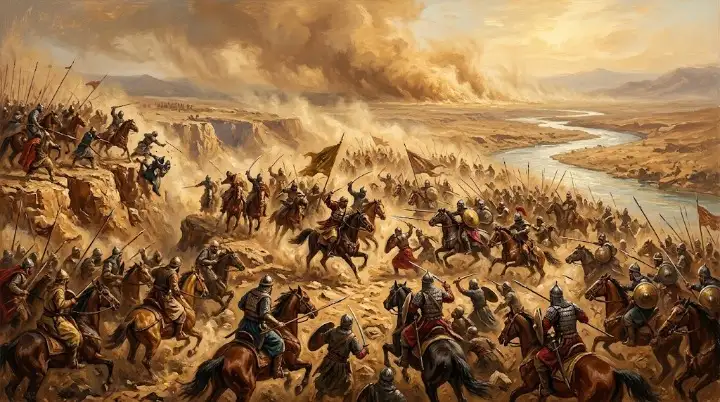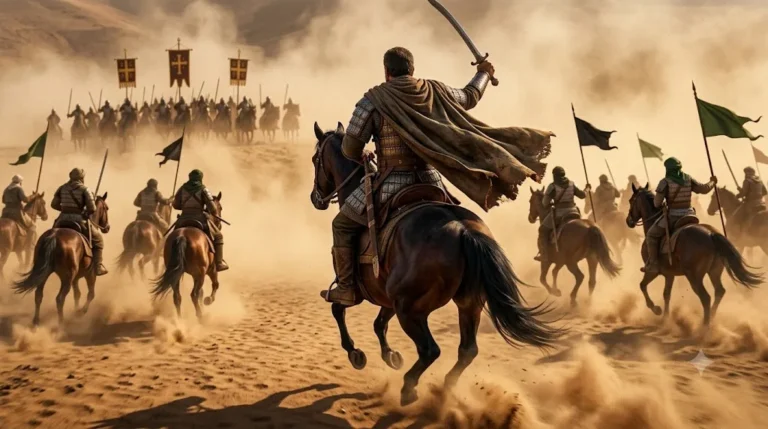
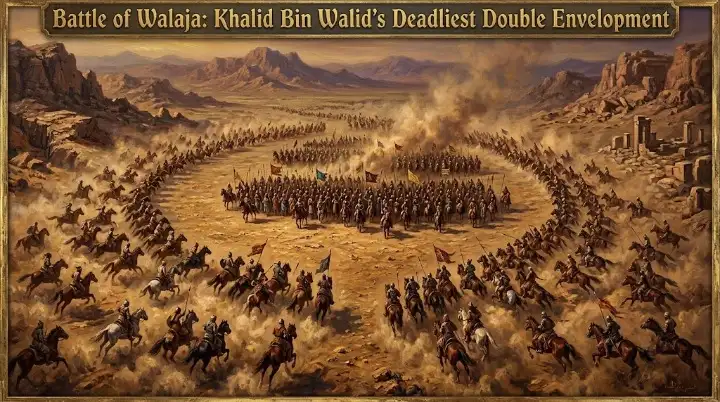
The Battle of Walaja was fought in 633 CE in southern Iraq between the forces of the Rashidun Caliphate, led by Khalid bin Walid, and a Sassanid Persian army reinforced by Arab Christian allies. Facing a larger enemy force on open ground, Khalid concealed two cavalry units behind terrain on his flanks, let his center fall back under pressure to draw the Persians forward, then sent the hidden cavalry sweeping around both flanks to close off their retreat. The result was a near-total encirclement that historians frequently compare to Hannibal’s tactics at the Battle of Cannae — one of the few times in history a commander pulled off a full double envelopment.
| Field | Detail |
|---|---|
| Date | 633 CE |
| Location | Near Walaja, southern Iraq |
| Combatants | Rashidun Caliphate vs. Sassanid Persian forces and Arab Christian allies |
| Muslim commander | Khalid bin Walid |
| Persian commanders | Andarzaghar and Bahman (accounts vary on exact leadership) |
| Tactic used |
Double envelopment
Hidden flanking cavalry combined with a feigned retreat at the center.
|
| Historical comparison | Often compared to Hannibal’s tactics at the Battle of Cannae (216 BCE) |
| Outcome | Decisive Muslim victory; much of the Persian force was encircled and destroyed |
Why This Battle Happened
By 633 CE, Khalid — who had already earned the title Sword of Allah years earlier at Mu’tah — was several months into his campaign in Iraq, part of the wider Muslim push against Sassanid Persian territory. The Persians, alarmed at the string of Muslim advances, assembled a fresh force to try to stop him — reinforced by local Arab Christian tribes allied with the Persian side, giving them a numerical edge over Khalid’s army.
Rather than avoid the fight or wait for reinforcements, Khalid chose the ground at Walaja and prepared something considerably more ambitious than a straightforward clash.
How the Double Envelopment Actually Worked
This is the part of the battle that gets the most attention from military historians, so it’s worth walking through step by step.
The setup. The night before the battle, Khalid quietly moved two cavalry units — some accounts put them at roughly 2,000 riders each — into concealed positions behind rising terrain on both flanks of the battlefield, well out of Persian sight.
The bait. The next day, Khalid’s infantry engaged the Persians head-on in the center. Rather than holding the line at full strength, he had his center gradually give ground under the Persian advance — not a real retreat, but a controlled one, designed to pull the Persian army further forward and stretch their formation out.
The trap. Once the Persians were fully committed and extended, Khalid gave the signal, and the two hidden cavalry units broke from cover and swept in from both flanks simultaneously, closing in behind the Persian line and cutting off any route of retreat.
The effect was to compress the Persian army into a shrinking pocket with no way out — which is exactly what a double envelopment is designed to do, and exactly what made it so devastating here. Once surrounded, a large portion of the Persian force was destroyed rather than able to withdraw and fight another day.
Why Historians Compare This to Hannibal
A double envelopment — encircling an enemy from both flanks at once rather than just pushing them back — is a difficult maneuver to execute in practice, because it requires exact timing, disciplined troops who won’t break formation early, and total surprise. Get any one of those wrong, and the flanking units either arrive too late, get spotted too early, or collapse the whole plan.
The most famous historical example is Hannibal’s crushing victory over Rome at the Battle of Cannae in 216 BCE, still studied in military academies today as close to a perfect execution of the tactic. What makes Walaja stand out in military history is that Khalid achieved a similar result nearly 850 years later, using a somewhat different method — where Hannibal’s plan relied on his center deliberately buckling backward to draw the Romans in, Khalid combined that same bait-and-fall-back principle with concealed terrain and hidden cavalry rather than a purely formation-based collapse.
| Element | Hannibal at Cannae (216 BCE) | Khalid at Walaja (633 CE) |
|---|---|---|
| Core tactic | Double envelopment | Double envelopment |
| Method of luring the enemy | Deliberately weaker, curved center formation | Controlled fighting withdrawal at the center |
| Flanking forces | Cavalry and infantry positioned in the line, then wheeling in | Cavalry hidden behind terrain, concealed until the signal |
| Enemy awareness | Not until fully engaged | Not until fully engaged |
| Outcome | One of history’s most devastating single-day defeats for Rome | Near-total destruction of the Persian force at Walaja |
What Happened Next
The victory at Walaja was one of several Muslim wins during the Iraq campaign that steadily pushed Sassanid influence out of the region, laying the groundwork for the wider conquest that followed. Historians frequently cite it alongside Khalid’s later achievements at Yarmouk as evidence of a consistent pattern across his wider military career — a willingness to use deception and misdirection rather than relying purely on numbers or brute force.
🛡️ Frequently Asked Questions — The Battle of Walaja
The Battle of Walaja was a 633 CE battle in southern Iraq in which Khalid bin Walid defeated a larger Sassanid Persian force using a double envelopment — concealed cavalry attacking from both flanks after luring the Persians into an exposed position.
Both battles feature a rare and difficult tactic called a double envelopment, where an army is surrounded from both flanks at once rather than simply pushed back. Hannibal executed it against Rome in 216 BCE, and Khalid achieved a similar result at Walaja using concealed cavalry and a controlled withdrawal at the center.
Yes. According to the traditional accounts of the battle, Khalid positioned two cavalry units behind terrain on both flanks the night before the battle, keeping them concealed from the Persians until he signaled them to attack.
Yes, it was a decisive victory for the forces of the Rashidun Caliphate, with much of the Persian army encircled and destroyed.
The battle took place in 633 CE, during the early phase of the Muslim conquest of Iraq.
Sources
- Baladhuri, Futuh al-Buldan (The Conquests of Lands)
- Akram, A.I., The Sword of Allah: Khalid bin al-Waleed, His Life and Campaigns
- Encyclopaedia Iranica, entries on the Sassanid military response to the early Muslim conquests