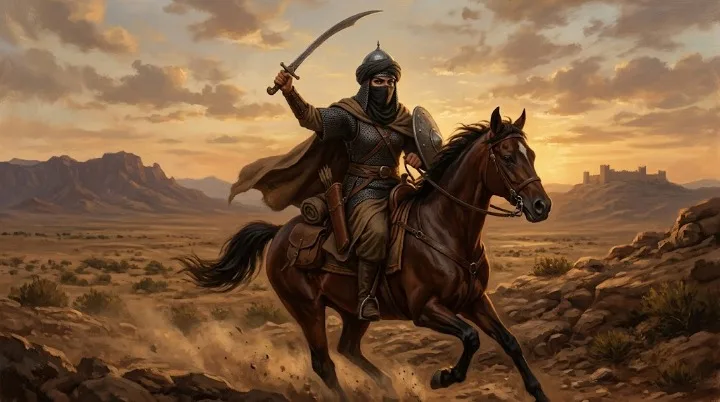
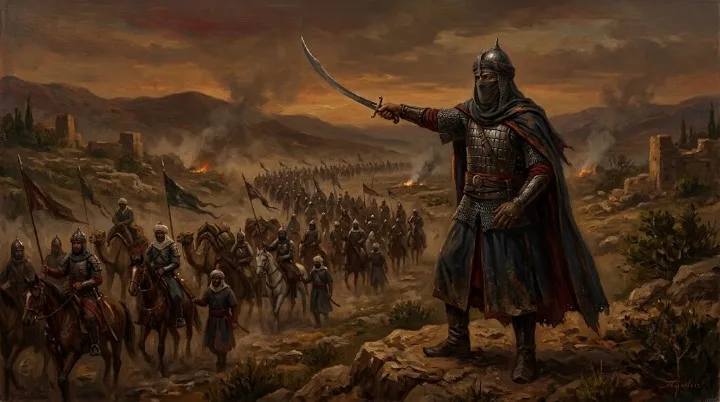
Khalid bin Walid was given the title “Sword of Allah” (Saifullah) by the Prophet Muhammad after the Battle of Mu’tah in 629 CE, when Khalid took command of a heavily outnumbered Muslim army following the deaths of its three appointed commanders, and managed to fight his way out without the force being destroyed. When news of the battle reached Medina, Muhammad is reported to have described Khalid as “a sword among the swords of Allah” — a phrase that stuck, and eventually shortened into the title he’s remembered by today.
| Field | Detail |
|---|---|
| Title in Arabic | Sayf Allah al-Maslul (سيف الله المسلول) |
| English translation | “The Drawn Sword of Allah” |
| Given by | The Prophet Muhammad |
| Occasion | The Battle of Mu’tah, 629 CE |
| Why it was given | Khalid took command mid-battle after three appointed commanders were killed, and led the army to safety despite being vastly outnumbered |
| Common shorter form | Saifullah |
The Battle of Mu’tah: How Khalid Earned the Name
To truly understand the weight of the title, you have to look closely at the tactical reality of the Battle of Mu’tah. It isn’t a straightforward story of absolute battlefield conquest—it is a masterclass in crisis management and avoiding a total catastrophe.
In 629 CE, an expeditionary Muslim force of roughly 3,000 soldiers marched north toward Byzantine territory. They unexpectedly collided with a massive, battle-hardened coalition army. Historical estimates from the period place the Byzantine and allied Arab Christian numbers deep into the tens of thousands.
The Muslim army had three commanders appointed in advance by Muhammad, with a strict line of succession:
- Zayd ibn Harithah
- Ja’far ibn Abi Talib
- Abdullah ibn Rawahah
Over the course of intense, brutal fighting, all three commanders fell as martyrs in quick succession.
⚔️ The Tactical Turning Point
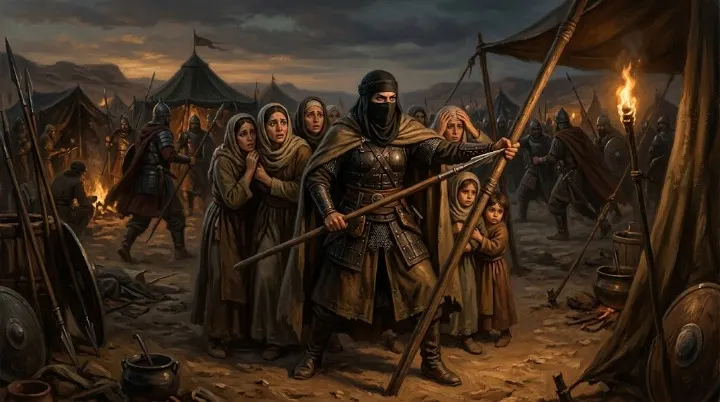
With the leadership decimated and the army on the brink of a routing disaster, the soldiers on the ground handed the battle banner to Khalid bin Walid. He was a recent convert to Islam, but possessed unmatched tactical instincts.
Instead of launching a reckless, suicidal charge, Khalid focused on preservation. On the fly, he restructured the army’s formations, rearranged his flanks, and used shifting cavalry positions to kick up dust clouds. This clever ruse made the Muslim force appear far larger and more heavily reinforced than it actually was. Under the cover of this psychological deception, he executed a disciplined fighting withdrawal, bringing the bulk of the army back to Medina intact.
That same instinct for improvisation under pressure would show up again years later at the Battle of Yarmouk, on a much larger scale.
“Sayf Allah”: What the Prophet Muhammad Actually Said
When the battered army returned to Medina, the community’s reaction was mixed; some viewed a retreat as a failure. However, accounts record Muhammad addressing the community from the pulpit to validate the survival of the men. He named the three fallen martyrs with grief, before announcing that the banner had ultimately been taken up by “a sword among the swords of Allah” (in Arabic: sayfun min suyufillah), and that God had granted them a way through.
This specific phrase is the direct origin of the title, which was later compressed into the honorific Sayf Allah or Saifullah.
The Nature of the Historical Evidence
It is worth noting for historical precision that this account comes down to us through secondary Islamic oral tradition—specifically hadith collections and early biographical literature (sira)—rather than a contemporaneous physical inscription or archaeological artifact. While standard for pre-modern history, this means historians treat the text as an invaluable cultural and religious record of how early Muslims viewed Khalid’s brilliant defensive maneuver.
The Historical Meaning of Saifullah
It is easy to read “Sword of Allah” today as a generic martial nickname, but in its 7th-century context, it carried immense political and military weight.
Interestingly, the title was tied directly to a battle that was technically a tactical setback. The fact that Khalid was rewarded for a fighting retreat tells us exactly what the early community valued: composed battlefield judgment. The title wasn’t celebrating a bloody conquest; it was recognizing that Khalid had possessed the cool-headed brilliance required to stop a disaster from becoming an absolute slaughter.
How the Title Followed Him Afterward
Once given, the name stuck for the rest of his career, and it gets applied retroactively in most later writing to everything he did afterward — including his campaigns years later at Yarmouk and in Iraq, even though the title itself dates specifically to Mu’tah. One of the clearest examples is the Battle of Walaja (633 CE), where Khalid encircled and destroyed a numerically superior Sassanid Persian army using hidden cavalry and a feigned retreat — a maneuver historians often compare to Hannibal’s tactics at Cannae. It’s a common pattern with historical epithets: the name gets attached to a person’s whole legacy, even though it originally referred to one specific moment.
| Claim | Historical Accuracy |
|---|---|
| “Sword of Allah” was given after the Battle of Yarmouk. |
Inaccurate
The title dates strictly to the Battle of Mu’tah in 629 CE, years before Yarmouk took place.
|
| The title means he never lost a single battle. |
Contextual
While Khalid is widely regarded as undefeated, the title itself commemorates a highly costly, defensive engagement, not an aggressive conquest.
|
| The phrase “Sword of Allah” appears in the Quran. |
Inaccurate
The phrase originates from hadith and biographical sira literature, not the text of the Quran.
|
| “Saifullah” is an exclusive title used only for Khalid. |
Inaccurate
While famously tied to Khalid, Saifullah has been used as a standard given name and honorific for various historical figures over the centuries.
|
🗡️ Frequently Asked Questions — The Sword of Allah
He was given the title after the Battle of Mu’tah in 629 CE, when he took command of a badly outnumbered Muslim army following the deaths of its three commanders and led it to safety. The Prophet Muhammad reportedly described him as “a sword among the swords of Allah” when news of the battle reached Medina.
Saifullah (سيف الله) is Arabic for “sword of Allah” or “sword of God.” It’s a title, and also used independently as a given name.
No. The title dates to the earlier Battle of Mu’tah in 629 CE. Yarmouk, fought in 636 CE, came years after Khalid had already been given the name.
Not in a straightforward sense. Mu’tah is generally described as an inconclusive or costly engagement in which the Muslim army was outnumbered and lost its three appointed commanders. Khalid’s contribution was managing a fighting withdrawal that brought the army home rather than seeing it destroyed.
No. It doesn’t appear in the Quran. The phrase comes from hadith and early Islamic biographical literature describing what the Prophet Muhammad reportedly said after the Battle of Mu’tah.
Sources
- Ibn Ishaq / Ibn Hisham,
- Akram, A.I., The Sword of Allah: Khalid bin al-Waleed, His Life and Campaigns
- Sahih al-Bukhari: Hadith literature referencing the casualties and aftermath of the Battle of Mu’tah.