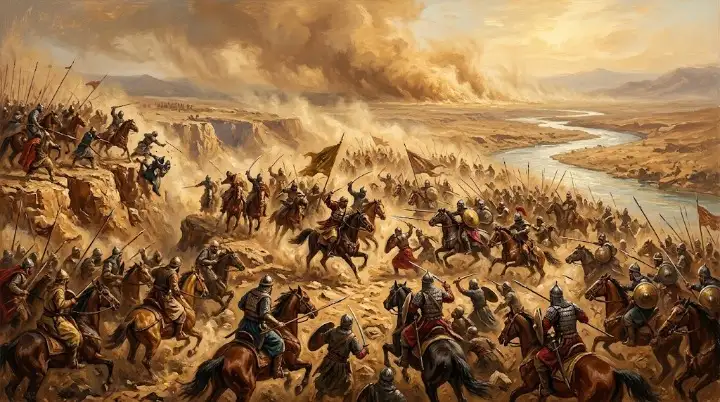
The Battle of Yarmouk was fought over six days in August 636 CE near the Yarmouk River, on the border between modern-day Syria and Jordan, between the forces of the Rashidun Caliphate and the Byzantine Empire. Muslim forces, with Khalid bin Walid directing the overall battle strategy, defeated a much larger Byzantine army sent by Emperor Heraclius to reclaim the Levant. The victory permanently ended Byzantine control over Syria and opened the way for the wider Muslim conquest of the region.
| Field | Detail |
|---|---|
| Date | August 15–20, 636 CE (six days of fighting) |
| Location | Near the Yarmouk River, on the modern Syria–Jordan border |
| Combatants | Rashidun Caliphate vs. Byzantine Empire |
| Muslim commander | Khalid bin Walid (directing overall strategy); Abu Ubaydah ibn al-Jarrah (senior commander) |
| Byzantine commander | Vahan (an Armenian general), under the authority of Emperor Heraclius |
| Muslim troop estimates | Roughly 25,000–40,000 |
| Byzantine troop estimates | Disputed — medieval Muslim sources claim 100,000+; modern historians generally estimate closer to 15,000–50,000 actually engaged |
| Outcome | Decisive Muslim victory |
| Historical significance | Ended Byzantine rule over Syria; opened the path for the wider Muslim conquest of the Levant |
What Caused the Battle of Yarmouk
By the mid-630s, Muslim forces had already taken Damascus and a string of other cities across Syria, and Byzantine control over the region was slipping fast. Emperor Heraclius, ruling from Constantinople, wasn’t willing to let that happen without a fight. He assembled one of the largest armies the Byzantines had fielded in years — drawing troops from across the empire, along with allied Arab Christian tribes like the Ghassanids — and sent them south to push the Muslim forces out of Syria and take back what had been lost.
On the other side, the Muslim commanders in Syria saw the Byzantine buildup coming and made a decision that, in hindsight, shaped the entire battle: instead of trying to hold multiple cities against a much larger force, they pulled their armies back and consolidated near the Yarmouk River, choosing ground that played to their strengths rather than spreading themselves thin.
(Read also about “Khawla bint al-Azwar,” who traditional accounts place among the Muslim forces at this battle)
Who Led Each Side
On the Muslim side, command was genuinely a bit unusual. Abu Ubaydah ibn al-Jarrah held the official senior position, but by general agreement among the commanders present, Khalid bin Walid was given operational control of the battle itself — a practical decision based on his track record rather than a change in formal rank. It’s part of why Khalid’s name is so tightly tied to this battle specifically, even though he wasn’t technically the top-ranking officer.
The Byzantine army was led by a general named Vahan, an ethnic Armenian commanding on behalf of Heraclius, who stayed behind in Antioch rather than leading the campaign in person. That’s worth noting, because the Byzantine force wasn’t a single unified army in the way that might suggest — it was a coalition of Byzantine regulars, Armenian troops, Arab Christian allies, and other contingents, and that internal diversity ended up mattering a lot once the fighting got difficult.
How Many Soldiers Fought at Yarmouk
This is one of the most argued-over details of the whole battle, and it’s worth being upfront about why. Medieval Muslim chronicles, writing generations after the battle, gave Byzantine troop numbers as high as 100,000 to 200,000 — figures modern historians generally treat as exaggerated, since armies of that size would have been logistically almost impossible to supply and move in that terrain and era.
More conservative modern estimates put the Byzantine force actually engaged somewhere between 15,000 and 50,000, still likely larger than the Muslim army, which is generally estimated at 25,000 to 40,000. The exact numbers on both sides will probably never be pinned down precisely — but the consistent thread across every version is that the Muslims were outnumbered, which is part of what makes the outcome notable in military history regardless of the exact ratio.
How the Battle Was Fought
Yarmouk wasn’t a single clash — it stretched across roughly six days of engagement, with periods of fighting, standoffs, and repositioning rather than one continuous battle.
The terrain played a major role from the start. The Muslim forces positioned themselves with their backs to open ground while the Byzantine army was hemmed in by ravines and steep terrain on several sides — a setup that, if the battle turned against the Byzantines, would make an organized retreat extremely difficult.
Through the early days of fighting, both sides probed each other with cavalry skirmishes and limited engagements rather than committing to a full assault. Khalid is credited with reorganizing the Muslim army’s cavalry into more flexible, mobile units, letting them respond quickly wherever the Byzantine line pushed hardest — a tactical adjustment that became decisive as the battle wore on.
The turning point came on the final day, when the combination of a sandstorm blowing directly into Byzantine faces and the internal fractures within their coalition army — disagreements and, in some accounts, defections among the various ethnic and religious contingents — broke the Byzantine formation. Once the line gave way, the terrain that had been chosen specifically to trap a retreating army did exactly that: large numbers of Byzantine soldiers were pushed back into ravines and steep drops with nowhere to go.
Why the Muslims Won Despite Being Outnumbered
A few factors come up consistently in military-historical analysis of this battle:
- Ground chosen deliberately. The Muslim commanders picked terrain that limited the Byzantines’ ability to retreat if things went badly for them — a decision made before the fighting even started.
- A fractured opposing army. The Byzantine force was a coalition of different ethnic and religious groups with varying loyalties, and that lack of cohesion showed under pressure.
- Tactical flexibility. Khalid’s reorganization of the cavalry into more mobile units let the Muslim side react and adapt faster than a more rigid Byzantine formation could.
- A battle stretched over days, not hours. The extended nature of the fighting gave the Muslim side room to probe for weaknesses rather than committing everything to one decisive clash early on.
What Happened After
The defeat at Yarmouk effectively ended Byzantine rule over Syria. Heraclius, on receiving news of the loss, is reported to have said his farewell to the province, recognizing that the empire wouldn’t be able to hold the region any longer. Byzantine forces withdrew north, and within a short time, the Muslim conquest extended across the rest of Syria and into the wider Levant, with Yarmouk generally regarded as the single most decisive battle in that process.
Yarmouk at a Glance
| Category | Detail |
|---|---|
| Duration | 6 days |
| Decisive factor | Terrain choice, cavalry mobility, Byzantine coalition fractures, and a sandstorm on the final day |
| Byzantine retreat route | Cut off by ravines and steep terrain |
| Immediate result | Byzantine withdrawal from Syria |
| Long-term result | Permanent end of Byzantine rule over the Levant |
| Commander most associated with the victory |
🌾 Frequently Asked Questions — The Battle of Yarmouk
The Battle of Yarmouk was fought over six days in August 636 CE, near the Yarmouk River on what is now the Syria–Jordan border.
Abu Ubaydah ibn al-Jarrah held the senior official command, but by agreement among the Muslim commanders, Khalid bin Walid directed the overall battle strategy.
The Byzantine forces were led by a general named Vahan, an ethnic Armenian commanding on behalf of Emperor Heraclius, who remained in Antioch during the campaign.
Estimates vary widely. The Muslim army is generally estimated at 25,000–40,000 soldiers. Byzantine troop numbers are disputed — medieval sources claim well over 100,000, while modern historians generally estimate a smaller figure, still likely larger than the Muslim force.
Emperor Heraclius assembled a large Byzantine army to retake Syria after Muslim forces had already captured Damascus and other cities in the region. The Muslim commanders consolidated their forces near the Yarmouk River to meet that counteroffensive rather than defend multiple cities separately.
A combination of factors: terrain that limited their retreat options, internal divisions within their coalition army, more flexible Muslim cavalry tactics, and a sandstorm on the final day that worked against the Byzantine line.
Sources
- Baladhuri, Futuh al-Buldan (The Conquests of Lands)
- Walter Kaegi, Byzantium and the Early Islamic Conquests (Cambridge University Press)
- Fred Donner, The Early Islamic Conquests (Princeton University Press)