Khalid bin Walid was a 7th-century Arab military commander with an undefeated record across more than 100 battles, which earned him the title “Sword of Allah” (Sayf Allah). He actually started out on the other side — commanding Meccan cavalry against the Muslims at the Battle of Uhud in 625 CE — before converting to Islam in 629 CE and going on to lead some of the most important campaigns in early Islamic history, including the Ridda wars, the conquest of Iraq, and the Battle of Yarmouk against the Byzantines. Military historians still study how he did it: constant movement, tactical improvisation, and a willingness to take risks that more cautious commanders wouldn’t.
| Field | Detail |
|---|---|
| Full name | Khalid bin Walid ibn al-Mughira al-Makhzumi |
| Era | Late 6th century – 642 CE |
| Tribe | Banu Makhzum (Quraysh) |
| Known for | Never lost a battle, across 100+ engagements |
| Epithet | Sayf Allah al-Maslul (“The Drawn Sword of Allah”) |
| Before Islam | Commanded Meccan cavalry at the Battle of Uhud (625 CE) |
| Converted to Islam | 629 CE |
| Major campaigns | Ridda wars, conquest of Iraq, conquest of Syria |
| Defining victory | Battle of Yarmouk (636 CE) |
| Died | 642 CE, in Homs, Syria |
He Was Beating the Muslims Before He Joined Them
Here’s the part of Khalid’s story people tend to skip: before he became Islam’s most famous general, he was the guy who beat them. At the Battle of Uhud in 625 CE, Khalid was commanding Meccan cavalry, and he spotted a gap in the Muslim lines that the rest of the battle had opened up. He took it. That single move flipped what looked like a Muslim victory into a serious setback, and it’s the reason historians don’t treat his later career as beginner’s luck — the guy already knew what he was doing.
He didn’t convert until 629 CE, a few years after Uhud, following the Treaty of Hudaybiyyah. And once he did, his record basically became one long win streak. It’s a strange thing to sit with — a commander who was elite on both sides of the same war.
The Ridda Wars: Holding the New State Together
When the Prophet Muhammad died in 632 CE, several Arab tribes decided the deal was off and pulled their allegiance from the new Muslim state. That triggered the Ridda wars — essentially a fight to keep the whole thing from falling apart before it had really started. Caliph Abu Bakr put Khalid in charge of the toughest part of it: the campaign against Musaylimah, a rival who’d declared himself a prophet.
The showdown, the Battle of Yamama in 632 CE, was brutal — arguably the bloodiest fight of Khalid’s career, win or lose. But it held Arabia together, and without that, the later conquests of Iraq and Syria simply don’t happen. There’s no invading Syria if your home base is still in pieces.
Iraq: Where Speed Became the Whole Strategy
In 633 CE, Khalid was sent to campaign against Sasanian territory in Iraq. What actually stands out here isn’t one dramatic battle — it’s how he moved. At one point he pushed his army across a stretch of desert that most commanders would’ve considered impassable, just to reach Syria by a route nobody was expecting.
That’s basically Khalid’s whole playbook in one move: go where the enemy assumes you can’t, and get there before they’ve adjusted. It’s part of why modern military historians still put him in the same conversation as generals like Belisarius — not because of the religious context of his wars, but because the tactics hold up on their own.
Yarmouk: The Battle That Made His Name
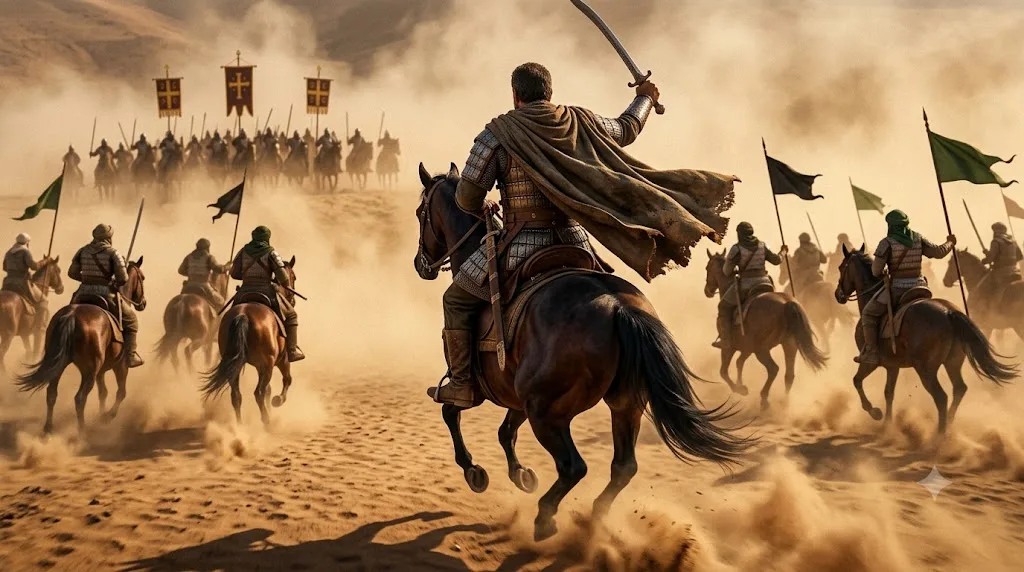
If there’s one battle that defines Khalid’s legacy, it’s Yarmouk, fought in 636 CE. He was leading a Muslim force that was outnumbered against a much larger Byzantine army, and he still found a way to win — using the terrain, his cavalry’s mobility, and a battle plan stretched across several days to grind down the Byzantine lines until they broke. That victory effectively ended Byzantine control of Syria.
Why He Got Demoted (It Wasn’t a Defeat)
Here’s the twist people don’t expect: in 638 CE, Caliph Umar removed Khalid from overall command — and it had nothing to do with losing. The reasons given were concerns about how freely Khalid was spending war spoils, and a broader push by Umar to make sure victories were credited to the Muslim cause as a whole, not to one famous general.
What’s genuinely notable is how Khalid handled it. He didn’t fight the decision or walk away. He kept serving as a field commander under new leadership. Historians tend to read that as a sign of real discipline — a man who cared more about the mission than his own name on it.
Years after his greatest victories, and long after Caliph Umar had removed him from supreme command, he fell ill in his own bed in Homs, passing away there in 642 CE.
| Category | Detail |
|---|---|
| Battles commanded (approximate) | 100+ |
| Recorded defeats | 0 |
| Best defensive move | Rotating units at Yarmouk to keep a smaller force fighting fresh |
| Best offensive move | The desert forced-march from Iraq into Syria |
| Style of command | Aggressive, mobile, quick to exploit any gap the enemy left open |
| Generals he’s often compared to | Belisarius, Hannibal (for tactical flexibility, not overall doctrine) |
⚔️ Frequently Asked Questions — Khalid ibn al-Walid
No — there’s no historical record of Khalid bin Walid losing a battle, across more than 100 engagements on both sides of the early Islamic conquests.
He earned the title Sayf Allah (“Sword of Allah”) for his role in the decisive victories of the Ridda wars and the conquests of Iraq and Syria, after his conversion to Islam.
Yes. He commanded Meccan cavalry against Muslim forces at the Battle of Uhud in 625 CE, several years before converting to Islam in 629 CE.
Umar removed him from overall command in 638 CE over concerns about his spending of war spoils, and a wish to credit military success to the Muslim cause rather than one commander. It wasn’t the result of a defeat.
The Battle of Yarmouk in 636 CE, where he defeated a larger Byzantine army and ended Byzantine control over Syria, is generally considered his defining victory.
He’s famous for never losing a battle across his entire military career, and for leading the decisive campaigns — the Ridda wars, the conquest of Iraq, and the Battle of Yarmouk — that secured and expanded the early Islamic state.
This is a popular claim about Khalid bin Walid, though the “200” figure is an exaggeration that’s spread through popular retellings. More careful historical estimates put the real number closer to 100 battles and skirmishes across his career, still an extraordinary record either way.
Yes. No historical source records a battlefield defeat for Khalid, whether he was fighting for the Meccans before his conversion or for the Muslims afterward.
Tradition holds that Khalid, dying of illness in his bed rather than in combat, expressed regret that after surviving countless battles and wounds, he wasn’t granted the death in battle he’d hoped for — a moment often cited as reflecting how much his identity was tied to the battlefield.
Historical sources mention that Khalid married more than once over his lifetime, which was common for Arab nobility of his era, but they don’t agree on a precise, consistent number — so any specific figure you see cited should be treated as uncertain rather than settled fact.
Khalid bin Walid was sent by the Prophet Muhammad to destroy Al-Uzza, one of the most important idols of pre-Islamic Arabia, shortly after the conquest of Mecca in 630 CE.
No. Khalid wasn’t present at the Battle of Badr in 624 CE. His first major engagement against the Muslims on record came a year later, at the Battle of Uhud.
No — across every campaign he led or fought in, on either side of the early Islamic wars, there’s no recorded defeat attributed to him.
Yes. The shrine and tomb, housed inside the Khalid ibn al-Walid Mosque in Homs, Syria, suffered severe damage — including the collapse of the minaret and parts of the dome — from shelling during the Syrian civil war around 2012–2013. Restoration efforts have taken place since.
Classical Arabic biographical sources describe him as tall and physically imposing, with some accounts noting he was balding later in life. No contemporary portraits of him exist — depicting the Prophet’s companions visually isn’t part of traditional Islamic art, so any images you see online are modern artistic reconstructions, not historical likenesses.
Sayf Allah, meaning “Sword of Allah” — a title he was reportedly given in recognition of his role in the decisive early Islamic victories.
Caliph Umar removed Khalid bin Walid in 638 CE for two main reasons:
Theological Concern: He wanted to prevent a cult of personality, ensuring people realized that military victory came from God rather than Khalid’s personal genius.
Financial Differences: Khalid was highly independent and distributed war spoils very freely to his soldiers and poets, which clashed with Umar’s strict financial accountability and centralized rule.
It was a strategic move to credit successes to the collective Muslim cause rather than one undefeated general. Khalid accepted the decision gracefully and kept fighting as a regular soldier.