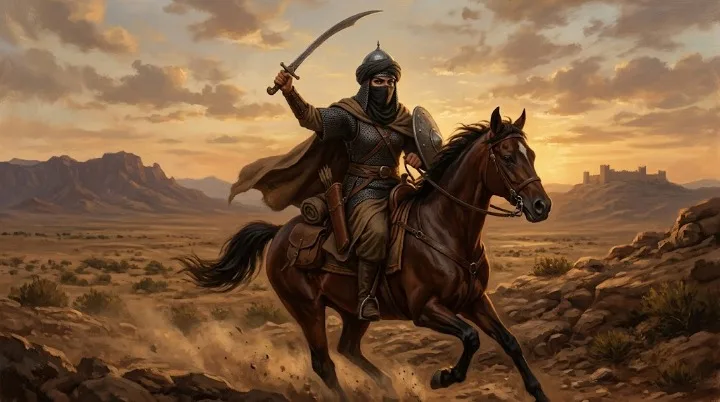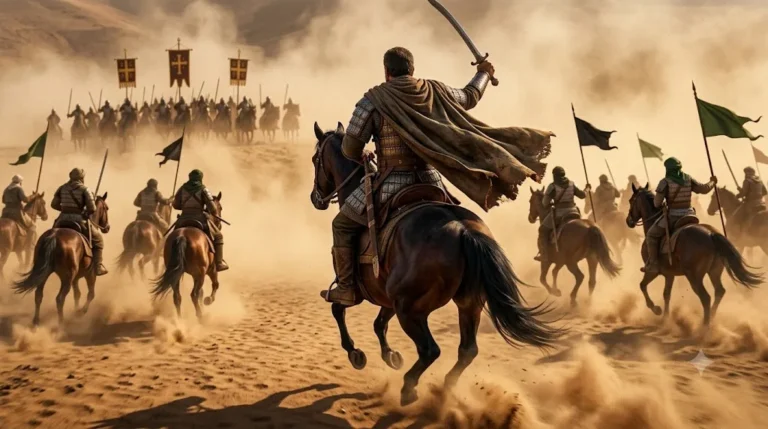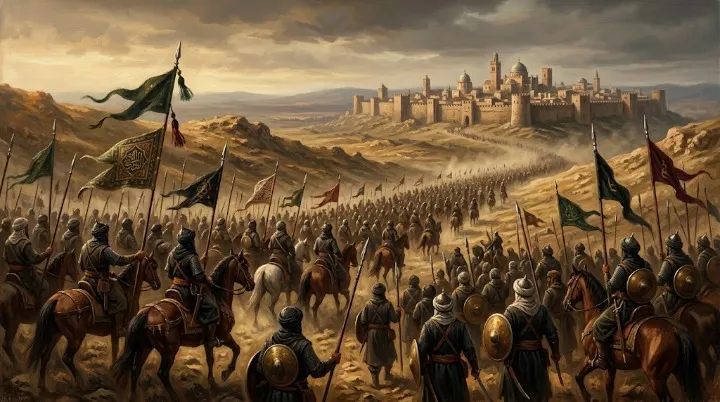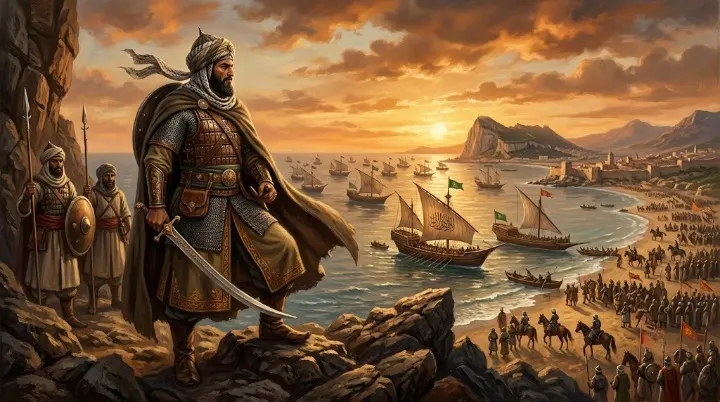
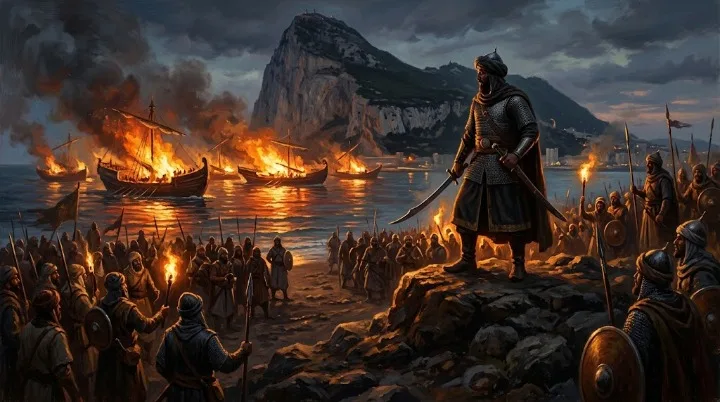
According to legend, Tariq ibn Ziyad burned his own ships after landing in Spain in 711 CE, cutting off any possibility of retreat and forcing his troops to fight with everything on the line. It’s one of the most repeated stories about him — but the earliest surviving accounts of the conquest don’t mention it at all, which means most historians treat it as a legend rather than a documented event. Tariq ibn Ziyad was the Berber general behind the 711 conquest of Spain — you can read his full biography and military career here — but no part of his story gets repeated more often than the legend of the burning ships.
What the Story Actually Says
As the story is usually told, after Tariq’s army crossed the Strait of Gibraltar, he ordered the ships that carried them destroyed. With their escape route gone, his troops had only one option — advance into Visigothic Spain and win, or die trying. Tariq is said to have delivered a rousing speech to his men afterward, telling them the sea was behind them and the enemy in front, leaving no path but forward.
It’s a powerful image: a general so confident, or so committed, that he removes his own army’s ability to retreat. That’s exactly why the story has stuck around for over a thousand years — it’s simple, dramatic, and memorable in a way that ordinary military history rarely is.
Why Historians Doubt It Happened
The problem is timing. The earliest Arabic chronicles covering the conquest of Spain don’t include this episode at all. The version of the story most people know today — including Tariq’s famous speech — traces back to a much later source: the 17th-century historian al-Maqqari, writing roughly 900 years after the actual events. That’s an enormous gap between the conquest itself and the first known written account of the ships being burned.
When a dramatic detail like this only shows up centuries after the fact, historians generally treat it with real skepticism. It doesn’t mean it’s impossible — but it means there’s no contemporary evidence tying it to Tariq specifically, and it likely reflects a story that grew in the retelling rather than something recorded by people who were there or close to it.
A Story Told About Other Conquerors Too
Tariq isn’t the only military leader credited with burning his own ships — and looking at the others makes the pattern even clearer.
The oldest well-documented case is Agathocles of Syracuse, a Greek tyrant who invaded Carthaginian territory in North Africa in 310 BC. After landing his roughly 14,000 troops, he reportedly burned his fleet in full view of his men, then won a surprising victory against a much larger force. Of the examples here, his is the one historians treat as most likely genuine, since it’s recorded relatively close to the actual event.
Nearly a century earlier, in China, the general Xiang Yu ordered his troops to sink their boats and smash their cooking pots before the Battle of Julu in 207 BC — a story so well known in Chinese history that it produced its own idiom, po fu chen zhou (“break the cauldrons and sink the boats”). Like Tariq’s story, it’s meant to illustrate total commitment with no path to retreat.
The most famous modern version belongs to Hernán Cortés, who is popularly said to have burned his ships after landing in Mexico in 1519 to conquer the Aztec Empire. But here’s the twist: most historians now believe Cortés didn’t burn his ships at all — he had them run aground and stripped for parts, then scuttled. The “burning” version of his story appears to have been embellished later, borrowing from older legends like Tariq’s and Agathocles’s rather than reflecting what Cortés actually did.
That last detail matters: even one of history’s most famous “burned the ships” stories turns out to be exaggerated. It’s a strong hint that the same thing likely happened to Tariq’s story too — a real, difficult campaign that got a more dramatic ending added onto it over time.
Why This Kind of Legend Attaches Itself to Real Conquerors
There’s a pattern worth naming here. Every leader in this list — Agathocles, Xiang Yu, Cortés, and Tariq — really did lead a small, outnumbered force into hostile territory and win against serious odds. The “burned the ships” detail isn’t randomly attached to obscure or forgettable figures; it clings to the genuinely remarkable victories, the ones people already want to tell a bigger story about.
That’s likely the real explanation for why Tariq’s story includes this detail at all. His actual, verified achievement — landing with roughly 7,000 men and toppling a Visigothic kingdom — was already dramatic enough to invite embellishment. Later storytellers didn’t need to invent an impressive campaign; they just added a vivid, symbolic detail to an already-true story to make the resolve behind it feel even more absolute.
Why the Legend Persists Anyway
Even without solid documentation, the story endures because it captures something true about how the conquest is remembered: Tariq led a small, outnumbered force into hostile, unfamiliar territory and won anyway. Whether or not any ships were literally burned, the underlying idea — total commitment, no fallback plan, and an against-the-odds victory — matches the way people already understood Tariq’s campaign. The legend didn’t have to be accurate to feel true, and that’s often enough for a story to survive for over a millennium.
What This Means for Understanding Tariq’s Legacy
Separating legend from documented fact doesn’t make Tariq’s story any less remarkable. He still crossed into a foreign kingdom with a modest force, won a decisive victory at the Battle of Guadalete, and triggered a conquest that reshaped the Iberian Peninsula for roughly 700 years. The burning-ships story is a later embellishment on an already extraordinary real story — not a substitute for it.
🔥 Frequently Asked Questions — The Burning Ships Legend
There’s no evidence for this in the earliest surviving accounts of the conquest. The story first appears in written form roughly 900 years later, in a 17th-century account, so most historians treat it as legend rather than documented fact.
As the story goes, he wanted to remove any possibility of retreat, forcing his troops to commit fully to the invasion rather than fall back to North Africa.
No — similar stories are told about Agathocles of Syracuse (310 BC), the Chinese general Xiang Yu (207 BC), and Hernán Cortés (1519 AD), which is one reason historians suspect this is a recurring legend rather than a one-time documented event.
Most historians now believe he didn’t — he had his ships run aground and scuttled, not burned. The “burning” version of his story appears to be a later embellishment, similar to what likely happened with Tariq’s account.
A speech telling his troops the sea was behind them and the enemy ahead, leaving them no option but to advance. It’s best known from a 17th-century account by al-Maqqari, centuries after the actual conquest.
Sources & Further Reading
- Encyclopaedia Britannica, “Ṭāriq ibn Ziyād”
- Wikipedia, “Tariq ibn Ziyad”
- Kennedy, Hugh. The Great Arab Conquests: How the Spread of Islam Changed the World We Live In. Da Capo Press, 2007.