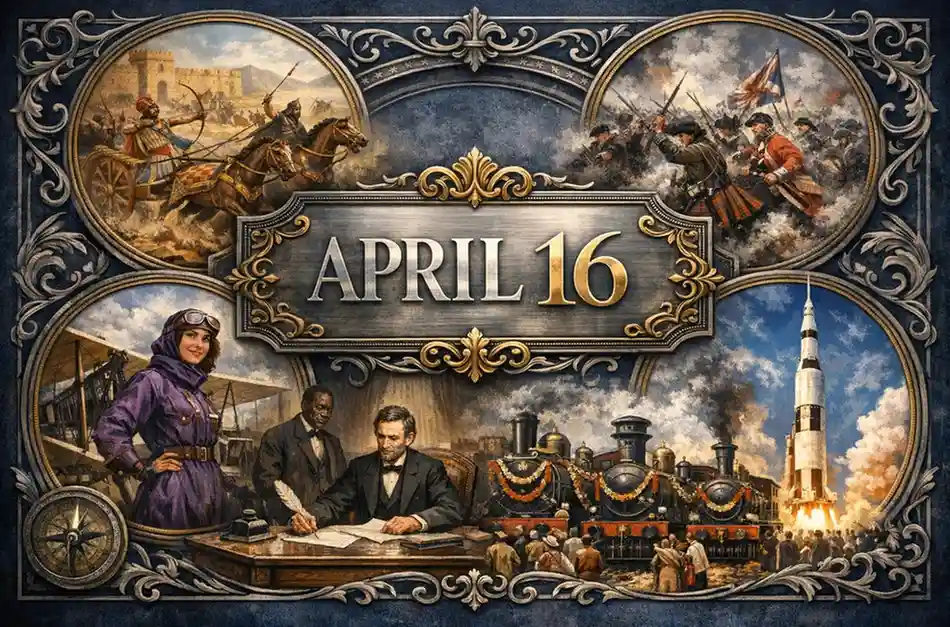
The landscape of global heritage is often redefined by specific moments, and revisiting this day in history April 16 allows us to trace the connection between early imperial expansions and the complexities of the modern era. Whether through revolutionary social advancements or significant technological milestones, these occurrences highlight the pivotal instances where the direction of humanity was irrevocably changed, providing essential context for our world today.
Important Events That Happened On April 16 In History
1457 BC – Battle of Megiddo
The Battle of Megiddo took place between Egyptian forces under Pharaoh Thutmose III and a large Canaanite coalition. This conflict is recognized as the first battle in human history to be recorded in relatively reliable and specific detail. The Egyptian victory allowed Thutmose III to expand his empire’s influence and secure vital trade routes throughout the Levant. It established a military legacy for the Pharaoh, who utilized tactical movements that were meticulously documented by his royal scribes.
69 – Suicide of Emperor Otho
Roman Emperor Otho took his own life after his troops suffered a devastating defeat at the hands of Vitellius during the Battle of Bedriacum. His death occurred during the chaotic “Year of the Four Emperors,” a period of intense civil war within the Roman Empire. Otho chose to end his life to prevent further bloodshed among Roman citizens and to stabilize the political situation. His passing cleared the way for Vitellius to briefly hold the imperial throne before the eventual rise of the Flavian dynasty.
73 – Fall of Masada
The Jewish fortress of Masada fell to the Roman military after a siege that lasted for several months during the first century. According to historical accounts, the Jewish defenders inside chose a path of collective death over surrender and enslavement by the Roman Tenth Legion. This event marked the final conclusion of the First Jewish–Roman War and the total suppression of the Jewish revolt. Today, the site remains a powerful symbol of national resolve and the struggle for autonomy against an overwhelming imperial force.
556 – Consecration of Pope Pelagius I
Pope Pelagius I was officially consecrated as the head of the Catholic Church following the formal approval of the Byzantine Emperor Justinian I. His rise to the papacy occurred during a time of intense theological debate and political maneuvering between Rome and Constantinople. He worked to rebuild the city of Rome following the Gothic Wars and sought to reconcile various factions within the Christian world. His tenure reflected the complex relationship between religious leadership and the secular power of the Eastern Roman Empire.
682 – Election of Pope Leo II
Pope Leo II was elected as the leader of the Catholic Church, though his formal consecration did not take place until August of that same year. During his brief papacy, he was responsible for confirming the acts of the Sixth Ecumenical Council, which addressed significant theological disputes. He was known for his eloquence and his efforts to maintain the dignity of church music and liturgical practices. His election represented a continuation of the administrative and spiritual work required to manage the growing influence of the papacy.
1346 – Coronation of Stefan Dušan
Stefan Dušan, often referred to as “the Mighty,” was crowned Emperor of the Serbs at Skopje, leading an empire that occupied much of the Balkans. His reign marked the peak of Serbian power, as he implemented a comprehensive legal code known as Dušan’s Code to govern his vast territories. He transformed the Serbian Archbishopric into a Patriarchate and expanded his borders at the expense of the weakening Byzantine Empire. His coronation established him as a dominant figure in medieval European history and a champion of Serbian cultural identity.
1520 – Revolt of the Comuneros
The Revolt of the Comuneros began in Spain as an uprising by the citizens of Castile against the rule of the Holy Roman Emperor Charles V. The rebels were motivated by concerns over foreign influence in the Spanish government and the imposition of heavy taxes to fund imperial ambitions. This conflict represented a struggle for traditional local rights and constitutional limits on the power of the monarchy. Although the revolt was eventually suppressed, it remains a significant event in the history of Spanish political development and civil resistance.
1582 – Founding of Salta
Spanish conquistador Hernando de Lerma officially founded the settlement of Salta in what is now modern-day Argentina. The location was chosen for its strategic importance in securing trade routes between the silver mines of Potosí and the southern territories. The early years of the settlement were marked by conflict with local indigenous groups and internal disputes among the Spanish colonizers. Over time, Salta grew into a major commercial and cultural center, retaining much of its colonial architecture and heritage.
1746 – Battle of Culloden
The Battle of Culloden was fought in Scotland, marking the final pitched battle to take place on the island of Great Britain. Government forces led by the Duke of Cumberland decisively defeated the Jacobite army under Charles Edward Stuart, ending the Stuart claim to the throne. The aftermath was characterized by a brutal crackdown on the Highland clans and the suppression of traditional Gaelic social structures. This victory ensured the stability of the Hanoverian monarchy and fundamentally changed the cultural landscape of the Scottish Highlands.
1780 – University of Münster Founded
Franz Friedrich Wilhelm von Fürstenberg founded the University of Münster in Germany to provide higher education and professional training. The institution began with faculties of theology, law, medicine, and philosophy, reflecting the educational ideals of the Enlightenment. Throughout its history, the university has survived various political upheavals and remains one of the largest and most prestigious research centers in Germany. Its founding was a key part of a broader movement to modernize the intellectual life of the Westphalia region.
1797 – Spithead Mutiny
The Spithead mutiny began when sailors of the British Channel Fleet refused to put to sea, immobilizing a critical component of the Royal Navy. The men were protesting poor pay, brutal discipline, and substandard living conditions on board the ships during the French Revolutionary Wars. Unlike many naval uprisings, this was a well-organized and largely peaceful demonstration aimed at securing specific reforms from the Admiralty. The government eventually granted many of the sailors’ demands, leading to improved conditions and the end of the standoff.
1799 – Battle of Mount Tabor
During the French Revolutionary Wars, Napoleon Bonaparte led his forces to victory over the Ottoman Turks at the Battle of Mount Tabor. The French military successfully drove the Ottoman reinforcements across the River Jordan, preventing them from relieving the ongoing siege of Acre. This tactical success demonstrated Napoleon’s ability to manage complex engagements against superior numbers in the Middle Eastern theater. The victory allowed the French to maintain their position in the region, even as their broader campaign faced significant challenges.
1818 – Rush–Bagot Treaty Ratified
The United States Senate ratified the Rush–Bagot Treaty, a landmark agreement that limited naval armaments on the Great Lakes and Lake Champlain. This treaty followed the War of 1812 and sought to reduce tensions and the risk of conflict between the United States and British North America. By restricting the number and size of armed vessels on these vital waterways, the two nations established a foundation for a demilitarized border. It remains one of the oldest and most successful arms control agreements in the history of international diplomacy.
1838 – Capture of Veracruz
The French Army captured the Mexican city of Veracruz during a conflict known as the Pastry War. The war was triggered by the Mexican government’s refusal to compensate French citizens for property damage caused by civil unrest, including a claim from a French pastry chef. The naval blockade and subsequent occupation of the port city forced Mexico to enter into negotiations regarding the outstanding debts. This intervention highlighted the growing willingness of European powers to use military force to protect their commercial interests in the Americas.
1847 – Opening of Wanganui Campaign
The shooting of a Māori individual by an English sailor resulted in the start of the Wanganui Campaign during the New Zealand Wars. This event escalated existing tensions between the British colonial government and local Māori tribes regarding land ownership and sovereignty. The campaign involved several skirmishes and the fortification of the Wanganui settlement as both sides sought to assert their authority. It was a significant chapter in the long and complex history of conflict and negotiation between the Crown and the indigenous people of New Zealand.
1853 – First Passenger Rail in India
The Great Indian Peninsula Railway officially opened the first passenger rail service in India, running from Bori Bunder in Bombay to Thane. The inaugural train carried 400 guests and covered a distance of approximately 21 miles, marking the start of the railway era in the subcontinent. This technological achievement revolutionized transportation and commerce, facilitating the movement of people and goods across vast distances. The success of this line led to the rapid expansion of a rail network that remains one of the largest in the modern world.
1858 – Wernerian Society Dissolved
The Wernerian Natural History Society, a prominent learned society in Scotland, was officially dissolved after fifty years of operation. Named after the German geologist Abraham Gottlob Werner, the group was dedicated to the advancement of natural history and geological science. During its tenure, the society published numerous papers and maintained a significant collection of specimens that contributed to the scientific community. Its dissolution marked the end of an era for a specific school of geological thought as new theories gained prominence in the field.
1862 – Battle at Lee’s Mills
During the American Civil War, Union and Confederate forces engaged in a skirmish known as the Battle at Lee’s Mills in Virginia. Part of the broader Peninsula Campaign, the engagement occurred as Union troops attempted to probe the Confederate defensive lines along the Warwick River. The exchange of artillery and infantry fire resulted in casualties on both sides but did not lead to a significant change in the strategic situation. This battle demonstrated the difficulty of breaching the well-prepared defensive positions that protected the approach to Richmond.
1862 – D.C. Compensated Emancipation Act
President Abraham Lincoln signed the District of Columbia Compensated Emancipation Act into law, officially ending slavery in the nation’s capital. This historic bill provided for the immediate freedom of enslaved individuals and offered financial compensation to loyal Union owners for their loss of property. It was the only example of compensated emancipation implemented by the federal government during the Civil War. The act served as an important precursor to the Emancipation Proclamation and signaled the government’s shifting policy toward the total abolition of slavery.
1863 – Running the Vicksburg Batteries
During the Vicksburg Campaign of the American Civil War, gunboats commanded by Rear Admiral David Dixon Porter successfully ran past Confederate artillery batteries. This daring nighttime operation allowed the Union naval force to move downriver and support General Ulysses S. Grant’s army south of the city. Despite being under heavy fire from the heights of Vicksburg, most of the vessels survived the transit with minimal damage. This maneuver was a critical logistical success that facilitated the eventual encirclement and surrender of the Confederate stronghold.
1878 – Establishment of Kotka
The Senate of the Grand Duchy of Finland issued a formal declaration establishing the city of Kotka on the southern islands of the old Kymi parish. The city was founded to serve as a major port and industrial center, taking advantage of its strategic location on the Gulf of Finland. The development of the timber and paper industries fueled rapid growth and attracted a diverse population to the burgeoning urban center. Today, Kotka is known for its maritime heritage and its extensive network of parks and green spaces along the coast.
1881 – Bat Masterson’s Last Gunfight
The famous lawman and gambler Bat Masterson participated in his final gun battle in Dodge City, Kansas. He had returned to the city to assist his brother, who was involved in a dispute with local business rivals. The confrontation resulted in a brief exchange of gunfire in the streets, but no one was killed during the encounter. Following this event, Masterson was fined for his involvement and eventually moved on to a career in journalism in New York City. This clash was one of the last notable gunfights of his legendary career in the Old West.
1908 – Natural Bridges National Monument
Natural Bridges National Monument was officially established in the state of Utah to protect three massive sandstone bridges carved by water. This was the first National Monument created in the state, highlighting the unique geological features of the Colorado Plateau. The bridges—named Kachina, Owachomo, and Sipapu—represent some of the largest natural spans in the world. The designation helped preserve the area’s natural beauty and its significant archaeological sites for the enjoyment of future generations.
1910 – Opening of Boston Arena
The Boston Arena, which remains the oldest existing indoor ice hockey arena still in use, opened its doors to the public for the first time. Throughout its long history, the venue has hosted countless professional and collegiate sporting events, as well as political rallies and concerts. It served as the original home of the Boston Bruins and has been a central part of the city’s athletic culture for over a century. Now known as Matthews Arena, it continues to serve as a vital facility for Northeastern University’s sports programs.
1912 – Harriet Quimby’s Channel Flight
Harriet Quimby became the first woman to successfully fly an airplane across the English Channel, traveling from Dover, England, to a beach in France. She navigated her monoplane through dense fog and difficult conditions, completing the historic journey in just under an hour. Her achievement was a landmark moment for women in aviation, proving their ability to handle long-distance flights in early aircraft. However, her feat received limited media attention at the time due to the overwhelming news of the Titanic disaster just one day prior.
1917 – Lenin Returns to Russia
Vladimir Lenin arrived at the Finland Station in Petrograd after years of exile in Switzerland, marking a turning point in the Russian Revolution. His return was facilitated by the German government, which hoped his presence would further destabilize the Russian war effort. Upon his arrival, he delivered a speech calling for “All Power to the Soviets” and the immediate withdrawal of Russia from World War I. This event catalyzed the Bolshevik faction and set the stage for the eventual overthrow of the Provisional Government later that year.
1919 – Gandhi’s Day of Prayer
Mohandas Gandhi organized a national day of “prayer and fasting” as a peaceful response to the British military’s killing of Indian protesters at Jallianwala Bagh. This act of non-violent resistance aimed to unify the Indian population against the repressive Rowlatt Act and colonial rule. By framing the protest as a spiritual exercise, Gandhi sought to demonstrate the moral power of the independence movement. The day of prayer helped mobilize millions of people and signaled the beginning of a more intensive phase of the struggle for Indian sovereignty.
1919 – Vilna Offensive
The Polish Army launched the Vilna offensive to capture the city of Vilnius, a key objective during the Polish–Lithuanian War. The operation aimed to secure the city from Soviet and Lithuanian forces and establish Polish control over the historically significant region. The ensuing conflict involved intense urban fighting and a series of maneuvers across the surrounding countryside. This offensive was part of a larger struggle to define the borders of the newly independent nations following the collapse of the German and Russian empires.
1922 – Treaty of Rapallo Signed
Germany and the Soviet Union signed the Treaty of Rapallo, an agreement that re-established diplomatic relations and renounced all territorial and financial claims against each other. The treaty was signed during the Genoa Conference and shocked the other major European powers, who had sought to keep the two nations isolated. It allowed for secret military cooperation and economic trade, helping both countries bypass the restrictions of the post-war international system. This diplomatic shift had long-term implications for the balance of power in Europe during the interwar period.
1925 – St Nedelya Church Assault
A devastating bomb attack occurred at the St Nedelya Church in Sofia, Bulgaria, carried out by members of the Bulgarian Communist Party. The assault targeted the nation’s political and military elite who had gathered for the funeral of a murdered general. The explosion resulted in the deaths of 150 people and left 500 others wounded, making it one of the deadliest terrorist acts in the country’s history. The government responded with a brutal crackdown on communist and left-wing organizations, leading to a period of intense political repression.
1941 – Destruction of Tarigo Convoy
During World War II, a British naval force intercepted and destroyed the Italian-German Tarigo convoy in the Mediterranean Sea. The convoy was transporting vital supplies and reinforcements to the Axis forces in North Africa when it was attacked near the coast of Tunisia. In the ensuing night action, all five merchant ships and three escorting destroyers were sunk, though the British also lost one destroyer in the battle. This success significantly disrupted the Axis supply lines and hindered their ability to sustain military operations in the desert.
1941 – Establishment of Independent Croatia
The Nazi-affiliated Ustaše organization was put in charge of the newly formed Independent State of Croatia by the Axis powers. This puppet state was created following the invasion of Yugoslavia and the implementation of Operation 25. Led by Ante Pavelić, the regime pursued a policy of extreme nationalism and systematic violence against Serbs, Jews, and Roma populations. The establishment of this state led to a period of intense conflict and humanitarian atrocity that would continue until the end of the Second World War.
1942 – George Cross Awarded to Malta
King George VI officially awarded the George Cross to the people of Malta in recognition of their collective heroism and endurance during the war. The island fortress had been subjected to a relentless and prolonged air bombardment by Axis forces seeking to cut off Allied supply routes. This was the first time the medal, the highest civilian award for bravery, was bestowed upon an entire population rather than an individual. The honor remains a source of great national pride for the Maltese people and is featured on the country’s national flag.
1943 – Hallucinogenic Effects of LSD
Swiss chemist Albert Hofmann accidentally absorbed a small amount of the research drug LSD through his fingertips, leading to the first recorded human experience of its effects. He reported a series of vivid hallucinations and altered perceptions, which he documented in his laboratory notes. Three days later, he performed a planned self-experiment with a larger dose to verify the source of his experience. This event opened a new field of psychiatric research and later had a profound impact on global counter-culture and the study of human consciousness.
1944 – Bombing of Belgrade
Allied forces launched a series of heavy bombing raids on the city of Belgrade, resulting in the deaths of approximately 1,100 people. The attack occurred on the Orthodox Christian Easter, leading to significant civilian casualties and the destruction of residential areas. While the mission targeted German military infrastructure and supply lines, the inaccuracy of high-altitude bombing caused widespread collateral damage. This event remains a tragic memory in the history of the city, highlighting the devastating impact of the air war on urban populations.
1945 – Assault on Seelow Heights
The Soviet Red Army began its final massive assault on German forces protecting the approach to Berlin at the Seelow Heights. Nearly one million Soviet troops, supported by thousands of tanks and artillery pieces, engaged the entrenched German defenders. This was one of the last major pitched battles of the war in Europe and resulted in heavy casualties for both sides. The eventual Soviet breakthrough at the heights opened the road to the German capital and signaled the imminent collapse of the Nazi regime.
1945 – Liberation of Oflag IV-C
The United States Army officially liberated the high-security prisoner-of-war camp Oflag IV-C, famously known as Colditz Castle. The facility had been used by the German military to house “incorrigible” Allied officers who had previously attempted to escape from other camps. Upon their arrival, the American troops found hundreds of prisoners from various nations who had spent years planning and executing elaborate escape attempts. The liberation brought an end to the legendary history of the castle as a place of incarceration for some of the war’s most resilient soldiers.
1945 – Sinking of the Goya
More than 7,000 people lost their lives when the German transport ship Goya was struck and sunk by a Soviet submarine in the Baltic Sea. The vessel was overcrowded with military personnel and civilian refugees fleeing the advancing Red Army during the final weeks of the war. After being hit by two torpedoes, the ship sank in just a few minutes, leaving very few survivors in the freezing waters. This disaster remains one of the deadliest maritime tragedies in history, illustrating the immense human cost of the chaotic evacuation of Germany.
1947 – Texas City Disaster
A massive explosion occurred on board a freighter in the port of Texas City, triggering a chain reaction of fires and further detonations. The ship was carrying a cargo of ammonium nitrate, which ignited and leveled much of the surrounding industrial area and residential neighborhoods. Nearly 600 people were killed, and thousands more were injured in what remains the deadliest industrial accident in the history of the United States. The disaster led to major changes in the regulations governing the transport and storage of hazardous chemical materials.
1947 – “Cold War” Term Applied
Bernard Baruch, an influential American financier and presidential advisor, first applied the term “Cold War” to describe the escalating tensions between the United States and the Soviet Union. He used the phrase during a speech to the South Carolina legislature to characterize the state of global affairs following the conclusion of World War II. The term accurately captured the unique nature of the conflict, which involved political maneuvering, proxy wars, and an arms race without direct military engagement. It quickly became the standard label for the ideological struggle that defined the next four decades.
1948 – OEEC Formed
The Organization for European Economic Co-operation (OEEC) was officially formed to manage the distribution of aid under the Marshall Plan. The organization aimed to promote economic stability and cooperation among the nations of Western Europe as they rebuilt following the devastation of the war. By coordinating trade policies and financial assistance, the OEEC laid the groundwork for future European integration and the eventual creation of the European Union. Its founding represented a major step toward the collective recovery and modernization of the continent’s economies.
1961 – Castro Declares Marxism
In a nationally broadcast speech, Cuban leader Fidel Castro officially declared that he was a Marxist–Leninist and that Cuba would adopt Communism. This announcement followed the successful defense of the island during the Bay of Pigs invasion and signaled a formal alignment with the Soviet Union. Castro’s declaration transformed the nature of the Cuban Revolution and established the island as a key player in the global Cold War. The move led to decades of ideological conflict and economic sanctions from the United States and its allies.
1963 – Letter from Birmingham Jail
Dr. Martin Luther King Jr. wrote his famous open letter from a jail cell in Birmingham, Alabama, where he was being held for protesting against racial segregation. The letter was a response to local clergymen who had criticized his non-violent tactics as “unwise and untimely.” In the text, King defended the moral necessity of civil disobedience and argued that “justice too long delayed is justice denied.” It remains one of the most eloquent and important documents of the American Civil Rights Movement, resonating with advocates for social justice worldwide.
1972 – Launch of Apollo 16
The Apollo 16 mission launched from Cape Canaveral, marking the fifth human landing on the lunar surface during the Apollo program. The crew—John Young, Ken Mattingly, and Charles Duke—traveled to the Descartes Highlands to conduct extensive scientific tasks and geological sampling. They utilized a lunar rover to explore the rugged terrain, collecting over 200 pounds of rock and soil for return to Earth. The mission provided invaluable data about the moon’s history and helped scientists better understand the geological processes of the lunar crust.
2001 – India–Bangladesh Border Conflict
A five-day military conflict broke out between Indian and Bangladeshi border forces over disputed territorial enclaves and the construction of a border fence. The skirmishes resulted in casualties on both sides and led to heightened tensions between the two neighboring South Asian nations. Although a ceasefire was eventually established, the underlying disputes regarding the exact location of the border remained unresolved for several years. The conflict highlighted the complex legacy of partition and the ongoing challenges of managing a heavily populated and porous international boundary.
2003 – EU Treaty of Accession
The Treaty of Accession was signed in Athens, officially admitting ten new member states—including Poland, Hungary, and the Czech Republic—to the European Union. This historic expansion represented the largest single enlargement in the history of the organization and signaled the further integration of Eastern and Central Europe. The addition of these nations significantly increased the population and economic diversity of the union, creating new opportunities for trade and political cooperation. It marked a major milestone in the post-Cold War reunification of the European continent.
2007 – Virginia Tech Shooting
A tragic mass shooting occurred on the campus of Virginia Tech in Blacksburg, Virginia, resulting in the deaths of 32 people. The perpetrator, a student at the university, carried out the attack in two separate buildings before taking his own life. This event was the deadliest school shooting in United States history at the time and led to a national conversation about gun control, campus safety, and mental health. The resilience of the Virginia Tech community in the aftermath of the tragedy inspired people across the globe.
2008 – Baze v. Rees Decision
The U.S. Supreme Court issued its decision in the case of Baze v. Rees, ruling that execution by lethal injection does not violate the Eighth Amendment. The court found that the three-drug protocol used by most states did not constitute cruel and unusual punishment as long as it was administered correctly. This decision upheld the constitutionality of the primary method of capital punishment in the United States and allowed many pending executions to proceed. It remains a significant ruling in the ongoing legal and ethical debate over the death penalty in America.
2012 – Trial of Anders Breivik
The trial for Anders Behring Breivik, the perpetrator of the 2011 terrorist attacks in Norway, officially began in the city of Oslo. The proceedings focused on the mental health of the defendant and his motivations for carrying out the bombing and mass shooting that killed 77 people. The trial was closely watched by the international community as a test of the Norwegian legal system’s commitment to justice and transparency in the face of extreme violence. Breivik was eventually found sane and sentenced to the maximum term of preventive detention allowed under Norwegian law.
2012 – Pulitzer Fiction Prize Omitted
The winners of the Pulitzer Prizes were announced, with the notable distinction that no award was given for the Fiction Prize for the first time since 1977. The three finalists selected by the jury failed to secure a majority vote from the Pulitzer Board, leading to the decision to withhold the award for that year. This omission sparked widespread debate and criticism within the literary community regarding the selection process and the state of contemporary American fiction. Despite the controversy, the board stood by its decision to maintain the high standards associated with the prize.
2013 – Sistan and Balochistan Earthquake
A powerful 7.8-magnitude earthquake struck the Sistan and Balochistan province of Iran, causing significant damage and loss of life in the region. The quake was felt across parts of Pakistan, India, and the Gulf states, making it one of the most widely noticed seismic events in the area’s history. At least 35 people were killed and over a hundred others were injured as buildings collapsed in remote villages and urban centers. Rescue efforts were complicated by the region’s rugged terrain and limited infrastructure, highlighting the ongoing vulnerability of the area to seismic activity.
2013 – Start of Baga Massacre
A violent conflict began in the town of Baga, Nigeria, when Boko Haram militants engaged government soldiers in a series of deadly clashes. The fighting resulted in a massive loss of life, with reports suggesting that hundreds of civilians were killed and thousands of buildings were destroyed. The massacre drew international condemnation and highlighted the extreme brutality of the insurgency in northeastern Nigeria. The event led to a humanitarian crisis as residents fled the violence, further complicating the government’s efforts to stabilize the region and protect its citizens.
2014 – Sinking of the MV Sewol
The South Korean ferry MV Sewol capsized and sank near Jindo Island, resulting in the deaths of 304 passengers and crew, most of whom were high school students. The disaster was attributed to a combination of cargo overloading, illegal structural modifications, and the failure of the crew to follow emergency protocols. The government’s handling of the rescue operation and the subsequent investigation led to widespread public anger and political fallout. This tragedy resulted in significant changes to maritime safety regulations and a national period of mourning in South Korea.
2016 – Ecuador Earthquake
A devastating 7.8-magnitude earthquake struck coastal regions of Ecuador, killing 676 people and leaving more than 230,000 others with various injuries. The disaster caused massive destruction to infrastructure, including homes, schools, and hospitals, particularly in the provinces of Manabí and Esmeraldas. A massive international relief effort was launched to provide food, water, and medical supplies to the affected population. The earthquake was the worst to hit the country in nearly forty years, highlighting the ongoing challenges of disaster preparedness and recovery in the region.
2018 – Pulitzer for Weinstein Scandal
The New York Times and the New Yorker were jointly awarded the Pulitzer Prize for Public Service for their roles in breaking the news of the Harvey Weinstein sexual abuse scandal. The investigative reporting uncovered decades of allegations against the powerful film producer and catalyzed the global #MeToo movement. This coverage encouraged countless individuals to speak out about their experiences with sexual harassment and assault in various industries. The award recognized the significant impact of the reporting on social norms and the accountability of powerful figures.
2024 – Fire at Børsen Copenhagen
A severe fire broke out at the historic Børsen building in Copenhagen, causing extensive damage to one of the city’s most iconic landmarks. The 17th-century structure, known for its distinctive dragon spire, was undergoing restoration when the flames spread through the roof and upper floors. Firefighters worked tirelessly to contain the blaze and save as many of the building’s priceless artifacts and architectural features as possible. The disaster was a major cultural loss for Denmark, sparking immediate calls for a full reconstruction of the historic exchange.
Want To Read About The April 15 Stories?
Famous People Born On April 16
| Name | Description | Date |
|---|---|---|
| Sir Hans Sloane, Baronet | British physician and naturalist, his collection founded the British Museum | April 16, 1660 – January 11, 1753 |
| Charles Montagu, 1st earl of Halifax | British Whig statesman, financial genius | April 16, 1661 – May 19, 1715 |
| John Hadley | British mathematician, improved the reflecting telescope | April 16, 1682 – February 14, 1744 |
| Élisabeth Vigée-Lebrun | French painter, most successful woman artist of her time | April 16, 1755 – March 30, 1842 |
| George Charles Bingham, 3rd earl of Lucan | British soldier, commanded cavalry at Battle of Balaklava | April 16, 1800 – November 10, 1888 |
| Ferdinand Gotthold Max Eisenstein | German mathematician, important contributions to number theory | April 16, 1823 – October 11, 1852 |
| Octave Crémazie | French-Canadian poet, father of French Canadian poetry | April 16, 1827 – January 16, 1879 |
| Ernest Solvay | Belgian industrial chemist, developed ammonia-soda process | April 16, 1838 – May 26, 1922 |
| Frederic Ward Putnam | American anthropologist, leader in founding anthropological science | April 16, 1839 – August 14, 1915 |
| Anatole France | French writer, Nobel Prize in Literature 1921 | April 16, 1844 – October 12, 1924 |
| Herbert Baxter Adams | American historian, pioneer of seminar method | April 16, 1850 – July 30, 1901 |
| Sidney Gilchrist Thomas | British metallurgist, invented phosphorus-removal method for steel | April 16, 1850 – February 1, 1885 |
| Ernst Thälmann | German Communist leader, presidential candidate | April 16, 1886 – August 18, 1944 |
| Leó Weiner | Hungarian composer in the tradition of Brahms | April 16, 1885 – September 14, 1960 |
| Nikolay Sergeyevich Trubetskoy | Russian linguist, key figure in Prague school of phonology | April 16, 1890 – June 25, 1938 |
| Jerzy Neyman | Polish mathematician and statistician, hypothesis testing pioneer | April 16, 1894 – August 5, 1981 |
| Sir John Bagot Glubb | British army officer, commander of Arab Legion (1939–56) | April 16, 1897 – March 17, 1986 |
| Frederick William Winterbotham | British secret service official, key to Ultra code-breaking | April 16, 1897 – January 28, 1990 |
| Nikolay Pavlovich Akimov | Russian scenic designer and producer | April 16, 1901 – September 6, 1968 |
| Merce Cunningham | American modern dancer and choreographer | April 16, 1919 – July 26, 2009 |
| Kingsley Amis | British novelist, author of Lucky Jim | April 16, 1922 – October 22, 1995 |
| John Chamberlain | American Abstract Expressionist sculptor | April 16, 1927 – December 21, 2011 |
| Dick Lane | American football cornerback, Hall of Famer | April 16, 1928 – January 29, 2002 |
| Bobby Vinton | American pop singer, “The Polish Prince” | April 16, 1935 – Present |
| Bill Belichick | American football coach, six-time Super Bowl winner with Patriots | April 16, 1952 – Present |
| Peter Westbrook | American fencer, first African American Olympic medalist in fencing | April 16, 1952 – Present |
| DJ Kool Herc | Jamaican American DJ, founder of hip-hop | April 16, 1955 – Present |
| Antony Blinken | American diplomat, 71st U.S. secretary of state (2021–25) | April 16, 1962 – Present |
| Selena | American Tejano singer, “Queen of Tejano” | April 16, 1971 – March 31, 1995 |
| Chance the Rapper | American rap and hip-hop singer-songwriter | April 16, 1993 – Present |
Famous People Died On April 16
| Name | Description | Date |
|---|---|---|
| Domenico Fetti | Italian Baroque painter of biblical parables | 1588/1589 – April 16, 1623 |
| Aphra Behn | English dramatist, first Englishwoman to earn living by writing | 1640? – April 16, 1689 |
| George Villiers, 2nd duke of Buckingham | English politician, member of King Charles II’s Cabal | January 30, 1628 – April 16, 1687 |
| Cornelis van Bynkershoek | Dutch jurist, developed positivist international law | May 29, 1673 – April 16, 1743 |
| Georges-Louis Leclerc, count de Buffon | French naturalist, author of Histoire naturelle | September 7, 1707 – April 16, 1788 |
| Henry Fuseli | Swiss-born painter of dramatic, sensual works | February 7, 1741 – April 16, 1825 |
| Marie Tussaud | French founder of Madame Tussaud’s wax museum | December 1, 1761 – April 16, 1850 |
| József Katona | Hungarian playwright, author of Bánk bán | November 11, 1791 – April 16, 1830 |
| Johann Baptist Cramer | German-born pianist and music publisher | February 24, 1771 – April 16, 1858 |
| Sydney Morgan, Lady Morgan | Anglo-Irish novelist | December 25, 1776 – April 16, 1859 |
| Thomas Blanchard | American inventor of machine tools | June 24, 1788 – April 16, 1864 |
| Marie-Caroline de Bourbon-Sicile, duchesse de Berry | French-Italian noble, staged 1832 rebellion | November 5, 1798 – April 16, 1870 |
| Sergey Mikhaylovich Solovyov | Russian historian | May 17, 1820 – April 16, 1879 |
| Dankmar Adler | American architect, partner of Louis Sullivan | July 3, 1844 – April 16, 1900 |
| Henry Augustus Rowland | American physicist, invented concave diffraction grating | November 27, 1848 – April 16, 1901 |
| Samuel Smiles | Scottish author of Self-Help | December 23, 1812 – April 16, 1904 |
| William James Farrer | Australian agriculturalist, developed rust-resistant wheat | April 3, 1845 – April 16, 1906 |
| George William Hill | American mathematical astronomer | March 3, 1838 – April 16, 1914 |
| Nelson W. Aldrich | U.S. senator, architect of Federal Reserve system | November 6, 1841 – April 16, 1915 |
| Ellsworth Milton Statler | American hotel magnate, founder of Statler chain | October 26, 1863 – April 16, 1928 |
| Sir John Morris-Jones | Welsh scholar and poet, revolutionized Welsh literature | October 17, 1864 – April 16, 1929 |
| José Carlos Mariátegui | Peruvian Marxist political essayist | June 14, 1894 – April 16, 1930 |
| Bertram Mills | English circus entrepreneur | August 11, 1873 – April 16, 1938 |
| Hans Adolf Eduard Driesch | German embryologist and vitalist philosopher | October 28, 1867 – April 16, 1941 |
| Carlos Arniches | Spanish dramatist of género chico | October 11, 1866 – April 16, 1943 |
| Ibrahim Datuk Tan Malaka | Indonesian Communist leader | 1894 – April 16, 1949 |
| Johnny Torrio | American gangster, founder of modern organized crime | February 1882 – April 16, 1957 |
| Rosalind Franklin | British scientist, key contributor to DNA structure discovery | July 25, 1920 – April 16, 1958 |
| Carl I. Hovland | American psychologist, pioneer of attitude-change research | June 12, 1912 – April 16, 1961 |
| Edna Ferber | American novelist, chronicler of Midwestern life | August 15, 1885 – April 16, 1968 |
Observances & Institutional Dates
- Emancipation Day (Washington, D.C.): A public holiday celebrating the 1862 act that abolished slavery in the nation’s capital, marked by parades and community events.
- World Voice Day: An international celebration dedicated to raising awareness about the importance of voice health and the diverse roles the voice plays in human life.
- Remembrance of Chemical Attack (Iraqi Kurdistan): A somber day of memory for the victims of the 1987 chemical weapons attacks on the villages of Balisan and Sheikh Wasan.
- National Healthcare Decisions Day (U.S.): An initiative to encourage individuals to express their preferences regarding advance care planning and healthcare decisions.
Frequently Asked Questions
- What was the first reliably recorded battle in history? The Battle of Megiddo, fought on April 16, 1457 BC, is recognized as the first battle documented in specific detail.
- Why is Emancipation Day celebrated in Washington, D.C.? It commemorates President Lincoln signing the act that officially freed enslaved people in the district on April 16, 1862.
- When did the first passenger train run in India? The inaugural journey took place on April 16, 1853, traveling from Bori Bunder to Thane.
- What happened to the Børsen building in 2024? The historic 17th-century exchange in Copenhagen was severely damaged by a catastrophic fire during restoration work.