📅 Quick Facts — June 30 in History
| 📌 Category | 📖 Event / Detail |
|---|---|
| 🌟 Most Significant Event | Albert Einstein submits his Special Relativity paper (1905) |
| 🏆 Top 10 Key Events | • Battle of Anchialus (763) • Jousting injury of King Henry II (1559) • Blondin crosses Niagara Falls (1859) • Einstein’s Special Relativity paper (1905) • The Tunguska Event (1908) • Night of the Long Knives (1934) • Soyuz 11 tragedy (1971) • Concorde tracks solar eclipse (1973) • Congolese Independence (1960) • Donald Trump enters North Korea (2019) |
| ⚔️ Key Battles | Battle of Anchialus (763), Battle of Arbedo (1422), Battle of Noáin (1521), Battle of Adwalton Moor (1643), Battle of Berestechko (1651) |
| 👤 Key Figures | Albert Einstein, King Henry II of France, Charles Blondin, Adolf Hitler |
| 🌍 Observances | Asteroid Day, Congo Independence Day, Philippine–Spanish Friendship Day |
Story of the Day: The Day the Siberian Sky Exploded
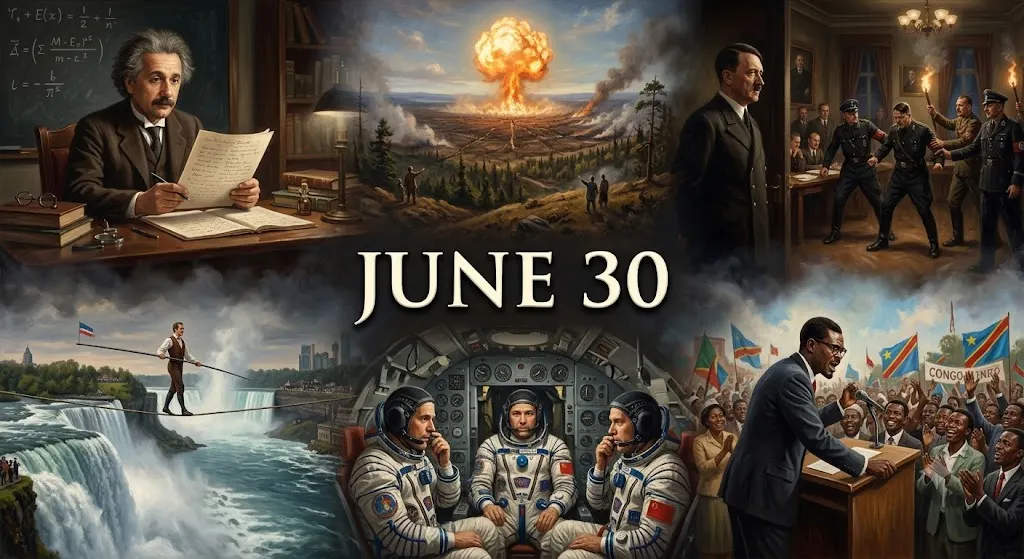
A massive fireball ripped through the sky above the remote Tunguska River in Siberia, detonating with the force of 15 megatons of TNT. The explosion flattened eighty million trees across eight hundred square miles of forest in an instant. Indigenous herders hundreds of miles away felt the scorching heat, while shockwaves circled the globe twice. Mysteriously, the blast left no impact crater behind, sparking over a century of debate among scientists. Today, researchers agree that a stony asteroid roughly 150 feet wide disintegrated in mid-air, making it the largest recorded impact event in human memory and inspiring the global creation of Asteroid Day.
Important Events That Happened On June 30 In History
Here’s your text with proper ### headings (the literal “h3” removed, just the heading format):
296 – Pope Marcellinus Begins Papacy
Roman bishop Marcellinus took office during a time of fragile peace for the early Christian church. Emperor Diocletian’s brutal persecutions lay just a few years away, testing the new pope’s leadership to its absolute limits. Records suggest Marcellinus struggled under the intense pressure, reportedly handing over sacred texts to Roman authorities to save his own life. His controversial reign ended in martyrdom, leaving a complicated legacy that debated the boundaries of faith under threat of death.
763 – Byzantine Triumph at Anchialus
Emperor Constantine V deployed a massive fleet of 800 ships carrying cavalry to confront Bulgarian forces on the Black Sea coast. The bloody clash lasted an entire day as both sides fought fiercely for control of the regional frontier. Byzantine soldiers broke the Bulgarian lines, taking thousands of prisoners and forcing Khan Telets to flee for his life. This decisive victory temporarily secured the imperial border and cemented Constantine’s reputation as a brilliant military tactician.
1398 – Zhu Yunwen Claims the Ming Throne
Zhu Yunwen knelt before the imperial altars in Nanjing to officially become the Jianwen Emperor of China. The young ruler inherited a vast empire but faced immediate threats from his powerful, ambitious uncles who controlled regional armies. His attempt to strip these royal relatives of their military power quickly backfired, sparking a devastating three-year civil war. The rebellion ended with his palace in ashes, his mysterious disappearance, and his uncle seizing the throne.
1422 – Blood on the Fields of Arbedo
Carmagnola led thousands of heavily armed Milanese cavalrymen in a surprise assault against a smaller force of Swiss pikemen. The Swiss soldiers formed a defensive square, desperate to hold their ground against the overwhelming mounted charge. Milanese forces forced the Swiss to retreat after inflicting massive casualties and capturing regional fortifications. This brutal encounter forced the Swiss cantons to rethink their military strategies, leading to the development of better-armored infantry units.
1521 – Spanish Victory at the Battle of Noáin
General Asparros led a combined French and Navarrese army into a narrow valley, hoping to reclaim the kingdom of Navarre from Spanish control. Spanish forces used superior numbers and positioning to completely surround the invading troops, turning the battlefield into a trap. Over five thousand men died in the chaotic fighting before the French lines shattered and retreated. This crushing defeat ended Navarrese hopes of independence and secured Spanish dominance over the region for centuries.
1559 – King Henry II Mortally Wounded in Joust
King Henry II of France raised his lance and charged against Gabriel, Count of Montgomery, during a celebratory tournament in Paris. Montgomery’s lance shattered upon impact, sending sharp wooden splinters directly through the king’s gilded visor and deep into his eye and brain. Royal physicians fought for ten days to save the king, using experimental treatments that failed to stop a fatal infection. His sudden death threw France into decades of religious civil war and political instability.
1598 – English Privateers Seize San Juan
Sir George Clifford ordered his fleet of English ships to open fire on the massive stone walls of Castillo San Felipe del Morro. English troops landed on the beaches of Puerto Rico, enduring a grueling fifteen-day siege under blistering tropical heat and disease. Spanish defenders ran low on ammunition and clean water, finally raising the white flag of surrender. The English occupied the strategic fort for several months before rampant dysentery forced them to abandon their prize.
1632 – The University of Tartu Founded
King Gustavus Adolphus of Sweden signed the official charter creating a new center of higher learning in Estonia. The institution opened its doors to both noblemen and peasants, a radical educational shift for seventeenth-century Europe. War and political shifts repeatedly forced the school to close or relocate over the following decades. Despite these disruptions, the university survived to become the intellectual cradle of Estonian national identity and scientific research.
1643 – Royalists Triumph at Adwalton Moor
The Earl of Newcastle ordered his Royalist army to charge across the muddy moorlands of Yorkshire to intercept Parliamentarian forces. Lord Fairfax’s troops held a strong defensive position inside the enclosed fields but lacked the ammunition to withstand a prolonged assault. Royalist pikes broke the enemy lines, forcing the Parliamentarians into a chaotic retreat toward Leeds and Bradford. This victory gave King Charles I control of northern England during the opening years of the English Civil War.
1651 – Polish Cavalry Prevail at Berestechko
King John II Casimir led a massive force of Polish soldiers and winged hussars to break a massive Ukrainian Cossack rebellion. The three-day battle culminated in a desperate defensive stand by the Cossacks inside a swampy river bend. Polish forces breached the makeshift fortifications, resulting in a devastating rout that claimed thousands of rebel lives. This victory halted the immediate advance of the Khmelnytsky Uprising and reestablished royal control over the volatile eastern borderlands.
1688 – The Invitation to William of Orange
Seven prominent English politicians slipped a highly treasonous letter into the hands of a secret courier bound for the Netherlands. This “Immortal Seven” group begged the Dutch Protestant Prince William of Orange to invade England and overthrow his Catholic father-in-law, King James II. The plotters promised widespread military and public support the moment his ships landed on English shores. This single letter triggered the Glorious Revolution, fundamentally changing the British monarchy forever.
1691 – The Siege of Athlone Concludes
Godert de Ginkell ordered a daring, daylight river crossing as Williamite soldiers waded through the deep waters of the River Shannon. Jacobite defenders inside the Irish city were caught completely off guard, having assumed the river was impassable. Williamite troops swarmed over the breached stone walls, capturing the strategic stronghold in less than an hour. This successful assault broke the Jacobite defensive line and paved the way for the final Williamite conquest of Ireland.
1703 – The Battle of Ekeren
General Jacob van Bedarrides found his Dutch troops completely surrounded by a much larger French army near the Belgian border. The Dutch soldiers refused to surrender, fighting fiercely in the narrow streets and ditches of the village for hours. Dutch units launched a desperate bayonet charge at dusk, breaking through the French lines to secure an escape route. While both sides claimed victory, the brutal standoff stalled the Allied advance during the War of the Spanish Succession.
1758 – Moravian Ambush at Domstadtl
Habsburg Austrian forces launched a surprise attack from the cover of dense woods against a massive Prussian supply convoy. General Loudon’s troops destroyed over three thousand wagons carrying vital food, gunpowder, and financial resources meant for the Prussian army. This devastating logistical blow forced King Frederick the Great to completely abandon his costly siege of Olomouc. The retreat marked a major turning point in the Seven Years’ War, saving the Austrian Empire from collapse.
1794 – Native Alliance Attacks Fort Recovery
Chief Blue Jacket led a unified force of Ohio Valley Native Americans in a fierce assault against a newly built American military outpost. The tribal warriors ambushed a supply convoy outside the fort walls, killing dozens of soldiers and capturing hundreds of packhorses. American defenders managed to hold the main blockhouses, using artillery fire to repel repeated charges over two days. The native retreat exposed growing divisions within the tribal alliance, weakening their resistance against future American expansion.
1805 – Michigan Territory Organized
United States congressional officials officially separated the vast northern peninsula from the Indiana Territory to create a new administrative government. Detroit was named the territorial capital, though the settlement was destroyed by a catastrophic fire just days before the new governor arrived. This bureaucratic split established the permanent legal boundaries and political infrastructure of the region. The move paved the way for rapid settlement, economic development, and eventual statehood.
1859 – Blondin Crosses Niagara Falls
Charles Blondin stepped onto a tightrope suspended 160 feet above the roaring, misty waters of the Niagara Gorge. A crowd of twenty thousand spectators gasped as the French acrobat walked, paused, and sat down on the two-inch-wide rope. Blondin completed the perilous 1,100-foot crossing using only a heavy balancing pole to stabilize himself against the shifting winds. This death-defying stunt turned him into an international celebrity and ignited a global craze for extreme tightrope walks.
1860 – The Great Oxford Evolution Debate
Bishop Samuel Wilberforce stood before a packed lecture hall and mockingly asked Thomas Henry Huxley whether he descended from monkeys on his grandfather’s or grandmother’s side. Huxley responded that he would rather have an ape for an ancestor than a man who used his intellect to obscure scientific truth. The dramatic clash over Charles Darwin’s newly published evolutionary theory split the religious and academic audience into shouting factions. This fiery exchange marked the first major public battle between traditional creationism and modern biological science.
1864 – Lincoln Protects Yosemite Valley
President Abraham Lincoln signed the historic Yosemite Valley Grant Act during the height of the American Civil War. The federal legislation handed control of the stunning Sierra Nevada valley and Mariposa Grove over to the state of California for public recreation. This act marked the first time the United States government set aside wilderness specifically for preservation and public use. This groundbreaking decision established the core legal and philosophical ideas that birthed the global national parks system.
1876 – Serbia Declares War on the Ottoman Empire
Prince Milan Obrenović issued a formal declaration of hostilities against the Ottoman government, responding to brutal imperial crackdowns in neighboring Bosnia. Serbian troops marched south toward the border, fueled by intense nationalist fervor and promises of secret military aid from Russia. The regular Ottoman army quickly overwhelmed the poorly equipped Serbian forces during the opening campaigns. This conflict dragged the great European powers into the Balkan crisis, reshaping the regional map.
1882 – Assassin Charles J. Guiteau Hanged
Guiteau walked up the wooden steps of a Washington, D.C. gallows while loudly reciting a religious poem he had written that morning. A somber crowd watched the trapdoor open, ending the life of the man who shot President James A. Garfield a year earlier. Guiteau spent his final months claiming that God ordered him to commit the murder to heal a political rift. His execution closed a dark chapter of national mourning and spurred major reforms to the federal political appointment system.
1886 – First Transcontinental Train Leaves Montreal
A sleek steam locomotive blew its whistle and chugged out of a Quebec station, pulling the first passenger train across Canada. The Canadian Pacific Railway train carried eager travelers across thousands of miles of rugged wilderness, prairies, and towering mountain passes. This journey connected the Atlantic and Pacific coasts by rail for the first time in the nation’s history. The train arrived safely in British Columbia five days later, transforming Canadian trade, immigration, and national unity.
1892 – The Homestead Strike Begins
Amalgamated Association steelworkers locked the gates of a massive Pennsylvania steel mill, initiating one of the most violent labor disputes in American history. Factory manager Henry Clay Frick ordered the immediate shutdown of the facility to break the powerful union and cut worker wages. Frick hired hundreds of armed Pinkerton detectives to reclaim the property, leading to a bloody gun battle along the Monongahela River. The arrival of state militia eventually crushed the strike, severely crippling the American labor movement for decades.
1900 – The Great Hoboken Pier Fire
A small spark inside a cotton warehouse ignited a roaring wall of flame along the New Jersey waterfront, quickly spreading to four massive German ocean liners. Raging fires trapped hundreds of sailors and passengers below deck as the vessels drifted into the Hudson River. Tugboats towed the burning ships away from the docks while rescue crews desperately cut through steel hulls to free survivors. The catastrophe killed over two hundred people and caused millions of dollars in maritime damage.
1905 – Einstein Submits Special Relativity Paper
Albert Einstein mailed his groundbreaking manuscript, “On the Electrodynamics of Moving Bodies,” to the prestigious journal Annalen der Physik. The young physicist’s paper introduced the radical concept that the speed of light is constant, while time and space change relative to an observer’s speed. This mathematical proof dismantled centuries of established Newtonian physics, fundamentally altering our understanding of the universe. This publication initiated a scientific revolution that birthed modern quantum mechanics and astrophysics.
1906 – Pure Food and Drug Act Passed
President Theodore Roosevelt signed landmark consumer protection legislation into federal law after reading horrific exposés about American meatpacking plants. The new laws banned the manufacturing and sale of adulterated, misbranded, or poisonous foods and medicines across state lines. Companies were forced to list active ingredients on labels and submit to regular government inspections for the first time. This regulatory shift transformed public health, established the foundation of the FDA, and restored consumer trust.
1912 – The Regina Cyclone Devastates Saskatchewan
A massive, green-tinted funnel cloud dropped from the sky and tore directly through the heart of Regina’s business and residential districts. The violent tornado pulverized brick warehouses, lifted houses off foundations, and dropped churches into splinters within three minutes. Twenty-eight people died in the chaos, while thousands more were left homeless in Canada’s deadliest tornado event. The community rallied to rebuild the provincial capital, implementing stronger construction standards that influenced future Canadian architecture.
1916 – The Day Sussex Died
Colonial troops of the Royal Sussex Regiment climbed out of their trenches at the Boar’s Head in France during a massive diversionary assault. German machine gunners opened fire immediately, cutting down waves of British soldiers crossing the muddy expanse of No Man’s Land. The regiment lost over three hundred men in less than five hours of intense, futile fighting. This local tragedy devastated communities back home in Sussex and served as a grim prelude to the Battle of the Somme.
1921 – Taft Appointed Chief Justice
President Warren G. Harding selected former President William Howard Taft to lead the United States Supreme Court. The appointment made Taft the only person in American history to serve as both head of the executive branch and leader of the judiciary. Taft spent his tenure reorganizing the federal court system and securing funds for a permanent, dedicated Supreme Court building. He considered this legal role the highest honor of his long life, preferring it to his time in the White House.
1922 – Hughes–Peynado Agreement Signed
Secretary of State Charles Evans Hughes shook hands with Dominican Ambassador Francisco J. Peynado after signing a historic diplomatic treaty in Washington. The agreement established a clear, orderly timeline for the withdrawal of United States military forces from the Dominican Republic. It also outlined plans for a provisional Dominican government to hold free national elections without foreign interference. This pact ended an eight-year military occupation and restored national sovereignty to the Caribbean nation.
1934 – Night of the Long Knives
Adolf Hitler ordered his elite SS squads to launch a coordinated, violent purge against his own political allies across Germany. Paramilitary leader Ernst Röhm and dozens of SA commanders were dragged from their beds and executed without trial over a bloody weekend. Hitler used the chaos to assassinate prominent conservative critics and old political rivals who threatened his absolute power. This ruthless betrayal eliminated all internal opposition, leaving the Nazi regime in total control of the state.
1936 – Haile Selassie Appeals to League of Nations
Emperor Haile Selassie of Abyssinia stood before a silent assembly in Geneva, pleading for international intervention against Italy’s brutal invasion of his African nation. The exiled monarch warned the global diplomats that their failure to act against illegal chemical weapons attacks would destroy international security. He uttered the chilling phrase, “It is us today. It will be you tomorrow.” The League’s refusal to impose meaningful sanctions exposed its utter weakness, clearing the path to World War II.
1937 – London Introduces 999 Emergency Line
Telephone operators in London handled the world’s first coordinated emergency telephone system, designed to connect citizens to police, fire, or ambulance services instantly. The system used a loud klaxon and flashing red lights inside the exchange building to alert staff to an incoming emergency call. Early critics feared the lines would be overwhelmed by accidental dials or pranks, but the service proved an instant success. This innovative public safety model was adopted by cities worldwide, saving countless lives.
1944 – American Forces Capture Cherbourg
General Joseph Lawton Collins led American troops into the shattered streets of the strategically vital French port city. German defenders sabotaged the docks, blowing up cranes and dropping ships into the harbor channels before finally surrendering. Allied engineers worked around the clock to clear the debris and open a direct supply line into western Europe. The capture of this deepwater port allowed massive amounts of troops and equipment to land, sustaining the liberation of France.
1953 – First Chevrolet Corvette Manufactured
Assembly line workers in Flint, Michigan, polished the fiberglass body of a sleek, white two-seater sports car, completing the very first Chevrolet Corvette. General Motors designed the vehicle to compete with European imports, featuring a unique lightweight body and a red interior. The initial production run was limited to just three hundred hand-assembled units, all painted identical colors. This car became an enduring symbol of American automotive design, pop culture, and engineering innovation.
1956 – Grand Canyon Air Disaster
A TWA Super Constellation and a United Airlines DC-7 collided in mid-air over the remote canyons of Arizona, plunging into the deep rocky gorges below. Rescue teams faced a perilous journey into the canyon to recover the remains of all 128 passengers and crew members. The tragedy exposed the absolute lack of radar tracking and flight separation rules for commercial airliners flying over rural areas. This disaster forced the United States government to completely overhaul air traffic control, leading to the creation of the FAA.
1959 – Okinawa Jet Crash Tragedy
A United States Air Force fighter jet suffered a catastrophic engine failure during a routine training flight, forcing the pilot to eject over Kadena Air Base. The unguided aircraft slammed directly into a crowded elementary school, destroying classrooms and nearby homes in a fiery explosion. The disaster killed eleven young students and six local residents, injuring over a hundred others. This horrific accident sparked massive public protests against the presence of American military bases on the island.
1960 – Belgian Congo Gains Independence
Patrice Lumumba delivered a fiery, unscripted speech in Léopoldville, celebrating the birth of the independent Republic of the Congo. The new Prime Minister openly condemned decades of brutal, exploitative Belgian colonial rule in front of King Baudouin. Celebrations swept the capital city as citizens tore down colonial monuments to mark their hard-won freedom. The sudden departure of Belgian administrators triggered an immediate political crisis, dragging the new nation into years of civil war and Cold War proxy conflicts.
1963 – Ciaculli Bombing Shakes Sicily
Police officers and military personnel gathered around a suspicious, abandoned Alfa Romeo car parked in a quiet orchard near Palermo. A lethal booby-trap bomb detonated as an officer opened the trunk, killing seven responders instantly. The explosion was intended for rival Mafia boss Salvatore Greco during the bloody First Mafia War. The public horror over these deaths forced the Italian government to launch its first massive, coordinated crackdown against organized crime syndicates.
1966 – National Organization for Women Founded
Betty Friedan and a small group of feminist activists gathered in a Washington hotel room to sign the founding statement of the National Organization for Women. The organizers grew deeply frustrated by the federal government’s total failure to enforce newly passed anti-discrimination laws for women. The group elected Friedan as their first president, dedicating themselves to securing true economic, legal, and social equality. This meeting ignited the second-wave feminist movement, transforming American workplace laws and family dynamics.
1968 – Pope Paul VI Issues Credo
Pope Paul VI stood before a massive gathering at St. Peter’s Basilica to deliver a solemn profession of traditional Catholic faith. The papal document reaffirmed core theological doctrines regarding the sacraments, original sin, and Church authority during a period of intense social and cultural upheaval. This move sought to anchor Catholic teaching following the sweeping reforms of the Second Vatican Council. The text split global theologians, with traditionalists praising its clarity while reformers viewed it as a retreat from modern dialogue.
1971 – Soyuz 11 Crew Perishes
Soviet recovery teams opened the hatch of the landed Soyuz 11 capsule, discovering all three cosmonauts dead in their seats. Georgi Dobrovolski, Vladislav Volkov, and Viktor Patsayev had just completed a record-breaking twenty-three days aboard the world’s first space station. An investigation revealed a faulty ventilation valve had jarred open during atmospheric reentry, leaking the capsule’s entire air supply into space within seconds. This tragedy forced the Soviet space program to halt all flights and redesign spacesuits for future launches.
1972 – First Leap Second Introduced
Timekeepers at the International Bureau of Weights and Measures officially paused global atomic clocks for exactly one second. This adjustment synchronized ultra-precise atomic time scales with the Earth’s naturally slowing physical rotation. The tiny temporal tweak ensured that astronomical navigation and global communication networks remained perfectly aligned. This practice initiated an ongoing technical debate among modern software engineers and scientists over the necessity of leap seconds in the digital age.
1973 – Concorde Tracks Total Solar Eclipse
A modified French Concorde supersonic jet took off from Africa, flying at twice the speed of sound directly along the path of a total solar eclipse. Scientist Pierre Léna watched out the reinforced roof windows as the aircraft chased the moon’s dark shadow across the Sahara Desert. The jet remained inside the zone of totality for an unprecedented seventy-four minutes, allowing researchers to gather unmatched data on the solar corona. This historic flight remains the longest continuous observation of a solar eclipse in human history.
1974 – Baltimore Municipal Strike Begins
Sanitation workers, jail guards, and highway crews walked off the job, initiating a massive wildcat strike that paralyzed Maryland’s largest city. Piles of uncollected garbage filled the city streets under the blistering July heat, sparking public health warnings and rat infestations. Police officers joined the picket lines days later, forcing the governor to deploy state troopers to maintain public order. The bitter labor dispute lasted nearly three weeks before city officials agreed to raise worker wages and improve healthcare benefits.
1977 – SEATO Officially Disbands
Diplomats gathered in Bangkok to formally dissolve the Southeast Asia Treaty Organization after twenty-two years of regional military alliance. The pact had been created to halt the spread of communism in Asia, but it failed to coordinate effective collective action during the Vietnam War. Pakistan and France withdrew their support, leaving the organization weak and irrelevant. The quiet lowering of the alliance flag marked a significant shift in Cold War diplomacy and regional security strategies.
1985 – Flight 847 Hostages Freed in Beirut
Thirty-nine American passengers smiled and waved to reporters as they boarded a bus out of Lebanon, ending a terrifying seventeen-day ordeal. Militants had hijacked TWA Flight 847, forcing the plane back and forth across the Mediterranean while demanding the release of Shiite prisoners held by Israel. The captors murdered a United States Navy diver during the early days of the standoff, dumping his body onto the tarmac. A complex, behind-the-scenes diplomatic deal finally secured the remaining hostages’ safe release.
1986 – Supreme Court Decides Bowers v. Hardwick
The United States Supreme Court issued a controversial 5-4 ruling upholding a Georgia state law that criminalized homosexual acts between consenting adults. Justice Byron White wrote the majority opinion, stating that the federal constitution did not grant a fundamental right to privacy that covered sodomy. This ruling devastated gay rights organizations, legally validating discriminatory state laws across the country. The decision stood for seventeen years before the court completely overturned it in 2003, declaring such bans unconstitutional.
1989 – Military Coup Deposes Sudanese Government
General Omar al-Bashir led an alliance of military officers and Islamist politicians to surround the presidential palace in Khartoum. Bloodless army units arrested Prime Minister Sadiq al-Mahdi, immediately suspending the constitution and dissolving the democratically elected parliament. Bashir established a military revolutionary council, banning all political parties and independent newspapers across the nation. This sudden takeover initiated thirty years of brutal authoritarian rule marked by devastating civil wars and economic isolation.
1990 – German Economic Merger Takes Effect
Eager East Germans lined up outside bank branches at midnight, waiting to exchange their worthless communist currency for stable West German Deutsche Marks. This economic union dismantled all trade barriers and custom checkpoints between the two nations months before official political reunification. The sudden introduction of capitalist market forces caused hundreds of inefficient state-run eastern factories to collapse within weeks. Despite the initial economic shock, this merger marked the point of no return for a unified Germany.
1993 – Malta Separates into Local Councils
The Maltese Parliament enacted the landmark Local Councils Act, officially dividing the Mediterranean island nation into sixty-eight administrative municipalities. This structural change established elected local governments responsible for managing regional infrastructure, waste collection, and community services. The reform sought to decentralize political power away from the capital city of Valletta, giving local residents a direct voice in community planning. This administrative shift modernized Maltese governance and strengthened local civic engagement.
1994 – Test Flight Crash Kills Seven in Toulouse
An Airbus A330-300 jet took off from a French runway, executing a simulated engine failure test at low altitude. The automated flight control system failed to compensate for the sudden loss of thrust, sending the commercial airliner into a steep, unrecoverable stall. The plane crashed into a nearby forest and exploded, killing all seven pilots and engineers on board instantly. This tragedy forced Airbus to modify its flight computer software and improve pilot training procedures for automated emergency recoveries.
2007 – Glasgow Airport Terrorist Attack
An individual rammed a Jeep filled with propane canisters directly into the glass doors of the main terminal building in Scotland. The vehicle burst into flames, trapping holiday travelers inside while heroic airport staff and bystanders tackled the burning driver to the ground. This failed suicide bombing occurred just twenty-four hours after British police discovered two unexploded car bombs parked in central London. The attack triggered a nationwide terror lockdown, permanently reshaping security procedures at airport entrances worldwide.
2009 – Miracle Survival in Yemenia Flight 626
An Airbus A310 passenger jet crashed into the turbulent waters of the Indian Ocean during a stormy night approach to the Comoros islands. One hundred and fifty-two passengers and crew members died as the aircraft broke apart upon impact. Rescue crews discovered fourteen-year-old Bahia Bakari floating amidst the floating debris hours later, clinging to a piece of wreckage despite having no life jacket and broken bones. She was the sole survivor of the disaster, later dubbed “the miracle girl” by global media.
2013 – Firefighters Die in Yarnell Hill Wildfire
Nineteen members of the elite Granite Mountain Hotshots crew were trapped when shifting winds suddenly turned a raging wildfire back toward their position in Arizona. The elite crew deployed their emergency silver fire shelters inside a rocky canyon as a wall of flame overran them. The fire incinerated the valley within minutes, leaving no survivors from the trapped unit. This tragedy marked the deadliest day for American wildland firefighters since 1933, leading to massive overhauls in wildland fire communication and safety protocols.
2013 – Protests Ignite Mass Coup in Egypt
Millions of Egyptian citizens poured into the streets of Cairo and Alexandria, demanding the immediate resignation of President Mohamed Morsi. Protesters accused the newly elected Islamist government of power-grabbing, economic mismanagement, and destroying secular institutions. The massive demonstrations ground the nation to a complete halt, prompting the military to issue a strict forty-eight-hour ultimatum to political leaders. This civil unrest culminated days later in a military coup that overthrew Morsi and reshaped Middle Eastern politics.
2015 – Military Transport Crash in Medan Residential Area
A Lockheed C-130 Hercules transport plane took off from an Indonesian air base, suffering a mechanical failure just moments into its flight. The pilot attempted to turn back, but the heavy aircraft plunged into a densely populated residential neighborhood, striking a hotel and several homes. The fiery crash killed all 121 people on board and dozens of residents on the ground. This disaster exposed deep systemic issues within the nation’s aging military fleet, forcing immediate safety reviews.
2019 – Donald Trump Enters North Korea
Donald Trump stepped over the concrete border marker at the Demilitarized Zone, shaking hands with North Korean leader Kim Jong Un. This brief, unscripted meeting marked the first time a sitting United States president set foot inside the reclusive totalitarian nation. The two leaders spoke privately for nearly an hour inside the Inter-Korean Peace House, attempting to jumpstart stalled nuclear disarmament talks. While the symbolic encounter captured global headlines, it failed to produce lasting diplomatic breakthroughs or policy changes.
2020 – Hong Kong Passes National Security Law
The Chinese government enacted a sweeping national security law for Hong Kong, bypassing the city’s local legislature to crack down on widespread pro-democracy protests. The legislation criminalized acts of secession, subversion, terrorism, and collusion with foreign forces, carrying penalties up to life in prison. Authorities used the new law immediately to arrest prominent political dissidents, shut down independent media outlets, and rewrite local election rules. This legal shift effectively ended the city’s political autonomy under the “one country, two systems” framework.
2021 – The Tiger Fire Ignites in Arizona
An intense lightning strike ignited dry brush near Black Canyon City, starting a fast-moving wildfire that threatened rural communities and historic mining towns. Fierce desert winds and extreme heat pushed the flames across rugged, inaccessible mountain terrain, forcing widespread resident evacuations. Over three hundred wildland firefighters battled the blaze for a month using air tankers and defensive burn lines. The fire burned over sixteen thousand acres of land before teams achieved full containment, serving as a grim indicator of intensifying western drought cycles.
2023 – Chisinau Airport Shooting
A Tajik national opened fire with a stolen weapon inside Moldova’s main international airport after border agents denied him entry into the country. The gunman killed a security officer and an airport staff member before special forces units wounded and arrested him during a dramatic tactical assault. Investigations revealed the attacker was wanted in his home country for kidnapping and murder, possessing deep ties to radical international networks. This violent incident forced European transit hubs to tighten security checks for travelers arriving from Central Asia.
Catch up on the historical tales you missed yesterday.
Famous People Born on June 30
| Name | Role / Description | Dates |
|---|---|---|
| John de Warenne | 7th Earl of Surrey | 1286–1347 |
| John, Elector of Saxony | Elector of Saxony | 1468–1532 |
| Charles VIII | King of France | 1470–1498 |
| John Frederick I | Elector of Saxony | 1503–1554 |
| John Gay | English poet and playwright | 1685–1732 |
| Paul Barras | French revolutionary politician | 1755–1829 |
| Joseph Dalton Hooker | English botanist and explorer | 1817–1911 |
| Georges Duhamel | French author and critic | 1884–1966 |
| Walter Ulbricht | East German political leader | 1893–1973 |
| Anthony Mann | American film director | 1906–1967 |
| Czesław Miłosz | Polish poet, Nobel laureate | 1911–2004 |
| Susan Hayward | American actress | 1917–1975 |
| Lena Horne | American singer and actress | 1917–2010 |
| Paul Berg | American biochemist, Nobel laureate | 1926–2023 |
| Billy Mills | American Olympic runner | 1938–Present |
| Robert Ballard | Oceanographer, discovered RMS Titanic | 1942–Present |
| Stanley Clarke | American jazz bassist | 1951–Present |
| David Alan Grier | American actor and comedian | 1956–Present |
| Vincent D’Onofrio | American actor | 1959–Present |
| Yngwie Malmsteen | Swedish guitarist | 1963–Present |
| Mike Tyson | American heavyweight boxing champion | 1966–Present |
| Sanath Jayasuriya | Sri Lankan cricketer | 1969–Present |
| Molly Parker | Canadian actress | 1972–Present |
| Ralf Schumacher | German Formula One driver | 1975–Present |
| Lizzy Caplan | American actress | 1982–Present |
| Cheryl | English singer and television personality | 1983–Present |
| Fantasia Barrino | American singer | 1984–Present |
| Michael Phelps | American Olympic swimmer | 1985–Present |
| Trea Turner | American baseball player | 1993–Present |
| A. J. Brown | American football player | 1997–Present |
Famous People Who Died on June 30
| Name | Role / Description | Dates |
|---|---|---|
| Charles II, Duke of Guelders | Duke of Guelders | 1467–1538 |
| Johann Reuchlin | German humanist and scholar | 1455–1522 |
| James Oglethorpe | Founder of the Georgia colony | 1696–1785 |
| Alcide d’Orbigny | French naturalist and paleontologist | 1802–1857 |
| Charles J. Guiteau | Assassin of James A. Garfield | 1841–1882 |
| John William Strutt (Lord Rayleigh) | Physicist, Nobel laureate | 1842–1919 |
| Dadabhai Naoroji | Indian nationalist leader | 1825–1917 |
| Paul Klee | Swiss painter | 1879–1940 |
| Ignacy Jan Paderewski | Polish pianist and Prime Minister | 1860–1941 |
| Lee de Forest | American inventor of the Audion tube | 1873–1961 |
| Giuseppe Farina | First Formula One World Champion | 1906–1966 |
| Margery Allingham | English mystery novelist | 1904–1966 |
| Georgy Dobrovolsky | Soviet cosmonaut | 1928–1971 |
| Viktor Patsayev | Soviet cosmonaut | 1933–1971 |
| Vladislav Volkov | Soviet cosmonaut | 1935–1971 |
| Nancy Mitford | English novelist and biographer | 1904–1973 |
| Lillian Hellman | American playwright | 1905–1984 |
| Haruo Remeliik | First President of Palau | 1933–1985 |
| Georgy Beregovoy | Soviet cosmonaut | 1921–1995 |
| Chet Atkins | American guitarist and producer | 1924–2001 |
| Joe Henderson | American jazz saxophonist | 1937–2001 |
| Buddy Hackett | American comedian and actor | 1924–2003 |
| Pina Bausch | German choreographer | 1940–2009 |
| Yitzhak Shamir | Prime Minister of Israel | 1915–2012 |
| Simone Veil | French politician and Holocaust survivor | 1927–2017 |
| Smoke Dawg | Canadian rapper | 1996–2018 |
| Stella Madzimbamuto | Zimbabwean activist | 1930–2020 |
| Raj Kaushal | Indian film director and producer | 1971–2021 |
| Kenneth Colley | English actor | 1937–2025 |
| Jim Shooter | American comic book writer and editor | 1951–2025 |
Observances on June 30
Asteroid Day: The United Nations officially recognizes this international day of education to raise public awareness about asteroid impact hazards. The date commemorates the anniversary of the historic 1908 Siberian Tunguska explosion. Scientists and filmmakers use global public events to advocate for advanced space-based tracking systems to protect the planet from future celestial collisions.
Democratic Republic of the Congo Independence Day: Citizens across the African nation celebrate their complete liberation from Belgian colonial rule, achieved in 1960. The national holiday features military parades, traditional music, and political speeches in the capital city of Kinshasa. It serves as a somber day of remembrance for the millions of lives lost during decades of brutal imperial exploitation.
Philippine–Spanish Friendship Day: This cultural observance honors the deep, shared history between the two nations, marking the moment in 1899 when President Emilio Aguinaldo praised Spanish soldiers who defended a besieged church. The law encourages cultural exchange programs and bilateral agreements, transforming an era of colonial conflict into a modern partnership based on mutual respect.
☄️ Frequently Asked Questions — June 30 in History
The remote Tunguska region of Siberia experienced the largest recorded celestial impact event in human history when a stony asteroid exploded in mid-air. The blast leveled eighty million trees across eight hundred square miles of wilderness with the force of fifteen megatons of TNT. The explosion left no impact crater, baffling researchers for decades before modern physics explained the airburst phenomenon.
Albert Einstein’s submission of his special relativity paper in 1905 stands as the day’s most transformative milestone. His mathematical proofs completely dismantled classical Newtonian physics by proving that space and time are fluid concepts relative to the speed of light. This single scientific breakthrough established the core foundation for modern quantum mechanics, nuclear physics, and exploration of the cosmos.
Legendary American swimmer Michael Phelps was born on this day in 1985, growing up to become the most decorated Olympian of all time with twenty-eight medals. On the same date in 1911, Polish poet and essayist Czesław Miłosz was born, later winning the Nobel Prize in Literature for his profound explorations of human morality under totalitarian regimes.
Adolf Hitler launched the Night of the Long Knives in 1934, executing hundreds of paramilitary leaders and conservative critics to consolidate his absolute power over Germany. Centuries earlier in 1651, Polish forces achieved a decisive victory against a massive Ukrainian Cossack rebellion at the Battle of Berestechko after days of brutal infantry fighting.
This United Nations observance educates the global public about the potential dangers of asteroid impacts and the vital importance of planetary defense systems. The date directly honors the memory of the devastating 1908 Tunguska explosion in Siberia. Global scientific organizations host lectures and digital broadcasts to fund telescopes that track near-Earth objects.
Donald Trump became the first sitting United States president to enter North Korea in 2019, stepping across the Demilitarized Zone to meet with Kim Jong Un. Just a year later in 2020, Beijing enacted the Hong Kong National Security Law, fundamentally altering the region’s legal system and crushing the city’s pro-democracy movement.