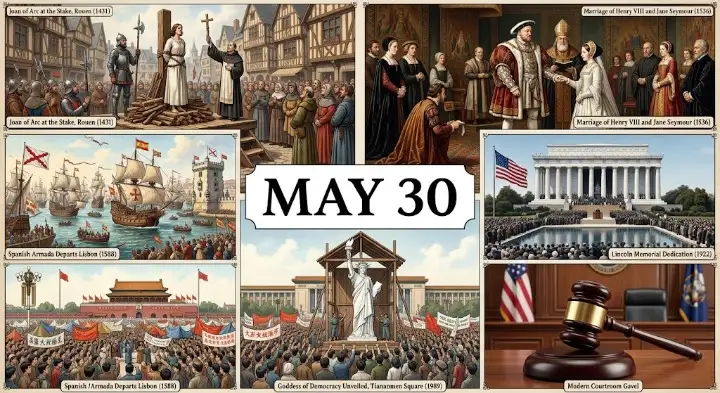
Nineteen-year-old Joan of Arc stood bound to a wooden pillar in the marketplace of Rouen, France, watching the executioner approach with a burning torch. Smoke soon choked the square as flames rose around the young mystic who had rallied a kingdom. This day in history May 30 marks her ultimate sacrifice, a moment that echoed down the centuries to anchor an extraordinary date of political upheavals, structural collapses, and modern legal precedents.
👶 Quick Facts — May 30 in History
| 📌 Category | 📖 Event / Detail |
|---|---|
| 🌟 Most Significant Event | Joan of Arc executed at the stake (1431) |
| 🏆 Top 10 Key Events | • Peasants’ Revolt begins (1381) • King Henry VIII marries Jane Seymour (1536) • Spanish Armada sets sail (1588) • Andrew Jackson wins a deadly duel (1806) • Lincoln Memorial dedicated (1922) • Memorial Day massacre in Chicago (1937) • Biafra separates from Nigeria (1967) • Mariner 9 launches to Mars (1971) • Goddess of Democracy unveiled (1989) • Donald Trump convicted (2024) |
| ⚔️ Key Battles | Battle of Lipany (1434), Battle of Borghetto (1796), Siege of Corinth ends (1862) |
| 👤 Key Figures | Joan of Arc, King Henry VIII, Napoleon Bonaparte, Andrew Jackson, Mao Zedong, Donald Trump |
| 🌍 Observances | Indian Arrival Day (Trinidad and Tobago), Mother’s Day (Nicaragua), Kaamatan (Malaysia), Anguilla Day (Anguilla), Canary Islands Day (Spain), Lod Massacre Remembrance Day (Puerto Rico), Statehood Day (Croatia) |
Story of the Day: The Trial and Death of Joan of Arc
English soldiers led a teenage girl through the crowded streets of Rouen to face a gruesome public execution on May 30, 1431. Convicted of heresy by a politically motivated church tribunal, Joan of Arc refused to recant her claims of divine guidance. She asked for a crucifix, which a sympathetic friar held high before her as the brushwood ignited. Her death was meant to break the spirit of French resistance during the Hundred Years’ War. Instead, the teenage martyr became an enduring symbol of French identity, leading to her canonization centuries later.
Important Events That Happened On May 30 In History
1381 – Beginning of the Peasants’ Revolt in England
Tax collector John Bampton arrived in Essex to collect unpaid poll taxes and met fierce resistance from locals who refused to pay a single penny. Outraged villagers grabbed farming tools, chased the royal officials out of town, and ignited a major popular uprising across the English countryside. The rebellion quickly spread to London, forcing the young King Richard II to meet the peasants and promise sweeping social reforms. Though royal forces ultimately crushed the movement, the poll tax was abandoned, shifting the feudal balance of power forever.
1416 – Jerome of Prague Burned for Heresy
Church authorities in Germany tied Czech philosopher Jerome of Prague to a stake after a long, grueling trial at the Council of Constance. Having traveled to defend his friend Jan Hus, Jerome found himself imprisoned, pressured to recant his theological criticisms of church corruption, and ultimately condemned when he recanted his recantation. He sang hymns loudly as the kindling caught fire, showing defiance until his voice was silenced by the smoke. His execution inflamed religious tensions in Bohemia, pushing Central Europe toward decades of brutal warfare.
1431 – Joan of Arc Burned at the Stake
English guards escorted nineteen-year-old Joan of Arc to the old marketplace of Rouen, where a massive pile of wood waited under an execution order. Condemned as a heretic for wearing men’s clothes and claiming to hear angelic voices, she kept her eyes fixed on a wooden cross until the flames enveloped her. Her enemies threw her ashes into the Seine River to prevent anyone from keeping her remains as holy relics. The execution backfired completely, turning her into an eternal national icon while her faction won the war.
1434 – Battle of Lipany Ends the Hussite Wars
Hussite armies split into two bitter factions and clashed on a sweeping field east of Prague in a final showdown for religious control of Bohemia. Moderate Utraquists teamed up with Catholic nobles, using a feigned retreat to lure the radical Taborites out from behind their armored wagon fortresses. The trap snapped shut, resulting in the absolute annihilation of the radical forces and ending more than a decade of religious crusades. This outcome secured a fragile peace, allowing Bohemia to remain a unique multi-confessional land within the Holy Roman Empire.
1510 – Prince of Anhua Rebellion Crushed in Ming China
Commander Qiu Yue led imperial Ming dynasty troops into battle against Zhu Zhifan, a rebellious prince who attempted to overthrow the corrupt imperial court. The commander used superior tactics and internal betrayals to surround the rebel forces, capturing the prince alive and ending the brief uprising in northern China. The victory preserved the reign of the Zhengde Emperor and prevented a massive civil war from fracturing the empire. Zhu Zhifan faced execution in Beijing, serving as a warning to other ambitious royals.
1536 – King Henry VIII Marries Jane Seymour
King Henry VIII exchanged wedding vows with Jane Seymour in a private ceremony at Whitehall Palace, just eleven days after executing his second wife, Anne Boleyn. The quiet lady-in-waiting stepped into the royal spotlight as the king desperately sought a male heir to secure the Tudor succession. She succeeded where her predecessors failed by giving birth to the future King Edward VI the following year. Her death from childbirth complications days later cemented her status as the only wife Henry truly mourned.
1539 – Hernando de Soto Lands at Tampa Bay
Spanish conquistador Hernando de Soto stepped onto the sandy shores of Florida with six hundred armor-clad soldiers, bloodhounds, and hundreds of horses. Driven by rumors of golden cities hidden in the wilderness, the expedition began a brutal march across the southeastern region of North America. They found no gold, but their journey brought devastating diseases and violence to countless Indigenous societies they encountered along the route. De Soto died on the journey, leaving behind a trail of destruction that reshaped the continent.
1574 – Henry III Becomes King of France
Henry III inherited the French throne following the sudden death of his brother, Charles IX, while religious conflict tore the kingdom apart. The newly crowned monarch abandoned his brief rule over Poland to rush back to Paris and claim his birthright amid the French Wars of Religion. His reign became a delicate balancing act as he fought off radical Catholic factions and Protestant armies led by Henry of Navarre. His eventual assassination ended the Valois line, passing the crown to the Bourbon dynasty.
1588 – Spanish Armada Departs Lisbon
The final heavy galleons of the Spanish Armada unreeled their canvas sails and glided out of Lisbon Harbor, charting a course toward the English Channel. King Philip II sent this massive fleet of one hundred and thirty ships to overthrow Queen Elizabeth I and return England to Catholicism. Ill-fated planning and unpredictable Atlantic weather plagued the mission before they even encountered the English navy. The enterprise ended in disaster, wrecking dozens of ships on Irish rocks and signaling the rise of English naval supremacy.
1631 – Publication of Gazette de France
Printers in Paris distributed the very first copies of Gazette de France, a publication created by royal physician Théophraste Renaudot under the patronage of Cardinal Richelieu. The weekly paper provided locals with official state news, foreign dispatches, and legal notices, establishing the template for modern French journalism. It acted as an effective propaganda tool for the absolute monarchy, ensuring the crown’s perspective dominated public discussion. The newspaper remained an influential institution for over two centuries, shaping the development of the European press.
1635 – Peace of Prague Signed During Thirty Years’ War
Imperial representatives and German Protestant states gathered in Prague to sign a peace treaty aimed at ending the horrific civil conflicts within the Holy Roman Empire. The agreement dissolved regional military alliances and restored territorial borders to where they stood before foreign armies intervened. While it brought temporary relief to exhausted German territories, it failed to stop the broader continental conflict. French and Swedish rulers ignored the pact, dragging the war onward for thirteen more blood-soaked years.
1642 – English Parliament Annulls Royal Honors
English parliamentarians passed a radical decree declaring every title, lordship, and honor granted by King Charles I over the past year completely null and void. This unprecedented political maneuver struck directly at the king’s authority to build an army of loyal aristocrats as the nation slid toward civil war. By stripping these new nobles of their legal status, Parliament asserted its own control over state governance. The move severed any remaining hope of peaceful compromise, ensuring an armed clash between Roundheads and Cavaliers.
1723 – Bach Takes Office as Thomaskantor in Leipzig
Johann Sebastian Bach stood before a packed congregation at St. Nicholas Church to conduct his brand-new cantata, Die Elenden sollen essen. Having just moved his family to Leipzig to take over as director of church music, the composer used this complex performance to prove his artistic worth to the city council. The intricate, two-part masterpiece set a high standard for the sacred music he would produce over the next two decades. This debut marked the start of his most prolific creative period, yielding some of the finest compositions in Western music history.
1796 – Napoleon Crosses the Mincio at the Battle of Borghetto
General Napoleon Bonaparte spurred his cavalry forward across the Mincio River, breaking through the defensive lines of an army of Austrian defenders in northern Italy. The daring tactical crossing caught the Austrian command by surprise, forcing them into a hasty retreat toward the mountain passes of the Tyrol. This brilliant maneuver isolated the massive fortress of Mantua, leaving it as the final enemy stronghold in Lombardy. The victory established the young French general’s reputation as a military genius who could rewrite conventional rules of engagement.
1806 – Andrew Jackson Kills Charles Dickinson in a Duel
Future American President Andrew Jackson stood quietly on a cold Kentucky riverbank, watching his opponent level a pistol at his chest. Charles Dickinson, a famous marksman who had insulted Jackson’s wife, fired first, shattering Jackson’s ribs and embedding a bullet dangerously close to his heart. Gritting his teeth against the agonizing pain, Jackson stayed on his feet, aimed his weapon, and fired a fatal shot across the clearing. The duel left Jackson with lifelong respiratory pain and a reputation as a dangerous, uncompromising man.
1814 – First Treaty of Paris Restores Bourbon Monarchy
Diplomats gathered in Paris to sign a sweeping peace treaty that officially ended the War of the Sixth Coalition against a defeated France. The agreement rolled back French borders to their 1792 limits, stripped away Napoleon’s conquests, and placed King Louis XVIII on the throne to restore the Bourbon dynasty. Crucially, the allied powers chose not to impose punishing financial reparations, hoping to foster stability and prevent future revolutions. This fragile geopolitical arrangement lasted less than a year before Napoleon escaped exile to challenge Europe again.
1815 – Wreck of the Arniston Near Cape Agulhas
The British transport ship Arniston lost its sails to a fierce storm, drifted off course, and struck a reef off the coast of South Africa. Lacking accurate navigational tools, the captain mistakenly believed they were near Cape Town rather than the jagged rocks of Waenhuiskrans. The hull split open within minutes under the hammering waves, killing three hundred and seventy-two people as they tried to reach land. Only six sailors survived the disaster, prompting British authorities to build a crucial lighthouse at Cape Agulhas.
1834 – Portugal Enacts the “Friar-Killer” Law
Minister of Justice Joaquim António de Aguiar signed a radical decree confiscating every convent, monastery, and college belonging to Catholic religious orders across Portugal. The aggressive law shuttered hundreds of historic institutions, seized vast estates for state use, and earned Aguiar the permanent nickname of “The Friar-Killer.” The move aimed to break the political influence of the Catholic Church, which had backed conservative royalists in the recent civil war. This dramatic seizure transformed Portuguese society, permanently reducing ecclesiastical power.
1842 – John Francis Attempts to Assassinate Queen Victoria
John Francis stepped out from a crowd on Constitution Hill, drew a pistol, and fired directly at Queen Victoria as her open carriage drove past. Prince Albert saw the flash and pulled his wife down, saving her from the flying bullet as royal guards tackled the lone gunman. This marked the second assassination attempt on the young queen in less than two days, shocking London residents and sparking a massive wave of public support for the monarchy. The government responded by tightening royal security detail around the palace.
1845 – The Fatel Razack Lands in Trinidad
The sailing ship Fatel Razack dropped anchor in the Gulf of Paria, carrying two hundred and twenty-seven passengers from India to the shores of Trinidad and Tobago. Following the abolition of slavery, these travelers arrived as indentured laborers to work the island’s expanding sugar plantations under grueling contracts. This historic arrival marked the beginning of a massive migration wave that brought over one hundred and forty thousand South Asians to the Caribbean. Their arrival reshaped the demographic, culinary, and musical landscape of the region.
1854 – The Kansas–Nebraska Act Becomes Law
President Franklin Pierce signed the controversial Kansas-Nebraska Act, a law that allowed local settlers to vote on whether to permit slavery within their territories. By repealing the long-standing Missouri Compromise line, the legislation ignited furious political debates between anti-slavery factions and pro-slavery settlers. The territory soon erupted into a mini-civil war known as “Bleeding Kansas” as rival groups fought for control. This law fractured the American political system, speeding the nation toward secession and full-scale war.
1862 – Union Forces Capture Corinth, Mississippi
General Henry Halleck led Union troops into the abandoned streets of Corinth, securing a strategic Southern railroad junction after a month-long siege. Confederate General P.G.T. Beauregard pulled his outnumbered forces back into the Mississippi countryside, saving his army but surrendering two vital rail lines that connected the Confederacy. The bloodless capture gave Union forces an ideal staging base to launch deeper invasions into the Deep South. It also severed a primary supply artery, crippling logistics for Confederate armies in the West.
1866 – Smetana’s The Bartered Bride Premieres in Prague
Musicians took the stage at the Provisional Theatre in Prague for the world premiere of Bedřich Smetana’s comic opera, The Bartered Bride. The production combined traditional Czech folk melodies, lively dances, and a humorous storyline centered on rural village life to create something unique. While early audiences were small due to an imminent war scare with Prussia, the opera quickly grew into a massive international hit. It proved that Czech musical culture could thrive on the world stage, establishing a new national style.
1868 – First Decoration Day Observed in the United States
Veterans and grieving families gathered at Arlington National Cemetery to place spring flowers on the graves of thousands of Civil War soldiers. Organized by John A. Logan, leader of the Grand Army of the Republic, this event marked the first national observance of Decoration Day. People across the country paused to honor those who died in the conflict, setting aside political divisions to remember shared sacrifices. The annual spring tradition evolved over the next century into the modern American holiday of Memorial Day.
1876 – Ottoman Sultan Abdülaziz Deposed in a Coup
Armed palace guards surrounded Dolmabahçe Palace in Constantinople, removing Sultan Abdülaziz from power after a swift, bloodless coup orchestrated by his own ministers. The conspirators blamed the ruler for an economic collapse, rising foreign debts, and failing to suppress violent nationalist uprisings across the Balkan provinces. They placed his nephew, Murad V, on the throne, hoping a new ruler could implement modern constitutional reforms. The political shift failed to save the empire from financial ruin and looming war with Russia.
1876 – Russian Tsar Issues the Secret Ems Ukaz Decree
Tsar Alexander II signed a secret decree in the German resort town of Bad Ems, completely banning the printing, import, or public performance of Ukrainian-language texts. The Russian imperial government feared that a growing Ukrainian cultural revival would undermine imperial unity and stoke nationalist rebellions. This repressive policy forced local writers into exile, shuttered independent schools, and banned traditional folk songs from theater stages. Despite decades of enforcement, the censorship failed to crush the underground language movement.
1883 – Deadly Stampede on the Newly Opened Brooklyn Bridge
A woman tripped and fell down a flight of narrow wooden steps on the Brooklyn Bridge, sparking a sudden panic among thousands of holiday pedestrians. Rumors raced through the dense crowd that the newly opened suspension bridge was about to collapse into the East River. Terrified people rushed for the exits, crushing those ahead against the iron railings and killing twelve victims in the chaos. The tragedy prompted city authorities to redesign the pedestrian walkways and increase security patrols across the span.
1899 – Outlaw Pearl Hart Robs an Arizona Stagecoach
Pearl Hart and her partner stepped out from behind a desert boulder, pointing pistols at an approaching stagecoach thirty miles southeast of Globe, Arizona. The female bandit cut her hair short, dressed in men’s clothing, and forced the terrified passengers to surrender hundreds of dollars in cash. She left each victim enough money for a meal before riding off into the rugged canyon country. Her subsequent capture, daring jailbreak, and dramatic trial turned her into a media sensation across the American West.
1911 – Ray Harroun Wins the First Indianapolis 500
Driver Ray Harroun sped across the finish line in his yellow Marmon Wasp racer, winning the inaugural Indianapolis 500-mile auto race before a cheering crowd. Harroun averaged seventy-four miles per hour over the long, grueling contest, using a unique homemade rearview mirror instead of carrying a riding mechanic to spot trailing cars. The event proved that long-distance auto racing was viable, establishing the speedway as an icon of global motorsport. The massive prize money drew international teams, securing the race’s future.
1913 – Treaty of London Ends the First Balkan War
Diplomats gathered in London to sign a peace treaty that ended the First Balkan War and stripped the Ottoman Empire of nearly all its remaining European lands. A coalition of Balkan allies forced the Ottomans to surrender territory west of a line running between Enos and Media, rewriting the map of southeastern Europe. The historic agreement also established an independent Albanian state, fulfilling a long-held dream for local nationalists. However, disputes over how to divide the conquered lands triggered another war weeks later.
1914 – RMS Aquitania Begins Her Maiden Voyage
The massive British luxury ocean liner RMS Aquitania cast off her thick mooring lines in Liverpool, steering into the Atlantic on her maiden voyage to New York City. Weighing over forty-five thousand tons, the floating palace featured beautiful interior designs modeled after historic European stateroons. The ship offered passengers unparalleled stability and comfort, representing the absolute peak of pre-war maritime engineering. She went on to enjoy a legendary thirty-six year career, serving as a troop transport through two world conflicts.
1922 – Lincoln Memorial Dedicated in Washington D.C.
Chief Justice William Howard Taft presented the newly completed Lincoln Memorial to President Warren G. Harding before a crowd of fifty thousand spectators. The Greek temple design featured a colossal marble statue of Abraham Lincoln looking out toward the Capitol dome. While speakers praised Lincoln for saving the Union, the event itself remained strictly segregated, forcing African American guests to sit in a separate section at the back. The monument grew into an iconic stage for civil rights demonstrations over the following decades.
1925 – May Thirtieth Movement Ignites in Shanghai
British-led municipal police opened fire on a dense crowd of Chinese student demonstrators in the streets of the Shanghai International Settlement, killing thirteen people. The protestors had gathered to support striking textile workers who were fighting against abusive foreign factory managers. The shootings sparked a massive wave of anti-imperialist strikes, commercial boycotts, and protests across China, radicalizing millions of ordinary citizens. This bloody incident unified the nationalist movement, altering the course of modern Chinese history.
1937 – Memorial Day Massacre in Chicago
Chicago police officers fired a volley of bullets into a crowd of striking steelworkers and their families marching across a prairie near the Republic Steel plant. The peaceful demonstrators were demanding union recognition when police intercepted them, triggering a brief argument that turned into a one-sided slaughter that killed ten people. Pathologists later discovered that most victims were shot in the back while fleeing the gunfire. The tragedy shocked the American labor movement, eventually forcing steel companies to accept collective bargaining.
1941 – Greek Resistance Tears Down the Nazi Flag in Athens
Teenagers Manolis Glezos and Apostolos Santas crept through the darkness, climbed the steep cliffs of the Athenian Acropolis, and tore down the massive swastika flag. The daring nighttime raid insulted the German occupying forces, who had captured the city just weeks earlier during World War II. The boys managed to escape through an ancient well system without alerting the sentries, carrying pieces of the flag as trophies. This single act of defiance inspired resistance movements across occupied Europe, proving the invaders were not invincible.
1942 – Royal Air Force Launches the First 1,000-Bomber Raid
Over one thousand British bombers roared over the city of Cologne, unleashing a devastating torrent of incendiary bombs during a ninety-minute midnight assault. Air Marshal Arthur Harris organized this massive attack to overwhelm German radar defenses and break enemy industrial productivity during World War II. The resulting firestorm destroyed thousands of buildings, leaving tens of thousands of civilians homeless and altering allied aerial strategy. This operation marked the start of a strategic bombing campaign that leveled major German cities.
1943 – Josef Mengele Arrives at Auschwitz
SS physician Josef Mengele assumed his new post as chief medical officer of the Romani family camp within the vast Auschwitz-Birkenau extermination complex. The German doctor used this position to conduct cruel, unscientific medical experiments on prisoners, focusing his attention on twins, dwarfs, and children. He stood on the railway platforms during arriving transports, casually selecting who would live for labor and who would die in the gas chambers. His actions turned him into one of the most notorious war criminals in human history.
1948 – Vanport Oregon Wiped Out by Flood
A massive wall of water tore through a railway embankment along the flooding Columbia River, obliterating the wartime housing city of Vanport within minutes. The sudden deluge caught residents by surprise, tossing apartment buildings off their foundations and killing fifteen people in the rushing currents. The disaster left tens of thousands of citizens homeless, completely erasing Oregon’s second-largest city from the map. The tragedy forced the federal government to overhaul regional flood control policies and rewrite local emergency housing procedures.
1958 – Unknown Soldiers Buried at Arlington National Cemetery
President Dwight D. Eisenhower presided over an official ceremony burying two unidentified American servicemen at the Tomb of the Unknown Soldier. Selected from overseas battlefields, these fallen troops represented those killed in action during World War II and the Korean War. Military honor guards escorted the caskets down the tree-lined avenues of Arlington, firing a final salute as the bodies were lowered into the earth. The solemn ritual provided a symbolic resting place for families whose loved ones vanished in those global conflicts.
1959 – Auckland Harbour Bridge Opens in New Zealand
Governor-General Charles Lyttelton cut a ceremonial ribbon to officially open the Auckland Harbour Bridge to vehicular traffic, connecting downtown Auckland with the expanding North Shore. Thousands of excited pedestrians walked across the steel structure during its opening week before it transitioned to exclusive automotive use. The bridge quickly became an essential transportation link, sparking an economic and residential boom across the northern suburbs. Rapid traffic growth later forced engineers to add extra clip-on lanes to handle the demand.
1961 – Dominican Dictator Rafael Trujillo Assassinated
Gunmen ambushed a blue Chevrolet sedan on a dark coastal highway outside Santo Domingo, killing long-time Dominican dictator Rafael Trujillo in a hail of bullets. A group of local dissidents, backed by clandestine foreign intelligence, planned the attack to end more than three decades of brutal totalitarian rule. Trujillo’s death triggered immediate political chaos as his relatives attempted to retain power through violent reprisals. The regime collapsed within months, opening the way for the nation’s transition toward democratic elections.
1961 – Viasa Flight 897 Crashes Off Lisbon Coast
A Douglas DC-8 passenger jet carrying sixty-one people climbed into a night storm from Lisbon Airport, entered a steep spiral, and plunged into the Atlantic Ocean. The Venezuelan airliner vanished from radar screens within minutes of takeoff, leaving no distress calls and leaving wreckage scattered across the ocean floor. Search teams recovered very little debris from the water, making it impossible for investigators to pinpoint the exact mechanical or human error that caused the disaster. The tragic crash remained one of Portugal’s worst aviation accidents.
1963 – Buddhist Protests Erupt in Saigon
Monks and Buddhist activists marched outside South Vietnam’s National Assembly building, launching the first open demonstration against the regime of President Ngo Dinh Diem. The protestors demanded an end to pro-Catholic discrimination, government violence, and restrictions on flying traditional religious flags. This public confrontation marked the beginning of a nationwide political crisis that fractured the military and alienated American allies. The escalating tensions culminated in a military coup that overthrew the presidency later that year.
1966 – Former Congolese Prime Minister Executed Publicly
Military guards marched former Prime Minister Évariste Kimba and three other high-ranking politicians onto a public platform in Kinshasa to face a public execution. President Joseph Mobutu ordered the hangings before a crowd of over fifty thousand spectators to crush an alleged coup plot against his new regime. The brutal display shocked international diplomats and served as a warning to anyone challenging Mobutu’s military dictatorship. The event signaled the start of decades of authoritarian rule over the Democratic Republic of the Congo.
1967 – Biafra Declares Independence from Nigeria
Military governor Odumegwu Ojukwu addressed a packed radio audience to announce the secession of the Eastern Region, declaring it the independent Republic of Biafra. The declaration followed months of ethnic violence and political friction within the Nigerian federation, forcing millions of Igbo people to seek safety inside the new borders. The Nigerian central government rejected the split, launching a total military blockade that triggered a devastating three-year civil war. The ensuing conflict resulted in mass starvation and over a million deaths.
1968 – Charles de Gaulle Defies French Protesters
French President Charles de Gaulle returned to Paris after a secret flight to a military base in West Germany, delivering a defiant radio address to the nation. He announced the dissolution of the National Assembly and called for new snap elections, rejecting demands from striking workers and student protestors. Within hours, nearly a million conservative supporters marched down the Champs-Élysées, shifting public momentum back to the government. This dramatic political maneuver broke the momentum of the May 1968 civil unrest.
1971 – NASA Launches Mariner 9 to Mars
An Atlas-Centaur rocket roared off its pad at Cape Canaveral, carrying NASA’s Mariner 9 spacecraft on a historic mission to study the red planet. The probe was designed to become the very first spacecraft to enter orbit around another world, outlasting previous flyby missions. It arrived during a massive global dust storm, waiting out the weather before capturing thousands of clear images of the Martian surface. The mission revealed giant volcanoes, vast canyons, and ancient riverbeds, altering our understanding of Mars.
1972 – Angry Brigade Members Go on Trial in London
Eight young political radicals stood inside the dock at the Old Bailey, facing trial for orchestrating a series of twenty-five bombings across the United Kingdom. The anarchist group, known as the Angry Brigade, had targeted government offices, embassies, and the homes of conservative politicians to protest capitalism. Police spent months tracking the group to a London flat, uncovering weapons, explosives, and radical literature used in the attacks. The high-profile trial ended with long prison sentences, breaking the underground movement.
1972 – Lod Airport Massacre in Israel
Three members of the Japanese Red Army pulled automatic rifles from their luggage and opened fire inside the arrivals terminal of Lod Airport, killing twenty-four travelers. The attackers, recruited by a radical Palestinian militant group, sprayed bullets and tossed grenades into the crowded baggage claim area, targeting innocent civilians. Israeli security forces killed two gunmen and captured the third after a brief shootout inside the terminal. The horrific assault forced airports worldwide to overhaul security screening and access protocols.
1974 – Airbus A300 Enters Commercial Service
An Airbus A300 passenger jet taxied onto the runway for its inaugural commercial flight from Paris to London, debuting the world’s first twin-engine wide-body airliner. Developed by a consortium of European aerospace companies, the aircraft combined high passenger capacity with fuel-efficient operation over short-to-medium routes. The successful launch broke the American monopoly on wide-body jet design, proving that European manufacturers could compete on a global scale. This design laid the foundation for Airbus’s growth into an industry giant.
1975 – European Space Agency Established
Representatives from ten European nations signed a formal agreement in Paris to merge their separate rocket and satellite programs into the single European Space Agency. This unified organization aimed to build a competitive space program capable of launching satellites independent of American or Soviet assistance. By pooling financial resources and engineering talent, the agency developed the successful Ariane rocket family and became a major force in global space exploration. This partnership proved that multinational collaboration could unlock the cosmos.
1979 – Downeast Airlines Flight 46 Crashes in Maine
A twin-engine commuter plane descended through thick fog toward the runway in Rockland, Maine, struck a grove of trees, and crashed into a wooded hillside. The impact destroyed the aircraft, killing seventeen passengers and crew members while leaving just a single teenage boy alive in the wreckage. Federal investigators later blamed the crash on pilot fatigue and corporate pressure to maintain schedules during terrible weather conditions. The tragedy forced the aviation industry to implement stricter safety audits for regional commuter airlines.
1982 – Spain Joins NATO Amid Cold War Tensions
Spanish diplomats signed official documents to make their nation the sixteenth member of the North Atlantic Treaty Organization, aligning with Western defense systems during the Cold War. The historic entry followed fierce political debates within Spain, which had maintained a neutral stance since the end of its civil war. Joining the alliance helped modernize the Spanish military and solidified its position within democratic Europe following decades of dictatorship. The move angered Soviet leaders, who viewed the expansion as a direct threat.
1989 – Goddess of Democracy Unveiled in Tiananmen Square
Student protestors pulled away canvas coverings to reveal the Goddess of Democracy, a ten-meter-tall foam and plaster statue erected in the center of Beijing. Built by art students over four days, the figure resembled the Statue of Liberty and faced a massive portrait of Mao Zedong across the crowded square. The monument became a striking visual focus for the ongoing pro-democracy demonstrations, drawing thousands of new supporters to the site. Days later, advancing military tanks crushed the statue during a bloody crackdown.
1990 – Croatian Parliament Constitutes After Free Elections
Newly elected representatives walked into the assembly hall in Zagreb to form Croatia’s first multi-party parliament following decades of communist rule. The assembly chose nationalist leader Franjo Tuđman to guide the republic as it sought greater autonomy from the Yugoslav federation. This historic meeting signaled the collapse of one-party rule and set the stage for Croatia’s eventual declaration of full independence. Today, the date is celebrated across the country as National Day to honor the birth of modern Croatian democracy.
1998 – Massive Earthquake Devastates Northern Afghanistan
A powerful 6.5 magnitude earthquake shook the remote Takhar Province of northern Afghanistan, collapsing mud-brick homes across dozens of isolated mountain villages. The violent tremors triggered massive landslides that buried entire communities, cutting off roads and blocking access for international rescue workers. Between four thousand and forty-five hundred people died in the disaster, while tens of thousands were left without shelter in the rugged terrain. The tragedy prompted a massive international aid effort to bring food, water, and medical supplies to the region.
1998 – Pakistan Conducts Kharan Desert Nuclear Test
Scientists in Pakistan detonated an underground plutonium device in the remote Kharan Desert, completing their second major nuclear test in less than a week. The twenty-kiloton blast sent shockwaves through the desert floor, solidifying the nation’s status as a declared nuclear-armed power following matching tests by neighboring India. The military demonstration drew swift condemnation and economic sanctions from Western governments worried about an arms race in South Asia. This blast established a policy of strategic nuclear deterrence in the region.
1999 – Nyamiha Metro Station Stampede in Minsk
A sudden, violent thunderstorm caught thousands of outdoor concertgoers by surprise in Minsk, Belarus, sending a panicked crowd rushing toward a nearby subway entrance. Hundreds of young people slipped on the wet concrete steps of the Nyamiha metro station, creating a horrific pileup as those behind continued to push forward. Fifty-three people died in the crushing weight of the stampede, while over a hundred others suffered severe injuries in the narrow corridor. The tragedy led to a national period of mourning and stricter crowd management laws.
2003 – Depayin Massacre in Burma
A government-sponsored mob armed with clubs and iron bars ambushed a convoy carrying pro-democracy leader Aung San Suu Kyi outside the town of Depayin. The attackers beat and killed at least seventy members of the National League for Democracy who had gathered to support her political tour. Aung San Suu Kyi managed to escape the bloody scene in a damaged car, but military authorities arrested her hours later and placed her back under strict house arrest. The massacre drew global condemnation, resulting in tougher international sanctions against the ruling military junta.
2008 – Convention on Cluster Munitions Adopted
Diplomats from over one hundred nations gathered in Dublin to adopt the Convention on Cluster Munitions, a treaty banning the use, production, and stockpaking of these weapons. Human rights groups campaigned for the ban, demonstrating that unexploded bomblets left behind in fields routinely killed and maimed innocent civilians years after conflicts ended. While the agreement marked a major victory for international humanitarian law, several major military powers refused to sign the document. The pact went into effect two years later, saving thousands of lives.
2008 – TACA Flight 390 Crashes in Honduras
An Airbus A320 passenger jet touched down on a rain-slicked runway at Toncontín International Airport, overshot the tarmac, and plunged down an embankment into a busy city street. The aircraft sliced through several vehicles and broke into three sections, killing three passengers and two motorists on the ground. Investigators blamed the crash on a tailwind landing approach combined with the notoriously short runway surrounded by mountainous terrain. The tragedy forced local authorities to temporarily divert all international flights to a safer military airfield.
2012 – Charles Taylor Sentenced to 50 Years for War Crimes
Judges at a special international court in The Hague sentenced former Liberian President Charles Taylor to fifty years in prison for his role in atrocities committed during the Sierra Leone Civil War. The historic ruling marked the first time an international tribunal convicted a former head of state for war crimes since the Nuremberg trials. Prosecutors proved that Taylor traded weapons for conflict diamonds while directing rebel forces who carried out mass executions, sexual violence, and forced conscription of child soldiers. The sentence ensured he would spend the rest of his life behind bars.
2013 – Nigeria Passes Law Banning Same-Sex Marriage
Lawmakers in Nigeria’s National Assembly voted overwhelmingly to pass a strict new law criminalizing same-sex marriage and relationships across the country. The legislation imposed prison sentences of up to fourteen years for anyone entering a same-sex union, while also penalizing those who operated LGBTQ+ clubs or organizations. Human rights organizations criticized the measure, warning that it would incite violence and restrict access to vital healthcare programs. Despite international pressure, the government defended the law as a reflection of local cultural values.
2020 – SpaceX Launches Crew Dragon Demo-2
Astronauts Doug Hurley and Bob Behnken strapped into their seats as a SpaceX Falcon 9 rocket blasted off from Kennedy Space Center during the historic Demo-2 mission. The successful launch marked the first time a private commercial company carried human passengers into Earth orbit, steering toward the International Space Station. It also ended a nine-year reliance on foreign spacecraft to launch American astronauts from domestic soil since the retirement of the Space Shuttle fleet. The mission opened a new era of commercial spaceflight and space tourism.
2024 – Donald Trump Convicted in New York Trial
A New York jury delivered a guilty verdict on thirty-four felony counts of falsifying business records against Donald Trump, concluding a high-profile criminal trial. Prosecutors proved that the former leader altered financial entries to conceal a hush-money payment made to an adult film actress before a presidential election. The historic decision marked the very first time a former American president became a convicted felon in a court of law. The ruling triggered immediate political debates across the country, reshaping the legal boundaries of executive power.
Keep the timeline turning—see yesterday’s facts here.
Famous People Born On May 30
| Name | Description | Date |
|---|---|---|
| Henry Addington, 1st Viscount Sidmouth | British prime minister (1801–04) | May 30, 1757 – February 15, 1844 |
| Mikhail Semyonovich, Prince Vorontsov | Russian statesman and military administrator | May 30, 1782 – November 18, 1856 |
| John Charles Spencer, 3rd Earl Spencer | British statesman, chancellor of the Exchequer (1830–34) | May 30, 1782 – October 1, 1845 |
| Amadeus | King of Spain (1870–73) | May 30, 1845 – January 18, 1890 |
| Abdülmecid II | Last caliph of the Ottoman dynasty | May 30, 1868 – August 23, 1944 |
| Giulio Douhet | Italian general, father of strategic air power | May 30, 1869 – February 15, 1930 |
| Alice Stopford Green | Irish historian, independence supporter | May 30, 1847 – May 28, 1929 |
| Ralph Metcalfe | American sprinter, Olympic gold medalist (1936) | May 30, 1910 – October 10, 1978 |
| Julius Axelrod | American biochemist, Nobel Prize (1970) | May 30, 1912 – December 29, 2004 |
| Hugh Emrys Griffith | British actor, Oscar winner for Ben Hur | May 30, 1912 – May 14, 1980 |
| John Cocke | American computer scientist, Turing Award (1984) | May 30, 1925 – July 16, 2002 |
| Robert Ryman | American minimalist painter | May 30, 1930 – February 8, 2019 |
| Mike Gravel | U.S. senator from Alaska (1969–81) | May 30, 1930 – June 26, 2021 |
| Pauline Oliveros | American composer, “deep listening” pioneer | May 30, 1932 – November 24, 2016 |
| Aleksei Leonov | Soviet cosmonaut, first space walk | May 30, 1934 – October 11, 2019 |
| Gale Sayers | American football legend, Pro Football Hall of Famer | May 30, 1943 – September 23, 2020 |
| Bertrand Delanoë | Mayor of Paris (2001–14) | May 30, 1950 – Present |
| Fernando Lugo | President of Paraguay (2008–12) | May 30, 1951 – Present |
| Colm Tóibín | Irish author | May 30, 1955 – Present |
| Brian K. Kobilka | American physician and biologist, Nobel Prize (2012) | May 30, 1955 – Present |
| Helen Sharman | First British citizen in space | May 30, 1963 – Present |
| Wynonna Judd | American country music singer | May 30, 1964 – Present |
| Naomi Kawase | Japanese film director, youngest Caméra d’Or winner | May 30, 1969 – Present |
| Idina Menzel | American actress and singer | May 30, 1971 – Present |
| Manny Ramirez | Dominican American baseball slugger | May 30, 1972 – Present |
| Andry Rajoelina | President of Madagascar (2009–14, 2019–25) | May 30, 1974 – Present |
| CeeLo Green | American singer and rapper | May 30, 1974 – Present |
| Marissa Mayer | American software engineer, former CEO of Yahoo! | May 30, 1975 – Present |
| K’Naan | Somali-born Canadian hip-hop musician | May 30, 1978 – Present |
| Steven Gerrard | English footballer, Liverpool legend | May 30, 1980 – Present |
Famous People Died On May 30
| Name | Description | Date |
|---|---|---|
| Jerome of Prague | Czech philosopher and theologian, early Reformation leader | c.1365 – May 30, 1416 |
| Prokop the Bald | Bohemian Hussite warrior-priest | c.1380 – May 30, 1434 |
| Bálint Balassi | Outstanding Hungarian lyric poet | October 20, 1554 – May 30, 1594 |
| Metrophanes Kritopoulos | Greek Orthodox patriarch of Alexandria | 1589 – May 30, 1639 |
| Pierre Mignard | French Baroque painter, court portraits | November 17, 1612 – May 30, 1695 |
| Antoine Masson | French painter and engraver | 1636 – May 30, 1700 |
| François Boucher | French Rococo painter | September 29, 1703 – May 30, 1770 |
| Ike Taiga | Japanese literati painter | June 6, 1723 – May 30, 1776 |
| Mary Monckton, countess of Cork and Orrery | English society hostess | May 21, 1746 – May 30, 1840 |
| André Coindre | French priest, founder of Brothers of the Sacred Heart | February 26, 1787 – May 30, 1826 |
| Johann Georg Bodmer | Swiss inventor of machine tools | December 6, 1786 – May 30, 1864 |
| John Catron | Associate justice of U.S. Supreme Court (1837–65) | 1786? – May 30, 1865 |
| Lewis Morris Rutherfurd | American astrophysicist, celestial photography pioneer | November 25, 1816 – May 30, 1892 |
| Gong Qinwang | Chinese Qing dynasty official | January 11, 1833 – May 30, 1898 |
| John Singleton Mosby | Confederate guerrilla ranger | December 6, 1833 – May 30, 1916 |
| Georgy Valentinovich Plekhanov | Russian Marxist revolutionary, Menshevik leader | December 11, 1856 – May 30, 1918 |
| Tōgō Heihachirō | Japanese admiral, Russo-Japanese War hero | January 27, 1848 – May 30, 1934 |
| Homer Watson | Canadian landscape painter | January 14, 1855 – May 30, 1936 |
| Prajadhipok | Last absolute king of Siam (1925–35) | November 8, 1893 – May 30, 1941 |
| Jessie Tarbox Beals | American photojournalist pioneer | 1870 – May 30, 1942 |
| Hermann Broch | Austrian novelist, The Sleepwalkers | November 1, 1886 – May 30, 1951 |
| Albert Lasker | American advertising executive and philanthropist | May 1, 1880 – May 30, 1952 |
| Boris Leonidovich Pasternak | Russian poet, Doctor Zhivago, Nobel Prize (1958) | February 10, 1890 – May 30, 1960 |
| Rafael Trujillo | Dominican dictator (1930–61) | October 24, 1891 – May 30, 1961 |
| Rui Ribeiro Couto | Brazilian Modernist poet | March 12, 1898 – May 30, 1963 |
| Leo Szilard | Hungarian-born physicist, Manhattan Project | February 11, 1898 – May 30, 1964 |
| Claude Rains | British character actor | November 10, 1889 – May 30, 1967 |
| Marcel Dupré | French organ virtuoso and composer | May 3, 1886 – May 30, 1971 |
| Steve Prefontaine | American long-distance runner | January 25, 1951 – May 30, 1975 |
| Sun Ra | American jazz composer and bandleader | May 22, 1914 – May 30, 1993 |
Observances on May 30
Indian Arrival Day (Trinidad and Tobago)
This national holiday honors the arrival of the first indentured laborers from India, who landed on the island aboard the Fatel Razack in 1845. Communities gather for lively parades, traditional music performances, and culinary festivals that celebrate Indo-Trinidadian heritage.
Mother’s Day (Nicaragua)
Nicaraguans set aside this date to honor mothers across the country with family feasts, serenades, and handmade gifts. Established in the 1940s, the holiday remains an important family celebration that brings generations together in homes and public parks.
Kaamatan Harvest Festival (Malaysia)
The Kadazan-Dusun community in Sabah observes this traditional harvest thanksgiving festival to honor the rice spirits for a bountiful crop. The celebration features traditional dances, rice wine tastings, and cultural pageants that preserve indigenous customs in Borneo.
Anguilla Day (Anguilla)
This public holiday marks the start of the Anguillian Revolution in 1967, when local residents expelled the St. Kitts police force to secure their political independence. Celebrations include a colorful round-the-island boat race, official parades, and beachside picnics.
Canary Islands Day (Spain)
Residents across the archipelago celebrate the anniversary of the first session of the Parliament of the Canary Islands, held on this date in 1983. People dress in traditional costumes, enjoy local folk music, and organize food festivals showcasing island cuisine.
Lod Massacre Remembrance Day (Puerto Rico)
This solemn observance honors the memory of the twenty-four victims, including several Puerto Rican pilgrims, who lost their lives in the airport terrorist attack in Israel in 1972. Families gather for memorial services to promote peace and remember the tragedy.
Statehood Day (Croatia)
Croatians observe this national holiday to mark the constitution of the country’s first freely elected, multi-party parliament in 1990. The day features official military parades, flag-raising ceremonies, and public concerts celebrating the birth of modern democracy.
🔥 Frequently Asked Questions — May 30 in History
English authorities executed nineteen-year-old Joan of Arc by burning her at the stake in the marketplace of Rouen, France. She had been convicted of heresy by a pro-English church court after leading French forces to historic victories during the Hundred Years’ War. Her death turned her into an enduring national martyr.
The execution of Joan of Arc in 1431 stands out as an event of lasting cultural and political significance. Her sacrifice shifted the momentum of the Hundred Years’ War and transformed a peasant girl into a global symbol of courage. This moment remains a defining chapter in medieval history.
Acclaimed American clarinetist and bandleader Benny Goodman, known as the “King of Swing,” was born on this date in 1909. He revolutionized big band jazz music during the mid-twentieth century and became one of the first white bandleaders to feature integrated musical ensembles on stage.
The Royal Air Force launched its historic first “1,000-bomber raid” against the German city of Cologne in 1942 during World War II. The massive ninety-minute assault unleashed a destructive firestorm that leveled industrial sectors and reshaped allied aerial bombing strategies for the remainder of the conflict.
Indian Arrival Day is a national holiday in Trinidad and Tobago that commemorates the 1845 landing of the ship Fatel Razack. The vessel carried the first indentured workers from India to replace enslaved labor on sugar plantations. It honors the cultural contributions of the Indo-Caribbean community.
A New York jury convicted former U.S. President Donald Trump on thirty-four felony counts of falsifying business records in 2024. The high-profile verdict marked the first time in American history that a former commander-in-chief was found guilty in a criminal court case.