| Event Category | Key Historical Details |
|---|---|
| Most Significant Event | Arrest of Maximilien Robespierre, ending the Reign of Terror (1794) |
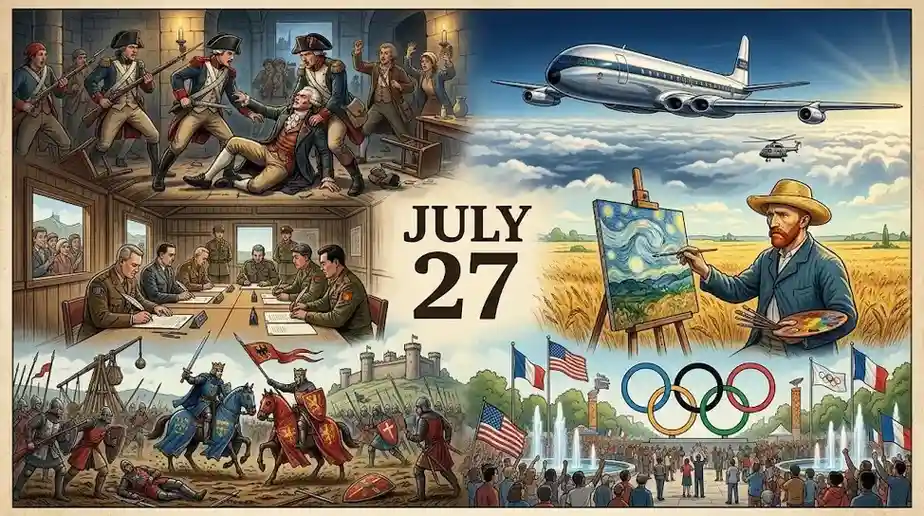
| Top 10 Key Events | Battle of Dunsinane (1054) • Battle of Bouvines (1214) • Founding of Ottoman state territory (1299) • Robespierre arrested (1794) • Van Gogh shoots himself (1890) • Insulin proven effective (1921) • Maiden flight of de Havilland Comet (1949) • Korean War Armistice (1953) • Nixon impeachment recommendation (1974) • Centennial Olympic Park bombing (1996) |
| Key Battles That Day | Dunsinane (1054), Basian (1202), Bouvines (1214), Bapheus (1302), Killiecrankie (1689), Gangut (1714), First Ushant (1778), Negro Fort (1816), Maiwand (1880) |
| Key Figures Today | Maximilien Robespierre, Vincent van Gogh, Frederick Banting, Francis Xavier, Joseph I (Holy Roman Emperor), Jacinda Ardern |
| Observances | José Celso Barbosa Day Medical Workers Day (Ukraine) Victory in the Great Fatherland Liberation War Day (North Korea) Iglesia ni Cristo Day Martyrs and Wounded Soldiers Day (Vietnam) |
Story of the Day: The Maiden Flight of the Jet Age
Test pilot John Cunningham walked out onto the tarmac at Hatfield Airfield in Hertfordshire on July 27, 1949, and climbed into the cockpit of the prototype de Havilland Comet. Up until this quiet Wednesday, commercial aviation belonged entirely to roaring, vibrating propeller planes. Cunningham brought four Ghost turbojet engines to life, released the brakes, and pushed the throttles forward. The sleek aluminum aircraft glided effortlessly off the runway, climbing gracefully into the clouds without the deafening clatter of pistons. Aviation was changed forever. The maiden flight of the world’s very first jet-powered airliner proved that passengers could travel above the weather at twice the speed of standard airliners, officially pulling international travel into the modern jet age.
Important Events That Happened On July 27 In History
1054 – Battle of Dunsinane
Earl Siward led a massive Anglo-Saxon invasion fleet north past the Firth of Forth to smash the forces of King Macbeth of Scotland. Blood washed over the Scottish hills as the bloody clash cost thousands of lives on both sides. Siward’s forces shattered Macbeth’s army and secured control of southern Scotland. The defeat crippled Macbeth’s reign and paved the way for Malcolm Canmore to claim the Scottish throne.
1189 – Barbarossa Reaches Niš
Emperor Friedrich Barbarossa marched his dust-covered Holy Roman Crusaders into Niš, the strategic capital of Serbian King Stefan Nemanja. The red-bearded ruler sought an alliance and passage through Balkan territories on his quest to reach the Holy Land. Stefan Nemanja welcomed the massive army with grand feasting, offering military aid against the Byzantine Empire. Their high-stakes meeting cemented Serbian diplomatic presence on the medieval European stage.
1202 – Battle of Basian
Queen Tamar’s Georgian forces ambushed the massive army of the Seljuk Sultanate of Rum in the mountain passes of Basian. Heavy cavalry clashed in a frantic struggle for control over the Caucasus frontier. Georgia smashed through the Turkish lines, capturing key generals and vast plunder. The triumph secured Georgia’s Golden Age and established its undisputed dominance over the region.
1214 – Battle of Bouvines
King Philip II of France faced a combined imperial force of English, German, and Flemish troops on a muddy marshland near Bouvines. Philip personally led a furious cavalry charge after being knocked off his horse and nearly killed. The French army completely routed the allied forces, taking captive powerful nobles and shattering King John of England’s continental ambitions. This crushing defeat forced King John to return home discredited, setting the stage for his barons to force the signing of the Magna Carta.
1299 – Osman I Invades Nicomedia
Osman I led a band of warrior horsemen across the border into Byzantine Nicomedia, raiding deep into imperial territory. Historian Edward Gibbon recorded this bold raid as the opening spark of a brand-new Islamic state. Osman’s forces outmaneuvered local defenders, establishing a permanent foothold in Anatolia. That single border cross-over laid the foundation for the Ottoman Empire, which ruled vast territories for six centuries.
1302 – Battle of Bapheus
Osman I rallied two thousand light cavalry to confront a formal Byzantine army sent to relieve the siege of Nicomedia. The mobile Ottoman horse archers encircled the rigid Byzantine infantry, ripping their lines apart in minutes. The defenders broke ranks and fled back toward Constantinople in total disarray. Winning this battle opened the rich countryside of Bithynia to Turkish settlement, sealing the fate of Byzantine Asia Minor.
1549 – Francis Xavier Reaches Japan
Spanish Jesuit priest Francis Xavier watched from the deck of a Chinese junk as the mist lifted over the port of Kagoshima, Japan. He stepped ashore carrying crucifixes and religious texts, becoming the first Catholic missionary to set foot in the island nation. Xavier began learning the language and meeting local samurai lords to preach Christianity. His landing opened an era of cultural exchange and rapid religious conversion across southern Japan.
1663 – Second Navigation Act
Members of the English Parliament gathered in Westminster to pass strict commercial regulations on overseas merchant ships. The new law forced all foreign goods heading to American colonies to pass through English ports on English-built vessels first. Colonial traders faced soaring prices and heavy taxes designed to enrich London merchants. The act deepened colonial resentment against imperial trade monopolies, sowing seeds of economic defiance.
1689 – Battle of Killiecrankie
Viscount Dundee led a force of Highland clansmen against a government army in a narrow Scottish mountain pass. The Jacobites waited on the high ground before launching a terrifying downhill charge through heavy musket fire. Dundee’s men crashed into the government lines, shattering the opposing army in less than thirty minutes. Though Dundee was mortally wounded during the charge, the victory gave the Jacobite cause its first hero.
1694 – Charter Granted to the Bank of England
King William III attached the royal seal to an official document creating a brand-new financial system for the realm. The royal charter formally created the Bank of England to raise money for the costly war against France. Wealthy merchants pooled their capital to lend millions directly to the government in exchange for banking privileges. This moment created the world’s first modern central bank and transformed international finance.
1714 – Battle of Gangut
Tsar Peter the Great directed Russian galleys through the fog near the Hanko Peninsula against a trapped Swedish naval squadron. Russian troops rowed directly into Swedish cannon fire before boarding the enemy warships hand-to-hand. Peter’s forces captured every single Swedish vessel in a brutal multi-hour engagement. This first major naval victory in Russian history ended Sweden’s complete dominance over the Baltic Sea.
1775 – U.S. Army Medical Department Founded
Delegates at the Second Continental Congress in Philadelphia voted to approve legislation creating a dedicated hospital system for 20,000 soldiers. General George Washington urgently needed organized medical care to stop dysentery and smallpox from destroying his young army. The resolution established the role of Director General and Physician-in-Chief with a modest budget for supplies. This decision created the foundation for today’s United States Army Medical Department.
1778 – First Battle of Ushant
Thirty British battleships maneuvered into combat formation against a matching French fleet off the coast of Brittany. Cannon smoke covered the water as both fleets traded broadsides for hours in rough seas without breaking enemy lines. Miscommunications between British commanders prevented a decisive tactical blow before night fell. The inconclusive battle sparked intense political feuds in both London and Paris over naval leadership.
1789 – Department of Foreign Affairs Created
Members of the first U.S. federal government voted to establish their very first executive administrative agency. President George Washington required an official department to manage diplomatic missions and deal with foreign powers. The agency took over secretarial duties, cataloging treaties and handling correspondence with European courts. Renamed the Department of State months later, it established the framework of American diplomacy.
1794 – Maximilien Robespierre Arrested
Maximilien Robespierre sat stunned inside the National Convention as fellow deputies shouted him down, calling for his immediate arrest. The feared architect of the Terror tried to speak, but angry delegates ordered guards to seize him and his closest allies. Placed under guard at the Hôtel de Ville, a chaotic night assault ended with Robespierre shot in the jaw. Dragged to the guillotine the next morning, his fall brought an instant end to the Reign of Terror.
1816 – Battle of Negro Fort
Gunboat No. 154 anchored in the river off Fort Apalachicola, targeting an enclave of escaped slaves and Native Americans. Navy gunners heated iron cannonballs in a furnace until they glowed bright red, then fired directly into the fort. The second heated shot pierced the fort’s open powder magazine, triggering a massive, blinding explosion. The blast killed roughly 275 people instantly, marking the deadliest single artillery shot in American history.
1857 – Defense of Arrah House
Sixty-eight British soldiers and loyal Indian troops fortified a small, two-story billiard home against thousands of attacking mutinous sepoys. The defenders dug a well inside the house, repelled constant assaults, and rationed food in intense heat. Outnumbered nearly forty to one, they held their positions for eight grueling days without breaking. Their defense ended when a relief column broke the siege, creating a key story of the 1857 Indian Rebellion.
1865 – Welsh Settlers Arrive in Chubut
One hundred and fifty-three Welsh emigrants stepped off the tea clipper Mimosa onto the desolate shores of Patagonia, Argentina. Seeking a place where their language and traditions could survive away from English pressure, they faced a dry wilderness. They built crude dugouts in the cliffs and struggled through bitter winds to find fresh water. Against heavy odds, their settlement survived, creating a Welsh-speaking community in South America.
1866 – Transatlantic Telegraph Cable Completed
Engineers aboard the massive steamship Great Eastern watched as the heavy copper cable was dragged onto the beach at Heart’s Content, Newfoundland. After multiple failed attempts and broken lines in previous years, an uninterrupted wire finally stretched back to Ireland. Operators immediately powered up the circuit and successfully sent test messages across the Atlantic Ocean floor. The achievement slashed communication times between Europe and North America from weeks to seconds.
1880 – Battle of Maiwand
Mohammad Ayub Khan deployed twenty-five thousand Afghan soldiers and artillery units against an isolated British brigade near Maiwand. Afghan ghazis charged forward under heavy fire, surrounding the outnumbered British infantry on an open, sun-baked plain. The British lines collapsed under continuous attack, resulting in a chaotic retreat toward Kandahar. The defeat stood as one of the rare complete victories by an Asian force over a Western army during the nineteenth century.
1890 – Vincent van Gogh Shoots Himself
Vincent van Gogh walked into a quiet wheat field behind the village of Auvers-sur-Oise carrying a small pocket revolver. Suffering from deep depression, the thirty-seven-year-old artist pointed the gun at his chest and pulled the trigger. The bullet deflected off a rib, missing vital organs, allowing him to stumble back to his room at the local inn. He lay in bed smoking his pipe until dying two days later with his brother Theo beside him.
1900 – Kaiser Wilhelm II’s “Hun Speech”
Kaiser Wilhelm II mounted a platform at Bremerhaven to address German troops embarking for China to suppress the Boxer Rebellion. Furious over the murder of the German ambassador, he exhorted his soldiers to show no mercy and take no prisoners. He declared that Germans should make their name feared like the Huns of King Attila centuries before. His aggressive words created a lasting stereotype, giving rise to the anti-German slur used throughout World War I.
1917 – Allies Reach the Yser Canal
British and French infantry pushed through heavy mud and shell craters toward the Yser Canal on the opening day of the Battle of Passchendaele. Soldiers waded through waterlogged terrain under heavy German machine-gun and artillery barrages. Despite severe casualties, advancing units secured strategic canal crossings and established forward positions. The ground gained marked the start of a grinding, months-long battle of attrition in the mud of Flanders.
1919 – Chicago Race Riot Begins
Eugene Williams, a Black teenager, drifted on a raft across an unofficial racial boundary line at a South Side Chicago beach. Angry white bathers threw stones at him, hitting Williams and causing him to drown in the water. Police refused to arrest the white perpetrator, sparking fights on the shore that spilled into surrounding neighborhoods. Five days of mob violence left thirty-eight people dead and over five hundred injured across the city.
1921 – Insulin Proven Effective
Frederick Banting and his assistant Charles Best monitored a diabetic dog inside a laboratory at the University of Toronto. They injected the animal with an extracted pancreatic hormone that they had isolated after months of work. Within hours, the dog’s dangerously high blood sugar levels plummeted back toward normal range. Their breakthrough proved that insulin was the key to treating diabetes, saving millions of human lives.
1929 – Geneva Convention Signed
Delegates from fifty-three nations gathered in Switzerland to sign an international treaty governing the treatment of war prisoners. The agreement mandated humane treatment, adequate food, medical care, and banned torture or reprisals against prisoners of war. Signatories established clear guidelines for Neutral Red Cross inspections of detention camps. The treaty set modern international humanitarian standards for armed conflict.
1940 – Bugs Bunny Debuts in “A Wild Hare”
Moviegoers sat in theaters as Tex Avery’s new animated short A Wild Hare flickered onto the silver screen. A gray, calm rabbit emerged from a hole, leaned casually against a rifle barrel, and asked Elmer Fudd, “What’s up, doc?” Audiences erupted in laughter at the rabbit’s cool, nonchalant attitude. That short marked the official debut of Bugs Bunny, launching the most iconic character in animation history.
1942 – First Battle of El Alamein Ends
Allied troops held their defensive lines in the Egyptian desert against the final armored push of Erwin Rommel’s Afrika Korps. General Claude Auchinleck launched series of counterattacks that ground the German advance to a dead halt just miles from the Suez Canal. Exhausted and low on fuel, Axis forces dug in, unable to break through toward the Middle Eastern oil fields. The tactical draw halted Axis expansion in North Africa, saving Egypt from invasion.
1947 – Canonization of Catherine Labouré
Pope Pius XII presided over a ceremony inside St. Peter’s Basilica to declare French nun Catherine Labouré an official saint. A century earlier, Labouré reported visions of the Virgin Mary, who instructed her to mint the Miraculous Medal. Millions of the small metal pendants had been distributed across the globe to believers seeking protection. Her canonization recognized her influence on Catholic devotional practices worldwide.
1949 – First Flight of the de Havilland Comet
John Cunningham taxied the sleek, silver de Havilland Comet onto the runway in Hertfordshire, England, for its secret initial test flight. The four internal jet engines roared as the aircraft accelerated, smoothly lifting into the air without propeller vibration. Cunningham spent thirty-one minutes putting the aircraft through basic flight maneuvers over the countryside. This maiden flight marked the birth of commercial jet aviation.
1953 – Korean War Armistice Signed
Military officers gathered inside a wooden pavilion at Panmunjom to sign an armistice ending three years of intense fighting. United States, Chinese, and North Korean commanders signed the document, establishing a four-kilometer-wide Demilitarized Zone across the peninsula. South Korean President Syngman Rhee refused to sign the agreement, though he pledged to respect the cease-fire. The signature froze the conflict in place, leaving North and South Korea technically at war to this day.
1955 – Austrian State Treaty Takes Effect
Diplomats in Vienna celebrated as sovereign authority was restored to Austria following ten years of joint Allied occupation. Foreign military forces from the United States, Britain, France, and the Soviet Union packed up and withdrew from the country. In exchange for independence, Austria passed a constitutional law declaring its permanent military neutrality. The treaty turned Austria into a neutral buffer zone in the middle of Cold War Europe.
1955 – El Al Flight 402 Shot Down
An El Al Constellation airliner carrying fifty-eight people drifted slightly off course during a flight from Vienna to Tel Aviv. Two Bulgarian MiG-15 fighter jets intercepted the civilian plane as it entered Bulgarian airspace and opened fire without warning. The damaged airliner broke apart in mid-air and crashed near the town of Petrich, killing everyone on board. Bulgaria later apologized and agreed to pay compensation to the victims’ families.
1959 – Continental League Announced
Attorney William Shea stood before press reporters in New York to announce the creation of the Continental League as baseball’s third major league. Major League Baseball had repeatedly rejected requests to place new franchises in major cities like New York, Minneapolis, and Atlanta. The bold move threatened the monopoly of existing team owners. Facing competition, Major League Baseball agreed to expand its existing leagues, bringing teams to those unserved markets.
1963 – Puijo Observation Tower Opens
Crowds of locals gathered on Puijo Hill in Kuopio, Finland, for the grand opening of a seventy-five-meter observation tower. Visitors rode elevators up to enjoy panoramic views of the surrounding Finnish lake district and countryside. The structure featured the very first revolving restaurant in the Nordic region, turning a full circle every hour. It quickly became a major architectural landmark and tourist attraction for eastern Finland.
1964 – U.S. Sends 5,000 Military Advisers to Vietnam
American defense officials announced that five thousand additional military advisers were heading to South Vietnam. The deployment brought total United States military personnel in the region to twenty-one thousand troops. President Lyndon Johnson ordered the expansion to bolster South Vietnamese forces fighting against Viet Cong guerrillas. The move marked a major escalation in direct American military involvement in Southeast Asia.
1974 – House Committee Recommends Nixon Impeachment
Members of the House Judiciary Committee sat in a packed, televised hearing room as the clerk read out the roll-call vote. By a vote of 27 to 11, six Republicans joined Democrats to pass the first article of impeachment against President Richard Nixon. The charge cited obstruction of justice in covering up the Watergate break-in. The vote made Nixon’s removal from office almost certain, leading directly to his resignation two weeks later.
1975 – Mayor of Jaffna Assassinated
Alfred Duraiappah, the Mayor of Jaffna, walked toward the Krishnan temple when young gunmen stepped out and drew pistols. The attackers shot Duraiappah at point-blank range before fleeing the scene in his stolen car. Velupillai Prabhakaran, leader of the nascent Tamil Tigers, claimed responsibility for the murder, targeted because of Duraiappah’s ties to the central government. The assassination marked the first major political killing in the rising Sri Lankan ethnic conflict.
1981 – Aeromexico Flight 230 Overruns Runway
Aeromexico Flight 230 touched down in dark, stormy weather at Chihuahua International Airport in Mexico. Strong wind shear slammed the DC-9 hard onto the tarmac, causing the aircraft to bounce and break off its landing gear. The plane slid off the runway, broke apart, and caught fire in a nearby field. Thirty-two of the sixty-six people on board lost their lives in the crash.
1983 – Welikada Prison Massacre
Ethnic violence spilled into Welikada High Security Prison in Colombo, Sri Lanka, for the second day in a row. A mob of Sinhalese prisoners broke through security doors and attacked Tamil political prisoners with iron bars and knives. Guard staff failed to intervene as eighteen Tamil inmates were murdered inside their cells. The prison attacks formed a brutal part of Black July, accelerating the full-scale outbreak of the Sri Lankan Civil War.
1989 – Korean Air Flight 803 Crashes in Tripoli
Korean Air Flight 803 descended through dense fog on its final approach to Tripoli International Airport in Libya. Heavy mist obscured the runway, causing the DC-10 to drop too low and strike orchard trees a mile short of the landing strip. The plane slammed into several houses and exploded, killing seventy-five people on board and four on the ground. The tragedy occurred less than two weeks after another fatal DC-10 crash in Iowa.
1990 – Coup Attempt in Trinidad and Tobago
Forty-two armed insurgents from the Jamaat al Muslimeen storm-trooped into the Red House parliament building in Port of Spain. They took Prime Minister A.N.R. Robinson and several cabinet ministers hostage at gunpoint, while another group seized the national television station. Fires broke out in the capital as looting erupted during the sudden political crisis. The standoff lasted six tense days before the rebels surrendered to security forces.
1995 – Korean War Veterans Memorial Dedicated
President Bill Clinton and South Korean President Kim Young-sam gathered on the National Mall in Washington, D.C., for a dedication ceremony. The new memorial featured nineteen stainless-steel statues depicting a squad of soldiers on patrol in harsh terrain. The site honored the hundreds of thousands of Allied soldiers who served in the conflict. The design ensured the “Forgotten War” received a permanent public place of honor.
1996 – Centennial Olympic Park Bombing
Thousands of spectators gathered for an outdoor concert at Centennial Olympic Park during the Summer Games in Atlanta. Security guard Richard Jewell noticed an abandoned green backpack under a bench and immediately alerted bomb technicians. As police began clearing the crowd, a powerful pipe bomb packed with nails detonated inside the bag. The blast killed one person and injured over one hundred others, casting a shadow over the Olympic Games.
1997 – Si Zerrouk Massacre
Armed militants belonging to the Armed Islamic Group surrounded the isolated village of Si Zerrouk in Algeria under cover of night. Attackers went from house to house, setting fire to homes and attacking residents with blades and firearms. Around fifty villagers were killed during the overnight assault before military units could respond. The raid stood as one of many massacres during the Algerian Civil War.
2002 – Ukraine Airshow Disaster
A Sukhoi Su-27 fighter jet pulled into a rolling maneuver at low altitude during an air display at Sknyliv airfield near Lviv, Ukraine. The aircraft stalled, clipped a tree, and slammed directly into the dense crowd of spectators before exploding. Both pilots ejected safely, but seventy-seven people on the ground were killed and over five hundred injured. It remains the deadliest air show accident in world history.
2015 – Gurdaspur Police Station Attack
Three heavily armed gunmen dressed in army fatigues crossed the border and hijacked a car in the Gurdaspur district of Punjab, India. The attackers stormed the local Dinanagar police station, opening fire on officers and civilians inside. A twelve-hour standoff ensued as elite SWAT teams surrounded the compound and engaged in a heavy firefight. All three attackers were killed, along with seven innocent people.
Uncover more of our curated historical moments here.
Famous People Born on July 27
| Name | Description | Dates |
|---|---|---|
| Wolfgang Langewiesche | German-American aviation pioneer and author | 1907 – 2002 |
| Norman Lear | American television producer and writer | 1922 – 2023 |
| Jack Higgins | British bestselling thriller novelist | 1929 – 2022 |
| Jerry Van Dyke | American actor and comedian | 1931 – 2018 |
| José Celso Martinez Corrêa | Brazilian playwright and theater director | 1937 – 2023 |
| Don Galloway | American television and film actor | 1937 – 2009 |
| B. Saroja Devi | Indian film actress | 1938 – 2025 |
| Pina Bausch | German choreographer and modern dance pioneer | 1940 – 2009 |
| Bharati Mukherjee | Indian-American novelist | 1940 – 2017 |
| Bobbie Gentry | American singer-songwriter | 1942 – Present |
| John Pitre | American science fiction artist | 1942 – Present |
| Mick Jagger | English singer, songwriter, and co-founder of The Rolling Stones | 1943 – Present |
| Yuen Woo-ping | Hong Kong martial arts choreographer and film director | 1945 – Present |
| Jean-Luc Thérier | French rally driver | 1945 – 2019 |
| Peggy Fleming | American Olympic figure skating champion | 1948 – Present |
| Maureen McGovern | American singer and actress | 1949 – Present |
| Allan Simonsen | Danish footballer and Ballon d’Or winner | 1952 – Present |
| Mariya Takeuchi | Japanese singer-songwriter | 1955 – Present |
| Jonathan Reed | British historian and biblical scholar | 1967 – Present |
| Julian McMahon | Australian actor | 1968 – 2025 |
| Triple H (Paul Levesque) | American professional wrestler and WWE executive | 1969 – Present |
| Charlotte Gainsbourg | French-British actress and singer | 1971 – Present |
| Maya Rudolph | American actress and comedian | 1972 – Present |
| Vijay | Indian actor and playback singer | 1974 – Present |
| Alex Rodriguez | American baseball superstar and MLB legend | 1975 – Present |
| Jonathan Rhys Meyers | Irish actor and musician | 1977 – Present |
| Taylor Schilling | American actress | 1984 – Present |
| Myles Garrett | American NFL player | 1995 – Present |
Famous People Died on July 27
| Name | Description | Dates |
|---|---|---|
| Johann Sebastian Bach | German composer and Baroque music genius | 1685 – 1750 |
| Makoto Saito | Japanese admiral and Prime Minister | 1858 – 1936 |
| Mikhail Gromov | Soviet test pilot | 1899 – 1985 |
| Frank Zamboni | American inventor of the ice resurfacing machine | 1901 – 1988 |
| William Wyler | American Academy Award-winning film director | 1902 – 1981 |
| Leo Durocher | American Baseball Hall of Fame manager | 1905 – 1991 |
| Yousuf Karsh | Armenian-Canadian portrait photographer | 1908 – 2002 |
| James Mason | English actor | 1909 – 1984 |
| Raúl Argüelles | Peruvian physician | 1917 – 2000 |
| Rade Marković | Serbian actor | 1921 – 2010 |
| Ivan Illich | Austrian philosopher and social critic | 1926 – 2002 |
| Harold Prince | American Broadway producer and director | 1928 – 2019 |
| Pierre Vidal-Naquet | French historian | 1930 – 2006 |
| A. P. J. Abdul Kalam | Indian aerospace scientist and 11th President of India | 1931 – 2015 |
| Ebrahim Yazdi | Iranian politician and foreign minister | 1931 – 2017 |
| M. Cherif Bassiouni | Egyptian-American jurist and human rights expert | 1937 – 2017 |
| Sam Shepard | American Pulitzer Prize-winning playwright and actor | 1943 – 2017 |
| John Robinson | American choreographer | 1944 – 2011 |
| Jerry Doyle | American actor and radio host | 1956 – 2016 |
| Taylor Negron | American actor and comedian | 1957 – 2015 |
| Kevin Carter | South African Pulitzer Prize-winning photojournalist | 1960 – 1994 |
| Julian McMahon | Australian actor | 1968 – 2025 |
| Mahmoud Abu Warda | Palestinian militant leader | 1973 – 2002 |
| Bobbi Kristina Brown | American television personality and singer | 1993 – 2015 |
Observances on July 27
- José Celso Barbosa Day (Puerto Rico): Celebrates the birth of Dr. José Celso Barbosa, a physician and political leader known as the father of Puerto Rico’s statehood movement.
- Medical Workers Day (Ukraine): Honors the dedication of healthcare professionals and emergency medical responders serving across the country.
- Day of Victory in the Great Fatherland Liberation War (North Korea): A public holiday celebrating the signing of the 1953 armistice as a military victory.
- Iglesia ni Cristo Day (Philippines): Marks the official foundation anniversary of the Iglesia ni Cristo church, established by Felix Manalo in 1914.
- Martyrs and Wounded Soldiers Day (Vietnam): A solemn day dedicated to honoring fallen military personnel and supporting disabled veterans.
⚖️ Frequently Asked Questions — July 27 in History
Maximilien Robespierre was arrested in Paris by members of the National Convention. His arrest brought a sudden end to the Reign of Terror, halting the mass executions that had gripped France.
The Korean War armistice was signed on July 27, 1953, at Panmunjom. The agreement ended active military combat on the peninsula and established the Demilitarized Zone.
Joseph I Holy Roman Emperor and Jacinda Ardern 40th Prime Minister of New Zealand were both born on July 27. A complete list of historic figures connected to this date can be found in our main entry section above.
The arrest of Maximilien Robespierre in 1794 stands out as the most significant event. It broke the violent hold of the French Revolution’s radical faction and shifted European political history.
José Celso Barbosa Day honors the Puerto Rican physician and political leader who championed statehood for the island. Citizens celebrate his medical contributions and political legacy every July 27.
Heavy gunmen attacked a police station in Punjab, India, leading to a long standoff in 2015. Additionally, a fighter jet crash in Ukraine marked the world’s deadliest airshow accident in 2002.