| Event Category | Key Historical Details |
|---|---|
| Most Significant Event | Austria-Hungary declares war on Serbia, starting World War I (1914) |
| Top Key Events | Execution of Robespierre • Battle of Ankara • July Crisis escalation • Tangshan Earthquake • IRA ends armed campaign |
| Key Battles That Day | Battle of Cascina, Battle of Ankara, Battle of Warsaw, Battle of Talavera, Battle of Ezra Church |
| Key Figures Today | Maximilien Robespierre, Sultan Mahmud II, General William T. Sherman, Ian Thorpe |
| Observances | World Hepatitis Day Fiestas Patrias (Peru) Ólavsøka Eve (Faroe Islands) Day of Commemoration of the Great Upheaval (Canada) Liberation Day (San Marino) |
Story of the Day: The Shot That Set Europe Ablaze
Count Leopold Berchtold signed the official declaration of war in Vienna, dispatching a simple telegram to Belgrade. Serbia’s rejection of Austro-Hungarian demands had run out the clock on diplomacy. Archduke Franz Ferdinand’s assassination four weeks earlier had sparked a diplomatic standoff, but this signature turned political tension into actual military aggression. Within days, complex military alliances pulled Russia, Germany, France, and Britain straight into the conflict. A localized Balkan quarrel had transformed overnight into the deadliest global catastrophe humanity had ever witnessed.
Important Events That Happened On July 28 In History
484 – Acacian Schism Begins
Pope Felix III formally excommunicated Patriarch Acacius of Constantinople inside the walls of Old St. Peter’s Basilica. Acacius had backed the imperial compromise known as the Henoticon, which Rome viewed as heresy against established church doctrine. The bold papal decree shattered religious unity between Western and Eastern Christianity. This theological split lasted thirty-five years and permanently deepened the rift between Rome and Constantinople.
1364 – Battle of Cascina
Florentine troops led by Galeotto Malatesta ambushed the invading forces of Pisa near the Arno River. The Pisan soldiers had unbuckled their armor to bathe in the summer heat, completely unprepared for an attack. Florentine cavalry charged the exposed lines and routed the enemy force in hours. Florence secured its regional dominance and protected its vital trade routes toward the Tuscan coast.
1402 – Battle of Ankara
Turco-Mongol warlord Timur deployed armored war elephants against the forces of Ottoman Sultan Bayezid I on the plain of Çubuk. Bayezid’s mercenary flanks defected mid-fight, leaving the core Ottoman infantry totally encircled. Timur crushed the main army and took the Sultan prisoner inside an iron cage. The Ottoman Empire collapsed into a decade of bloody civil strife known as the Ottoman Interregnum.
1540 – Henry VIII Marries Catherine Howard
King Henry VIII stood beside sixteen-year-old Catherine Howard at Oatlands Palace to recite his fifth wedding vows. The aging monarch sought a young, vibrant bride to restore his youthful vigor after his failed marriage to Anne of Cleves. Court factions celebrated the union as a major victory for conservative Catholic noble families. The reckless marriage ended tragically less than two years later on the executioner’s block.
1540 – Execution of Thomas Cromwell
Thomas Cromwell walked up the scaffold at Tower Hill without ever receiving a formal court trial. King Henry VIII had sacrificed his loyal Chief Minister under a bill of attainder brought by political enemies. The headsman took multiple strikes to complete the clumsy execution. England lost the administrative genius who had engineered the Reformation and built the modern Tudor state.
1571 – Foundation of La Laguna Encomienda
Spanish conquistador Miguel López de Legazpi declared the establishment of the La Laguna encomienda in the Luzon highlands. Crown officials granted vast tracts of native land and labor to Spanish military officers. Local Tagalog communities were forced into the colonial taxation system. The territory grew into the Laguna province, becoming one of the oldest administrative regions in the Philippines.
1635 – Spanish Capture Schenkenschans
Spanish infantry stormed the river fortress of Schenkenschans during a surprise nighttime assault along the Rhine. The fort controlled the critical junction where the Rhine and Waal rivers divided into the Dutch heartland. Dutch commanders panicked as the fall of the stronghold opened their eastern frontier to direct invasion. The Dutch army spent nearly a year of hard siege warfare to win the fort back.
1656 – Battle of Warsaw
King Charles X Gustav of Sweden launched a combined Swedish-Brandenburg attack against Polish forces outside the city walls. Polish cavalry charged with traditional lances but failed to breach the tight Swedish infantry lines. Three days of brutal urban fighting left the Polish army fractured and in full retreat. The engagement marked a decisive tactical turning point during the Second Northern War.
1778 – Ratification of the Cantabria Constitution
Delegates gathered at the Assembly Hall in Bárcena la Puente to formally ratify the Constitution of Cantabria. Local representatives united several independent coastal valleys under a single legal framework. The agreement established local governance rights and protected regional tax privileges against central royal overreach. The historic vote created the political identity of modern northern Spain.
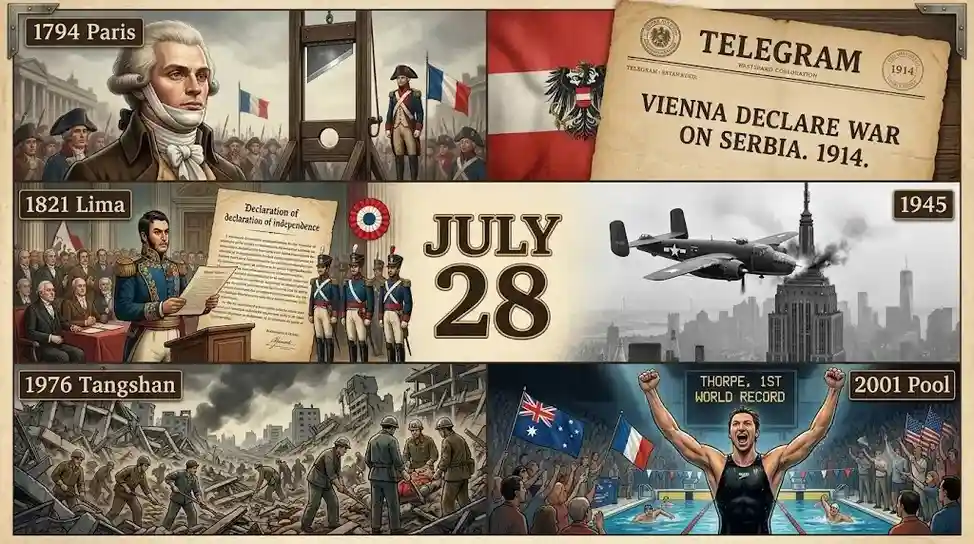
1794 – Maximilien Robespierre Guillotined
Guards dragged Maximilien Robespierre through a screaming crowd to the Place de la Révolution in Paris. The National Convention had turned against its terrifying dictator after months of relentless executions. Robespierre was bound to the plank and executed alongside his closest ally, Louis Antoine de Saint-Just. Their deaths ended the Reign of Terror and dismantled the most radical phase of the French Revolution.
1808 – Mahmud II Becomes Ottoman Sultan
Rebel janissaries broke into the Topkapi Palace and proclaimed Prince Mahmud as the new Ottoman Sultan. Mahmud climbed to the throne right as his brother spent his last moments dying in a royal palace coup. The young Sultan immediately set out to centralize imperial control and curb military mutinies. His eventual reign modernized the empire’s military and laid the groundwork for nineteenth-century Ottoman reforms.
1809 – Battle of Talavera
Sir Arthur Wellesley lined up his British and Spanish infantry along the rugged ridges of Talavera to face French forces under Joseph Bonaparte. French infantry units launched repeated frontal charges uphill, but disciplined British volley fire threw them back each time. The French withdrew from the field by nightfall after suffering heavy casualties. Wellesley was awarded the title Viscount Wellington for his firm defense of Spain.
1821 – Peru Declares Independence
General José de San Martín stepped onto a wooden platform in the Plaza Mayor of Lima and declared Peruvian independence. Spanish royalist troops had retreated into the Andes mountains, leaving the colonial capital open to liberating forces. San Martín raised the new national flag before a cheering crowd of thousands. The proclamation shattered three centuries of Spanish imperial dominance over South America’s richest viceroyalty.
1854 – Commissioning of the USS Constellation
Naval officers raised the American flag aboard the USS Constellation at the Gosport Shipyard in Virginia. Workers built the sloop-of-war as a modern warship equipped with heavy shell-firing cannon. She sailed as the final sail-only combat vessel constructed for the United States Navy. Today the ship rests in Baltimore Harbor as an active museum memorializing maritime history.
1864 – Battle of Ezra Church
General John Bell Hood hurled Confederate regiments against entrenched Union positions west of Atlanta. General William T. Sherman’s soldiers repulsed three successive Southern charges with concentrated rifle fire. Hood lost thousands of veterans without breaking the Union supply line encircling the city. The defeat forced Southern commanders closer to losing Atlanta entirely.
1866 – Vinnie Ream Receives Congressional Commission
Eighteen-year-old sculptor Vinnie Ream signed a formal contract with United States government officials in Washington. Congress had chosen the young artist to carve a full-scale marble statue of Abraham Lincoln. She became the youngest person and first woman ever awarded a federal art commission. Her completed statue still stands inside the Rotunda of the United States Capitol.
1868 – 14th Amendment Certified
Secretary of State William H. Seward issued an official certificate confirming the ratification of the 14th Amendment. The constitutional change granted full citizenship to formerly enslaved African Americans across the nation. It explicitly guaranteed equal protection under the law and due process to every citizen. The amendment fundamentally reshaped American civil rights law for generations to come.
1883 – Ischia Earthquake
A sudden magnitude 4.3 earthquake struck the volcanic island of Ischia off the coast of Naples. Stone houses and resort hotels in the town of Casamicciola collapsed instantly into rubble. Over 2,300 residents and summer tourists died beneath the fallen masonry. The disaster prompted the Italian government to establish stricter building standards for earthquake-prone zones.
1896 – Incorporation of Miami
Julia Tuttle and a small group of local landowners met in a wooden storefront to vote on incorporating the city of Miami. Standard Oil tycoon Henry Flagler had extended his Florida East Coast Railway down to the small settlement earlier that year. Three hundred and forty-four men cast their ballots to approve municipal status. The isolated trading post transformed into a major metropolis.
1911 – Australasian Antarctic Expedition Departs
Captain John King Davis guided the research ship SY Aurora out of London docks toward southern oceans. Australian explorer Douglas Mawson had organized the expedition to map thousands of miles of uncharted Antarctic coastlines. Scientists packed cold-weather gear, sled dogs, and advanced radio equipment for the polar journey. The voyage yielded vast geographical and magnetic data about the frozen continent.
1914 – World War I Begins
Austro-Hungarian diplomats sent a formal declaration of war to the Serbian government via telegram. Austria blamed Serbian elements for the assassination of Archduke Franz Ferdinand and demanded full territorial access. The military invasion opened fire across the Danube River that same evening. The localized conflict dragged global superpowers into four long years of trench warfare.
1915 – United States Occupies Haiti
United States Marines waded ashore at Port-au-Prince following the assassination of Haitian President Vilbrun Guillaume Sam. President Woodrow Wilson ordered military forces in to protect American financial assets and prevent European intervention. Marine units disarmed local militias and took control of customs houses. The military occupation lasted nineteen years, deeply shaping Haitian politics.
1917 – Silent Parade in New York
Over ten thousand African Americans marched down Fifth Avenue in total silence to the beat of muffled drums. The NAACP organized the protest to condemn recent race riots, lynchings, and mob violence in East St. Louis. Marchers carried banners demanding civil rights and an end to racial violence. It marked the first major mass street protest against racial terror in American history.
1932 – Eviction of the Bonus Army
General Douglas MacArthur led armed troops and tanks into the Bonus Army encampment at Anacostia Flats. Thousands of World War I veterans had camped in Washington demanding early payment of promised service bonuses. Military forces used tear gas and bayonets to clear the shantytown and burn the makeshift shelters. The violent eviction shocked the American public during the depth of the Great Depression.
1935 – First Flight of the B-17 Flying Fortress
Test pilot Leslie Tower throttled up four engines and lifted the Boeing Model 299 prototype off the runway at Seattle. Engineers designed the heavy bomber to carry heavy bomb loads over long ocean ranges. The design featured multiple defensive machine-gun turrets built into its aluminum airframe. The aircraft evolved into the iconic B-17 Flying Fortress used during World War II.
1938 – Disappearance of the Hawaii Clipper
The Hawaii Clipper flying boat lost radio contact while flying over open water between Guam and Manila. Nine crew members and six passengers vanished along with the giant Pan American airliner. Search planes swept thousands of square miles of the Pacific Ocean without finding floating debris. The incident recorded the first total loss of an airliner in trans-Pacific commercial aviation.
1939 – Discovery of the Sutton Hoo Helmet
Archaeologist Basil Brown unearthed crushed iron fragments inside an Anglo-Saxon burial ship in Suffolk, England. Restorers pieced together the decorative iron faceplate and helmet of a 7th-century East Anglian king. The site contained gold jewelry, silver feast bowls, and ornate ceremonial weapons. The discovery reshaped modern understanding of early medieval British culture.
1942 – Stalin Issues Order No. 227
Joseph Stalin signed Soviet Military Order No. 227, famously known across the front lines as “Not a Step Back!” The directive barred officers and soldiers from retreating without explicit high-command authorization. Commanders sent violators directly to penal battalions or executed them on the spot. The brutal order forced Soviet forces to hold their ground at Stalingrad.
1943 – Operation Gomorrah Firestorm
Royal Air Force bombers dropped thousands of incendiary bombs on the residential districts of Hamburg, Germany. High winds and extreme dry heat fused individual fires into an unstoppable column of flame. The firestorm consumed entire neighborhoods and killed over 42,000 civilians in a single night. It demonstrated the horrifying destructive power of concentrated strategic aerial bombing.
1945 – Empire State Building B-25 Crash
Lt. Col. William Smith lost his orientation in heavy fog and crashed a B-25 bomber into the Empire State Building. The twin-engine plane ripped a hole between the 78th and 79th floors, showering street pedestrians with burning aviation fuel. Fourteen people died, but structural steel beams kept the skyscraper from collapsing. Operators reopened the building for business just two days later.
1957 – Isahaya Mudslide Disaster
Torrential monsoon rains poured over western Kyushu, triggering massive landslides along the hillsides of Isahaya, Japan. Torrents of mud and mountain debris swept through densely populated valleys, destroying hundreds of homes. Emergency crews struggled through flooded roads to rescue trapped survivors. The disaster took 992 lives and forced major flood-control projects across the country.
1960 – Volkswagen Act Enacted
The West German Parliament passed the Volkswagen Act to privatize the state-owned car manufacturer. The legislation transferred majority shares of the automaker to public investors while keeping strategic veto power with local government. The law protected the company from corporate takeovers and secured worker representation. It helped turn the Beetle into a global automotive powerhouse.
1962 – 8th World Festival of Youth Opens
Delegates from over one hundred countries gathered in Helsinki for the 8th World Festival of Youth and Students. Soviet-aligned organizations funded the gathering to build political influence among international youth movements. Anti-communist student groups staged large counter-demonstrations across the city streets. The event reflected deep Cold War ideological battles fought through cultural diplomacy.
1965 – Johnson Escalates Vietnam War
President Lyndon B. Johnson announced a dramatic expansion of American military forces in South Vietnam. He increased troop deployments from 75,000 to 125,000 soldiers and doubled monthly draft calls. The decision marked a shift from advisory support to direct ground combat operations. The commitment plunged the United States into a prolonged military draft and a contentious war.
1973 – Summer Jam at Watkins Glen
Nearly 600,000 rock music fans gathered at the Watkins Glen International Raceway in New York. The Allman Brothers Band, The Grateful Dead, and The Band performed across a massive outdoor stage. Traffic jams backed up for miles along rural roads as crowds doubled the size of Woodstock. The concert set a record for the largest audience at a pop festival.
1974 – Formation of Spetsgruppa A
KGB Chairman Yuri Andropov signed a secret decree creating Spetsgruppa A as Russia’s elite counter-terrorism unit. Military officials formed the specialized team to counter hijacking threats ahead of the 1980 Moscow Olympics. Recruits underwent rigorous hand-to-hand combat training and tactical marksmanship. The secretive group became the premier special operations force known today as Alpha Group.
1976 – Tangshan Earthquake
A magnitude 7.8 earthquake struck the industrial city of Tangshan in northern China while residents slept. Brick apartment buildings and factories collapsed in seconds, trapping hundreds of thousands beneath concrete slabs. Official reports recorded 242,769 fatalities, making it one of the deadliest earthquakes in human history. The disaster exposed severe structural weaknesses in unreinforced urban construction.
1984 – Opening of the Los Angeles Olympics
Rafer Johnson lit the Olympic flame inside the Los Angeles Memorial Coliseum to open the Games of the XXIII Olympiad. Fourteen Eastern Bloc nations boycotted the sporting event in response to the American-led boycott of the 1980 Moscow Games. Private corporate sponsorships funded the operational budget for the first time in modern Olympic history. The Games delivered a financial surplus and set new standards for sports marketing.
1996 – Discovery of Kennewick Man
Two spectators watching a hydroplane race found a human skull along the banks of the Columbia River in Washington. Radiocarbon tests dated the ancient skeleton back over 9,000 years, making it one of the oldest complete human remains in North America. Native American tribes requested the remains for traditional reburial under federal repatriation laws. The discovery sparked a twenty-year legal battle between scientists and indigenous groups.
2001 – Ian Thorpe’s Sixth Gold Medal
Australian swimmer Ian Thorpe touched the wall first in the 800-meter freestyle at the World Championships in Fukuoka. The win earned him his sixth gold medal at a single international championship event. Thorpe broke multiple world records during the week with his signature powerful leg kick. His historic performance set a record in modern competitive swimming.
2002 – Quecreek Mine Rescue
Rescue workers broke through nine hundred feet of solid rock to free nine trapped miners in Somerset County, Pennsylvania. The miners had survived seventy-seven hours in a dark, flooded mine shaft by breathing compressed air pockets. Operations relied on giant drill rigs working around the clock to sink an air pipe. All nine men emerged alive to national media celebration.
2002 – Pulkovo Flight 9560 Crash
An Ilyushin Il-86 passenger jet crashed seconds after takeoff from Sheremetyevo International Airport in Moscow. The tail section pitched violently upward due to a mechanical trim failure, causing the aircraft to stall. The plane impacted a wooded area outside the airport perimeter, killing 14 of the 16 crew members aboard. The crash prompted stricter pre-flight safety inspections across Russian aviation fleets.
2005 – Provisional IRA Ends Armed Campaign
The Provisional Irish Republican Army issued a formal statement ordering an end to its thirty-year armed campaign in Northern Ireland. The leadership commanded all units to dump arms and pursue political goals purely through peaceful democratic channels. Independent monitors verified the complete decommissioning of the group’s weapons arsenals. The announcement solidified the peace process established under the Good Friday Agreement.
2010 – Airblue Flight 202 Crash
Airblue Flight 202 crashed into the fog-shrouded Margalla Hills while attempting a rainy landing at Islamabad, Pakistan. The Airbus A321 struck steep mountain terrain after the flight crew deviated from standard approach procedures. All 152 passengers and crew members died instantly on impact. The accident recorded the deadliest aviation disaster in Pakistani history.
2011 – Asiana Airlines Flight 991 Crash
An Asiana Airlines Boeing 747 freighter developed an intense cargo fire while flying over the sea near Jeju Island. The crew attempted an emergency landing, but fire destroyed critical flight control systems before they reached the runway. The cargo aircraft crashed into open waters, killing both pilots on board. The crash triggered new international safety rules for shipping lithium-ion batteries by air.
2017 – Disqualification of Nawaz Sharif
The Supreme Court of Pakistan issued a unanimous ruling disqualifying Prime Minister Nawaz Sharif from public office for life. Investigative reports linked his family assets to offshore companies listed in the Panama Papers leaks. The court ruled that Sharif had failed to declare financial earnings on his nomination papers. The decision forced his immediate resignation and threw Pakistani politics into turmoil.
2018 – Wendy Tuck Wins Clipper Race
Australian skipper Wendy Tuck steered her yacht Sanya Serenity across the finish line in Liverpool. She became the first female captain to win the grueling 40,000-mile Clipper Round the World Yacht Race. Her crew navigated through violent ocean storms and equipment failures across eleven race legs. The win marked a historic milestone for women in professional sailing.
2022 – Eastern Kentucky Floods
Torrential mountain rains dropped over eight inches of water across eastern Kentucky in less than twenty-four hours. Fast-rising creek waters swept away roads, bridges, and hundreds of residential homes in isolated Appalachian hollows. Emergency crews deployed helicopters and boats to rescue families stranded on rooftops. The catastrophic flooding claimed 45 lives and destroyed local community infrastructure.
Dive into our full collection of past daily stories here.
Famous People Born on July 28
| Name | Description | Dates |
|---|---|---|
| Margaret of Durazzo | Queen of Naples and Hungary | 1347 – 1412 |
| Jacopo Sannazaro | Italian Renaissance poet and humanist | 1458 – 1530 |
| Ludwig Feuerbach | German philosopher and anthropologist | 1804 – 1872 |
| Gerard Manley Hopkins | English poet | 1844 – 1889 |
| Beatrix Potter | English children’s author and illustrator | 1866 – 1943 |
| Marcel Duchamp | French-American artist and pioneer of modern art | 1887 – 1968 |
| Karl Popper | Austrian-British philosopher of science | 1902 – 1994 |
| Albert Namatjira | Australian Aboriginal painter | 1902 – 1959 |
| Earl Tupper | American inventor, founder of Tupperware | 1907 – 1983 |
| Malcolm Lowry | English novelist and poet | 1909 – 1957 |
| Charles H. Townes | American physicist, Nobel Prize winner | 1915 – 2015 |
| Jacques Piccard | Swiss oceanographer and deep-sea explorer | 1922 – 2008 |
| Baruch S. Blumberg | American physician, Nobel Prize winner | 1925 – 2011 |
| John Ashbery | American Pulitzer Prize-winning poet | 1927 – 2017 |
| Jacqueline Kennedy Onassis | First Lady of the United States | 1929 – 1994 |
| Firoza Begum | Bangladeshi Nazrul Sangeet singer | 1930 – 2014 |
| Garfield Sobers | Barbadian cricket legend | 1936 – Present |
| Alberto Fujimori | President of Peru | 1938 – 2024 |
| Riccardo Muti | Italian orchestral conductor | 1941 – Present |
| Bill Bradley | American basketball player and politician | 1943 – Present |
| Richard Wright | English musician, co-founder of Pink Floyd | 1943 – 2008 |
| Jim Davis | American cartoonist, creator of Garfield | 1945 – Present |
| Fahmida Riaz | Pakistani poet and writer | 1946 – 2018 |
| Santiago Calatrava | Spanish architect and engineer | 1951 – Present |
| Vajiralongkorn | King of Thailand | 1952 – Present |
| Hugo Chávez | President of Venezuela | 1954 – 2013 |
| Terry Fox | Canadian athlete and cancer awareness activist | 1958 – 1981 |
| Dana White | American businessman, UFC president | 1969 – Present |
| Manu Ginóbili | Argentine basketball Hall of Famer | 1977 – Present |
| Harry Kane | English footballer | 1993 – Present |
Famous People Died on July 28
| Name | Description | Dates |
|---|---|---|
| Theodosius II | Roman Emperor | 401 – 450 |
| Victor II | Pope of the Catholic Church | 1018 – 1057 |
| Rodrigo de Bastidas | Spanish explorer, founder of Santa Marta | 1460 – 1527 |
| Thomas Cromwell | English statesman and chief minister to Henry VIII | 1495 – 1540 |
| Antonio Vivaldi | Italian Baroque composer | 1678 – 1741 |
| Johann Sebastian Bach | German composer and musical genius | 1685 – 1750 |
| Maximilien Robespierre | Leader of the French Revolution | 1758 – 1794 |
| Selim III | Ottoman Sultan and reformer | 1761 – 1808 |
| Gaspard Monge | French mathematician and founder of descriptive geometry | 1746 – 1818 |
| Nathan Mayer Rothschild | British banker and financier | 1777 – 1836 |
| Joseph Bonaparte | King of Spain and brother of Napoleon | 1768 – 1844 |
| Jan Evangelista Purkyně | Czech anatomist and physiologist | 1787 – 1869 |
| Moses Montefiore | British philanthropist and banker | 1784 – 1885 |
| Flinders Petrie | English archaeologist and Egyptologist | 1853 – 1942 |
| Saint Alphonsa | First Indian woman canonized as a Catholic saint | 1910 – 1946 |
| Otto Hahn | German chemist, Nobel Prize winner | 1879 – 1968 |
| Frank Loesser | American composer and songwriter | 1910 – 1969 |
| Keith Green | American Christian singer-songwriter | 1953 – 1982 |
| Roger Tory Peterson | American naturalist and ornithologist | 1908 – 1996 |
| Trygve Haavelmo | Norwegian economist, Nobel Prize winner | 1911 – 1999 |
| Ahmed Sofa | Bangladeshi author and intellectual | 1943 – 2001 |
| Francis Crick | British molecular biologist, co-discoverer of DNA structure | 1916 – 2004 |
| David Gemmell | British fantasy novelist | 1948 – 2006 |
| Mahasweta Devi | Indian novelist and social activist | 1926 – 2016 |
| Clive Rice | South African cricketer | 1949 – 2015 |
| Dusty Hill | American musician, bassist of ZZ Top | 1949 – 2021 |
| Bernard Cribbins | English actor and comedian | 1928 – 2022 |
| Francine Pascal | American author, creator of Sweet Valley High | 1932 – 2024 |
| Laura Dahlmeier | German Olympic biathlete | 1993 – 2025 |
| John Anderson | Scottish television personality and coach | 1931 – 2024 |
Observances on July 28
- World Hepatitis Day: Established by the World Health Organization to raise global awareness about viral hepatitis infection and treatment access.
- Fiestas Patrias (Peru): Commemorates Peru’s 1821 declaration of independence from Spanish rule with parades and military reviews.
- Ólavsøka Eve (Faroe Islands): Marks the opening of the Faroese parliament with traditional folk dances, concerts, and rowing races.
- Day of Commemoration of the Great Upheaval (Canada): Remembers the forcible 1755 deportation of the Acadian people from maritime Canada by British forces.
- Liberation Day (San Marino): Celebrates the 1943 collapse of the local fascist regime and the restoration of republic traditions.
📜 Frequently Asked Questions — July 28 in History
Austria-Hungary issued a formal declaration of war against Serbia via telegram, escalating the July Crisis into World War I. Imperial troops launched artillery bombardments across the Danube River that same evening, triggering system-wide military alliances across Europe.
Multiple major battles occurred on this date, including the Battle of Ankara in 1402 where Timur captured Ottoman Sultan Bayezid I. The date also marks the start of World War I in 1914 and the Battle of Talavera during the Peninsular War in 1809.
Margaret of Durazzo, Queen of Naples and Hungary, was born on this day in 1347, and Venezuelan President Hugo Chávez was born on this day in 1954. Many other notable historical figures share this birthday, as detailed in our complete daily records.
The outbreak of World War I in 1914 stands as the most consequential event on this date. Austria-Hungary’s declaration of war set off a chain reaction that reshaped global borders and political empires.
World Hepatitis Day is an international public health observance held every July 28 to educate communities about viral hepatitis prevention and testing. The date honors Nobel Laureate Baruch Blumberg, who discovered the hepatitis B virus and developed its first vaccine.
In 2022, devastating flash floods swept through Eastern Kentucky, killing 45 people and destroying thousands of homes. In 2018, Wendy Tuck made history as the first female skipper to win the Clipper Round the World Yacht Race.