Anne Frank looked around the tiny hidden rooms tucked behind a bookcase at Prinsengracht 263, realizing her world had just shrunk to a few hundred square feet. The date was July 6, 1942. Her sister Margot had received a terrifying call-up notice to a Nazi labor camp the day before, forcing the family to abandon their home ahead of schedule. Slipping into layers of clothing despite the summer warmth to avoid carrying suspicious luggage, they walked into hiding. That quiet step into the dark changed modern literature forever, providing humanity with its most intimate chronicle of resilience under tyranny.
📅 Quick Facts — July 6 in History
| 📌 Category | 📖 Event / Detail |
|---|---|
| 🌟 Most Significant Event | Anne Frank and her family enter the Secret Annexe in Amsterdam to hide from Nazi persecution (1942) |
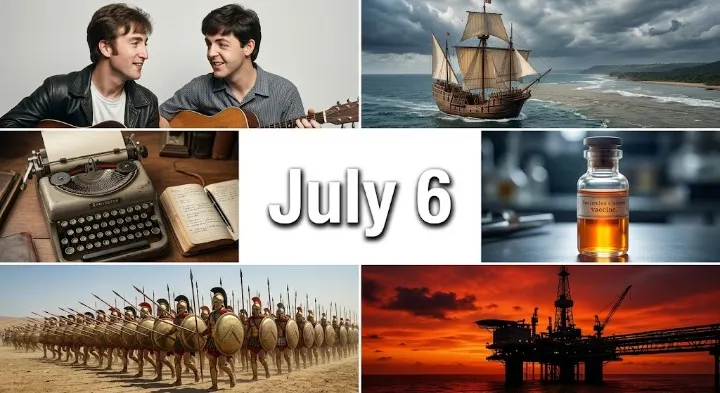
| 🏆 Top 10 Key Events | • Thebans defeat Spartans at the Battle of Leuctra, shattering Spartan military hegemony (371 BC) • Church reformer Jan Hus is burned at the stake for heresy at the Council of Constance (1415) • Sir Thomas More is executed for treason after refusing to accept King Henry VIII as head of the Church (1535) • Louis Pasteur successfully tests his rabies vaccine on Joseph Meister, a boy mauled by a rabid dog (1885) • T.E. Lawrence (“Lawrence of Arabia”) and Arab forces successfully seize the strategic port of Aqaba (1917) • Anne Frank and her family go into hiding in the hidden rooms of her father’s office building (1942) • The catastrophic Hartford Circus Fire breaks out in Connecticut, killing more than 160 people (1944) • The Soviet Union begins manufacturing the iconic AK-47 assault rifle designed by Mikhail Kalashnikov (1947) • Teenagers John Lennon and Paul McCartney meet for the very first time at a church fete in Woolton (1957) • The Piper Alpha oil production platform in the North Sea explodes, killing 167 workers (1988) |
| ⚔️ Key Battles | Battle of Leuctra (371 BC), Battle of Heliopolis (640), Battle of Fornovo (1495), Battle of Sedgemoor (1685), Battle of Grenada (1779), Battle of Wagram (1809), Battle of Brunete (1937) |
| 👤 Key Figures | Louis Pasteur, Anne Frank, John Lennon, Paul McCartney, King Richard III, Sir Thomas More |
| 🌍 Observances | Independence Day (Malawi), Independence Day (Comoros), Statehood Day (Lithuania), Jan Hus Day (Czech Republic), International Kissing Day |
Story of the Day: The Day the Beatles Began
Teenage guitarist John Lennon was tuning his instrument in the parish hall of St. Peter’s Church in Woolton on July 6, 1957, when a mutual friend introduced him to a fifteen-year-old named Paul McCartney. Paul stepped forward, showed John how to tune a guitar properly, and belted out a flawless rendition of Eddie Cochran’s “Twenty Flight Rock.” John, visibly impressed by the younger boy’s talent, realized he needed this kid in his skiffle group, the Quarrymen. Within three years, the duo transformed their local partnership into the Beatles, reshaping global music culture permanently.
Important Events That Happened On July 6 In History
371 BC – The Battle of Leuctra
Epaminondas deployed his Theban soldiers fifty shields deep on the left flank, completely upending traditional Greek warfare logic. Spartan forces watched in horror as this massive wall of muscle crashed straight through their elite royal guard. Cleombrotus, the Spartan king, fell mortally wounded in the chaos alongside hundreds of his finest warriors. The myth of Spartan military invincibility died on that muddy field, stripping Sparta of its hegemony over Greece forever.
83 BC – The Capitoline Temple Fire
Flames engulfed the sacred Temple of Jupiter Optimus Maximus, sending plumes of smoke over the Roman Forum. Citizens watched helplessly as the supreme religious sanctuary of the republic crumbled into ash and cinders. The mystical Sibylline Books of prophecy, consulted for centuries during national emergencies, perished entirely within the burning vaults. Romans viewed the catastrophic destruction as a terrifying omen of the bloody civil wars that soon tore their republic apart.
640 – Battle of Heliopolis
‘Amr ibn al-‘As trapped the Byzantine garrison outside the ancient city walls of Heliopolis using a brilliant three-pronged ambush strategy. The Arab cavalry swarmed the imperial ranks from hidden positions behind the desert dunes, shattering the Christian lines. Byzantine commander Theodore fled the field toward Babylon Fortress, leaving the rest of Egypt vulnerable to the rapidly expanding Islamic Caliphate. The clash sealed the fate of Byzantine rule in North Africa, shifting the region’s cultural balance permanently.
1253 – Coronation of Mindaugas
Mindaugas received the royal crown from the hands of Bishop Christian, binding his Baltic lands to the Catholic Church of Rome. The newly minted king chose baptism solely to neutralize the aggressive Teutonic Knights who threatened his borders. His political maneuver successfully united the disparate pagan tribes under a single, recognized Christian monarchy. The ceremony birthed the early Kingdom of Lithuania, establishing a powerful new player on the medieval European map.
1348 – Pope Clement VI Protects the Jews
Pope Clement VI issued the papal bull Sicut Judaeis, condemning the widespread violence against Jewish communities during the horrors of the Black Death. Terrified mobs across Europe were butchering their Jewish neighbors, falsely accusing them of poisoning water wells to spread the plague. The pontiff noted that Jews were dying of the pestilence in the exact same numbers as Christians, rendering the accusations illogical. Despite the papal decree, local rulers largely ignored the Vatican, and the deadly pogroms continued unabated.
1411 – Zheng He Returns to Nanjing
Admiral Zheng He sailed his massive treasure fleet back into the Yangtze River port after his historic third voyage across the Indian Ocean. The grand eunuch marched into the imperial court and presented Alakeshvara, the captured king of Kotte, to the Yongle Emperor. Zheng He had launched a daring inland raid in Ceylon after the local monarch tried to attack his supply lines. The emperor showed mercy, releasing the foreign king, while China firmly cemented its trade dominance over the global spice routes.
1415 – Execution of Jan Hus
Jan Hus stood inside the crowded Konstanz Cathedral while Catholic bishops stripped him of his priestly vestments and placed a paper crown decorated with devils on his head. The popular Czech reformer refused to recant his critiques of papal corruption, choosing death over ideological surrender. Guards led him outside the city gates and chained his neck to a wooden stake surrounded by bundles of kindling. The executioner lit the fire, but the martyr’s burning words sparked the bloody Hussite Wars that rocked Bohemia for decades.
1438 – The Compromise of Kolozsmonostor
Rebellious Transylvanian peasants and wealthy Hungarian noblemen gathered inside the Kolozsmonostor Abbey to sign a temporary truce. The impoverished farmers had taken up scythes and pitchforks to fight against ruinous taxes and unfair church tithes. The treaty offered minor concessions to the working class, temporarily cooling the fires of the bloody uprising. The ruling lords broke their promises within months, violently crushing the peasant movement and tightening feudal serfdom for generations.
1439 – Catholic and Orthodox Reunion Proclaimed
Pope Eugenius IV and Byzantine Emperor John VIII Palaiologos stood together inside the Florence Cathedral as the decree Laetentur Caeli echoed through the vault. The leaders proclaimed a formal end to the Great Schism that had severed Eastern and Western Christianity for nearly four hundred years. The desperate emperor traded theological concessions for Western military aid against the encroaching Ottoman armies. Back in Constantinople, the eastern clergy and public rejected the union, leaving the city to fall to the Turks fourteen years later.
1483 – Coronation of Richard III
Richard III walked down the aisle of Westminster Abbey to claim the English crown alongside his wife, Anne Neville. The ambitious duke had seized the throne after declaring his young nephews, the Princes in the Tower, illegitimate. Londoners watched the lavish ceremony with a mixture of awe and deep suspicion regarding the fate of the missing boys. His controversial reign lasted just two turbulent years before ending in blood at the Battle of Bosworth Field.
1484 – Diogo Cão Reaches the Congo
Diogo Cão steered his Portuguese caravel through heavy Atlantic waves and noticed the ocean water suddenly turning muddy and fresh. The experienced navigator followed the current inward, becoming the first European to locate the mouth of the massive Congo River. He erected a heavy stone pillar called a padrão on the riverbank to claim the vast territory for King John II. The voyage opened up central Africa to European trade networks, triggering centuries of intense colonial interaction.
1495 – Battle of Fornovo
Charles VIII ordered his French cavalry to charge through the swollen Taro River to break the lines of the surrounding Holy League army. The Italian coalition sought to trap the retreating French forces and reclaim the heavy loot taken from Naples. The chaotic combat lasted less than an hour, leaving thousands of soldiers dead in the mud before the French punched through. The battle allowed the king to escape back to France, proving that gunpowder armies had fundamentally changed European warfare.
1536 – Execution of Thomas More
Thomas More walked up the rickety wooden steps of the scaffold at Tower Hill, joking softly with the executioner not to fear doing his duty. The former Lord Chancellor refused to acknowledge King Henry VIII as the supreme head of the Church of England, choosing silent resistance over political survival. He declared he was dying as the king’s good servant, but God’s first. The heavy axe fell, turning the brilliant humanist philosopher into an enduring symbol of individual conscience against state power.
1536 – Jacques Cartier Returns to St. Malo
Jacques Cartier dropped anchor in the harbor of St. Malo, ending his second grueling expedition into the North American wilderness. The French explorer stepped ashore empty-handed, having found none of the golden cities or boundless treasures promised by local indigenous guides. He brought back the captured Iroquoian chief Donnacona to pitch the mysterious lands directly to the French king. The voyage failed to find gold, but it firmly mapped the St. Lawrence River, laying the groundwork for French Canada.
1557 – Philip II Abandons England
King Philip II of Spain boarded a warship at the Dover docks, leaving his distraught wife, Queen Mary I, watching from the shore. The foreign king had spent months pressuring England to join his expensive military campaign against France. The reluctant English parliament finally relented, entering a conflict that quickly resulted in the humiliating loss of Calais, their last continental stronghold. Mary never saw her husband again, dying heartbroken and isolated just one year later.
1560 – Treaty of Edinburgh Signed
English and French diplomats gathered in Edinburgh to sign a peace treaty that ordered all foreign military forces to evacuate Scotland. The agreement effectively ended the long-standing defensive alliance between France and Scotland known as the Auld Alliance. Queen Mary Stuart, residing in Paris, refused to ratify the document because it acknowledged her cousin Elizabeth as the rightful ruler of England. The treaty secured the Scottish Reformation, shifting the nation’s political orbit away from Catholic Europe toward Protestant Britain.
1573 – Córdoba Founded in Argentina
Jerónimo Luis de Cabrera unfurled the Spanish flag beside the Suquía River and declared the birth of the city of Córdoba de la Nueva Andalucía. The ambitious conquistador disobeyed direct viceroyal orders by moving further south to establish the settlement in the territory of the Comechingones people. He designed the city with a classic grid system, intending it to serve as a vital trading hub between the Andes and the Atlantic coast. The founder was executed for his insubordination a year later, but his city grew into a major cultural center.
1573 – The Siege of La Rochelle Ends
The Duke of Anjou ordered his royal Catholic army to halt their relentless bombardments and pull back from the fortified walls of La Rochelle. The wealthy Protestant stronghold had successfully resisted a brutal four-month siege, surviving multiple bloody assaults and near-starvation. The crown ran out of money to fund the war, forcing the king to sign the Edict of Boulogne to pacify the rebels. The treaty guaranteed Huguenots the right to practice their faith, ending the fourth phase of the French Wars of Religion.
1614 – The Raid on Żejtun
Ottoman soldiers scrambled out of sixty galleys onto the rocky shores of Marsaxlokk bay, launching a surprise terror raid against southern Malta. The raiders marched inland, plundering farms and setting fire to the ancient village of Żejtun before local forces mobilized. Maltese cavalry and citizen militias confronted the invaders, driving them back to their ships after hours of intense hand-to-hand combat. The retreat marked the last major attempt by the Ottoman Empire to conquer the strategic island stronghold.
1630 – Gustavus Adolphus Lands in Pomerania
Gustavus Adolphus led four thousand Swedish troops down the gangplanks onto the sandy beaches of Peenemünde, Germany. The devout Protestant king entered the Thirty Years’ War to protect his Baltic trade interests and rescue the collapsing German Protestant states. His highly disciplined, innovative army brought devastating new artillery tactics to the imperial battlefields. The Swedish intervention completely turned the tide of the war, breaking the Catholic Habsburg dominance over central Europe.
1685 – Battle of Sedgemoor
James Scott, the Duke of Monmouth, led his rebel army of farmers and weavers through the dense midnight fog toward the royal camp at Sedgemoor. The surprise attack dissolved into chaos when a stray musket shot alerted the sleeping royalist soldiers across a deep drainage ditch. The professional troops of King James II turned their heavy artillery on the untrained rebels, slaughtering over a thousand men. The defeat ended the Monmouth Rebellion, and the captured duke faced the executioner’s axe days later.
1751 – Patriarchate of Aquileia Suppressed
Pope Benedict XIV issued the papal bull Injunctum Nobis, officially abolishing the ancient Patriarchate of Aquileia after centuries of political squabbling. The historic diocese sat directly on the tense border between the Republic of Venice and the Holy Roman Empire, causing constant diplomatic friction. The pontiff divided the vast territory into two new archdioceses located at Udine and Gorizia to satisfy both rival empires. The decree erased a venerable ecclesiastical power player that had shaped northern Italian history since Roman times.
1777 – Siege of Fort Ticonderoga
General John Burgoyne ordered British artillery batteries to drag heavy cannons up the steep slopes of Mount Defiance, overlooking Fort Ticonderoga. American commander Arthur St. Clair realized his garrison was completely exposed to the enemy guns positioned on the high ground. The outgunned American forces evacuated the fort under the cover of darkness, retreating across Lake Champlain into the Vermont wilderness. The loss shocked the Continental Congress, but the British victory slowed Burgoyne’s march toward his ultimate defeat at Saratoga.
1779 – Battle of Grenada
Admiral Count d’Estaing ordered the French fleet to unleash a devastating broadside against the approaching British warships off the coast of Grenada. The British fleet tried to recapture the valuable sugar island, but they sailed straight into a superior tactical trap. The French gunners heavily damaged the enemy hulls, forcing the British admiral to withdraw his broken ships toward St. Kitts. The naval victory protected French control of the Caribbean, dealing a heavy blow to British maritime power during the Revolutionary War.
1791 – The Padua Circular
Emperor Leopold II issued a confidential letter from Padua, calling on the monarchs of Europe to unite against the radical French Revolution. The emperor feared for the lives of his sister, Marie Antoinette, and King Louis XVI after their failed attempt to escape Paris. His diplomatic letter urged the royal houses to demand the immediate restoration of the French monarchy’s absolute freedom and authority. The declaration marked the first major step toward the coalition wars that engulfed the continent for twenty years.
1801 – First Battle of Algeciras
Admiral Charles Linois anchored his outnumbered French squadron deep under the protection of the Spanish artillery forts inside Algeciras bay. The British fleet sailed directly into the harbor, expecting an easy victory, but shifting winds left their warships stranded under a merciless crossfire. The French gunners forced the British ship HMS Hannibal to strike its colors and surrender after it ran aground on the rocks. The defensive triumph boosted French naval morale, humiliating the royal navy on the doorstep of Gibraltar.
1809 – Battle of Wagram
Napoleon Bonaparte directed a massive hundred-gun artillery bombardment across the Danube plains to smash the center of the Austrian lines. Over three hundred thousand soldiers clashed in the blistering heat during the final day of the colossal encounter. The French infantry broke the imperial army, forcing Archduke Charles to order a full retreat into Bohemia. The bloody victory ended the War of the Fifth Coalition, securing Napoleon’s position at the absolute peak of his European empire.
1854 – The First Republican Convention
Under the shade of an oak grove in Jackson, Michigan, over ten hundred anti-slavery activists gathered to hold the first formal Republican Party convention. The delegates united to oppose the controversial Kansas-Nebraska Act, which threatened to expand slavery into the western territories. They adopted an official party platform and selected a full slate of political candidates for the upcoming state elections. The grassroots movement exploded in popularity, transforming into a major national political force within two years.
1885 – Pasteur Saves Joseph Meister
Louis Pasteur gingerly injected a weakened strain of the rabies virus into the arm of nine-year-old Joseph Meister, who had been brutally mauled by a rabid dog. The French scientist took a massive professional gamble, as his experimental vaccine had previously been tested only on dogs. The boy remained under close medical supervision for weeks, receiving increasingly potent doses of the treatment. Meister survived without ever developing the fatal disease, proving to the world that medical science could defeat rabies.
1887 – The Bayonet Constitution
An armed militia composed of white businessmen cornered King David Kalākaua in his palace and forced him to sign a restrictive new constitution at gunpoint. The document stripped the Hawaiian monarch of most of his executive authority and handed political control to the foreign-dominated legislature. The new laws used high property requirements to disenfranchise the vast majority of native Hawaiian voters and Asian immigrants. The forced signing crippled the kingdom’s sovereignty, opening the door for the eventual American annexation.
1892 – The Homestead Strike Battle
Three hundred armed Pinkerton agents tried to slip off barges onto the shores of the Monongahela River under the cover of early morning darkness. Thousands of striking steelworkers spotted the guards, opening fire with rifles and deploying a small cannon to protect their steel mill. The day-long firefight left ten people dead and dozens wounded before the trapped Pinkerton agents surrendered to the angry crowd. The violent clash forced the governor to send in the state militia to break the historic strike.
1917 – Lawrence of Arabia Captures Aqaba
T. E. Lawrence and Auda ibu Tayi led a ragtag army of Bedouin horsemen out of the blistering sands of the Nefud desert to launch a surprise rear assault on Aqaba. The Ottoman garrison had pointed all their heavy artillery pieces out toward the Red Sea, expecting a naval attack rather than a land invasion. The Arab forces swarmed the unprotected land defenses, capturing the strategic port city in a matter of hours. The spectacular victory opened up vital supply lines to the British military, shifting the desert campaign.
1918 – The Left SR Uprising Begins
Yakov Blumkin walked into the German embassy in Moscow, pulled a pistol from his pocket, and assassinated Ambassador Wilhelm von Mirbach. The radical Left Socialist-Revolutionaries orchestrated the political murder to shatter the Brest-Litovsk peace treaty and force Russia back into World War I against Germany. The assassination triggered an armed rebellion against Vladimir Lenin’s Bolshevik government across the capital city. Lenin responded with overwhelming military force, arresting the rebel leaders and establishing a one-party communist state.
1919 – The R34 Airship Lands in New York
Major George Scott guided the British dirigible R34 down through heavy crosswinds to land safely on the grassy fields of Long Island, New York. The massive, fabric-covered airship had spent 108 grueling hours crossing the Atlantic Ocean from Scotland, battling fierce storms and running dangerously low on fuel. A crew member actually parachuted out from the vessel just before landing to organize the ground crew below. The historic voyage marked the first successful transatlantic crossing completed by a lighter-than-air craft.
1933 – The First MLB All-Star Game
Babe Ruth stepped up to the plate in the third inning and crushed a historic two-run home run into the right-field stands of Chicago’s Comiskey Park. The legendary slugger led the American League team to a tight 4-2 victory over the National League rivals. Arch Ward, a sports editor for the Chicago Tribune, devised the exhibition game to boost national morale during the dark days of the Great Depression. The single event proved so immensely popular with fans that it became a permanent midsummer baseball tradition.
1936 – The Manchester Canal Breach
A massive structural failure tore open the earthen banks of the Manchester, Bolton and Bury Canal in Lancashire, England. Millions of gallons of rushing canal water cascaded over a 200-foot drop into the River Irwell below, eroding the hillside. The raging torrent swept away two empty coal barges, smashing them to pieces against the valley rocks. The catastrophic breach emptied a major section of the waterway, effectively ending commercial shipping traffic on that portion of the canal network forever.
1937 – The Battle of Brunete Begins
General Vicente Rojo ordered eighty thousand Spanish Republican soldiers to launch a massive surprise offensive against the Nationalist lines west of Madrid. The republican troops advanced rapidly through the dry summer dust, capturing the town of Brunete and threatening to encircle the besieging enemy forces. The Nationalist command rushed elite reinforcements and German Condor Legion aircraft to the front to halt the sudden breakthrough. The clash dissolved into a brutal war of attrition, resulting in horrific casualties for both sides.
1939 – Nazi Germany Closes Jewish Businesses
Nazi officials enforced a draconian economic decree that forced the final remaining Jewish-owned enterprises across Germany to close their doors. The racist laws banned Jewish citizens from operating independent commercial shops, manufacturing facilities, or mail-order businesses. The state seized all remaining corporate assets, completing the total economic exclusion of Jews from the public sphere. The forced closures left thousands of families completely destitute, foreshadowing the violent horrors of the Holocaust.
1940 – The Story Bridge Opens
Queensland Governor Leslie Wilson rode in an open-top car across the Brisbane River to formally inaugurate the grand opening of the Story Bridge. Thousands of proud citizens braved the winter morning chill to walk across Australia’s longest home-designed cantilever bridge. Engineer John Bradfield supervised the construction project, employing hundreds of local workers during the severe economic downturn of the decade. The steel structure connected the city centers, turning into an architectural icon.
1941 – The Smolensk Pocket Offensive
General Heinz Guderian directed his Panzer divisions to race forward across the Dnieper River to encircle several Soviet armies near Smolensk. The German army sought to trap over three hundred thousand Red Army soldiers and clear the open road to Moscow. Soviet commanders ordered desperate counterattacks to break the closing ring, but their uncoordinated infantry waves fractured against the German armor. The massive battle resulted in immense Soviet losses, slowing the German advance toward the capital.
1944 – The Jackie Robinson Court-Martial
Lieutenant Jackie Robinson refused a civilian bus driver’s hostile order to move to the back of a military shuttle bus at Camp Hood, Texas. The young black officer pointed out that the military had recently integrated all camp transit lines, making the driver’s demand unlawful. Military police detained Robinson at the gate, and his commanding officers framed exaggerated charges of insubordination against him. The resulting court-martial failed to break his spirit, and a military panel acquitted him of all charges before his historic baseball career.
1944 – The Hartford Circus Fire
A small fire ignited on the canvas wall of the Ringling Bros. circus tent during a matinee performance in Hartford, Connecticut. The flames raced up the fabric structure, which had been waterproofed with a highly flammable mixture of paraffin wax and gasoline. Over eight thousand terrified spectators rushed toward the clogged exit gates as burning canvas collapsed onto the crowd. The disaster claimed the lives of approximately 168 people, triggering strict safety regulations for public tents nationwide.
1947 – The Sylhet Referendum
Thousands of voters lined up outside polling stations across the tea-growing district of Sylhet to cast their ballots in a high-stakes border referendum. The citizens had to choose whether their region would join Muslim-majority East Pakistan or remain within Hindu-majority India during the Partition. The final vote tally favored joining Pakistan by a narrow margin, redrawing the geopolitical map of Northeast India. The decision triggered massive population shifts, permanently altering the cultural demographics of the region.
1947 – AK-47 Production Begins
Mikhail Kalashnikov supervised the final manufacturing blueprints as the Soviet military authorized the official mass production of the Avtomat Kalashnikova model 1947. The young red army mechanic designed the assault rifle to operate reliably in the freezing mud and sand of any battlefield. The weapon’s simple internal mechanics made it incredibly cheap to produce and remarkably easy for untrained soldiers to maintain. The AK-47 became the most widely distributed firearm in human history, shaping global conflicts for decades.
1957 – Althea Gibson Wins Wimbledon
Althea Gibson charged the net at the All England Club, defeating Darlene Hard in straight sets to claim the prestigious Wimbledon singles title. The American tennis star shattered decades of racial barriers, becoming the first black athlete to win the tournament. Queen Elizabeth II stepped onto the court to present the heavy silver trophy to the champion in front of an applauding crowd. Her historic victory challenged the deep segregation of mainstream sports, inspiring a generation of minority athletes.
1962 – The Sedan Nuclear Test
Engineers detonated a 104-kiloton thermonuclear warhead buried 635 feet beneath the desert sands of the Nevada Test Site. The massive underground explosion moved twelve million tons of earth, creating a crater 320 feet deep and a quarter-mile wide. The blast formed part of Operation Plowshare, a government program exploring the use of nuclear weapons for peaceful excavation projects like digging canals. The resulting radioactive dust cloud drifted across two states, ending American experiments with nuclear engineering.
1962 – The Late Late Show Debuts
Host Gay Byrne walked out in front of the television cameras as The Late Late Show broadcasted across Irish airwaves for the first time. The innovative talk show format discarded stuffy societal conventions, featuring open panel discussions on taboo cultural topics like religion and politics. The live broadcast shocked conservative viewers, transforming Irish television into a modern arena for social change. The program grew into the world’s longest-running chat show hosted by a single broadcaster.
1964 – Malawi Gains Independence
Hastings Banda stood before a cheering crowd in Blantyre as the British Union Jack descended, replaced by the new black, red, and green flag of Malawi. The African nation ended seventy-one years of colonial rule as the former British protectorate of Nyasaland dissolved. Prince Philip attended the official ceremonies, representing Queen Elizabeth II to hand over executive political power to the new leaders. The independence marked the birth of a new sovereign nation determined to chart its own course.
1966 – Malawi Becomes a Republic
Hastings Banda took the official oath of office in the capital city, transforming Malawi from a constitutional monarchy into an independent republic. The prime minister assumed the role of the nation’s first President, consolidating his political control over the government infrastructure. He quickly used his new executive powers to suppress political opposition, establishing a strict one-party state within months. The constitutional transition began three decades of authoritarian rule under his absolute presidency.
1967 – Nigerian Forces Invade Biafra
Two columns of the Nigerian federal army crossed the northern border of the breakaway Eastern Region, opening fire on Biafran defensive outposts. General Yakubu Gowon ordered the military operation to crush the newly declared Republic of Biafra and preserve national unity. The sudden invasion triggered the bloody Nigerian Civil War, which quickly devolved into a brutal economic blockade. The ensuing three-year conflict resulted in a catastrophic famine, claiming the lives of over a million civilians.
1975 – Comoros Declares Independence
Ahmed Abdallah stood before the parliament in Moroni and unilaterally proclaimed the total independence of the Comoros archipelago from France. The sudden political declaration bypassed a scheduled French referendum, leaving the status of the island of Mayotte up in the air. The French government accepted the independence of the three main islands but maintained its colonial hold over Mayotte after locals voted to stay with France. The split triggered decades of political instability and mercenary coups across the islands.
1982 – Aeroflot Flight 411 Crashes
Captain Boris Chernov tried to steer his fully loaded Ilyushin Il-62 aircraft back toward Sheremetyevo Airport after an engine fire alarm went off seconds after takeoff. The pilots struggled against failing controls as a second engine shut down, causing the heavy airliner to lose altitude rapidly. The plane crashed into a swampy forest near Mendeleyevo, exploding into flames upon impact. The tragic accident claimed the lives of all ninety passengers and crew on board, exposing maintenance flaws in the fleet.
1988 – The Piper Alpha Disaster
A sudden gas leak ignited inside the pump room of the Piper Alpha drilling platform, triggering a series of massive explosions in the North Sea. The raging inferno melted the structural steel legs of the offshore rig, trapping dozens of oil workers inside the living quarters. The emergency evacuation systems failed completely as toxic smoke filled the corridors, forcing men to jump 170 feet into the freezing ocean. The disaster killed 167 workers, remaining the deadliest offshore oil accident in history.
1989 – Bus 405 Suicide Attack
An extremist seized the steering wheel of the Tel Aviv–Jerusalem bus 405, forcing the heavy passenger vehicle off a steep cliff into a rocky ravine. The bus careened down the mountainside, exploding into flames as it rolled over the jagged rocks. Sixteen civilian passengers died in the burning wreckage, and dozens suffered horrific injuries inside the canyon. The violent attack marked a major escalation in target selection during the First Intifada, shocking the nation.
1995 – The Srebrenica Attack Begins
General Ratko Mladić ordered Bosnian Serb forces to launch a heavy artillery bombardment against the isolated town of Srebrenica. The enclave had been designated a “safe area” by the United Nations, protected by a small garrison of Dutch peacekeepers. The outgunned UN soldiers offered no resistance as the Serb troops advanced through the defensive perimeters. The initial assault began a horrific week of systematic violence, culminating in the massacre of over eight thousand Muslim men and boys.
1996 – Delta Flight 1288 Engine Failure
Captain Prewitt ordered an immediate emergency abort after the left engine of his McDonnell Douglas MD-88 exploded during its takeoff roll in Pensacola. Shrapnel from the shattered turbine fan blades pierced the aluminum fuselage, tearing into the rear passenger cabin where families sat. The uncontained engine failure killed a mother and her son instantly while injuring five others before the plane stopped. Investigators traced the catastrophic structural break to an undetected microscopic crack in the fan hub.
1997 – The Drumcree Riots Begin
Masked youths clashed with police officers in nationalist districts across Northern Ireland, setting fire to hijacked vehicles and blocking major transit routes. The widespread violence erupted after authorities allowed a controversial Protestant Orange Order parade to march through a Catholic neighborhood in Portadown. British soldiers deployed plastic bullets and tear gas to control the angry mobs during five days of intense street battles. The riots marked one of the final major urban upheavals of the turbulent period known as the Troubles.
1998 – Chek Lap Kok Airport Opens
A commercial Cathay Pacific flight touched down on the tarmac of the newly constructed Hong Kong International Airport at Chek Lap Kok. The massive airport project required engineers to level two small mountainous islands and reclaim kilometers of land from the sea. The modern facility replaced the historic Kai Tak Airport, famous for its terrifyingly low low-altitude approaches over crowded residential skyscrapers. The engineering triumph expanded the city’s global cargo and transit capabilities overnight.
2003 – Cosmic Call 2 Sent
Scientists at the Yevpatoria Planetary Radar aimed their massive 70-meter dish antenna toward the constellation Ursa Major to transmit Cosmic Call 2. The radio message contained a digital encyclopedia of human knowledge, mathematical languages, and recording fragments of terrestrial music. The team selected five nearby star systems capable of harboring habitable planets to receive the powerful interstellar broadcast. The cosmic signals are scheduled to reach their destination stars between the years 2036 and 2049.
2006 – The Nathu La Pass Re-opens
Border guards rolled back the heavy rusted barbed-wire gates at the Nathu La pass, restoring direct trade links between India and China. The high-altitude Himalayan mountain pass had been completely sealed since the bloody Sino-Indian War of 1962. Traders from both nations cheered as the first cargo trucks crossed the rocky border at 14,000 feet above sea level. The ceremonial re-opening marked a major diplomatic thaw between the two Asian economic giants.
2013 – Yobe State School Shooting
Gunmen stormed a boarding school in the early morning darkness in Yobe State, Nigeria, opening fire on sleeping students inside the dormitories. The attackers set fire to the school buildings, burning several victims alive as they tried to escape the flames. The horrific assault claimed the lives of forty-two people, mostly young students and teachers. Authorities blamed the extremist group Boko Haram, whose name translates to “Western education is forbidden,” sparking international outrage.
2013 – Asiana Airlines Flight 214 Crashes
The tail assembly of a Boeing 777 struck the seawall at San Francisco International Airport as the flight crew misjudged their final landing approach. The airliner slammed into the runway, spinning out of control and shedding its landing gear before bursting into smoke. Three passengers lost their lives in the impact, and over 180 suffered severe injuries during the chaotic evacuation. The accident broke a long period of commercial aviation safety, focusing attention on pilot training for manual landings.
2013 – The Lac-Mégantic Derailment
An unattended 73-car train carrying volatile crude oil rolled down a steep track grade and derailed in the center of Lac-Mégantic, Quebec. The derailed tank cars ruptured instantly, sending a massive wall of fire through the downtown district. The explosions killed forty-seven people and completely incinerated over thirty historic buildings in the town center. The environmental disaster forced stricter regulations on the transport of hazardous materials by rail across North America.
2021 – Petropavlovsk-Kamchatsky Flight 251 Crashes
An Antonov An-26 passenger aircraft collided with a jagged coastal cliff while attempting to land in heavy fog at Palana Airport in Russia. The pilots lost situational awareness during their instrument approach, flying the twin-engine plane directly into the rock face. The violent impact tore the aircraft apart, sending wreckage tumbling into the Okhotsk Sea below. The tragic accident claimed the lives of all twenty-eight people on board, highlighting the dangers of flying in remote Arctic regions.
2022 – Georgia Guidestones Bombing
An explosive device detonated at midnight, shattering one of the massive granite slabs of the controversial Georgia Guidestones monument. Security cameras captured a car fleeing the rural site immediately after the blast tore through the structure. Authorities dismantled the remaining upright stones later that afternoon due to safety concerns regarding structural instability. The monument had drawn intense public scrutiny and conspiracy theories for decades due to its cryptic engraved instructions for humanity.
Click here to browse our collection of previous daily facts.
Famous People Born on July 5
| Name | Description | Dates |
|---|---|---|
| Thomas Hooker | Founder of the Colony of Connecticut | 1586 – 1647 |
| Sarah Siddons | England’s greatest tragic stage actress | 1755 – 1831 |
| Stamford Raffles | Founder of modern Singapore | 1781 – 1826 |
| Sylvester Graham | American dietary reformer; creator of Graham flour | 1794 – 1851 |
| David Farragut | First Admiral of the U.S. Navy | 1801 – 1870 |
| Robert FitzRoy | HMS Beagle captain and pioneering meteorologist | 1805 – 1865 |
| P. T. Barnum | Legendary American showman and circus founder | 1810 – 1891 |
| William J. M. Rankine | Scottish engineer and thermodynamics pioneer | 1820 – 1872 |
| Cecil Rhodes | British imperialist and founder of Rhodes Scholarship | 1853 – 1902 |
| Clara Zetkin | German socialist leader and women’s rights activist | 1857 – 1933 |
| A. E. Douglass | Astronomer; founder of dendrochronology | 1867 – 1962 |
| Dwight F. Davis | Founder of the Davis Cup tennis tournament | 1879 – 1945 |
| Inayat Khan | Indian Sufi mystic and spiritual teacher | 1882 – 1927 |
| Willem Drees | Prime Minister who rebuilt the Netherlands after WWII | 1886 – 1988 |
| Jean Cocteau | French poet, novelist, filmmaker, and artist | 1889 – 1963 |
| Ernst Mayr | Influential evolutionary biologist | 1904 – 2005 |
| Georges Pompidou | President of France (1969–1974) | 1911 – 1974 |
| James Mirrlees | Nobel Prize-winning economist | 1936 – 2018 |
| Chuck Close | American photorealist painter | 1940 – 2021 |
| Robbie Robertson | Guitarist and songwriter for The Band | 1943 – 2023 |
| Gerard ‘t Hooft | Nobel Prize-winning theoretical physicist | 1946 – Present |
| Huey Lewis | American rock singer and frontman of Huey Lewis and the News | 1950 – Present |
| Bill Watterson | Creator of the Calvin and Hobbes comic strip | 1958 – Present |
| Edie Falco | Emmy Award-winning actress (The Sopranos, Nurse Jackie) | 1963 – Present |
| Gianfranco Zola | Italian football legend and manager | 1966 – Present |
| Susan Wojcicki | Former CEO of YouTube | 1968 – 2024 |
| RZA | Rapper, producer, and founder of Wu-Tang Clan | 1969 – Present |
| Hernán Crespo | Argentine football striker and coach | 1975 – Present |
| Megan Rapinoe | American footballer and World Cup champion | 1985 – Present |
| Shohei Ohtani | Japanese baseball superstar and MLB two-way player | 1994 – Present |
Famous People Died on July 5
| Name | Description | Dates |
|---|---|---|
| Anthony Maria Zaccaria | Italian Catholic saint and founder of the Barnabites | 1502 – 1539 |
| Stamford Raffles | Founder of modern Singapore | 1781 – 1826 |
| Nicéphore Niépce | Inventor of the world’s first permanent photograph | 1765 – 1833 |
| Lewis Armistead | Confederate general of the American Civil War | 1817 – 1863 |
| Albrecht Kossel | Nobel Prize-winning German biochemist | 1853 – 1927 |
| John Curtin | Prime Minister of Australia during World War II | 1885 – 1945 |
| Georges Bernanos | French novelist and essayist | 1888 – 1948 |
| Carole Landis | American film actress | 1919 – 1948 |
| George de Hevesy | Nobel Prize-winning chemist | 1885 – 1966 |
| Walter Gropius | Founder of the Bauhaus school of architecture | 1883 – 1969 |
| Tom Mboya | Influential Kenyan independence leader and politician | 1930 – 1969 |
| Leo McCarey | Academy Award-winning film director | 1898 – 1969 |
| Harry James | American jazz trumpeter and bandleader | 1916 – 1983 |
| Howard Nemerov | Pulitzer Prize-winning American poet | 1920 – 1991 |
| Sid Luckman | Hall of Fame American football quarterback | 1916 – 1998 |
| Katy Jurado | Mexican actress and Hollywood pioneer | 1924 – 2002 |
| Ted Williams | Baseball Hall of Fame legend | 1918 – 2002 |
| James Stockdale | U.S. Navy admiral and Medal of Honor recipient | 1923 – 2005 |
| Kenneth Lay | Founder and CEO of Enron | 1942 – 2006 |
| Cy Twombly | Influential American contemporary artist | 1928 – 2011 |
| Yoichiro Nambu | Nobel Prize-winning theoretical physicist | 1921 – 2015 |
| Nick Cordero | Canadian actor and Broadway performer | 1978 – 2020 |
| Raffaella Carrà | Italian singer, dancer, and television icon | 1943 – 2021 |
| Richard Donner | Director of Superman and Lethal Weapon | 1930 – 2021 |
| Jon Landau | Oscar-winning producer of Titanic and Avatar | 1960 – 2024 |
| Bengt I. Samuelsson | Nobel Prize-winning Swedish biochemist | 1934 – 2024 |
| Vic Seixas | American tennis champion and Grand Slam winner | 1923 – 2024 |
Observances on July 6
- Independence Day (Malawi): Celebrates the historic achievement of independence from British colonial rule in 1964.
- Independence Day (Comoros): Marks the unilateral declaration of freedom from French colonial governance in 1975.
- Statehood Day (Lithuania): Commemorates the medieval coronation of Mindaugas as the nation’s first king in 1253.
- Jan Hus Day (Czech Republic): Honors the memory and martyrdom of the religious reformer burned at the stake in 1415.
- International Kissing Day: An informal global celebration encouraging affection and human connection.
📔 Frequently Asked Questions — July 6 in History
Anne Frank and her family went into hiding in the Secret Annexe located behind her father’s office building in Amsterdam. They took this drastic step to save her sister Margot from being deported to a Nazi labor camp. The family spent over two years in the hidden rooms before their discovery.
The entry of the Frank family into hiding stands out as a defining moment of human endurance. It led directly to the creation of the famous diary that educated the world about the horrors of the Holocaust. The event continues to shape how modern generations connect with the human cost of the war.
The famous Mexican painter Frida Kahlo was born on this day in 1907. She gained international renown for her uncompromising, vibrant self-portraits that explored identity, the human body, and pain. Her artistic legacy remains a major influence on modern art movements worldwide.
The Battle of Wagram ended with a decisive victory for Napoleon Bonaparte against the Austrian army in 1809. It involved over three hundred thousand soldiers clashing outside Vienna, making it the largest conflict of the Napoleonic Wars up to that point. The triumph secured France’s control over central Europe.
Jan Hus Day is a national holiday in the Czech Republic that honors the memory of the religious reformer executed in 1415. Hus challenged the corruption of the Catholic Church and advocated for religious freedom before he was burned at the stake. His death sparked decades of popular resistance against imperial authority.
The Georgia Guidestones monument was heavily damaged by a bombing in the middle of the night in 2022. Officials completely dismantled the remaining granite structures later that day to protect public safety. The attack ended decades of intense public debate regarding the mysterious origin of the monument.