Ptolemy IV Philopator stood atop his war elephant in the dust of Gaza, watching thousands of Seleucid soldiers break rank and flee into the desert. The young Pharaoh had just secured Egypt’s borders against a massive invasion, reshaping the ancient Mediterranean power balance in a single afternoon. History turns entirely on what happens during these single, frantic stretches of twenty-four hours. Looking at this day in history June 22, we find an incredible mix of cosmic shifts, desperate warfare, and world-altering human drama.
📅 Quick Facts — June 22 in History
| 📌 Category | 📖 Event / Detail |
|---|---|
| 🌟 Most Significant Event | Operation Barbarossa begins (1941) |
| 🏆 Top 10 Key Events | • Battle of Raphia (217 BC) • Galileo forces recantation (1633) • Laki volcano cloud reaches France (1783) • Napoleon invades Russia (1812) • GI Bill signed (1944) • Windrush arrives in Britain (1948) • Cuyahoga River catches fire (1969) • Charon discovered (1978) • Maradona scores “Hand of God” (1986) • Checkpoint Charlie dismantled (1990) |
| ⚔️ Key Battles | Battle of Raphia, Battle of Pydna, Battle of Versinikia, Battle of Sirhind, Battle of Sisak, Battle of Cap-Français, Battle of Tijuana, Battle of Okinawa |
| 👤 Key Figures | Galileo Galilei, Laura Secord, Erwin Rommel, Diego Maradona |
| 🌍 Observances | Anti-Fascist Struggle Day (Croatia), Day of Remembrance (Belarus), Windrush Day (UK), Teachers’ Day (El Salvador) |
Story of the Day: Galileo Kneels Before the Inquisition
Inquisitors filled the candlelit room in Rome, their dark robes matching the grim mood of the hall. Sixty-nine-year-old Galileo Galilei knelt on the hard stone floor, holding a prepared piece of paper with trembling hands. Pope Urban VIII had made it clear that the astronomer faces torture or burning at the stake if he refuses to reject his own life’s work.
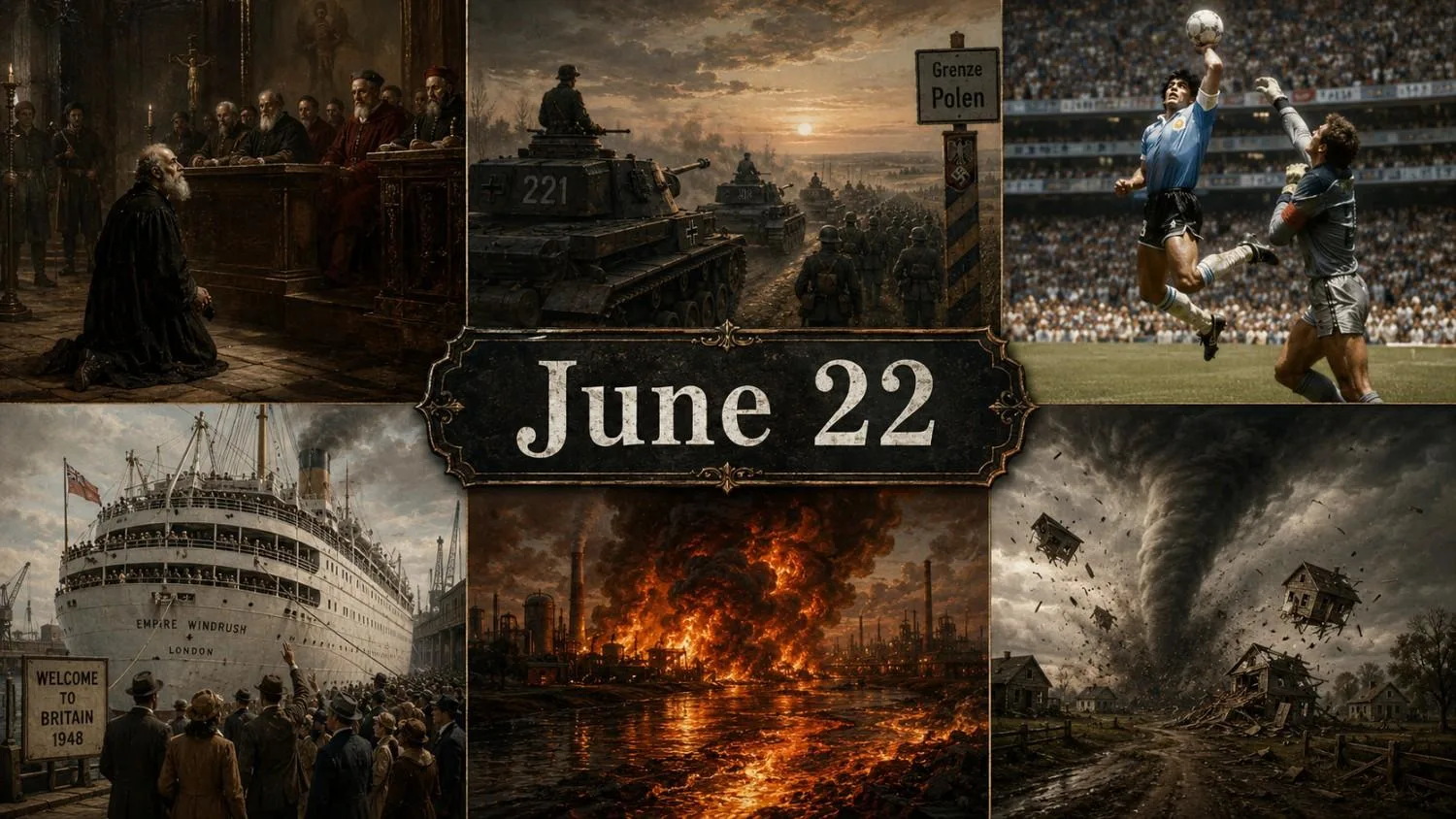
Galileo spent decades peering through telescopes, gathering undeniable proof that the Earth moves around the Sun. Church doctrine stated the exact opposite, viewing his textbook as an open assault on holy scripture. Broken by months of threats and failing health, the old philosopher read the forced confession aloud, swearing he cursed and detested his past errors. Legend says that as Galileo stood up, he stamped his foot and whispered a defiant phrase under his breath: “And yet it moves.”
Important Events That Happened On June 22 In History
217 BC – Battle of Raphia
Ptolemy IV Philopator rode his war elephant directly into the front lines near Gaza to face the advancing Seleucid army under Antiochus the Great. Over seventy thousand soldiers clashed in the choking desert heat while armor-clad beasts trampled men into the sand. Ptolemy’s unexpected victory secured the borders of Egypt and preserved his dynasty’s rule over the region for another generation. The bloody clash stopped a massive kingdom from collapsing and reset the politics of the ancient Mediterranean.
168 BC – Battle of Pydna
Lucius Aemilius Paullus watched his Roman legions break the famous Macedonian phalanx apart by slipping into the small gaps between the enemy spears. Macedonian King Perseus saw his lines splinter under the brutal short-sword attacks and fled the field, surrendering shortly after the slaughter ended. The decisive victory brought a sudden end to the Third Macedonian War and shattered the kingdom built by Alexander the Great. Rome became the undisputed master of the Greek world from that afternoon onward.
431 – The Council of Ephesus
Bishops from across the Christian world crowded into the grand cathedral at Ephesus to debate the true nature of Jesus Christ. Patriarch Nestorius of Constantinople argued that Christ possessed two entirely separate natures, a view that infuriated his theological rivals. High-stakes political maneuvering and shouting matches dominated the first session as church leaders voted to condemn his ideas as heresy. This fiery gathering caused a deep, permanent split in eastern Christianity that remains visible today.
813 – Battle of Versinikia
Khan Krum led his Bulgarian cavalry in a furious charge against the invading Byzantine forces near the city of Edirne. Byzantine Emperor Michael I watched his soldiers panic and run from the battlefield, leaving their fortified camp completely exposed to the fierce horsemen. The humiliating military disaster forced the broken emperor to abdicate his throne just days after returning to Constantinople. Leo V the Armenian seized power immediately, inheriting a empire teetering on the edge of total ruin.
816 – Election of Pope Stephen IV
Roman clergy and local nobles gathered in St. Peter’s Basilica to select a successor following the death of Pope Leo III. Stephen IV won the vote quickly and took office without waiting for approval from the powerful Frankish court. The new pope knew he needed to protect church independence, so he quickly ordered all Romans to swear loyalty to Emperor Louis the Pious. This strategic political move kept the peace between the Holy See and Europe’s most powerful empire.
910 – Battle of the Rednitz River
Hungarian horse archers ambushed the East Frankish army along the banks of the Rednitz River, raining thousands of arrows upon the heavy German infantry. Gebhard, Duke of Lotharingia, tried to rally his men into a defensive wall, but the swift nomadic riders cut his forces to pieces. Gebhard died in the mud alongside the majority of his noble knights during the chaotic rout. The victory allowed Hungarian raiders to plunder deep into European territory completely unopposed for years.
1527 – Fatahillah Expels Portuguese Forces
Fatahillah led a combined Muslim fleet into the busy harbor of Sunda Kelapa and attacked the Portuguese trading posts lining the shore. The local commander drove the European warships back into the open sea, reclaiming control over the vital spice trade routes. He immediately renamed the coastal settlement Jayakarta, which translates directly to “Complete Victory.” Modern citizens celebrate this successful military operation as the true historical founding date of Jakarta.
1555 – Battle of Sirhind
Humayun stood before his assembled Mughal troops alongside his trusted general Bairam Khan, staring down a massive Afghan army led by Sikandar Shah Suri. Monsoon rains turned the battlefield into a swamp as the Mughal cavalry charged, breaking the enemy lines with coordinated horse-archery tactics. The decisive victory crushed the ruling Suri dynasty and opened the road for the exiles to march toward the capital. Humayun captured Delhi weeks later, reestablishing the great Mughal Empire across India.
1593 – Battle of Sisak
Ban Toma Erdődy deployed his outnumbered Christian forces in a tight triangle where the Sava and Kupa rivers meet, waiting for the Ottoman army to strike. Hassan Pasha ordered his regional forces to cross the water, but the defenders trapped them against the deep currents and launched a brutal counterattack. Thousands of Ottoman soldiers drowned or fell to the swords of the Croatian and Austrian troops during the panic. The unexpected triumph halted the Ottoman advance into central Europe and saved Zagreb from conquest.
1633 – Galileo Recants His Views
Galileo Galilei knelt before the stone-faced judges of the Holy Office in Rome to save himself from the Inquisition’s torture chambers. The aging scientist read aloud a confession declaring that the Sun did not sit at the center of the solar system. Church authorities banned his scientific dialogues and placed him under permanent house arrest for the remainder of his life. His forced silence became a symbol of the historic battle between scientific reality and dogmatic state power.
1774 – The British Pass the Quebec Act
King George III signed the Quebec Act into law, setting out new rules of governance for the French-speaking colony in British North America. The parliament expanded the territory’s borders into the Ohio Valley and guaranteed the free practice of the Catholic faith for its citizens. While the law secured French-Canadian loyalty to the crown, it deeply enraged the thirteen American colonies to the south. Modern historians view this specific act as a major trigger for the American Revolution.
1783 – Laki Volcano Cloud Reaches France
Peasants in Le Havre looked up to see a thick, sulfurous fog rolling across the landscape from the English Channel, choking out the summer sun. The poisonous cloud originated from the massive eruption of the Laki volcano in distant Iceland weeks prior. This toxic haze ruined crops, killed livestock, and caused thousands of respiratory deaths across Europe over the following months. The resulting agricultural failures caused widespread poverty, helping spark the social anger that fueled the French Revolution.
1793 – Battle of Cap-Français
French Republican commissioner Léger-Félicité Sonthonax made a desperate pact with thousands of armed black slave insurgents outside the walls of Cap-Français. The combined forces stormed the colonial city, driving the white royalist planters out of their mansions and into the harbor ships. Buildings burned to the ground as the newly freed slaves took complete control of the richest port in Saint-Domingue. This violent clash marked a point of no return for the Haitian Revolution, leading directly to the abolition of slavery.
1807 – Chesapeake-Leopard Affair
Captain Salusbury Humphreys ordered the British warship HMS Leopard to fire broadsides directly into the American frigate USS Chesapeake just outside Virginia waters. The unprepared American crew surrendered after three men died, allowing British officers to board and seize four sailors suspected of desertion. This blatant assault on American sovereignty outraged the public and pushed the young nation close to open warfare. The tense confrontation created a diplomatic crisis that led straight to the War of 1812.
1812 – France Declares War on Russia
Napoleon Bonaparte issued a grand proclamation to his massive army of over half a million soldiers, officially declaring war on the Russian Empire. The French emperor believed a swift, aggressive march eastward would force Tsar Alexander I to sign a peace treaty within weeks. Grand Army units began moving toward the Niemen River to launch the invasion that very night. This massive military campaign ended in a catastrophic winter retreat that permanently broke Napoleon’s grip on European power.
1813 – Laura Secord’s Walk
Laura Secord slipped out of her home in American-occupied Ontario and began a treacherous thirty-kilometer journey on foot through dense swamps and forests. She walked for hours to reach a British outpost after overhearing American officers planning a surprise attack on Beaver Dams. Her timely warning allowed Lieutenant James FitzGibbon to ambush the invading force and capture nearly five hundred American soldiers. Her exhausting trek transformed her into one of the most celebrated heroes in Canadian history.
1839 – Cherokee Leaders Assassinated
Armed groups of Cherokee men attacked Major Ridge, his son John, and Elias Boudinot outside their new homes in Oklahoma, killing all three within hours. The victims had signed the controversial Treaty of New Echota against the explicit wishes of the tribal majority, forcing the Cherokee nation onto the deadly Trail of Tears. Fellow tribesmen carried out the executions under an ancient blood law that punished selling ancestral lands with death. The violent targeted killings triggered a bitter internal civil war that lasted for decades.
1870 – Creation of the US Department of Justice
President Ulysses S. Grant signed an act of Congress that officially established the United States Department of Justice under the Attorney General. The federal government needed a centralized legal department to handle the complicated civil rights trials exploding across the post-Civil War South. Government lawyers used their new statutory powers to systematically prosecute and dismantle the Ku Klux Klan during Reconstruction. The agency grew from a tiny group of investigators into the largest law enforcement network in the nation.
1893 – Sinking of HMS Victoria
Vice-Admiral Sir George Tryon ordered the Mediterranean Fleet flagship HMS Victoria to execute a tight turn during maneuvers off the coast of Lebanon. The battleship HMS Camperdown could not clear the path in time, ramming its armored bow deep into the flagship’s steel side. The massive warship capsized and sank within thirteen minutes, drowning 358 crew members, including the admiral himself. This shocking peace-time disaster forced the Royal Navy to completely overhaul its rigid tactical signaling systems.
1897 – Assassination of Rand and Ayerst
Damodar and Balkrishna Chapekar waited in the midnight shadows of Pune as the horse-drawn carriages of British colonial officials left a royal jubilee party. The brothers leaped onto the moving vehicles, shooting plague commissioner Charles Walter Rand and Lieutenant Charles Egerton Ayerst at close range. The attack stemmed from public fury over the British military’s intrusive and disrespectful plague containment measures in local homes. Imperial police captured the nationalist brothers months later, sending them to the gallows as early martyrs.
1898 – US Troops Land at Daiquirí
General William Shafter ordered six thousand American soldiers to row ashore through heavy surf at the small Cuban port town of Daiquirí. Spanish General Arsenio Linares held a two-to-one troop advantage on the nearby hills but chose not to fire upon the vulnerable landing craft. US forces established a secure beachhead without suffering a single casualty during the chaotic operation. This uncontested landing allowed the American military to launch its land campaign toward the fortress of Santiago de Cuba.
1907 – Hampstead Tube Opens
Passersby crowded around the newly built station entrances in central London as the Charing Cross, Euston, and Hampstead Railway officially opened for business. Electric trains ran deep underground, connecting the northern suburbs directly to the heart of the city’s theater district in minutes. The engineering feat relied on advanced rotary tunneling shields to cut through the heavy London clay. This innovative underground transit line formed the foundation of what commuters now call the Northern Line.
1911 – Coronation of George V
King George V and Queen Mary of Teck sat before the high altar of Westminster Abbey as the Archbishop of Canterbury placed St. Edward’s Crown upon the monarch’s head. Over a hundred thousand spectators lined the streets of London to watch the grand royal procession pass by. The ceremony celebrated the global reach of the British Empire at its absolute peak of territorial size. This lavish event marked the start of a turbulent reign defined by global warfare and massive social change.
1911 – Second Battle of Tijuana
Colonel Celso Vega led a force of Mexican government soldiers into the streets of Tijuana, launching a fierce assault against entrenched rebel positions. The regular army troops overwhelmed the Magonista revolutionaries, who had held the border town for weeks under a banner of radical anarchism. Survivors fled across the international border into California as the federal forces reclaimed control of the municipal buildings. This decisive battle ended the armed socialist uprising in Baja California.
1918 – Hammond Circus Train Wreck
An empty military troop train plowed into the back of the stalled Hagenbeck-Wallace Circus train near Hammond, Indiana, while most performers slept soundly in their wooden berths. The speeding locomotive splintered the rear passenger cars within seconds, igniting a massive fire that swept through the wreckage. Eighty-six people died and over a hundred suffered severe injuries in the tangled metal. Investigators discovered the engineer had fallen asleep at the controls, missing multiple warning lights.
1940 – Second Compiègne Armistice
Adolf Hitler sat inside the historic wooden railroad car in the forest of Compiègne, watching French generals sign a humiliating document of total surrender. The German dictator insisted on using the exact same train car where Germany signed the 1918 armistice, reversing the historical symbolism of their past defeat. The harsh treaty divided France into a northern German occupation zone and a southern collaborationist puppet state centered in Vichy. The ceremony marked the complete collapse of French military resistance in western Europe.
1941 – Operation Barbarossa Begins
Three million German soldiers stormed across the Soviet border along a frontier stretching thousands of miles, catching the Red Army completely unprepared. Adolf Hitler launched this massive invasion with tank divisions, artillery batteries, and warplanes, opening the bloody Eastern Front of World War II. The sudden assault shattered the non-aggression pact signed between Berlin and Moscow two years prior. This colossal campaign triggered a war of extermination that cost tens of millions of human lives.
1942 – Erwin Rommel Promoted to Field Marshal
Adolf Hitler called the headquarters of the Afrika Korps to personally promote General Erwin Rommel to the prestigious rank of Field Marshal. The promotion followed Rommel’s stunning capture of the British fortress at Tobruk, a victory that yielded thousands of prisoners and massive fuel supplies. The “Desert Fox” reached the absolute pinnacle of his military career and public fame with this single African victory. The triumph gave the Axis powers a clear path to march directly toward Egypt and the Suez Canal.
1942 – Pledge of Allegiance Formally Adopted
The United States Congress passed a federal flag code that officially adopted the Pledge of Allegiance into national law. Writers originally drafted the pledge fifty years prior for a school anniversary, but it lacked official legal standing within the government. Lawmakers wanted to unify the country during the darkest days of World War II by codifying proper flag etiquette. The law established standard wording and a formal hand-over-heart posture for citizens during public recitations.
1944 – Operation Bagration Launches
General Konstantin Rokossovsky ordered thousands of Soviet artillery pieces to open fire on German lines in Belarus, signaling the start of Operation Bagration. The massive Red Army offensive targeted Nazi Germany’s Army Group Centre with a synchronized assault involving millions of soldiers. Soviet tank armies tore through the broken defensive works, encircling and destroying entire divisions within days. This enormous campaign wiped out the core of the German army on the Eastern Front, clearing the road to Berlin.
1944 – GI Bill Signed Into Law
President Franklin D. Roosevelt signed the Servicemen’s Readjustment Act into law inside the White House, creating the historic program known as the G.I. Bill. The legislation guaranteed millions of returning World War II veterans free college tuition, low-interest home mortgages, and unemployment allowances. Government planners designed the bill to prevent a sudden economic depression when millions of soldiers entered the civilian job market at once. The law transformed the American middle class and reshaped the landscape of higher education.
1945 – Battle of Okinawa Ends
American soldiers raised the Stars and Stripes over the shattered cliffs of southern Okinawa, officially ending eighty-two days of relentless island fighting. The brutal campaign claimed the lives of over twelve thousand American troops, one hundred thousand Japanese soldiers, and countless local civilians. Japanese commanders chose ritual suicide over surrender as their final defensive lines collapsed into the sea. The capture of this strategic island provided the United States with a vital staging base for the planned invasion of mainland Japan.
1948 – HMT Empire Windrush Arrives
The passenger liner HMT Empire Windrush dropped anchor at Tilbury Docks near London, carrying 802 immigrants from the West Indies. Jamaican veterans and workers stepped down the gangplank onto British soil, eager to fill critical labor shortages in the postwar economy. Many faced immediate racial prejudice and housing discrimination despite holding full British citizenship under the law. This historic arrival marked the true beginning of modern multicultural society across the United Kingdom.
1948 – King George VI Relinquishes Imperial Title
Buckingham Palace issued a royal proclamation announcing that King George VI had formally removed the title “Emperor of India” from his official style. The legal change took place nearly a year after Great Britain granted full independence to India and Pakistan during Partition. The crown had held the imperial title since Queen Victoria took it in the nineteenth century. This brief bureaucratic announcement signaled the definitive end of the British Raj in South Asia.
1962 – Air France Flight 117 Crash
The captain of an Air France Boeing 707 lost visual contact with the runway during a violent tropical thunderstorm over the Caribbean island of Guadeloupe. The airliner slammed directly into a jungle-covered mountain ridge while attempting to land at Pointe-à-Pitre International Airport. All 112 passengers and crew died instantly when the aircraft exploded upon impact. Investigators blamed the tragic accident on a combination of severe weather conditions and radar equipment failures at the airport.
1965 – Treaty on Basic Relations Signed
Foreign Ministers from Japan and South Korea sat at a conference table in Tokyo to sign the historic Treaty on Basic Relations. The agreement established formal diplomatic ties between the two Asian nations twenty years after the end of Japanese colonial rule. Japan provided hundreds of millions of dollars in economic grants and loans to settle past historical compensation claims. While the treaty normalized trade, it left deep-seated wartime grievances unresolved for decades.
1966 – Thích Trí Quang Arrested
South Vietnamese soldiers arrested radical Buddhist activist leader Thích Trí Quang inside his main pagoda in the city of Hué. The military junta led by Nguyen Cao Ky deployed tanks and paratroopers to systematically crush the months-long Buddhist Uprising. Monks and citizens protested the US-backed military dictatorship by launching hunger strikes and performing self-immolations in public squares. His arrest broke the back of the religious protest movement, cementing the military’s absolute control over Saigon.
1969 – Cuyahoga River Catches Fire
A spark from a passing train ignited a slick of oil and industrial chemicals floating on the surface of the Cuyahoga River in Cleveland, Ohio. Flames shot five stories into the air, burning a railway bridge before firefighters managed to control the toxic river blaze. This dramatic image of a burning river shocked the nation and exposed the terrifying scale of industrial water pollution. Public outrage over the incident directly triggered the passing of the Clean Water Act and the creation of the EPA.
1978 – Discovery of Charon
Astronomer James W. Christy noticed a peculiar, recurring bulge on one side of Pluto’s image while examining highly magnified photographic plates at the US Naval Observatory. He realized the distortion was not a defect in the glass plate, but an entirely separate planetary body orbiting the distant world. Christy named the newly found moon Charon, after the mythological ferryman who carried souls across the river Styx. The discovery allowed scientists to calculate Pluto’s true mass for the very first time.
1979 – Jeremy Thorpe Acquitted
The judge at the Old Bailey courthouse watched former Liberal Party leader Jeremy Thorpe walk free after a jury found him not guilty of conspiracy to murder. Norman Scott had publicly accused the prominent politician of ordering a hit on him to conceal their past clandestine relationship. The high-profile trial exposed underground details of British political life and ruined Thorpe’s career despite his legal victory. The sensational scandal remained the talk of London society for a generation.
1984 – Virgin Atlantic Launches
Passengers boarded a bright red Boeing 747 at London Gatwick airport for Virgin Atlantic’s inaugural flight across the Atlantic to Newark, New Jersey. Entrepreneur Richard Branson launched the airline to challenge the expensive monopolies held by established national air carriers. The new company stood out by offering cheap fares alongside quirky onboard perks like premium ice cream and free seat-back entertainment packs. This single flight transformed Branson from a music mogul into a global aviation player.
1986 – Maradona’s Hand of God Goal
Diego Maradona leaped high into the air ahead of English goalkeeper Peter Shilton during the World Cup quarter-final in Mexico City, slyly punching the soccer ball into the net with his fist. The referee missed the clear foul, letting the illegal goal stand amidst furious protests from the English defenders. Minutes later, Maradona dribbled past five players to score the legendary “Goal of the Century,” winning the match 2–1. Argentina went on to capture the World Cup trophy, cementing Maradona’s controversial legacy forever.
1990 – Checkpoint Charlie Dismantled
A massive crane hoisted the iconic white wooden guardhouse of Checkpoint Charlie into the air as thousands of Berliners cheered and wept below. Allied and Soviet officials stood side-by-side to watch the removal of the world’s most famous Cold War border crossing. The post had stood for nearly three decades as a tense symbol of the divided city and the constant threat of nuclear war. Its removal marked a physical step toward the complete reunification of Germany.
2000 – Wuhan Airlines Flight 343 Crash
The flight crew of a Wuhan Airlines Xian Y-7 aircraft encountered a severe line of thunderstorms while circling above the city of Wuhan. A sudden lightning strike hit the plane, causing it to lose control and plummet into the suburban Hanyang District. The twin-engine aircraft exploded across a riverbank, killing all 42 people on board and seven workers on the ground. The tragic disaster led Chinese aviation officials to speed up the retirement of older domestic passenger planes.
2002 – Northwestern Iran Earthquake
A powerful 6.5 magnitude earthquake tore through the rural villages of northwestern Iran, collapsing thousands of fragile mud-brick homes in seconds. The tremor killed at least 261 people and left tens of thousands completely homeless across Qazvin province. Local survivors blocked mountain roads to protest the slow arrival of official government tents and medical supplies. The natural disaster exposed deep public anger over the state’s total lack of emergency infrastructure.
2007 – Elie Manitoba Tornado
A massive funnel cloud touched down near the small town of Elie, Manitoba, packing winds that surpassed three hundred kilometers per hour. The violent storm lifted entire wood-frame houses off their foundations, shredding them to pieces in mid-air before throwing cars into nearby fields. Residents escaped serious injury by taking shelter in concrete basements before the funnel struck. Environment Canada rated the storm an F5, making it the most intense tornado ever recorded in Canadian history.
2009 – Washington DC Metro Collision
A southbound Metro train slammed directly into the rear of another train waiting outside Fort Totten station during the evening rush hour. The force of the impact launched the front car of the moving train on top of the stationary vehicle, crushing the passenger compartments inside. The collision killed nine people, including the train operator, and left eighty riders with severe injuries. Investigators blamed the disaster on a malfunctioning automatic track circuit that failed to detect the stopped train.
2012 – Impeachment of Fernando Lugo
Paraguayan senators voted overwhelmingly to remove President Fernando Lugo from office following a swift, controversial impeachment trial that lasted less than twenty-four hours. Lawmakers blamed the former bishop for a bloody land clash between police and peasant farmers that left seventeen people dead weeks earlier. Vice President Federico Franco took the oath of office immediately as the country’s new leader. Neighboring South American nations condemned the rapid removal, calling it an unconstitutional congressional coup.
2012 – Syrian Forces Shoot Down Turkish Jet
A Syrian anti-aircraft missile battery fired upon a Turkish McDonnell Douglas F-4 Phantom fighter jet flying over the Mediterranean Sea, blowing the plane apart. Both Turkish military pilots died in the crash, their bodies recovered from the seabed weeks later. Syrian authorities claimed the warplane had violated their national airspace, a charge Turkish officials denied. The military strike brought the two neighboring nations to the absolute brink of open warfare.
2015 – Afghan Parliament Attacked
A Taliban suicide bomber detonated a car packed with explosives outside the gates of the Afghan National Assembly building in Kabul. Armed gunmen rushed the breach, firing automatic rifles and rocket-propelled grenades at security forces while lawmakers scrambled for cover inside. Security forces killed all six attackers during a fierce two-hour gunbattle in the courtyard. The sophisticated assault exposed glaring holes in the defense of the capital’s high-security government zone.
2022 – Eastern Afghanistan Earthquake
A sudden 6.0 magnitude earthquake struck the rugged mountains of eastern Afghanistan during the middle of the night while families slept. The shallow tremor turned stone and mud-brick mountain homes into rubblestone, killing over one thousand people across Paktika province. International aid groups struggled to reach the remote disaster sites due to washed-out dirt roads and heavy seasonal rains. The catastrophic loss of life overwhelmed the country’s broken medical system.
2025 – US Airstrikes on Iranian Nuclear Sites
American stealth bombers launched a coordinated midnight raid on three highly fortified Iranian nuclear installations in Fordow, Natanz, and Isfahan. Precision-guided bunker buster bombs tore through underground laboratories, destroying advanced uranium enrichment centrifuges. The White House stated the aggressive military strike was necessary to halt Iran’s immediate breakout toward a nuclear weapon. The surprise bombardment triggered emergency sessions at the UN Security Council as regional tensions exploded.
Click here to read the full archives from our recent entries.
Famous People Born On June 22
| Name | Description | Date |
|---|---|---|
| Wilhelm von Humboldt | German philosopher, linguist, and founder of modern education system | 1767 – 1835 |
| Hermann Minkowski | German mathematician who developed the geometry of spacetime | 1864 – 1909 |
| Julian Huxley | English evolutionary biologist and humanist thinker | 1887 – 1975 |
| Erich Maria Remarque | German novelist, author of *All Quiet on the Western Front* | 1898 – 1970 |
| John Dillinger | American gangster and bank robber during the Great Depression | 1903 – 1934 |
| Billy Wilder | Austrian-American film director and Hollywood legend | 1906 – 2002 |
| Konrad Zuse | German computer pioneer, inventor of the Z3 computer | 1910 – 1995 |
| Cicely Saunders | British nurse, founder of the modern hospice movement | 1918 – 2005 |
| Gower Champion | American choreographer and Broadway director | 1919 – 1980 |
| Henri Tajfel | Polish social psychologist, founder of Social Identity Theory | 1919 – 1982 |
| Jovito Salonga | Filipino statesman and Senate President | 1920 – 2016 |
| Joseph Papp | American theatre producer, founder of The Public Theater | 1921 – 1991 |
| Bill Blass | American fashion designer and luxury brand founder | 1922 – 2002 |
| Clair Cameron Patterson | American geochemist who determined Earth’s age accurately | 1922 – 1995 |
| Rachid Solh | Lebanese Prime Minister | 1926 – 2014 |
| Bruce Kent | British peace activist and Catholic priest | 1929 – 2022 |
| Amrish Puri | Iconic Indian film actor known for villain roles | 1932 – 2005 |
| Prunella Scales | English actress known for *Fawlty Towers* | 1932 – 2025 |
| Dianne Feinstein | American politician and long-serving senator | 1933 – 2023 |
| James Bjorken | American theoretical physicist | 1934 – 2024 |
| Kris Kristofferson | American singer-songwriter and actor | 1936 – 2024 |
| Cyndi Lauper | American pop singer and Grammy-winning artist | 1953 – Present |
| Dan Brown | American author of *The Da Vinci Code* | 1964 – Present |
| Stephen Chow | Hong Kong filmmaker and actor | 1962 – Present |
| Clyde Drexler | American NBA Hall of Fame basketball player | 1962 – Present |
| Amy Brenneman | American actress (Judging Amy) | 1964 – Present |
| Carson Daly | American TV host and radio personality | 1973 – Present |
| Vijay | Indian Tamil film superstar and actor | 1974 – Present |
| Andoni Iraola | Spanish footballer and manager | 1982 – Present |
| Rodri | Spanish footballer, Manchester City midfielder | 1996 – Present |
Famous People Died On June 22
| Name | Description | Date |
|---|---|---|
| Hasdrubal Barca | Carthaginian general, brother of Hannibal | 245 BC – 207 BC |
| Roger I of Sicily | Norman ruler and conqueror of Sicily | 1031 – 1101 |
| Innocent V | Pope of the Catholic Church (1276) | 1225 – 1276 |
| Leonardo Loredan | Doge of Venice during early Renaissance | 1436 – 1521 |
| John Fisher | English bishop and Catholic saint | 1469 – 1535 |
| Matthew Henry | Welsh biblical commentator and minister | 1662 – 1714 |
| Felix Klein | German mathematician (Klein geometry) | 1849 – 1925 |
| Armand Fallières | President of France (1906–1913) | 1841 – 1931 |
| Tim Birkin | British racing driver, “Bentley Boy” | 1896 – 1933 |
| Szymon Askenazy | Polish historian and diplomat | 1866 – 1935 |
| Moritz Schlick | Founder of logical positivism philosophy | 1882 – 1936 |
| C. J. Dennis | Australian poet and writer | 1876 – 1938 |
| Monty Noble | Australian cricketer and captain | 1873 – 1940 |
| David O. Selznick | Hollywood film producer (*Gone with the Wind*) | 1902 – 1965 |
| Walter de la Mare | English poet and novelist | 1873 – 1956 |
| Joseph Losey | American film director (*The Servant*) | 1909 – 1984 |
| Fred Astaire | Legendary American dancer and actor | 1899 – 1987 |
| Judy Garland | American actress and singer (*The Wizard of Oz*) | 1922 – 1969 |
| Ilya Frank | Soviet Nobel Prize-winning physicist | 1908 – 1990 |
| Pat Nixon | Former First Lady of the United States | 1912 – 1993 |
| Darius Milhaud | French composer of modern classical music | 1892 – 1974 |
| George Carlin | American stand-up comedian and social critic | 1937 – 2008 |
| Bob Bemer | American computer pioneer | 1920 – 2004 |
| Mattie Stepanek | American poet and peace activist | 1990 – 2004 |
| James Horner | American film composer (*Titanic*) | 1953 – 2015 |
| Yves Coppens | French paleoanthropologist, co-discoverer of “Lucy” | 1934 – 2022 |
| Harry Markowitz | Nobel Prize-winning economist | 1927 – 2023 |
| Vinnie Paul | American drummer (Pantera) | 1964 – 2018 |
| Bruton Smith | American motorsport executive | 1927 – 2022 |
| Arnaldo Pomodoro | Italian sculptor known for bronze spheres | 1926 – 2025 |
Observances on June 22
Anti-Fascist Struggle Day (Croatia)
Croatians mark this national holiday to honor the founding of the Sisak Partisan Detachment in the Brezovica Forest back in 1941. This small group of fighters formed the very first organized anti-fascist resistance movement in occupied Europe. Citizens lay wreaths at historical monuments to remember the thousands of local partisans who died fighting Axis occupation forces.
Day of Remembrance of the Victims of the Great Patriotic War (Belarus)
Belarusians observe a solemn national day of mourning to mark the exact date and hour Nazi Germany launched its brutal invasion in 1941. Dawn ceremonies take place across the country, most notably at the Brest Fortress where isolated Soviet border guards held out for weeks. The state honors the three million citizens who perished during the devastating three-year occupation.
Windrush Day (UK)
People across Great Britain celebrate the vital contributions of Caribbean immigrants to British culture, society, and the post-war economy. This day marks the anniversary of the moment the HMT Empire Windrush arrived at Tilbury Docks in 1948. Communities hold vibrant carnivals, public exhibitions, and educational workshops to tell the stories of the pioneer Windrush generation.
Teachers’ Day (El Salvador)
Salvadorans set aside this date to celebrate the hard work, dedication, and social impact of educators across the nation. Schools host special assemblies, musical performances, and award ceremonies where students present gifts to their teachers. The national holiday recognizes education as the fundamental pillar for building a peaceful and prosperous society.
🎖️ Frequently Asked Questions — June 22 in History
Nazi Germany launched Operation Barbarossa, a massive surprise invasion of the Soviet Union that involved three million soldiers. This colossal assault opened the Eastern Front, initiating the bloodiest and most destructive theater of World War II.
The launch of Operation Barbarossa in 1941 stands as the most critical event because it expanded World War II into a war of global survival. The campaign directly caused the deaths of tens of millions of people and reshaped world politics for half a century.
Famous American actor Meryl Streep was born on this day in 1949, going on to win multiple Academy Awards and become one of the most celebrated performers in cinema history.
Napoleon Bonaparte officially declared war on the Russian Empire in 1812, beginning his ill-fated invasion with half a million troops. The campaign ended in a catastrophic winter retreat that permanently broke his grip on European power.
Windrush Day is a British observance celebrating the arrival of the passenger ship HMT Empire Windrush in 1948 with over eight hundred Caribbean immigrants. It honors the immense cultural and economic impact that generation had on rebuilding modern Britain.
The United States conducted massive stealth bomber airstrikes on three major Iranian nuclear facilities in Fordow, Natanz, and Isfahan in 2025. The attack destroyed underground centrifuges and caused a severe international diplomatic crisis.