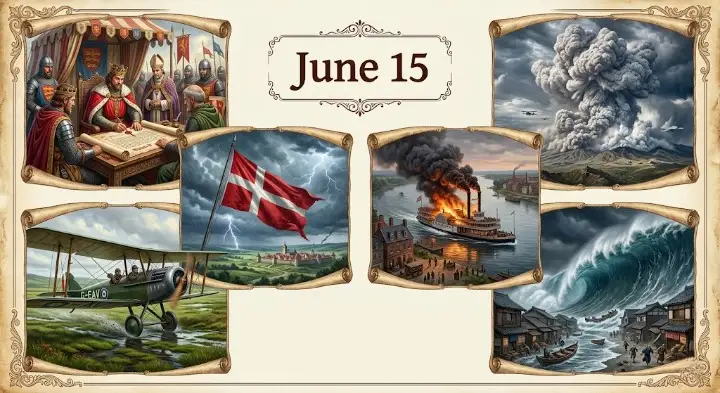
King John sat inside a brightly colored tent pitched on the marshy grass of Runnymede, his fingers pressing a heavy wax seal into parchment. Surrounding him stood armed, angry barons who refused to leave until the monarch signed away his absolute power. This tense showdown forced a tyrant to admit that even kings must obey the law. Decades of royal overreach collapsed in a single morning, creating a foundational blueprint for modern democracy. Knowing what happened on this day in history June 15 reveals how quickly the balance of human power can shift.
📅 Quick Facts — June 15 in History
| 📌 Category | 📖 Event / Detail |
|---|---|
| 🌟 Most Significant Event | King John seals the Magna Carta (1215) |
| 🏆 Top 10 Key Events | • Assyrian solar eclipse (763 BC) • Battle of Soissons (923) • Battle of Kosovo (1389) • Martin Luther excommunication threat (1520) • Jamestown Fort completed (1607) • Oregon Treaty signed (1846) • Meiji-Sanriku tsunami (1896) • General Slocum steamboat fire (1904) • Alcock and Brown transatlantic flight (1919) • Mount Pinatubo eruption (1991) |
| ⚔️ Key Battles | Battle of Soissons, Battle of Fimreite, Battle of Lindanise, Battle of Rozgony, Battle of Kosovo, Second Battle of Petersburg |
| 👤 Key Figures | King John of England, Sultan Murad I, Martin Luther, Mary, Queen of Scots |
| 🌍 Observances | Day of Valdemar (Denmark), Arbor Day (Costa Rica), Engineer’s Day (Italy), Global Wind Day, National Beer Day (UK), National Salvation Day (Azerbaijan) |
Story of the Day: The Cataclysm of Mount Pinatubo
Darkness swallowed the midday Philippine sky as Mount Pinatubo blew its peak apart, launching twenty million tons of sulfur dioxide straight into the stratosphere. Roofs collapsed under the weight of wet volcanic ash while typhoon winds whipped the debris into a blinding slurry. This massive eruption altered global temperatures for years, cooling the planet by a full Fahrenheit degree.
Important Events That Happened On June 15 In History
763 BC – The Nineveh Centennial Eclipse
Assyrian astronomers looked up from their stone towers to see the midday sun turn into a black void. Royal scribes quickly carved the terrifying celestial event into clay tablets alongside the year’s political rebellions. This ancient documentation allowed modern archaeologists to anchor the entire timeline of Mesopotamian civilization to an exact calendar date. Without this precise solar tracking, huge swaths of early human progress would remain lost to guesswork.
844 – Louis II Claims The Italian Crown
Louis II marched his armored retinue into the heart of Rome to demand the ultimate spiritual endorsement. Pope Sergius II placed the golden crown of Italy upon the young Carolingian prince’s head inside St. Peter’s Basilica. This ceremony bound the destiny of the Holy See to Frankish military protection during a time of intense regional instability. The coronation solidified a fractured European power dynamic that dictated medieval politics for generations.
923 – The Bloody Clash At Soissons
King Robert I of France charged his cavalry directly into the rival lines of Duke Rudolph of Burgundy. The fierce melee ended with Robert dead on the field, yet his furious troops pushed onward to secure a bitter tactical victory. Rebel forces immediately arrested the deposed King Charles the Simple, locking him away in a fortress for the rest of his life. This violent afternoon fractured the Carolingian dynasty and threw the French monarchy into decades of internal chaos.
1184 – Slaughter At The Battle Of Fimreite
Sverre Sigurdsson directed his longships through the narrow, cliff-shadowed waters of the Sognefjord to ambush the Norwegian royal fleet. Rebel warriors swarmed the enemy vessels, sending heavily armored men panic-striking into the freezing fjord. King Magnus V drowned alongside thousands of his finest soldiers as their overcrowded ships capsized. Sverre seized the throne of Norway, fundamentally altering the lineage of Nordic royalty through sheer naval brutality.
1215 – Magna Carta Obtains The Royal Seal
King John surrendered his claim to absolute royal authority under the shadow of rebel rebel swords at Runnymede. The document he sealed established the revolutionary principle that the law applies to rulers and subjects alike. Furious baronial pressure forced this concession, protecting free men from arbitrary imprisonment and unfair royal taxation. This parchment became the bedrock of constitutional law across the Western world.
1219 – The Heavenly Banner Of Lindanise
King Valdemar II led his Danish crusaders into a desperate, chaotic defensive stand against pagan Estonian warriors. Legend says a red banner with a white cross dropped from the clouds just as Danish lines began to break. This sudden omen rallied the retreating soldiers to win a crushing victory that secured the Duchy of Estonia. The fallen emblem became the Dannebrog, establishing the oldest continuously used national flag in human history.
1246 – The Babenberg Dynasty Collapses
Duke Frederick II of Austria rode hard into the muddy banks of the Leitha River to fight Hungarian invaders. The aggressive ruler perished during the chaotic melee, leaving behind no male heirs to claim his vast territories. This sudden battlefield death ended generations of Babenberg rule over the Austrian lands. The vacuum sparked decades of bitter conflict until the Habsburgs swept in to seize control of Central Europe.
1285 – Venice Secures Constantinople Trading Rights
Byzantine diplomats sat across from Venetian envoys to finalize a sweeping ten-year maritime truce. The Emperor granted Venice a sprawling, tax-privileged commercial quarter within the walls of Constantinople. This calculated deal restored ancient trading dominance to the Venetian republic after years of bitter Mediterranean warfare. The agreement filled Venetian coffers while keeping the fragile Byzantine economy afloat against eastern threats.
1310 – The Street Battle Of Venice
Bajamonte Tiepolo led a heavily armed band of conspirators through a torrential storm toward the Piazza San Marco. Alert government guards intercepted the rebels, turning the flooded canals and narrow stone alleys into a slaughterhouse. Citizens threw heavy clay pots from windows to help crush the uprising against the Doge. The thwarted coup forced Venice to create the Council of Ten, a ruthless secret police network that ruled for centuries.
1312 – Charles I Triumphs At Rozgony
King Charles I of Hungary aligned his foreign mercenaries against the rebellious, entrenched forces of the Aba clan. The ensuing clash on the plains of Rozgony turned into a ruthless medieval bloodbath that broke the back of the local oligarchy. Charles secured undisputed control over his fractured kingdom after years of territorial division. This decisive victory unified Hungary under a powerful central administration.
1389 – The Mutual Slaughter Of Kosovo
Sultan Murad I faced the heavy cavalry of Serbian Prince Lazar on a vast plain covered in wild field flowers. Both commanders perished during the savage fighting—Murad by an assassin’s blade, Lazar by public execution after capture. The Ottoman victory wiped out the core of the Serbian nobility and opened the Balkans to imperial conquest. This brutal afternoon became an enduring, tragic symbol of national identity across Southeastern Europe.
1410 – The Yongle Emperor Devastates The Mongols
Chinese soldiers under the Yongle Emperor dragged heavy artillery to the remote banks of the Onon River. The Ming army unleashed a coordinated assault that decimated the Mongol forces of Oljei Temur. This massive military expedition pushed Chinese border security deeper into the northern steppes than ever before. The crushing defeat shattered Mongol unity and protected the Ming heartland from nomadic invasions for a generation.
1410 – Battle Of Kosmidion
Süleyman Çelebi deployed his veteran troops outside the ancient walls of Constantinople to halt his brother Musa’s advance. The brutal clash marked a critical turning point in the chaotic Ottoman Interregnum civil war. Süleyman’s victory temporarily secured his claim to the imperial throne while the Byzantine capital watched from its battlements. The fratricidal war kept the empire divided and delayed their expansion into Europe.
1520 – The Pope Condemns Martin Luther
Pope Leo X issued the papal bull Exsurge Domine, fiercely demanding that Martin Luther recant forty-one specific heresies. The document compared the German monk to a wild boar destroying the Lord’s vineyard. Luther refused to back down, publicly burning the papal decree outside the gates of Wittenberg. This dramatic break severed the Western Church forever and ignited the fires of the Protestant Reformation.
1567 – The Surrender At Carberry Hill
Mary, Queen of Scots, stood on a sun-baked hillside beside her controversial new husband, the Earl of Bothwell. Disgruntled Scottish nobles surrounded the royal couple, demanding Bothwell’s arrest for the murder of Mary’s previous husband. Rather than risk a bloody civil slaughter, Mary surrendered herself into custody while her husband fled into exile. This dramatic standoff ended Mary’s active reign, leading to her forced abdication and lifelong imprisonment.
1607 – Jamestown Fort Finished
Virginia colonists drove the final wooden spikes into the marshy soil of James’s Fort, completing a triangular wooden wall. Men worked through sweltering heat and constant mosquito swarms to secure protection against Spanish ships and Native American archers. This primitive outpost became the fragile anchor for the first permanent English settlement in the New World. Within months, disease and starvation would test the colony to its absolute limits.
1804 – New Hampshire Ratifies The Twelfth Amendment
New Hampshire legislators gathered in Concord to cast a crucial vote approving the restructuring of the American executive branch. This ratification provided the final state approval needed to embed the Twelfth Amendment into the United States Constitution. The new law forced electors to cast distinct, separate ballots for president and vice president. This simple administrative change prevented a repeat of the chaotic, tied election of 1800.
1826 – The Auspicious Incident
Sultan Mahmud II ordered his loyal artillery officers to open fire on the barracks of the rebellious Janissary corps. Cannon fire tore through the wooden quarters, killing thousands of the elite soldiers who had dominated Ottoman politics for centuries. This deliberate, bloody purge completely dismantled the military caste that blocked modern reforms. The Sultan immediately formed a Westernized army to defend his shrinking imperial borders.
1834 – The Plunder Of Safed
Armed rioters poured into the mountain city of Safed, initiating weeks of brutal violence against the local Jewish population. Attackers demolished stone homes, desecrated ancient synagogues, and plundered commercial property across the community. This devastating outbreak of sectarian violence left the historic district completely impoverished and physically ruined. The trauma forced many families to flee the region, shifting the demographics of Galilee.
1846 – The Oregon Treaty Signed
James Buchanan signed a sweeping diplomatic agreement in Washington, drawing a clear line through the wilderness of the Pacific Northwest. The treaty extended the American-British border straight along the 49th parallel all the way to the Pacific Ocean. This compromise averted a potentially catastrophic war between the United States and Great Britain. The pen stroke added vast, resource-rich territories to the growing American map.
1859 – The Pig War Confrontation
American farmer Lyman Cutlar pulled his rifle trigger, shooting a British-owned pig that was digging up his potato patch on San Juan Island. This minor property dispute escalated into an absurd international standoff involving three British warships and hundreds of American soldiers. Ambiguity in the freshly signed Oregon Treaty left both nations claiming sole jurisdiction over the island chain. The bizarre confrontation ended without a single human casualty.
1864 – The Siege Of Petersburg Commences
General Ulysses S. Grant directed the Union Army of the Potomac across the James River to strike the rail hub of Petersburg. Confederate defenders scrambled into defensive earthworks, holding off the initial wave of northern assaults through desperate trench warfare. This intense encounter initiated a grueling ten-month siege that choked the supply lines of Richmond. The brutal war of attrition ultimately broke the back of the Confederate rebellion.
1896 – The Meiji-Sanriku Tsunami Devastates Japan
Shinto priests and fishermen along the Sanriku coast felt a mild, barely noticeable earthquake ripple beneath their feet. Meaningful warning arrived too late as a monstrous ninety-foot wall of water slammed into the coast thirty minutes later. The catastrophic surge obliterated thousands of coastal homes and claimed more than twenty-two thousand human lives. This disaster prompted Japan to pioneer modern tsunami warning systems and coastal engineering.
1904 – The General Slocum Steamboat Disaster
Captain William Van Schaick steered the paddle steamer SS General Slocum up New York’s East River as a fire erupted in the forward cabin. Rotten life preservers crumbled in the hands of panicked mothers, and rusted lifeboats remained stuck to the deck. More than one thousand passengers, mostly German immigrant women and children, drowned or burned to death within sight of land. The horrific tragedy wiped out the cultural heart of Manhattan’s Little Germany.
1919 – Alcock And Brown Concord The Atlantic
John Alcock and Arthur Brown climbed out of their modified Vickers Vimy bomber into a muddy Irish peat bog. They had just completed the first nonstop transatlantic flight, crossing nearly two thousand miles of ocean fog in less than seventy-two hours. The harrowing journey proved that long-distance aviation was a viable reality rather than a dangerous stunt. Their muddy landing changed global transit and communication options forever.
1920 – Northern Schleswig Returns To Denmark
Danish border guards opened the frontier gates to welcome Northern Schleswig back into the national fold after decades of German rule. This territorial transfer followed a peaceful democratic plebiscite held under the terms of the Treaty of Versailles. Citizens voted overwhelmingly to realign their local communities with Denmark rather than Weimar Germany. This peaceful boundary correction remains a model for resolving European border disputes.
1940 – Operation Aerial Evacuation Begins
Allied naval commanders dispatched hundreds of civilian and military vessels to the western ports of collapsing France. Sailors braved relentless Luftwaffe bombing runs to rescue stranded troops following the tragic fall of Paris. This massive evacuation operation saved over one hundred and ninety thousand personnel from certain capture. The rescued soldiers formed the core of the free forces that later liberated the continent.
1944 – American Marines Storm Saipan
United States Marines waded through exploding coral reefs to establish a bloody beachhead on the strategic island of Saipan. Japanese defenders dug deep into volcanic caves, fighting to the absolute last man to protect the imperial outpost. The capture of this island placed American B-29 bombers within striking range of Tokyo. The intense fighting signaled the beginning of the end for the Japanese home islands.
1944 – North America’s First Socialist Government
Tommy Douglas celebrated a historic landslide victory as the Co-operative Commonwealth Federation swept the Saskatchewan general election. This political upset marked the creation of the first democratic socialist provincial administration in North American history. Douglas used this mandate to pioneer universal, single-payer healthcare for his constituents. The regional experiment eventually became the model for Canada’s national medical system.
1972 – Bombing Of Cathay Pacific Flight 700Z
Cathay Pacific Flight 700Z cruised over the dense jungles of Pleiku, Vietnam, when a suitcase bomb detonated inside the cabin. The mid-air explosion shattered the Convair 880 airliner, killing all eighty-one passengers and crew on board. Investigators discovered that a Thai police officer had sabotaged the flight to claim a lucrative insurance policy on his family. This tragedy forced international airlines to drastically tighten luggage inspection protocols.
1977 – Spain Votes In First Post-Franco Election
Millions of Spanish citizens stood in long, quiet lines outside polling stations to cast ballots in their first free election in forty-one years. The sudden death of dictator Francisco Franco in 1975 opened the door to this peaceful democratic transition. Voters rejected extremist factions, choosing moderate leadership to draft a new national constitution. This historic vote transformed Spain into a modern, democratic European state.
1988 – The Maiden Flight Of Ariane 4
Engineers at the Kourou spaceport watched the Ariane 4 rocket lift off into the skies of French Guiana. The launcher successfully placed its commercial satellite payload into orbit, proving the reliability of Europe’s new workhorse rocket. This maiden voyage secured Europe’s independent access to space for the next fifteen years. The design became the dominant commercial satellite launcher of its generation.
1991 – The Colossal Eruption Of Mount Pinatubo
Mount Pinatubo blew its summit into the sky during the second-largest volcanic eruption of the twentieth century. A rain of heavy ash combined with a passing typhoon, collapsing thousands of structures across Luzon. The disaster claimed over eight hundred lives and forced the permanent closure of massive American military bases nearby. The ash cloud altered global climate patterns for several seasons.
1992 – United States v. Álvarez-Machaín
The United States Supreme Court ruled that federal agents possess the authority to forcibly abduct criminal suspects from foreign soil without local government consent. This controversial decision validated the extrajudicial kidnapping of a Mexican doctor tied to the murder of a DEA agent. Foreign nations fiercely protested the ruling, viewing it as a direct violation of international law. The legal precedent fundamentally reshaped American cross-border law enforcement.
1996 – The IRA Devastates Manchester City Centre
Provisional Irish Republican Army operatives parked a heavy truck loaded with homemade explosives outside a crowded Manchester shopping mall. A clear telephoned warning allowed police to evacuate eighty thousand citizens before the massive detonation tore through the commercial district. The blast injured two hundred people and caused hundreds of millions of dollars in structural damage. This destruction triggered a massive, multi-year urban architectural regeneration project.
2013 – Quetta Bus Bombing Sparks Terror
A hidden explosive device ripped through a university bus carrying female students in the southwestern Pakistani city of Quetta. The initial blast killed twenty-five people, and a subsequent siege at the emergency hospital killed several medical workers. Militants targeted the young women to terrorize families seeking higher education for their daughters. The tragedy provoked nationwide protests demanding better security for educational institutions.
Catch up on the historical tales you missed yesterday.
Famous People Born On June 15
| Name | Description | Date |
|---|---|---|
| Edward, the Black Prince | English military commander and hero of the Hundred Years’ War | 1330 – 1376 |
| Lisa del Giocondo | Subject of Leonardo da Vinci’s Mona Lisa | 1479 – 1542 |
| Edvard Grieg | Norwegian composer of classical masterpieces | 1843 – 1907 |
| Erik Erikson | Psychologist known for psychosocial development theory | 1902 – 1994 |
| Wilbert Awdry | Creator of Thomas the Tank Engine | 1911 – 1997 |
| Yuri Andropov | Soviet leader | 1914 – 1984 |
| Herbert A. Simon | Nobel Prize-winning economist & AI pioneer | 1916 – 2001 |
| John Fenn | Nobel Prize-winning chemist | 1917 – 2010 |
| Alberto Sordi | Italian actor and filmmaker | 1920 – 2003 |
| Erroll Garner | Jazz pianist and composer | 1921 – 1977 |
| Ezer Weizman | President of Israel | 1924 – 2005 |
| Ibn-e-Insha | Pakistani poet & humorist | 1927 – 1978 |
| Mario Cuomo | Governor of New York | 1932 – 2015 |
| Waylon Jennings | Country music legend | 1937 – 2002 |
| Johnny Hallyday | French rock singer | 1943 – 2017 |
| Miriam Defensor Santiago | Filipino politician | 1945 – 2016 |
| Alain Aspect | Nobel Prize physicist | 1947 – Present |
| Simon Callow | Actor & author | 1949 – Present |
| Lakshmi Mittal | Business magnate | 1950 – Present |
| Xi Jinping | President of China | 1953 – Present |
| Jim Belushi | Actor & comedian | 1954 – Present |
| Helen Hunt | Oscar-winning actress | 1963 – Present |
| Courteney Cox | Actress (Friends) | 1964 – Present |
| Ice Cube | Rapper & actor | 1969 – Present |
| Oliver Kahn | Football goalkeeper legend | 1969 – Present |
| Neil Patrick Harris | Actor & entertainer | 1973 – Present |
| Mohamed Salah | Football superstar | 1992 – Present |
Famous People Died On June 15
| Name | Description | Date |
|---|---|---|
| Robert I of France | King of West Francia | 923 |
| Minamoto no Yoshitsune | Japanese commander | 1189 |
| Wat Tyler | Peasants’ Revolt leader | 1381 |
| Lazar of Serbia | Serbian prince | 1389 |
| James K. Polk | US President | 1849 |
| Frederick III | German Emperor | 1888 |
| Ella Fitzgerald | Jazz singer | 1996 |
| Choi Hong Hi | Taekwondo founder | 2002 |
| Franco Zeffirelli | Film director | 2019 |
| Glenda Jackson | Actress & politician | 2024 |
Observances on June 15
Day of Valdemar and Reunion Day (Denmark)
Danish citizens raise the national flag on this dual holiday celebrating the legendary 1219 appearance of their national emblem. The day also honors the 1920 return of Northern Schleswig to Danish territory after a democratic border plebiscite.
Arbor Day (Costa Rica)
Schoolchildren and environmental activists across Costa Rica spend this day planting thousands of native trees to combat local deforestation. This national holiday emphasizes the country’s long-term commitment to biodiversity and ecological preservation.
Engineer’s Day (Italy)
Italian universities and architectural firms host technical symposiums to honor the historical and contemporary contributions of the engineering profession. The event promotes innovation and remembers the master builders who shaped Italy’s iconic infrastructure.
Global Wind Day
International energy organizations host educational workshops and wind farm tours to promote the growth of renewable wind energy. The day highlights how modern turbine technology can reduce carbon emissions and combat climate change.
National Beer Day (United Kingdom)
Pubs across Britain celebrate the anniversary of the Magna Carta, which explicitly mentioned standardizing the measures of ale in 1215. Citizens toast local breweries and participate in historical tavern tours.
National Salvation Day (Azerbaijan)
Azerbaijan commemorates the 1993 return of Heydar Aliyev to leadership in Baku, an event credited with halting a civil war. Public concerts and political rallies emphasize national stability and independence.
📜 Frequently Asked Questions — June 15 in History
King John met with rebel barons at Runnymede to place his royal seal upon the Magna Carta. This historic document limited the arbitrary power of the English monarchy for the first time. It established the foundational legal concept that no citizen is above the law of the land.
The sealing of the Magna Carta in 1215 stands as the most influential event on this calendar date. This single parchment laid the groundwork for modern constitutional governance, individual liberties, and the American legal system. Its core principles still shape democratic societies around the world today.
Black Hawk, the influential leader of the Sauk Native American tribe, was born on this day in 1767. He later led his people in a fierce, historic resistance against American expansionism in the Midwest during the Black Hawk War. His legacy remains a powerful symbol of indigenous sovereignty.
The United States military launched a massive amphibious invasion of the island of Saipan during World War II in 1944. American Marines fought through intense, entrenched Japanese resistance to secure the strategic territory. This costly victory placed Tokyo within direct range of American long-range bombers.
The Day of Valdemar is a Danish holiday commemorating the legendary fall of the Dannebrog flag from the heavens during a 1219 battle in Estonia. It represents national pride and unity across Denmark. The date also celebrates the peaceful return of the Schleswig region to Denmark in 1920.
Militants detonated a devastating bomb on a student bus in the city of Quetta, Pakistan, killing twenty-five people in 2013. The attack specifically targeted female university students seeking higher education. This tragedy provoked widespread international condemnation and local demands for improved educational security.