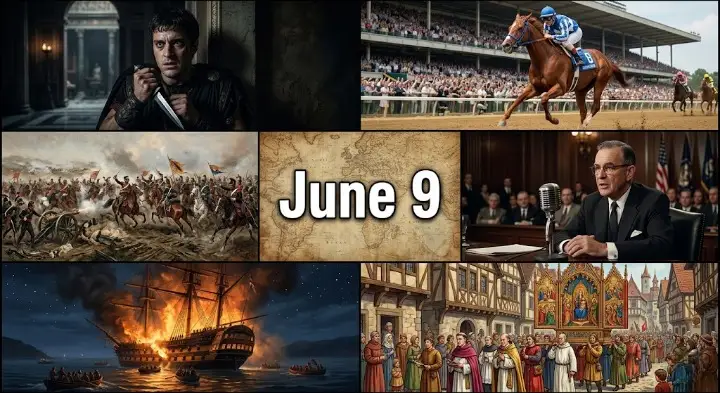
Nero Claudius Caesar clutched a dagger in his shaking hand on June 9, 68 AD, listening to the thundering hooves of Roman cavalry closing in to arrest him. Abandoned by his guards and declared a public enemy by the Senate, the final ruler of the Julio-Claudian dynasty drove the blade into his own throat. His dying breath ended an era and plunged Rome into a chaotic civil war. This single date bridges ancient imperial collapse with modern cultural milestones, offering a window into how quickly human fortunes shift. Understanding what happened on June 9 in history reveals how moments of individual crisis shape the broader story of our world.
👶 Quick Facts — June 9 in History
| 📌 Category | 📖 Event / Detail |
|---|---|
| 🌟 Most Significant Event | Secretariat wins the Belmont Stakes to capture the U.S. Triple Crown (1973) |
| 🏆 Top 10 Key Events | • Nero commits suicide, ending the Julio-Claudian dynasty (68 AD) • Duccio’s Maestà masterpiece is unveiled in Siena (1311) • Jacques Cartier begins mapping the Saint Lawrence River (1534) • British schooner Gaspee is burned by American patriots (1772) • Congress of Vienna concludes, reshaping the map of Europe (1815) • Battle of Brandy Station marks the largest cavalry clash on U.S. soil (1863) • Charles Kingsford Smith completes the first trans-Pacific flight (1928) • Army counsel Joseph Welch delivers his legendary rebuke to Senator McCarthy (1954) • Israel captures the Golan Heights during the Six-Day War (1967) • Yugoslavia and NATO sign a peace treaty to end the Kosovo War (1999) |
| ⚔️ Key Battles | Battle of Toulouse (721), Battle of Arklow (1798), Battle of Saintfield (1798), Battle of Port Republic (1862), Battle of Brandy Station (1863), Battle of Đồng Xoài (1965) |
| 👤 Key Figures | Emperor Nero, James Oglethorpe, Stonewall Jackson, Joseph N. Welch, Ron Turcotte |
| 🌍 Observances | Autonomy Day (Åland), National Heroes’ Day (Uganda), Coral Triangle Day, Murcia Day (Spain), La Rioja Day (Spain) |
Story of the Day: Secretariat’s Immortal 31-Length Triumph
Penny Chenery watched from the grandstands at Belmont Park as her towering chestnut colt, Secretariat, stepped onto the track with jockey Ron Turcotte. No horse had captured the elusive American Triple Crown in twenty-five years, and the pressure on the three-year-old thoroughbred was immense. Rather than running a cautious, tactical race to preserve his energy over the grueling mile-and-a-half track, Secretariat accelerated away from his rival, Sham, at a pace that seemed suicidal to seasoned turf writers.
Turcotte never pulled the whip, simply letting the horse run his own race as the crowd’s murmur swelled into a deafening roar. Secretariat opened up a lead of ten lengths, then twenty, and finally crossed the finish line an astronomical thirty-one lengths ahead of his nearest competitor. He stopped the clock at 2:24 flat, setting a world record on dirt that stands completely unbroken more than a half-century later.
Important Events That Happened On June 9 In History
Here’s your text with proper ### headings (the literal “h3” removed, just the heading format):
411 BC – The Athenian Coup
Hundreds of aristocratic conspirators marched into the democratic assembly at Athens and forced the citizens to vote away their own political freedoms. Dissatisfied with the handling of the Peloponnesian War, these wealthy oligarchs replaced the democratic system with a restrictive council known as the Four Hundred. The coup instantly shattered the internal stability of the city-state while its naval fleet remained stationed abroad at Samos. Democratic sailors refused to recognize the new regime, forcing the oligarchy to collapse within a few chaotic months.
53 – Nero Marries Claudia Octavia
Sixteen-year-old Nero Claudius Caesar took his stepsister Claudia Octavia as his bride in a lavish imperial wedding designed solely to secure his line of succession. Agrippina the Younger engineered the marriage to seal her son’s path to the throne over the rightful heir, Britannicus. The union brought no joy to Octavia, who found herself trapped in a dangerous court web of betrayal. Nero eventually banished and executed her a decade later, sparking widespread outrage among the Roman populace who viewed her as a symbol of innocence.
68 – The Suicide of Emperor Nero
Nero hid in a freedman’s villa outside Rome, trembling as the sound of approaching horses signaled the arrival of soldiers sent to arrest him. Declared a public enemy by the Senate, the cornered ruler forced a blade into his throat with the help of his secretary. His final words lamented the loss of his own artistic talent, ending the historic Julio-Claudian dynasty. The empire immediately fractured, descending into a brutal civil war known as the Year of the Four Emperors.
721 – The Battle of Toulouse
Duke Odo of Aquitaine looked out at the massive siege lines surrounding Toulouse before ordering his heavy cavalry to charge the unsuspecting Umayyad forces. The sudden assault caught the Muslim army entirely by surprise as they celebrated their impending victory over the city. Odo’s decisive victory broke the momentum of the governor-general’s northern expansion into western Europe. The triumph bought valuable decades for neighboring Frankish kingdoms to organize their military defenses before the next major invasion.
747 – The Abbasid Revolution Begins
Abu Muslim Khorasani raised a massive black banner in Merv, signaling an open insurrection against the ruling Umayyad Caliphate. Capitalizing on widespread social discontent, the enigmatic commander united diverse political and religious factions under one military movement. The raising of the standard launched a bloody civil war that swept across the Middle East. Within three years, the Abbasids dismantled the old order and established a new capital city in Baghdad.
1311 – Duccio’s Maestà Unveiled
Thousands of Siena citizens walked alongside government officials, musicians, and priests as they paraded Duccio di Buoninsegna’s massive altarpiece through the streets to the cathedral. The completed masterpiece represented years of meticulous work and signaled a bold shift toward human emotion in religious art. Crowds marveled at the vibrant colors and detailed storytelling scenes covering both sides of the wood panels. The public celebration cemented the city’s status as a major cultural rival to neighboring Florence during the early Renaissance.
1523 – Simon de Colines Fined
Church authorities at the Parisian Faculty of Theology ordered printer Simon de Colines to pay a heavy fine for distributing Jacques Lefèvre d’Étaples’s commentary on the Gospels. The conservative faculty viewed the publication as a dangerous threat because it encouraged everyday readers to interpret biblical texts without church mediation. This public reprimand highlighted the intense anxiety gripped European universities during the early years of the Protestant Reformation. Colines continued to refine his typography and printing techniques, pushing humanistic literature forward despite the constant threat of censorship.
1534 – Cartier Maps the Saint Lawrence
French navigator Jacques Cartier guided his two wooden ships past the rugged cliffs of Quebec and entered a vast, uncharted waterway. Recognizing the strategic value of the river, he began sketching the shorelines and documenting the villages of the Indigenous people he encountered. This expedition marked the first official European charting of the Saint Lawrence River system. The detailed maps Cartier brought back to King Francis I laid the direct geopolitical foundations for the colony of New France.
1732 – Royal Charter for Georgia
King George II pressed his royal seal onto a charter granting James Oglethorpe and twenty corporate trustees the right to establish a brand-new American colony. Oglethorpe envisioned the territory as a haven where indebted prisoners from London could rebuild their lives through hard work and farming. The British government viewed the land primarily as a vital military buffer zone against Spanish forces occupying Florida. This legal document set the stage for the founding of Savannah and the creation of Britain’s thirteenth colony.
1772 – The Burning of the Gaspee
John Brown led a group of local Rhode Island patriots out into Narragansett Bay under the cover of a moonless night to surround a stranded British schooner. The royal vessel had run aground while aggressively chasing American merchant ships suspected of smuggling goods past customs. The raiders boarded the ship, shot the commander in the groin, and forced the crew ashore before setting the vessel on fire. The destruction of the royal ship enraged the British crown, escalating pre-revolutionary tensions across New England.
1798 – Battles of Arklow and Saintfield
United Irishmen rebels armed with pikes charged British infantry lines in two separate, bloody clashes across the Irish countryside. At Arklow, government grapeshot tore through the rebel ranks, killing their leader and breaking the back of the southern uprising. Meanwhile, northern rebels secured a temporary victory at Saintfield by ambushing an overconfident British cavalry unit. The mixed military outcomes exposed the lack of coordination that ultimately doomed the 1798 rebellion to a brutal defeat.
1815 – The Congress of Vienna Concludes
Diplomats from Europe’s major powers gathered around a massive table to sign the Final Act, officially redrawing the political borders of the continent. Following the chaotic collapse of Napoleon’s empire, the negotiators focused on creating a stable balance of power to prevent future revolutions. The agreement ignored local nationalist ambitions, shuffling millions of citizens into newly designed kingdoms and confederations. This conservative political framework prevented a continent-wide war in Europe for nearly a century.
1856 – Mormons Depart Iowa City
Five hundred pioneers grabbed the wooden handles of their homemade handcarts and began walking westward out of Iowa City toward the Utah territory. Lacking the money to purchase traditional oxen and heavy canvas wagons, these families relied entirely on their own physical strength to pull their belongings across the rugged plains. The arduous journey tested the endurance of the travelers as they faced unpredictable weather and limited food rations. This departure marked the beginning of the handcart pioneer era, a defining chapter in the westward migration of the Latter-day Saints.
1861 – The Beyoglu Protocol Signed
Ottoman officials and European diplomats signed an international agreement transforming Mount Lebanon into a semi-autonomous district ruled by a Christian governor. The treaty followed a series of bloody civil massacres between local Druze and Maronite Christian populations. By granting the Christian majority distinct legal privileges, the European powers established a direct foothold in Middle Eastern governance. This administrative shift altered the delicate sectarian balance of the region for generations to come.
1862 – The Battle of Port Republic
General Stonewall Jackson directed his Confederate infantry across a makeshift wagon bridge to launch a fierce counterattack against Union forces in the Shenandoah Valley. The bloody struggle for a strategic hilltop artillery position ended with a Federal retreat, securing Jackson’s control over the region. This victory concluded a brilliant month-long campaign that successfully distracted tens of thousands of Union soldiers from marching on Richmond. Jackson’s reputation soared, providing a massive morale boost to the Southern war effort.
1863 – The Battle of Brandy Station
General J.E.B. Stuart’s Confederate cavalrymen woke to the sound of pistol shots as ten thousand Union horsemen launched a surprise dawn assault across the Rappahannock River. The resulting ten-hour melee involved desperate hand-to-hand sabre fighting across the dusty Virginia hillsides. Though the Confederates ultimately held the field, the Union cavalry proved they could match the southern horsemen in skill and bravery. This engagement shattered the myth of invincibility surrounding the Confederate cavalry in the eastern theater of the American Civil War.
1885 – The Treaty of Tientsin
Qing dynasty representatives signed a peace treaty officially ending the Sino-French War and surrendering China’s long-standing suzerainty over northern Vietnam. The agreement forced the Chinese empire to recognize French protectorates over Tonkin and Annam after months of costly border skirmishes. This diplomatic concession marked a major step forward for French imperial expansion in Southeast Asia. The newly acquired territories were quickly consolidated to form the core of French Indochina.
1900 – The Death of Birsa Munda
Twenty-four-year-old tribal leader Birsa Munda collapsed and died of cholera while shackled inside a British prison cell in Ranchi. Munda had organized a massive guerrilla rebellion against colonial land policies that threatened the traditional lifestyle of his people. His spiritual and political movement challenged the authority of the British Raj across eastern India. Though his life ended early, Munda became an enduring symbol of anti-colonial resistance and indigenous land rights.
1915 – William Jennings Bryan Resigns
Secretary of State William Jennings Bryan walked into the White House and handed his official resignation letter to President Woodrow Wilson. Bryan refused to sign a stern diplomatic note to Germany regarding the sinking of the passenger liner RMS Lusitania, fearing it would drag America into the European war. His dramatic departure highlighted a deep philosophical rift within the administration over the concept of strict neutrality. Bryan chose to sacrifice his political career to spend his remaining years campaigning publicly for peace.
1922 – Åland’s Regional Assembly Convenes
Politicians gathered in the town of Mariehamn for the historic opening session of the Åland Regional Assembly, marking the official birth of their self-governing status. The meeting followed a tense international dispute resolved by the League of Nations, which granted sovereignty to Finland while guaranteeing the islands’ Swedish culture. Locals celebrated their hard-won legislative autonomy by raising flags throughout the archipelago. Today, residents commemorate this specific gathering as Self-Government Day.
1923 – The Bulgarian Coup d’État
Armed soldiers and members of the Military League seized government buildings in Sofia before dawn, arresting the country’s prime minister. The conspirators overthrew the populist government of Aleksandâr Stamboliyski, which had angered the military elite with its radical agrarian policies. Stamboliyski fled to his home village but was captured and brutally executed days later. The violent takeover ushered in a dark era of political instability and internal repression across Bulgaria.
1928 – Kingsford Smith Crosses the Pacific
Aviator Charles Kingsford Smith guided his three-engine Fokker monoplane, the Southern Cross, down onto a runway in Brisbane to a cheering crowd of thousands. Alongside his co-pilot and crew, Smith had completed the first flight across the Pacific Ocean, traveling from California to Australia with stops in Hawaii and Fiji. The treacherous journey over open ocean required nearly eighty-five hours of flying time through severe tropical storms. This historic landing proved that long-distance international aviation was a practical reality.
1930 – The Murder of Jake Lingle
A lone gunman stepped behind Chicago Tribune reporter Jake Lingle in a crowded pedestrian tunnel during rush hour and fired a single bullet into his head. Investigators quickly discovered that the low-paid crime reporter lived a lavish lifestyle funded by a hundred-thousand-dollar gambling debt owed to Al Capone. Lingle had been acting as an unauthorized middleman between city police officials and the criminal underworld. The brazen daytime assassination forced a public reckoning over the deep corruption gripping Chicago during the Prohibition era.
1944 – The Tulle Massacres
German SS troops rounded up hundreds of male civilians in the town of Tulle, France, and began hanging ninety-nine of them from lampposts and balconies. The mass execution served as a brutal reprisal for recent resistance attacks on German garrisons as Allied forces pushed inland from Normandy. The remaining men were deported to concentration camps, where over a hundred more lost their lives. This atrocity stood out as a horrifying example of total war directed against innocent European communities.
1944 – The Soviet Invasion of Karelia
Red Army artillery units unleashed a massive bombardment along the Finnish border, launching a major offensive to reclaim the disputed territory of Karelia. Tens of thousands of Soviet infantrymen pushed forward, breaking through the fortified defensive lines that Finland had held since 1941. The sudden assault forced the Finnish military into a rapid, desperate retreat toward their inner defense perimeters. This military campaign eventually pressured Finland to exit World War II and sign an armistice with the Soviet Union.
1948 – International Council on Archives Founded
Archivists from across the globe met in Paris under the guidance of UNESCO to officially establish an international organization dedicated to preserving historical records. The founders recognized that the destruction of World War II highlighted the urgent need for global cooperation in document conservation. The council focused on setting professional standards for managing records and protecting cultural heritage from future conflicts. This meeting laid the foundation for a global network that today safeguards billions of historical documents.
1953 – The Flint-Worcester Tornado Outbreak
A massive, dark funnel cloud touched down outside Worcester, Massachusetts, ripping through residential neighborhoods and killing ninety-four people in its path. The deadly storm system had devastated Flint, Michigan, just one day prior, leveling hundreds of homes with winds exceeding two hundred miles per hour. The destruction caught local communities completely off guard because radar technology was in its absolute infancy. This catastrophic weather event prompted the U.S. government to completely overhaul its severe storm warning and tracking systems.
1954 – Joseph Welch Rebukes Senator McCarthy
Army counsel Joseph N. Welch turned to Senator Joseph McCarthy during a live, televised congressional hearing and delivered a devastating verbal takedown. Frustrated by McCarthy’s cruel, unprovoked attack on a young lawyer in his firm, Welch asked the senator if he possessed any sense of decency at long last. The packed hearing room erupted into applause, stunning the anti-communist crusader who had dominated American politics for years. This public confrontation broke McCarthy’s political power, marking the beginning of his rapid downfall.
1957 – First Ascent of Broad Peak
Four Austrian mountaineers stood on the windswept summit of Broad Peak, celebrating the first successful climb of the world’s twelfth-highest mountain. Led by Marcus Schmuck, the team reached the peak without relying on supplemental oxygen or high-altitude porters. This historic achievement proved that a small, lightweight expedition could conquer an eight-thousand-meter Himalayan giant using alpine style. The innovative climbing method forever changed the approach to modern high-altitude mountaineering.
1958 – Aeroflot Flight 105 Crashes
An Aeroflot Ilyushin airliner struck a forested hillside during a low-visibility approach to Magadan Airport, killing all twenty-four passengers and crew members on board. The flight crew had descended below the safe altitude limit while navigating heavy fog and rain over the rugged Siberian terrain. This tragic accident exposed significant gaps in Soviet regional air traffic control and weather reporting systems. The disaster forced Aeroflot to implement stricter pilot training guidelines for operating in extreme northern weather conditions.
1959 – Launch of the USS George Washington
The massive steel hull of the USS George Washington slid into the waters of the Mystic River at Groton, Connecticut, during a crowded shipyard ceremony. Designed as the world’s very first nuclear-powered ballistic missile submarine, the vessel represented a massive technological leap forward in naval warfare. The ship provided the United States with a stealthy, mobile nuclear deterrent capability that could remain submerged for months at a time. Its launch added a powerful new element to the tense global arms race of the Cold War.
1965 – Phan Huy Quát Resigns
South Vietnamese Prime Minister Phan Huy Quát stepped down from his office after failing to resolve a paralyzing constitutional crisis with his cabinet. The civilian leader surrendered executive authority to a military junta led by Air Marshal Nguyễn Cao Kỳ. This resignation marked the end of a brief experiment with civilian governance in Saigon during a critical phase of the conflict. The political transition consolidated military control over the country just as American combat troops began arriving in massive numbers.
1965 – The Battle of Đồng Xoài
Viet Cong insurgents launched a massive midnight assault on a South Vietnamese district headquarters at Đồng Xoài, sparking days of brutal close-quarters combat. Heavy monsoon rains prevented effective American air support, allowing the communist fighters to overrun the garrison’s defenses. The battle resulted in heavy casualties on both sides and highlighted the growing military strength of the guerrilla forces. The fierce engagement convinced U.S. commanders that civilian forces could not hold territory without direct American ground intervention.
1967 – Israel Captures the Golan Heights
Israeli armored units scrambled up the steep, rocky slopes of the Golan Heights, overcoming fortified Syrian artillery bunkers during the final days of the Six-Day War. The strategic plateau had been used for years by the Syrian military to shell civilian farming villages in the valleys below. The capture of the high ground drastically altered the geopolitical map and military boundaries of the Middle East. This territorial shift created an enduring flashpoint that remains a central issue in international diplomacy today.
1968 – National Day of Mourning for Robert F. Kennedy
Flags flew at half-staff across the United States as citizens gathered in churches and public squares to mourn the assassination of Senator Robert F. Kennedy. President Lyndon B. Johnson issued an official proclamation calling for a unified day of reflection following the young politician’s tragic death in Los Angeles. The public funeral service in New York brought together a grieving nation reeling from a chaotic year of political violence. The loss of Kennedy left the civil rights movement and the anti-war movement without its most prominent political champion.
1972 – The Rapid City Flood
A wall of muddy water tore through Rapid City, South Dakota, after torrential rains caused the Canyon Lake Dam to burst in the middle of the night. The sudden deluge swept away hundreds of homes, cars, and bridges, catching sleeping residents completely by surprise. The disaster claimed two hundred and thirty-eight lives and caused over a hundred and sixty million dollars in property damage. This catastrophic failure forced local engineers to completely redesign urban floodplains and eliminate residential building zones along vulnerable waterways.
1978 – LDS Church Lifts Priesthood Ban
President Spencer W. Kimball announced a historic revelation extending the priesthood to all worthy male members of the Church of Jesus Christ of Latter-day Saints, regardless of race. The decision overturned a century-old policy that had strictly barred black men of African descent from ordinations and temple ordinances. The announcement brought widespread joy to congregations worldwide and sparked an immediate wave of missionary work across Africa and Brazil. This administrative shift modernized the church’s global structure and altered its international growth.
1979 – The Luna Park Ghost Train Fire
Thick, toxic smoke poured out of the Ghost Train ride at Sydney’s Luna Park as families rushed toward the exits in a panic. The sudden blaze tore through the popular wooden attraction within minutes, trapping several passengers inside the dark tunnels. The disaster claimed the lives of seven people, including a father and his two young sons. A flawed police investigation failed to pinpoint the exact cause of the electrical fire, sparking decades of public controversy and conspiracy theories across Australia.
1995 – Crash of Ansett New Zealand Flight 703
An Ansett New Zealand commuter plane slammed into a foggy ridge in the Tararua Range while approaching Palmerston North Airport, killing four people on board. The pilots had become distracted while attempting to troubleshoot a malfunctioning landing gear indicator light. This failure to monitor their altitude allowed the aircraft to descend directly into the hidden mountain peak. The tragedy prompted international aviation authorities to enforce stricter cockpit resource management procedures to prevent future CFIT (controlled flight into terrain) accidents.
1999 – Kosovo Peace Treaty Signed
Military commanders from the Federal Republic of Yugoslavia and NATO met inside a military tent in Kumanovo to sign a historic international peace agreement. The treaty officially ended an intense eleven-week bombing campaign directed at stopping ethnic violence across the region. Under the terms of the agreement, Yugoslav forces agreed to completely withdraw from Kosovo to make way for international peacekeepers. This document brought an end to the last major European armed conflict of the twentieth century.
2008 – Algiers Train Station Bombing
Two explosive devices detonated in quick succession outside a crowded passenger railway station near Algiers, killing thirteen people and wounding dozens of commuters. The first blast targeted a team of French engineers, while the second secondary device exploded minutes later to target arriving emergency first responders. The coordinated attack highlighted the ongoing security threat posed by extremist insurgent groups operating throughout North Africa. The incident forced Algerian authorities to implement tighter security checkpoints around public transportation hubs.
2009 – Peshawar Hotel Bombing
A truck packed with military-grade explosives smashed through the security gates of the luxury Pearl Continental Hotel in Peshawar, killing seventeen people. The blast collapsed a significant portion of the building, trapping international aid workers and diplomats beneath the heavy concrete rubble. The terrorist assault targeted a prominent hub used frequently by foreign delegations working in northwestern Pakistan. The tragedy underscored the intense volatility of the regional border areas during ongoing military operations against militant strongholds.
2010 – Kandahar Wedding Bombing
A suicide bomber walked into a crowded courtyard during a wedding celebration in the Arghandab district, detonating an explosive vest that killed forty guests. The blast targeted a gathering attended by members of a local anti-Taliban militia, turning a joyful family milestone into a scene of carnage. Over seventy injured survivors crowded into nearby regional hospitals. This tragedy highlighted the brutal insurgent strategy of targeting civilian social gatherings to intimidate local communities cooperating with security forces.
Visit our archive to read about yesterday’s major turning points.
Famous People Born On June 9
| Name | Description | Date |
|---|---|---|
| Leopold I, Holy Roman Emperor | Holy Roman Emperor who reigned for nearly 50 years, leading the Habsburg monarchy during a period of major conflicts | 1640 – 1705 |
| Peter the Great | Russian emperor who transformed Russia into a major European power through extensive reforms and expansion | 1672 – 1725 |
| George Stephenson | English engineer, pioneer of railway locomotion and designer of the Liverpool and Manchester Railway | 1781 – 1848 |
| Johann Gottfried Galle | German astronomer who was the first person to observe the planet Neptune and confirm its existence | 1812 – 1910 |
| Elizabeth Garrett Anderson | English physician, the first woman to qualify as a physician and surgeon in Britain | 1836 – 1917 |
| Bertha von Suttner | Austrian journalist and author, the first woman to be awarded the Nobel Peace Prize | 1843 – 1914 |
| Charles Joseph Bonaparte | American lawyer and politician, 46th United States Attorney General and founder of the FBI | 1851 – 1921 |
| Carl Nielsen | Danish violinist, composer, and conductor, one of the most celebrated composers of the 20th century | 1865 – 1931 |
| Henry Hallett Dale | English pharmacologist and physiologist, Nobel Prize laureate for work on chemical transmission of nerve impulses | 1875 – 1968 |
| Cole Porter | American composer and songwriter, one of the great Broadway and Hollywood songwriters of the 20th century | 1891 – 1964 |
| Skip James | American Delta blues singer-songwriter and guitarist, a key figure in the blues revival of the 1960s | 1902 – 1969 |
| Patrick Steptoe | English scientist, a pioneer of in vitro fertilization (IVF) and co-developer of the technique | 1913 – 1988 |
| Les Paul | American guitarist and songwriter, inventor of the solid-body electric guitar and multi-track recording | 1915 – 2009 |
| Robert McNamara | American businessman and politician, 8th United States Secretary of Defense during the Vietnam War | 1916 – 2009 |
| Eric Hobsbawm | Egyptian-English historian and author, one of the most influential Marxist historians of the 20th century | 1917 – 2012 |
| Jackie Mason | American stand-up comedian, known for his sharp, Jewish observational humor and Broadway shows | 1928 – 2021 |
| Nandini Satpathy | Indian author and politician, 8th Chief Minister of Odisha, a prominent figure in Indian politics | 1931 – 2006 |
| Jackie Wilson | American singer-songwriter, a dynamic performer and one of the most influential R&B and soul singers of all time | 1934 – 1984 |
| Dick Vitale | American basketball player, coach, and sportscaster, a legendary voice in college basketball broadcasting | 1939 – Present |
| Jon Lord | English singer-songwriter and keyboard player, co-founder and keyboardist of the rock band Deep Purple | 1941 – 2012 |
| Joe Haldeman | American science fiction author, best known for his novel The Forever War, a Hugo and Nebula Award winner | 1943 – Present |
| Charles Saatchi | Iraqi-English businessman and art collector, co-founder of Saatchi & Saatchi, one of the world’s largest advertising agencies | 1943 – Present |
| James Newton Howard | American composer, conductor, and producer, known for his film scores for The Hunger Games and The Dark Knight | 1951 – Present |
| Patricia Cornwell | American journalist and author, creator of the bestselling Kay Scarpetta crime fiction series | 1956 – Present |
| Michael J. Fox | Canadian-American actor, producer, and author, known for the Back to the Future trilogy and his advocacy for Parkinson’s disease research | 1961 – Present |
| Aaron Sorkin | American screenwriter, producer, and playwright, known for The West Wing and The Social Network, winner of an Academy Award | 1961 – Present |
| Johnny Depp | American actor, one of the most bankable and versatile actors of his generation, known for Pirates of the Caribbean | 1963 – Present |
| Natalie Portman | Israeli-American actress, Academy Award winner for Black Swan and known for the Star Wars prequel trilogy | 1981 – Present |
| Wesley Sneijder | Dutch footballer, a key figure for Ajax, Real Madrid, and Inter Milan, Champions League winner | 1984 – Present |
| Miroslav Klose | German footballer, the all-time top scorer in FIFA World Cup history with 16 goals | 1978 – Present |
Famous People Died On June 9
| Name | Description | Date |
|---|---|---|
| Nero | Roman emperor, the fifth and last emperor of the Julio-Claudian dynasty, infamous for his tyranny and extravagance | 37 – 68 |
| Columba | Irish missionary and saint, credited with spreading Christianity in Scotland and founding the monastery at Iona | 521 – 597 |
| Jeanne d’Albret | Queen of Navarre and a Huguenot leader, a key figure in the French Wars of Religion | 1528 – 1572 |
| Chevalier de Saint-Georges | Caribbean-French violinist, composer, and conductor, one of the most prominent musicians of the 18th century | 1745 – 1799 |
| Charles Dickens | English novelist and critic, one of the greatest and most popular novelists of the Victorian era, author of A Christmas Carol | 1812 – 1870 |
| Anna Atkins | English botanist and photographer, considered one of the first people to publish a book illustrated with photographic images | 1799 – 1871 |
| Victoria Woodhull | American activist for women’s rights, the first woman to run for President of the United States | 1838 – 1927 |
| Robert Donat | English actor, winner of an Academy Award for Best Actor for his role in Goodbye, Mr. Chips | 1905 – 1958 |
| Adolf Otto Reinhold Windaus | German chemist, Nobel Prize laureate for his work on the structure of sterols and their connection to vitamins | 1876 – 1959 |
| Max Aitken, 1st Baron Beaverbrook | British businessman and politician, a powerful press baron and Chancellor of the Duchy of Lancaster | 1879 – 1964 |
| Erich von Manstein | German general, one of the most brilliant and successful military commanders of World War II | 1887 – 1973 |
| Miguel Ángel Asturias | Guatemalan journalist, author, and poet, Nobel Prize laureate in Literature, known for his works on Latin American identity | 1899 – 1974 |
| George Wells Beadle | American geneticist and academic, Nobel Prize laureate for work on the role of genes in biochemical processes | 1903 – 1989 |
| Claudio Arrau | Chilean-American pianist and educator, one of the greatest pianists of the 20th century, renowned for his interpretations of Beethoven | 1903 – 1991 |
| Jan Tinbergen | Dutch economist and academic, Nobel Prize laureate for pioneering econometrics and economic policy analysis | 1903 – 1994 |
| Jacob Lawrence | American painter and academic, known for his depictions of African American life and historical narratives | 1917 – 2000 |
| M. F. Husain | Indian painter and director, one of India’s most celebrated and controversial artists of the 20th century | 1915 – 2011 |
| Iain Banks | Scottish author, known for both literary fiction and science fiction under the name Iain M. Banks | 1954 – 2013 |
| Rik Mayall | English comedian, actor, and screenwriter, a leading figure in the alternative comedy movement of the 1980s | 1958 – 2014 |
| Adam West | American actor, best known for his iconic portrayal of Batman in the 1960s television series | 1928 – 2017 |
| Julee Cruise | American singer-songwriter, musician, and actress, known for her ethereal vocals on the Twin Peaks soundtrack | 1956 – 2022 |
| Alain Touraine | French sociologist, one of the most influential sociologists of the 20th century, known for his work on social movements | 1925 – 2023 |
| James Lawson | American activist, professor, and minister, a leading strategist of nonviolent protest in the civil rights movement | 1928 – 2024 |
| Sly Stone | American musician and record producer, frontman of Sly and the Family Stone, a pioneering figure in funk and soul | 1943 – 2025 |
| Princess Helena of the United Kingdom | British princess, daughter of Queen Victoria, known for her charitable work and patronage of nursing | 1846 – 1923 |
| John Creasey | English author and politician, one of the most prolific novelists of all time, writing over 600 books | 1908 – 1973 |
| Allen Ludden | American game show host, best known for hosting Password and for his marriage to Betty White | 1917 – 1981 |
| Lois Mailou Jones | American painter and academic, a major figure in the Harlem Renaissance and African American art | 1905 – 1998 |
| Algis Budrys | Lithuanian-American author and critic, a prominent science fiction writer and editor | 1931 – 2008 |
| Pedro Zerolo | Spanish lawyer and politician, a leading advocate for LGBTQ+ rights in Spain | 1960 – 2015 |
Observances on June 9
- Autonomy Day (Åland Islands): Celebrates the historic 1922 opening session of the regional parliament, marking the islands’ self-governing status within Finland.
- National Heroes’ Day (Uganda): Honors the brave citizens who sacrificed their lives during the Ugandan Bush War and other historic struggles for freedom.
- Coral Triangle Day: A massive annual celebration across Southeast Asia dedicated to ocean conservation and protecting marine biodiversity.
- Murcia Day (Spain): Commemorates the anniversary of the signing of the regional statute of autonomy for the Murcia region in 1982.
- La Rioja Day (Spain): Celebrates the distinct cultural identity and historical autonomy of the famous wine-producing province of La Rioja.
🐎 Frequently Asked Questions — June 9 in History
Secretariat made history at Belmont Park by winning the Belmont Stakes by an unprecedented thirty-one lengths. His historic victory secured the American Triple Crown, breaking a twenty-five-year drought and setting a world record time that stands entirely unbeaten today.
The suicide of Roman Emperor Nero in 68 AD stands as the most critical event, as his death ended the historic Julio-Claudian dynasty. His demise plunged the entire Roman Empire into a chaotic civil war that reshaped the ancient world’s political landscape.
The legendary Hollywood actor Johnny Depp was born on June 9, 1963, in Owensboro, Kentucky. He rose to international fame through his diverse film roles, eventually becoming one of the most successful box-office stars of the modern cinematic era.
The Battle of Brandy Station took place in Virginia on June 9, 1863, marking the largest cavalry engagement ever fought on American soil. The ten-hour clash proved that Union horsemen could match the legendary skill of the Confederate cavalry forces.
Autonomy Day is an annual holiday celebrated on the Åland Islands to mark the first session of their regional assembly in 1922. It honors the peaceful international resolution that granted the Swedish-speaking archipelago legislative self-governance within Finland.
A devastating suicide bombing targeted a crowded wedding party in the Arghandab district of Kandahar, Afghanistan, killing forty people on June 9, 2010. The violent assault specifically aimed to dismantle local community support for anti-insurgent security initiatives.