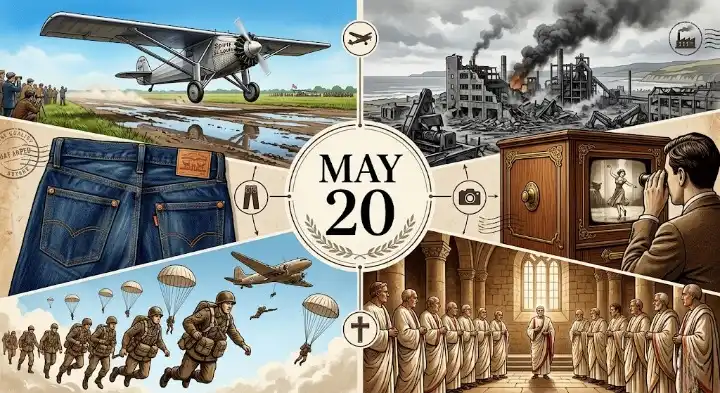
In the chilly, grey dawn of May 20, 1927, a young pilot named Charles Lindbergh strapped himself into a custom-built monoplane in Long Island, New York. Mud clung to the tires of the Spirit of St. Louis as it labored down the rain-soaked runway, barely clearing the telephone wires at the field’s edge. He was chasing an impossible dream: flying solo across the Atlantic Ocean without a radio or a parachute. Exactly five years later to the day, Amelia Earhart would pull on her leather flight jacket to attempt the exact same feat. May 20 is a day etched with daring leaps, violent collapses, and the quiet inventions that changed daily life forever, showing us what happened on this day in history May 20.
👶 Quick Facts — May 20 in History
| 📌 Category | 📖 Event / Detail |
|---|---|
| 🌟 Most Significant Event | Charles Lindbergh takes off from New York to begin the first solo nonstop transatlantic flight (1927) |
| 🏆 Top 10 Key Events | • Opening of the First Council of Nicaea (325) • The devastating Syrian Earthquake strikes (1202) • Vasco da Gama lands in India (1498) • Shakespeare’s sonnets are published in London (1609) • Sack of Magdeburg during the Thirty Years’ War (1631) • Levi Strauss and Jacob Davis patent riveted blue jeans (1873) • Amelia Earhart takes off for her solo Atlantic crossing (1932) • Arrival of the first prisoners at Auschwitz (1940) • Scientists publish the identification of the HIV virus (1983) • Russian forces seize full control of Mariupol (2022) |
| ⚔️ Key Battles | Battle of Dun Nechtain (685), Second Battle of Lincoln (1217), Battle of Pampeluna (1521), Battle of Cartagena de Indias (1741), Battle of Bautzen (1813), Battle of Ware Bottom Church (1861), Battle of Crete (1941), Battle of Hamburger Hill (1969) |
| 👤 Key Figures | Charles Lindbergh, Amelia Earhart, Vasco da Gama, Abraham Lincoln, Ignatius of Loyola, Mamata Banerjee |
| 🌍 Observances | World Bee Day, World Metrology Day, East Timor Independence Restoration Day, Cambodia Day of Remembrance, Florida Emancipation Day, National Day (Cameroon), Doug the Pug Day |
Story of the Day: The Birth of the Blue Jean
Jacob Davis, a tailor from Reno, Nevada, sat at his sewing machine in December 1870 with a problem brought to him by a frustrated customer: her husband kept ripping the pockets off his heavy work pants. Davis grabbed some copper rivets used for horse harnesses and hammered them directly into the pocket corners of the heavy duck cloth. The reinforcement worked beautifully, and demand boomed so fast that Davis lacked the money to file a patent alone. He wrote to his fabric supplier, a wealthy San Francisco merchant named Levi Strauss. On May 20, 1873, the U.S. Patent Office granted patent number 139,121 to the duo, turning humble gold-rush workwear into the universal uniform of modern global culture.
Important Events That Happened On May 20 In History
325 – The First Council of Nicaea
Emperor Constantine gathered more than three hundred Christian bishops in the lakeside city of Nicaea to stop his empire from fracturing over religious doctrine. Intense theological debates raged over the divine nature of Jesus Christ relative to God the Father. This assembly produced the Nicene Creed, a foundational statement of faith that consolidated imperial church authority. Western and Eastern Christianity still use this exact statement of belief to define their orthodoxy today.
491 – Empress Ariadne Marries Anastasius I
Empress Ariadne stood before the citizens and court of Constantinople just weeks after her husband, Emperor Zeno, died of agonizing dysentery. The Roman tradition granted her the rare political authority to choose the next man to wear the imperial purple. She passed over Zeno’s power-hungry brother and selected Anastasius, an elderly, respected palace administrator with eyes of two different colors. Her choice stabilized the Byzantine treasury and kept the empire secure during a volatile transition of power.
685 – The Battle of Dun Nechtain
King Ecgfrith led a proud Northumbrian army deep into the marshy hills of Scotland, intent on crushing the northern tribes. King Bridei III of the Picts feigned a panicked retreat, drawing the confident invaders into a deadly bottleneck against the crags of Dun Nechtain. The resulting ambush wiped out the Northumbrian forces, ending their aggressive expansion into northern Britain. This critical victory secured the territorial borders that allowed the distinct kingdom of Scotland to form.
794 – King Æthelberht II Beheaded
King Æthelberht II of East Anglia arrived at the royal Mercian estate of Sutton Walls expecting a grand wedding feast with Princess Ælfthryth. King Offa of Mercia chose political dominance over hospitality, ordering the young visiting monarch seized and tied down. An executioner severed Æthelberht’s head, allowing Offa to swiftly annex the East Anglian kingdom into his own lands. The murdered king became a local martyr, remembered in folklore as a saint whose regular shrine drew pilgrims for centuries.
921 – Christopher Lekapenos Crowned Co-Emperor
Emperor Romanos I Lekapenos stood inside the Hagia Sophia on the holy feast of Whitsun to secure his family’s grip on the Byzantine throne. He placed an imperial crown upon the head of his eldest son, Christopher, elevating him above the legitimate heir of the old dynasty. This calculated move sparked fierce palace intrigue and resentment among the traditional ruling elite. Christopher died young before he could rule alone, leaving his family’s grand dynastic ambitions to collapse into chaos.
942 – Magyar Raid on Fraxinetum
A fast-moving Magyar cavalry force swept across southern France, bypassing traditional alpine defenses to strike a Muslim frontier outpost. The raiders caught the garrison of Fraxinetum off guard, forcing the local governors to pay a heavy tribute to save their coastal stronghold. This clash showed how far Hungarian raiding parties could penetrate into Western Europe during the Middle Ages. The defeat weakened the prestige of the local Andalusian elite, leading to their total expulsion from the region decades later.
1202 – The Syrian Earthquake
A terrifying rumble tore through the earth along the Dead Sea Rift system, shattering cities from Sicily all the way to Iraq. Walls collapsed instantly in Jerusalem and Damascus, burying thousands of sleeping residents under avalanches of stone. The resulting agricultural disruption and famine killed an estimated tens of thousands of people across the Eastern Mediterranean. Modern geologists study this specific disaster to map the long-term seismic risks threatening Middle Eastern cities today.
1217 – The Second Battle of Lincoln
William Marshal, the aging 70-year-old Regent of England, led a desperate cavalry charge through the narrow medieval streets of Lincoln. His royalist forces collided with invading French troops under Prince Louis and rebellious English barons who had cornered the castle. Marshal’s decisive tactical victory forced the French back toward London and eventually out of the country entirely. This fierce clash saved the young King Henry III’s crown and preserved the independence of the English monarchy.
1293 – Founding of the Alcalá General Schools
King Sancho IV of Castile signed a royal decree establishing the Estudio de Escuelas de Generales in the town of Alcalá de Henares. He granted the school properties and funding to ensure local scholars could study theology and law without traveling abroad. This early institution laid the structural groundwork for the famous Complutense University founded at the same site centuries later. The town grew into a major intellectual center of the Spanish Golden Age, eventually producing writers like Miguel de Cervantes.
1426 – King Mohnyin Thado Ascends the Ava Throne
Mohnyin Thado marched his provincial armies into the imperial capital of Ava, ending months of bloody court assassinations and civil unrest. He formally ascended the throne, launching a reign dedicated to pacifying rebellious minority regions across Myanmar. His rise to power required constant military campaigns against rivals who questioned his royal lineage. The dynasty he stabilized preserved the unique administrative structures of Upper Burma for another century.
1449 – The Battle of Alfarrobeira
King Afonso V of Portugal led his royal army to the banks of the Alfarrobeira river to confront his rebellious uncle, the Duke of Coimbra. A stray arrow pierced the Duke’s heart early in the fighting, breaking the morale of his insurgent forces. The victory allowed the Duke of Braganza, who supported the young king, to consolidate unmatched land and political influence. This shift established the House of Braganza as the premier aristocratic power that would eventually rule Portugal.
1497 – John Cabot Sets Sail
John Cabot walked the bustling wooden docks of Bristol before boarding his small, sturdy ship named the Matthew. Backed by King Henry VII, the Italian navigator steered out into the choppy waters of the Atlantic, gambling on a northern route to Asian spice markets. His voyage resulted in the European location of Newfoundland, opening up rich cod fisheries to English merchants. This maritime trek formed the legal basis for Britain’s later territorial claims across North America.
1498 – Vasco da Gama Lands in India
Vasco da Gama watched the lush, palm-fringed coast of Kozhikode appear on the horizon as his battered fleet dropped anchor in Indian waters. He had spent nearly a year navigating around Africa’s southern tip, surviving storms and scurvy to find a direct sea path to Asia. The local ruler received the Portuguese crew with skepticism, unimpressed by the cheap trade goods da Gama offered. This tense meeting bypassed traditional Arab trade routes, igniting centuries of European colonial expansion in Asia.
1520 – Hernán Cortés Defeats Narváez
Hernán Cortés launched a surprise nighttime ambush in the pouring rain against a rival Spanish force led by Pánfilo de Narváez. Narváez had arrived on the Mexican coast under royal orders to arrest Cortés for insubordination and stealing resources. Cortés lost an eye in the brief, chaotic brawl, but he quickly bribed the surviving enemy soldiers into joining his army. This victory doubled the size of his forces, allowing him to resume his brutal conquest of the Aztec Empire.
1521 – Ignatius of Loyola Wounded at Pampeluna
A heavy French cannonball shattered the stone walls of Pampeluna and struck Ignatius of Loyola directly in the legs. The young Spanish knight fell to the ground in agony, his dreams of military glory instantly ruined by the broken bones. During a long, painful convalescence, he turned away from chivalric romances to read spiritual books. This agonizing injury sparked a profound religious conversion, leading him to found the Society of Jesus, or the Jesuits.
1570 – Publication of the First Modern Atlas
Abraham Ortelius watched printing presses in Antwerp bind thirty-three copperplate maps into a single, uniform volume titled Theatrum Orbis Terrarum. Before this moment, sea captains and merchants used mismatched, unstructured charts of varying shapes and sizes. Ortelius compiled the latest geographical data into a scannable book, standardizing how humans visualized the continents. This innovative publication accelerated global trade, exploration, and geographic education across Europe.
1609 – Shakespeare’s Sonnets Published
Thomas Thorpe distributed hundreds of slim, cheaply printed paper booklets across London containing 154 of William Shakespeare’s sonnets. The printing took place without the playwright’s direct permission, exposing deeply personal themes of love, age, and betrayal to the public. Readers encountered timeless lines about the “Fair Youth” and the “Dark Lady” for the very first time. This illicit publishing venture preserved some of the greatest poetic structures ever written in the English language.
1631 – The Sack of Magdeburg
Imperial Catholic forces smashed through the defensive gates of the Protestant stronghold of Magdeburg during the Thirty Years’ War. Count Tilly lost control of his mercenary soldiers, who spent three days burning homes and slaughtering over twenty thousand non-combatants. The massive fires reduced a proud medieval city to a smoking field of ash and rubble. The horror of this massacre turned “Magdeburgization” into a terrifying wartime slogan across Europe for decades.
1645 – The Yangzhou Massacre
General Dodo led Qing dynasty troops over the city walls of Yangzhou, intent on punishing the inhabitants for their fierce resistance. Qing soldiers spent ten systematic days killing local residents and burning records to break the spirit of Ming loyalists. The mass violence cost hundreds of thousands of civilian lives and emptied the prosperous cultural hub. This brutal pacification campaign consolidated Manchu rule across southern China, cementing the authority of the new Qing state.
1714 – Bach Conducts Erschallet, ihr Lieder
Johann Sebastian Bach stood in the sunlit chapel of Schloss Weimar to direct the premier of his new Pentecost cantata, BWV 172. Trumpets, drums, and strings filled the small space, weaving complex musical harmonies around traditional Christian hymns. Bach designed the piece to mimic the rushing wind of the Holy Spirit, demanding intense technical precision from his singers. This early performance cemented his reputation as a master composer capable of turning theology into transcendent art.
1741 – The Battle of Cartagena de Indias Ends
Admiral Edward Vernon ordered the battered remnants of the British fleet to cut their anchor lines and retreat toward Jamaica. A smaller Spanish garrison under the brilliant, one-eyed commander Blas de Lezo had successfully defended the colonial port against a massive siege force. The British suffered thousands of casualties, mostly from yellow fever and dysentery contracted during the humid tropical campaign. This humiliating defeat secured Spain’s military dominance over its lucrative Caribbean trade networks for another generation.
1775 – The Mecklenburg Declaration of Independence
Local leaders gathered in the small frontier town of Charlotte, North Carolina, to allegedly sign a bold document severing all ties with the British Crown. The text declared the king’s laws null and void, drafted a full month before the national call for separation in Philadelphia. Critics still debate whether the original document existed or if it was a misremembered version of later revolutionary resolutions. The controversial date remains on the North Carolina state flag today as a proud symbol of early rebellion.
1802 – Napoleon Reinstates Slavery
Napoleon Bonaparte signed a cold administrative decree revoking the historic abolition of slavery enacted during the radical phase of the French Revolution. He wanted to restore the lucrative sugar revenues of Caribbean colonies like Guadeloupe and Saint-Domingue to fund his European wars. This regressive law sparked immediate, violent uprisings among free and enslaved Black populations in the colonies. The decision led directly to the bloody war that culminated in the independent Republic of Haiti.
1813 – The Battle of Bautzen Begins
Napoleon Bonaparte stood on the hills of Saxony, watching his French regiments march into defensive positions against a combined Russian and Prussian army. He launched an intense artillery bombardment that forced the allied troops to pull back after hours of bloody, close-quarters combat. The French won the territory but failed to capture any enemy supply trains or take prisoners, leaving the coalition forces intact. This indecisive victory exhausted Napoleon’s remaining cavalry, forcing him into a temporary autumn truce.
1861 – Kentucky Proclaims Neutrality
Governor Beriah Magoffin issued an official executive proclamation declaring that the Commonwealth of Kentucky would take no part in the American Civil War. He refused to send troops to either Abraham Lincoln or the Confederacy, attempting to keep his border state safe from invasion. This fragile neutrality lasted until September, when Confederate troops marched into the state to secure western river bluffs. The occupation forced Kentucky’s legislature to formally align with the Union, splitting local families apart.
1861 – North Carolina Secedes
Delegates gathered at a tense convention in Raleigh voted unanimously to dissolve North Carolina’s political union with the United States. The state had resisted secession for months, but Lincoln’s call for troops after Fort Sumter forced local leaders to choose a side. This decision made North Carolina the last major Southern state to formally join the Confederate States of America. The state would go on to supply more soldiers and suffer more battlefield casualties than almost any other rebel territory.
1862 – Lincoln Signs the Homestead Act
President Abraham Lincoln dipped his pen in ink to sign a law granting eighty-four million acres of public land to ordinary citizens. The act allowed any individual head of a household to claim 160 acres of surveyed government land for a small filing fee, provided they lived on it and farmed it for five years. This policy triggered a massive westward migration of millions of poor American families and European immigrants. The settlement permanently altered the geography of the American West and displaced Native tribes.
1864 – The Battle of Ware Bottom Church
General P.G.T. Beauregard directed ten thousand Confederate troops in a furious counterattack against Union positions near the Bermuda Hundred line in Virginia. The intense infantry clash ended with a Southern victory, trapping a major Union army under Benjamin Butler behind their own defensive earthworks. This bottleneck prevented Federal forces from advancing toward Richmond to support Ulysses S. Grant’s main offensive. The defensive line became a static trench system where cold soldiers endured weeks of heavy sniping.
1873 – Patent Granted for Blue Jeans
Levi Strauss and Jacob Davis opened an official letter from the U.S. Patent Office confirming their exclusive rights to use copper rivets on denim work pants. Davis had invented the reinforcement to prevent miners’ pockets from tearing, but he needed Strauss’s capital to secure legal protection. The resulting “waist overalls” featured durable construction that quickly became standard apparel for working-class westerners. This single patent laid the financial foundation for a global fashion empire.
1875 – The Metre Convention Signed
Diplomats from seventeen international nations gathered in Paris to sign a treaty standardizing global measurement units. They established a permanent International Bureau of Weights and Measures, creating precise physical prototypes for the meter and the kilogram. This agreement eliminated regional, confusing measurement variations that disrupted international scientific research and manufacturing. The convention created the metric system used by almost every country on Earth today.
1882 – The Triple Alliance Formed
Foreign ministers from Germany, Austria-Hungary, and Italy signed a secret defensive pact in Vienna to isolate France. The treaty bound the three nations to defend one another if any member suffered an unprovoked attack by an outside major power. This diplomatic deal locked Central Europe into a rigid security block, shifting the continental balance of power. The secret network of obligations directly contributed to the rapid escalation of conflict that triggered World War I.
1883 – Krakatoa Begins Erupting
The volcanic island of Krakatoa in the Sunda Strait began venting massive columns of dark ash and steam into the sky. Ship captains miles away noted strange pumice stones floating in the water and loud acoustic rumblings shaking their cabins. This initial activity marked the awakening of a volcano that would explode three months later in one of the deadliest eruptions in human history. The final cataclysmic blast killed thirty-six thousand people and altered global temperatures for years.
1891 – First Public Kinetoscope Display
Thomas Edison opened the doors of his West Orange laboratory to a visiting delegation of the National Federation of Women’s Clubs. The women peered one by one through a small peephole in a wooden cabinet to watch a brief, flickering film of a man bowing and smiling. This successful prototype display proved that moving images could be captured and replayed mechanically. The device launched the commercial motion picture industry, transforming global entertainment forever.
1902 – Cuba Gains Independence
Tomás Estrada Palma took the oath of office as Cuba’s first president as the American flag was lowered from Havana’s public buildings. The island gained formal independence after years of brutal anti-colonial warfare against Spain and a subsequent U.S. military occupation. The new republic remained constrained by the Platt Amendment, which granted Washington the legal right to intervene in Cuban affairs. This conditional freedom shaped decades of tense, complicated relations between the two neighboring nations.
1927 – The Treaty of Jeddah
British diplomats signed an official treaty recognizing the absolute sovereignty of King Ibn Saud over the unified regions of Hejaz and Nejd. This document replaced old wartime agreements, ending Britain’s colonial oversight over the central Arabian peninsula. Ibn Saud used this diplomatic recognition to consolidate his rule over the holy cities of Mecca and Medina. Within five years, he merged these territories to form the modern Kingdom of Saudi Arabia.
1927 – Lindbergh Takes Off for Paris
Charles Lindbergh accelerated his heavily loaded monoplane down a muddy runway at Roosevelt Field, Long Island, bound for Europe. He flew without a front windshield or a co-pilot, relying on a periscope and basic instruments to navigate across the featureless Atlantic Ocean. The risky flight captured global attention, with millions tracking his progress through newspaper updates. His successful landing in Paris thirty-three hours later transformed aviation from a dangerous stunt into a viable global industry.
1932 – Amelia Earhart Attempts Atlantic Flight
Amelia Earhart climbed into the cockpit of her bright red Lockheed Vega in Newfoundland, determined to cross the Atlantic solo. Exactly five years after Lindbergh’s flight, she braved thick ice on her wings, fractured exhaust pipes, and a leaking fuel tank during a terrifying night over the ocean. She landed safely in a pasture in Northern Ireland the next afternoon, terrifying local cows. The historic flight cemented her status as a global icon of courage and a pioneer for women in aviation.
1940 – First Prisoners Arrive at Auschwitz
A train carrying thirty German criminal convicts pulled up to a former army barracks in occupied Poland, marking the opening of Auschwitz. SS guards selected these brutal individuals to serve as kapos, camp overseers tasked with terrorizing future inmates. Within weeks, thousands of Polish political prisoners arrived, initiating the systematic expansion of the facility. The site evolved into the largest mass extermination camp in human history, becoming the universal symbol of the Holocaust.
1941 – The Invasion of Crete Begins
Thousands of elite German paratroopers dropped from transport planes into the blue skies over the Mediterranean island of Crete. Allied soldiers and local Cretan civilians fought back fiercely, killing hundreds of invaders before they could secure the local airfields. The brutal ten-day battle ended in a German victory, but the high casualty rates shocked the German high command. The heavy losses forced Hitler to abandon large-scale airborne invasions for the remainder of the war.
1943 – Discovery of the Luttra Woman
Peat cutters working in a bog near Luttra, Sweden, uncovered the remarkably preserved remains of a young prehistoric woman. Her skin and bones survived intact due to the acidic, oxygen-free environment of the wetland. Radiocarbon testing placed her life in the Early Neolithic period, around 3900 BC, making her one of Scandinavia’s oldest bog bodies. Analysis of her stomach contents revealed a final meal of raspberries, offering researchers an intimate glimpse into Stone Age life.
1948 – Chiang Kai-shek Sworn In as President
Chiang Kai-shek stood inside a government hall in Nanjing to take the oath of office as the first constitutional president of the Republic of China. His election took place amidst a disastrous civil war against Mao Zedong’s advancing communist armies. Within months of the ceremony, Nationalist defenses collapsed, forcing Chiang to flee with his remaining loyalists to the island of Taiwan. The inauguration marked the final, desperate days of the Nationalist government on the Chinese mainland.
1949 – The AFSA Established
Defense Secretary Louis Johnson signed a secret directive creating the Armed Forces Security Agency within the United States military. The new department consolidated the separate code-breaking and communications intelligence teams of the Army, Navy, and Air Force under a unified command. The agency struggled with bureaucratic infighting and missed critical foreign signals during the early months of the Korean War. A total restructuring followed, transforming this early cryptologic unit into the National Security Agency.
1956 – First Airborne Hydrogen Bomb Dropped
A United States B-52 bomber released a multi-megaton thermonuclear weapon over the turquoise waters of Bikini Atoll during Operation Redwing. The detonation produced a massive fire-ball that lit up the Pacific sky, testing the deployment of hydrogen bombs from operational aircraft. The radioactive fallout contaminated local marine life and left a permanent crater in the coral reef. The test accelerated the nuclear arms race, forcing global superpowers to develop advanced ballistic missile delivery systems.
1958 – Capital Airlines Flight 300 Collision
A commercial Capital Airlines Viscount turboprop collided in mid-air with a military Lockheed T-33 jet trainer over rural Maryland. All twelve passengers aboard the airliner died instantly as the broken fuselage plunged into a farm field below. The tragic accident occurred in clear visibility, exposing dangerous gaps in civilian and military radar coordination. The disaster forced Congress to pass the Federal Aviation Act, establishing the FAA to manage safe American airspace.
1964 – Discovery of Cosmic Microwave Background
Robert Wilson and Arno Penzias directed a sensitive horn antenna toward the sky at Bell Labs, encountering a persistent, low hum they could not explain. They cleaned out bird nests and removed urban interference, but the mysterious background static remained completely unchanged day and night. Princeton physicists realized the duo had accidentally recorded the residual heat left over from the Big Bang. This accidental observation confirmed the foundational theories of modern cosmology, earning the scientists a Nobel Prize.
1965 – Pakistan International Airlines Flight 705 Crashes
A modern Boeing 707 carrying dozens of international passengers plummeted into the desert sands during its final approach to Cairo International Airport. The aircraft exploded on impact, killing 121 people and leaving only six survivors among the smoking wreckage. Investigators found no evidence of mechanical failure, attributing the disaster to an unexplained, rapid descent by the flight crew. The tragedy remains one of the deadliest aviation accidents in Middle Eastern history.
1967 – Founding of the MPR in the Congo
Mobutu Sese Seko gathered thousands of supporters in Kinshasa to announce the creation of the Popular Movement of the Revolution political party. He declared the new organization the sole legal political party of the Democratic Republic of the Congo, effectively banning all opposition. The state apparatus forced every citizen to become a member at birth, establishing a total cult of personality. This political monopoly enabled Mobutu to rule the nation as a personal dictatorship for three decades.
1969 – The Battle of Hamburger Hill Ends
Exhausted American infantrymen finally secured the bomb-torn summit of Hill 937 after ten days of brutal frontal assaults against entrenched North Vietnamese troops. Commanders ordered the troops to abandon the peak days later, allowing enemy forces to move back into the bunkers. The high casualty rate and apparent lack of strategic value sparked fierce public outrage across the United States. The controversial battle forced military leaders to abandon major ground offensives in favor of a faster withdrawal.
1971 – The Chuknagar Massacre
Pakistani military units deployed trucks to the border town of Chuknagar, opening fire on thousands of unarmed Bengali Hindu refugees. The crowds had gathered in western Bangladesh to escape regional violence, hoping to cross safely into neighboring India. Soldiers used automatic weapons to systematically kill men, women, and children along the river banks over several hours. This horrific atrocity stands as one of the single bloodiest episodes of the 1971 Bangladesh Liberation War.
1980 – Quebec Rejects Independence
Voters across Quebec lined up at polling stations to cast ballots in a historic referendum on separating from Canada. The provincial government sought a mandate to negotiate a sovereign association, sparking intense debates over cultural identity and economic security. Final tallies revealed that 60 percent of the population voted to reject the separatist proposal, choosing to stay within the federation. The definitive result quieted the secession movement for a decade, preserving Canadian national unity.
1983 – Discovery of the HIV Virus Published
French researchers Francoise Barre-Sinoussi and Luc Montagnier published a groundbreaking paper in the journal Science isolating a new retrovirus from an AIDS patient. They identified the pathogen as the root cause of the terrifying immune deficiency syndrome sweeping through global communities. This breakthrough allowed labs to develop the first diagnostic blood tests to protect the world’s blood supply from contamination. The discovery launched a massive international research effort to find effective antiviral treatments.
1983 – The Church Street Bombing
A powerful car bomb packed with explosives detonated outside military headquarters on a busy street in Pretoria, South Africa. The blast ripped through afternoon traffic, killing nineteen people and injuring more than two hundred passing civilians and servicemen. The armed wing of the African National Congress claimed responsibility, targeting apartheid state structures in an escalation of their urban sabotage campaign. The attack prompted the government to enforce harsher state of emergency laws across the country.
1985 – Radio Martí Begins Broadcasting
The Voice of America turned on high-powered radio transmitters in Florida, sending news programs across the water to communist Cuba. Named after the Cuban national hero José Martí, the station aimed to bypass state-controlled media and counter Soviet influence in the Caribbean. Fidel Castro responded instantly by jamming the signal and cancelling an active migration agreement with the United States. The broadcasts became a permanent fixture of Cold War psychological operations in Latin America.
1989 – Martial Law Declared in Beijing
Chinese Premier Li Peng appeared on national television to declare martial law across Beijing in response to massive student protests. Thousands of troops and military vehicles moved toward Tiananmen Square, where peaceful demonstrators had camped out for weeks demanding democratic reforms. The official decree banned public assemblies and authorized the military to use force to clear the streets. This political move set the stage for the violent military crackdown that occurred two weeks later.
1990 – First Post-Communist Romanian Elections
Millions of Romanians waited in long lines at polling stations to cast ballots in their first free elections since the fall of Nicolae Ceaușescu. The National Salvation Front, led by former communist official Ion Iliescu, won a landslide victory amid charges of media manipulation and intimidation. Despite regional protests from student groups, international observers validated the final results as an important step toward democracy. The vote marked the formal end of decades of totalitarian rule in Bucharest.
1996 – US Supreme Court Rules in Romer v. Evans
Justice Anthony Kennedy delivered a landmark civil rights opinion striking down a Colorado state constitutional amendment that banned local protections for gay and lesbian individuals. The court ruled 6-3 that targeting a specific minority group for legal exclusion violated the Equal Protection Clause of the Fourteenth Amendment. This historic decision established that animus or prejudice cannot serve as a legitimate government interest. The ruling laid the legal framework for future victories regarding marriage equality.
2002 – East Timor Independence Restored
Thousands of citizens gathered in Dili to watch the new national flag rise over East Timor, celebrating the birth of the new nation. The ceremony formally ended decades of brutal Indonesian military occupation and a temporary United Nations transitional administration. Xanana Gusmão took the oath of office as the country’s first president, facing the task of rebuilding a ruined infrastructure. This historic moment marked the successful end of a long, bloody struggle for self-determination.
2009 – Indonesian Hercules Crash in Magetan
A military Lockheed L-100 Hercules transport plane carrying over one hundred passengers clipped houses before plunging into a rice paddy in East Java. The aircraft erupted into a ball of flame, killing ninety-nine people aboard and two residents on the ground. Investigators pointed to poor maintenance schedules and structural fatigue in the aging airframe as key factors in the disaster. The tragedy forced the Indonesian Air Force to launch a complete safety review of its transport fleet.
2011 – Mamata Banerjee Sworn In
Mamata Banerjee took the oath of office in Kolkata, becoming the first female Chief Minister of West Bengal. Her historic election victory ended thirty-four years of continuous Left Front rule, shattering the longest-serving democratically elected communist government in world history. She campaigned on promises of agricultural reform and industrial revitalization for the populous eastern state. Her rise to power reshaped the modern landscape of regional coalition politics across India.
2012 – Northern Italy Earthquake
A shallow 6.0-magnitude earthquake struck the Emilia-Romagna region of northern Italy, shaking historic towns awake in the early morning. The intense tremors collapsed centuries-old brick bell towers, factories, and historic churches, killing twenty-seven people and displacing thousands. The disaster caused billions of euros in damages to local manufacturing plants and stored wheels of Parmigiano-Reggiano cheese. Residents spent months living in temporary tent cities while engineers stabilized historic architectural treasures.
2013 – The Moore EF5 Tornado
A massive, two-mile-wide EF5 tornado tore through the Oklahoma City suburb of Moore with winds exceeding two hundred miles per hour. The violent vortex obliterated entire residential blocks, flattened two elementary schools, and killed twenty-four people, including several children trapped inside their classrooms. The total damage path extended for over seventeen miles, leaving a scar of twisted metal and pulverized wood. The disaster forced local school boards to install hardened storm shelters in every public school.
2016 – Singapore Executes Kho Jabing
The government of Singapore carried out the controversial execution of convicted murderer Kho Jabing at Changi Prison. The hangman proceeded hours after an appeals court rejected a final, desperate stay of execution filed by his legal defense team. International human rights organizations and the United Nations had repeatedly pleaded for clemency, arguing against the city-state’s rigid use of the death penalty. The case triggered intense local debates over transparency within the regional judicial process.
2019 – Redefinition of the Kilogram
The International System of Units officially retired the physical cylinder of platinum-iridium kept in a high-security vault outside Paris. Metrologists voted to redefine the base units of measurement, binding the kilogram to the unvarying Planck constant using a quantum balance instead. This historic shift ensured that the fundamental scales of science would remain perfectly stable over time without relying on a physical object that could degrade. The change modernized high-tech manufacturing and laboratory work globally.
2022 – Russia Claims Control of Mariupol
Russian military commanders announced the complete capture of the strategic Ukrainian port city of Mariupol after a brutal, three-month siege. The final group of Ukrainian defenders emerged from the labyrinth of underground bunkers beneath the shattered Azovstal iron and steel works, surrendering into captivity. The intense bombardment reduced flourishing seaside neighborhoods to hollow, burnt-out concrete shells, displacing hundreds of thousands of residents. The fall of the city secured a land bridge connecting western Russian territory to occupied Crimea.
Continue your journey through time by clicking here.
Famous People Born On May 20
| Name | Description | Date |
|---|---|---|
| Pietro Bembo | Italian Renaissance cardinal and writer, established Italian literary language | May 20, 1470 – January 18, 1547 |
| Elijah Fenton | English poet, collaborator with Alexander Pope on Odyssey | May 20, 1683 – July 16, 1730 |
| Henry Bathurst, 2nd Earl Bathurst | British statesman | May 20, 1714 – August 6, 1794 |
| Stephen Girard | American financier and philanthropist | May 20, 1750 – December 26, 1831 |
| William Thornton | British-born American architect, designed U.S. Capitol | May 20, 1759 – March 28, 1828 |
| Bernardino Rivadavia | First president of Argentina (1826–27) | May 20, 1780 – September 2, 1845 |
| Thomas Dartmouth Rice | American actor, father of the minstrel show | May 20, 1808 – September 19, 1860 |
| Alfred Domett | Prime minister of New Zealand (1862–63) | May 20, 1811 – November 2, 1887 |
| Christian Johansson | Swedish-Russian ballet dancer and teacher | May 20, 1817 – December 25, 1903 |
| William George Fargo | American businessman, co-founder of Wells Fargo | May 20, 1818 – August 3, 1881 |
| Potter Palmer | American merchant, developed Chicago’s downtown | May 20, 1826 – May 4, 1902 |
| Félix-Jules Méline | Premier of France (1896–98) | May 20, 1838 – December 20, 1925 |
| Ferdinand Zirkel | German geologist, pioneer in microscopic petrography | May 20, 1838 – June 12, 1912 |
| Albert Augustus Pope | American bicycle and automobile manufacturer | May 20, 1843 – August 10, 1909 |
| Alexander von Kluck | German general in World War I | May 20, 1846 – October 19, 1934 |
| Sir George Goldie | British colonial administrator, established rule on Niger River | May 20, 1846 – August 20, 1925 |
| Georges de Porto-Riche | French playwright of psychological dramas | May 20, 1849 – September 5, 1930 |
| Allan Nevins | American historian, biographer, and educator | May 20, 1890 – March 5, 1971 |
| Earl Browder | U.S. Communist Party leader (1934–45) | May 20, 1891 – June 27, 1973 |
| Adela Rogers St. Johns | American journalist and novelist | May 20, 1894 – August 10, 1988 |
| R.J. Mitchell | British aircraft designer, developed the Spitfire | May 20, 1895 – June 11, 1937 |
| John Marshall Harlan | Associate justice of U.S. Supreme Court (1955–71) | May 20, 1899 – December 29, 1971 |
| Max Euwe | Dutch chess world champion (1935–37) | May 20, 1901 – November 26, 1981 |
| Margery Allingham | British detective novelist, creator of Albert Campion | May 20, 1904 – June 30, 1966 |
| Gerrit Achterberg | Dutch poet of surreal language | May 20, 1905 – January 17, 1962 |
| Bernard Brodie | American military strategist, nuclear strategy theorist | May 20, 1910 – November 24, 1978 |
| Wilfrid Sellars | American philosopher, critique of traditional mind-knowledge concepts | May 20, 1912 – July 2, 1989 |
| William Hewlett | American engineer, co-founder of Hewlett-Packard | May 20, 1913 – January 12, 2001 |
| Wolfgang Borchert | German playwright and short-story writer of post-WWII anguish | May 20, 1921 – November 20, 1947 |
| Sadaharu Oh | Japanese baseball player, world home run record holder | May 20, 1940 – Present |
Famous People Died On May 20
| Name | Description | Date |
|---|---|---|
| Ecgfrith | Anglo-Saxon king of Northumbria (670–85) | – May 20, 685 |
| John XXI | Pope (1276–77), one of the most scholarly pontiffs | c.1210/1220 – May 20, 1277 |
| Pedro, 1st duke of Coimbra | Prince and regent of Portugal | December 9, 1392 – May 20, 1449 |
| Osman II | Ottoman sultan (1618–22), reform-minded | November 15, 1603 – May 20, 1622 |
| Pedro Páez | Spanish Jesuit missionary to Ethiopia | 1564 – May 20, 1622 |
| Johan Banér | Swedish field marshal in Thirty Years’ War | July 3, 1596 – May 20, 1641 |
| George Digby, 2nd earl of Bristol | English Royalist statesman | February 22, 1611 – May 20, 1676? |
| Thomas Sprat | English bishop, historian of Royal Society | 1635 – May 20, 1713 |
| Nicholas Brady | Anglican clergyman, metrical version of Psalms | October 28, 1659 – May 20, 1726 |
| Henri Grégoire | French prelate, defender of Constitutional church and Jews | December 4, 1750 – May 20, 1831 |
| William Radcliffe | English inventor of power loom innovations | November 14, 1761 – May 20, 1842 |
| Philippe-Sirice Bridel | Swiss man of letters, advocated indigenous literature | November 20, 1757 – May 20, 1845 |
| Mary Ann Lamb | English writer, Tales from Shakespear (with brother Charles) | December 3, 1764 – May 20, 1847 |
| John Clare | English Romantic peasant poet | July 13, 1793 – May 20, 1864 |
| Artúr Görgey | Hungarian army officer in Revolution of 1848–49 | January 30, 1818 – May 20, 1916 |
| Jacob Moleschott | Dutch-Italian physiologist, materialist philosopher | August 9, 1822 – May 20, 1893 |
| Edmund Hodgson Yates | English journalist, pioneer of gossip column | July 3, 1831 – May 20, 1894 |
| Ferdinand Hodler | Swiss painter, important of late 19th/early 20th century | March 14, 1853 – May 20, 1918 |
| Henry M. Flagler | American financier, partner of Rockefeller, developed Florida | January 2, 1830 – May 20, 1913 |
| Philipp Lenard | German physicist, Nobel Prize (1905) for cathode rays | June 7, 1862 – May 20, 1947 |
| Hector Guimard | French Art Nouveau architect, Paris Metro stations | March 10, 1867 – May 20, 1942 |
| Damaskinos | Archbishop of Athens, regent of Greece (1944–46) | March 3, 1891 – May 20, 1949 |
| Varvara Fyodorovna Stepanova | Russian avant-garde artist | October 21, 1894 – May 20, 1958 |
| Alfred Schutz | Austrian-born U.S. sociologist and philosopher | April 13, 1899 – May 20, 1959 |
| Max Beerbohm | English caricaturist and wit | August 24, 1872 – May 20, 1956 |
| Zoltán Halmay | Hungarian swimmer, seven Olympic medals | June 18, 1881 – May 20, 1956 |
| André Charlot | French theatrical impresario | July 26, 1882 – May 20, 1956 |
| Gilbert Murray | British classical scholar, translator of Greek drama | January 2, 1866 – May 20, 1957 |
| Barbara Hepworth | British abstract sculptor | January 10, 1903 – May 20, 1975 |
| Helen Brooke Taussig | American physician, founder of pediatric cardiology | May 24, 1898 – May 20, 1986 |
Observances on May 20
- World Bee Day: This global day highlights the critical role pollinators play in maintaining planetary biodiversity and food security, celebrating the birthday of pioneering beekeeper Anton Janša.
- Day of Remembrance (Cambodia): Citizens gather across Cambodia to honor the millions of victims who died under the brutal Khmer Rouge regime during the late twentieth century.
- Emancipation Day (Florida): Communities across Florida celebrate the historic day in 1865 when Union General Edward McCook arrived in Tallahassee to formally announce the abolition of slavery.
- Independence Restoration Day: East Timor marks its formal emergence as a sovereign nation in 2002 following decades of foreign rule.
- European Maritime Day: This day honors the rich seafaring heritage, diverse marine industries, and vital blue economy that link coastal European communities together.
- Josephine Baker Day: The NAACP honors the legendary dancer, civil rights activist, and French Resistance agent for her lifelong work against global racism.
- World Metrology Day: Scientists celebrate the anniversary of the 1875 Metre Convention, which created the unified framework for global measurement precision.
- National Day (Cameroon): Citizens celebrate the historic 1972 referendum that replaced a divided federal structure with a unified Republic of Cameroon.
- Doug the Pug Day: The city of Nashville honors the famous social media icon and therapy animal for bringing joy to millions of fans globally.
✈️ Frequently Asked Questions — May 20 in History
Charles Lindbergh took off from Long Island, New York, aboard the Spirit of St. Louis to attempt the first solo nonstop flight across the Atlantic Ocean. He flew into thick fog and sleet without a radio, landing safely in Paris thirty-three hours later.
The solo transatlantic flights of Charles Lindbergh in 1927 and Amelia Earhart in 1932 stand as the most significant events of this day. These separate journeys proved that long-distance aviation was viable, shrinking the spatial boundaries of the planet.
The raw historical data for May 20 does not record a specific birth for a famous historical individual. However, the day marks the birth of pioneering Slovenian beekeeper Anton Janša, whose innovative methods are honored through World Bee Day.
The Battle of Crete began on May 20, 1941, when thousands of elite German paratroopers dropped onto the Mediterranean island. The ensuing struggle resulted in heavy casualties, forcing Hitler to abandon future large-scale airborne invasions.
World Bee Day is an international observance created to raise global awareness about the environmental importance of bees and other vital pollinators. It reminds communities to protect fragile habitats that secure global food production.
Russian forces seized full control of the Ukrainian port city of Mariupol following a brutal three-month siege at the Azovstal steel plant. The victory secured a strategic coastal corridor linking western Russian territory directly to Crimea.