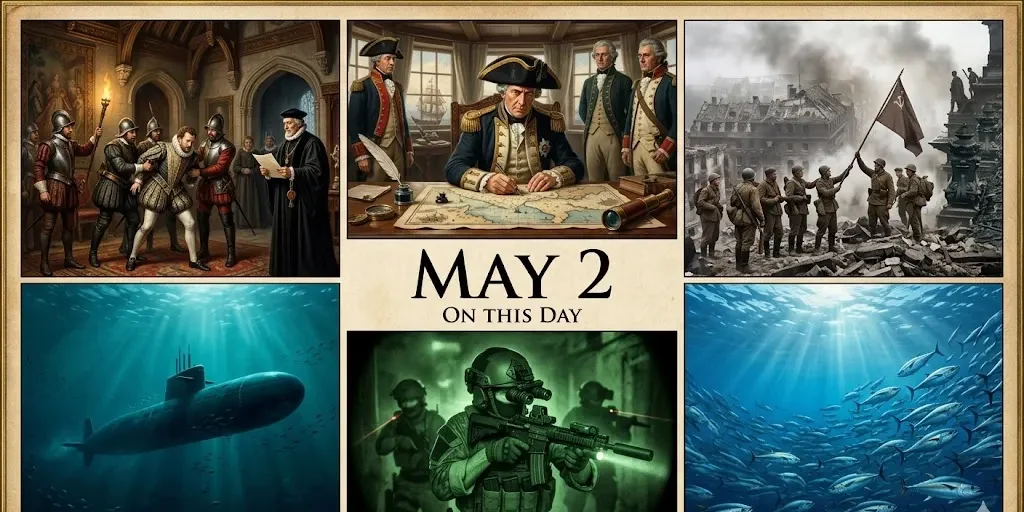
In the quiet hills of Abbottabad, a midnight raid in 2011 brought an end to the world’s most hunted man, Osama bin Laden, fundamentally altering the trajectory of the War on Terror. Years earlier, on this same date, the streets of Madrid erupted in a desperate revolt against Napoleonic forces, while in Germany, a dark chapter of the 20th century drew to a close as Soviet troops claimed Berlin. May 2 is a day where power shifts, nations rise, and history pivots.
⚡ Quick Facts — May 2 in History
| 📌 Category | 📖 Event / Detail |
|---|---|
| 🌟 Most Significant Event | Death of Osama bin Laden (2011) |
| 🏆 Top 10 Key Events | • Dos de Mayo Uprising • King James Bible publication • Anne Boleyn’s arrest • Hudson’s Bay Company charter • Battle of Cut Knife • Fall of Berlin • Sinking of the ARA General Belgrano • Chernobyl evacuation • Cyclone Nargis • Death of Osama bin Laden |
| ⚔️ Key Battles | Battle of Callao (1866), Battle of Cut Knife (1885), Anglo-Iraqi War (1941), Battle of Chancellorsville (1863) |
| 👤 Key Figures Today | Anne Boleyn, King Richard I, Mary Queen of Scots, Osama bin Laden}- |
| 🌍 Observances | World Tuna Day, International Harry Potter Day, Flag Day (Poland), National Education Day (Indonesia) |
Story of the Day: The Midnight Raid in Abbottabad
Navy SEALs descended from the night sky into a compound in Abbottabad, Pakistan, on May 2, 2011, executing a mission that had been years in the making. President Barack Obama watched from the White House as the team navigated the high-stakes operation to neutralize the architect of the September 11 attacks. Within forty minutes, the threat that had haunted global intelligence agencies for a decade was eliminated. This precise tactical strike provided a sense of closure for millions, though it sparked intense debate regarding international sovereignty and the future of global counter-insurgency efforts.
Important Events That Happened On May 2 In History
1194 – King Richard I grants Portsmouth its charter
King Richard I of England issued the town’s first royal charter, formally establishing it as a commercial and naval hub. This legal act granted the settlement the right to host an annual fifteen-day fair and a weekly market. The charter provided the foundation for the city’s long-standing role in English maritime logistics. It remains a key milestone in the development of England’s coastal defense and trade infrastructure.
1230 – The execution of William de Braose
Prince Llywelyn the Great ordered the hanging of the powerful Marcher lord William de Braose. This act of violence took place amid the volatile power struggles between the Welsh princes and Anglo-Norman nobility. The execution signaled Llywelyn’s assertion of authority and his refusal to be sidelined by Marcher interests. It heightened regional tensions, further destabilizing the borderlands between Wales and England.
1250 – The murder of Sultan Turanshah
Mamluk commanders led by Baybars assassinated the Ayyubid sultan Turanshah following his victory against the Seventh Crusade. The conspirators feared the sultan intended to purge them from their privileged positions of power. His death ended Ayyubid rule in Egypt and marked the rise of the Mamluk Sultanate. This transition solidified military dominance over Egyptian governance for the next two centuries.
1388 – The end of Catalan control in Athens
The surrender of the Acropolis of Athens to Nerio Acciaioli finalized the expulsion of the Catalan Company from the Duchy of Athens. This conclusion of the Catalan presence shifted the political alignment of the region toward Italian influence. It marked the end of an era of occupation that had lasted over 75 years. The transfer of the citadel altered the administrative trajectory of the Greek territories.
1536 – The arrest of Queen Anne Boleyn
King Henry VIII ordered the imprisonment of Anne Boleyn on charges of adultery, incest, treason, and witchcraft. Tudor guards took the Queen into custody at the Tower of London as her political position collapsed under the King’s pressure to secure a new marriage. Her detention served as the decisive move in the King’s campaign to annul their union. This moment fundamentally reshaped the English court and the path of the Reformation.
1559 – John Knox returns to Scotland
John Knox arrived back in Scotland after years of exile to spearhead the Scottish Reformation. His leadership provided the theological and organizational force needed to challenge the established Catholic hierarchy. By mobilizing public sentiment, he successfully shifted the nation’s religious and political identity. The movement he fostered fundamentally altered the power structures of the Scottish state.
1568 – Mary, Queen of Scots escapes
Mary, Queen of Scots, broke out of her captivity at Lochleven Castle, where she had been held by Scottish lords. Her escape ignited a renewed campaign to reclaim her throne and restore her influence. This daring flight created immediate political instability for the regency government. It set in motion a series of events that eventually led her to seek refuge in England.
1625 – Afonso Mendes arrives in Ethiopia
Pope Gregory XV’s appointee, Afonso Mendes, reached Beilul from Goa to serve as the Latin Patriarch of Ethiopia. His arrival represented a major effort by the Catholic Church to bring the Ethiopian Orthodox Church into formal union with Rome. This attempt at religious unification met intense local resistance, complicating diplomatic ties. The mission ultimately highlighted the friction between European ecclesiastical ambition and local tradition.
1670 – The Hudson’s Bay Company charter
King Charles II granted a perpetual charter to the Hudson’s Bay Company to regulate the North American fur trade. This document bestowed the company with vast administrative and commercial control over the territory surrounding the bay. It transformed the region into a cornerstone of the British colonial economy for generations. The charter established a lasting corporate presence that dictated regional development.
1808 – The Dos de Mayo Uprising in Madrid
The citizens of Madrid rose in armed rebellion against the French forces occupying the city. This spontaneous revolt triggered the broader Peninsular War, as nationalist fervor spread throughout Spain. Francisco de Goya later documented the intensity of this resistance in his iconic series of paintings. The event remains a central symbol of Spanish defiance against foreign rule.
1812 – The Siege of Cuautla concludes
The military standoff at Cuautla ended during the Mexican War of Independence, with both insurgent and royalist forces claiming a strategic win. While the royalists broke the blockade, the rebel leadership managed to escape, sustaining the momentum of the revolutionary cause. This engagement demonstrated the resilience of the independence fighters against entrenched colonial defenses. The siege left a lasting mark on the Mexican quest for sovereignty.
1829 – The founding of the Swan River Colony
Captain Charles Fremantle of HMS Challenger arrived to formally declare the Swan River Colony in Western Australia. This British action aimed to preempt French territorial claims in the region and expand colonial reach. Establishing this settlement served as the genesis for what would become the state of Western Australia. The colony faced significant early logistical challenges, yet established a permanent British footprint.
1866 – The Battle of Callao
Peruvian coastal defenses successfully repelled an attack by the Spanish Pacific fleet. This victory was a defining moment for Peruvian national pride and military capability during the Chincha Islands War. By preventing the Spanish from capturing the critical port, the defenders effectively ended the threat to their coastline. The outcome confirmed the efficacy of modern harbor fortifications against naval bombardment.
1867 – The New Zealand tuatara classification
Albert Günther published findings proving that the New Zealand tuatara was not a lizard, but a distinct biological order. This scientific breakthrough corrected a major misconception in zoological classification. It highlighted the evolutionary significance of the species as a living relic from the Mesozoic era. The research remains a cornerstone of New Zealand’s natural history.
1876 – The outbreak of the April Uprising
The April Uprising began in Ottoman Bulgaria as a desperate insurrection against imperial rule. Despite being met with swift and brutal suppression, the revolt drew international attention to the plight of the Bulgarian people. The global outcry it generated served as a catalyst for the eventual liberation of the region. This uprising shifted the political landscape of the Balkans by weakening Ottoman authority.
1885 – The Battle of Cut Knife
Cree and Assiniboine warriors achieved a significant tactical victory over Canadian forces during the North-West Rebellion. Using the terrain to their advantage, the Indigenous fighters successfully repelled the advance of government troops. This engagement remains their most notable success during the conflict. The battle underscored the challenges faced by colonial forces when engaging experienced local defenders.
1889 – The Treaty of Wuchale is signed
Emperor Menelik II of Ethiopia entered into an agreement with Italy, granting them control over Eritrea. The treaty was intended to ensure peace and facilitate modernization, but translation disputes led to deep future conflict. Misunderstandings regarding the text’s implications eventually triggered the First Italo-Ethiopian War. This agreement remains a critical point in the history of African diplomatic relations with Europe.
1906 – The Intercalated Games close
The final ceremony of the 1906 Intercalated Games in Athens marked the conclusion of an effort to keep Olympic spirit alive between official cycles. These games were instrumental in establishing the viability of future Olympic events. The success of the competition helped cement Athens’ place in the modern sports movement. It set a precedent for how international athletic events are managed and celebrated.
1920 – The first Negro National League game
The inaugural game of the Negro National League took place in Indianapolis, signaling a new era for Black baseball. This organized league provided a professional platform for talent that had been excluded from major white-only organizations. It fostered a unique cultural and sporting identity that thrived for decades. The league’s formation stands as a landmark in the history of American professional sports.
1933 – The German Labour Front is created
The Nazi regime replaced independent labor unions with the German Labour Front to consolidate control over the workforce. This move effectively silenced worker advocacy and tied employment status to loyalty to the state. It eliminated collective bargaining, stripping workers of their independence during the economic restructuring of the 1930s. The action was essential to the consolidation of totalitarian power in Germany.
1941 – The Anglo-Iraqi War begins
The United Kingdom launched military operations to restore the pro-British Crown Prince ‘Abd al-Ilah to power following a local coup. The conflict was driven by strategic concerns over oil interests and British influence in the Middle East during the early stages of World War II. Combat operations quickly escalated, impacting the political stability of the region. The war solidified the British presence in Iraq for the duration of the global conflict.
1945 – The fall of Berlin announced
The Soviet Union declared the capture of the German capital after intense fighting through the city’s ruins. The symbolic raising of the Soviet flag over the Reichstag signaled the final collapse of the Third Reich’s administrative center. This victory brought the war in Europe to a near-total cessation. The fall of the city left a deep, lasting imprint on the post-war order in Europe.
1945 – The surrender of Caserta
German forces in Italy formally ceased hostilities under the terms of the Caserta surrender. This regional capitulation brought an end to the brutal fighting that had ravaged the Italian peninsula. It enabled the Allied powers to stabilize the region and begin the process of liberation. The agreement effectively closed the Italian theater of World War II.
1945 – Wöbbelin concentration camp liberated
The U.S. 82nd Airborne Division discovered the horrific conditions at Wöbbelin, finding 1,000 prisoners who had starved to death. This encounter exposed the brutality of the Nazi camp system to the Allied soldiers, who forced local civilians to witness the evidence. It remains a stark reminder of the crimes uncovered during the final days of the war. The liberation efforts captured the scale of human suffering in the camp’s final hours.
1945 – 522nd Field Artillery Battalion intervenes
The segregated, all-Nisei 522nd Field Artillery Battalion of the U.S. Army halted a forced death march of prisoners from Dachau in southern Bavaria. Their timely arrival prevented further mass murder and saved hundreds of lives. This unit’s actions demonstrated profound bravery while they served in a military that was itself segregated. The rescue operation is a defining moment for the battalion’s legacy.
1952 – The first commercial jetliner flight
A de Havilland Comet completed the first jet-powered flight carrying fare-paying passengers from London to Johannesburg. This flight ushered in the jet age, dramatically reducing travel time and shrinking the perceived size of the globe. It revolutionized the civil aviation industry by proving the reliability and speed of jet engines. The event marked the beginning of modern mass global transit.
1963 – Berthold Seliger launches a rocket
Berthold Seliger successfully tested a three-stage sounding rocket near Cuxhaven, reaching altitudes over 100 kilometers. This launch was the only development of its kind by a private German entity during that period. It provided critical data for high-altitude scientific research. The flight demonstrated the potential for independent aerospace advancement outside of state programs.
1964 – USNS Card is sunk
Viet Cong swimmers placed explosives on the hull of the American aircraft carrier USNS Card while it was docked in Saigon, causing it to sink. The operation highlighted the vulnerability of large military assets in unconventional warfare environments. The vessel was successfully raised and returned to service, showing the resilience of the logistical fleet. This attack signaled the increasing intensity of the conflict in Vietnam.
1964 – First ascent of Shishapangma
Climbers successfully reached the summit of Shishapangma, the lowest of the world’s fourteen “eight-thousanders.” This achievement marked the completion of the conquest of all peaks over 8,000 meters. The ascent showcased the advancement of high-altitude mountaineering techniques. It stands as a pinnacle of endurance in exploration history.
1969 – Queen Elizabeth 2 maiden voyage
The British liner Queen Elizabeth 2 departed for her first journey to New York City. The ship represented the height of maritime engineering and luxury travel. Her voyage symbolized the continuation of the golden age of ocean travel despite the rising dominance of air flight. The vessel became a permanent fixture of international maritime culture.
1970 – ALM Flight 980 crash
ALM Flight 980 ditched into the Caribbean Sea near Saint Croix, resulting in 23 fatalities. The disaster brought critical attention to fuel management and landing protocols in commercial aviation. The subsequent investigations led to significant changes in flight safety training. It remains a tragic incident in the history of Caribbean commercial air travel.
1972 – The Sunshine Mine fire
A catastrophic fire broke out at the Sunshine Mine in Idaho, killing 91 workers. This tragedy remains one of the deadliest mining disasters in American history. It prompted widespread reform in mine safety standards and emergency evacuation procedures. The event caused lasting structural changes in the industrial oversight of subsurface mining.
1982 – Sinking of the ARA General Belgrano
The British submarine HMS Conqueror torpedoed the Argentine cruiser in the South Atlantic, killing over 300 sailors. This incident transformed the Falklands War from a minor confrontation into a full-scale naval conflict. It remains one of the most controversial tactical decisions of the era due to the loss of life and the strategic context. The event defined the international perception of the war.
1986 – Chernobyl evacuation
The City of Chernobyl was officially evacuated six days after the nuclear disaster at the nearby power plant. The delay in the evacuation order caused widespread public alarm and exposed thousands to radiation. This event became a symbol of the dangers of state secrecy and poor crisis management. The evacuation created a long-term “Exclusion Zone” that persists to this day.
1989 – Hungary opens its border
Hungary began dismantling the fence along its border with Austria, creating the first breach in the Iron Curtain. This opening allowed East German citizens to flee to the West, accelerating the collapse of the communist bloc. It served as a pivotal crack in the geopolitical divisions of the Cold War. The removal of the barrier paved the way for the reunification of Europe.
1995 – Zagreb cluster bomb attack
The Army of the Republic of Serb Krajina fired cluster bombs into civilian areas of Zagreb, killing seven and wounding over 175 people. This attack was a major escalation during the Croatian War of Independence, targeting non-combatants in the capital. The brutality of the shelling drew international condemnation. It marked a dark chapter in the fragmentation of the former Yugoslavia.
1998 – The European Central Bank is founded
The European Central Bank was established in Brussels to define and manage the monetary policy of the European Union. Its creation was an essential step toward the implementation of the Euro as a common currency. The institution took over the control of price stability and financial regulation across member states. Its founding signaled the deepening of economic integration within Europe.
1999 – Mireya Moscoso elected President
Mireya Moscoso became the first woman elected as President of Panama. Her victory signaled a significant shift in Panamanian political representation. Throughout her term, she oversaw critical transitions, including the final stages of the Panama Canal handover. Her election remains a key milestone for women in leadership within Latin American politics.
2000 – Clinton ends GPS restriction
President Bill Clinton announced that the United States would stop intentionally degrading the accuracy of GPS for civilian use. This decision opened the technology to precise commercial and personal navigation. It catalyzed the massive growth of mobile mapping and location-based services that define modern life. The shift democratized access to high-accuracy positioning systems.
2004 – Yelwa massacre concludes
The massacre in Yelwa, Nigeria, ended after months of violent cycles between Muslim and Christian groups, resulting in over 700 total deaths. The incident highlighted deep-seated communal tensions that often exploded into widespread violence. It remains a tragic example of regional conflict and the breakdown of local security. The massacre is a focal point in discussions regarding Nigerian communal stability.
2008 – Cyclone Nargis strikes Burma
The massive cyclone made landfall in Burma, causing unprecedented destruction and killing over 138,000 people. Millions were left homeless as the regime struggled to coordinate a response to the natural disaster. The scale of the loss prompted global debate regarding humanitarian aid and governmental transparency. It is the most significant natural disaster in the modern history of the nation.
2008 – Chaitén Volcano erupts
The Chaitén Volcano in Chile began an explosive eruption, forcing the immediate evacuation of thousands. The eruption dramatically changed the local topography and disrupted regional travel for weeks. It provided scientists with rare data on rhyolitic volcanic activity. The event fundamentally reshaped the life of the residents in the surrounding coastal region.
2011 – Osama bin Laden killed
U.S. Navy SEALs killed Osama bin Laden during a targeted raid in Abbottabad, Pakistan. This mission neutralized the primary suspect behind the September 11 attacks after a decade of intelligence tracking. The death removed the central figure of al-Qaeda, forcing the organization to adjust its leadership and operational structure. The event significantly impacted the course of the ongoing global counter-terrorism campaigns.
2011 – E. coli outbreak in Europe
A major E. coli outbreak centered in Germany led to the deaths of more than 30 people and sickened thousands. The contamination caused significant economic damage to the agricultural sector as authorities scrambled to find the source. It demonstrated the fragility of the modern international food supply chain. The incident led to stricter monitoring and food safety protocols across Europe.
2012 – The Scream auction record
A pastel version of Edvard Munch’s The Scream sold for $120 million at auction in New York City. The sale set a new world record for a work of art, highlighting the extreme valuation of iconic masterpieces. The transaction brought renewed attention to the cultural significance of the work. It remains one of the highest prices ever paid for a single piece of art.
2014 – Badakhshan mudslides
Two massive mudslides in Badakhshan, Afghanistan, buried villages and left up to 2,500 people missing. The disaster underscored the extreme vulnerability of mountain populations to sudden environmental collapse. International relief agencies faced immense difficulty accessing the remote, destroyed terrain. The event serves as a grim example of the impact of climate-driven disasters on isolated communities.
Step back one more day—explore yesterday’s archives here.
Famous People Born On May 2
| Name | Description | Date |
|---|---|---|
| Tokugawa Hidetada | Second Tokugawa shogun of Japan | May 2, 1579 – March 15, 1632 |
| William Camden | English antiquarian, author of Britannia | May 2, 1551 – November 9, 1623 |
| Athanasius Kircher | German Jesuit scholar, “last Renaissance man” | May 2, 1601 – November 27, 1680 |
| John Murray, 2nd earl and 1st marquess of Atholl | Scottish Royalist leader | May 2, 1631 – May 6, 1703 |
| Elias Boudinot | American lawyer and Revolutionary politician | May 2, 1740 – October 24, 1821 |
| Vicente Martín y Soler | Spanish composer of Italian comic operas | May 2, 1754 – January 30, 1806 |
| Henrik Steffens | German philosopher and physicist | May 2, 1773 – February 13, 1845 |
| Augustus Egg | British genre painter and actor | May 2, 1816 – March 26, 1863 |
| John C. Heenan | American heavyweight boxing champion | May 2, 1833 – October 28, 1873 |
| Henry Martyn Robert | U.S. Army officer, Robert’s Rules of Order | May 2, 1837 – May 11, 1923 |
| Albion W. Tourgée | American lawyer, judge, novelist | May 2, 1838 – May 21, 1905 |
| Jerome K. Jerome | English humorous novelist, Three Men in a Boat | May 2, 1859 – June 14, 1927 |
| Sir William Maddock Bayliss | British physiologist, co-discoverer of hormones | May 2, 1860 – August 27, 1924 |
| Sir D’Arcy Wentworth Thompson | Scottish zoologist, On Growth and Form | May 2, 1860 – June 21, 1948 |
| Uchimura Kanzō | Japanese Christian philosopher and writer | May 2, 1861 – March 28, 1930 |
| Clyde Fitch | American playwright of social satire | May 2, 1865 – September 4, 1909 |
| Jesse William Lazear | American physician, yellow fever researcher | May 2, 1866 – September 26, 1900 |
| Paul Kretschmer | German linguist, Indo-European studies | May 2, 1866 – March 9, 1956 |
| Robert Williams Wood | American physicist, Raman spectroscopy pioneer | May 2, 1868 – August 11, 1955 |
| Higuchi Ichiyō | Japanese poet and novelist | May 2, 1872 – November 23, 1896 |
| Owen Josephus Roberts | Associate justice of U.S. Supreme Court (1930–45) | May 2, 1875 – May 17, 1955 |
| Eddie Collins | American baseball Hall of Fame second baseman | May 2, 1887 – March 25, 1951 |
| Ki Hadjar Dewantoro | Indonesian educator, Taman Siswa schools | May 2, 1889 – April 26, 1959 |
| E.E. Smith | American science-fiction author, “space opera” | May 2, 1890 – August 31, 1965 |
| Norman Ross | American swimmer, three Olympic golds (1920) | May 2, 1896 – June 19, 1953 |
| W.J. Cash | American author, The Mind of the South | May 2, 1900 – July 1, 1941 |
| Alan Rawsthorne | English composer | May 2, 1905 – July 24, 1971 |
| Aileen Riggin | American swimmer and diver, three Olympic medals | May 2, 1906 – October 17, 2002 |
| Axel Springer | German publisher, Axel Springer Verlag | May 2, 1912 – September 22, 1985 |
| Valery Gergiev | Russian conductor, Mariinsky Theatre | May 2, 1953 – Present |
Famous People Died On May 2
| Name | Description | Date |
|---|---|---|
| Meir of Rothenburg | German Jewish rabbi and Tosafist | c.1215 – May 2, 1293 |
| Saint Antoninus | Archbishop of Florence, founder of moral theology | March 1, 1389 – May 2, 1459 |
| William de la Pole, 1st duke of Suffolk | English commander, dominated Henry VI’s government | October 16, 1396 – May 2, 1450 |
| Joan Bocher | English Anabaptist burned for heresy | Unknown – May 2, 1550 |
| Bartolomé de Carranza | Spanish Dominican theologian, Archbishop of Toledo | 1503 – May 2, 1576 |
| Vasily Vasilyevich, Prince Golitsyn | Russian statesman, adviser to Sophia Alekseyevna | 1643 – May 2, 1714 |
| Lawrence Hyde, 1st earl of Rochester | English statesman under Charles II and James II | March 1642 – May 2, 1711 |
| Herman Willem Daendels | Governor general of Dutch East Indies | October 21, 1762 – May 2, 1818 |
| William Beckford | English writer, Gothic novel Vathek | September 29, 1760 – May 2, 1844 |
| Alfred de Musset | French Romantic dramatist and poet | December 11, 1810 – May 2, 1857 |
| Sheldon Jackson | American Presbyterian missionary and educator | May 18, 1834 – May 2, 1909 |
| Johann Palisa | Silesian astronomer, discovered 120 asteroids | December 6, 1848 – May 2, 1925 |
| Eugen Ehrlich | Austrian legal scholar, founder of sociology of law | September 14, 1862 – May 2, 1922 |
| Ernest Henry Starling | British physiologist, Starling’s law of the heart | April 17, 1866 – May 2, 1927 |
| George Fisher Baker | American financier, Harvard Business School benefactor | March 27, 1840 – May 2, 1931 |
| William Cooper Procter | American businessman, Procter & Gamble profit-sharing | August 25, 1862 – May 2, 1934 |
| Simon Flexner | American pathologist, meningitis serum | March 25, 1863 – May 2, 1946 |
| William Moulton Marston | American psychologist, invented lie detector prototype | May 9, 1893 – May 2, 1947 |
| John Reed Swanton | American anthropologist, North American Indian ethnology | February 19, 1873 – May 2, 1958 |
| Caryl Chessman | American criminal, anti-capital punishment symbol | May 27, 1921 – May 2, 1960 |
| Van Wyck Brooks | American critic and literary historian | February 16, 1886 – May 2, 1963 |
| Nancy Witcher Astor, Viscountess Astor | First woman to sit in British House of Commons | May 19, 1879 – May 2, 1964 |
| Franz von Papen | German statesman, helped Hitler become chancellor | October 29, 1879 – May 2, 1969 |
| J. Edgar Hoover | First director of the FBI (1924–72) | January 1, 1895 – May 2, 1972 |
| Giulio Natta | Italian chemist, Nobel Prize for polymers | February 26, 1903 – May 2, 1979 |
| George Pal | Hungarian-born animator and director, Puppetoons | February 1, 1908 – May 2, 1980 |
| Alioune Diop | Senegalese publisher, Présence Africaine | January 10, 1910 – May 2, 1980 |
| David Wechsler | American psychologist, Wechsler intelligence scales | January 12, 1896 – May 2, 1981 |
| Pridi Phanomyong | Thai political leader, instigated 1932 revolution | May 11, 1900 – May 2, 1983 |
| Ruth Rendell | British mystery writer, Chief Inspector Wexford series | February 17, 1930 – May 2, 2015 |
Observances on May 2
- World Tuna Day: A global initiative to highlight the importance of sustainable fishing for this critical species.
- International Harry Potter Day: Fans celebrate the fictional date on which the Battle of Hogwarts concluded.
- Flag Day (Poland): A day honoring the national identity and the white-and-red colors of the Polish flag.
- National Education Day (Indonesia): Commemorating the birth of Ki Hajar Dewantara, a pioneer of Indonesian education.
⚡ Frequently Asked Questions — May 2 in History
United States Navy SEALs conducted a high-stakes raid on a compound in Abbottabad, Pakistan. They successfully killed Osama bin Laden, the leader of al-Qaeda and the primary target of the global War on Terror.
The death of Osama bin Laden in 2011 is widely considered the most significant modern event due to its massive impact on global security and foreign policy. Historically, the Fall of Berlin in 1945 also ranks as a turning point that changed the world map.
Catherine the Great of Russia was born on this day in 1729. She became one of the most influential empresses in history, expanding the borders of the Russian Empire and overseeing a period of enlightenment.
The Battle of Chancellorsville occurred in 1863, marked by the tragic accidental shooting of Stonewall Jackson. Additionally, the sinking of the ARA General Belgrano in 1982 escalated the Falklands War significantly.
World Tuna Day is observed to bring awareness to the ecological and economic importance of tuna populations. It reminds nations to practice sustainable fishing to prevent the collapse of marine ecosystems.
In 2014, massive mudslides in Badakhshan, Afghanistan, buried villages and left thousands of people missing. It remains a poignant reminder of the vulnerability of mountain communities to natural disasters.