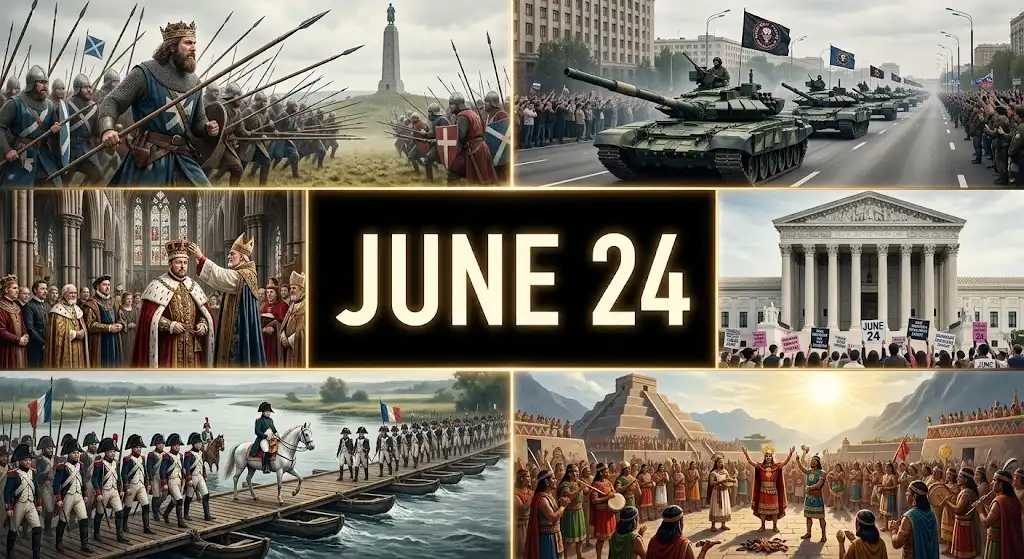
Napoleon Bonaparte stood on the banks of the Neman River on the morning of June 24, 1812, watching nearly half a million soldiers march toward the Russian border. His Grande Armée looked unstoppable, yet this crossing marked the beginning of a catastrophic campaign that would decimate his empire. June 24 is consistently defined by such moments of massive ambition, unexpected defiance, and sudden turns of fate that completely altered global politics. Looking at what happened on this day in history June 24 reveals a dense tapestry of human struggle, from medieval battlefields to modern political insurrections.
📅 Quick Facts — June 24 in History
| 📌 Category | 📖 Event / Detail |
|---|---|
| 🌟 Most Significant Event | The Wagner Group launches an armed rebellion against Moscow (2023) |
| 🏆 Top 10 Key Events | • Trajan opens the Aqua Traiana (109) • Battle of Moira (637) • Battle of Bannockburn ends (1314) • Battle of Sluys destroys French fleet (1340) • John Cabot lands in North America (1497) • Henry VIII crowned (1509) • Napoleon invades Russia (1812) • Berlin Blockade begins (1948) • Dobbs v. Jackson overturns Roe v. Wade (2022) |
| ⚔️ Key Battles | Moira (637), Cedynia (972), São Mamede (1128), Bannockburn (1314), Sluys (1340), Wilhelmsthal (1762), Carabobo (1821), Nezib (1839), Solferino (1859), Custoza (1866) |
| 👤 Key Figures | King Robert the Bruce, King Henry VIII, Emperor Napoleon Bonaparte, Yevgeny Prigozhin |
| 🌍 Observances | Bannockburn Day (Scotland), Inti Raymi (Inca Solstice), Battle of Carabobo Day (Venezuela), Fors Fortuna (Ancient Rome) |
Story of the Day: The Day the Wagner Group Marched on Moscow
Yevgeny Prigozhin ordered his heavily armed mercenary convoy to turn north toward Moscow, rapidly seizing control of the military headquarters in Rostov-on-Don. The world watched in absolute shock as a private military force, heavily relied upon by the Kremlin, openly revolted against Russia’s military leadership. Panicked security forces erected checkpoints outside the capital while the military scrambled to dig trenches across major highways to stop the advancing tanks. The columns suddenly halted just 200 kilometers from Moscow after a midnight deal was brokered, ending the 24-hour mutiny. This stunning defiance exposed deep vulnerabilities within modern Russia’s leadership and preceded Prigozhin’s fatal plane crash just two months later.
Important Events That Happened On June 24 In History
1312 BC – Mursili II Attacks Azzi-Hayasa
King Mursili II mobilized the Hittite army for a sudden, aggressive push into the rugged borderlands of the Kingdom of Azzi-Hayasa. Tribal raids had long threatened his northern borders, demanding a decisive military response to secure his kingdom’s agricultural heartland. Hittite chariots managed to breach the mountain defenses, forcing the local chieftains into temporary submission. The campaign established Hittite dominance across the region, securing vital trade paths through the Armenian Highlands for several decades.
109 – Trajan Opens the Aqua Traiana
Emperor Trajan stood before a massive crowd northwest of Rome to open a monumental aqueduct drawing water from Lake Bracciano. Roman engineers had spent months carving channels across 40 kilometers of rugged terrain to supply the city’s rapidly growing population. Millions of gallons of clean water began flowing directly into the Trastevere district, powering mills and public baths. The engineering feat fundamentally improved urban sanitation and remains partially functional today, feeding Rome’s iconic fountains.
474 – Julius Nepos Seizes the Western Throne
Julius Nepos sailed into the harbor of Ravenna with a powerful fleet, cornering the vulnerable Roman usurper Glycerius. Roman authority was crumbling rapidly, and the eastern emperor had sent Nepos specifically to depose the unapproved ruler. Glycerius realized resistance was entirely futile and stripped off his imperial purple robes without fighting a single battle. Nepos immediately proclaimed himself emperor, though his fragile reign lasted barely a year before he was forced to flee into exile.
637 – The High King Triumphs at Moira
High King Domnall mac Áedo deployed his forces across the fields of County Down to confront the rebellious armies of Ulster and Dál Riata. Thousands of Gaelic warriors clashed in what chroniclers later described as the largest, bloodiest battle ever fought on Irish soil. Domnall’s forces broke the rebel lines, killing the king of Ulster and shattering the coalition. The massive victory consolidated the High King’s authority and significantly checked Scottish influence within northern Ireland for generations.
843 – Vikings Sack the City of Nantes
Viking longships glided silently up the Loire River, catching the wealthy citizens of Nantes completely unprepared during a major religious festival. Norse warriors stormed the cathedral doors, slaughtering the bishop at the altar and killing thousands of trapped worshippers. The raiders filled their hulls with gold, silver, and captives before burning large sections of the town to the ground. This brutal raid marked the start of deep, systematic Viking exploitation and settlement along the vulnerable coast of France.
972 – Polish Forces Win the Battle of Cedynia
Duke Mieszko I arrayed his West Slavic troops near the Oder River to ambush an invading force of German nobles. Count Hodo sought to expand his territory eastward, confident that his heavy cavalry would easily crush the local defenders. Mieszko’s brother led a hidden cavalry charge from the nearby hills, trapping the German knights in a swampy valley. This historic engagement stands as the first documented military victory for Poland, successfully securing the nation’s early western borders.
1128 – Afonso I Triumphs at São Mamede
Afonso Henriques led a passionate faction of Portuguese nobles into battle outside Guimarães against the armies of his own mother, Countess Teresa. Teresa’s romantic and political alliance with a Galician noble had deeply enraged local barons who feared a total loss of independence. Afonso’s troops decisively broke his mother’s lines, driving her loyalist forces out of the region forever. The victory allowed Afonso to take absolute control of Portugal, paving the way for him to declare himself its first king.
1230 – Castile Begins the Siege of Jaén
King Ferdinand III brought the full might of the Castilian army to the walls of Jaén, a crucial Islamic stronghold protecting the valley of Andalusia. Christian knights erected massive siege engines, determined to starve out the fiercely defended Moorish garrison. The defenders held out with incredible resilience, forcing the Castilian forces to break camp after several months of brutal, inconclusive skirmishes. This bitter deadlock delayed the Christian advance for sixteen years until the city finally fell during a subsequent campaign.
1314 – Robert the Bruce Wins Bannockburn
King Robert the Bruce watched his tightly packed Scottish schiltrons push a massive English cavalry force directly into the marshy waters of the Bannockburn. King Edward II had marched north with an army three times the size of the Scottish defenders, fully expecting a quick surrender. The disciplined Scottish pikemen held their ground, panicking the English horses and causing a disastrous, disorganized retreat. This stunning victory secured Scotland’s de facto independence and cemented Bruce’s legendary status as a savior of his nation.
1340 – Edward III Destroys the French Fleet at Sluys
King Edward III commanded his English longbowmen to unleash a relentless hail of arrows onto an immense French fleet anchored tightly in Sluys harbor. The French had chained their ships together to form a massive floating wooden wall, severely limiting their own ability to maneuver. English soldiers boarded the trapped vessels, killing nearly twenty thousand French sailors in a savage, day-long melee. The total destruction of the fleet gave England absolute control of the English Channel for the opening phase of the Hundred Years’ War.
1374 – The Dancing Plague Hits Aachen
Dozens of citizens suddenly flooded the cobblestone streets of Aachen, screaming of vivid hallucinations and twisting their bodies in a wild, uncontrollable frenzy. This bizarre outbreak of St. John’s Dance spread rapidly to hundreds of people who danced for days without sleeping or eating. Musicians were brought into the public squares to guide the mania, but people kept collapsing from broken bones and sheer exhaustion. The strange phenomenon highlighted the terrifying power of mass psychogenic illness during an era dominated by disease and superstition.
1497 – John Cabot Lands in North America
John Cabot stepped ashore onto the rocky coast of Newfoundland, raising a Venetian flag and claiming the unfamiliar territory for King Henry VII. Sailing aboard the Matthew, he had braved weeks of rough Atlantic waters to find a shorter sea route to the wealthy markets of Asia. Cabot found no great cities, but he reported oceans so thick with cod fish that ships could barely sail through them. His brief landing marked the beginning of England’s long, aggressive colonial claims over the North American continent.
1509 – Henry VIII is Crowned at Westminster
Archbishop William Warham placed the heavy golden crown of England onto the head of the eighteen-year-old, athletic Henry VIII at Westminster Abbey. Alongside him knelt his new Spanish bride, Catherine of Aragon, amidst a city celebrating with fountains flowing openly with red wine. The young king promised a glorious new era of culture, military prestige, and joy after his father’s notoriously stingy reign. No one present could have anticipated that his desperate quest for a male heir would eventually shatter the English Church.
1520 – The Field of the Cloth of Gold Concludes
King Henry VIII and King Francis I bid farewell after two weeks of lavish jousting tournaments, massive feasts, and political wrestling matches near Calais. The two young monarchs had built an entire temporary city of gold-trimmed canvas tents to showcase their incredible wealth and power. Despite the displays of eternal friendship and expensive gift exchanges, the summit failed to secure any lasting peace between the rival nations. Within two years, England formidably allied with the Holy Roman Empire to declare open war against France.
1535 – The Anabaptist State of Münster Falls
Armed soldiers loyal to the Prince-Bishop scaled the defensive walls of Münster, bringing a bloody end to a radical religious regime. Anabaptist extremists had seized the city a year prior, establishing a bizarre communal state that legalized polygamy and forced rebaptism. The besieging army executed the remaining cult leaders, placing their bodies in iron cages hung high from St. Lambert’s Church tower. The brutal fall of the city crushed the radical wing of the Reformation, leaving the iron cages hanging for centuries.
1540 – Henry VIII Banishes Anne of Cleves
King Henry VIII summoned his councilors to command that his fourth wife, Anne of Cleves, pack her belongings and leave the royal court immediately. Henry had been deeply disappointed by her physical appearance, complaining bitterly that Hans Holbein’s portrait had completely deceived him. Anne wisely accepted the king’s demands for an annulment, avoiding the violent fate of her predecessor, Anne Boleyn. Henry rewarded her compliance with a massive financial settlement and several royal estates, affectionately calling her his “King’s Sister.”
1571 – Miguel López de Legazpi Founds Manila
Conquistador Miguel López de Legazpi led Spanish troops into a strategic, burnt-out native settlement along the shores of Manila Bay. He quickly displaced the local chieftains, declaring the site the new administrative capital of the Spanish East Indies. Workers immediately began constructing thick stone fortifications to protect the settlement from rival European powers and regional pirates. The city quickly transformed into the western hub of the legendary Galleon trade, linking Asian silver markets directly with the Americas.
1593 – Geertruidenberg Surrenders to Maurice of Nassau
Prince Maurice of Nassau accepted the formal surrender of the Spanish garrison occupying the heavily fortified Dutch city of Geertruidenberg. Maurice had utilized revolutionary, scientific engineering techniques to completely encircle the city with an unbreakable double ring of earthworks and trenches. The starving Spanish defenders realized no relief army could break through Maurice’s sophisticated lines and laid down their arms. This victory demonstrated the absolute superiority of modern siege tactics and significantly shifted the balance of the Eighty Years’ War.
1604 – Champlain Names the Saint John River
Samuel de Champlain steered his small French exploration vessel into the wide mouth of a massive river along the coast of New Brunswick. It was the feast day of St. John the Baptist, prompting the explorer to name the waterway in the saint’s honor. He watched in fascination as the extreme Bay of Fundy tides forced the river to flow backward over a series of rocky gorges. The site eventually grew into a thriving fur-trading post and became the modern, bustling port city of Saint John.
1622 – Dutch Invaders Fail at the Battle of Macau
Captain Kornelis Reyerszoon ordered hundreds of armed Dutch East India Company soldiers to storm the rocky beaches of Portuguese-controlled Macau. The Dutch desperately wanted to seize the lucrative trading port to control the supply of Chinese silk heading to European markets. A lucky shot from a Jesuit priest blew up the main Dutch gunpowder wagon, causing immense casualties and widespread panic. The botched invasion saved Portuguese influence in East Asia and forced the Dutch to build a base on Taiwan instead.
1663 – The Spanish Garrison at Évora Capitulates
Spanish commanders opened the gates of Évora to Portuguese forces, surrendering the city just weeks after taking it. The capitulation followed a disastrous Spanish defeat at the Battle of Ameixial, which cut off all imperial supply lines. Portuguese troops marched into the city to cheers from local residents who had endured a brief, harsh occupation. This surrender broke Spain’s momentum, ensuring that Portugal would successfully maintain its hard-won independence from the Spanish crown.
1713 – Russia and the Ottoman Empire Sign the Treaty of Adrianople
Diplomats gathered in Adrianople to finalize a peace treaty, officially ending the short, tense Russo-Ottoman War. Peter the Great agreed to dismantle several key frontier fortresses and surrender strategic ports along the Sea of Azov to the Sultan. The territorial concessions were painful, but the peace allowed Russian forces to disengage from their southern border entirely. Peter immediately redirected his entire military focus north, successfully defeating the Swedish Empire in the Great Northern War.
1717 – The Premier Grand Lodge of England Forms
Four existing London secret societies met at the Goose and Gridiron Ale-house to merge into the world’s very first Masonic Grand Lodge. The founders elected Anthony Sayer as their inaugural Grand Master, establishing a centralized authority to govern local Freemasonry. This meeting transformed the ancient stonemasons’ craft into an organized, influential network of philosophical gentleman’s clubs. The movement spread rapidly across Europe and the American colonies, deeply shaping the intellectual elite of the Enlightenment.
1724 – Bach Conducts a New Cantata in Leipzig
Johann Sebastian Bach took his place before the choir at the St. Thomas Church to conduct the premier of his new cantata, BWV 7. He had composed the intricate piece specifically for the Feast of St. John the Baptist as part of his ambitious second annual cantata cycle. The complex polyphonic melodies and rich string arrangements filled the cavernous church, challenging the traditional tastes of local church authorities. The performance solidified Bach’s relentless, unmatched creative output during his legendary tenure as cantor in Leipzig.
1762 – Allied Forces Win the Battle of Wilhelmsthal
The Duke of Brunswick led a combined force of British and Hanoverian troops in a surprise, multi-pronged assault against French positions in Westphalia. French commanders failed to detect the allied movements through the dense woods, leaving their flanks completely exposed to artillery fire. A desperate rearguard action saved the French army from total destruction, but they lost nearly four thousand men and fell back in confusion. This critical victory protected Hanover from occupation during the final months of the Seven Years’ War.
1779 – The Great Siege of Gibraltar Begins
Spanish and French artillery units began digging massive gun emplacements facing the British fortress on the Rock of Gibraltar. Spain had entered the American Revolutionary War determined to exploit Britain’s distractions and reclaim this strategic Mediterranean outpost. The blockading fleets completely cut off all maritime supply lines, subjecting the British garrison to years of intense bombardment and starvation. The defenders held out through incredible ingenuity for over three and a half years, executing one of the longest military sieges in British history.
1793 – France Adopts Its First Republican Constitution
The National Convention voted overwhelmingly to approve a radical new constitution, officially cementing France’s transition into a democratic republic. Drafted primarily by the Jacobins, the document promised universal male suffrage, the right to public education, and the right to rebel against tyranny. The government suspended the implementation of these progressive rights just weeks later due to escalating foreign wars and internal rebellions. This text became a symbol of radical democracy, though it was replaced before ever taking effect.
1812 – Napoleon’s Grande Armée Invades Russia
Napoleon Bonaparte watched nearly half a million soldiers march across the Neman River to begin his ambitious invasion of Russia. He aimed to force Tsar Alexander I to stop trading with Britain, expecting a quick, decisive battle near the border. The Russian armies retreated deep into their vast interior, burning crops and destroying villages to deny the invaders any food. This fateful crossing marked the beginning of a catastrophic campaign that eventually destroyed Napoleon’s empire.
1813 – Indigenous Warriors Defeat the Americans at Beaver Dams
Mohawk and Kahnawake warriors ambushed an advancing column of American soldiers in a dense, swampy forest near Niagara. British officer James FitzGibbon had received an advance warning about the attack thanks to Laura Secord’s legendary 20-mile trek through enemy lines. The indigenous forces utilized brilliant guerrilla tactics, convincing the panicked American commander that he was entirely surrounded by superior numbers. The American force surrendered, halting their offensive into Upper Canada during the War of 1812.
1821 – Simón Bolívar Secures Independence at Carabobo
Simón Bolívar led a determined army of South American patriots through a hidden, narrow ravine to ambush Spanish royalist forces on the plains of Carabobo. The British Legion held the line against furious royalist cavalry charges, suffering heavy casualties but preventing a patriot retreat. Bolívar’s main force exploited the opening, breaking the Spanish lines and forcing a total, disorganized rout. The decisive victory liberated Caracas and effectively ended Spanish colonial rule over Venezuela forever.
1839 – Ibrahim Pasha Routs the Ottomans at Nezib
Ibrahim Pasha ordered Egyptian artillery units to open a devastating fire on an entrenched Ottoman army near the Syrian border. The Ottoman Sultan had sent his forces to reclaim lost territories, ignoring advice from his young military advisor, Helmuth von Moltke. The disciplined Egyptian infantry advanced rapidly, shattering the Ottoman lines and capturing thousands of fleeing soldiers within hours. The total rout threatened Constantinople itself, forcing major European powers to intervene to save the Ottoman Empire.
1859 – The Bloody Battle of Solferino Rages
Emperor Napoleon III and Emperor Franz Joseph personally commanded over two hundred thousand soldiers clashing across the hills of northern Italy. The brutal engagement lasted fifteen hours, leaving forty thousand men dead, dying, or horribly mangled across the sunbaked battlefields. Henri Dunant walked through the horrific aftermath, shocked by the complete lack of medical care for the wounded survivors. His harrowing experience inspired him to found the International Red Cross and write the Geneva Conventions.
1866 – Austria Triumphs at the Battle of Custoza
Archduke Albrecht led an outnumbered Austrian army to a stunning victory over invading Italian forces during the Austro-Prussian War. The Italian commanders failed to coordinate their movements across the Mincio River, leaving their individual divisions isolated and vulnerable. Austrian cavalry charges broke through the fractured Italian lines, forcing a hasty and humiliating retreat. The victory protected Austria’s southern territories, though their defeats on the northern front eventually forced them to cede Venice to Italy anyway.
1880 – “O Canada” is Performed for the First Time
A formal gathering of French-Canadian citizens in Quebec City listened intently to the very first public performance of a new patriotic song, “O Canada.” Composed by Calixa Lavallée with original French lyrics, the anthem was commissioned to celebrate the national feast day of St. John the Baptist. The powerful, uplifting melody resonated deeply with the audience and spread quickly through schools and public events. The song was translated into English decades later and officially became Canada’s national anthem in 1980.
1894 – An Anarchist Assassins French President Carnot
Anarchist Sante Caserio stepped forward from a cheering crowd in Lyon, drawing a hidden dagger and plunging it deep into the chest of President Sadi Carnot. Caserio acted in direct revenge for the recent executions of several notorious anarchist bomb-makers. The president died from his internal injuries within hours, plunging the French Republic into a severe national security crisis. The assassination resulted in harsh government crackdowns on the press and massive, violent riots targeting Italian immigrants across France.
1913 – Greece and Serbia Break the Bulgarian Alliance
Diplomats in Athens and Belgrade formally tore up their military treaties with Bulgaria, bracing for an immediate conflict over Balkan territories. The former allies had successfully stripped the Ottoman Empire of its European lands but quickly turned on each other over the spoils of Macedonia. Bulgaria launched a preemptive strike within days, initiating the explosive Second Balkan War. This bitter conflict further destabilized southeastern Europe, turning the region into the volatile powder keg that ignited World War I.
1916 – Mary Pickford Signs the First Million-Dollar Contract
Mary Pickford walked out of the Famous Players-Lasky studio after signing a historic contract guaranteeing her a minimum of one million dollars a year. The twenty-four-year-old actress had achieved unprecedented global fame, making her the undisputed queen of early silent cinema. The groundbreaking deal gave her complete artistic control over her movies, including the right to choose her own directors and writers. Her contract permanently transformed the Hollywood studio system, elevating actors into powerful, independent cultural figures.
1918 – Canada Launches Its First Airmail Service
Pilot Brian Peck climbed into the cockpit of a modified Curtiss JN-4 military biplane, taking off from Montreal with a heavy bag of mail bound for Toronto. He braved thick fog and heavy rain, navigating visually along railway tracks to complete the historic flight. The successful delivery proved that aviation could reliably handle commercial transport across Canada’s vast terrain. The flight initiated a new era of rapid, domestic communication and laid the foundation for Canada’s commercial aviation industry.
1922 – The APFA Rebrands as the National Football League
Team owners gathered in a small Canton, Ohio automobile showroom to officially change the name of their organization to the National Football League. The young American Professional Football Association had struggled for two years to gain national attention and financial stability. The owners hoped the new, clean title would attract wealthier investors and establish greater credibility among sports fans. The rebranding marked the quiet beginning of what eventually grew into the most profitable sports league in American history.
1932 – A Bloodless Revolution Ends Siamese Absolutism
A small group of western-educated military officers and intellectuals launched a swift, bloodless coup against King Prajadhipok in Bangkok. Calling themselves the People’s Party, they seized control of key government buildings while the king was vacationing at his seaside palace. The revolutionaries demanded a transition to a constitutional monarchy, fully stripping the royal family of its centuries-old absolute power. The king accepted the terms peacefully, ending over seven hundred years of absolute royal rule in Siam.
1938 – A Massive Meteorite Explodes Over Pennsylvania
Residents across Chicora, Pennsylvania looked up in terror as a roaring fireball streaked through the daytime sky, causing sonic booms that shattered windows. The incoming space rock weighed an estimated 450 metric tons before hitting the atmosphere and exploding with massive force. Small, charred fragments rained down over local cow pastures, triggering an immediate rush of curious geologists and collectors. The event remains one of the most significant recorded atmospheric meteorite explosions in modern American history.
1939 – Siam Changes Its Name to Thailand
Prime Minister Plaek Phibunsongkhram issued a sweeping state decree changing the official name of the country from Siam to Thailand. The nationalist leader aimed to unify the population under a modern, distinct identity while reducing the cultural influence of ethnic minorities. The new name translated directly to “Land of the Free,” signaling a fierce independence during an era of Western colonial dominance in Southeast Asia. The change permanently altered the country’s global branding and fostered a powerful new wave of national pride.
1940 – British Commandos Launch Operation Collar
Dozens of elite volunteers paddled small assault craft onto the beaches of occupied France to execute Britain’s first commando raid of World War II. Organized by No 11 Independent Company, the raid aimed to gather vital intelligence, kill German sentries, and boost domestic morale after the retreat from Dunkirk. The commandos successfully cut communication wires and engaged an enemy patrol before slipping back into the dark English Channel. The brief action proved that Britain could strike back, initiating modern special forces tactics.
1943 – The Battle of Bamber Bridge Mutiny Explodes
Black American soldiers stationed in a small English village clashed violently with white military police who tried to enforce racial segregation in a local pub. Tensions boiled over into an overnight gun battle, with soldiers breaking into gun lockers to defend themselves against armed MPs. The mutiny left one black soldier dead and several others wounded before British authorities calmed the base. The tragic incident exposed deep, systemic racism within the US military to a shocked wartime British public.
1945 – Moscow Hosts the First Victory Day Parade
Marshal Georgy Zhukov rode a white stallion into Red Square to review thousands of decorated Soviet troops gathered beneath a heavy summer rain. The massive parade celebrated the unconditional surrender of Nazi Germany, marking the costly end of the Eastern Front. Soviet soldiers marched past the Kremlin wall, throwing two hundred captured Nazi battle standards directly into the wet mud. The historic display symbolized the immense power of the Soviet Union and set the stage for the coming Cold War.
1947 – Kenneth Arnold Reports the First Modern UFO Sighting
Pilot Kenneth Arnold looked out his cockpit window near Mount Rainier and spotted nine glowing, unidentified objects flying at incredible speeds. He described their bizarre movement as looking like “saucers skipping across water,” completely confounding local journalists who reported the story. The news spread rapidly across the nation, coining the immortal cultural term “flying saucer” and triggering thousands of similar reports worldwide. His sighting initiated the modern era of intense public obsession with UFOs and potential alien life.
1948 – The Soviet Union Launches the Berlin Blockade
Soviet authorities halted all rail, road, and water traffic between the western zones of Germany and the isolated city of West Berlin. Joseph Stalin aimed to starve the city into submission, forcing the Western Allies to abandon their plans for a new West German state. The blockade cut off food, coal, and medical supplies to over two million civilians overnight. The Allies responded by launching the legendary Berlin Airlift, flying cargo planes into the city around the clock for nearly a year.
1949 – Hopalong Cassidy Debuts on National Television
Families gathered around early television sets as NBC aired the very first episode of the Western series Hopalong Cassidy, starring William Boyd. The show repurposed old theatrical cowboy movies, introducing millions of postwar children to the clean-cut, black-hatted hero. The broadcast triggered an unprecedented wave of children’s merchandising, from themed lunchboxes to cowboy boots. The massive success of the show proved that Westerns were perfect for the television medium, dominating the airwaves for two decades.
1954 – Viet Minh Forces Ambush France at Mang Yang Pass
Viet Minh guerillas launched a devastating surprise attack on a heavily armed French military convoy moving through the central highlands of Vietnam. Ambushing from hidden mountain ridges, the communist troops disabled the lead vehicles and trapped the French soldiers in a narrow valley. The week-long battle resulted in the total destruction of France’s elite Groupement Mobile 100 force. This humilitating defeat came just weeks after Dien Bien Phu, forcing France to withdraw from Indochina entirely.
1957 – The Supreme Court Restricts Obscenity in Roth v. United States
Justice William J. Brennan delivered a major Supreme Court ruling declaring that explicit obscenity was not protected by the First Amendment. The court established a new legal standard, defining obscene material as anything appealing primarily to prurient interests according to contemporary community standards. The decision aimed to give local law enforcement greater power to crack down on adult bookstores and explicit magazines. The complex ruling triggered decades of fierce legal battles over artistic freedom and censorship in America.
1960 – Venezuelan President Betancourt Survives a Car Bomb
President Rómulo Betancourt was driving through Caracas when a parked vehicle packed with high explosives detonated alongside his presidential limousine. The massive blast blew the car across the street, killing his chief security officer and burning the president’s hands severely. Investigators quickly tracked the assassination plot back to Rafael Trujillo, the brutal, long-serving dictator of the Dominican Republic. Betancourt survived to lead Venezuela toward stable democracy, while the attack isolated Trujillo internationally.
1963 – Britain Grants Internal Self-Government to Zanzibar
British administrators in Stone Town formally handed over legislative authority to the newly elected government of the Sultanate of Zanzibar. The island protectorate had spent decades under British imperial rule, longing for a return to absolute sovereignty. The grant of self-government served as the final step before the island achieved full, legal independence later that year. The rapid political transition triggered deep, explosive ethnic tensions that resulted in a bloody revolution just months later.
1973 – Arson Destroys the UpStairs Lounge in New Orleans
A fire erupted at the base of the stairs leading to a crowded gay bar in the French Quarter, trapping dozens of patrons behind emergency exit doors. The inferno spread with terrifying speed through the second-floor lounge, killing thirty-two people from smoke inhalation and burns. Local authorities conducted a notoriously cold investigation, while several churches openly refused to hold funerals for the victims. The horrific tragedy remained the deadliest attack on a gay venue in US history until the Pulse nightclub shooting.
1975 – Eastern Air Lines Flight 66 Crashes at JFK
An Eastern Air Lines Boeing 727 encountered an invisible, violent downdraft on its final approach, slamming into the runway lights at JFK Airport. The sudden crash killed 113 people on board, marking the deadliest single-aircraft accident in United States history at the time. Meteorologists quickly realized the plane had been taken down by a microburst, a dangerous weather phenomenon completely misunderstood by pilots. The tragedy prompted decades of intense research, leading to the installation of modern Doppler radar systems at every major airport.
1978 – A Suitcase Bomb Kills the President of North Yemen
President Ahmad al-Ghashmi opened a diplomatic leather briefcase presented by a visiting South Yemeni envoy, triggering a massive explosion inside his Sana’a office. The blast killed both the president and the envoy instantly, plunging the volatile nation into an immediate state of military emergency. Authorities blamed the assassination on radical factions within the South Yemeni government who sought to derail peace talks. The high-profile murder escalated the bitter proxy war between the divided northern and southern states of Yemen.
1981 – The Iconic Humber Bridge Opens to Traffic
Engineers in England watched the first commuter vehicles cross the Humber Bridge, connecting Yorkshire and Lincolnshire after years of difficult construction. The massive suspension bridge featured a central span of 1,410 meters, making it the longest single-span bridge anywhere in the world. The engineering marvel eliminated a tedious, hours-long driving detour around the wide Humber Estuary, transforming the regional economy. It held its world-record title for seventeen years, remaining an enduring icon of British civil engineering.
1982 – British Airways Flight 009 Encounters Volcanic Ash
Captain Eric Moody watched in horror as all four engines of his Boeing 747 failed simultaneously over the Indian Ocean. The passenger jet had unknowingly flown into a massive, invisible cloud of abrasive volcanic ash thrown up by Mount Galunggung. Moody calmly glided the massive aircraft out of the ash cloud, allowing the crew to successfully restart the engines just minutes before hitting the ocean. The terrifying incident led to strict new international aviation protocols regarding flight paths near active volcanoes.
1989 – Jiang Zemin Rises to Power in China
The Central Committee of the Chinese Communist Party appointed Jiang Zemin as General Secretary, replacing the ousted, moderate reformer Zhao Ziyang. The sudden leadership shake-up came just weeks after the military violently crushed student protests in Tiananmen Square. Party leaders chose Jiang because he had successfully maintained order in Shanghai without relying on a bloody military crackdown. He stabilized the fractured party, initiating decades of rapid economic growth while keeping tight political control over the nation.
1994 – A B-52 Stratofortress Crashes at Fairchild Air Force Base
An experienced Air Force pilot pushed his massive B-52 bomber into a steep, unauthorized bank during a practice flight for an upcoming airshow. The aircraft stalled at low altitude, rolling onto its side and slamming into the ground before a horrified crowd of onlookers. The violent explosion killed all four crew members on board, including several decorated senior officers. The tragic accident triggered a major military investigation, forcing a total overhaul of safety cultures and command oversight within the Air Force.
1995 – Nelson Mandela Presents the Rugby World Cup
President Nelson Mandela walked onto the field at Ellis Park wearing a Springbok jersey to present the Webb Ellis Cup to South African captain Francois Pienaar. The Springboks had defeated New Zealand in a tense final, uniting a nation long fractured by the brutal legacy of apartheid. Mandela’s choice to embrace a sport previously despised by Black South Africans served as a masterclass in political reconciliation. The iconic moment symbolized the true birth of the diverse, unified “Rainbow Nation.”
2002 – The Igandu Train Disaster Devastates Tanzania
A crowded passenger train lost its brakes while climbing a steep hill, rolling backward at terrifying speeds into a stationary freight locomotive. The horrific collision derailed several passenger cars, crushing hundreds of sleeping travelers inside the twisted metal wreckage. Local rescue workers faced a desperate shortage of medical supplies, forcing nearby residents to dig through the debris with their bare hands. The disaster killed 281 people, marking the deadliest rail accident in African history.
2004 – New York Declares Capital Punishment Unconstitutional
The New York Court of Appeals issued a landmark ruling striking down the state’s reinstatement of the death penalty. Judges determined that a specific instruction given to juries violated the state constitution’s due process protections by unfairly coercion. The decision spared several inmates on death row and effectively ended the practice of capital punishment across New York State. Lawmakers consistently refused to rewrite the flawed statute, leaving the state entirely without a death penalty law.
2010 – Isner and Mahut Conclude the Longest Tennis Match
John Isner hammered a final backhand passing shot past Nicolas Mahut to win an epic, three-day first-round match at Wimbledon. The grueling contest lasted an unbelievable eleven hours and five minutes, with the final set alone ending at 70-68. Both players collapsed from extreme exhaustion, having shattered every existing professional tennis record for duration, games played, and total aces. The historic marathon forced tournament organizers to eventually introduce final-set tiebreakers to prevent such physical strain again.
2010 – Julia Gillard Becomes Australia’s First Female PM
Julia Gillard walked into Government House in Canberra to be sworn in as Australia’s very first female Prime Minister. She assumed office after launching a swift, late-night leadership challenge within the ruling Labor Party, deposing Kevin Rudd. Her sudden rise to power shocked the Australian public and triggered years of intense, deeply polarized political debate. Gillard led a minority government through a complex legislative period, passing landmark reforms in education, carbon pricing, and disability care.
2012 – Lonesome George Dies in the Galápagos
Park rangers at the Santa Cruz research station discovered the lifeless body of Lonesome George, the last known Pinta Island tortoise. Scientists had spent decades searching the globe for a female companion for George, but every attempt to breed him failed completely. His death at an estimated age of one hundred years brought an end to his specific evolutionary lineage. George became a global symbol of extinction, highlighting the critical importance of modern wildlife conservation.
2013 – Silvio Berlusconi is Sentenced to Prison
An Italian court found former Prime Minister Silvio Berlusconi guilty of abusing his political power and paying for sex with an underage prostitute. Judges sentenced the media tycoon to seven years in prison and banned him from holding public office for life. Berlusconi fiercely denied the charges, claiming the entire trial was a politically motivated witch hunt orchestrated by left-wing magistrates. The conviction was overturned on appeal, but it permanently tarnished his dominant political legacy.
2021 – The Champlain Towers South Collapse in Surfside
A twelve-story oceanfront condominium building in Surfside, Florida suffered a sudden, catastrophic structural failure, pancaking into a massive pile of rubble within seconds. Families slept soundly inside as the building dropped, leaving ninety-eight people dead under tons of concrete. Investigators quickly pointed to decades of severe saltwater corrosion, structural design flaws, and delayed maintenance on the pool deck. The horrific tragedy resulted in the passage of strict new building inspection laws across the United States.
2022 – The Supreme Court Overturns Roe v. Wade
The United States Supreme Court released its historic decision in Dobbs v. Jackson, ruling that the U.S. Constitution does not confer a right to abortion. The 6-3 conservative majority explicitly overturned the landmark precedents set by Roe v. Wade and Planned Parenthood v. Casey. The ruling returned the absolute authority to regulate or ban abortion back to individual state legislatures. The decision triggered immediate trigger laws across dozens of states, reshaping American politics and healthcare access.
2023 – The Wagner Group Launches an Insurrection
Armed mercenary columns under Yevgeny Prigozhin seized control of Russia’s southern military headquarters in Rostov-on-Don before racing north toward Moscow. The sudden, violent mutiny caught the Kremlin completely unprepared, forcing security forces to frantically dig trenches across major highways to protect the capital. Prigozhin abruptly halted the advancing tanks just 200 kilometers from the city limits after negotiating a midnight exile deal to avoid catastrophic bloodshed. This stunning defiance exposed deep fractures within modern Russia’s military leadership and directly preceded Prigozhin’s fatal plane crash exactly two months later.
Dive into the archives for yesterday’s fascinating entries.
Famous People Born On June 24
| Name | Description | Date |
|---|---|---|
| Philippa of Hainault | Queen of England and wife of Edward III | 1314–1369 |
| Robert Dudley | Favorite of Queen Elizabeth I | 1532–1588 |
| Éleuthère Irénée du Pont | Founded the DuPont industrial empire | 1771–1834 |
| Ambrose Bierce | Author of The Devil’s Dictionary | 1842–1914 |
| Roy O. Disney | Business partner of Walt Disney | 1893–1971 |
| Juan Manuel Fangio | Five-time Formula One world champion | 1911–1995 |
| Fred Hoyle | Popularized the term “Big Bang” | 1915–2001 |
| Robert Reich | Former U.S. Secretary of Labor | 1946–Present |
| Mick Fleetwood | Drummer and co-founder of Fleetwood Mac | 1947–Present |
| Gautam Adani | Founder of the Adani Group | 1962–Present |
| Claudia Sheinbaum | Scientist and politician | 1962–Present |
| Lionel Messi | Football legend and World Cup winner | 1987–Present |
| David Alaba | International football star | 1992–Present |
| Darwin Núñez | Professional football striker | 1999–Present |
Notable Deaths On June 24
| Name | Description | Date |
|---|---|---|
| Lucrezia Borgia | Renaissance noblewoman | 1480–1519 |
| Grover Cleveland | Only U.S. president to serve non-consecutive terms | 1837–1908 |
| Walther Rathenau | Influential Weimar statesman | 1867–1922 |
| Jackie Gleason | Star of The Honeymooners | 1916–1987 |
| Eli Wallach | Star of The Good, the Bad and the Ugly | 1915–2014 |
| Paul Winchell | Voice of Tigger in Winnie the Pooh | 1922–2005 |
| Chris Benoit | Professional wrestler | 1967–2007 |
| Benigno Aquino III | 15th President of the Philippines | 1960–2021 |
| Shifty Shellshock | Lead singer of Crazy Town | 1974–2024 |
| Bobby Sherman | Teen idol of the 1960s–70s | 1943–2025 |
Observances on June 24
- Bannockburn Day (Scotland): A day celebrating King Robert the Bruce’s historic victory over English forces in 1314, often marked by historical reenactments and gatherings at the battlefield monument.
- Inti Raymi (Inca Solstice Festival): A traditional winter solstice festival honoring the sun god Inti, still celebrated with vibrant costumes, music, and dramatic processions across Cusco, Peru.
- Battle of Carabobo Day / Army Day (Venezuela): A major national holiday honoring Simón Bolívar’s decisive victory in 1821, celebrated with grand military parades and civic ceremonies.
- Fors Fortuna (Ancient Rome): A traditional Roman festival honoring the goddess of luck and fortune, where citizens traveled down the Tiber River to feast and drink at her sacred shrines.
🏴 Frequently Asked Questions — June 24 in History
King Robert the Bruce led Scottish forces to a decisive victory over King Edward II’s English army at the Battle of Bannockburn. Despite being heavily outnumbered, the disciplined Scottish pikemen forced the English cavalry into a disastrous retreat. This historic victory secured Scotland’s independent status for generations.
The 2023 Wagner Group mutiny stands out as the most significant event, directly challenging Russian state authority. The private military company seized control of Rostov-on-Don and marched toward Moscow before halting their advance. This brief insurrection exposed severe vulnerabilities within modern Russia’s military structure.
Argentine soccer legend Lionel Messi was born on June 24, 1987, growing up to become one of the greatest athletes in sports history. On this same date in 1542, the influential Spanish mystic and poet Saint John of the Cross was born, deeply transforming Christian spirituality.
Emperor Napoleon Bonaparte launched his ill-fated invasion of Russia on June 24, 1812, by leading his Grande Armée across the Neman River. The campaign proved disastrous as Russian scorched-earth tactics decimated his forces, initiating the collapse of his empire.
Inti Raymi is an ancient Incan solstice festival held to honor the sun god, Inti, and secure good harvests for the coming year. It marks the winter solstice in the Southern Hemisphere and remains an important cultural celebration of indigenous heritage in Peru.
The United States Supreme Court issued its landmark ruling in Dobbs v. Jackson on June 24, 2022, overturning Roe v. Wade. This historic decision removed constitutional protections for abortion access, returning the authority to regulate the procedure back to individual states.