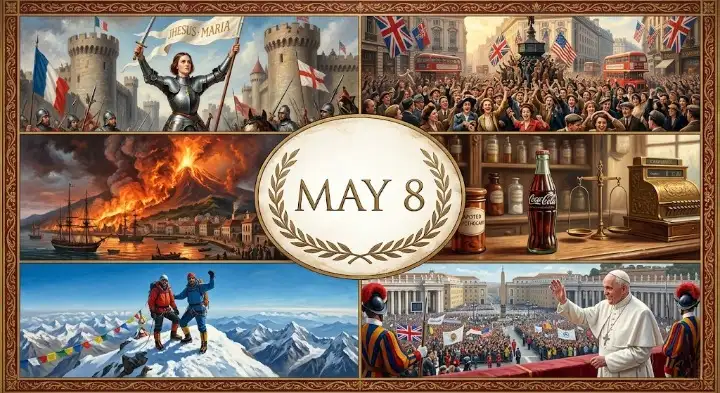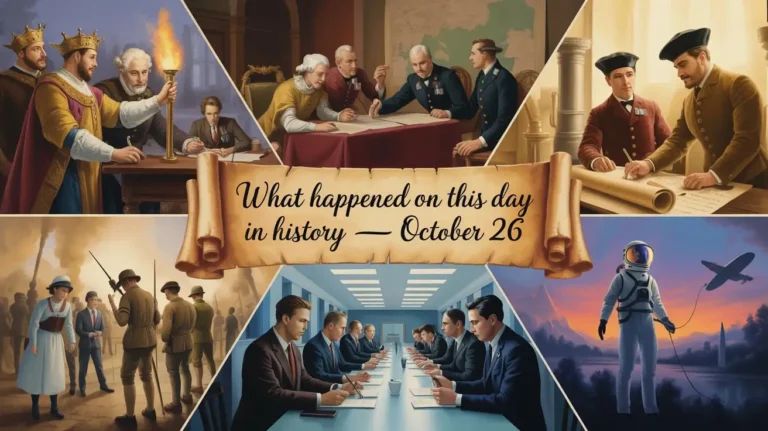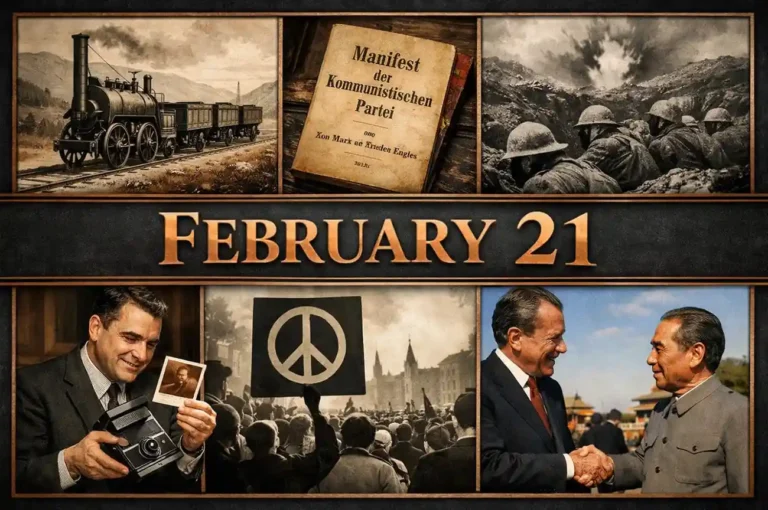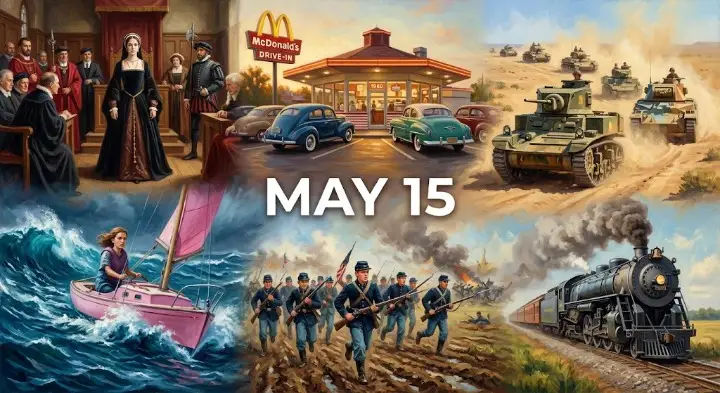
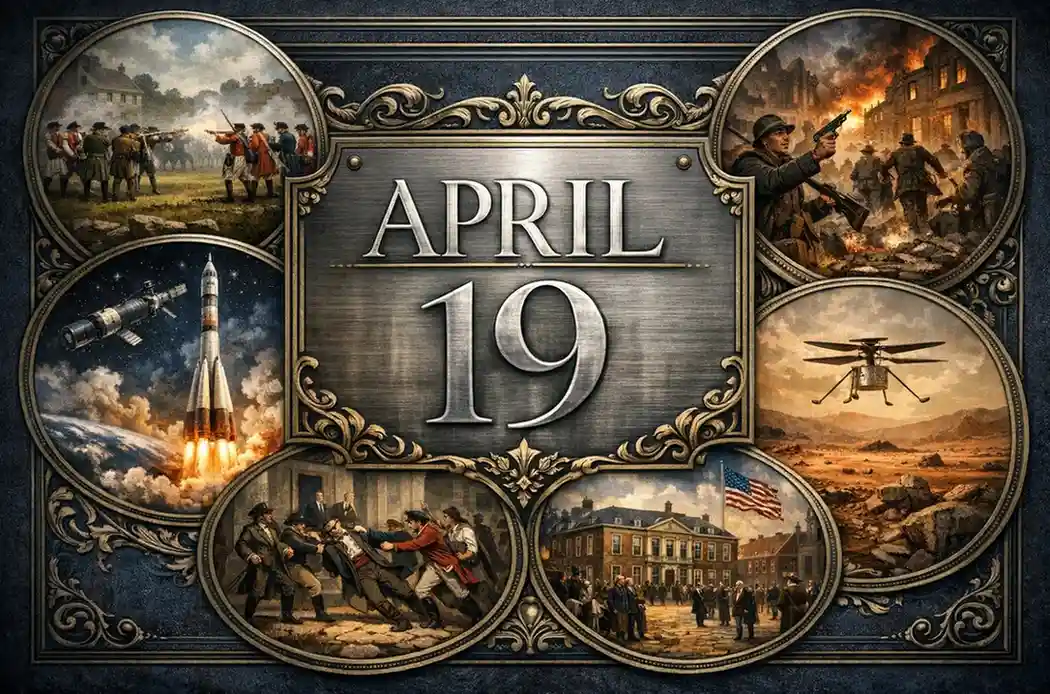
The trajectory of modern society is often traced back to moments of intense rebellion and scientific ambition, and exploring this day in history April 19 illuminates the thin line between the collapse of old empires and the birth of new eras. From the initial sparks of the American Revolutionary War to the pioneering deployment of orbital space stations, these events showcase a relentless drive to challenge existing boundaries, ultimately redefining the limits of both democratic governance and human exploration.
Important Events That Happened On April 19 In History
AD 65 – Betrayal of the Pisonian Conspiracy
A freedman named Milichus alerted the authorities to a major plot led by Gaius Calpurnius Piso to assassinate Emperor Nero. This betrayal led to the immediate arrest of the conspirators and a series of high-profile executions and forced suicides across Rome. The failed coup highlighted the growing tension between the Roman aristocracy and the increasingly erratic leadership of the Emperor. It remains a significant example of the internal power struggles that defined the mid-first century of the Roman Empire.
531 – Battle of Callinicum
A Byzantine military force led by the legendary general Belisarius suffered a defeat at the hands of the Persians near the city of Raqqa. The engagement occurred during the Iberian War as both empires vied for dominance over the strategic territories of northern Syria. Despite the loss, Belisarius managed to organize an orderly retreat that prevented the total destruction of his remaining troops. This conflict demonstrated the enduring military strength of the Sassanid Empire and the challenges of Byzantine expansion in the East.
1024 – Election of Pope John XIX
Following the death of his brother Pope Benedict VIII, John XIX was elected to lead the Catholic Church in Rome. His rise to the papacy was largely facilitated by the influence of his powerful family, the House of Tusculum, which dominated local politics. During his tenure, he focused on maintaining administrative stability and presided over the coronation of the Holy Roman Emperor Conrad II. His election underscored the era’s deep connection between familial nobility and the highest offices of religious authority.
1042 – Popular Uprising in Constantinople
A massive popular uprising broke out in Constantinople after Byzantine Emperor Michael V attempted to depose his wife, the popular Empress Zoe. The citizens took to the streets with the firm intention to restore her to power and protect her rightful place on the throne. The rebellion successfully forced the Emperor from the city and led to his eventual blinding and exile into a monastery. This event proved the significant political power held by the urban population of the Byzantine capital during the middle ages.
1506 – The Lisbon Massacre
The Lisbon Massacre began as Portuguese Catholics attacked and slaughtered approximately two thousand Jews who had been forcibly converted to Christianity. The violence was fueled by religious zealotry and a devastating plague that many locals blamed on the presence of the “New Christians.” This brutal event lasted for several days and remains a somber reminder of the extreme religious intolerance of the period. The tragedy led many survivors to flee the country, contributing to the growth of the Sephardic Jewish diaspora.
1529 – The Protest at Speyer
A group of German princes and independent cities issued a formal protest at the Second Diet of Speyer against a ban on Lutheranism. They stood against the reinstatement of the Edict of Worms, arguing that their primary religious allegiance belonged to God rather than the Emperor. This act of defiance gave rise to the term “Protestant” and marked a critical development in the Reformation movement. It solidified the religious and political division within the Holy Roman Empire that would shape European history for centuries.
1539 – Treaty of Frankfurt Signed
Protestant leaders and the Holy Roman Emperor Charles V signed the Treaty of Frankfurt to establish a temporary peace within the empire. The agreement provided a brief suspension of hostilities and allowed the Lutheran princes to maintain their religious practices for a set period. This diplomatic move was largely driven by the Emperor’s need to focus on external threats from the Ottoman Empire and France. The treaty represented a significant, though fleeting, effort to manage the theological tensions of the early Reformation era.
1572 – Treaty of Blois Alliance
England and France signed a formal military alliance against the Spanish Empire through the signing of the Treaty of Blois. Both nations sought to limit the growing power of Spain and protect their own commercial and territorial interests in Europe. The agreement included provisions for mutual defense and signaled a major shift in the traditional rivalries between the two northern powers. This diplomatic alignment reflected the complex web of religious and political strategies that defined the late sixteenth-century international landscape.
1608 – O’Doherty’s Rebellion Begins
O’Doherty’s Rebellion was launched in Ireland with the intentional burning of the city of Derry by Sir Cahir O’Doherty. The uprising was sparked by personal grievances and the increasing pressure of English colonial policies on the traditional Gaelic lords. While the rebellion was relatively short-lived, it caused significant destruction and led to a harsh military response from the English crown. The failure of the revolt cleared the way for the extensive Plantation of Ulster and the further loss of Irish land.
1677 – French Capture of Cambrai
The French army successfully captured the town of Cambrai after a siege against the Spanish troops who had held the fortification. This victory was part of the broader expansionist wars led by King Louis XIV to secure the northern borders of France. The town was a vital strategic prize due to its location and its role as a regional hub for trade and defense. Its fall highlighted the military engineering and logistical superiority of the French forces during the height of the Bourbon monarchy.
1713 – Issuance of the Pragmatic Sanction
Holy Roman Emperor Charles VI issued the Pragmatic Sanction to ensure that the Austrian throne could be inherited by a female heir. Lacking a living male successor, he sought to guarantee the integrity of the Habsburg lands and prevent a future succession crisis. This legal decree was designed to protect the rights of his future daughter, Maria Theresa, who would not be born for another four years. The effort to gain international recognition for this sanction would dominate the Emperor’s foreign policy for the rest of his life.
1770 – James Cook Sights Australia
Captain James Cook, then holding the rank of lieutenant, made the first recorded European sighting of the eastern coast of modern-day Australia. While sailing on the HMS Endeavour, he mapped the coastline and identified various natural features that would later be used for colonization. This event opened the way for the British claim to the territory and the eventual establishment of penal colonies and settlements. Cook’s journey remains a foundational moment in the history of global navigation and the colonial expansion of the Pacific.
1770 – Wedding of Marie Antoinette
Marie Antoinette was officially married to the future King Louis XVI of France in a formal proxy wedding ceremony. This union was a calculated political alliance between the Austrian House of Habsburg and the French House of Bourbon. The marriage aimed to solidify the peace between the two traditional rivals and provide a stable future for the French monarchy. The young archduchess traveled to France shortly after the ceremony to begin her life as the Dauphine, a role that would eventually lead to tragedy.
1775 – Battles of Lexington and Concord
The American Revolutionary War began with the Battles of Lexington and Concord, where local minutemen engaged British troops in armed conflict. This victory by the American militia is often described as the “shot heard round the world,” signaling the start of a global struggle for independence. The fighting started as British forces moved to seize military supplies and ended with a disorganized British retreat back to Boston. This day transformed a colonial protest into an all-out war that would result in the creation of a new nation.
1775 – The Siege of Boston Begins
Immediately following the battles at Lexington and Concord, American militias moved to block all land access to the British-held city of Boston. This action initiated a nearly year-long siege that trapped the British military and thousands of loyalist citizens within the town. The colonial forces established a series of fortifications in the surrounding hills to monitor British movements and limit their supplies. This strategic containment demonstrated the organizational strength of the newly formed American forces and their commitment to removing British rule.
1782 – Dutch Recognition of the United States
John Adams successfully secured official recognition of the United States as an independent government from the Dutch Republic. He purchased a house in The Hague that became the first American embassy on foreign soil, marking a major diplomatic achievement. The Netherlands was only the second nation to recognize the new country, providing vital financial loans that helped sustain the American war effort. This recognition strengthened the international legitimacy of the United States and fostered a long-lasting friendship between the two republics.
1809 – Battles of Raszyn and Teugen-Hausen
An Austrian corps suffered a defeat against the forces of the Duchy of Warsaw during the Battle of Raszyn in Poland. Simultaneously, the main Austrian army was beaten by a French corps led by Louis-Nicolas Davout at the Battle of Teugen-Hausen in Bavaria. These engagements were part of a broader four-day campaign that ultimately resulted in a decisive victory for the First French Empire. These clashes highlighted the tactical skill of Napoleon’s marshals and the effectiveness of French military organization during the Fifth Coalition.
1810 – Home Rule in Venezuela
The people of Caracas removed Vicente Emparán, the Governor of the Captaincy General, and installed a local junta to govern the territory. This event marked the achievement of home rule for Venezuela and signaled the beginning of the end for Spanish colonial authority in South America. While the junta initially claimed to rule in the name of the deposed Spanish king, it quickly moved toward full independence. This day is celebrated as the start of the Venezuelan struggle for sovereignty and the rise of republican ideals in the region.
1818 – Fresnel’s Note on Diffraction
French physicist Augustin Fresnel signed his preliminary “Note on the Theory of Diffraction,” a document that laid the groundwork for modern wave optics. The text detailed his mathematical approach to light behavior and ended with the formulas now known as the Fresnel integrals. His work provided a robust theoretical basis for the wave theory of light, challenging the prevailing corpuscular models of the time. This document remains a cornerstone of physical science, influencing how light interactions and wave patterns are calculated today.
1839 – The Treaty of London
The Treaty of London was signed to establish Belgium as an independent kingdom and formally guarantee its status as a neutral nation. This international agreement was recognized by the major European powers and aimed to prevent future conflicts over the strategic territory. The treaty defined the borders of the new state and provided a legal framework for its peaceful coexistence with neighboring countries. This commitment to Belgian neutrality would play a critical role in the diplomatic crises that led to the start of World War I.
1861 – The Baltimore Riot
A pro-secessionist mob in Baltimore attacked United States Army troops as they marched through the city on their way to Washington, D.C. The confrontation resulted in several deaths and multiple injuries on both sides, making it the first significant bloodshed of the American Civil War. The violence highlighted the deep internal divisions within the border state of Maryland and the difficulty of moving federal forces southward. In response, the government eventually implemented martial law to secure the vital rail lines and maintain control of the city.
1903 – The Kishinev Pogrom
A violent anti-Jewish pogrom broke out in the city of Kishinev, leading to widespread destruction of homes and the loss of many lives. The assault was fueled by fabricated rumors and anti-Semitic propaganda, causing thousands of Jews to later seek refuge in Palestine and the West. This event drew international outrage and focused global attention on the brutal treatment of Jewish populations within the Russian Empire. The tragedy acted as a major catalyst for the Zionist movement and the large-scale emigration of Jews to the United States.
1925 – Founding of Colo-Colo
The successful Chilean soccer club Colo-Colo was founded at the El Llano Stadium in San Miguel by footballer David Arellano. He and several teammates established the new team after leaving the Deportes Magallanes club due to disagreements over team management. The club quickly became the most popular and successful football team in Chile, earning a legendary status in South American sports history. Its founding reflected the growing professionalization of the sport and the intense passion for football within Chilean culture.
1927 – Sentencing of Mae West
Actress and playwright Mae West was sentenced to ten days in jail for obscenity following the production of her controversial play, Sex. The court ruled that the play’s content was indecent and harmful to public morals, leading to a highly publicized legal battle in New York. West utilized the situation to enhance her celebrity status, famously opting for a “workhouse” sentence and gaining massive media attention. This event highlighted the era’s strict censorship laws and the ongoing struggle between artistic expression and traditional social standards.
1936 – Commencement of Jaffa Riots
The Jaffa riots began in Mandatory Palestine, initiating a widespread Arab revolt against British colonial rule and Jewish immigration. The violence was sparked by deep-seated political tensions and economic grievances within the Arab community regarding the future of the region. The revolt lasted for three years and involved a series of strikes, protests, and armed clashes that required a significant British military response. This period of unrest fundamentally shaped the political landscape of the region and influenced the eventual decision to partition the land.
1942 – Establishment of Majdan-Tatarski Ghetto
The German authorities established the Majdan-Tatarski ghetto in occupied Poland to house Jews from the surrounding Lublin region. The ghetto was situated in a strategic location between the main Lublin Ghetto and a subcamp of the Majdanek concentration camp. This controlled area was used to facilitate the forced labor and eventual deportation of thousands of Jewish families during the Holocaust. Its creation was part of the systematic Nazi policy to isolate and liquidate the Jewish populations of Eastern Europe.
1943 – Warsaw Ghetto Uprising Begins
The Warsaw Ghetto Uprising began as Jewish resistance fighters launched an armed struggle against German troops entering the ghetto. The uprising was a desperate response to the final round-up and deportation of the remaining Jewish residents to extermination camps. Despite being heavily outnumbered and poorly equipped, the fighters held out for several weeks against the full might of the German military. This act of defiance remains one of the most powerful symbols of Jewish resistance against the atrocities of the Nazi regime.
1943 – Albert Hofmann’s First LSD Dose
Swiss chemist Albert Hofmann deliberately took a dose of LSD for the first time to verify the effects he had previously felt by accident. This event, which involved a historic bicycle ride home from his laboratory, is commonly celebrated in psychedelic culture as “Bicycle Day.” His experiment provided the first intentional documentation of the drug’s powerful hallucinogenic properties and potential for psychological research. The day marked the beginning of decades of scientific study and social debate regarding the role of psychedelics in medicine and culture.
1956 – Marriage of Grace Kelly
American actress Grace Kelly married Prince Rainier III of Monaco in a lavish ceremony that captured the attention of the global media. The wedding transformed the Hollywood star into a European princess and brought significant international prestige to the small Mediterranean principality. Known as the “Wedding of the Century,” the event was broadcast to millions of viewers and featured a guest list of celebrities and world leaders. This union solidified a new era for Monaco, blending royal tradition with the glamour of the American film industry.
1960 – South Korean Student Protests
Students in South Korea held a massive nationwide protest to voice their opposition to the government of President Syngman Rhee. The demonstrations were sparked by evidence of widespread election fraud and government corruption during the recent presidential balloting. The intensity of the protests and the subsequent loss of life eventually forced the aging president to resign and leave the country. This movement, known as the April Revolution, paved the way for the establishment of the Second Republic and a brief period of democratic reform.
1971 – Sierra Leone Becomes a Republic
Sierra Leone officially transitioned to a republican form of government, severing its remaining constitutional ties with the British monarchy. Siaka Stevens was sworn in as the nation’s first president, moving the country away from its previous status as a parliamentary democracy. This change aimed to centralize executive power and promote a new national identity following years of colonial rule. The move to a republic was a significant milestone in the post-colonial history of the West African nation and its ongoing political development.
1971 – Launch of Salyut 1
The Soviet Union successfully launched Salyut 1, making it the first space station to ever be placed into orbit around the Earth. The mission aimed to test the feasibility of long-term human habitation in space and conduct a variety of scientific experiments. Although the station was only occupied for a short period, it paved the way for future programs like Mir and the International Space Station. The launch represented a major achievement in the space race and a significant advancement in human spaceflight technology.
1971 – Sentencing of Charles Manson
Charles Manson was officially sentenced to death for his role in the conspiracy behind the Tate–LaBianca murders in Los Angeles. The court found him guilty of leading a cult-like “family” that carried out a series of brutal killings designed to spark a racial conflict. His sentence was later commuted to life imprisonment after the California Supreme Court temporarily abolished capital punishment in 1972. The trial and sentencing brought a legal end to one of the most infamous and disturbing criminal cases in modern American history.
1973 – Portuguese Socialist Party Founded
The Portuguese Socialist Party was officially founded by a group of exiles in the German town of Bad Münstereifel. Led by Mário Soares, the party aimed to challenge the long-standing dictatorship of the Estado Novo regime and promote democratic socialism. This organization played a critical role in the transition to democracy following the Carnation Revolution the following year. Its founding in exile demonstrated the resilience of the Portuguese democratic movement and the importance of international support for political reform.
1975 – Launch of Aryabhata Satellite
India launched its first-ever satellite, named Aryabhata, into orbit from the Kapustin Yar launch site in the Soviet Union. The satellite was named after the ancient Indian astronomer and was designed to conduct experiments in X-ray astronomy and solar physics. While the mission was cut short due to power failure, it successfully demonstrated India’s capability to build and operate complex space technology. This achievement marked the birth of the Indian space program and its ongoing efforts to explore the solar system.
1975 – Withdrawal from Xuan Loc
South Vietnamese forces officially withdrew from the town of Xuan Loc, signaling the end of the last major battle of the Vietnam War. The intense fighting at Xuan Loc had temporarily halted the advance of the North Vietnamese army toward the capital city of Saigon. The withdrawal of the remaining defenders marked the final collapse of the South Vietnamese defensive lines and the imminent end of the conflict. This event is remembered as a turning point that led directly to the unification of the country under communist rule.
1976 – Brownwood F5 Tornado
A violent F5 tornado struck the area around Brownwood, Texas, causing significant damage and injuring 11 people in its path. In a remarkable survival story, two individuals were thrown at least 1,000 yards by the powerful winds and emerged entirely uninjured. The tornado destroyed several buildings and disrupted local infrastructure, highlighting the extreme power of nature in the central United States. This event remains one of the most notable examples of tornado survival and the destructive potential of high-intensity storm systems.
1984 – Proclamation of National Anthem
The song “Advance Australia Fair” was officially proclaimed as the national anthem of Australia, replacing the traditional British anthem. At the same time, green and gold were formally recognized as the national colors, reflecting the country’s unique landscape and athletic identity. These changes aimed to strengthen Australia’s distinct national character and move away from colonial-era symbols. The adoption of the anthem followed years of public debate and several national polls to determine the preferred choice of the Australian people.
1985 – Siege of the CSA Compound
Hundreds of ATF and FBI agents initiated a siege at the compound of a white supremacist group in Arkansas. The group, known as The Covenant, the Sword, and the Arm of the Lord (CSA), had been stockpiling weapons and preparing for a racial conflict. Following two days of negotiations and a tense standoff, the members of the group eventually surrendered peacefully to federal authorities. The operation highlighted the growing concern over domestic extremism and the challenges of managing armed standoffs with radical anti-government organizations.
1987 – First Appearance of The Simpsons
The Simpson family made their first television appearance as a series of animated shorts on The Tracey Ullman Show. The first short, titled “Good Night,” introduced the dysfunctional family to the public through a series of humorous and relatable vignettes. These shorts were created by Matt Groening and served as the testing ground for what would become the longest-running scripted show in American history. The success of these early segments led to the creation of a full-length series that fundamentally changed the landscape of television.
1989 – USS Iowa Explosion
A massive explosion occurred within a gun turret on the battleship USS Iowa, resulting in the tragic deaths of 47 sailors. The blast happened during a routine gunnery exercise in the Atlantic Ocean and caused extensive damage to the ship’s interior. A lengthy and controversial investigation followed to determine the cause of the explosion, initially pointing toward a deliberate act before being revised. This disaster remains one of the deadliest non-combat accidents in the history of the United States Navy, leading to changes in weapon handling.
1993 – The Waco Siege Ends
A 51-day standoff between federal agents and the Branch Davidian group in Waco, Texas, came to a tragic end when a fire broke out. The blaze occurred as the FBI launched a final assault on the compound using tear gas and armored vehicles to force an end to the siege. Seventy-six individuals, including 18 children, lost their lives in the resulting inferno that consumed the entire building. The event sparked intense debate regarding the use of force by federal law enforcement and became a focal point for anti-government sentiment.
1995 – Oklahoma City Bombing
The Alfred P. Murrah Federal Building in Oklahoma City was destroyed by a massive truck bomb, resulting in the deaths of 168 people. The attack was carried out by domestic terrorists who were motivated by extreme anti-government beliefs and a desire for retaliation against the events in Waco. This act remains the deadliest act of domestic terrorism in United States history, causing widespread shock and grief across the nation. The tragedy led to significant changes in federal building security and a renewed focus on the threat posed by internal extremism.
1999 – Bundestag Returns to Berlin
The German Bundestag officially returned to the Reichstag building in Berlin, completing the symbolic move of the capital from the city of Bonn. This relocation followed the reunification of Germany and aimed to re-establish Berlin as the political heart of the unified nation. The Reichstag building had undergone an extensive renovation, including the addition of a modern glass dome that represents transparency in government. The return to Berlin signaled a new chapter in German history and the final conclusion of the Cold War division of the city.
2000 – Air Philippines Flight 541
An Air Philippines Flight 541 crashed on the island of Samal, resulting in the deaths of all 131 people on board the aircraft. The plane was attempting to land at Davao International Airport during poor weather conditions when it struck a hillside several miles from the runway. This tragedy remains the deadliest aviation accident in the history of the Philippines, leading to a major review of flight safety and air traffic procedures in the country. The loss of life caused a national period of mourning and highlighted the risks of regional air travel.
2001 – Launch of STS-100
The Space Shuttle Endeavour launched on mission STS-100, carrying the Canadarm2 robotic arm to the International Space Station. This complex piece of technology was essential for the ongoing assembly of the station and the handling of large cargo and spacecraft. The mission involved several spacewalks to install the arm and ensure its proper operation within the station’s environment. The successful delivery of the Canadarm2 represented a major milestone in international space cooperation and the development of orbital construction capabilities.
2005 – Election of Pope Benedict XVI
Cardinal Joseph Ratzinger was elected to the papacy, taking the name Pope Benedict XVI following the death of Pope John Paul II. He had previously served as the Prefect of the Congregation for the Doctrine of the Faith and was known for his conservative theological views. His election was greeted by thousands of followers gathered in St. Peter’s Square and signaled a period of continuity for the Catholic Church’s core teachings. During his papacy, he focused on the relationship between faith and reason and navigated a variety of modern ecclesiastical challenges.
2008 – Quito Club Fire
A devastating fire broke out at the Ultratumba nightclub in Quito, Ecuador, resulting in the deaths of 19 people and injuring dozens more. The blaze was ignited by indoor pyrotechnics during a rock concert, trapped many attendees within the building due to a lack of emergency exits. This tragedy sparked a national outcry regarding the enforcement of safety regulations and the management of public entertainment venues. It led to a series of legal reforms and a crackdown on non-compliant establishments across the city to prevent future disasters.
2011 – Resignation of Fidel Castro
Fidel Castro officially resigned as the First Secretary of the Communist Party of Cuba, a position he had held since the party’s formation in 1961. This move marked the end of his formal leadership roles within the Cuban government, as his brother Raul had already assumed the presidency. His departure from the party’s top office signaled a generational shift in Cuban politics and the start of a gradual process of economic and social reform. Castro remained an influential figure until his death, representing the legacy of the 1959 revolution.
2013 – Death of Tamerlan Tsarnaev
Boston Marathon bombing suspect Tamerlan Tsarnaev was killed in a violent shootout with police in the suburb of Watertown. The confrontation followed a massive manhunt that had paralyzed the city of Boston and the surrounding areas for several days. His brother and accomplice, Dzhokhar, was later captured while hiding in a boat inside a residential backyard. This event brought a violent end to the immediate threat posed by the suspects and began a lengthy legal process to determine the motivations behind the deadly 2013 attack.
2020 – Nova Scotia Killing Spree
A violent rampage in the Canadian province of Nova Scotia resulted in the deaths of 22 people and the perpetrator over the course of several hours. This event was the deadliest mass killing in Canada’s history, causing widespread shock and profound grief across the nation. The perpetrator utilized a replica police vehicle and uniform to carry out the attacks in multiple communities, complicating the law enforcement response. The tragedy led to a public inquiry and a significant national conversation regarding gun control and police communication during active emergencies.
2021 – Flight of the Ingenuity Helicopter
The Ingenuity helicopter successfully achieved the first-ever powered, controlled flight on another planet as it rose above the surface of Mars. The small aircraft, which traveled as part of NASA’s Perseverance rover mission, demonstrated that flight was possible in the thin Martian atmosphere. This historic achievement opened a new era for aerial exploration of other worlds, proving that helicopters could be used to survey difficult terrain and assist future rovers. The success of Ingenuity exceeded all expectations, completing dozens of subsequent flights during its mission.
Take A Look At April 18: Military Raids & Modern Governance
Famous People Born On April 19
| Name | Description | Date |
|---|---|---|
| Paulus Jovius | Italian historian, author of vivid Latin historical works | April 19, 1483 – December 10, 1552 |
| Michel Le Tellier | French secretary of state for war under Louis XIV | April 19, 1603 – October 30, 1685 |
| Sarah Kemble Knight | American colonial diarist, vivid travel chronicler | April 19, 1666 – September 25, 1727 |
| Roger Sherman | American politician, key figure at Constitutional Convention | April 19, 1721 – July 23, 1793 |
| August Wilhelm Iffland | German actor, dramatist, and theatrical manager | April 19, 1759 – September 22, 1814 |
| Vasily Mikhaylovich Golovnin | Russian naval officer and seafarer | April 19, 1776 – July 11, 1831 |
| Ferdinand | Emperor of Austria (1835–48) | April 19, 1793 – June 29, 1875 |
| Christian Gottfried Ehrenberg | German biologist, founder of micropaleontology | April 19, 1795 – June 27, 1876 |
| Gustav Fechner | German physicist and philosopher, founder of psychophysics | April 19, 1801 – November 18, 1887 |
| Charles Philipon | French caricaturist, founded Le Charivari | April 19, 1806 – January 25, 1862 |
| Mary Louise Booth | American journalist, first editor of Harper’s Bazar | April 19, 1831 – March 5, 1889 |
| Octave Pirmez | Belgian man of letters | April 19, 1832 – May 1, 1883 |
| José Echegaray y Eizaguirre | Spanish dramatist, Nobel Prize in Literature (1904) | April 19, 1832 – September 4, 1916 |
| Augustus D. Juilliard | American banker, bequeathed fortune for music education | April 19, 1836 – April 25, 1919 |
| Mikhail Nikolayevich, Count Muravyov | Russian diplomat and statesman | April 19, 1845 – June 21, 1900 |
| Lucien Lévy-Bruhl | French philosopher, studied primitive mentality | April 19, 1857 – March 13, 1939 |
| Alice Salomon | German social worker and feminist | April 19, 1872 – August 30, 1948 |
| Ole Evinrude | Norwegian-American inventor of outboard marine engine | April 19, 1877 – July 12, 1934 |
| Albert Wallace Hull | American physicist, X-ray crystallography pioneer | April 19, 1880 – January 22, 1966 |
| Dame Margery Corbett Ashby | British women’s rights pioneer | April 19, 1882 – May 15, 1981 |
| Richard von Mises | Austrian-born mathematician, statistics and probability | April 19, 1883 – July 14, 1953 |
| Manuel Bandeira | Brazilian poet, Modernismo leader | April 19, 1886 – October 13, 1968 |
| Riccardo Bacchelli | Italian novelist and playwright | April 19, 1891 – October 8, 1985 |
| Richard Hughes | British novelist, A High Wind in Jamaica | April 19, 1900 – April 28, 1976 |
| Glenn T. Seaborg | American nuclear chemist, Nobel Prize, discovered transuranium elements | April 19, 1912 – February 25, 1999 |
| Stanley Fish | American literary critic, reader-response theory | April 19, 1938 – Present |
| Fred Brooks | American computer scientist, Turing Award | April 19, 1931 – November 17, 2022 |
| Fernando Botero | Colombian painter and sculptor of inflated forms | April 19, 1932 – September 15, 2023 |
| Andrea Mead Lawrence | American Alpine skier, two Olympic gold medals | April 19, 1932 – March 31, 2009 |
| Murray Perahia | American pianist and conductor | April 19, 1947 – Present |
Famous People Died On April 19
| Name | Description | Date |
|---|---|---|
| Boniface VI | Pope in April 896 | Unknown – April 19, 896 |
| Saint Aelfheah | Archbishop of Canterbury, martyred by Danes | 954 – April 19, 1012 |
| St. Leo IX | Pope (1049–54), oversaw East-West Schism of 1054 | June 21, 1002 – April 19, 1054 |
| Olaus Petri | Swedish Lutheran churchman, key reformer | January 6, 1493? – April 19, 1552 |
| Thomas Sackville, 1st earl of Dorset | English statesman, poet, and dramatist | 1536 – April 19, 1608 |
| Anthony van Diemen | Dutch colonial governor-general of East Indies | 1593 – April 19, 1645 |
| Robert Rich, 2nd earl of Warwick | English colonial administrator, religious toleration advocate | June 1587? – April 19, 1658 |
| Jacob Israel Emden | Danish rabbi and Talmudic scholar | June 4, 1697 – April 19, 1776 |
| Richard Price | British moral philosopher, supported American/French revolutions | February 23, 1723 – April 19, 1791 |
| Benjamin Rush | American physician, signer of Declaration of Independence | January 4, 1746 – April 19, 1813 |
| Hamilton Hume | Australian explorer | June 19, 1797 – April 19, 1873 |
| Johann Peter Friedrich Ancillon | Prussian statesman and foreign minister | April 30, 1767 – April 19, 1837 |
| Owen Jones | English architect and designer, The Grammar of Ornament | February 15, 1809 – April 19, 1874 |
| Samuel Sebastian Wesley | English composer and organist | August 14, 1810 – April 19, 1876 |
| Warren De la Rue | English pioneer of astronomical photography | January 15, 1815 – April 19, 1889 |
| A.S. Abell | American newspaper editor, founded Baltimore Sun | August 10, 1806 – April 19, 1888 |
| John Addington Symonds | English essayist and biographer of Renaissance | October 5, 1840 – April 19, 1893 |
| Gustav Nachtigal | German explorer, helped obtain African protectorates | February 23, 1834 – April 19, 1885 |
| Hugo Winckler | German archaeologist, excavated Hittite capital Hattusa | July 4, 1863 – April 19, 1913 |
| Charles Sanders Peirce | American philosopher and logician, founder of pragmatism | September 10, 1839 – April 19, 1914 |
| Ephraim Shay | American inventor of Shay geared steam locomotive | July 17, 1839 – April 19, 1916 |
| Colmar, baron von der Goltz | Prussian field marshal, reorganized Turkish army | August 12, 1843 – April 19, 1916 |
| Sir Squire Bancroft | English actor and theatrical manager | May 14, 1841 – April 19, 1926 |
| Sir William Watson Cheyne, 1st Baronet | British surgeon, pioneer of antiseptic methods | December 14, 1852 – April 19, 1932 |
| William Morton Wheeler | American entomologist, authority on ants | March 19, 1865 – April 19, 1937 |
| William Martin Conway, Baron Conway | British mountain climber and art historian | April 12, 1856 – April 19, 1937 |
| Suzanne Valadon | French painter, mother of Maurice Utrillo | September 23, 1865 – April 19, 1938 |
| Sir Henry Newbolt | English poet of patriotic and nautical verse | June 6, 1862 – April 19, 1938 |
| Jimmie Noone | American jazz clarinetist | April 23, 1895 – April 19, 1944 |
| Octavio Paz | Mexican poet, Nobel Prize in Literature (1990) | March 31, 1914 – April 19, 1998 |
Observances & Institutional Dates
- Bicycle Day: An unofficial holiday celebrated by psychedelic researchers and enthusiasts to honor Albert Hofmann’s first intentional use of LSD in 1943.
- Patriots’ Day (U.S.): A regional holiday celebrated in several states to commemorate the Battles of Lexington and Concord that began the American Revolution.
- Declaration of Independence (Venezuela): A national holiday marking the removal of the Spanish governor in 1810 and the start of the independence movement.
- April 19 (Eastern Orthodox): A liturgical date featuring various feast days for saints and religious observances within the Eastern Orthodox Church.
Frequently Asked Questions
- What was the “shot heard round the world”? It refers to the first shot fired at the Battle of Lexington on April 19, 1775, signaling the start of the American Revolution.
- When did the Warsaw Ghetto Uprising begin? The uprising started on April 19, 1943, as Jewish residents fought back against Nazi forces attempting to liquidate the ghetto.
- Why is April 19 significant in space history? It marks the launch of Salyut 1 in 1971, the world’s first space station, and the first flight of the Ingenuity helicopter on Mars in 2021.
- What happened in Oklahoma City on this day in 1995? The Alfred P. Murrah Federal Building was destroyed by a truck bomb in a major act of domestic terrorism that killed 168 people.