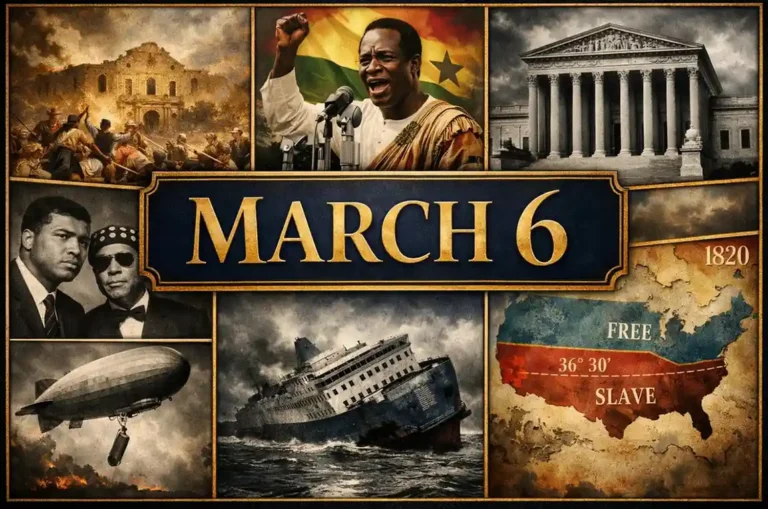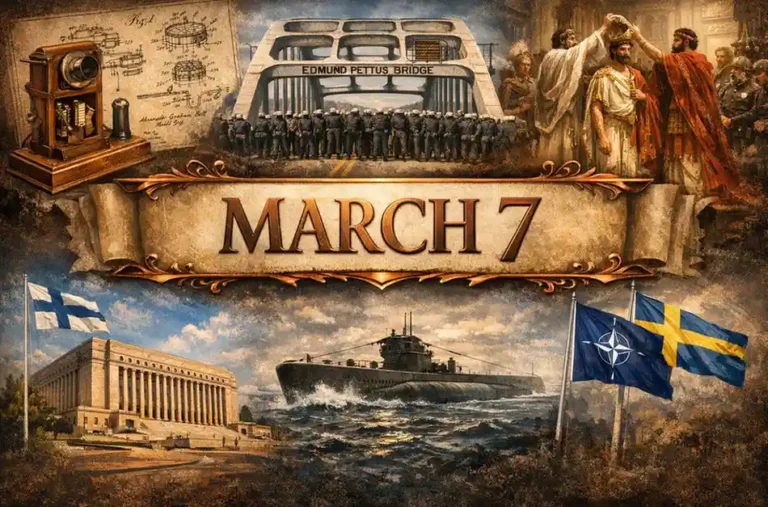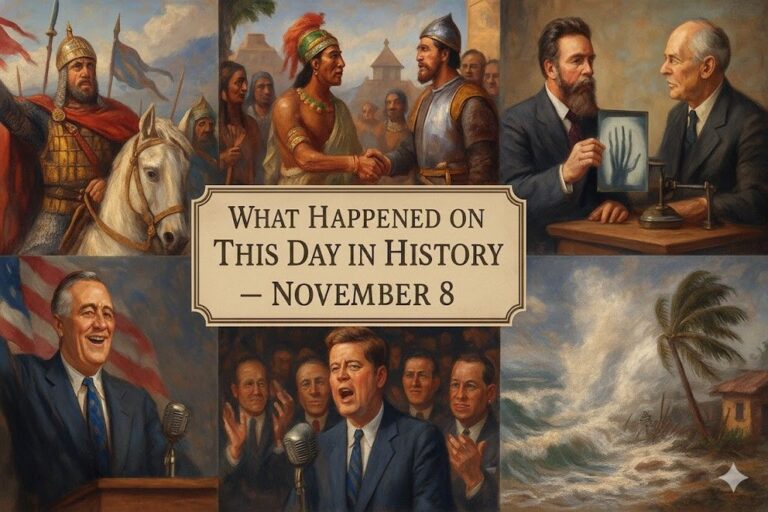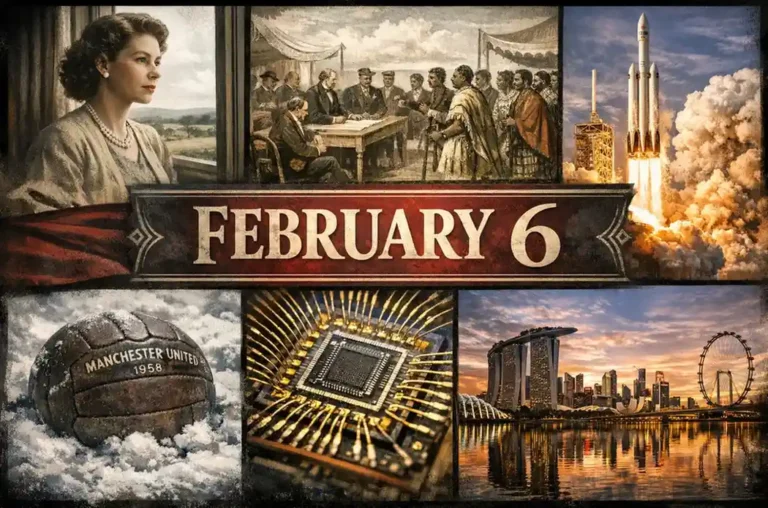
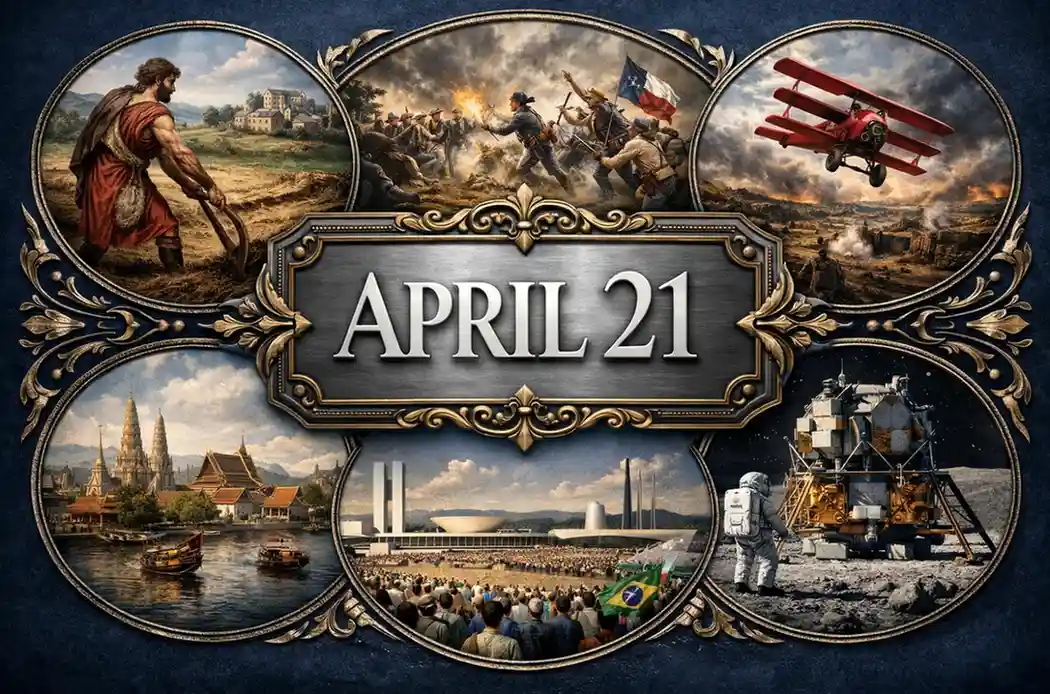
The evolution of society is frequently defined by the rise of new nations and the somber lessons of global conflict, and a look back at this day in history April 21 offers a window into the enduring cycle of growth and upheaval. By tracing the path from ancient territorial beginnings to the high-stakes maneuvers of the World Wars, we can see how specific dates serve as the foundation for the political structures and social movements that govern our world today.
Important Events That Happened On April 21 In History
753 BC – The Founding of Rome
According to ancient tradition and legend, Romulus founded the city of Rome on this day, marking the start of one of history’s greatest empires. The date is still celebrated as the birthday of the city, serving as a symbolic beginning for the Roman civilization that would eventually dominate the Mediterranean. This founding established the cultural and administrative heart that would influence Western law, governance, and architecture for over a thousand years. It remains a foundational milestone in the historical consciousness of the Western world.
43 BC – The Battle of Mutina
Mark Antony suffered a significant military defeat at the hands of Aulus Hirtius during the Battle of Mutina in northern Italy. Although Hirtius was killed in the heat of the conflict, the battle successfully prevented Antony from capturing the strategic city and forced his retreat. Shortly after the engagement, Decimus Brutus was murdered, further complicating the power vacuum following the assassination of Julius Caesar. This period of intense civil strife eventually led to the formation of the Second Triumvirate and the end of the Roman Republic.
900 – Laguna Copperplate Inscription
The Laguna Copperplate Inscription, the earliest known written document found in the Philippines, was created on this date to record a significant legal release. The document states that the Honourable Jayadewa, acting for the Kingdom of Tondo, officially pardoned the Honourable Namwaran and his family from all their outstanding debts. This artifact provides vital evidence of a complex, pre-colonial legal and social structure in the region that utilized Sanskrit-influenced scripts. It serves as a primary source for understanding the early history and sophisticated maritime trade networks of Southeast Asia.
1092 – Elevation of the Diocese of Pisa
The Diocese of Pisa was officially elevated to the rank of a metropolitan archdiocese by a decree issued by Pope Urban II. This administrative promotion reflected the growing political and economic power of the maritime Republic of Pisa during the medieval period. The move granted the local church increased authority over neighboring dioceses and solidified its status as a major religious hub in Italy. This institutional growth mirrored the city’s success in trade and its significant contributions to the early Crusades in the Mediterranean.
1506 – End of the Lisbon Massacre
The brutal three-day Lisbon Massacre finally came to an end after the slaughter of over 1,900 suspected Jews by Portuguese Catholic mobs. The violence was initially fueled by religious fanaticism and a devastating plague that had left the city’s population in a state of terror and unrest. The monarchy eventually restored order, but the event left a permanent scar on the community and led to a large-scale exodus of the Jewish population. This tragedy highlighted the extreme religious tensions that plagued the Iberian Peninsula during the early sixteenth century.
1509 – Accession of Henry VIII
Henry VIII officially ascended to the English throne on this day following the death of his father, King Henry VII. The transition of power was peaceful and greeted with great optimism by a public eager for the rule of the young and charismatic prince. His reign would become one of the most famous and transformative in British history, characterized by radical religious shifts and political centralization. This day marked the beginning of a new era for the Tudor dynasty and the future of the English state.
1526 – First Battle of Panipat
The last ruler of the Lodi dynasty, Ibrahim Lodi, was defeated and killed by the forces of Babur during the First Battle of Panipat. This engagement featured the innovative use of field artillery and firearms, which allowed Babur’s smaller army to overwhelm the much larger Lodi forces. The victory effectively ended the Delhi Sultanate and paved the way for the establishment of the Mughal Empire in the Indian subcontinent. This battle remains a critical turning point that redefined the military and political landscape of South Asia for centuries.
1615 – Inauguration of Wignacourt Aqueduct
The Wignacourt Aqueduct was officially inaugurated in Malta to provide a reliable supply of fresh water to the growing city of Valletta. Commissioned by Grand Master Alof de Wignacourt, the massive stone structure spanned several miles to transport water from the central plateaus to the coast. This engineering feat addressed a critical resource shortage and allowed for the continued expansion of the island’s primary fortifications and civilian populations. The aqueduct remained a vital part of Malta’s infrastructure for generations and stands as a testament to Hospitaller engineering.
1782 – Founding of Bangkok
King Buddha Yodfa Chulaloke founded the city of Rattanakosin, now known globally as Bangkok, on the eastern bank of the Chao Phraya River. The new capital was established to provide a more defensible and strategic center for the Kingdom of Siam following the destruction of Ayutthaya. The king commissioned the construction of the Grand Palace and numerous temples, creating a cultural and spiritual heart for the modern Thai nation. This founding marked the start of the Chakri dynasty, which continues to lead the country to this day.
1789 – John Adams Sworn In
John Adams was officially sworn in as the first Vice President of the United States, taking office nine days before the first president. As the runner-up in the first electoral college vote, he assumed the role of presiding over the Senate and assisting in the formation of the new government. His early start reflected the urgent need to establish the administrative functions of the federal system under the new Constitution. This day inaugurated the executive branch of the American republic and set the precedent for the peaceful transfer of power.
1789 – Washington’s Reception at Trenton
George Washington was honored with a grand reception hosted by the Ladies of Trenton while traveling to New York City for his inauguration. The citizens of the town erected a ceremonial arch and showered the general with flowers to celebrate his leadership during the Revolutionary War. This stop was part of a larger, triumphal journey through the states that helped solidify national unity and public support for the new presidency. The event demonstrated the deep emotional connection between the American people and the man who would become their first leader.
1792 – Execution of Tiradentes
The Brazilian revolutionary leader known as Tiradentes was hanged, drawn, and quartered by colonial authorities for his role in a movement for independence. As a primary figure in the Inconfidência Mineira, he had sought to overthrow Portuguese rule and establish a republic modeled after the United States. His brutal execution was intended to serve as a deterrent to other rebels, but it instead transformed him into a powerful martyr for the cause. Today, he is revered as a national hero and a symbol of Brazil’s long struggle for sovereignty.
1796 – Battle of Mondovi
Napoleon Bonaparte achieved a decisive victory over the army of Piedmont at the Battle of Mondovi, the climax of his brilliant Montenotte Campaign. This success forced the surrender of Piedmont within a week and effectively removed one of Austria’s key allies from the ongoing conflict. The victory turned the Italian campaign significantly in France’s favor and demonstrated Napoleon’s talent for rapid, offensive warfare. This day solidified his reputation as a formidable military commander and established French dominance in northern Italy during the First Coalition.
1802 – Sacking of Karbala
A force of twelve thousand Wahhabis attacked and sacked the city of Karbala, resulting in the deaths of over three thousand inhabitants. The invaders targeted the holy shrines and religious sites of the city, causing extensive damage to the cultural and spiritual heritage of the region. This event was a major escalation of sectarian violence and reflected the growing influence of the Wahhabi movement in the Arabian Peninsula. The sacking of the city drew condemnation from across the Islamic world and had a lasting impact on regional religious relations.
1806 – Action of 21 April 1806
A French frigate successfully escaped from a pursuing force of British warships off the coast of South Africa during the Napoleonic Wars. The engagement occurred near the Cape of Good Hope, a vital strategic point for international trade and military logistics between Europe and Asia. Despite the superior numbers of the British squadron, the French crew utilized skillful navigation and favorable winds to evade capture and continue their mission. This minor naval encounter highlighted the ongoing global nature of the conflict as both nations vied for control of the seas.
1809 – Retreat from Landshut
Napoleon led a French army to drive two Austrian army corps from the town of Landshut during a series of intense maneuvers in Bavaria. While the main French forces were engaged in the south, two other corps to the north successfully held off the primary Austrian army. This coordinated effort was part of the first day of the Battle of Eckmühl, a campaign that aimed to disrupt Austrian communications and supply lines. The victory at Landshut forced the Austrians into a disorganized retreat and maintained the momentum of the French offensive.
1821 – Benderli Ali Pasha Exiled
Benderli Ali Pasha arrived in Constantinople to take office as the new Grand Vizier of the Ottoman Empire during a period of intense internal turmoil. However, his tenure was incredibly short-lived, as he remained in power for only nine days before being removed and sent into exile. His rapid downfall was the result of political maneuvering and the Sultan’s dissatisfaction with his handling of the rising Greek War of Independence. This event underscored the extreme instability and frequent turnover of high-ranking officials within the Ottoman administration during the nineteenth century.
1836 – Battle of San Jacinto
Republic of Texas forces led by Sam Houston achieved a stunning and decisive victory over the Mexican army under General Antonio López de Santa Anna. The battle lasted only eighteen minutes and resulted in the capture of the Mexican president and the near-total destruction of his forces. This victory effectively secured Texas’ independence from Mexico and led to the creation of a sovereign republic that would later join the United States. The Battle of San Jacinto is remembered as one of the most consequential military engagements in North American history.
1856 – Eight-Hour Day March
Stonemasons and other building workers in Melbourne, Australia, marched from the University of Melbourne to Parliament House to demand an eight-hour working day. The protesters argued for a balanced life consisting of eight hours of work, eight hours of recreation, and eight hours of rest. Their successful demonstration led to the adoption of the shorter workday in the building industry without any loss of pay for the laborers. This event was a major milestone for the international labor movement and is still celebrated as a victory for workers’ rights.
1894 – Adoption of the Krag–Jørgensen Rifle
Norway officially adopted the Krag–Jørgensen bolt-action rifle as the primary firearm for its armed forces, a decision that would shape its military for decades. The weapon was known for its unique magazine design and smooth action, making it a highly reliable and effective arm for the period. It remained in active service for almost 50 years, through both world wars and numerous regional tensions. The adoption of the rifle marked a significant step in the modernization of the Norwegian military and its commitment to utilizing advanced domestic technology.
1898 – Blockade of Cuban Ports
The United States Navy initiated a formal blockade of Cuban ports as tensions with Spain reached a breaking point following the sinking of the USS Maine. While a formal declaration of war was not issued until several days later, the blockade effectively launched the hostilities of the Spanish–American War. This action aimed to isolate the Spanish forces in Cuba and prevent them from receiving reinforcements or supplies from Europe. The decision to begin the blockade on this date was later cited by Congress as the official start of the state of war.
1914 – The Ypiranga Incident
A German arms shipment intended for the Mexican government was intercepted by the United States Navy near the port of Veracruz. The US sought to prevent the delivery of weapons to the regime of Victoriano Huerta, whom the Wilson administration refused to recognize as legitimate. This intervention led to the American occupation of Veracruz and a significant escalation of diplomatic tensions between the United States and Mexico. The incident highlighted the complex and often interventionist role played by the US in the internal affairs of its southern neighbor.
1918 – Death of the Red Baron
The legendary German fighter ace Manfred von Richthofen, famously known as “The Red Baron,” was shot down and killed over northern France. He had recorded 80 confirmed aerial victories, making him the highest-scoring pilot of World War I and a symbol of German military prowess. His death in pursuit of a British aircraft marked the end of an era for early aerial combat and the legendary “Flying Circus” squadron. Richthofen was buried with full military honors by the Allied forces in a show of respect for his skill and chivalry.
1926 – Leveling of Al-Baqi Cemetery
The historic Al-Baqi cemetery in Medina, which housed the mausoleums of four Shi’a Imams and many family members of the Prophet Muhammad, was leveled to the ground. The destruction was carried out by Wahhabi forces following their capture of the city, as part of a campaign against religious sites they considered idolatrous. This event caused immense grief and outrage across the Islamic world, particularly among Shi’a and Sufi communities. The leveling of the cemetery remains a somber and controversial event that continues to impact religious sentiment and regional relations.
1934 – “Surgeon’s Photograph” Published
The Daily Mail published the “Surgeon’s Photograph,” which became the most famous image allegedly showing the existence of the Loch Ness Monster. The photo depicted a long-necked creature rising from the water, sparking decades of intense public interest and scientific debate regarding the creature’s existence. However, in 1994, it was revealed that the photograph was a clever hoax involving a toy submarine and a sculpted head. Despite the revelation, the image remains a primary icon of cryptozoology and the enduring human fascination with the mysteries of the deep.
1945 – Attack on German High Command
Soviet forces advancing south of Berlin launched a major assault on the German High Command headquarters located in the town of Zossen. The facility served as the primary coordination center for the remaining German military operations on the Eastern and Western fronts. The rapid Soviet advance forced the evacuation of the military leadership and disrupted the final defensive plans for the German capital. This capture was a critical step in the final liquidation of the Nazi regime and the eventual unconditional surrender of Germany just weeks later.
1946 – Record Tornado in Timber Lake
The U.S. Weather Bureau recorded a massive tornado that struck the area near Timber Lake, South Dakota, measuring approximately 4 miles in width. This storm remains among the widest tornadoes ever documented on record, showcasing the extreme power of weather systems in the Great Plains. The tornado caused significant damage to rural property and infrastructure, though the low population density of the region helped limit the number of casualties. This event continues to be a subject of study for meteorologists looking to understand the formation of supercell storm systems.
1948 – Resolution 47 on Kashmir
The United Nations Security Council officially adopted Resolution 47, which aimed to address the ongoing conflict between India and Pakistan over the region of Kashmir. The resolution called for an immediate ceasefire and suggested a three-step process to restore peace, including the withdrawal of troops and a free plebiscite for the local population. While the resolution provided a framework for a peaceful resolution, many of its key provisions were never fully implemented by the two nations. This failure to resolve the dispute has led to decades of tension and multiple wars in the region.
1950 – Nainital Wedding Massacre
A tragic and violent attack known as the Nainital wedding massacre occurred in India, resulting in the deaths of 22 members of the Dalit (Harijan) caste. The victims were targeted during a wedding celebration by members of higher castes, highlighting the deep-seated social and systemic violence that plagued the region. This massacre drew national attention to the ongoing struggle for civil rights and protections for marginalized communities in the newly independent nation. It remains a somber reminder of the challenges of achieving social equality and the rule of law in a divided society.
1952 – First Secretary’s Day
The first Secretary’s Day, now known internationally as Administrative Professionals’ Day, was celebrated to recognize the contributions of administrative staff in the workplace. The holiday was created by the National Secretaries Association to highlight the vital role these professionals play in the success and efficiency of modern businesses. Over time, the observance has expanded to honor a wide range of support roles and is now celebrated globally in late April. This recognition helped elevate the status of administrative careers and foster a culture of appreciation within professional environments.
1958 – Mid-Air Collision over Nevada
A United Air Lines Flight 736 collided with a United States Air Force fighter jet in the skies near Arden, Nevada, resulting in a tragic loss of life. Both aircraft were destroyed in the high-speed impact, and all passengers and crew on both flights were killed. The disaster occurred within a busy air corridor, leading to a major investigation into the safety of the expanding commercial and military aviation sectors. This accident was a catalyst for the creation of more rigorous air traffic control regulations and the eventual establishment of the Federal Aviation Administration.
1960 – Inauguration of Brasília
Brazil’s new capital city, Brasília, was officially inaugurated in a grand ceremony that saw the transfer of the three powers of the Republic from Rio de Janeiro. The city was a masterpiece of modern urban planning and architecture, designed by Lúcio Costa and Oscar Niemeyer to promote the development of the nation’s interior. This move fulfilled a long-standing goal of the Brazilian government to shift the political heart of the country away from the crowded coastal regions. Today, Brasília remains a unique symbol of national ambition and a UNESCO World Heritage site for its design.
1962 – Opening of Seattle World’s Fair
The Seattle World’s Fair, also known as the Century 21 Exposition, officially opened to the public, marking the first World’s Fair in the United States since the end of World War II. The event was centered on the theme of science and the future, featuring the construction of the iconic Space Needle and a state-of-the-art monorail system. The fair aimed to showcase American technological superiority during the space race and revitalize the city’s downtown core. It attracted millions of visitors and left a lasting legacy of modern architecture and public parks in the Seattle region.
1963 – Establishment of the Universal House of Justice
The first election of the Universal House of Justice was held, marking the formal establishment of the supreme governing institution of the Baháʼí Faith. This body was created to provide guidance and administrative leadership for the global Baháʼí community, fulfilling the vision of the faith’s founders. The election was carried out by members of national governing councils from around the world, representing a unique model of international democratic religious governance. The institution continues to operate from its seat on Mount Carmel in Haifa, overseeing the growth and development of the faith.
1964 – Failed Satellite Launch and Plutonium Dispersal
A Transit-5bn satellite failed to reach its intended orbit after launch, leading to its eventual re-entry and destruction in the Earth’s atmosphere. As the satellite broke apart, 2.1 pounds of radioactive plutonium in its SNAP RTG power source was widely dispersed over a large geographical area. This incident raised significant international concern regarding the safety of nuclear power sources in space exploration and their potential environmental impact. It led to more stringent design and safety requirements for future satellites to ensure that radioactive materials would remain contained during a failure.
1965 – Second Season of NY World’s Fair
The 1964–1965 New York World’s Fair opened for its second and final season in Flushing Meadows–Corona Park, attracting millions more visitors to its massive pavilions. The fair featured groundbreaking exhibits on space travel, computer technology, and global cultures, many of which were sponsored by major international corporations. It served as a massive showcase for the optimistic vision of the 1960s and the potential of modern science to improve human life. While the fair was a cultural success, it faced significant financial challenges that would impact future international exhibitions.
1966 – Haile Selassie Visits Jamaica
Emperor Haile Selassie of Ethiopia arrived in Jamaica for a historic state visit, an event that was met with overwhelming enthusiasm by the local population. For members of the Rastafari movement, who revere Selassie as a divine figure, the visit was a profound spiritual experience and a validation of their beliefs. The day of his arrival, known as Grounation Day, is still celebrated annually by Rastafarians worldwide as a major religious and cultural holiday. This visit had a lasting impact on the social and political status of the Rastafari movement within Jamaican society.
1967 – Military Coup in Greece
A group of middle-ranking army officers, led by Colonel George Papadopoulos, carried out a successful coup d’état in Greece just days before a scheduled general election. The military seized control of key government buildings and suspended civil liberties, establishing a regime that would last for seven years. This coup ushered in a period of intense political repression, censorship, and the exile of many leading Greek intellectuals and politicians. The regime of the colonels remains a somber chapter in modern Greek history, ending only after the collapse of the military government in 1974.
1967 – Illinois Tornado Outbreak
A devastating tornado outbreak struck the state of Illinois, resulting in the deaths of over 50 people and injuring more than 1,000 others. The town of Belvidere suffered heavy casualties when a violent tornado struck the local high school as students were being dismissed from classes. Another powerful tornado hit the Chicago suburb of Oak Lawn, causing extensive damage to homes and businesses across the community. This disaster remains one of the deadliest and most destructive weather events in the history of the Midwest, leading to improved warning systems and storm preparedness.
1972 – Apollo 16 Moon Landing
Astronauts John Young and Charles Duke successfully landed the Apollo Lunar Module on the surface of the Moon, marking the fifth crewed landing of the NASA program. Their mission targeted the Descartes Highlands, a rugged and geologically interesting region that provided new insights into the history of the lunar surface. The crew spent several days exploring the area in their lunar rover and conducting experiments that enhanced our understanding of the Moon’s origin. This successful landing demonstrated the continued technological capability and scientific ambition of the United States during the space race.
1975 – Fall of Xuân Lộc
The town of Xuân Lộc, the last South Vietnamese military outpost blocking a direct assault on Saigon, fell to North Vietnamese forces. This defeat effectively broke the back of the South Vietnamese defense and led to the flight of President Nguyễn Văn Thiệu from the country shortly after. The fall of this strategic point signaled the imminent end of the Vietnam War and the inevitable collapse of the South Vietnamese government. This event marked the final stages of a decades-long conflict that had profound social and political consequences for the United States and Vietnam.
1977 – “Annie” Opens on Broadway
The musical Annie officially opened on Broadway, beginning a long and successful run that would make it one of the most beloved shows in theatrical history. Based on the “Little Orphan Annie” comic strip, the production featured iconic songs like “Tomorrow” and telling the story of a young girl’s search for her parents during the Great Depression. The show was a massive hit with both critics and audiences, eventually winning seven Tony Awards including Best Musical. Its success sparked numerous national tours, international productions, and several film adaptations over the following decades.
1982 – Rollie Fingers Records 300th Save
Milwaukee Brewers pitcher Rollie Fingers became the first player in Major League Baseball history to record 300 career saves. This milestone achievement solidified his reputation as one of the greatest relief pitchers to ever play the game and a pioneer of the modern “closer” role. Fingers was known for his durability and his ability to secure victories for his team in the final innings of high-pressure games. His record-breaking performance on this date was a major highlight of his Hall of Fame career and a significant moment in the history of professional baseball.
1985 – Surrender of the CSA
The militant white supremacist group known as The Covenant, The Sword, and the Arm of the Lord (CSA) surrendered to federal authorities following a two-day government siege. The group had been stockpiling weapons and preparing for a racial war from their fortified compound in rural Arkansas. Following an intense period of negotiations and a tactical standoff, the leaders agreed to lay down their arms and end the confrontation without further violence. This operation was a major success for federal law enforcement in their ongoing efforts to combat domestic terrorism and extremist organizations.
1987 – Colombo Car Bombing
A massive car bomb detonated in the Sri Lankan capital of Colombo, resulting in the tragic deaths of 106 people and wounding many others. The attack, which was blamed on the Tamil Tigers, targeted a crowded bus station during the afternoon rush hour, causing widespread devastation. This bombing was one of the deadliest incidents in the country’s long-running civil war and led to a major escalation of hostilities between the government and separatist forces. The tragedy drew international condemnation and highlighted the horrific cost of the ongoing ethnic and political conflict in Sri Lanka.
1989 – Protests at Tiananmen Square
Around 100,000 students gathered in Beijing’s Tiananmen Square to commemorate the death of Chinese reform leader Hu Yaobang, sparking a massive protest movement. The students called for greater government transparency, freedom of the press, and democratic reforms within the Chinese political system. This gathering marked the beginning of a weeks-long occupation of the square that would eventually draw millions of participants and attract global media attention. The protests represented a significant challenge to the authority of the Communist Party and set the stage for a tragic military crackdown in June.
1993 – Sentencing of Luis García Meza
The Supreme Court in La Paz, Bolivia, sentenced former dictator Luis García Meza to 30 years in prison without the possibility of parole. He was found guilty of numerous crimes committed during his brutal regime in the early 1980s, including murder, theft, fraud, and violating the nation’s constitution. This verdict was seen as a major victory for the rule of law and the ongoing efforts to hold past human rights abusers accountable in Latin America. The sentencing marked the culmination of a lengthy legal process that sought to provide justice for the victims of his authoritarian rule.
1996 – Jokela Train Accident
A tragic train accident occurred near the town of Jokela, Finland, resulting in the deaths of four people and injuring 75 others. An express train derailed while traveling at high speed through a switch, causing several carriages to overturn and sustain severe damage. An investigation later determined that the primary cause of the accident was excessive speed and a lack of modern automated safety systems on that section of the track. This event led to a major overhaul of Finnish railway safety protocols and the installation of new signaling technology across the national network.
2004 – Basra Suicide Bombings
Five coordinated suicide car bombings targeted police stations in and around the Iraqi city of Basra, resulting in the deaths of 74 people and wounding 160 more. Many of the victims were school children who were traveling in buses near the targeted buildings when the explosions occurred. This wave of attacks was one of the deadliest incidents in the region following the 2003 invasion of Iraq and highlighted the ongoing volatility and danger faced by the local population. The bombings were widely condemned as a senseless act of violence against innocent civilians during a period of transition.
2010 – Signing of the Kharkiv Pact
Ukrainian President Viktor Yanukovych and Russian President Dmitry Medvedev signed the controversial Kharkiv Pact, extending Russia’s lease on the naval base in Sevastopol. In exchange for the long-term naval presence, Russia agreed to provide a significant discount on natural gas exports to Ukraine for the next decade. The treaty was met with intense protests and political debate within Ukraine, with opponents arguing that it compromised the nation’s sovereignty and strategic independence. The pact was later unilaterally terminated by Russia in 2014 following the annexation of Crimea.
2012 – Sloterdijk Train Collision
Two passenger trains were involved in a violent head-on collision near the Sloterdijk station in Amsterdam, resulting in one death and 116 injuries. The accident occurred during the busy weekend schedule, causing a major disruption to the Dutch railway network and a massive emergency response. A subsequent investigation found that a signal failure and human error were the primary factors that led to both trains being on the same section of track. This tragedy prompted a renewed focus on the implementation of advanced safety systems and better communication between train operators and dispatchers.
2014 – Start of the Flint Water Crisis
The city of Flint, Michigan, officially switched its water source from Lake Huron to the Flint River as a cost-saving measure during a financial emergency. The move triggered a public health crisis as the corrosive river water caused lead to leach from the city’s aging pipes into the drinking water supply. This contamination led to widespread lead poisoning in the population, particularly affecting thousands of young children, and a deadly outbreak of Legionnaires’ disease. The crisis eventually resulted in national outrage, a federal state of emergency, and criminal indictments against multiple government officials.
2019 – Sri Lanka Easter Bombings
A series of coordinated suicide bombings targeted churches, hotels, and other public locations in Sri Lanka on Easter Sunday, killing at least 269 people. The attacks were carried out by a local extremist group with links to international networks, causing immense devastation and social unrest across the nation. The bombings targeted both local worshippers and international tourists, drawing a wave of global condemnation and support for the victims. This tragedy highlighted the persistent threat of extremist violence and the challenges of maintaining national security in a diverse and interconnected society.
2021 – Sinking of the KRI Nanggala
The Indonesian Navy submarine KRI Nanggala (402) tragically sank in the Bali Sea during a routine military drill, resulting in the loss of all 53 crew members on board. The vessel lost communication shortly after being cleared to dive, prompting an international search and rescue operation that eventually located the wreckage on the sea floor. An investigation suggested that the submarine suffered a catastrophic mechanical failure that caused it to exceed its maximum depth and break apart. The loss of the crew was a profound national tragedy for Indonesia and a somber reminder of the dangers of naval operations.
Famous People Born On April 21
| Name | Description | Date |
|---|---|---|
| John Capgrave | English historian, theologian, and hagiographer | April 21, 1393 – August 12, 1464 |
| Ulrich von Hutten | German knight, humanist, and supporter of Martin Luther | April 21, 1488 – August 29, 1523? |
| Jan van Riebeeck | Dutch colonial administrator, founded Cape Town | April 21, 1619 – January 18, 1677 |
| Nakae Tōju | Japanese neo-Confucian scholar | April 21, 1608 – October 11, 1648 |
| Louis, 4th duke de Noailles | French duke and military officer | April 21, 1713 – August 22, 1793 |
| Humphry Repton | English landscape designer, successor to Lancelot Brown | April 21, 1752 – March 24, 1818 |
| George Stephen Kemble | English actor and theatrical manager | April 21, 1758 – June 5, 1822 |
| François-Athanase Charette de La Contrie | French royalist leader in the Wars of the Vendée | April 21, 1763 – March 29, 1796 |
| Étienne, duc de Pasquier | French statesman, last chancellor of France | April 21, 1767 – July 5, 1862 |
| Népomucène Lemercier | French poet and dramatist | April 21, 1771 – June 7, 1840 |
| Jean-Baptiste Biot | French physicist, Biot-Savart law | April 21, 1774 – February 3, 1862 |
| Friedrich Froebel | German educator, founder of kindergarten | April 21, 1782 – June 21, 1852 |
| Auguste, count de Flahaut de la Billarderie | French army officer and diplomat | April 21, 1785 – September 1, 1870 |
| Robert Allston | Governor of South Carolina, rice planter | April 21, 1801 – April 7, 1864 |
| James Martineau | English Unitarian theologian and philosopher | April 21, 1805 – January 11, 1900 |
| Angela Georgina Burdett-Coutts, Baroness Burdett-Coutts | English philanthropist | April 21, 1814 – December 30, 1906 |
| Josh Billings | American humorist | April 21, 1818 – October 14, 1885 |
| Hippolyte Taine | French critic and historian, positivist | April 21, 1828 – March 5, 1893 |
| James Starley | British inventor, father of the bicycle industry | April 21, 1830 – June 17, 1881 |
| Werner Munzinger | Swiss linguist and explorer of Eritrea | April 21, 1832 – October 27, 1875 |
| Fredrik Bajer | Danish politician, Nobel Peace Prize (1908) | April 21, 1837 – January 22, 1922 |
| Charles Follen Adams | American humorous poet, Pennsylvania German dialect | April 21, 1842 – March 8, 1918 |
| Walther Flemming | German anatomist, founder of cytogenetics | April 21, 1843 – August 4, 1905 |
| Carl Stumpf | German philosopher and psychologist, music psychology | April 21, 1848 – December 25, 1936 |
| Oskar Hertwig | German embryologist, discovered fertilization mechanism | April 21, 1849 – October 25, 1922 |
| Herman Bang | Danish Impressionist novelist | April 21, 1857 – January 29, 1912 |
| Edwin S. Porter | American film director, The Great Train Robbery | April 21, 1870 – April 30, 1941 |
| Billy Bitzer | American cinematographer, pioneer with D.W. Griffith | April 21, 1874 – April 29, 1944 |
| Percy Williams Bridgman | American physicist, Nobel Prize (1946) for high-pressure studies | April 21, 1882 – August 20, 1961 |
| Paul Karrer | Swiss chemist, Nobel Prize (1937) for vitamins | April 21, 1889 – June 18, 1971 |
Famous People Died On April 21
| Name | Description | Date |
|---|---|---|
| Alexander II | Pope (1061–73) | Unknown – April 21, 1073 |
| Peter Abelard | French theologian and philosopher, celebrated love with Héloïse | 1079 – April 21, 1142 |
| Elizabeth Barton | English ecstatic, executed for prophecies against Henry VIII | c.1506 – April 21, 1534 |
| Cosimo I | Duke of Florence, first Grand Duke of Tuscany | June 12, 1519 – April 21, 1574 |
| Pietro della Valle | Italian traveler to Persia and India | April 11, 1586 – April 21, 1652 |
| John Michell | British geologist and astronomer, father of seismology | 1724 – April 21, 1793 |
| Joaquim José da Silva Xavier (Tiradentes) | Brazilian revolutionary, martyr for independence | 1748 – April 21, 1792 |
| Johann Friedrich Pfaff | German mathematician, partial differential equations | December 22, 1765 – April 21, 1825 |
| Samuel Slater | English-American industrialist, founder of U.S. cotton-textile industry | June 9, 1768 – April 21, 1835 |
| Henry Baldwin | Associate justice of the U.S. Supreme Court (1830–44) | January 14, 1780 – April 21, 1844 |
| Bertrand, Count Clauzel | Marshal of France, governor of Algeria | December 12, 1772 – April 21, 1842 |
| Aleksandr Semyonovich Shishkov | Russian statesman, precursor of Slavophile movement | March 20, 1754 – April 21, 1841 |
| John Adams Dix | American politician and Union Army officer | July 24, 1798 – April 21, 1879 |
| Orville Hitchcock Platt | U.S. senator, introduced Platt Amendment on Cuba | July 19, 1827 – April 21, 1905 |
| Theodor von Sickel | Austrian historian, founder of modern diplomatics | December 18, 1826 – April 21, 1908 |
| Alfred Elis Törnebohm | Swedish geologist, pioneer of mountain structure analysis | October 16, 1838 – April 21, 1911 |
| Louis-Marie-Olivier Duchesne | French church historian | September 13, 1843 – April 21, 1922 |
| Eleonora Duse | Italian actress, great interpreter of Ibsen and D’Annunzio | October 3, 1858 – April 21, 1924 |
| Marie Corelli | Best-selling English romantic novelist | 1855 – April 21, 1924 |
| Robert Bridges | English poet, poet laureate (1913–30) | October 23, 1844 – April 21, 1930 |
| Gustav Stickley | American furniture designer, Mission style | March 9, 1858 – April 21, 1942 |
| Aldo Leopold | American environmentalist, A Sand County Almanac | January 11, 1887 – April 21, 1948 |
| Sir Stafford Cripps | British chancellor of the exchequer (1947–50) | April 24, 1889 – April 21, 1952 |
| Charles MacArthur | American playwright and screenwriter | November 5, 1895 – April 21, 1956 |
| Sir Frederick Handley Page | British aircraft designer of heavy bombers | November 15, 1885 – April 21, 1962 |
| Sir Edward Victor Appleton | British physicist, Nobel Prize, discovered Appleton layer | September 6, 1892 – April 21, 1965 |
| Aleksandr Oparin | Russian biochemist, origin of life theory | March 2, 1894 – April 21, 1980 |
| Rudi Gernreich | Austrian-born avant-garde fashion designer | August 8, 1922 – April 21, 1985 |
| Erté | Russian fashion illustrator and designer | November 23, 1892 – April 21, 1990 |
| Prince | American singer, songwriter, and musician | June 7, 1958 – April 21, 2016 |
Observances & Institutional Dates
- Natale di Roma: An annual celebration in Rome marking the traditional founding of the city in 753 BC with parades and historical reenactments.
- San Jacinto Day: A legal holiday in the state of Texas commemorating the 1836 victory that secured the republic’s independence from Mexico.
- Grounation Day: An important religious holiday for the Rastafari movement, celebrating Haile Selassie’s historic 1966 visit to Jamaica.
- Administrative Professionals’ Day: An annual observance honoring the work of secretaries and administrative staff, first celebrated on this date in 1952.
- National Tea Day (UK): A celebration of the United Kingdom’s favorite beverage, featuring events and promotions across the country to honor the history of tea.
Frequently Asked Questions
- Who founded Rome and when? According to traditional accounts, the city of Rome was founded by Romulus on April 21, 753 BC.
- What was the outcome of the Battle of San Jacinto? Texas forces led by Sam Houston defeated the Mexican army in 1836, securing independence for the Republic of Texas.
- What happened during the 1918 death of the Red Baron? German ace Manfred von Richthofen was shot down and killed over France after achieving 80 aerial victories.
- Why did the Flint water crisis begin? On April 21, 2014, the city switched its water source to the Flint River, leading to severe lead contamination and a public health disaster.