Picture yourself hauling a wooden bucket to the nearest river at dawn, your arms already aching, the water ice-cold even in summer. You’ve got a pile of linen shirts, wool stockings, and a dress that hasn’t been properly cleaned in two weeks. No soap powder, no spin cycle, no dryer. Just you, a rock, and sheer physical effort. This was laundry day — and for most of human history, it was one of the most gruelling tasks in a person’s life. So how did people wash clothes before washing machines? The answer involves rivers, wood ash, urine, and more ingenuity than you’d expect.
The River Was the Original Washing Machine
Before soap, before washboards, before anything — there was the river.
For thousands of years, across every continent, rivers were the default laundry room. In ancient Egypt, professional washermen called washermen of the Nile — known as plakates — would beat clothes against flat rocks, scrub them with natron (a naturally occurring salt), and rinse them in the current. We know this because Egyptian tomb paintings from around 2000 BCE show the process in vivid detail.
In ancient Rome, fullers (fullones) operated commercial laundry businesses in almost every city. They would tread clothes underfoot in large stone basins filled with water and a rather startling cleaning agent — human urine. Urine contains ammonia, which breaks down grease and organic matter. Roman fullers actually collected urine from public urinals placed on street corners for exactly this purpose.
The Romans took laundry seriously enough to have a guild for it, and Pompeii’s excavated fulleries still show the stone vats today.
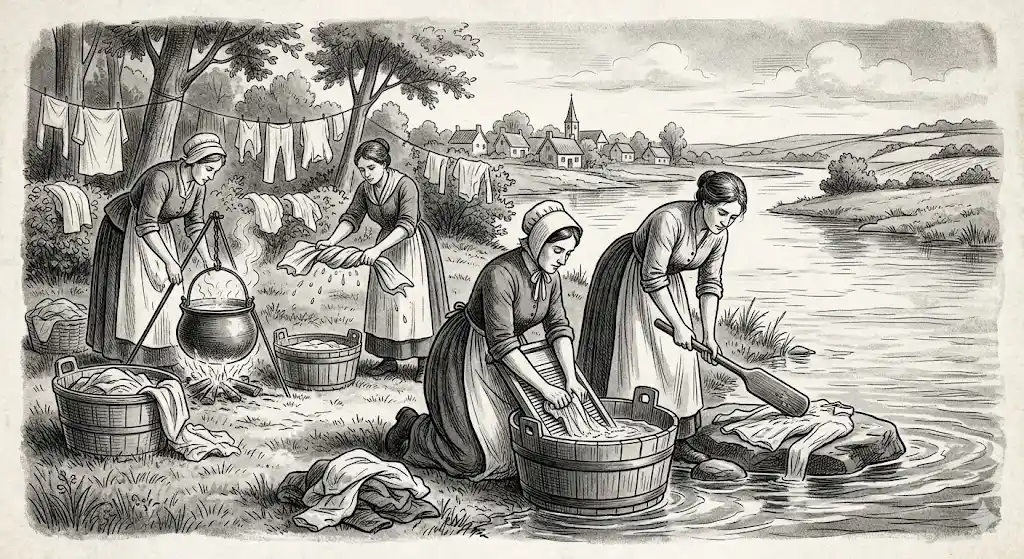
Here’s the part that surprises most people — washing clothes in rivers wasn’t just practical. For women across medieval Europe, it was also a social occasion. Groups would gather, gossip, sing, and share news while working. The “washerwomen by the river” became a cultural institution across France, Spain, Portugal, and beyond.
Wood Ash, Lye, and the First Soap
The invention of soap-like substances was a game changer — and it came from an unlikely place: wood.
When you burn wood and collect the grey ash, then mix that ash with water, you get a strongly alkaline liquid called lye. Lye dissolves grease, strips grime, and softens fibres. People across Europe, Asia, and the Americas independently discovered this trick thousands of years ago.
By the medieval period in Europe, washerwomen were soaking laundry in large tubs of lye water — sometimes called “buck washing” or a bucking tub — and letting the alkaline liquid draw out the dirt. They’d leave clothes to soak overnight, then rinse and beat them the next morning. The process took days, not hours.
In China, soapberries (Sapindus species) were used for centuries as a natural detergent. The berries contain saponins — natural foaming compounds — that work remarkably well on fabric. In South Asia, the soapnut tree served the same purpose and is still sold in eco-friendly laundry shops today.
True soap — made from animal fat and ash lye — was being produced in Babylon as early as 2800 BCE, but for most of history it was a luxury item. Ordinary people used lye, clay, or plant-based substances instead.
The Washboard and the Evolution of Tools
Even after water and cleaning agents, you still had to physically attack the dirt.
Beating clothes on rocks was replaced — gradually — by the washboard, one of those inventions so simple it’s easy to overlook. The washboard as we know it, with its corrugated ridged surface, emerged in Scandinavia and Northern Europe around the late 1700s. The earliest recorded patent for one in America was filed in 1833.
The principle was simple: rub wet, soapy cloth back and forth over the ridges to create mechanical friction, loosening dirt from the fibres without destroying them. It was a huge improvement over rock-beating, which could damage delicate fabrics badly.
Before the washboard, wooden paddles called bats, beetles, or battledores were common across Europe and Asia. Women would lay wet cloth on a flat surface and beat it rhythmically — the same action used in parts of rural India and West Africa today, where the tradition has never entirely disappeared.
In Japan, wooden kinuta boards were used for pounding and softening silk fabric. In Korea, daechangno beating sticks were part of the traditional laundry process well into the 20th century. The tools changed shape depending on the culture, but the core idea — hit the cloth until it’s clean — was universal.
What the Rich Did vs What Everyone Else Did
Here’s where things get sharply unequal — because in the past, how you washed your clothes depended enormously on whether you had money.
In wealthy Tudor and Stuart households in England, laundry was done by dedicated servants — sometimes an entire department of staff called the laundress. Clothes were washed infrequently to preserve delicate fabrics, perhaps once every few weeks, and the process could take an entire working week for a large household.
Wealthy Romans sent their clothes to professional fullers. Medieval European nobles employed washerwomen and purchased imported Castile soap — a luxury product made from olive oil, produced in Spain since at least the 8th century. When Queen Isabella I of Spain died in 1504, her household inventory listed what was considered an adequate soap supply for a royal court.
For ordinary working people, the story was different. Poorer families might own two sets of clothes at most — one to wear, one to wash. Laundry was an event, not a routine. Many rural households in 18th-century Europe washed clothes just once or twice a year, in what was called a “great wash.” Everything was saved up, then cleaned in a single exhausting multi-day effort.
The difference between the wealthy and the poor wasn’t just soap — it was time. For a peasant woman or an urban labourer, washing clothes competed with every other survival task of the day.
Laundry Methods Around the World
The methods people used for washing were astonishingly diverse — shaped by geography, available resources, and cultural tradition.
In West Africa, particularly along the Niger River, cloth was soaked in water and pounded vigorously in large wooden mortars — the same vessels used to grind grain. The combination of water, motion, and the natural minerals in local soil provided a reasonably effective clean.
In the Andes, Indigenous peoples used the dried roots of the maguey plant (a type of agave), which foam when agitated in water and function as a natural detergent. Spanish colonists were reportedly baffled by how effectively it worked when they arrived in the 16th century.
In Japan, silks and fine fabrics were carefully hand-washed in cold water, a process called arai hari — the fabric was literally unstitched from the garment, washed flat, stretched on boards to dry, and then resewn. Remarkable care went into a single kimono.
Indigenous communities in the Pacific Northwest of North America used warm springs, where the geothermal minerals aided cleaning. The natural world offered a solution in almost every environment — if people looked hard enough.
The Wringer, the Mangle, and Getting Things Dry
Washing was only half the battle. Getting water out of heavy, soaking wet wool or linen was brutal work.
Before spin cycles existed, the main tools were hand-wringing, the mangle, and the wringer. Hand-wringing meant literally twisting the cloth tightly by two people pulling in opposite directions — effective but slow, and potentially damaging to delicate fabrics.
The mangle — a device with two heavy rollers turned by a crank handle — appeared in Northern Europe in the 18th century and became a fixture of working-class households well into the 20th. You fed wet cloth between the rollers, cranked the handle, and the rollers squeezed the water out. It was hard work, but it was faster than wringing by hand.
After wringing, clothes were hung to dry outdoors on lines or over hedgerows, draped on bushes, laid over grass, or stretched on wooden frames near a fire in winter. The smell of fresh laundry dried in open air is one of the few things that hasn’t changed.
The box mangle — a larger version that used heavy weighted boxes to press flat items like table linens — appeared in wealthy households by the 1700s and required at least two strong people to operate. If your sheets were perfectly smooth and pressed in Georgian England, somebody sweated hard to make them that way.
The Road to the Washing Machine
The first mechanical washing machines appeared in the early 1800s, but they barely resemble what we use today.
In 1797, Nathaniel Briggs of New Hampshire received the first US patent for a washing machine — though it was essentially a wooden box with a hand-cranked paddle inside. It reduced some effort, but it still required hot water, soap, and a great deal of human energy.
The first drum-based washing machines powered by steam appeared in the 1850s in commercial laundries. James King patented a drum washing machine in 1851. For most ordinary households, though, electric washing machines wouldn’t arrive until the early 20th century — the Thor, produced by Hurley Machine Company in Chicago in 1908, is widely considered the first electric washing machine sold commercially.
Even then, it took decades for them to become affordable for average families. As late as the 1950s, many households in Britain and America still used washboards, twin tubs, or hand-wringers. The automatic washing machine — the kind that fills itself, agitates, and drains without intervention — only became truly widespread in the 1960s.
The long road from the riverbank to the spin cycle is one of the great under-celebrated stories in domestic history.
🧺 A Quick Comparison: Laundry Across the Ages
| 📅 Era / Culture | 🧼 Primary Method | 🧴 Cleaning Agent | ⏱️ Time Required |
|---|---|---|---|
| Ancient Egypt (c. 2000 BCE) | River beating on rocks | Natron (natural salt) | Full day |
| Ancient Rome (c. 100 CE) | Treading in stone vats | Human urine (ammonia) | Several hours |
| Medieval Europe (c. 1200–1500) | Buck washing in lye tubs | Wood ash lye | 2–3 days |
| South Asia (traditional) | River beating with paddles | Soapnuts (saponins) | Half to full day |
| Japan (Edo period, 1603–1868) | Arai hari (flat washing) | Cold water, careful handling | Days (including drying) |
| 18th-century Europe | Washboard + mangle | Soap (if affordable) or lye | 1–2 days per “great wash” |
| Early 20th century (Western) | Hand-cranked drum machine | Washing powders (new) | Half day |
| 1960s onwards | Automatic electric washer | Modern detergents | Under 2 hours |
A Labour That Shaped Lives
Next time you drop a load of laundry into your machine and walk away, spare a moment for the sheer scale of what you’re not doing. No hauling water. No building a fire under the copper pot. No spending three days soaking, beating, wringing, and drying a family’s worth of clothes while your knuckles go raw.
For most of human history, washing clothes was a physical ordeal that consumed hours, days, and real physical strength. It was shaped by poverty and privilege, by geography and ingenuity, by wood ash and river stone and the quiet know-how passed from mother to daughter across generations. The ancient Egyptian washerman, the Roman fuller, the medieval peasant woman at her bucking tub, the Victorian laundress with her box mangle — they all found ways to get it done.
What they shared, across every culture and century, was resourcefulness. The raw materials changed, the tools evolved, but the fundamental human need — to be clean, to care for the things we wear — never did.
You Can Also Read About the How Did People Light Their Homes Before Electricity?
🧺 Frequently Asked Questions
No, most families did not. Before the 20th century, laundry was such an intense labor that people often wore garments for much longer periods. They focused on washing undergarments frequently, while outer layers were brushed, aired out, or spot-cleaned.
In colder climates, clothes were hung indoors near hearths or stoves. It was a slow process that often kept the home smelling of damp wool, but it was necessary to prevent the fabric from freezing solid while hanging on an outdoor line.
Urban dwellers often relied on public pumps or water carriers. In large cities like London, laundry was a major challenge, and poorer families often relied on public wash-houses or professional laundresses who had access to better water supplies.
They used natural bleaching agents, most commonly sunlight and grass. Spreading wet linens out on a clean grassy lawn allowed the sun’s UV rays to naturally whiten the fabric, a process known as “grassing” or “bleaching on the green.”