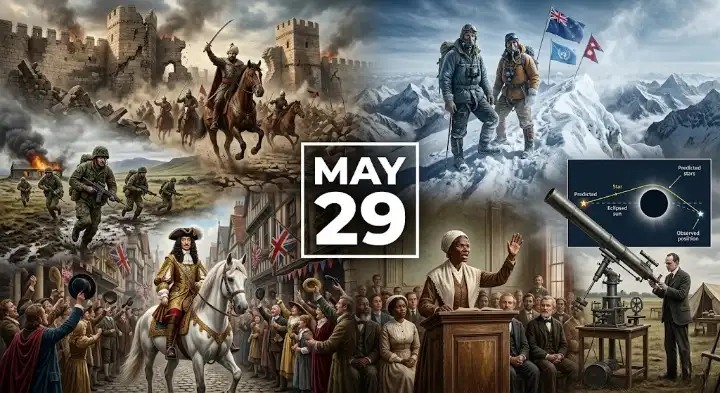
Sultan Mehmed II stared at the massive triple walls of Constantinople, knowing his cannons had finally broken the world’s greatest fortress. For 53 days, his Ottoman forces had pounded the ancient stone defenses. On this day in history May 29, the city finally fell, bringing a violent end to the Roman Empire after more than two millennia. The capture shook Europe and changed global trade routes forever, marking the true boundary line where the Middle Ages died and the modern world began.
👶 Quick Facts — May 29 in History
| 📌 Category | 📖 Event / Detail |
|---|---|
| 🌟 Most Significant Event | Fall of Constantinople (1453) |
| 🏆 Top 10 Key Events | • Roman victory at Ctesiphon (363) • English Restoration (1660) • Waxhaws Massacre (1780) • Rhode Island ratifies Constitution (1790) • Sojourner Truth’s speech (1851) • Austro-Hungarian Empire formed (1867) • Premiere of The Rite of Spring (1913) • First summit of Mount Everest (1953) • Battle of Goose Green (1982) • International Space Station docking (1999) |
| ⚔️ Key Battles | Battle of Ctesiphon (363), Battle of Uclés (1108), Battle of Monte Porzio (1167), Battle of Legnano (1176), Battle of Gallipoli (1416), Battle of Samugarh (1658), Battle of Sardarabad (1918), Battle of Goose Green (1982) |
| 👤 Key Figures | Sultan Mehmed II, King Charles II, Sojourner Truth, Sir Edmund Hillary, Sherpa Tenzing Norgay |
| 🌍 Observances | Army Day (Argentina), Veterans Day (Sweden), Democracy Day (Nigeria), Ascension of Bahá’u’lláh (Baháʼí Faith) |
Story of the Day: The Conquest of Everest
Edmund Hillary and Sherpa Tenzing Norgay stood on a frozen, wind-scoured knife-edge of ice, looking down at the entire world. It was 11:30 AM on May 29, 1953, when the thin-aired isolation of Earth’s highest peak was broken by human boots for the very first time. Navigating treacherous crevasses and gasping for oxygen, the duo had spent weeks battling the brutal elements of the Himalayas. Their success arrived just in time for the coronation of Queen Elizabeth II, sending a wave of post-war pride rushing through the British Empire. Today, their feat stands as the ultimate symbol of human endurance, proving that even the planet’s most hostile environments can be overcome by grit and partnership.
Important Events That Happened On May 29 In History
363 – Battle of Ctesiphon
Emperor Julian led his Roman legions to a bloody victory outside the heavily fortified walls of the Sasanian capital. Persian elephants panicked under a barrage of Roman spears, scattering forces outside the city gates. Julian lacked the heavy siege equipment needed to break the capital itself, forcing a hasty and dangerous retreat. The emperor was mortally wounded weeks later, ending the last major pagan offensive against the East.
526 – Antioch Earthquake
Deep underground faults ruptured violently beneath the bustling metropolis of Antioch, triggering a massive collapse of stone homes and temples. Fires broke out instantly across the ruins, trapping thousands of survivors under burning timbers, including Patriarch Euphrasius. The disaster claimed a staggering 250,000 lives across the region as the great ancient hub crumbled into ash. Antioch lost its position as a crown jewel of the Byzantine East, shifting regional power forever.
757 – Election of Pope Paul I
Roman church authorities gathered quickly after the death of Pope Stephen II to elect his brother, Paul, to the papal throne. A rival faction had tried to install a different candidate, but Paul secured the seat through swift political maneuvering. Paul immediately cemented a critical defensive alliance with Pepin the Short, King of the Franks, to protect Rome from Lombard aggression. This consolidation strengthened the independence of the Papal States, shaping medieval European politics for centuries.
1108 – Battle of Uclés
Tamim ibn Yusuf led Almoravid Muslim forces in a devastating ambush against a combined alliance of Castile and León. Christian knights charged forward blindly, only to be surrounded by light cavalry and cut down in the desert heat. Prince Sancho Alfónsez, the sole heir to the Spanish throne, was killed while trying to escape the slaughter. The tragedy plunged the Christian kingdom into a bitter succession crisis, grinding the Reconquista to a temporary halt.
1138 – Abdication of Antipope Victor IV
Victor IV walked away from his claim to the papal throne after bowing to the immense moral pressure of Bernard of Clairvaux. The church had been torn apart by a bitter eight-year schism that divided European rulers between rival popes. Bernard convinced Victor that peace within Christendom was worth more than a disputed crown. Pope Innocent II was left as the sole leader of the Catholic Church, restoring spiritual unity across Europe.
1167 – Battle of Monte Porzio
Christian of Buch led a small force of imperial German knights into a ferocious clash against a much larger Roman civic army. The Roman soldiers expected an easy victory but were shattered by a disciplined, heavy cavalry charge from the flanks. Dead bodies littered the fields around Tusculum, forcing Pope Alexander III to flee the city in disguise. The defeat forced the papacy to negotiate terms with Emperor Frederick Barbarossa after years of open rebellion.
1176 – Battle of Legnano
Lombard League infantrymen formed a wall of spears around their sacred war chariot, holding off a fierce charge by Emperor Frederick I. The Italian city-states fought with desperation, throwing the imperial cavalry into complete chaos and unhorsing the emperor himself. Rumors of Frederick’s death spread through the German ranks, causing a total panic and panic-driven retreat. The unexpected victory forced the Holy Roman Empire to recognize the local autonomy of northern Italian towns.
1233 – Fall of Kaifeng
Mongol horsemen poured through the broken gates of Kaifeng after a brutal, disease-ridden siege that decimated the defenders. General Subutai oversaw the systematic looting of the fallen capital, capturing centuries of accumulated Chinese wealth and technology. The Jin dynasty’s emperor fled into the countryside, leaving his subjects to face the wrath of the conquerors. This victory effectively broke the back of Jin resistance, clearing the path for total Mongol dominance over northern China.
1328 – Coronation of Philip VI
Philip VI felt the heavy crown of France placed upon his head at Reims Cathedral, launching the new Valois dynasty. A rival claim by King Edward III of England had been brushed aside by French nobles using ancient legal loopholes. The coronation snub rankled the English court, fueling a bitter diplomatic feud over land and sovereignty. This royal ceremony acted as the direct spark for the Hundred Years’ War, a conflict that would tear Western Europe apart.
1416 – Battle of Gallipoli
Pietro Loredan led a disciplined Venetian fleet into a head-on naval battle against a larger Ottoman armada off the Gallipoli peninsula. Venetian archers raked the wooden decks of the enemy ships with deadly precision before launching aggressive boarding actions. The clash ended with the total destruction of the fledgling Ottoman navy and the execution of captured Christian renegades. Venice secured temporary mastery over Aegean trade routes, delaying Ottoman maritime expansion for a generation.
1453 – Fall of Constantinople
Sultan Mehmed II watched his elite Janissaries swarm through a broken gate, ending the 53-day siege of the Byzantine capital. Emperor Constantine XI died fighting in the streets as the ancient walls were finally overcome by massive gunpowder artillery. The fall of the city sent shockwaves through Europe, closing traditional trade routes to Asia and forcing sailors to look toward the Atlantic. This world-altering event marked the definitive end of the Roman Empire and the beginning of the Ottoman Golden Age.
1555 – Treaty of Amasya
Sultan Suleiman the Magnificent and Shah Tahmasp signed a formal peace document inside the city of Amasya, ending decades of brutal warfare. The borders were carefully redrawn, giving the Ottomans control of Baghdad while ensuring the Safavids kept northwestern Iran. Pilgrims were finally granted safe passage across hostile territory to visit holy sites in Iraq and Arabia. The treaty brought two decades of peace to the Middle East, allowing both empires to internalize their administrative control.
1658 – Battle of Samugarh
Aurangzeb led a disciplined army into a ferocious clash against his older brother, Dara Shikoh, for the Mughal throne. Dara made a fatal mistake by dismounting his war elephant, causing his troops to believe he had been killed. Panic spread instantly through the imperial ranks, turning a balanced fight into a total route. Aurangzeb seized the treasury, imprisoned his aging father Shah Jahan, and began a strict, conservative rewrite of Mughal policy.
1660 – The English Restoration
King Charles II rode through the packed, cheering streets of London on his 30th birthday to reclaim the empty British throne. A decade of strict Puritan military rule collapsed following the death of Oliver Cromwell, leaving the public desperate for stability. Parliament voted to restore the traditional monarchy, bringing a swift end to the experimental English Commonwealth. theaters reopened, festivals returned, and a new era of royal artistic patronage reshaped British culture.
1733 – Enslavement Upheld in New France
Intendant Gilles Hocquart issued an official legal ordinance in Quebec City confirming the right of colonists to buy and sell Indigenous people. French traders relied heavily on captured native labor to power the expanding fur trade and household economies. The ruling formalized an informal practice, trapping thousands of Panis individuals in a brutal system of lifelong servitude. This legal decree hardened racial lines across colonial Canada, leaving a dark legacy that lasted for generations.
1780 – Waxhaws Massacre
Colonel Banastre Tarleton led his British dragoons in a merciless cavalry charge against retreating Virginia continentals in South Carolina. Abraham Buford tried to raise a white flag of surrender, but Tarleton’s men ignored the plea and bayoneted the defenseless soldiers. Over one hundred Americans were slaughtered in cold blood, while dozens of others were left with horrific, crippling wounds. The brutality backfired on the British, turning “Tarleton’s quarter” into a fierce rallying cry that energized southern rebel militias.
1790 – Rhode Island Ratifies the Constitution
Rhode Island delegates voted narrowly to accept the United States Constitution, making them the last of the original thirteen colonies to join. The tiny state had held out for months, fearing that a powerful federal government would crush local commerce and individual liberties. A threat of total economic isolation from neighboring states finally forced the hand of the stubborn independent politicians. Their reluctant signature completed the political unification of the infant American republic, solidifying the new federal system.
1798 – Kildare Executions
British Army officers ordered the systematic execution of hundreds of suspected United Irishmen rebels across the fields of County Kildare. The prisoners had surrendered their weapons under a promise of safe passage, but the military chose to make a terrifying example of them. Bodies were left in ditches as a stark warning to anyone thinking of joining the active nationalist rebellion. The executions failed to quiet the country, instead driving thousands of moderate peasants into open, desperate warfare against the crown.
1807 – Mustafa IV Becomes Sultan
Palace guards placed Mustafa IV onto the Ottoman throne after a violent mutiny by conservative Janissaries deposed his reform-minded cousin. The new sultan immediately dismantled the modern military academies and progressive reforms that had angered the old military elite. His chaotic reign lasted barely a year before rival loyalist factions launched a bloody counter-coup to remove him. The political instability crippled Ottoman administration, leaving the empire vulnerable to European geopolitical maneuvering.
1825 – Coronation of Charles X
Charles X knelt before the altar of Reims Cathedral to receive the crown in a lavish ceremony steeped in absolute medieval tradition. The king insisted on reviving ancient rituals, including touching scrofula victims to prove his divine right to heal. Liberal citizens viewed the expensive, outdated spectacle as an insult to the constitutional progress made since the revolution. The stubborn royal refusal to compromise with modern politics triggered the July Revolution five years later, ending the Bourbon line forever.
1851 – Ain’t I a Woman? Speech
Sojourner Truth stood before a crowded church in Akron, Ohio, and delivered a powerful, impromptu address on women’s rights. The former enslaved woman challenged both white male supremacy and the narrow focus of middle-class white suffragists by highlighting her own heavy labor. Her booming voice and raw arguments silenced a hostile crowd of hecklers who had tried to disrupt the convention. The speech became an instant classic of American civil rights literature, forever linking the fights for racial and gender equality.
1852 – Jenny Lind Departs New York
Jenny Lind stepped onto the deck of an Atlantic-bound steamship, waving goodbye to thousands of weeping fans gathered at the Manhattan docks. The “Swedish Nightingale” had spent two years touring the United States under the aggressive showmanship of P.T. Barnum, sparking a wave of commercial obsession. She donated most of her massive earnings to American charities and free schools before turning her back on the frantic celebrity lifestyle. Her tour revolutionized the American entertainment industry, creating the modern template for pop music stardom.
1861 – Hong Kong Chamber of Commerce Founded
British and Chinese merchants gathered in the bustling colonial port to establish the Hong Kong General Chamber of Commerce. The new organization sought to standardize trading rules, build infrastructure, and lobby the British government for favorable maritime policies. The harbor quickly transformed into an efficient, tax-free gateway for Western goods entering the vast markets of Qing dynasty China. This corporate foundation secured Hong Kong’s future as a global financial powerhouse and trading hub.
1864 – Maximilian I Arrives in Mexico
Archduke Maximilian of Austria stepped ashore at Veracruz alongside his wife, Carlota, to claim the newly manufactured throne of Mexico. French troops had invaded the republic to install the puppet emperor, taking advantage of American distraction during the Civil War. Mexican conservatives welcomed the royal couple with elaborate parties, but the majority of the population remained fiercely loyal to President Benito Juárez. The romantic, naive emperor found himself trapped in a brutal guerrilla war that ended before a firing squad.
1867 – Austro-Hungarian Compromise
Emperor Franz Joseph signed Act 12, splitting his sprawling Central European domain into the dual monarchy of Austria-Hungary. The agreement appeased the rebellious Hungarian nobility by giving them their own parliament, prime minister, and domestic control. Other ethnic minorities within the empire, especially Slavic groups, found themselves excluded from power and treated as second-class citizens. This fragile political fix kept the Habsburg dynasty alive but stoked the ethnic nationalisms that eventually ignited World War I.
1886 – First Coca-Cola Advertisement
John Pemberton placed a small, simple notice in the pages of The Atlanta Journal promoting his new medicinal soda drink. The advertisement described the bubbly syrup as a delicious, refreshing beverage that could cure nervous exhaustion and headaches. Customers trooped into Jacob’s Pharmacy to try the five-cent drink, which was mixed by hand with carbonated water. That single newspaper column launched a marketing empire that transformed a local soda fountain tonic into a global cultural icon.
1900 – N’Djamena Founded
French military commander Émile Gentil established a strategic outpost called Fort-Lamy near the banks of the Chari River. The fort was named after an officer killed fighting local warlords during the scramble for colonial control of Central Africa. The settlement grew rapidly into an administrative base, locking in French control over the territory of Chad. Renamed N’Djamena after independence, the city endured decades of post-colonial civil conflict to remain the nation’s political heart.
1903 – The May Coup
Black Hand conspirators infiltrated the royal palace in Belgrade, hunting down King Alexander I and Queen Draga through the dark corridors. The officers shot the royal couple, mutilated their bodies, and threw them out of a palace window into the gardens below. The brutal assassination brought a sudden end to the Obrenović dynasty and shifted Serbian foreign policy toward a pro-Russian stance. This bloody regime change heightened tensions with Austria-Hungary, setting the stage for the Balkan crises.
1913 – The Rite of Spring Riot
Igor Stravinsky watched from the wings as the premiere of his new ballet score triggered a near-riot inside Paris’s Théâtre des Champs-Élysées. The audience was shocked by the unconventional choreography and aggressive, pounding rhythms of the pagan-themed performance. Shouted insults quickly turned into fistfights in the aisles, drowning out the orchestra and forcing the police to intervene. The chaotic opening night became a legendary moment in cultural history, signaling the arrival of musical modernism.
1914 – Sinking of the RMS Empress of Ireland
The ocean liner RMS Empress of Ireland collided with a Norwegian coal ship in a dense, creeping fog on the Saint Lawrence River. Water rushed into the hull so fast that the vessel rolled onto its side and sank in fourteen minutes. Most passengers were trapped asleep in their lower cabins, unable to reach the few lifeboats that launched successfully. The disaster claimed 1,012 lives, making it one of the deadliest maritime peacetime tragedies in Canadian history.
1918 – Battle of Sardarabad
Armenian military units and civilian volunteers launched a desperate counter-offensive against advancing Ottoman forces near Sardarabad. Outgunned and fighting for survival following years of genocide, the defenders managed to break the Turkish lines after days of brutal combat. The victory halted the Ottoman advance into the Caucasus, preventing the total elimination of the Armenian homeland. This military triumph allowed leaders to declare the independent First Republic of Armenia just days later.
1919 – Relativity Confirmed
Arthur Eddington monitored a total solar eclipse from the remote island of Príncipe, measuring the tiny shifts in starlight passing near the sun. The observations proved that gravity bends light, confirming a core prediction of Albert Einstein’s radical theory of general relativity. The data swept away centuries of Newtonian physics, changing how humans understand space, time, and cosmic structure. Einstein went from an academic theorist to a global celebrity overnight, transforming the face of modern science.
1920 – The Louth Flood
A sudden, violent cloudburst dumped millions of gallons of water onto the Lincolnshire Wolds, sending a wave of water tearing through the town of Louth. The River Lud rose fifteen feet in minutes, smashing brick homes, flipping vehicles, and trapping families in their kitchens. Twenty-three people drowned before the waters receded as quickly as they had arrived. The tragedy led to a massive overhaul of British weather forecasting and river management systems.
1931 – Execution of Michele Schirru
An Italian military firing squad executed Michele Schirru, an American citizen, inside a Rome prison yard. Schirru had traveled to Italy with a plan to assassinate fascist dictator Benito Mussolini but was arrested before he could carry out the attack. Fascist judges used a new political law to condemn him to death, ignoring diplomatic pleas from the United States. The execution signaled Mussolini’s absolute grip on power and his willingness to eliminate any foreign-backed opposition.
1932 – Bonus Army Assembles
World War I veterans began marching into Washington, D.C., setting up a massive tent city within sight of the United States Capitol. The penniless ex-soldiers demanded the immediate cash payment of bonuses promised to them by Congress for their military service. As the Great Depression deepened, the encampment swelled to over twenty thousand desperate men and their families. The government’s eventual, violent eviction of these veterans shocked the public and destroyed President Herbert Hoover’s re-election chances.
1935 – First Flight of the Messerschmitt Bf 109
Test pilot Hans-Dietrich “Bubi” Knötsch taxied onto a Bavarian runway and took off in the prototype Messerschmitt Bf 109 fighter plane. The sleek, all-metal monoplane featured advanced engineering, including retractable landing gear and a supercharged engine. The aircraft outclassed rival designs, becoming the backbone of the German Luftwaffe during the Spanish Civil War and World War II. Its innovative design forced allied air forces to rapidly modernize their own fighter fleets to survive.
1945 – B-32 Dominator First Combat Mission
United States Army Air Forces crews took off from an airfield in Luzon, Philippines, to fly the first combat mission of the B-32 Dominator heavy bomber. The aircraft targeted Japanese positions on the island, testing its heavy payload capacity and defensive capabilities under real war conditions. Production problems had delayed the plane’s deployment, leaving it in the shadow of the more famous B-29 Superfortress. The bomber flew a handful of missions before the atomic bombs brought the war to a sudden end.
1947 – LaGuardia Airport Crash
United Airlines Flight 521 accelerated down a short runway during a severe gust of wind, failing to lift off before reaching the edge of the airfield. The four-engine transport plane crashed through a perimeter fence, slammed into a structure, and exploded into flames. Forty-three passengers and crew died in the inferno, while the pilot miraculously survived the impact. The tragedy forced aviation authorities to implement longer runways and stricter weight limits for commercial takeoffs.
1948 – UNTSO Founded
The United Nations Security Council voted to deploy a team of military observers to the Middle East, establishing the United Nations Truce Supervision Organization. The unarmed officers were tasked with monitoring the fragile ceasefire between newly declared Israel and neighboring Arab armies. This deployment marked the official birth of modern UN peacekeeping operations around the globe. The mission remains active on the ground today, serving as a reminder of the region’s unresolved political tensions.
1950 – St. Roch Arrives in Halifax
The Arctic patrol vessel St. Roch glided into Halifax harbor, completing a historic voyage around the North American continent. Captain Henry Larsen navigated the small wooden schooner through the ice-choked Northwest Passage and the Panama Canal. The journey proved that a properly equipped vessel could maintain a year-round presence in remote, frozen waters. The feat secured Canadian sovereignty over its vast northern territories during the early years of the Cold War.
1953 – First Ascent of Everest
Edmund Hillary and Tenzing Norgay stepped onto the windswept summit of Mount Everest, reaching the highest point on Earth. The climbers spent fifteen minutes taking photographs, burying sweets in the snow, and checking for signs of missing explorers before beginning their dangerous descent. News of their success reached London on the morning of Queen Elizabeth II’s coronation, sparking massive celebrations across the world. Their triumph redefined the limits of human mountaineering and mountaineering exploration.
1962 – Yining Incident
Chinese security forces opened fire on a crowd of Uighur protesters demonstrating outside a government building in Yining, Xinjiang. The residents were protesting grain shortages and strict cross-border travel restrictions that separated families from relatives in the Soviet Union. At least five protesters were killed instantly, triggering a mass migration of over sixty thousand refugees across the border. The incident caused a severe diplomatic rift between Beijing and Moscow, hardening China’s regional security policies.
1964 – PLO Founded
Arab leaders gathered at a summit in East Jerusalem to discuss the ongoing Palestinian displacement and regional territorial disputes. The meetings led to the official drafting of a national charter and the formal creation of the Palestine Liberation Organization. The new coalition sought to unite various resistance groups under a single political and military banner. This foundation reshaped Middle Eastern geopolitics, establishing an independent nationalist movement that would dominate regional diplomacy for decades.
1964 – South Vietnamese Coup Convictions
Military dictator Nguyễn Khánh stood before a tribunal in Saigon to oversee the conviction of rival generals Trần Văn Đôn and Lê Văn Kim. The officers had been deposed in a bloodless January coup and were charged with “lax morality” for allegedly considering peace talks with communist forces. The trial was a transparent political theater designed to eliminate internal military rivals and secure American financial backing. This internal infighting undermined the stability of the South Vietnamese government during a critical phase of the war.
1973 – Tom Bradley Elected Mayor
Tom Bradley won a decisive victory in the Los Angeles mayoral election, becoming the first Black leader of the nation’s second-largest city. The former police lieutenant defeated an incumbent who had used racially charged campaign ads to scare voters. Bradley built a diverse coalition of Black, Jewish, and Latino residents to secure his historic victory at the polls. His twenty-year tenure transformed the city’s infrastructure, expanded the airport, and brought the 1984 Olympic Games to Los Angeles.
1974 – SETA Founded
Finnish activists met in Helsinki to establish SETA, a national organization dedicated to fighting for the rights of sexual minorities. The group formed at a time when homosexuality was still classified as a mental illness and criminalized under Finnish law. Founders launched public education campaigns, offered support services, and lobbied politicians for legal protections against discrimination. Their decades of work transformed Finland from a conservative state into an inclusive nation with full marriage equality.
1982 – Papal Visit to Canterbury
Pope John Paul II walked down the stone aisle of Canterbury Cathedral, kneeling in prayer alongside the Archbishop of Canterbury. The historic meeting marked the first time a reigning Roman pontiff had stepped inside the mother church of the Anglican Communion since the Reformation. The two religious leaders signed a joint declaration pledging to work toward healing centuries of theological division. The symbolic visit signaled a new era of ecumenical cooperation between the Catholic and Anglican churches.
1982 – Battle of Goose Green
British paratroopers launched an infantry assault against fortified Argentine positions during a freezing, rain-soaked night on East Falkland. Outnumbered and fighting without heavy artillery support, the British forces advanced across open ground under intense machine-gun fire. Colonel H. Jones was killed leading a charge against a bunker, but his men rallied to secure the tactical high ground. The surrender of over one thousand Argentine soldiers marked the first major land victory of the Falklands War.
1985 – Heysel Stadium Disaster
A crumbling brick retaining wall collapsed inside Brussels’ Heysel Stadium prior to the European Cup Final between Liverpool and Juventus. Italian fans fled in panic after being charged by a group of aggressive British hooligans, getting crushed against the perimeter barriers. Thirty-nine people died of asphyxiation and hundreds more were injured as the concrete terrace gave way under the pressure. The tragedy led to a five-year ban on English clubs from European competition and a total overhaul of stadium safety.
1985 – Steve Fonyo Completes Marathon
Steve Fonyo sprinted across the finish line in Victoria, British Columbia, completing an grueling cross-Canada marathon. The 19-year-old amputee had spent fourteen months running through snow, rain, and heat to raise millions for cancer research. Having lost his left leg to the disease, Fonyo ran on a prosthetic limb to complete the journey that Terry Fox had been forced to leave unfinished. His triumph inspired the nation, proving that physical limitations cannot conquer human determination.
1988 – Reagan Visits Moscow
President Ronald Reagan stepped off Air Force One onto Soviet soil, arriving in Moscow for a high-stakes summit with Mikhail Gorbachev. The former anti-communist actor walked through Red Square, shaking hands with curious Russian citizens and chatting about human rights. The leaders finalized the historic INF Treaty, which mandated the destruction of an entire class of nuclear missiles. This diplomatic breakthrough signaled a permanent thawing of Cold War tensions, paving the way for the fall of the Iron Curtain.
1989 – US–Egypt F-16 Agreement
Defense officials signed a formal military industrial pact in Cairo allowing Egypt to manufacture parts for American F-16 fighter jets. The deal allowed Egyptian factories to produce wings and fuselage components, integrating their local economy with US defense systems. The agreement rewarded Egypt for maintaining its peace treaty with Israel and anchoring Western security interests in the region. This partnership cemented Cairo’s status as a top recipient of American foreign military assistance.
1990 – Boris Yeltsin Elected President
The Congress of People’s Deputies voted narrowly to elect Boris Yeltsin as the President of the Russian Soviet Federative Socialist Republic. Yeltsin campaigned as a populist reformer, openly challenging the centralized authority of Soviet leader Mikhail Gorbachev. His victory gave him a powerful democratic platform to push for Russian autonomy and economic independence from the USSR. This political shift fractured the Soviet power structure, accelerating the ultimate collapse of the Soviet Union.
1993 – Miss Sarajevo Pageant
Teenage contestants walked across a makeshift stage holding a banner that read “Don’t let them kill us,” while artillery shells echoed in the distance. The Miss Sarajevo beauty pageant was organized inside a dark basement to show the world that the city’s spirit remained unbroken during the brutal Bosnian siege. The defiance caught the attention of international journalists and musicians, who broadcast the footage globally. The event transformed a standard competition into a heart-wrenching protest against international indifference.
1999 – First Space Station Docking
Commander Rick Husband guided the Space Shuttle Discovery through a series of delicate thruster firings to dock with the infant International Space Station. The astronauts opened the hatches to enter the uncrewed outpost, delivering tons of logistics, tools, and water supplies. The crew spent days installing equipment and performing spacewalks to prepare the station for its first permanent residents. This orbital connection marked the true beginning of continuous human habitation in outer space.
2001 – Casey Martin Supreme Court Ruling
The United States Supreme Court ruled 7-2 that disabled golfer Casey Martin had a legal right to use a motorized cart during PGA tournaments. Martin suffered from a rare circulatory disorder that made walking long distances down the fairway excruciatingly painful and dangerous. The PGA Tour had fought the request, arguing that walking was a fundamental part of the athletic competition. The landmark decision expanded the protections of the Americans with Disabilities Act into professional sports.
2004 – WWII Memorial Dedicated
Thousands of aging veterans gathered on the National Mall in Washington, D.C., to witness the formal dedication of the National World War II Memorial. The stone and bronze monument features fifty-six pillars surrounding a central plaza, honoring the sixteen million Americans who served in the conflict. President George W. Bush delivered the keynote address, thanking the “Greatest Generation” for saving global democracy from fascism. The long-awaited tribute was completed just as the wartime generation entered their twilight years.
2005 – France Rejects EU Constitution
French voters turned out in massive numbers to reject the proposed European Union Constitution in a historic national referendum. The decisive 55% “No” vote shocked the political establishment, which had campaigned heavily in favor of deeper European integration. Working-class citizens feared the document would erode local labor laws, outsource jobs, and compromise national sovereignty. The French rejection effectively killed the constitutional project, forcing EU leaders to draft the scaled-back Lisbon Treaty instead.
2008 – Iceland Doublet Earthquake
Two powerful earthquakes struck southern Iceland within seconds of each other, cracking roads and damaging homes near the town of Selfoss. The combined 6.1 magnitude tremors sent boulders tumbling down mountainsides and shattered glass windows across rural villages. Thirty people suffered minor injuries, but modern, earthquake-resistant building codes prevented a single fatality or structural collapse. The seismic event reminded residents of the shifting tectonic plates that constantly reshape their volcanic island.
2012 – Northern Italy Earthquakes
A sharp 5.8-magnitude earthquake struck the industrial heartland of northern Italy, causing historic brick factories and medieval bell towers to collapse. The tremor hit just weeks after an earlier quake had already weakened structures across the Emilia-Romagna region. At least twenty-four people were killed, many of them factory workers crushed when warehouse roofs gave way. The disaster caused billions of euros in economic damages, devastating local agricultural and manufacturing industries.
2015 – One World Observatory Opens
The high-speed elevators of One World Trade Center welcomed their first public visitors to the newly completed One World Observatory. Guests stepped out onto the 102nd floor to take in panoramic views of the New York skyline from the tallest building in the Western Hemisphere. The opening marked a major milestone in the decades-long rebuilding process following the terrorist attacks of September 11. The tower stands as a bold symbol of civic resilience and architectural rebirth.
2020 – Norilsk Oil Spill
A rusted fuel storage tank collapsed at a power plant in northern Siberia, releasing 17,500 tons of toxic diesel oil into the local environment. The crimson sludge poured into the Ambarnaya River, turning the waters bright red and threatening the fragile Arctic ecosystem. Permafrost thaw caused by rising global temperatures had weakened the foundations beneath the industrial facility. The disaster triggered a federal state of emergency and led to a multi-billion-dollar cleanup operation.
2021 – Percy Priest Lake Crash
A private Cessna Citation business jet stalled shortly after takeoff and plunged into the waters of Tennessee’s Percy Priest Lake. The crash killed all seven people on board, including actor Joe Lara, famous for playing Tarzan, and his wife, diet church leader Gwen Shamblin Lara. Federal investigators spent months recovering the scattered wreckage from the murky lake bed to determine the cause of the mechanical failure. The tragedy brought a sudden end to the controversial religious empire the couple had built.
2022 – Tara Air Flight 197 Crash
A Twin Otter passenger plane flew directly into a cloud-shrouded mountainside in Nepal’s rugged Mustang District, killing all twenty-two people on board. The aircraft lost contact with air traffic control minutes before the impact, making it impossible to send immediate rescue teams through the mountain passes. Ground forces found the wreckage scattered across an alpine slope after an agonizing two-day search. The accident highlighted the extreme dangers of flying through the unpredictable weather of the high Himalayas.
Dive into our full collection of past daily stories here.
Famous People Born On May 29
| Name | Description | Date |
|---|---|---|
| Carlos de Aragon, prince de Viana | Heir to throne of Navarre (from 1428) | May 29, 1421 – September 23, 1461 |
| George Carew, earl of Totnes | English soldier and administrator in Ireland | May 29, 1555 – March 27, 1629 |
| Sarah Jennings, Duchess of Marlborough | Close friend of Queen Anne, wife of John Churchill | May 29, 1660 – October 18, 1744 |
| Cornelis van Bynkershoek | Dutch jurist, positivist international law | May 29, 1673 – April 16, 1743 |
| Edmé Bouchardon | French sculptor, precursor of Neoclassicism | May 29, 1698 – July 27, 1762 |
| Louis-Jean-Marie Daubenton | French naturalist, comparative anatomy pioneer | May 29, 1716 – January 1, 1800 |
| Giovanni Battista Caprara | Italian diplomat and churchman | May 29, 1733 – June 21, 1810 |
| William Jackson | English composer and writer on music | May 29, 1730 – July 5, 1803 |
| Philippe Lebon | French engineer, inventor of illuminating gas | May 29, 1767 – December 2, 1804 |
| Alexander Bryan Johnson | American philosopher and semanticist | May 29, 1786 – September 9, 1867 |
| Konstantin Nikolayevich Batyushkov | Russian elegiac poet, influenced Pushkin | May 29, 1787 – July 19, 1855 |
| Johann Heinrich von Mädler | German astronomer, produced first complete Moon map | May 29, 1794 – March 14, 1874 |
| Ebenezer Butterick | American manufacturer, invented paper clothing patterns | May 29, 1826 – March 31, 1903 |
| Philip Howard Colomb | British naval officer and sea power theorist | May 29, 1831 – October 13, 1899 |
| Sir Sidney Godolphin Alexander Shippard | British colonial official in Bechuanaland (Botswana) | May 29, 1837 – March 29, 1902 |
| Albert, Count Apponyi | Hungarian statesman | May 29, 1846 – February 7, 1933 |
| Ulrich, count von Brockdorff-Rantzau | German foreign minister at Treaty of Versailles | May 29, 1869 – September 8, 1928 |
| Doris Ulmann | American photographer of rural Southern life | May 29, 1882 – August 28, 1934 |
| L. L. Thurstone | American psychologist, psychometrics pioneer | May 29, 1887 – September 29, 1955 |
| Beatrice Lillie | British-American comedienne, revue star | May 29, 1894 – January 20, 1989 |
| Erich Wolfgang Korngold | Austrian-born composer, film music pioneer | May 29, 1897 – November 29, 1957 |
| T. H. White | English novelist, The Once and Future King | May 29, 1906 – January 17, 1964 |
| Pamela Hansford Johnson | English novelist | May 29, 1912 – June 18, 1981 |
| Tony Zale | American world middleweight boxing champion | May 29, 1913 – March 20, 1997 |
| Iannis Xenakis | Romanian-born French composer, architect, mathematician | May 29, 1922 – February 4, 2001 |
| Abdoulaye Wade | President of Senegal (2000–2012) | May 29, 1926 – Present |
| Peter Higgs | British physicist, Nobel Prize for Higgs boson | May 29, 1929 – April 8, 2024 |
| André Philippus Brink | South African novelist | May 29, 1935 – February 6, 2015 |
| Jerry Moran | U.S. senator from Kansas | May 29, 1954 – Present |
| Jean-Christophe Yoccoz | French mathematician, Fields Medal (1994) | May 29, 1957 – September 3, 2016 |
Famous People Died On May 29
| Name | Description | Date |
|---|---|---|
| Philippe de Mézières | French knight and Crusade advocate | c.1327 – May 29, 1405 |
| Henry II | King of Castile (1369–79), founder of Trastámara dynasty | 1333 – May 29, 1379 |
| David Beaton | Scottish cardinal and statesman, opponent of Reformation | c.1494 – May 29, 1546 |
| Henry II | King of Navarre (1516–55) | April 1503 – May 29, 1555 |
| Louis I de Lorraine, cardinal de Guise | French cardinal, brother of François de Guise | October 21, 1527 – May 29, 1578 |
| Cornelis Tromp | Dutch admiral, second son of Maarten Tromp | September 9, 1629 – May 29, 1691 |
| Carl, Count Piper | Swedish statesman, leading minister of Charles XII | July 29, 1647 – May 29, 1716 |
| Paul, knight von Feuerbach | German jurist, criminal law reformer | November 14, 1775 – May 29, 1833 |
| John Fielden | British radical reformer, factory worker protection | January 17, 1784 – May 29, 1849 |
| Sir Humphry Davy | British chemist, discovered sodium, potassium, miner’s safety lamp | December 17, 1778 – May 29, 1829 |
| Friedrich Christian Diez | German scholar, founded Romance philology | March 15, 1794 – May 29, 1876 |
| John Lothrop Motley | American diplomat and historian, The Rise of the Dutch Republic | April 15, 1814 – May 29, 1877 |
| Sir Bartle Frere, 1st Baronet | British colonial administrator in India and South Africa | March 29, 1815 – May 29, 1884 |
| William McDougall | Canadian father of Confederation | January 25, 1822 – May 29, 1905 |
| Julius von Sachs | German botanist, plant physiology pioneer | October 2, 1832 – May 29, 1897 |
| Carlotta Grisi | Italian ballerina, original Giselle | June 28, 1819 – May 29, 1899 |
| Mily Balakirev | Russian composer, leader of nationalist “Mighty Handful” | January 2, 1837 – May 29, 1910 |
| W.S. Gilbert | English playwright, collaborator with Sullivan | November 18, 1836 – May 29, 1911 |
| Stephanus Jacobus du Toit | South African political leader, founder of Afrikaner Bond | 1847 – May 29, 1911 |
| Pyotr Danilovich Svyatopolk-Mirsky | Russian minister of the interior | 1857 – May 29, 1914 |
| Yevgeny Bagrationovich Vakhtangov | Russian theatrical director, Moscow Art Theatre | February 13, 1883 – May 29, 1922 |
| Paul Cambon | French diplomat, architect of Entente Cordiale | January 20, 1843 – May 29, 1924 |
| Georges Eekhoud | Belgian regionalist novelist | May 27, 1854 – May 29, 1927 |
| Mary Anderson | American actress | July 28, 1859 – May 29, 1940 |
| Josef Bohuslav Förster | Czech composer | December 30, 1859 – May 29, 1951 |
| Anne Elizabeth O’Hare McCormick | American journalist, first woman on NYT editorial board | May 16, 1882 – May 29, 1954 |
| James Whale | British-born American film director, Frankenstein | July 22, 1889 – May 29, 1957 |
| Arnold Gesell | American psychologist, child development pioneer | June 21, 1880 – May 29, 1961 |
| Eva Hesse | German-born American sculptor | January 11, 1936 – May 29, 1970 |
| John Gunther | American journalist, Inside Europe series | August 30, 1901 – May 29, 1970 |
Observances on May 29
- Army Day (Argentina): Commemorates the creation of the Argentine national land forces during the May Revolution of 1810, celebrated with military parades and historical exhibitions across Buenos Aires.
- Veterans Day (Sweden): Honors all military veterans of the Swedish Armed Forces and those who served in international peacekeeping missions, featuring a formal ceremony at the Maritime Museum in Stockholm.
- Democracy Day (Nigeria): Marks the historic end of military dictatorship and the restoration of civilian rule in 1999 when Olusegun Obasanjo took office as president.
- Ascension of Bahá’u’lláh (Baháʼí Faith): Observes the anniversary of the passing of the faith’s founder in 1892 near Acre, marked by solemn community gatherings and prayers at 3:00 AM, the exact hour of his death.
🏰 Frequently Asked Questions — May 29 in History
Sultan Mehmed II led his Ottoman army into Constantinople, breaching the city’s ancient stone walls after a brutal 53-day siege. The final assault resulted in the death of Emperor Constantine XI and the collapse of the Byzantine Empire. The capture ended more than two thousand years of Roman imperial rule and reshaped global trade.
The fall of Constantinople in 1453 stands as the most critical event on this date. By closing the traditional overland spice routes between Europe and Asia, it forced European monarchs to fund maritime expeditions. This strategic shift triggered the Age of Discovery and changed the map of the world.
John F. Kennedy, the 35th President of the United States, was born on this day in 1917 in Brookline, Massachusetts. His leadership during the Cuban Missile Crisis and his push for the Apollo moon landing defined American politics in the early 1960s. His legacy remains a major influence on modern political history.
British paratroopers engaged Argentine forces in the fierce Battle of Goose Green on this day in 1982 during the Falklands War. Outnumbered British troops advanced across freezing, open terrain to capture the strategic settlement. The victory resulted in the capture of over one thousand prisoners and marked a major turning point in the conflict.
Democracy Day is a national holiday in Nigeria that marks the official restoration of civilian government after sixteen years of harsh military dictatorships. On this date in 1999, Olusegun Obasanjo was sworn in as the democratically elected president. The day serves as a reminder of the nation’s struggle for political freedom.
A twin-engine passenger aircraft operated by Tara Air crashed into a remote mountain slope in Nepal’s Mustang District on this day in 2022. The accident claimed the lives of all twenty-two passengers and crew members on board. The tragedy exposed the ongoing safety challenges of navigating commercial flights through the unpredictable weather of the Himalayas.