Captain William Bligh gripped the splintered wood of a tiny, open launch boat, staring at the distant shoreline of Timor through salt-crusted eyes. It was June 14, 1789, and he had just completed an impossible 4,600-mile journey across the unforgiving Pacific Ocean after being cast adrift by his mutinous crew on the HMS Bounty. This exact calendar date is a tapestry of human survival, radical beginnings, and deep global scars. Understanding what happened on this day in history June 14 reminds us how quickly the tides of destiny turn.
📅 Quick Facts — June 14 in History
| 📌 Category | 📖 Event / Detail |
|---|---|
| 🌟 Most Significant Event | The Continental Army is established by the Continental Congress (1775) |
| 🏆 Top 10 Key Events | • Munich founded (1158) • Peasants’ Revolt storms Tower of London (1381) • Battle of Naseby (1645) • US Army born (1775) • US Flag Act passed (1777) • Bligh reaches Timor (1789) • Battle of Marengo (1800) • German occupation of Paris begins (1940) • First inmates arrive at Auschwitz (1940) • Falklands War ends (1982) |
| ⚔️ Key Battles | Battle of Naseby, Battle of the Dunes, Battle of Marengo, Battle of Friedland, Second Battle of Winchester, Battle of Bessang Pass |
| 👤 Key Figures | Captain William Bligh, Napoleon Bonaparte, King William III, Owain Glyndŵr |
| 🌍 Observances | Flag Day (United States), Liberation Day (Falkland Islands), World Blood Donor Day, Freedom Day (Malawi), Day of Memory for Repressed People (Armenia) |
Story of the Day: The Birth of the American Frontier Forces
A ragtag collection of dynamic, unorganized colonial militias stood outside Boston, staring down the highly trained barrels of the British Empire. Continental Congress delegates realized that local passion would not win a continental war against global superpowers. John Adams stood before the assembly on June 14, 1775, and urged the formation of a unified grand army funded by all thirteen colonies. The resolution passed instantly, sparking the birth of the United States Armed Forces and cementing a formal military structure that altered global geopolitics forever.
Important Events That Happened On June 14 In History
1158 – Munich Rises on the Isar
Henry the Lion looked across the rushing waters of the Isar River and declared a new trading post open for European commerce. Destructive political rivalries had pushed the Duke to burn down a nearby bishop’s bridge to redirect lucrative salt trade routes through his territory. This aggressive economic maneuver established the foundations of Munich, transforming a simple monastic settlement into a global powerhouse. Capital wealth flowed into Bavaria from that single choice, setting up centuries of cultural, artistic, and political dominance.
1216 – Winchester Falls to the French
Prince Louis of France marched his victorious forces into the historic streets of Winchester without facing a single defensive arrow. King John of England had abandoned the city hours earlier, fleeing the advancing French troops who had crossed the English Channel at the invitation of rebellious barons. This striking invasion placed over half of the English kingdom under foreign control within a matter of mere weeks. The ultimate collapse of the rebellion only came after King John’s sudden death shifted political alliances back to his young son.
1276 – A Child Emperor Crowned in Exile
Emperor Duanzong sat upon a makeshift throne in the coastal enclave of Fuzhou while Mongol invaders advanced relentlessly across the northern provinces. Remnants of the desperate Song dynasty court had fled into the deep south to escape complete annihilation by Kublai Khan’s unstoppable horseback armies. This hurried coronation ceremony attempted to rally the remaining Chinese loyalties around a vulnerable nine-year-old boy. The empire ultimately succumbed to Mongol rule a few years later despite this fierce display of royal defiance.
1285 – Vietnam Smashes the Mongol Fleet
Prince Trần Quang Khải stood at the helm of his war vessel at Chuong Duong and watched the grand Mongol naval fleet dissolve into smoke. Invading forces sent by the great Yuan dynasty found themselves utterly trapped in the unfamiliar, narrow river systems of Vietnam. Highly coordinated Vietnamese ambush tactics turned the flowing waters into a deadly graveyard for thousands of Mongol sailors. This staggering defensive victory broke the momentum of the massive northern invasion and preserved Vietnamese sovereignty against overwhelming odds.
1287 – Kublai Khan Crushes the Princes
Kublai Khan rode at the head of a massive imperial force into Eastern Mongolia to confront his rebellious relative, Nayan. Traditionalist Borjigin princes had launched an armed insurrection to stop the growing adoption of Chinese administrative customs within the Mongol Empire. A swift, decisive battlefield victory allowed the Great Khan to eliminate his domestic rivals and consolidate his absolute authority. This brutal internal purge ensured that the expansionist Yuan dynasty maintained its iron grip over East Asia.
1381 – Rebels Storm the Tower of London
Fourteen-year-old King Richard II rode out to Mile End to meet the angry leaders of the historic Peasants’ Revolt. Armed laborers broke through the outer perimeter of the Tower of London simultaneously, entering the royal fortress without encountering any physical resistance from the guards. The furious crowd dragged out the unpopular Archbishop of Canterbury and executed him on nearby Tower Hill for enforcing unfair poll taxes. This shocking breach showed the English monarchy that the working classes could break the kingdom’s greatest defenses.
1404 – Wales Joins Hands with France
Owain Glyndŵr raised his dragon standard over Welsh soil and signed a formal military alliance with King Charles VI of France. The self-declared Prince of Wales needed continental military power to sustain his massive rebellion against the reigning King Henry IV of England. French ships arrived in British waters shortly afterward, landing troops to help Welsh forces push deep into English territory. The alliance eventually fractured under intense English counter-pressures, but it showed how close Wales came to securing permanent independence.
1618 – The First Dutch Newspaper Prints
Joris Veseler leaned over his heavy wooden printing press in Amsterdam and pulled the first proof of the Courante uyt Italien, Duytslandt, &c. This modest broadsheet presented crowded columns of international trade news, foreign conflicts, and European political gossip directly to regular citizens. Regular individuals gained access to uncensored global information for the first time without relying on government proclamations. This media innovation sparked a printing revolution that transformed the Netherlands into the absolute information hub of the Western world.
1645 – The Monarchy Smashed at Naseby
King Charles I watched his frontline Royalist cavalry charge into the disciplined ranks of Oliver Cromwell’s New Model Army. Twelve thousand Royalist troops were completely overwhelmed by fifteen thousand highly trained Parliamentarian soldiers in the muddy fields of Northamptonshire. The catastrophic defeat resulted in the total destruction of the King’s main veteran infantry and the capture of his private papers. This major turning point effectively ended any realistic chance of a royal victory in the English Civil War.
1658 – Turenne Triumphs at the Dunes
Marshal Turenne led his French battalions across the shifting sands near Dunkirk to engage the formidable Spanish defensive lines. French forces, supported by English redcoats, used the changing tides to outflank the legendary Spanish infantry formations. This decisive battlefield triumph forced Spain to seek immediate peace terms after years of grueling border warfare. The resulting treaty rearranged the map of Western Europe and established France as the dominant military power on the continent.
1666 – The Four Days’ Battle Concludes
Admiral George Monck surveyed his battered warships as the smoke cleared from the English Channel after ninety-six hours of non-stop cannon fire. The epic naval engagement ended with the English fleet retreating toward their home ports after suffering massive casualties against the Dutch. The Dutch navy celebrated a tremendous victory, having successfully protected their vital maritime trade routes from English aggression. This brutal war of attrition demonstrated that control of the global seas would require a massive financial sacrifice.
1690 – William of Orange Lands in Ireland
King William III stepped off his flagship onto the docks at Carrickfergus to assume direct command of the Protestant military campaign. The Dutch-born monarch brought thousands of veteran European troops to confront his deposed Catholic rival, King James II. This fateful arrival set the stage for a massive, bloody showdown along the banks of the River Boyne. The resulting conflict shaped Irish religious and political divisions for the next three centuries, creating echoes that remain today.
1777 – The Stars and Stripes is Born
Delegates of the Second Continental Congress gathered in Philadelphia and passed the historic Flag Act of 1777. The new resolution stated that the national flag would feature thirteen alternating red and white stripes with thirteen white stars set against a blue field. This simple design provided a unified visual symbol for thirteen separate colonies fighting a desperate war for independence. Regular citizens and front-line soldiers finally had a single national banner to rally behind during the darkest hours.
1789 – Captain Bligh’s Miraculous Landing
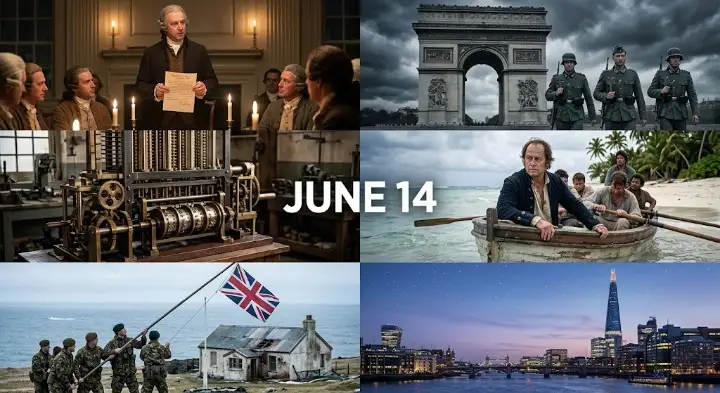
Captain William Bligh guided his tiny, overloaded open boat onto the shores of Timor after forty-seven days at sea. Mutinous crew members on the HMS Bounty had cast him adrift in the middle of the Pacific Ocean with only eighteen loyal men. Relying on a single pocket watch and a quadrant, Bligh successfully navigated 4,600 miles of dangerous ocean without losing a single man to starvation. This extraordinary feat of seamanship remains one of the greatest survival stories in human maritime history.
1800 – Napoleon Snatches Victory at Marengo
First Consul Napoleon Bonaparte launched a desperate counterattack against the victorious Austrian lines in Northern Italy. The unexpected arrival of French reinforcements turned a near-certain military disaster into a stunning, total victory for the French republic. This dramatic triumph forced the Austrian army to abandon the Italian peninsula and sign a sweeping armistice. Napoleon returned to Paris with his political authority completely secure, paving his path to the imperial throne.
1807 – The Russian Army Broken at Friedland
Emperor Napoleon watched his Grande Armée pin the Russian army against the deep waters of the Alle River in Poland. French artillery batteries fired directly into the crowded Russian ranks, destroying over twenty thousand enemy soldiers in a single afternoon. This overwhelming military catastrophe forced Tsar Alexander I to sue for immediate peace with the French Empire. The resulting Treaty of Tilsit divided Europe between the two monarchs and marked the absolute peak of Napoleon’s power.
1821 – A 300-Year-Old Kingdom Ends
Badi VII walked out of his palace in Sennar and formally surrendered his throne to the advancing general Ismail Pasha. The Ottoman Empire’s modern artillery forces had marched into the region to claim control over the valuable territory of Sudan. This quiet surrender brought an immediate, permanent end to the historic Funj Kingdom, which had ruled for three centuries. The fall of Sennar opened the door to decades of foreign Ottoman exploitation across East Africa.
1822 – Charles Babbage Conceptualizes Computing
Charles Babbage stood before the members of the Royal Astronomical Society and presented his paper on calculating astronomical tables. The brilliant mathematician proposed building a massive mechanical calculation device known as the Difference Engine to eliminate human mathematical errors. This revolutionary concept used a complex system of gears and wheels to perform complex polynomial equations automatically. His innovative design laid the intellectual groundwork for the invention of the modern programmable computer.
1830 – France Launches the Invasion of Algiers
Thirty-four thousand heavily armed French soldiers stepped off their transport ships onto the sandy beaches of Sidi Fredj. King Charles X had ordered this massive amphibious assault to distract domestic voters from growing political crises back home in Paris. The landing forces quickly overwhelmed the local Algerian defenses, marking the violent beginning of a century of French colonization. This aggressive military expedition fundamentally altered the cultural and political landscape of North Africa for generations.
1839 – The First Henley Royal Regatta
Crowds of excited spectators lined the lush green banks of the River Thames at Henley-on-Thames to watch the town’s inaugural regatta. Local officials had organized the public rowing competition to boost tourism and provide entertainment for the surrounding communities. The event proved to be an instant success, drawing elite amateur athletes from across the British Isles to compete for historic trophies. This afternoon of competitive sport established a prestigious global rowing tradition that continues to this day.
1846 – The Bear Flag Revolt Ignites
A determined group of American settlers marched into the Mexican garrison town of Sonoma and placed the local comandante under arrest. The frontiersmen acted without any official orders from Washington, driven by rumors that the Mexican government planned to expel them from California. They hastily painted a crude flag featuring a grizzly bear and declared the birth of the independent California Republic. This local insurrection lasted less than a month before American military forces arrived to claim the territory.
1863 – Winchester Shattered by the Confederacy
General Richard Ewell led his Confederate divisions in a fierce assault against the fortified Union garrison at Winchester, Virginia. The southern forces successfully overwhelmed the northern defenses, capturing over four thousand Union soldiers and vast amounts of valuable military supplies. This decisive victory cleared the entire Shenandoah Valley of federal troops, opening a clear path for the Confederacy. General Robert E. Lee used this momentum to launch his historic, fateful invasion of Pennsylvania.
1863 – A Bloody Repulse at Port Hudson
Union General Nathaniel Banks ordered his infantry regiments to charge the heavily fortified Confederate earthworks along the Mississippi River. The desperate assault turned into a complete slaughter as southern defenders cut down waves of northern soldiers from their elevated positions. This failed attack resulted in over eighteen hundred Union casualties while achieving absolutely no strategic advantage. The bloody repulse forced the Union command to dig in for a grueling, long-term siege of the fortress.
1872 – Canada Legalizes the Working Class Voice
Prime Minister Sir John A. Macdonald stood before parliament and secured the passage of the historic Trade Unions Act. The new legislation protected regular working-class organizations from being prosecuted as criminal conspiracies under outdated common law rules. This political move came after thousands of typographers walked off the job in Toronto to demand a standard nine-hour workday. The new law gave Canadian workers the legal right to organize and fight for fair wages.
1888 – Sarawak Becomes a British Protectorate
Rajah Charles Brooke signed a formal diplomatic treaty that placed the independent Kingdom of Sarawak under British protection. The White Rajahs had ruled this vast territory on the island of Borneo as private monarchs for nearly five decades. Facing constant threats from rival European empires, the Brooke dynasty traded control over their foreign policy for British military security. This geopolitical arrangement preserved the unique dynasty’s rule while expanding British influence across Southeast Asia.
1900 – Hawaii is Absorbed by Washington
President William McKinley signed the Organic Act, formally transforming the islands of Hawaii into an official United States territory. This administrative move came two years after the modern kingdom had been annexed during the Spanish-American War. Local native populations found themselves stripped of their traditional political authority as American corporate interests took control of the government. This legislative act set up the eventual statehood of the islands, forever altering their native culture.
1900 – Germany Sparks a Naval Arms Race
Members of the German Reichstag gathered in Berlin and passed the ambitious Second Naval Law into effect. The new legislation called for the Imperial German Navy to double its fleet size, aiming to build thirty-eight battleships over twenty years. This massive expansion directly challenged Great Britain’s long-standing naval supremacy across the Atlantic Ocean. The aggressive building program triggered a dangerous, competitive arms race that directly contributed to the outbreak of World War I.
1907 – Norwegian Women Win the Ballot
Suffrage activists cheered in the galleries of the Storting as Norwegian lawmakers voted to grant women the right to vote. The historic legislation allowed women who paid taxes, or were married to taxpayers, to participate in parliamentary elections. This major victory followed decades of organized campaigning by the National Association for Women’s Suffrage. Norway became one of the very first independent European nations to open the democratic process to female citizens.
1919 – Alcock and Brown Take to the Skies
John Alcock and Arthur Whitten Brown climbed into their modified Vickers Vimy bomber and taxied down a rough field in Newfoundland. The brave aviators took off into heavy fog, aiming to complete the first nonstop transatlantic flight in human history. They battled freezing temperatures, broken instruments, and thick ice accumulation for sixteen grueling hours over the open Atlantic. Their dramatic landing in an Irish bog the next day proved that commercial intercontinental aviation was possible.
1926 – Brazil Abandons the League of Nations
Diplomats in Geneva watched in stunned silence as Brazil formally submitted its resignation to the League of Nations. The South American nation took this drastic step after being denied a permanent seat on the powerful League Council during recent reorganization talks. Brazilian leaders felt that the international organization favored European interests at the absolute expense of developing global powers. This high-profile exit exposed deep structural flaws in the early global peacekeeping body.
1931 – A Deadly Vortex Hits Birmingham
A black funnel cloud dropped from the storm clouds over England, tearing a path of destruction directly through the heart of Birmingham. The powerful tornado destroyed or severely damaged over twenty-two hundred homes and local businesses in just a few minutes. Flying debris killed one resident and injured dozens of others as they scrambled for cover inside ruined structures. This rare meteorological disaster remains one of the most destructive tornadoes in British history.
1934 – The Eastern Mission Returns Home
John Latham stepped off his ship in Sydney, concluding the historic three-month Australian Eastern Mission to East Asia. The Australian Deputy Prime Minister had led a large diplomatic delegation to establish direct ties with Japan, China, and the Dutch East Indies. This extensive tour marked Australia’s first independent diplomatic foray into regional affairs without relying on British foreign office guidance. The mission highlighted the continent’s growing awareness of its complex geopolitical neighborhood.
1937 – Pennsylvania Leads on Flag Day
Governor George Earle signed a new bill that made Pennsylvania the first US state to declare Flag Day a legal holiday. While other states marked the occasion with simple school ceremonies, Pennsylvania businesses closed their doors to allow workers to celebrate. The official holiday honored the anniversary of the 1777 resolution that created the original Stars and Stripes. This legislative action cemented a deep tradition of public patriotism across the state.
1937 – The Marihuana Tax Act Passes
Lawmakers in the United States House of Representatives gathered and passed the highly controversial Marihuana Tax Act. The new legislation placed heavy taxes and strict regulations on the cultivation, sale, and medical use of cannabis plants. This federal move effectively criminalized regular possession of the drug across the entire country for the first time. The law laid the foundational framework for decades of aggressive federal anti-drug enforcement policies.
1940 – Nazi Boots March into Paris
German soldiers marched down the deserted, silent avenues of Paris as swastika flags were raised over the Arc de Triomphe. The French government had fled the capital days earlier, declaring it an open city to prevent its total destruction by Luftwaffe bombers. Shocked residents watched from behind closed curtains as the era of Nazi occupation officially began. This dark morning broke the spirit of France and signaled the complete collapse of Western European security.
1940 – Lithuania Receives a Soviet Ultimatum
Foreign Minister Vyacheslav Molotov issued a late-night ultimatum to the Lithuanian government in Kaunas. The Soviet Union demanded immediate permission to station an unlimited number of Red Army troops within Lithuanian borders. Facing the threat of an immediate military invasion, the vulnerable Baltic nation had no choice but to accept the harsh terms. This aggressive move resulted in the complete loss of Lithuanian independence for the next fifty years.
1940 – The First Prisoners Arrive at Auschwitz
A train pulled onto the siding at an abandoned army barracks near Oświęcim, carrying seven hundred and twenty-eight Polish political prisoners. These individuals, including young students and resistance fighters, became the very first official inmates of the Auschwitz concentration camp. SS guards branded the new arrivals with registration numbers, beginning a system of industrial slaughter. This regular Tuesday morning marked the activation of what became the most lethal killing center in human history.
1941 – Soviet Trains Roll in the Baltics
Red Army soldiers hammered on thousands of doors across Estonia, Latvia, and Lithuania to launch the June deportation wave. Over forty thousand innocent citizens were dragged from their homes and packed into crowded cattle cars bound for Siberian labor camps. This brutal ethnic cleansing aimed to eliminate all political opposition to the recent Soviet occupation of the region. Entire families vanished into the frozen east, leaving a deep scar that still shapes Baltic identity.
1944 – Britain Abandons Operation Perch
General Bernard Montgomery ordered British armored divisions to halt their advance and withdraw from the outskirts of Caen. German Panzer units had launched a ferocious counterattack at Villers-Bocage, destroying dozens of British tanks in a single afternoon. This tactical failure forced the Allied command to abandon their early plan to encircle and capture the strategic French town. The costly retreat ensured that the battle for Normandy would become a long, bloody war of attrition.
1945 – The Battle of Bessang Pass Ignites
Filipino troops of the Philippine Commonwealth Army launched a massive assault against the fortified Japanese mountain strongholds in Northern Luzon. The local soldiers fought through dense jungle and steep cliffs to clear the vital pass of entrenched imperial defenders. This grueling military campaign aimed to cut off the retreat routes of the main Japanese forces operating in the valley. The successful breakthrough broke the back of Japanese resistance across the island.
1949 – A Monkey Reaches the Edge of Space
Albert II, a brave rhesus monkey, sat strapped inside the nose cone of a modified V-2 rocket at White Sands. The missile blasted off from the desert floor, roaring to an astonishing altitude of eighty-three miles above the Earth. This historic flight made Albert II the very first mammal to pass the official boundary of outer space. The primate tragically died on impact when a parachute failed, but his journey proved that complex life could survive the launch into orbit.
1950 – Tragedy Repeats Near Bahrain
An Air France Douglas DC-4 plunged into the dark waters of the Persian Gulf during its final approach to Bahrain. The catastrophic crash claimed the lives of forty passengers and crew members just miles from the runway. Bizarrely, this disaster occurred exactly forty-eight hours after another Air France flight crashed in the exact same location. Investigators rushed to the scene to determine if mechanical failure or poor airport lighting caused the twin tragedies.
1951 – UNIVAC I Opens the Digital Era
Officials at the United States Census Bureau gathered to formally dedicate the newly installed UNIVAC I computer system. This massive, room-sized machine used thousands of vacuum tubes to process complex data sets automatically. It represented the world’s very first commercial computer designed specifically for business and administrative applications. The successful activation of this system marked the true beginning of the modern information age, changing how societies manage data.
1954 – “Under God” Added to the Pledge
President Dwight D. Eisenhower signed a new bill that altered the words of the United States Pledge of Allegiance. The executive order inserted the phrase “under God” into the national pledge, placing it directly between “one nation” and “indivisible.” This legislative change aimed to draw a clear moral line between American democratic values and the state atheism of Soviet communism. Millions of schoolchildren began reciting the new version in classrooms the following autumn.
1955 – Chile Joins the Copyright Accord
Diplomats in Santiago signed the official documents to ratify the Buenos Aires copyright treaty. This international agreement ensured that Chilean authors, artists, and inventors received legal protection for their creative works across the Americas. The treaty helped stop the widespread illegal copying of books and music across national borders. By joining the accord, Chile helped create a more secure economic environment for creative professionals across the continent.
1959 – Disneyland Launches the Monorail
Walt Disney stood before a cheering crowd in Anaheim and snipped the ribbon to open the Disneyland Monorail System. This sleek, futuristic train became the very first daily operating monorail system in the entire Western Hemisphere. Regular visitors crowded into the elevated cars to experience a smooth ride high above the amusement park grounds. The innovative transportation system served as a practical demonstration of how modern cities could solve growing traffic problems.
1962 – Europe Unites for Space Exploration
Representatives from ten Western European nations gathered in Paris and signed the convention to establish the European Space Research Organisation. This collaborative scientific agency aimed to pool financial resources and intellectual talent to compete with American and Soviet space programs. The group focused on launching research satellites and developing advanced rocket technologies. This early partnership eventually evolved into the modern European Space Agency, which drives European space missions today.
1966 – The Vatican Burns the Banned Index
Cardinal Alfredo Ottaviani stood before reporters in Rome and announced the total abolition of the Index Librorum Prohibitorum. This infamous list of prohibited books had been maintained by the Catholic Church since its creation in 1557 to protect Catholics from heresy. Masterpieces by Galileo, Victor Hugo, and Jean-Paul Sartre were instantly freed from centuries of formal religious censorship. This dramatic reform signaled a major shift toward intellectual openness within the modern Church.
1967 – Mariner 5 Blasts Off for Venus
A powerful Atlas-Agena rocket roared off the launch pad at Cape Canaveral, carrying the Mariner 5 spacecraft into space. The specialized NASA probe began a four-month journey toward Venus to study the planet’s dense atmosphere and magnetic fields. Scientists hoped the automated flight would provide critical data about the extreme greenhouse effect shaping the Venusian environment. The successful launch marked another major step forward in the competitive space race.
1972 – Flight 471 Crashes in New Delhi
A Japan Air Lines Douglas DC-8 descended through thick evening smog and slammed into the ground short of the runway at Palam International Airport. The violent impact and subsequent fire killed eighty-two people on board and four laborers working on the ground below. Emergency crews rushed through the wreckage to rescue the five miraculous survivors. Air safety investigators blamed the tragic accident on a pilot error during the tricky instrument approach.
1982 – Argentina Surrenders the Falklands
General Mario Menéndez signed the official surrender documents in Stanley, handing control of the islands back to British forces. The capitulation brought an immediate end to the fierce, seventy-four-day Falklands War, which had cost hundreds of lives. Crowds of relieved British soldiers raised the Union Jack over the capital building as Argentine troops were disarmed. The humiliating defeat triggered the immediate collapse of the military dictatorship ruling Argentina.
1985 – The Schengen Agreement is Signed
Officials from five European nations gathered on a passenger boat along the Moselle River and signed the Schengen Agreement. This historic accord established a free travel zone that eliminated regular border checks between France, Germany, Belgium, Luxembourg, and the Netherlands. Regular citizens could drive across national borders without stopping for passport inspections for the first time in modern history. This quiet signature laid the foundational framework for a deeply integrated, unified Europe.
1986 – The Mindbender Derails in Edmonton
A packed roller coaster train rounded a sharp turn on the Mindbender track inside the West Edmonton Mall. A mechanical failure caused the rear car to derail at high speed, slamming passengers into a concrete support pillar. The horrific accident claimed the lives of three riders and left another victim fighting for survival with catastrophic injuries. Investigators shut down the popular indoor amusement park to conduct a massive safety review of all thrill rides.
1994 – Riots Explode in Vancouver
Thousands of angry hockey fans poured into the streets of downtown Vancouver after the Canucks lost the Stanley Cup to the New York Rangers. The crowd quickly turned violent, smashing storefront windows, overturning vehicles, and setting fires in the middle of major intersections. Riot police used tear gas and plastic bullets to disperse the crowd during a night of chaotic street battles. The destruction resulted in over one million dollars in property damage and two hundred arrests.
2002 – A Cosmic Near-Miss
Astronomers at the LINEAR observatory watched a massive space rock zip past Earth at a speed of several miles per second. The near-Earth asteroid, named 2002 MN, missed our planet by a mere seventy-five thousand miles. This distance represents roughly one-third of the space between the Earth and the Moon, making it an incredibly close cosmic encounter. The close pass reminded scientists that large space objects could strike without warning.
2014 – A Ukrainian Airlifter Shot Down
A Ukrainian Ilyushin Il-76 transport aircraft dropped its flaps to land at Luhansk International Airport when a surface-to-air missile struck the fuselage. The heavy military cargo plane exploded in mid-air, killing all forty-nine soldiers and crew members on board instantly. Pro-Russian separatist forces claimed responsibility for the deadly strike, which marked a major escalation in the regional conflict. The loss triggered national mourning and deepened geopolitical tensions across Eastern Europe.
2017 – The Grenfell Tower Catastrophe
A small kitchen fire broke out on the fourth floor of the Grenfell Tower apartment building in North Kensington, London. Flames caught onto the building’s exterior cladding, spreading with terrifying speed up the sides of the twenty-four-story residential tower. Trapped residents scrambled to escape down the single smoke-filled stairwell while emergency operators struggled to handle hundreds of desperate calls. The horrific inferno claimed seventy-two lives, sparking national anger over public housing safety.
2017 – Congressional Baseball Shooting
A gunman walked up to a baseball field in Alexandria, Virginia, and opened fire on a group of Republican congressmen practicing for a charity game. House Majority Whip Steve Scalise fell to the ground with a severe abdominal wound as his security detail rushed forward to return fire. Capitol Police officers successfully neutralized the shooter before he could breach the dugout where other lawmakers hid. The violent assault shocked Washington and forced a massive increase in security.
Step back one more day—explore yesterday’s archives here.
Famous People Born On June 14
| Name | Description | Date |
|---|---|---|
| Nilakantha Somayaji | Indian astronomer and mathematician, author of the Tantrasangraha, a key figure in the Kerala school of astronomy | 1444 – 1544 |
| Ferdinand II, Archduke of Austria | Austrian archduke, ruler of Tyrol and a patron of the arts and sciences | 1529 – 1595 |
| Charles-Augustin de Coulomb | French physicist and engineer, known for Coulomb’s law of electrostatic force, the SI unit of charge is named after him | 1736 – 1806 |
| Harriet Beecher Stowe | American author and activist, author of Uncle Tom’s Cabin, which fueled the abolitionist movement | 1811 – 1896 |
| Yamagata Aritomo | Japanese Field Marshal and politician, 3rd and 9th Prime Minister of Japan, a key figure in the Meiji Restoration | 1838 – 1922 |
| Robert M. La Follette | American lawyer and politician, 20th Governor of Wisconsin, a progressive leader and presidential candidate | 1855 – 1925 |
| Andrey Markov | Russian mathematician and theorist, known for Markov chains and Markov processes in probability theory | 1856 – 1922 |
| Alois Alzheimer | German psychiatrist and neuropathologist, first described the disease that bears his name | 1864 – 1915 |
| Karl Landsteiner | Austrian biologist and physician, Nobel Prize laureate for the discovery of blood groups | 1868 – 1943 |
| John McCormack | Irish tenor and actor, one of the greatest voices of the 20th century | 1884 – 1945 |
| José Carlos Mariátegui | Peruvian writer and political philosopher, a leading figure in Latin American Marxism | 1894 – 1930 |
| Alonzo Church | American mathematician and logician, developed the lambda calculus and the Church-Turing thesis | 1903 – 1995 |
| Margaret Bourke-White | American photographer and journalist, the first female war correspondent and a pioneer of photojournalism | 1904 – 1971 |
| René Char | French poet and author, a leading figure in the Surrealist movement and the French Resistance | 1907 – 1988 |
| Burl Ives | American actor and singer, a beloved folk singer and character actor in films like The Big Country | 1909 – 1995 |
| Dorothy McGuire | American actress, known for her roles in Gentleman’s Agreement and A Tree Grows in Brooklyn | 1916 – 2001 |
| Atle Selberg | Norwegian-American mathematician and academic, a leading figure in analytic number theory | 1917 – 2007 |
| Gene Barry | American actor, known for his roles in Bat Masterson and Burke’s Law | 1919 – 2009 |
| Sam Wanamaker | American actor and director, instrumental in the reconstruction of Shakespeare’s Globe Theatre in London | 1919 – 1993 |
| Judith Kerr | German-English author and illustrator, creator of the beloved children’s book The Tiger Who Came to Tea | 1923 – 2019 |
| James Black | Scottish pharmacologist and academic, Nobel Prize laureate for the development of beta-blockers and H2 antagonists | 1924 – 2010 |
| Pierre Salinger | American journalist and politician, 11th White House Press Secretary under Presidents Kennedy and Johnson | 1925 – 2004 |
| Don Newcombe | American baseball player, the first pitcher to win the Cy Young, MVP, and Rookie of the Year awards | 1926 – 2019 |
| Jerzy Kosiński | Polish-American novelist and screenwriter, author of The Painted Bird, a controversial and acclaimed writer | 1933 – 1991 |
| Peter Mayle | English author and screenwriter, best known for his memoir A Year in Provence | 1939 – 2018 |
| Donald Trump | American businessman, television personality, and politician, 45th and 47th President of the United States | 1946 – Present |
| Harry Turtledove | American historian and author, considered the “master of alternate history” | 1949 – Present |
| Papa Wemba | Congolese singer, known as the “King of Rumba Rock,” a major figure in African music | 1949 – 2016 |
| Steffi Graf | German tennis player, one of the greatest tennis players of all time, winner of 22 Grand Slam singles titles | 1969 – Present |
| Boy George | English singer-songwriter and producer, lead singer of Culture Club, a prominent figure in 1980s pop music | 1961 – Present |
Famous People Died On June 14
| Name | Description | Date |
|---|---|---|
| Orlande de Lassus | Flemish composer and educator, one of the most prolific and versatile composers of the Renaissance | 1532 – 1594 |
| Henry Vane the Younger | English-American politician, Governor of the Massachusetts Bay Colony, executed for treason by Charles II | 1613 – 1662 |
| Colin Maclaurin | Scottish mathematician, known for the Maclaurin series expansion, a key figure in the development of calculus | 1698 – 1746 |
| Benedict Arnold | American general during the American Revolution who later defected to the British, becoming synonymous with treason | 1741 – 1801 |
| Pierre Charles L’Enfant | French-American architect and engineer, designed the city plan for Washington, D.C. | 1754 – 1825 |
| Giacomo Leopardi | Italian poet and philosopher, one of the most important Italian poets and thinkers of the 19th century | 1798 – 1837 |
| Edward FitzGerald | English poet and author, best known for his translation of the Rubáiyát of Omar Khayyám | 1809 – 1883 |
| Alexander Ostrovsky | Russian director and playwright, the founder of modern Russian realistic theatre | 1823 – 1886 |
| Mary Cassatt | American-French painter, a leading Impressionist artist and one of the most important female painters of the 19th century | 1843 – 1926 |
| Emmeline Pankhurst | English activist and academic, a leader of the British suffragette movement who fought for women’s right to vote | 1857 – 1928 |
| G. K. Chesterton | English essayist, poet, playwright, and novelist, a prolific and influential writer of the early 20th century | 1874 – 1936 |
| John Logie Baird | Scottish-English physicist and engineer, inventor of the first working television system | 1888 – 1946 |
| Salvatore Quasimodo | Italian novelist and poet, Nobel Prize laureate in Literature, a leading figure in Italian modernism | 1901 – 1968 |
| Carlos P. Garcia | Filipino politician, 8th President of the Philippines, known for the “Filipino First” policy | 1896 – 1971 |
| Alan Reed | American actor, the original voice of Fred Flintstone in the animated series The Flintstones | 1907 – 1977 |
| Jorge Luis Borges | Argentine short-story writer, essayist, poet and translator, one of the most influential literary figures of the 20th century | 1899 – 1986 |
| Alan Jay Lerner | American composer and songwriter, half of the legendary Lerner and Loewe duo, known for My Fair Lady | 1918 – 1986 |
| Peggy Ashcroft | English actress, one of the great stage and screen actresses of the 20th century, winner of an Academy Award | 1907 – 1991 |
| Henry Mancini | American composer and conductor, one of the most influential film and television composers, known for The Pink Panther | 1924 – 1994 |
| Rory Gallagher | Irish singer-songwriter, guitarist, and producer, a legendary blues and rock musician | 1948 – 1995 |
| Roger Zelazny | American author and poet, a major figure in the science fiction and fantasy genres, creator of The Chronicles of Amber | 1937 – 1995 |
| Carlo Maria Giulini | Italian conductor and director, one of the most respected conductors of the 20th century | 1914 – 2005 |
| Kurt Waldheim | Secretary-General of the United Nations and 9th President of Austria, a controversial figure due to his wartime service | 1918 – 2007 |
| Gitta Sereny | Austrian-English historian, journalist, and author, known for her biographical works on Nazi figures | 1921 – 2012 |
| Sushant Singh Rajput | Indian film actor, a popular Bollywood star known for his roles in MS Dhoni: The Untold Story and Kai Po Che! | 1986 – 2020 |
| A. B. Yehoshua | Israeli novelist, essayist, and playwright, one of the most prominent figures in modern Hebrew literature | 1936 – 2022 |
| Max Weber | German sociologist and economist, one of the founders of modern sociology, known for The Protestant Ethic and the Spirit of Capitalism | 1864 – 1920 |
| Adlai Stevenson I | American lawyer and politician, 23rd Vice President of the United States under Grover Cleveland | 1835 – 1914 |
| Frederick Stanley, 16th Earl of Derby | English captain and politician, 6th Governor General of Canada, after whom the Stanley Cup is named | 1841 – 1908 |
| Louis Desaix | French general, a celebrated commander under Napoleon Bonaparte, killed at the Battle of Marengo | 1768 – 1800 |
Observances on June 14
Flag Day (United States)
This annual event commemorates the adoption of the Stars and Stripes as the official national flag by the Continental Congress in 1777. Communities across America celebrate by hosting parades, displaying banners outside homes, and organizing patriotic essay contents for local schoolchildren.
Liberation Day (Falkland Islands)
This public holiday marks the anniversary of the 1282 surrender of Argentine forces to the British military in Stanley. Island residents celebrate their preserved sovereignty with official military parades, wreath-laying ceremonies at war memorials, and public community feasts.
World Blood Donor Day
Organized by the World Health Organization, this global campaign thanks voluntary blood donors for their life-saving gifts. Healthcare centers use the day to raise public awareness about the constant global need for safe blood products to support critical medical treatments.
🇫🇷 Frequently Asked Questions — June 14 in History
Nazi forces marched into Paris on this day, beginning a dark era of foreign military occupation that broke the spirit of France. Farther east on that exact same day, the first shipment of political prisoners arrived at the Auschwitz concentration camp, activating the machinery of the Holocaust.
The most significant event occurred in 1775 when the Continental Congress voted to establish the Continental Army. This historic resolution unified thirteen separate colonial militias into a single fighting force, triggering the birth of the United States military and altering global history.
Che Guevara, the iconic Argentine Marxist revolutionary and major figure of the Cuban Revolution, was born on this day in 1928. His radical political theories and distinctive portrait became global symbols of counterculture rebellion across the twentieth century.
The Falklands War ended on this day in 1982 when the Argentine garrison in Stanley surrendered to British forces. This decisive military victory restored British control over the islands and triggered the immediate collapse of the ruling military junta back in Buenos Aires.
Flag Day is a US observance honoring the 1777 adoption of the national flag by the Continental Congress. It is remembered to encourage citizens to reflect on the historical struggles for freedom that the Stars and Stripes symbol represents.
A catastrophic fire tore through the Grenfell Tower high-rise apartment building in London in 2017, claiming seventy-two lives. The tragedy triggered massive public protests and forced an international review of building safety codes for high-density residential structures.