Henry Hudson looked out at the icy, grey waters of the bay that would eventually bear his name, listening to the angry shouts of his own crew. It was the summer of 1611, and a bitter mutiny was unfolding on the Discovery. The men had suffered through a brutal Canadian winter, trapped by ice and starved for fresh rations. When Hudson wanted to push further into the unknown, his desperate sailors broke. They forced the famous English explorer, his teenage son John, and seven loyal, sick crewmen into a small, open wooden boat. Dropped into the freezing waters with no oars and little food, the small craft drifted away as the ship sailed south.
No one ever saw them again. These deep human struggles hide behind the dates on our calendar. This day in history June 23 brings a heavy collection of moments where small human choices, desperate gambles, and sudden acts of violence completely altered the path of the world.
📅 Quick Facts — June 23 in History
| 📌 Category | 📖 Event / Detail |
|---|---|
| 🌟 Most Significant Event | The United Kingdom votes to leave the European Union (2016) |
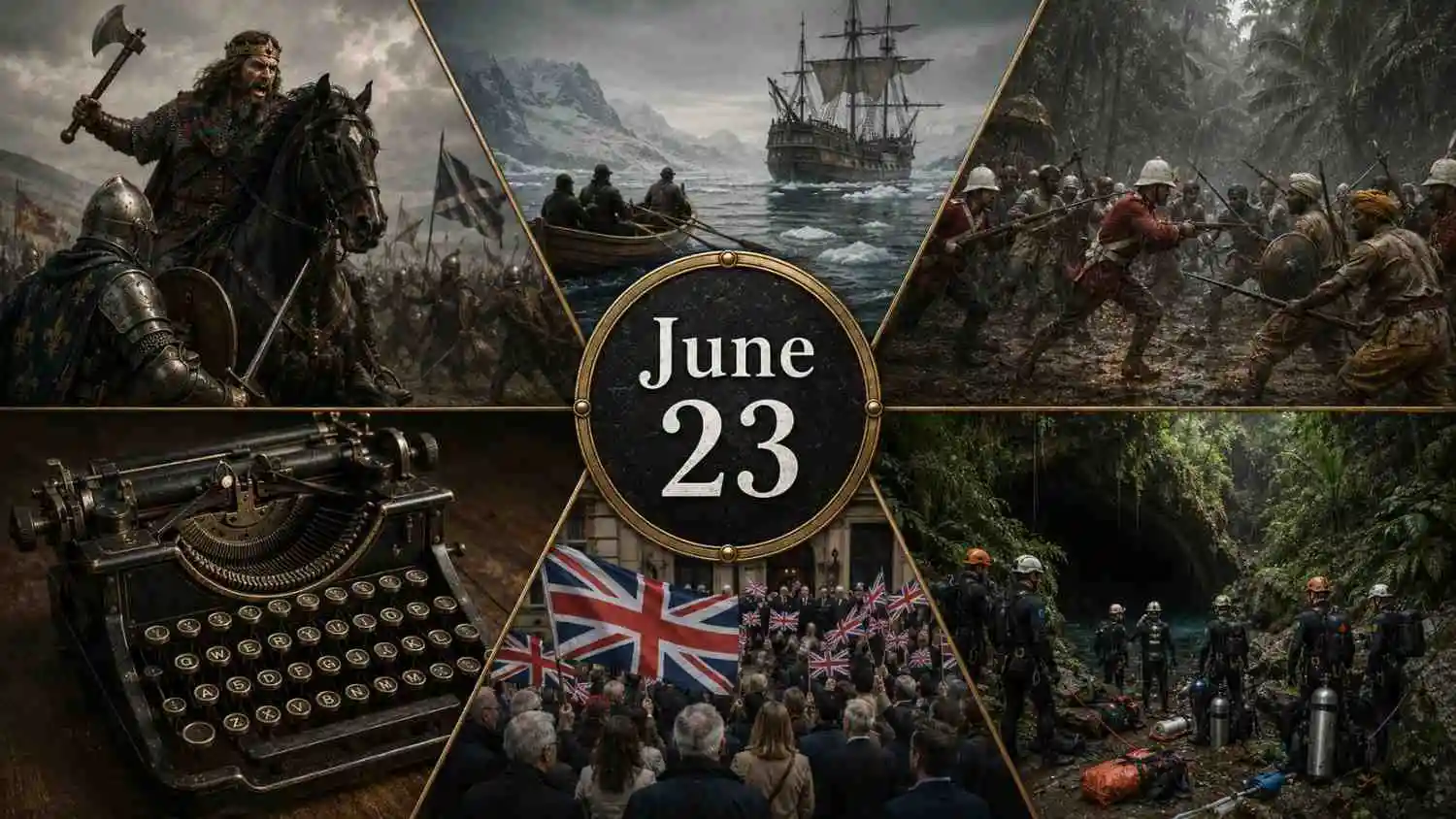
| 🏆 Top 10 Key Events | • Sun Quan becomes emperor (229) • Battle of Bannockburn begins (1314) • Henry Hudson set adrift (1611) • Battle of Plassey (1757) • Typewriter patented (1868) • International Olympic Committee founded (1894) • Birth control pill approved (1960) • IBM unbundles software (1969) • Air India Flight 182 bombing (1985) • Brexit referendum (2016) |
| ⚔️ Key Battles | Battle of Trapani (1266); Battle of Moclín (1280); Battle of the Counts (1287); Battle of Bannockburn (1314); Battle of Plassey (1757); Battle of Krefeld (1758); Battle of Landeshut (1760); Battle of Springfield (1780); Battle of Doiran (1913); Battle of Cēsis (1919) |
| 👤 Key Figures | Henry Hudson, King Robert the Bruce, Siraj ud-Daulah, Adolf Hitler, Richard Nixon |
| 🌍 Observances | International Women in Engineering Day, Victory Day (Estonia), International Widows Day, National Day of Remembrance for Victims of Terrorism (Canada) |
Story of the Day: The Birth of the Modern Software Industry
Engineers at IBM headquarters prepared for a quiet announcement on June 23, 1969, that would completely disrupt the tech world. Up to this point, buying a massive computer meant getting all the operating programs, setup services, and maintenance thrown in for a single, giant price tag. Software was treated like a free accessory to the heavy metal machinery. Under heavy pressure from government antitrust lawyers, the tech giant decided to unbundle its services and price its code entirely separate from its physical machines. This corporate decision single-handedly allowed independent programming companies to exist, forming the multi-trillion-dollar modern software industry we use every single day.
Important Events That Happened On June 23 In History
229 – Sun Quan Becomes Emperor
Sun Quan climbed the ceremonial platform in Wuchang to declare himself the first emperor of Eastern Wu. Decades of brutal warlord conflicts had shattered the ancient Han Dynasty into three competing kingdoms. This bold political move solidified the deep three-way split of China, triggering generations of legendary warfare and political scheming. The dramatic coronation formalised a colorful era of divided rule that shaped Chinese literature and cultural identity for nearly two millennia.
1266 – Battle of Trapani
Admiral Gilberto Dandolo guided his Venetian warships into a tight, aggressive formation just off the coast of Sicily. The rival Genoese fleet held a significant numerical advantage, but their commanders hesitated, choosing to chain their vessels together into a defensive floating wall. Venetian sailors exploited this lack of movement, storming the stagnant enemy line with fierce boarding parties and capturing every single Genoese vessel. This total naval disaster broke Genoa’s momentum, shifting control of Mediterranean trade routes to Venice for decades.
1280 – Battle of Moclín
Castilian knights charged deep into a narrow mountain pass near Granada, confident their superior numbers would crush the Muslim defenders. Soldiers fighting for the Emirate of Granada lay hidden along the rocky ridges, waiting until the heavy cavalry was completely boxed in before launching a massive ambush. The sudden rain of arrows and spears panicked the horses, turning the retreat into a chaotic slaughter where over two thousand Christian troops died. This crushing military disaster halted the Kingdom of Castile’s southern advance, protecting the borders of Granada for generations.
1287 – Battle of the Counts
Roger of Lauria scanned the Bay of Naples as his Aragonese ships closed the distance with the Neapolitan fleet. The Angevin commanders rushed out to meet him, falling directly into a brilliant trap where Lauria feigned a retreat to scatter the enemy ships. Aragonese crossbowmen then turned and rained bolts on the isolated vessels, capturing the enemy leadership and sinking the heart of their navy. This decisive victory secured Aragonese dominance over Sicily, completely frustrating French ambitions to control the southern Italian kingdoms.
1305 – Treaty of Athis-sur-Orge
Flemish magistrates sat across from French royal officials to sign a tense peace agreement at Athis-sur-Orge. Years of bloody, exhausting urban uprisings had drained the wealthy textile cities of Flanders and stretched the French treasury to its absolute limit. The harsh treaty forced the Flemish to pay massive financial penalties and surrender key border territories in exchange for keeping their regional independence. This bitter compromise failed to bring real peace, fueling decades of deep anti-French resentment across the low countries.
1314 – Battle of Bannockburn
King Robert the Bruce stood before his heavily outnumbered Scottish pikemen, watching the brilliant armor of the English vanguard gleam in the summer sun. King Edward II brought a massive army north to break the Scottish siege of Stirling Castle, confident that sheer numbers would secure a quick victory. The opening day of conflict shifted instantly when Bruce killed an English knight in single combat with a battleaxe, electrifying his troops. This legendary clash marked the start of a two-day struggle that secured Scotland’s independence.
1532 – Treaty of Pommeraye
King Henry VIII of England held a secret meeting with King Francis I of France to sign the Treaty of Closer Amity. Both monarchs shared a deep fear of the growing, massive empire controlled by Charles V, the Holy Roman Emperor. The two kings pledged mutual military assistance and financial support to block Spanish and German dominance across continental Europe. This strategic alliance gave Henry the diplomatic cover he needed to break away from the Catholic Church and pursue his divorce.
1565 – Death of Dragut
Ottoman Admiral Dragut lay mortally wounded inside a siege trench, struck by flying stone shrapnel during the assault on Fort St. Elmo. The brilliant corsair commander had terrorized Christian shipping for decades and was the strategic mind behind the massive Great Siege of Malta. His sudden death shattered the morale of the Turkish troops and caused chaos among the high military command just as the fort was about to fall. The loss of his leadership saved the island defenders from total annihilation, turning the tide of the entire Mediterranean war.
1594 – Sinking of the Cinco Chagas
English privateers surrounded the massive Portuguese carrack Cinco Chagas just off the rocky coast of the Azores islands. The giant ship was returning from the East Indies, packed to the brim with precious gems, African slaves, and wealthy passengers. A brutal, close-quarters gun battle raged for days until a stray English shot ignited the Portuguese gunpowder storage, causing a massive explosion. Only thirteen people survived out of more than seven hundred souls on board, sending an unimaginable fortune straight to the ocean floor.
1713 – Acadian Allegiance Ultimatum
British officers walked through the farming villages of Nova Scotia to deliver a stern, life-altering royal decree to the French-speaking Acadians. Following the end of Queen Anne’s War, Britain took official control of the region and demanded the local population swear an oath of unconditional allegiance to the British Crown within one year. The French families refused to take up arms against France, demanding religious freedom and strict neutrality instead. This diplomatic standoff sowed the seeds of suspicion that caused the brutal mass expulsion of the Acadian people forty years later.
1757 – Battle of Plassey
Robert Clive stood in a muddy mango grove near Calcutta, commanding three thousand British and Indian soldiers against a massive army of fifty thousand. Siraj ud-Daulah, the young Nawab of Bengal, held an overwhelming numerical advantage, but Clive had secretly bribed the Nawab’s top general, Mir Jafar, to hold back his troops. When a sudden monsoon downpour soaked the Nawab’s uncovered gunpowder, British artillery tore through the defenseless Indian lines. This quick, decisive victory allowed the British East India Company to conquer Bengal, laying the foundation for British rule over the entire Indian subcontinent.
1758 – Battle of Krefeld
Prince Ferdinand of Brunswick led a combined force of British, Prussian, and Hanoverian troops through a hidden swamp to surprise the French army. The French commander had deployed his men behind a long defensive ditch, expecting a standard head-on attack on his position. Ferdinand’s clever flanking maneuver caught the French completely off guard, forcing a chaotic, bloody retreat across the German countryside. This key victory protected the western flank of Prussia, allowing King Frederick the Great to focus his main forces on the eastern front.
1760 – Battle of Landeshut
General Heinrich von Loudon ordered his Austrian columns to storm the fortified mountain ridges held by a much smaller Prussian garrison. The Prussian commander refused to retreat despite being outnumbered three to one, fighting a desperate defensive action among the rocky peaks. Austrian infantry eventually overwhelmed the trenches, killing or capturing nearly the entire Prussian force of twelve thousand men. This costly defeat stripped Prussia of its defensive mountain barrier, opening the heart of their territory to a direct Austrian invasion.
1780 – Battle of Springfield
General Wilhelm von Knyphausen led a column of British and Hessian soldiers into the streets of Springfield, New Jersey, desperate to crush George Washington’s nearby base. Local Continental soldiers and furious civilian militia blocked the bridges, using wads of hymn books from a local church as makeshift gun padding. The intense resistance forced the British forces to stop their advance and retreat back toward New York, burning the entire town to the ground as they left. This fierce engagement marked the very last major British ground invasion of the northern colonies.
1794 – Catherine the Great’s Decree
Empress Catherine II of Russia signed a royal decree officially permitting Jewish merchants and citizens to settle in the historic city of Kyiv. This administrative move expanded the borders of the Pale of Settlement, the specific western border region where Jews were legally forced to live within the Russian Empire. While the law opened new economic avenues, it strictly kept Jewish communities separate from the main Russian population. This systematic segregation set a dangerous precedent for future state-sponsored anti-Semitic policies across Eastern Europe.
1810 – Pacific Fur Company Founded
John Jacob Astor gathered a group of wealthy investors in New York to officially organize the Pacific Fur Company. The ambitious millionaire planned to build a global trade network by trapping beaver furs in the Pacific Northwest and shipping them directly to eager markets in China. His agents established the remote outpost of Astoria on the coast of Oregon, making it the very first American community on the Pacific coast. This commercial gamble triggered intense territorial rivalries with British traders, establishing American political claims to the Pacific Northwest.
1812 – Repeal of the Orders in Council
British Prime Minister Lord Liverpool stood in Parliament to officially revoke the aggressive trade bans on American shipping. For years, the Royal Navy had blocked American merchants from trading with Napoleonic Europe, seizing ships and forcing American sailors into British service. British factories were suffering from a lack of American raw materials, forcing the government to back down to save its own economy. The diplomatic reversal came too late; the United States had declared war on Great Britain just five days earlier, before the news could cross the Atlantic.
1860 – Government Printing Office Established
Members of the United States Congress passed a bill officially creating the Government Printing Office to centralize all federal communications. Before this law, the government hired private printers to produce documents, leading to massive financial corruption and highly inaccurate records of political debates. The new federal agency bought a large private print shop in Washington, turning it into a massive operation dedicated to keeping the public informed. This structural reform ensured that all laws, congressional speeches, and federal documents were preserved transparently for the public.
1865 – Surrender of Stand Watie
Brigadier General Stand Watie walked into the military post at Fort Towson, Oklahoma, to sign official surrender papers with Union officers. Watie, a prominent Cherokee leader, was the only Native American to achieve the rank of general on either side of the American Civil War. His battle-hardened cavalry unit had fought a brutal guerrilla war across Indian Territory, long after Robert E. Lee surrendered in Virginia. This quiet meeting marked the official surrender of the very last major Confederate army on land.
1868 – Typewriter Patent Issued
Christopher Latham Sholes walked out of the U.S. Patent Office holding a certificate for an invention he simply called the “Type-Writer.” The Milwaukee newspaper editor had spent years tweaking a mechanical machine that used metal arms to strike ink letters onto paper. To prevent the fast-moving mechanical keys from jamming together, Sholes arranged the letters into a unique layout known as the QWERTY system. This simple mechanical layout transformed office work worldwide, creating an enduring keyboard design that survives on every modern smartphone today.
1887 – Banff National Park Created
Canadian lawmakers passed the Rocky Mountains Park Act, setting aside a massive tract of wilderness around the hot springs of Alberta. The government wanted to protect the pristine mountain scenery from aggressive logging and unregulated mining while building a luxury tourist destination along the new transcontinental railroad. This landmark law created Banff National Park, the very first national park in Canadian history. The decision established Canada’s modern conservation system, balancing wilderness protection with public tourism.
1894 – International Olympic Committee Founded
Baron Pierre de Coubertin stood before a packed assembly at the Sorbonne in Paris to announce the official creation of the International Olympic Committee. The idealistic French educator believed that bringing young athletes together from across the globe would promote international peace and mutual cultural respect. The delegates enthusiastically voted to revive the ancient Greek athletic tradition, planning the first modern Olympic Games for Athens in 1896. This meeting launched the largest peaceful international sporting event in human history.
1908 – Bombardment of the Majles
Colonal Vladimir Liakhov ordered the Russian-led Persian Cossack Brigade to surround and shell the National Consultative Assembly building in Tehran. The absolute monarch, Shah Mohammad Ali, was determined to crush the young Persian Constitutional Revolution and regain absolute control over the country. Artillery shells tore through the parliament building, killing hundreds of pro-democracy activists and leading politicians in the streets. This bloody assault triggered a brutal civil war across Iran, highlighting the dangerous lengths monarchs went to destroy early democratic movements.
1913 – Battle of Doiran
Greek infantry charged up the rugged, fortified hillsides of Doiran, attacking the entrenched Bulgarian defensive lines under a hail of machine-gun fire. This fierce confrontation during the Second Balkan War saw both sides take massive casualties in a brutal, close-quarters struggle for regional supremacy. The Greek forces broke through the lines, forcing a massive Bulgarian retreat and capturing key border territory. This quick, bloody victory led directly to the collapse of the Bulgarian war effort and reshaped the national borders of the Balkan peninsula.
1914 – Battle of Zacatecas
Pancho Villa ordered his famous Division of the North to launch a massive, coordinated assault on the mountain city of Zacatecas. The city served as the final northern stronghold for the brutal military dictator Victoriano Huerta, who had fortified the steep hills surrounding the town. Villa’s artillery pounded the federal positions before his cavalry swept down the slopes, completely destroying the defending army of twelve thousand men. This crushing defeat broke the back of the regime, forcing Huerta to resign and flee the country.
1917 – Ernie Shore’s Perfect Game
Boston Red Sox pitcher Ernie Shore walked onto the mound in the first inning to replace his superstar teammate, Babe Ruth. Ruth had just been ejected by the home plate umpire after launching into a furious argument and punching him in the face over a base walk. Shore stepped up with a runner already on first base, who was immediately thrown out trying to steal second. Shore then retired the next twenty-six batters in a row without letting a single man reach base, completing one of the most unusual pitching feats in baseball history.
1919 – Battle of Cēsis
Estonian and Latvian soldiers launched a massive, coordinated counter-attack to drive German forces out of the historic town of Cēsis. The German Baltische Landeswehr sought to maintain Baltic-German landowners’ dominance over the region following the collapse of the Russian Empire. The decisive Allied victory shattered the German forces, securing the national independence of both Estonia and Latvia. Today, Estonia celebrates this specific summer date as Victory Day to honor their hard-fought freedom.
1925 – Shameen Incident
British and French soldiers stationed in the foreign concession of Shameen Island opened fire on a massive crowd of Chinese protesters. The crowd, made up of radical students, striking workers, and military cadets, was marching past the canal to protest foreign imperialist control over Chinese territory. The sudden volley of gunfire killed fifty-two people and wounded over a hundred others, turning the quiet canal into a horrific scene of panic. This tragedy triggered a massive anti-foreign boycott across southern China, accelerating the growth of the nationalist movement.
1926 – First SAT Administered
More than eight thousand high school students sat at wooden desks across America to take the very first Scholastic Aptitude Test. Designed by an eccentric Princeton psychologist, the new multiple-choice exam was built to measure inherent mental intelligence rather than memorized school facts. The test featured hundreds of intense vocabulary definitions, complex word analogies, and logic puzzles packed into a strict time limit. This administrative experiment grew into the primary gateway for American higher education, shaping the lives of millions of college applicants.
1931 – Wiley Post Takeoff
Pilot Wiley Post and navigator Harold Gatty waved to a cheering crowd as their single-engine plane, the Winnie Mae, roared down the runway at Roosevelt Field. The adventurous duo aimed to shatter the world record by circumnavigating the globe in a single-engine aircraft, navigating through unpredictable weather without modern radar. They flew across the Atlantic, wrestled with thick mud in Siberia, and pushed through exhaustion before landing back in New York less than nine days later. This daring flight proved the incredible reliability and future potential of long-distance commercial aviation.
1938 – Civil Aeronautics Act Signed
President Franklin D. Roosevelt signed the Civil Aeronautics Act into law, creating a new independent agency to oversee all commercial flight operations. Before this law, the young aviation industry lacked clear safety rules, reliable pilot licensing, or consistent economic routes, leading to frequent commercial crashes. The new federal authority took complete control over air traffic management, airway development, and crash investigations across the nation. This regulatory framework stabilized the aviation industry, making commercial air travel safe and reliable for the public.
1940 – Adolf Hitler’s Visit to Paris
Adolf Hitler stepped out of his Mercedes limousine into the quiet morning streets of Paris, launching a brief three-hour tour of the conquered French capital. Flanked by his favorite architect Albert Speer and sculptor Arno Breker, the dictator visited the Opera House, walked past the Eiffel Tower, and stood quietly before Napoleon’s tomb. Hitler wanted to study the city’s classic architecture to plan a much grander rebuilding of Berlin after the war. This chilly morning visit marked the absolute only time the German dictator ever saw Paris.
1940 – Northwest Passage Expedition Begins
Captain Henry Larsen guided the sturdy wooden schooner St. Roch out of Vancouver harbor, embarking on a dangerous secret mission into the Arctic. The Royal Canadian Mounted Police sent the crew to assert Canadian sovereignty over the remote northern islands during the chaos of World War II. Larsen navigated through shifting ice packs, survived two brutal winters trapped in the ice, and pushed through dense fogs. The voyage ended successfully in Halifax, marking the first west-to-east navigation of the legendary Northwest Passage.
1941 – Lithuanian Uprising
Members of the Lithuanian Activist Front rushed into the streets of Vilnius to declare national independence from the Soviet Union. As German troops advanced into Soviet territory, local resistance fighters seized radio stations and public buildings to form a new Provisional Government. The bold bid for freedom lasted only a few weeks before Nazi occupation authorities dismantled the government and took complete control of the country. This brief uprising highlighted the tragic plight of the Baltic nations trapped between two brutal totalitarian empires.
1942 – Capture of the Fw 190
Arminah Faber, a highly experienced German pilot, mistakenly guided his advanced Focke-Wulf Fw 190 fighter aircraft down onto the runway at RAF Pembrey in Wales. Confused by the rolling terrain and low clouds over the Bristol Channel, the pilot believed he had landed safely at a German airbase in occupied France. British airmen ran out onto the tarmac to capture the sophisticated plane intact before the pilot could destroy his equipment. This incredible mistake gave Allied engineers their first direct look at Germany’s top fighter technology, reshaping the air war over Europe.
1944 – Shinnston Tornado
A massive F4 tornado dropped out of a dark summer sky, cutting a path of total destruction through the rugged Appalachian Mountains of West Virginia. The violent storm completely leveled entire farming communities, striking the small town of Shinnston with unimaginable force. Heavy winds ripped homes off their foundations, threw cars into rivers, and killed over one hundred people in a single afternoon. This natural disaster remains one of the deadliest and most destructive tornado outbreaks in the history of the region.
1946 – Vancouver Island Earthquake
A powerful 7.3 magnitude earthquake struck the rugged coastline of Vancouver Island, shaking the entire province of British Columbia. The violent tremors caused brick chimneys to collapse, cracked roads open, and triggered massive underwater landslides that generated localized tsunamis. Two people died as boats capsized and heavy debris fell, while towns hundreds of miles away reported significant structural damage. This massive event remains the largest onshore earthquake ever recorded in modern Canadian history.
1947 – Taft-Hartley Act Enacted
Members of the United States Senate voted overwhelmingly to override President Harry S. Truman’s fierce executive veto of the Taft-Hartley Act. A new conservative Congress rushed the bill through to curb the massive wave of post-war labor strikes that had paralyzed major American industries. The controversial law banned closed shops, blocked unions from making political contributions, and allowed the president to intervene in strikes that threatened national health. This political showdown altered the balance of power between American corporations and organized labor for decades.
1951 – SS United States Launched
Thousands of spectators cheered as the massive ocean liner SS United States slid down the shipping ways into the waters of Newport News, Virginia. Built with secret military funding, the luxury ship featured a hidden hull design and powerful engines engineered to convert the liner into a high-speed troop transport during a war. On her maiden voyage, the ship shattered the transatlantic speed record, crossing the ocean in less than three and a half days. This vessel represents the absolute peak of American maritime engineering before commercial jet travel took over.
1956 – Passing of the Loi Cadre
The French National Assembly passed the sweeping Loi Cadre, reforming the political administration of France’s overseas territories. Facing growing independence movements across Africa, the law transferred significant governing powers from Paris to local assemblies elected by universal suffrage in French West Africa. While France kept control over defense and foreign policy, this reform allowed local African leaders to gain vital governing experience. This legislative shift served as the final step toward full national independence for over a dozen African colonies.
1959 – Release of Klaus Fuchs
German physicist Klaus Fuchs walked out of a British prison after serving nine years for passing top-secret atomic secrets to the Soviet Union. The brilliant scientist had worked at the heart of the Manhattan Project, delivering technical blueprints of the first atomic bomb to Soviet handlers during World War II. Upon his early release, British authorities allowed him to emigrate directly to Dresden in communist East Germany. Fuchs immediately resumed his scientific career, becoming a leading figure in East Germany’s nuclear research program.
1960 – Enovid Approval
Officials at the United States Food and Drug Administration issued a formal statement approving Enovid as the world’s first oral contraceptive pill. This historic decision followed years of secret research and controversial clinical trials spearheaded by feminist activist Margaret Sanger and biologist Gregory Pincus. The tiny daily pill offered women complete, reliable control over their own reproductive health for the first time in human history. This medical breakthrough triggered a profound social and economic revolution, shifting women’s roles in education and the global workforce.
1961 – Antarctic Treaty Takes Effect
Diplomats from twelve nations cheered as the Antarctic Treaty officially came into force, creating a unique framework for international cooperation. Signed at the height of the Cold War, the agreement banned all military bases, weapons testing, and nuclear waste disposal on the icy southern continent. The treaty set aside the entire landmass as a shared preserve dedicated exclusively to peaceful scientific research and open data sharing. This legal framework successfully protected an entire continent from geopolitical conflict and environmental exploitation.
1967 – Glassboro Summit Conference
President Lyndon B. Johnson greeted Soviet Premier Alexei Kosygin on the campus of Glassboro State College in New Jersey for an unexpected three-day summit. Tensions between the two superpowers had reached a dangerous peak due to the escalating Vietnam War and the intense Six-Day War in the Middle East. While the leaders failed to reach formal agreements on arms control, the friendly face-to-face talks helped defuse immediate military misunderstandings. The meeting became known as the “Spirit of Glassboro,” demonstrating the value of direct communication during the Cold War.
1968 – Puerta 12 Tragedy
A massive, suffocating crowd pressed into the dark exit tunnels of the El Monumental stadium in Buenos Aires following a tense football match. Fans leaving the game between rivals Boca Juniors and River Plate found the exit gates at Puerta 12 locked, while the crowd behind them kept pushing forward. Seventy-four young fans were crushed to death and over one hundred fifty lay injured in the dark, narrow stairwell. This remains the deadliest sporting disaster in Argentine history, leading to massive changes in stadium safety and crowd management.
1969 – Warren Burger Sworn In
Retiring Chief Justice Earl Warren administered the oath of office to Warren E. Burger, officially making him the fifteenth Chief Justice of the United States. President Richard Nixon selected the conservative judge to steer the Supreme Court away from the aggressive social activism of the previous era. Despite expectations of a conservative shift, Burger’s court issued landmark decisions on abortion rights, school busing, and capital punishment. This transition marked a major turning point in modern American judicial history and constitutional law.
1972 – Watergate Smoking Gun Tape
President Richard Nixon sat in the Oval Office with Chief of Staff H.R. Haldeman, discussing how to handle the widening FBI investigation into the Watergate break-in. Nixon instructed Haldeman to tell top CIA officials to intervene and stop the FBI probe, claiming it would expose sensitive national security secrets. The White House audio system recorded this conversation, providing clear evidence that the president actively participated in a criminal cover-up. The release of this “Smoking Gun” tape two years later destroyed Nixon’s political support, forcing his historic resignation.
1972 – Title IX Enacted
President Richard Nixon signed the Education Amendments of 1972 into law, including a short provision simply known as Title IX. The law banned sex discrimination in any educational program or activity receiving federal funding. While the original text did not mention sports, the law forced schools to provide equal funding and athletic opportunities for female athletes. This legislative change transformed American education, causing an explosion in women’s college sports and academic opportunities.
1973 – Hull House Fire
A fire tore through a terraced home in Hull, England, killing a six-year-old boy in what local police quickly dismissed as a tragic household accident. Local authorities failed to notice clues of arson, allowing the fire to be written off without a deep criminal investigation. It took years for investigators to realize this blaze was actually the opening act for a serial arsonist named Peter Dinsdale. Dinsdale went on to set dozens of fires over the next seven years, causing twenty-six deaths before he was finally caught.
1985 – Air India Flight 182 Bombing
A sudden explosion tore through the baggage hold of Air India Flight 182 as the Boeing 747 cruised off the coast of Ireland. Just one hour earlier, a separate suitcase bomb had exploded at Narita Airport in Tokyo, killing two baggage handlers. The mid-air explosion killed all three hundred twenty-nine passengers and crew members on board, sending the plane crashing into the Atlantic Ocean. This coordinated attack, orchestrated by extremist militants, remains the deadliest act of aviation terrorism prior to the September 11 attacks.
1991 – Sonic the Hedgehog Released
Sega of America shipped the very first copies of Sonic the Hedgehog to retail stores across North America for the Sega Genesis console. The fast-paced platformer featured a bright blue protagonist designed to showcase the superior processing speed of Sega’s hardware against its rival, Nintendo. The game became an instant cultural phenomenon, driving massive console sales and establishing a multi-billion-dollar media franchise. This release launched the legendary 16-bit console wars that completely reshaped the modern video game industry.
1994 – Space Station Processing Facility Opens
NASA officials gathered at the Kennedy Space Center in Florida to cut the ribbon on the Space Station Processing Facility. The new three-story building featured massive clean rooms designed specifically to manufacture, test, and prepare complex components for the International Space Station. Engineers from across the globe used the hub to assemble delicate solar arrays, habitation modules, and science labs before launch. The opening of this facility marked a shift from theoretical design to the physical assembly of humanity’s largest outpost in space.
2001 – Southern Peru Earthquake
A massive 8.4 magnitude earthquake struck the rugged coastline of southern Peru, violently shaking cities from Arequipa to northern Chile. The intense tremors triggered a destructive tsunami that rushed inland, wiping out coastal villages and destroying thousands of homes. At least seventy-four people died and over two thousand suffered severe injuries as brick buildings collapsed into the streets. This earthquake ranks as one of the most powerful seismic events recorded worldwide since the turn of the century.
2005 – Reddit Founded
Steve Huffman and Alexis Ohanian sat in a small apartment in Medford, Massachusetts, to officially launch a simple news website called Reddit. The two college graduates designed the platform as a bulletin board where users could submit links, share text posts, and vote content up or down. This simple voting system allowed the most engaging discussions to rise organically to the front page, bypassing traditional media editors. The site grew into a global internet giant, organizing millions of distinct online communities.
2012 – Ashton Eaton’s World Record
Ashton Eaton stood on the track at the United States Olympic Trials in Eugene, Oregon, staring at the scoreboard in absolute disbelief. Pushing through a heavy downpour, the athlete completed a grueling two-day decathlon, competing in ten distinct track and field events to score a world-record 9,039 points. His performance broke a long-standing record, proving him to be one of the greatest all-around athletes in track and field history. This victory secured his spot at the London Olympics, where he won his first gold medal.
2013 – Grand Canyon Tightrope Walk
Nik Wallenda stepped out onto a slender two-inch steel cable, balancing high above the rocky floor of the Little Colorado River Gorge near the Grand Canyon. The daredevil walked across the quarter-mile gap without using a safety harness or a protective net, relying entirely on his balance pole and decades of intense training. High winds shook the cable, forcing him to crouch twice to regain his footing as millions watched the live broadcast worldwide. His successful crossing made him the first person to walk across the gorge on a tightrope.
2013 – Nanga Parbat Base Camp Attack
Militants disguised as local police officers stormed a high-altitude mountaineering base camp near Nanga Parbat in northern Pakistan. The armed attackers moved through the tents, killing ten international climbers and a local guide who had traveled to climb the world’s ninth-highest peak. This unprecedented act of violence targeted a traditionally safe region, devastating the local tourism and climbing industry. The tragedy forced international expeditions to cancel their climbs, highlighting the spread of militant violence into remote mountain sanctuaries.
2014 – Syrian Chemical Weapons Exported
The final crates of Syria’s declared chemical weapons stockpile were loaded onto a Danish cargo ship at the port city of Latakia. Under intense international pressure and a UN-backed disarmament deal, international inspectors oversaw the removal of hundreds of tons of dangerous nerve agents. The toxic materials were shipped to specialized naval vessels in the Mediterranean Sea for safe destruction. This logistical operation successfully removed a massive arsenal of weapons of mass destruction from a volatile civil war zone.
2016 – The Brexit Referendum
Voters across the United Kingdom walked into local polling stations to cast their ballots in a historic referendum on European Union membership. After a divisive campaign focused on national sovereignty, immigration, and economic independence, the final tally shocked global markets with a 52% to 48% vote to leave. This historic decision triggered immediate political chaos, forcing the resignation of Prime Minister David Cameron and launching years of tense exit negotiations. This historic vote permanently altered the political and economic landscape of modern Europe.
2017 – Pakistan Terrorist Attacks
A series of coordinated terrorist bombings ripped through crowded marketplaces and public security checkpoints across Pakistan on a single Friday afternoon. The blasts targeted busy shoppers in the cities of Parachinar and Quetta just as families gathered to celebrate the end of Ramadan. The explosions killed ninety-six people and left over two hundred wounded, turning the holiday preparations into scenes of grief and panic. This tragedy united the country in mourning, triggering widespread public protests demanding better security.
2018 – Tham Luang Cave Trapped
Twelve young Thai soccer players and their assistant coach walked into the Tham Luang cave complex after a practice match, planning a quick exploration. A sudden, unseasonal monsoon downpour filled the narrow exit tunnels with rushing water, trapping the team deep inside the dark mountain network. Local park rangers found abandoned bicycles at the cave entrance, launching what grew into an epic, eighteen-day international rescue operation. The desperate search brought together elite cave divers, military units, and thousands of volunteers from across the globe.
Missed the last chapter? Catch up on yesterday’s facts here.
Famous People Born On June 23
| Name | Description | Date |
|---|---|---|
| Caesarion | Last pharaoh of Egypt and son of Cleopatra VII | 47 BC – 30 BC |
| Oda Nobunaga | Japanese warlord who began the unification of Japan | 1534 – 1582 |
| Giambattista Vico | Italian philosopher and historian | 1668 – 1744 |
| Joséphine de Beauharnais | First Empress of France and wife of Napoleon Bonaparte | 1763 – 1814 |
| Carl Reinecke | German pianist, composer, and conductor | 1824 – 1910 |
| Huda Sha’arawi | Egyptian feminist pioneer and women’s rights activist | 1879 – 1947 |
| Anna Akhmatova | Influential Russian poet of the Silver Age | 1889 – 1966 |
| Alfred Kinsey | American sexologist and researcher | 1894 – 1956 |
| Edward VIII | King of the United Kingdom who abdicated the throne | 1894 – 1972 |
| Ahmet Hamdi Tanpınar | Renowned Turkish novelist and poet | 1901 – 1962 |
| James Meade | British economist and Nobel Prize laureate | 1907 – 1995 |
| Jean Anouilh | French playwright and dramatist | 1910 – 1987 |
| Gordon B. Hinckley | President of the LDS Church | 1910 – 2008 |
| Alan Turing | English mathematician and father of modern computing | 1912 – 1954 |
| Len Hutton | Legendary English cricketer | 1916 – 1990 |
| Mohamed Boudiaf | Algerian revolutionary and President of Algeria | 1919 – 1992 |
| Bob Fosse | American choreographer, dancer, and film director | 1927 – 1987 |
| June Carter Cash | American singer and wife of Johnny Cash | 1929 – 2003 |
| Richard Bach | American author of Jonathan Livingston Seagull | 1936 – Present |
| Martti Ahtisaari | Finnish President and Nobel Peace Prize laureate | 1937 – 2023 |
| Wilma Rudolph | American Olympic sprint champion | 1940 – 1994 |
| Martin Rees | British astronomer and cosmologist | 1942 – Present |
| Vint Cerf | American computer scientist, co-creator of the Internet | 1943 – Present |
| Bryan Brown | Australian actor and producer | 1947 – Present |
| Clarence Thomas | Associate Justice of the U.S. Supreme Court | 1948 – Present |
| Frances McDormand | Academy Award-winning American actress | 1957 – Present |
| Joss Whedon | American filmmaker and screenwriter | 1964 – Present |
| Zinedine Zidane | French football legend and manager | 1972 – Present |
| Jason Mraz | American singer-songwriter | 1977 – Present |
| Lisa Carrington | New Zealand Olympic canoeing champion | 1989 – Present |
Famous People Died On June 23
| Name | Description | Date |
|---|---|---|
| Vespasian | Roman emperor and founder of the Flavian dynasty | AD 9 – 79 |
| Æthelthryth | Anglo-Saxon saint and abbess | 636 – 679 |
| Pedro de Mendoza | Spanish conquistador and founder of Buenos Aires | 1487 – 1537 |
| Dragut | Celebrated Ottoman admiral and corsair | 1485 – 1565 |
| James Mill | Scottish philosopher, historian, and economist | 1773 – 1836 |
| Matthias Jakob Schleiden | German botanist and co-founder of cell theory | 1804 – 1881 |
| Wilhelm Eduard Weber | German physicist and pioneer of electromagnetism | 1804 – 1891 |
| Bhaktivinoda Thakur | Indian philosopher and spiritual reformer | 1838 – 1914 |
| Albert Gleizes | French Cubist painter | 1881 – 1953 |
| Reinhold Glière | Russian composer and music educator | 1875 – 1956 |
| Boris Vian | French novelist, poet, and playwright | 1920 – 1959 |
| Volmari Iso-Hollo | Finnish Olympic long-distance runner | 1907 – 1969 |
| Roscoe Turner | American aviator and air-racing pioneer | 1895 – 1970 |
| Sanjay Gandhi | Indian politician and son of Indira Gandhi | 1946 – 1980 |
| Clyfford Still | American Abstract Expressionist painter | 1904 – 1980 |
| Harindranath Chattopadhyay | Indian poet, actor, and politician | 1898 – 1990 |
| Jonas Salk | American physician who developed the polio vaccine | 1914 – 1995 |
| Anatoli Tarasov | Father of Soviet ice hockey | 1918 – 1995 |
| Andreas Papandreou | Prime Minister of Greece | 1919 – 1996 |
| Ray Lindwall | Australian cricket great | 1921 – 1996 |
| Betty Shabazz | American educator and civil rights advocate | 1936 – 1997 |
| Maureen O’Sullivan | Irish-American actress and Tarzan film star | 1911 – 1998 |
| Peter Dubovský | Slovak international footballer | 1972 – 2000 |
| Shana Alexander | American journalist and commentator | 1926 – 2005 |
| Manolis Anagnostakis | Influential Greek poet | 1925 – 2005 |
| Aaron Spelling | American television producer and creator | 1923 – 2006 |
| Arthur Chung | First President of Guyana | 1918 – 2008 |
| Ed McMahon | American television host and announcer | 1923 – 2009 |
| Jerri Nielsen | American physician and Antarctic explorer | 1952 – 2009 |
| Giuseppina Tuissi | Italian resistance fighter and anti-fascist activist | 1923 – 1945 |
Observances on June 23
International Women in Engineering Day
This global day focuses on celebrating the achievements of female engineers and encouraging more young women to pursue careers in science and technology. Established to address the gender gap in the engineering industry, the observance highlights innovative projects led by women worldwide. Schools, universities, and tech corporations host workshops and networking events to showcase career paths in field research, civil construction, and software engineering.
Victory Day (Estonia)
Estonians celebrate this important national holiday to honor their decisive military victory over German forces at the Battle of Cēsis in 1919. The annual celebration features military parades, traditional midsummer bonfires, and public festivals in towns across the country. The holiday symbolizes Estonia’s long, historic struggle for national independence and regional freedom following the collapse of foreign empires.
International Widows Day
The United Nations officially recognizes this international day to raise awareness about the severe poverty, systemic discrimination, and legal injustice faced by millions of widows worldwide. Many cultures strip women of their inheritance rights, land ownership, and social status after the death of a husband. The day advocates for legal protections, economic empowerment programs, and educational access to help vulnerable women care for their families.
Frequently Asked Questions — June 23 in History
The United Kingdom voted to leave the European Union in a historic referendum that shocked global political leaders. The historic 52% to 48% vote triggered immediate economic instability and forced Prime Minister David Cameron to resign his office. This decision launched years of complex political negotiations that permanently altered Britain’s trade and legal relationship with continental Europe.
The UK’s historic vote to exit the European Union in 2016 stands out due to its sweeping geopolitical and economic impact on modern Western history. The vote challenged decades of European integration, shifting the balance of international trade and inspiring nationalist movements across the globe. The choice reshaped modern border controls, European financial markets, and British domestic politics for a generation.
Alan Turing, the brilliant British mathematician and pioneer of computer science, was born in London on this day in 1912. Turing built the electromechanical machines that cracked the German Enigma code during World War II, saving millions of lives. His theoretical work laid the foundation for modern artificial intelligence, turning him into one of the most influential scientific minds of the twentieth century.
King Robert the Bruce led his Scottish pikemen to face the vanguard of a much larger English army at the Battle of Bannockburn in 1314. The opening day of this iconic encounter was highlighted by Bruce killing an English knight in single combat with a battleaxe. This legendary engagement marked the start of a historic two-day victory that secured Scotland’s independence.
Victory Day is an important Estonian national holiday that honors the historic defeat of German forces at the Battle of Cēsis in 1919. This hard-fought victory secured Estonia’s borders and protected its young independence during the chaos following World War I. Today, citizens celebrate with traditional midsummer bonfires and military parades to honor their ancestors’ fight for national freedom.
Twelve young soccer players and their coach became trapped deep inside a flooding cave complex in northern Thailand in 2018. A sudden monsoon downpour filled the exit tunnels, cutting off the team and launching a massive, international rescue effort. The operation brought elite divers from across the globe together for a dangerous, eighteen-day mission that successfully saved all thirteen people.