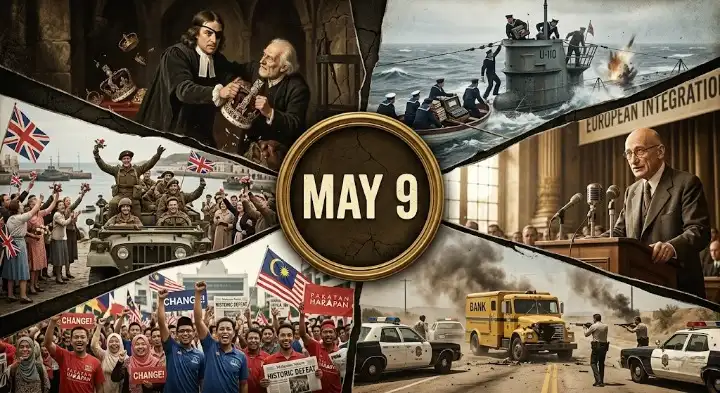
In the final weeks of 1941, Royal Navy sailors spotted the German submarine U-110 struggling in the North Atlantic. They didn’t just sink it; they boarded the vessel, snatching a pristine Enigma machine and the secret codebooks that had kept Allied intelligence in the dark. It changed the entire trajectory of World War II. May 9 is a date defined by such turning points, from the end of the war in Europe to the political unification of a continent. Here is what happened on this day in history May 9.
🎉 Quick Facts — May 9 in History
| 📌 Category | 📖 Event / Detail |
|---|---|
| 🌟 Most Significant Event | Victory Day / End of WWII in Europe (1945) |
| 📊 Total Major Events | 35+ |
| ⚔️ Key Battles | Battle of Heligoland (1864) |
| 👤 Key Figures | Robert Schuman, Andrew Johnson, Richard Nixon, Imran Khan}- |
| 🌍 Observances | Europe Day, Victory Day, Goku Day |
Story of the Day: The Birth of the European Union
Robert Schuman, the French Foreign Minister, stood before a crowded press conference in Paris on May 9, 1950, with a radical proposal to prevent another total war. He suggested placing French and West German coal and steel production under a single authority. This wasn’t just about resources; it was about making war between these historic rivals “not merely unthinkable, but materially impossible.” His declaration laid the foundation for the European Coal and Steel Community, the entity that eventually blossomed into the European Union. Today, the bloc celebrates Europe Day to honor this vision.
Important Events That Happened On May 9 In History
328 – Election of Patriarch Athanasius
Alexandrian church bells rang as a 30-year-old deacon named Athanasius ascended the patriarchal throne of Alexandria, succeeding his mentor Alexander. Church leaders chose him to safeguard orthodox Christian doctrine against the surging Arian heresy that threatened to fracture the Roman Empire. This election sparked decades of theological warfare, resulting in Athanasius being exiled five separate times by various emperors. His steadfast defense of Christ’s divinity shaped the core tenets of the Nicene Creed, cementing his enduring legacy as a doctor of the church.
1009 – Lombard Revolt in Bari
Melus, a wealthy Lombard nobleman, gathered a small band of armed insurgents in the streets of Bari to launch a sudden uprising against the Byzantine governor of southern Italy. Decades of harsh imperial taxation and cultural suppression had pushed the local population to their breaking point. Byzantine troops quickly mobilized, turning the city into a bloody battleground as they fought to suppress the localized rebellion. Melus escaped north, eventually recruiting fierce Norman mercenaries whose subsequent arrival forever altered the geopolitical landscape of the Italian peninsula.
1310 – Consecration of Patriarch Nephon
Nephon, the esteemed Bishop of Cyzicus, knelt before the high altar of Constantinople to receive his sacred consecration as the new Ecumenical Patriarch. Imperial politics and deep internal rifts had left the eastern church fractured and desperate for an administrative reformer. Nephon immediately launched an aggressive anti-corruption campaign, removing venal clergymen and stabilizing the patriarchate’s depleted finances. His brilliant tenure lasted only four years before court intrigues forced his abdication, plunging the Byzantine religious establishment back into chaos.
1386 – Ratification of the Treaty of Windsor
King John I of Portugal and King Richard II of England signed a parchment document in Windsor, sealing a permanent military alliance with oaths of perpetual friendship. Heavy French pressure and Spanish expansionism had forced both kingdoms to seek a reliable maritime and defensive partner. English longbowmen had already helped the Portuguese secure their crown, proving the practical value of this mutual defense pact. This historic agreement created the oldest continuous diplomatic alliance in human history, one that remained unbroken through both World War campaigns.
1450 – Assassination of ‘Abd al-Latif
Timurid ruler ‘Abd al-Latif sat in his palace apartments when a group of heavily armed conspirators, sent by disgruntled local nobles, burst through the doors. The ambitious monarch had held the throne for mere months after ordering the brutal murder of his own father, the famous astronomer-king Ulugh Beg. This swift retaliatory strike brought an end to his tyrannical rule before he could consolidate full military control over Samarkand. His violent demise triggered a devastating civil war that permanently weakened the Timurid Empire’s hold on Central Asia.
1502 – Fourth Voyage of Columbus
Christopher Columbus walked down the docks of Cádiz, boarding his flagship Capitana to begin his final voyage across the Atlantic Ocean. The aging explorer had lost his titles, his health, and much of his royal favor, yet he remained determined to find a passage to the Indian Ocean. Four small, aging caravels sailed out into the open sea, carrying a crew of eager teenage sailors and veteran mariners. This difficult expedition resulted in the mapping of Central America, though Columbus returned to Spain broken, impoverished, and blind.
1540 – Expedition of Hernando de Alarcón
Spanish explorer Hernando de Alarcón stood on the deck of his vessel as two caravels hoisted their sails and glided away from the port of Acapulco. Viceroy Antonio de Mendoza had ordered Alarcón to sail up the uncharted coastline to support Francisco Vázquez de Coronado’s land expedition. Alarcón braved treacherous currents to navigate his small fleet directly into the mouth of the Gulf of California. This voyage established that Baja California was a peninsula rather than an island, and Alarcón became the first European to explore the lower Colorado River.
1645 – Battle of Auldearn
James Graham, the Marquis of Montrose, deployed his Royalist Highland regiments along the ridges of Auldearn to ambush an approaching Covenanter army under John Urry. The Covenanters attacked during a blinding rainstorm, confident that their superior numbers would easily crush the king’s supporters. Montrose used the rolling terrain to shield his forces before launching a devastating flank attack with his screaming clan infantrymen. This stunning victory broke the Covenanter grip on northern Scotland, securing a brilliant tactical triumph for King Charles I.
1662 – First Appearance of Mr. Punch
Italian puppeteer Pietro Gimonde set up a small canvas booth in London’s bustling Covent Garden and introduced a hook-nosed puppet named Pulcinella to the English public. Famous diarist Samuel Pepys paused to watch the raucous performance, recording his amusement at the strange, energetic figure in his personal journal. The grotesque character quickly adapted to English tastes, morphing into the violent, anti-authority figure known as Mr. Punch. This performance marked the birth of the iconic Punch and Judy show, a tradition that shaped British seaside entertainment for centuries.
1671 – Theft Attempt of Crown Jewels
Thomas Blood, wearing the robes of a country clergyman, convinced the keeper of the Tower of London to open the heavy iron grate protecting the Crown Jewels. Once inside the vault, Blood knocked the elderly keeper unconscious, flattened the royal crown with a wooden mallet, and stuffed the sovereign’s orb into his breeches. Tower guards raised the alarm before the thieves could reach their horses, tackling Blood as he fled down the stone wharves. King Charles II found the audacity of the crime so amusing that he pardoned Blood and granted him Irish land rewards.
1726 – Executions at Tyburn
Five condemned men stood in the back of an open wooden cart as it rolled toward the triple gallows of Tyburn under heavy guard. London constables had arrested them during a brutal raid on Mother Clap’s molly house, an underground gathering place for the city’s homosexual community. A hostile, jeering crowd watched as executioners placed ropes around the necks of the prisoners. The state used these public hangings to terrorize sexual minorities, enforcing strict sodomy laws that remained active in England for more than a century.
1761 – Exhibition of the Society of Artists
Eager patrons crowded into the elegant rooms of Spring Gardens in London as the Society of Artists opened their first official public art exhibition. Renowned painter William Hogarth helped organize the event to showcase domestic talent without relying on elite aristocratic patronage. Visitors paid a shilling for catalogs, marveling at dozens of original landscapes, portraits, and modern sculptures. This groundbreaking exhibition proved that a commercial public market could sustain fine art, directly inspiring the creation of the Royal Academy.
1864 – Battle of Heligoland
Captain Edouard Suenson stood on the bridge of the Danish frigate Niels Juel, directing heavy broadsides against a combined Austrian and Prussian squadron off the German coast. The Austro-Prussian ships sought to break the effective Danish naval blockade of Germany’s northern ports during the Second Schleswig War. Shellfire tore through the Austrian flagship Schwarzenberg, setting its canvas sails ablaze and forcing the allied fleet to flee to neutral waters. This engagements marked the last major naval battle fought by wooden sailing fleets, securing a brilliant tactical victory for Denmark.
1865 – Surrender of Nathan Bedford Forrest
Confederate General Nathan Bedford Forrest gathered his exhausted cavalrymen in an open field near Gainesville, Alabama, to read his final military order. Union armies had shattered the Southern rebellion, leaving Forrest’s cavalry corps isolated, outmaneuvered, and completely depleted of ammunition. The brilliant but controversial commander advised his men to accept the hard reality of defeat and become peaceful citizens. This surrender brought an end to all organized Confederate military resistance east of the Mississippi River, closing a dark chapter of the American Civil War.
1865 – Proclamation of President Andrew Johnson
President Andrew Johnson signed a sweeping executive decree at the White House, officially withdrawing all belligerent rights from the defeated Confederate states. The proclamation warned international governments that foreign ports would be closed to any Confederate vessels still roaming the seas. Johnson ordered the immediate international internment or expulsion of all remaining rebel warships, treating them as lawless pirate vessels. This political move cut off the last lifelines of the Southern rebellion, cementing global recognition of a unified United States.
1873 – Vienna Stock Exchange Crash
Anxious traders panicked on the floor of the Vienna Stock Exchange as the sudden collapse of several overextended banks triggered frantic, uncontrolled selling. Dubbed “Der Krach,” this financial meltdown exposed years of rampant speculation and fraudulent corporate bookkeeping following the Unification of Germany. The panic spread across Europe within hours, causing hundreds of financial institutions to close their doors permanently. This crash marked the beginning of the Panic of 1873, plunging the global economy into the devastating Long Depression.
1877 – Romanian Declaration of Independence
Foreign Minister Mihail Kogălniceanu stepped up to the rostrum of the Chamber of Deputies in Bucharest to read a historic declaration of absolute sovereignty. Romanian leaders seized the opportunity presented by the Russo-Turkish War to break their centuries-old status as a vassal state to the Ottoman Empire. The parliament voted unanimously to approve the document, and the state immediately mobilized its army to fight alongside Russian forces. This declaration established the modern independent state of Romania, a milestone celebrated annually as the nation’s principal holiday.
1901 – Opening of Australian First Parliament
Duke Cornwall and York stood before a massive crowd of twelve thousand dignitaries inside Melbourne’s Royal Exhibition Building to open Australia’s first national parliament. Six separate British colonies had recently united to form a single, independent Commonwealth. Prime Minister Edmund Barton watched as the new federal representatives took their official oaths of office. This grand ceremony marked the political birth of modern Australia, establishing a democratic government tasked with managing an entire continent.
1915 – Second Battle of Artois
French General Victor d’Urbal ordered a massive infantry assault against entrenched German lines along the ridges of Vimy in northern France. A four-hour artillery bombardment had pounded the enemy positions, turning the landscape into a cratered wasteland. French colonial troops charged forward through heavy machine-gun fire, capturing key trenches before German counterattacks halted their advance. This bloody offensive resulted in more than one hundred thousand casualties, demonstrating the horrific human cost of deadlocked trench warfare.
1918 – Second Ostend Raid
Commodore Hubert Lynes guided the old British cruiser HMS Vindictive through thick sea fog toward the narrow harbor entrance of German-occupied Ostend, Belgium. The Royal Navy sought to sink the concrete-filled vessel directly across the shipping channel to block deadly German U-boats from reaching the sea. German shore batteries opened a devastating fire, shattering the cruiser’s bridge and killing its commander. The crew successfully grounded the ship in the channel before fleeing on motor launches, scoring a brave but partial tactical success.
1920 – Polish Victory Parade in Kiev
General Edward Rydz-Śmigły sat on his horse along Khreshchatyk Boulevard, watching thousands of Polish and Ukrainian soldiers march through the captured streets of Kiev. Polish forces had launched a rapid offensive to push back the Red Army and help establish an independent Ukrainian state. Local residents cheered the arriving troops, throwing spring flowers onto the passing military vehicles. This parade marked the high-water mark of the Polish-Soviet War, preceding a massive Soviet counteroffensive that drove deep into Poland.
1926 – Richard E. Byrd North Pole Flight
Aviation pioneer Richard E. Byrd and pilot Floyd Bennett climbed out of their three-engine Fokker monoplane at Kings Bay, Spitsbergen, claiming they had just flown over the North Pole. A cheering public celebrated the crew as international heroes, and the United States government awarded Byrd the Medal of Honor. Skeptical experts questioned the flight’s short duration, arguing the aircraft lacked the speed to cover the distance in fifteen hours. The subsequent discovery of Byrd’s original flight diary revealed erased navigational calculations, throwing serious doubt on their achievement.
1927 – Opening of Old Parliament House
Prince Albert, the Duke of York, turned a golden key to open the doors of Australia’s new Provisional Parliament House in the capital city of Canberra. The federal government had outgrown its temporary home in Melbourne, necessitating a relocation to this purpose-built capital city. Dame Nellie Melba sang the national anthem before politicians entered the chamber for their first official legislative session. This building served as the intense heart of Australian democracy for sixty years, witnessing the country’s transformation into a modern power.
1936 – Italian Annexation of Ethiopia
Benito Mussolini stood on the balcony of the Palazzo Venezia in Rome, announcing to a roaring crowd that Italy had formally annexed the Empire of Ethiopia. Italian armies had captured the capital city of Addis Ababa four days earlier, forcing Emperor Haile Selassie into exile. Mussolini declared the rebirth of a fascist Roman Empire, defying condemnation and economic sanctions from the League of Nations. This aggressive conquest exposed the complete helplessness of international security organizations, accelerating the global descent toward world war.
1941 – Capture of German U-boat U-110
British destroyers depth-charged the German submarine U-110 in the North Atlantic, forcing the damaged vessel to surface amidst heavy gunfire. Sailors from HMS Bulldog boarded the abandoned submarine, recovering an intact naval Enigma machine along with its vital settings and codebooks. The top-secret operation remained concealed from German intelligence, allowing Allied cryptographers at Bletchley Park to read encrypted Nazi naval radio traffic. This incredible intelligence coup allowed the Allies to reroute Atlantic convoys, saving hundreds of merchant ships.
1942 – Holocaust Executions in Ukraine
SS execution squads, assisted by local auxiliary police, rounded up 588 Jewish residents in the Podolian town of Zinkiv and marched them to nearby pits. The victims were forced to strip before being shot, their bodies tumbling into mass graves prepared outside the village. That same day, Nazi forces liquidated the Zoludek Ghetto in Belarus, deporting or killing every single inhabitant. These coordinated actions formed part of the systematic campaign known as the Holocaust by Bullets, which erased entire communities across Eastern Europe.
1945 – Liberation of the Channel Islands
British troops aboard the destroyer HMS Bulldog arrived in the harbors of Guernsey and Jersey to accept the surrender of the isolated German garrisons. The Channel Islands had endured five difficult years of harsh German military occupation, leaving the civilian population starving. Delighted islanders flooded the stone piers, waving Union Jacks and cheering the arriving British soldiers. This peaceful liberation removed the final vestige of Nazi control over British territory, bringing an end to World War II in Western Europe.
1946 – Abdication of King Victor Emmanuel III
King Victor Emmanuel III signed his official abdication papers in Rome, stepping down from the Italian throne in a desperate attempt to save the monarchy. The aging king had lost the respect of his citizens due to his long collaboration with Benito Mussolini’s fascist regime. His son Umberto II immediately ascended the throne as the new King of Italy. This last-minute political maneuver failed to sway public opinion, and Italians voted to abolish the monarchy in a national referendum less than a month later.
1948 – Czechoslovak Ninth-of-May Constitution
The Czechoslovak National Assembly gathered in Prague to approve a new constitution, declaring the nation a people’s democratic republic. The document followed a communist coup, embedding Soviet-style economic and political structures into the country’s legal system. President Edvard Beneš refused to sign the document, resigning his office rather than validating the destruction of Czech democracy. This constitution institutionalized single-party communist rule, locking Czechoslovakia behind the Iron Curtain for four decades.
1950 – Presentation of Schuman Declaration
French Foreign Minister Robert Schuman called an unexpected press conference at the Quai d’Orsay to read a proposal for restructuring Europe’s industrial complex. Schuman proposed placing French and West German coal and steel production under a single, independent authority open to other European nations. This plan aimed to make future war between the historic rivals materially impossible by linking their heavy industries. The historic declaration succeeded, leading directly to the creation of the European Coal and Steel Community, the precursor to the European Union.
1955 – West Germany Joins NATO
Chancellor Konrad Adenauer stood before international diplomats in Paris as West Germany officially became the fifteenth member of the North Atlantic Treaty Organization. The United States and its allies sought to rearm the German state to counter the growing military threat posed by the Soviet Union. This integration deeply angered Soviet leaders, who viewed a rearmed Germany as an existential threat to Eastern Europe. Moscow responded days later by establishing the Warsaw Pact alliance, freezing the geopolitical division of the Cold War.
1960 – Approval of First Birth Control Pill
The United States Food and Drug Administration issued a brief public statement approving the drug Enovid for use as an oral contraceptive. Developed by Gregory Pincus and backed by activist Margaret Sanger, the pill offered women unprecedented control over their reproductive systems. Demand skyrocketed within months, transforming family planning and spark an immediate socioeconomic revolution worldwide. This regulatory decision reshaped the structure of modern society, expanding educational and career opportunities for generations of women.
1969 – Guerrilla Bank Heists in São Paulo
Former army captain Carlos Lamarca led a heavily armed cell of urban guerrillas into two major commercial banks in the heart of São Paulo. The insurgents neutralized security guards, seized large amounts of cash, and distributed anti-government pamphlets to stunned customers. Lamarca launched this raid to secure operational funding for the Vanguardia Popular Revolucionaria’s campaign against Brazil’s military dictatorship. This double robbery triggered an aggressive state manhunt, escalating political violence across Brazil during the regime’s harshest years.
1974 – Nixon Impeachment Hearings Open
Chairman Peter Rodino rapped his wooden gavel in a crowded congressional room, opening formal, public impeachment hearings against President Richard Nixon. The House Judiciary Committee sought to investigate Nixon’s involvement in the Watergate break-in and subsequent cover-up. National television networks broadcast the intense proceedings to millions of citizens, exposing deep systemic abuses of executive power. These historic hearings produced the bipartisan consensus that forced Nixon’s resignation three months later.
1979 – Execution of Habib Elghanian
A revolutionary firing squad stood in the courtyard of Tehran’s Qasr Prison, executing prominent Jewish businessman Habib Elghanian after a brief trial. The newly established Islamic court convicted the wealthy philanthropist of corruption and spying for Zionism. Elghanian’s sudden death sent a wave of terror through Iran’s ancient, integrated religious minorities. This state execution triggered a massive panic, prompting the immediate exodus of over three-quarters of Iran’s 100,000-strong Jewish community.
1980 – Sunshine Skyway Bridge Collapse
The massive Liberian freighter MV Summit Venture lost all visibility in a violent thunderstorm, drifting wildly out of the shipping channel in Florida’s Tampa Bay. The ship’s towering bow slammed directly into a support pier of the southbound Sunshine Skyway Bridge, causing a 430-meter section of steel span to collapse. Six passenger cars and a Greyhound bus plunged forty-six meters into the churning water below, killing thirty-five people. This disaster prompted engineers to install massive protective barriers around bridge supports worldwide.
1980 – Norco Bank Robbery Shoot-out
Five masked gunmen, armed with automatic weapons and thousands of ammunition rounds, raided a Security Pacific Bank in Norco, California. A routine police response escalated into a full-scale military engagement as the robbers laid down a heavy base of fire. The suspects fled in a hijacked truck, destroying thirty-three police vehicles with gunfire during a twenty-mile pursuit. Officers killed two gunmen, while one deputy died, forcing law enforcement agencies to upgrade their standard patrol weapons.
1987 – LOT Flight 5055 Crash
Captain Zygmunt Pawlaczyk fought the controls of his Soviet-built Ilyushin Il-62M airliner after an engine explosion tore through the aircraft’s tail section. The Warsaw-to-New York flight suffered a catastrophic fire, knocking out the primary flight controls and cabin pressure. Pawlaczyk attempted a desperate emergency landing at Warsaw’s Okęcie Airport, but the burning plane clipped trees and crashed into the Kabaty Woods. The disaster killed all 183 passengers and crew, marking the deadliest aviation accident in Polish history.
1988 – Opening of New Parliament House
Queen Elizabeth II stood on Capital Hill in Canberra to officially open Australia’s striking New Parliament House. Built directly into the land, the architectural design featured a massive four-legged stainless steel flagpole dominating the city skyline. The project cost more than one billion Australian dollars, replacing the outdated provisional building located down the hill. This grand opening marked the completion of Canberra’s original urban plan, providing a modern home for the Australian legislature.
1992 – Capture of Shusha
Armenian mountain forces launched a coordinated nocturnal assault against the strategic hilltop stronghold of Shusha in the Nagorno-Karabakh region. Azerbaijani forces had used the high-altitude town to rain continuous rocket fire onto nearby Armenian settlements. Armenian commandos scaled the cliffs, forcing the defenders into a hasty retreat down the southern mountain passes. This victory marked the major turning point of the First Nagorno-Karabakh War, shifting the balance of power in the region.
1992 – Westray Mine Disaster
A spark ignited a buildup of methane gas and volatile coal dust deep inside the Westray Mine in Plymouth, Nova Scotia. The resulting subterranean explosion tore through the underground shafts, instantly killing twenty-six miners working the night shift. Rescue teams braved toxic air and collapsing tunnels for days in a desperate attempt to find survivors. A subsequent public inquiry exposed systemic safety violations by corporate management, leading to sweeping changes in Canadian workplace safety laws.
1999 – New Orleans Mother’s Day Bus Crash
A commercial charter bus carrying fifty senior citizens toward a Mississippi casino veered across Interstate 10 in New Orleans, Louisiana. The vehicle careened down an embankment, smashing through a golf course fence before overturning in a dirt ditch. The violent impact killed twenty-two passengers and left twenty-two others, including the driver, with severe injuries. Federal investigators blamed the accident on the driver’s untreated medical conditions, resulting in stricter federal health evaluations for commercial interstate drivers.
2001 – Accra Sports Stadium Disaster
Anxious football fans panicked inside Accra’s main sports stadium when police fired tear gas canisters directly into the packed grandstands. The officers sought to quell a minor crowd disturbance following a controversial refereeing decision during a match between rivals Hearts of Oak and Asante Kotoko. Terrified spectators rushed toward the exit gates, only to find them chained shut from the outside. The resulting crush killed 129 people, marking the worst stadium disaster in African sports history.
2002 – End of Church of the Nativity Siege
Thirteen suspected Palestinian militants walked out of Bethlehem’s ancient Church of the Nativity, boarding a bus to begin permanent international exile. The move brought an end to a tense, 38-day military standoff with the Israeli army, which had surrounded the holy site. Franciscan friars and civilian civilians trapped inside survived on minimal food rations during the intense siege. European diplomats brokered the final deportation agreement, preventing the destruction of one of Christianity’s holiest shrines.
2018 – Defeat of Barisan Nasional Coalition
Malaysian voters lined up at polling stations, delivering a historic electoral defeat to the ruling Barisan Nasional political coalition. Led by Mahathir Mohamad, the opposition alliance capitalized on public anger surrounding the massive 1MDB international corruption scandal. The defeat ended Barisan Nasional’s unbroken 61-year rule, which began with Malaysia’s independence in 1957. This election marked the first democratic transition of executive power in the history of modern Malaysia.
2020 – COVID-19 Pandemic Economic Crisis
The United States Department of Labor released a catastrophic monthly report showing the national unemployment rate had jumped to 14.9 percent. Sweeping lockdown orders, designed to halt the spread of the COVID-19 virus, had shuttered businesses and brought economic activity to an abrupt halt. More than twenty million workers lost their jobs in a matter of weeks, destroying years of steady economic growth. This sudden collapse marked the sharpest economic contraction since the Great Depression.
2022 – Signing of Ukraine Lend-Lease Act
President Joe Biden sat at his desk in the Oval Office, signing the Ukraine Democracy Defense Lend-Lease Act into law. The legislation resurrected a famous World War II-era policy to expedite the shipment of heavy American military equipment to Eastern Europe. This move aimed to bypass bureaucratic hurdles as Ukraine fought to counter the ongoing Russian invasion. The signing ceremony sent a clear message of long-term Western commitment to European security.
2023 – May 9 Riots in Pakistan
Paramilitary forces burst into the Islamabad High Court, arresting former Prime Minister Imran Khan on corruption charges while he attended a legal hearing. News of the arrest triggered immediate, violent protests across the country as thousands of supporters took to the streets. Demonstrators targeted sensitive military installations, storming the army headquarters in Rawalpindi and setting a commander’s residence in Lahore. This unprecedented unrest led to a massive state crackdown, permanently altering Pakistan’s political landscape.
Don’t stop now—see what history held for us yesterday.
Famous People Born On May 9
| Name | Description | Date |
|---|---|---|
| János Batsányi | Hungarian political poet of French Revolutionary era | May 9, 1763 – May 12, 1845ERC20ERC20 |
| J.-C.-L. Simonde de SismondiERC20ERC20 | Swiss economist, critic of unchecked industrialismERC20ERC20 | May 9, 1773 – June 25, 1842ERC20ERC20 |
| Jacob Jennings BrownERC20ERC20 | U.S. general, “the fighting Quaker” of War of 1812ERC20ERC20 | May 9, 1775 – February 24, 1828ERC20ERC20 |
| James Pollard EspyERC20ERC20 | American meteorologist, cloud thermodynamicsERC20ERC20 | May 9, 1785 – January 24, 1860ERC20ERC20 |
| Samuel CousinsERC20ERC20 | English mezzotint engraver, interpreter of Sir Thomas LawrenceERC20ERC20 | May 9, 1801 – May 7, 1887ERC20ERC20 |
| Sir Frederick Aloysius WeldERC20ERC20 | Prime minister of New Zealand (1864–65)ERC20ERC20 | May 9, 1823 – July 20, 1891ERC20ERC20 |
| Harriet LaneERC20ERC20 | Acting American first lady, niece of James BuchananERC20ERC20 | May 9, 1830 – July 3, 1903ERC20ERC20 |
| Belle BoydERC20ERC20 | Confederate spy during American Civil WarERC20ERC20 | May 9, 1844 – June 11, 1900ERC20ERC20 |
| Carl Gustaf Patrik de LavalERC20ERC20 | Swedish engineer, high-speed turbine pioneerERC20ERC20 | May 9, 1845 – February 2, 1913ERC20ERC20 |
| Rudolph FisherERC20ERC20 | Harlem Renaissance writer of Black urban lifeERC20ERC20 | May 9, 1897 – December 26, 1934ERC20ERC20 |
| Harold WagstaffERC20ERC20 | English rugby player, “Prince of Centres”ERC20ERC20 | May 9, 1891 – 1939?ERC20ERC20 |
| Frederick J. TeggartERC20ERC20 | Irish-born American historian, scientific method to historyERC20ERC20 | May 9, 1870 – October 12, 1946ERC20ERC20 |
| Lilian Mary BaylisERC20ERC20 | English theatre manager, Old Vic founderERC20ERC20 | May 9, 1874 – November 25, 1937ERC20ERC20 |
| Gilbert Ames BlissERC20ERC20 | American mathematician, calculus of variationsERC20ERC20 | May 9, 1876 – May 8, 1951ERC20ERC20 |
| Henry J. KaiserERC20ERC20 | American industrialist, founded Kaiser Aluminum and SteelERC20ERC20 | May 9, 1882 – August 24, 1967ERC20ERC20 |
| José Ortega y GassetERC20ERC20 | Spanish philosopher and humanistERC20ERC20 | May 9, 1883 – October 18, 1955ERC20ERC20 |
| Pancho GonzalesERC20ERC20 | American tennis champion, 8-time U.S. professional championERC20ERC20 | May 9, 1928 – July 3, 1995ERC20ERC20 |
| Barbara Ann ScottERC20ERC20 | Canadian figure skater, first North American world championERC20ERC20 | May 9, 1928 – September 30, 2012ERC20ERC20 |
| James L. BrooksERC20ERC20 | American screenwriter, director, and producerERC20ERC20 | May 9, 1940 – PresentERC20ERC20 |
| John AshcroftERC20ERC20 | U.S. attorney general (2001–05)ERC20ERC20 | May 9, 1942 – PresentERC20ERC20 |
| Vince CableERC20ERC20 | British Liberal Democrat leader (2017–19)ERC20ERC20 | May 9, 1943 – PresentERC20ERC20 |
| Candice BergenERC20ERC20 | American actress, Murphy BrownERC20ERC20 | May 9, 1946 – PresentERC20ERC20 |
| Yukiya AmanoERC20ERC20 | Japanese diplomat, IAEA director general (2009–19)ERC20ERC20 | May 9, 1947 – July 18, 2019ERC20ERC20 |
| Michael LevittERC20ERC20 | American-British-Israeli chemist, Nobel Prize (2013)ERC20ERC20 | May 9, 1947 – PresentERC20ERC20 |
| Billy JoelERC20ERC20 | American singer-songwriter, “Piano Man”ERC20ERC20 | May 9, 1949 – PresentERC20ERC20 |
| Joy HarjoERC20ERC20 | American poet, first Native American U.S. poet laureateERC20ERC20 | May 9, 1951 – PresentERC20ERC20 |
| Jorie GrahamERC20ERC20 | American poetERC20ERC20 | May 9, 1951 – PresentERC20ERC20 |
| Anne Sofie von OtterERC20ERC20 | Swedish mezzo-sopranoERC20ERC20 | May 9, 1955 – PresentERC20ERC20 |
| Steve YzermanERC20ERC20 | Canadian ice hockey player, Detroit Red Wings captainERC20ERC20 | May 9, 1965 – PresentERC20ERC20 |
| Nicolas GhesquièreERC20ERC20 | French fashion designer, Balenciaga and Louis VuittonERC20ERC20 | May 9, 1971 – PresentERC20ERC20 |
Famous People Died On May 9
| Name | Description | Date |
|---|---|---|
| Julius NeposERC20ERC20 | Last legitimate Western Roman emperor (474–75)ERC20ERC20 | Unknown – May 9, 480ERC20ERC20 |
| Magnus VIERC20ERC20 | King of Norway (1263–80), legal reformerERC20ERC20 | 1238 – May 9, 1280ERC20ERC20 |
| Francis Russell, 4th earl of BedfordERC20ERC20 | English nobleERC20ERC20 | 1593 – May 9, 1641ERC20ERC20 |
| William BradfordERC20ERC20 | Governor of Plymouth colony for 30 yearsERC20ERC20 | March 1590 – May 9, 1657ERC20ERC20 |
| Luis de MoralesERC20ERC20 | Spanish Mannerist painter, “El Divino”ERC20ERC20 | c.1509 – May 9, 1586ERC20ERC20 |
| Dietrich BuxtehudeERC20ERC20 | Danish-German organist and composerERC20ERC20 | 1637 – May 9, 1707ERC20ERC20 |
| Charles AvisonERC20ERC20 | English composer and writer on musicERC20ERC20 | February 16, 1709 – May 9, 1770ERC20ERC20 |
| Nikolaus Ludwig, count von ZinzendorfERC20ERC20 | German Pietist religious leaderERC20ERC20 | 1700 – May 9, 1760ERC20ERC20 |
| Thomas-Arthur, comte de LallyERC20ERC20 | French general, executed for loss in IndiaERC20ERC20 | January 13, 1702 – May 9, 1766ERC20ERC20 |
| Paolo RuffiniERC20ERC20 | Italian mathematician, group theory pioneerERC20ERC20 | September 22, 1765 – May 9, 1822ERC20ERC20 |
| Benjamin LincolnERC20ERC20 | Continental army officer in American RevolutionERC20ERC20 | January 24, 1733 – May 9, 1810ERC20ERC20 |
| Jean-Baptiste Vaquette de GribeauvalERC20ERC20 | French artillery engineerERC20ERC20 | September 15, 1715 – May 9, 1789ERC20ERC20 |
| Joseph-Louis Gay-LussacERC20ERC20 | French chemist and physicist, gas behavior pioneerERC20ERC20 | December 6, 1778 – May 9, 1850ERC20ERC20 |
| Samuel Griswold GoodrichERC20ERC20 | American author, “Peter Parley” children’s booksERC20ERC20 | August 19, 1793 – May 9, 1860ERC20ERC20 |
| Jacques-Joseph Champollion-FigeacERC20ERC20 | French paleographer, brother of Jean-FrançoisERC20ERC20 | October 5, 1778 – May 9, 1867ERC20ERC20 |
| George BrownERC20ERC20 | Canadian journalist and politician, federalism advocateERC20ERC20 | November 29, 1818 – May 9, 1880ERC20ERC20 |
| C.W. PostERC20ERC20 | American industrialist, breakfast cereal pioneerERC20ERC20 | October 26, 1854 – May 9, 1914ERC20ERC20 |
| Paul-Louis-Toussaint HéroultERC20ERC20 | French chemist, invented electric-arc furnaceERC20ERC20 | April 10, 1863 – May 9, 1914ERC20ERC20 |
| Thomas Wentworth HigginsonERC20ERC20 | American abolitionist and reformerERC20ERC20 | December 22, 1823 – May 9, 1911ERC20ERC20 |
| Conrad SchlumbergerERC20ERC20 | German geophysicist, co-founder of SchlumbergerERC20ERC20 | October 2, 1878 – May 9, 1936ERC20ERC20 |
| Humfry PayneERC20ERC20 | English archaeologist, NecrocorinthiaERC20ERC20 | February 19, 1902 – May 9, 1936ERC20ERC20 |
| Tanaka ŌdōERC20ERC20 | Japanese philosopher, introduced pragmatism to JapanERC20ERC20 | 1867 – May 9, 1932ERC20ERC20 |
| A.A. MichelsonERC20ERC20 | German-born American physicist, Nobel Prize (1907)ERC20ERC20 | December 19, 1852 – May 9, 1931ERC20ERC20 |
| Dame Ethel SmythERC20ERC20 | British composer and suffragetteERC20ERC20 | April 22, 1858 – May 9, 1944ERC20ERC20 |
| Ezio PinzaERC20ERC20 | Italian-born operatic bassERC20ERC20 | May 18, 1892 – May 9, 1957ERC20ERC20 |
| Sir Charles Vyner de Windt BrookeERC20ERC20 | Last White Rajah of SarawakERC20ERC20 | September 26, 1874 – May 9, 1963ERC20ERC20 |
| Harold GrayERC20ERC20 | American cartoonist, “Little Orphan Annie”ERC20ERC20 | January 20, 1894 – May 9, 1968ERC20ERC20 |
| Albert LewinERC20ERC20 | American film director and producerERC20ERC20 | September 23, 1894 – May 9, 1968ERC20ERC20 |
| Walter ReutherERC20ERC20 | American labor leader, UAW presidentERC20ERC20 | September 1, 1907 – May 9, 1970ERC20ERC20 |
| James JonesERC20ERC20 | American novelist, From Here to EternityERC20ERC20 | November 6, 1921 – May 9, 1977ERC20ERC20 |
Observances on May 9
- Europe Day: Celebrated across the European Union, Kosovo, Moldova, and Ukraine to honor the historic Schuman Declaration of 1950.
- Victory Day: Observed in Russia, Belarus, Azerbaijan, Israel, and several former Soviet republics to mark the surrender of Nazi Germany in 1945.
- Home Front Heroes Day: A regional US observance, celebrated in Dallas, Texas, to recognize the sacrifices of civilian workers during wartime.
- Goku Day: An official Japanese celebration honoring the famous fictional character Goku from the Dragon Ball franchise, based on the numbers 5 and 9 sounding like his name.
🎉 Frequently Asked Questions — May 9 in History
British sailors from HMS Bulldog boarded the crippled German submarine U-110 in the Atlantic Ocean, recovering an intact Enigma machine along with its naval codebooks. This top-secret operation allowed Allied cryptographers at Bletchley Park to decipher German naval communications, turning the tide of the Battle of the Atlantic.
The most significant event is the presentation of the Schuman Declaration in 1950, which united French and German coal and steel production under a single authority. This single diplomatic agreement prevented future European wars and led directly to the creation of the European Union.
Legendary American singer-songwriter Billy Joel was born on May 9, 1949, in the Bronx, New York. He achieved international fame with iconic hits like “Piano Man” and became one of the best-selling music artists of all time.
The Second Battle of Artois began on May 9, 1915, when French forces launched a massive infantry assault against entrenched German positions at Vimy Ridge during World War I. The bloody offensive resulted in more than one hundred thousand casualties.
Europe Day is an annual celebration held on May 9 to honor peace and unity across the European continent. It marks the anniversary of the Schuman Declaration of 1950, which laid the foundation for modern European integration.
On May 9, 2023, the arrest of former Prime Minister Imran Khan triggered widespread riots across Pakistan, leading to attacks on key military installations. The unprecedented unrest resulted in a sweeping state crackdown and major political shifts.