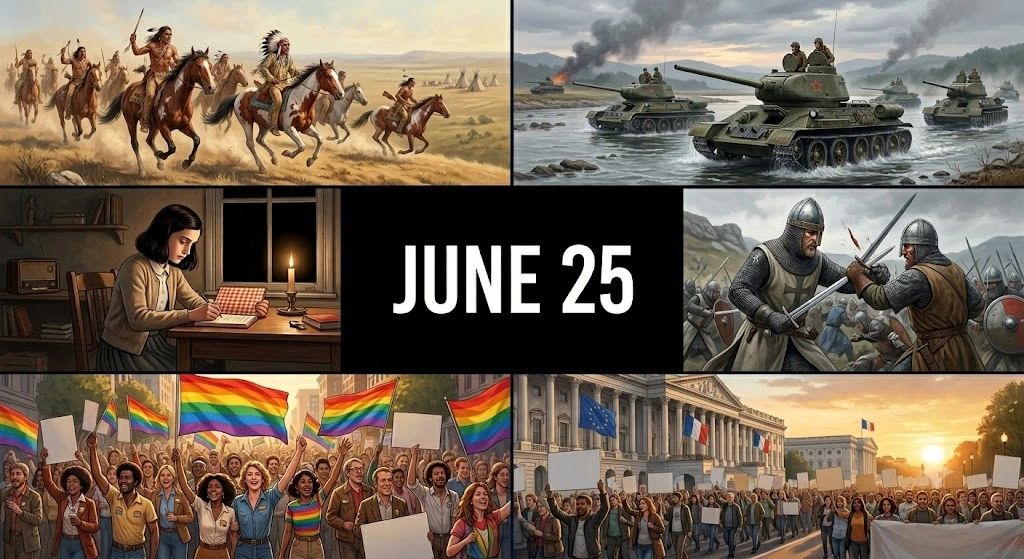
Sitting Bull watched his warriors assemble along the greasy grass of the Little Bighorn River, knowing the bluecoated soldiers were marching straight into a trap. Lieutenant Colonel George Custer pushed his men forward without rest, fueled by ambition and reckless confidence. Dust choked the Montana air as hundreds of Lakota, Cheyenne, and Arapaho horsemen surrounded the isolated cavalry detachment. By nightfall, Custer and every single man under his direct command lay dead on the prairie. Understanding what happened on June 25 in history starts with this shattering clash of cultures.
📅 Quick Facts — June 25 in History
| 📌 Category | 📖 Event / Detail |
|---|---|
| 🌟 Most Significant Event | Battle of the Little Bighorn (1876) |
| 🏆 Top 10 Key Events | • Franks defeated at Vézeronce (524) • Fontenay-en-Puisaye civil war (841) • Augsburg Confession presented (1530) • Virginia joins the Union (1788) • Little Bighorn clash (1876) • Dunhuang cave texts found (1900) • Anne Frank’s diary printed (1947) • Korean War begins (1950) • Mozambique wins independence (1975) • Yugoslavia fractures as Slovenia and Croatia exit (1991) |
| ⚔️ Key Battles | Battle of Vézeronce, Battle of Fontenay-en-Puisaye, Battle of Acre, Battle of Crotoy, Battle of Rio Nuevo, Battle of the Little Bighorn, Battle of Tali-Ihantala, Battle of Cherbourg, Battle of Sievierodonetsk |
| 👤 Key Figures | Sitting Bull, Anne Frank, Indira Gandhi, Kim Campbell |
| 🌍 Observances | Statehood Day (Slovenia), Independence Day (Mozambique), Independence Day (Microatia), National Catfish Day (United States), Statehood Day (Virginia), Teacher’s Day (Guatemala), World Vitiligo Day |
Story of the Day: The Cold War Explodes in Korea
Heavy artillery opened fire across the 38th Parallel at dawn, shattering the morning peace and plunging the Korean Peninsula into total war. North Korean troops surged south across the border, utilizing Soviet-built tanks to smash through poorly equipped South Korean defensive positions. General Secretary Kim Il-sung gambled that Washington would not intervene to save the southern regime. President Harry Truman shocked the world by ordering American military forces into action within days, turning a localized civil dispute into a global proxy conflict. This sudden invasion launched a brutal three-year war that cost millions of lives and permanently divided the peninsula.
Important Events That Happened On June 25 In History
524 – Battle of Vézeronce
King Chlodomer led his Frankish warriors into the heart of Burgundy, hungry for territorial conquest and dynastic glory. The fierce Burgundian defenders stood their ground, trapping the overconfident king amidst the chaotic, bloody melee. Frankish momentum collapsed entirely when Chlodomer was slain and his severed head was displayed on a pike. Burgundy preserved its fragile independence for another decade, halting the relentless Merovingian expansion across Gaul.
841 – Battle of Fontenay-en-Puisaye
Charles the Bald aligned his armored knights alongside Louis the German to break the supreme imperial claims of their brother, Lothair. Thousands of Carolingian soldiers slaughtered one another in a desperate civil war that tore Charlemagne’s old empire apart. Lothair retreated from the bloody field, his dreams of total dominance shattered forever. The devastating slaughter forced the brothers to sign the Treaty of Verdun, drawing the linguistic boundaries of modern France and Germany.
1258 – War of Saint Sabas:
Lorenzo Tiepolo steered his Venetian war galleys directly into the crowded harbor of Acre, gunning for the rival Genoese naval blockade. Ramming speed and superior seamanship allowed the outnumbered Venetians to break through the enemy lines, sinking or capturing half the opposing fleet. Genoese sailors abandoned their burning ships, leaving their fortified colony in the Levant completely exposed. Venice secured total commercial dominance over the lucrative Eastern Mediterranean trade routes for generations.
1357 – The battle of Crotoy
English sailors intercepted a desperate French supply fleet attempting to slip provisions into the starving, surrounded garrison at Calais. Wooden hulls smashed together in the choppy waters off Crotoy as English longbowmen rained arrows down upon the French decks. The entire relief effort dissolved into chaos, forcing the French ships to scatter or surrender. Deprived of food, the desperate defenders of Calais surrendered their keys to King Edward III just weeks later.
1401 – Schaffhausen massacre:
Town magistrates bound thirty Jewish residents to wooden stakes after torturing them into confessing to a fabricated ritual murder. Fanatical crowds cheered as the executioners lit the fires, burning the innocent community members alive based entirely on religious hysteria. Property owned by the victims was immediately seized by the city to pay off pressing municipal debts. This brutal massacre foreshadowed centuries of systemic violence against European Jewish populations during times of economic crisis.
1530 – Augsburg Confession
Chancellor Christian Beyer stood before Emperor Charles V and read aloud twenty-eight pillars of Protestant faith in a booming voice. German princes risked execution for heresy by publically backing this bold theological break from the Roman Catholic Church. Charles V refused to accept the document, demanding a total return to traditional Catholic obedience. The defiant declaration became the foundational creed of the Lutheran reformation, splitting Western Christendom permanently.
1658 – Spanish forces fail to retake Jamaica
Edward D’Oyley led an aggressive amphibious assault against a fortified Spanish stockade hidden along the northern cliffs of Jamaica. Spanish defenders fought desperately to reclaim their lost island colony, but English discipline quickly breached the defensive walls. The surviving Spanish soldiers fled into the dense interior jungle, abandoning their heavy artillery pieces and provisions. England cemented its strategic military foothold in the Caribbean, turning Jamaica into a bustling hub for privateers and sugar plantations.
1678 – Elena Cornaro Piscopia first woman awarded a doctorate of philosophy
Elena Cornaro Piscopia stood before a massive crowd of European scholars, speaking fluently in Latin as she defended her complex philosophical theses. University officials initially refused to grant her a theology degree simply because of her gender, offering philosophy as a reluctant compromise. The assembled professors awarded her the doctoral laurel wreath by a unanimous vote of approval. Her historic academic triumph cracked open the doors of higher education for women across the Western world.
1741 – Maria Theresa is crowned Queen of Hungary
Maria Theresa rode a white charger up the coronation hill in Pressburg, brandishing the ancient sovereign sword toward the four cardinal directions. Hungarian nobles cheered the young Habsburg ruler, setting aside their traditional prejudices against female governance in exchange for political concessions. Rival European empires had already invaded her territories, betting she would crumble under military pressure. Her iron display of sovereignty rallied the Hungarian army, preserving her crown during the grueling War of the Austrian Succession.
1786 – Gavriil Pribylov discovers St. George Island of the Pribilof Islands in the Bering Sea
Gavriil Pribylov navigated his storm-battered fur-hunting vessel through a dense, blinding fog bank in the middle of the northern seas. The crew followed the loud, echoing barks of millions of northern fur seals straight to an uncharted island coastline. Russian merchants immediately established permanent hunting outposts on the isolated shores, enslaving indigenous Aleut workers to harvest the lucrative pelts. This voyage sparked an environmental slaughter that pushed the regional fur seal population to the brink of absolute extinction.
1788 – Virginia becomes the tenth state to ratify the United States Constitution
Patrick Henry thundered against federal overreach during a heated convention debate, warning that the new constitution threatened individual liberties. James Madison countered with brilliant political logic, promising a comprehensive bill of rights to secure the narrow 89-79 victory for ratification. Virginia’s entry into the constitutional framework provided the young republic with its largest population and richest economy. The historic vote ensured the new federal government possessed the geopolitical weight required to actually survive.
1848 – A photograph of the June Days uprising becomes the first known instance of photojournalism
An anonymous photographer dragged a heavy camera apparatus to a Parisian window, capturing a stark image of barricades blocking the deserted streets. Working-class revolutionaries lay dead or hiding behind the makeshift fortifications just before the military launched a clearing assault. The grainy silver-plate image stripped away the romanticized myths of urban warfare, showing the cold reality of civil conflict. This single picture altered how humanity documents current events, creating the modern medium of visual news reporting.
1876 – Battle of the Little Bighorn
Lieutenant Colonel George Custer ordered his fragmented cavalry regiment to charge a massive Native American encampment along the Little Bighorn River. Crazy Horse led a ferocious counterassault that completely surrounded the tactical position, cutting down the troopers in a matter of hours. News of the total military annihilation shocked the American public during Centennial celebrations, prompting a wave of national grief. The sweeping tactical victory marked the final, desperate stand for the free plains tribes before total forced reservation confinement.
1900 – Wang Yuanlu discovers the Dunhuang manuscripts
Wang Yuanlu cleared away mountains of drifting sand from a hidden walled chamber inside the ancient Mogao Cave complex. His flashlight revealed thousands of tightly rolled paper scrolls, silk paintings, and artifacts preserved by the dry desert air for centuries. Western archaeologists soon arrived, buying up priceless thousands of these medieval texts for a fraction of their true worth. The discovery revolutionized the modern understanding of the Silk Road, providing unparalleled insight into early global trade and religious exchange.
1906 – Harry Thaw shoots and kills prominent architect Stanford White
Harry Thaw stepped up to a crowded rooftop theater table and fired three close-range pistol shots directly into the face of architect Stanford White. The public execution stemmed from White’s past sexual assault and obsession with Thaw’s wife, the famous model Evelyn Nesbit. Newspapers immediately dubbed the subsequent courtroom battle the “Trial of the Century,” exposing the sordid, decadent underbelly of America’s Gilded Age elite. The sensationalized media circus permanently altered how high-society scandals were packaged and sold to the public.
1910 – Mann Act
Federal lawmakers rushed the Mann Act into law under the guise of halting the criminal “white slave traffic” operating across state lines. Bureau agents quickly twisted the law’s vague, moralistic language to target unpopular public figures, political dissidents, and interracial couples. Heavyweight boxing champion Jack Johnson was notoriously prosecuted under the act simply for traveling across state borders with his white girlfriend. The legislation expanded the domestic powers of the early FBI, setting a dark precedent for government overreach into private lives.
1910 – Igor Stravinsky’s ballet The Firebird is premiered in Paris, bringing him to prominence as a composer
Igor Stravinsky watched from the shadows of the Paris Opera as the curtain rose on his radical new orchestral masterpiece. The audience gasped at the explosive, syncopated rhythms and striking orchestral colors accompanying the avant-garde Russian folktale choreography. Thunderous applause erupted as the final chords faded, instantly transforming the unknown twenty-eight-year-old composer into a global musical sensation. This premiere launched a revolutionary era in modern classical music, shattering traditional nineteen-century harmonic rules forever.
1913 – American Civil War veterans begin arriving at the Great Reunion of 1913
Old men clad in faded blue and gray uniforms stepped off steam trains onto the historic, blood-stained soil of the Gettysburg battlefield. Over fifty thousand elderly veterans gathered to pitch tents, share old camp stories, and shake hands across the stone wall at Bloody Angle. President Woodrow Wilson used the massive public spectacle to promote national reconciliation, though the event deliberately ignored ongoing racial segregation. The historic gathering marked the final grand assembly of the generation that fought America’s defining existential conflict.
1935 – Colombia–Soviet Union relations are established
Diplomats in Moscow and Bogotá signed formal accords to bridge the vast ideological divide separating South America from the communist bloc. Trade considerations drove both nations to open official communication channels despite deep-seated mutual suspicion regarding political subversion. The agreement provided the Soviet Union with a legitimate diplomatic foothold in a region traditionally dominated by American foreign policy. These fragile ties dissolved into open hostility following the conclusion of World War II and the onset of the global Cold War.
1938 – Dr. Douglas Hyde is inaugurated as the first President of Ireland
Douglas Hyde stepped before an emotional Dublin crowd to take the official oath of office under the newly adopted Irish Constitution. The renowned Gaelic scholar was chosen by consensus to serve as a non-political figurehead capable of uniting a fractured, post-civil war nation. British officials watched quietly as the new state systematically dismantled the remaining legal vestiges of imperial rule. His inauguration solidified Ireland’s transition toward a fully independent republic, free from the British crown.
1940 – World War II: The French armistice with Nazi Germany comes into effect
French bugles sounded a somber ceasefire across the Western Front as the formal surrender terms dictated by Adolf Hitler took effect. Nazi troops officially occupied northern and western France, forcing the puppet Vichy regime to govern the remaining southern territories. General Charles de Gaulle broadcast a defiant radio message from London, urging citizens to resist the brutal German occupation. The humiliating capitulation plunged the French nation into four dark years of collaboration, resistance, and systemic terror.
1941 – World War II: The Continuation War between the Soviet Union and Finland
Soviet bombers rained explosives down on Finnish airfields, prompting Helsinki to declare open hostilities against Moscow alongside the Axis powers. Finnish troops marched east to reclaim the vast border territories stripped away during the brutal Winter War of the previous year. The entering conflict locked Finland into a dangerous, pragmatic alliance with Adolf Hitler’s genocidal regime. This costly three-year struggle drained Finnish resources and ended in another painful territorial surrender to the Red Army.
1943 – The Holocaust and World War II:
A small band of Jewish resistance fighters opened fire with smuggled pistols as Nazi liquidation squads entered the Częstochowa Ghetto. Outnumbered and starved, the insurgents chose to die fighting rather than board the trains bound for the Treblinka extermination camp. German forces retaliated with overwhelming military brutality, burning the entire ghetto enclave to the ground to crush the pocket of resistance. The heroic, desperate stand illustrated the unyielding spirit of resistance among those facing systematic annihilation.
1943 – The left-wing German Jewish exile Arthur Goldstein is murdered in Auschwitz
S S guards marched Arthur Goldstein directly into the gas chambers of Auschwitz immediately after his transport train arrived at the selection platform. The brilliant journalist and communist organizer had spent years fleeing Nazi agents across Europe, writing underground anti-fascist pamphlets from exile. French police eventually arrested him in Paris, callously handing him over to the German deportation machinery. His murder silenced a powerful intellectual voice who sacrificed everything to expose the horrors of totalitarianism.
1944 – World War II: The Battle of Tali-Ihantala
Soviet artillery batteries unleashed a massive, deafening bombardment against the Finnish defensive lines blocking the strategic Karelian Isthmus. Finnish soldiers dug into the rocky terrain, utilizing newly arrived German anti-tank weapons to halt the advancing Red Army armored divisions. Weeks of ferocious, close-quarter combat turned the surrounding forests into a scarred wasteland of mud and twisted metal. The desperate Finnish defense succeeded in stopping the Soviet steamroller, forcing Moscow to eventually offer a negotiated peace.
1944 – World War II: Battle of Cherbourg
Allied battleships unleashed heavy naval salvos against the concrete German artillery bunkers defending the vital port city of Cherbourg. Crimson flashes lit up the coastal horizon as naval guns cracked open the enemy fortifications to assist advancing American infantrymen. The German garrison fought fiercely, systematically wrecking the deep-water harbor facilities before finally surrendering the city. Allied engineers quickly repaired the port, securing the vital supply lifeline needed to fuel the liberation of Western Europe.
1944 – The final page of the comic Krazy Kat is published
Readers opened their morning newspapers to find the final, melancholic installment of the influential comic strip Krazy Kat. Artist George Herriman had drawn every single panel himself, mixing surreal desert landscapes with complex, poetic dialogue for over thirty years. Media mogul William Randolph Hearst loved the strip so much he personally financed its publication despite low mainstream syndicate ratings. The strip’s conclusion marked the end of an artistic era, leaving a lasting legacy that redefined the cultural boundaries of American graphic art.
1947 – The Diary of Anne Frank is published
Otto Frank stood in a small Amsterdam printing house, holding the first published Dutch edition of his deceased daughter’s private wartime diary. The intimate journal entries detailed the terrifying reality of hiding from Nazi capture inside a cramped secret annex for two agonizing years. Readers around the world were captivated by Anne’s enduring optimism, sharp wit, and profound humanity in the face of absolute horror. The book transformed a nameless teenager into the defining human voice of the millions murdered during the Holocaust.
1948 – Displaced Persons Act
President Harry Truman reluctantly signed the Displaced Persons Act into law, providing a legal lifeline for hundreds of thousands of European refugees languishing in crowded post-war camps. The legislation bypassed strict, discriminatory immigration quotas to grant entry to families displaced by Nazi terror and Soviet expansion. Truman publically criticized the bill’s initial anti-Semitic restrictions, demanding immediate legislative fixes from a reluctant Congress. The law ultimately reshaped American demographics, welcoming a wave of resilient new citizens who rebuilt their broken lives.
1950 – The Korean War begins
This defining historical event occurred on June 25 in history when North Korean troops crossed the 38th Parallel under the cover of a massive dawn artillery barrage. Soviet-built tanks spearheading the invasion quickly routed the disorganized South Korean forces, capturing Seoul within days. The sudden military strike dragged the United States and United Nations into a bloody, three-year conflict that cemented the lines of the Cold War. The peninsula remains divided to this day by a heavily fortified demilitarized zone.
1960 – Cold War
William Martin and Bernon Mitchell boarded a flight out of Mexico City, slipping through the Iron Curtain to surface at a propaganda press conference in Moscow. The elite American codebreakers publically denounced U.S. espionage methods, revealing that the NSA routinely intercepted the secret communications of its own democratic allies. The shocking defection sent shockwaves through Washington’s intelligence community, forcing a complete overhaul of domestic security clearance protocols. The breach handed Moscow a massive psychological and intelligence victory at the height of the Cold War.
1975 – Mozambique achieves independence from Portugal
Samora Machel raised the new national flag over Lourenço Marques as cheering crowds celebrated the total collapse of centuries of Portuguese colonial rule. A decade of grueling guerrilla warfare led by FRELIMO fighters had finally broken Lisbon’s imperial will following a democratic revolution back in Europe. The new government immediately launched radical socialist reforms, nationalizing land and expanding public education across the impoverished country. Neighboring white-minority regimes quickly financed a brutal civil war to destabilize the young independent nation.
1975 – Prime Minister Indira Gandhi declares a state of internal emergency in India
President Fakhruddin Ali Ahmed signed an official decree at midnight, granting Prime Minister Indira Gandhi near-dictatorial powers over the world’s largest democracy. Police forces immediately arrested opposition politicians, severed electricity to major newspapers, and suspended all fundamental civil liberties across India. Gandhi claimed the draconian measures were absolutely necessary to save the country from widespread economic chaos and political subversion. The ensuing nineteen-month Emergency remains the darkest, most controversial chapter in India’s modern democratic history.
1976 – Missouri Governor Kit Bond
Governor Kit Bond signed an official executive decree to formally overturn the infamous 1838 extermination order issued by his predecessor, Lilburn Boggs. The original state mandate had legalized the violent expulsion or murder of all Mormon residents living within Missouri borders. Bond publically apologized for the historic state-sanctioned violence, acknowledging the deep suffering inflicted upon early church pioneers. The symbolic signing marked a major step toward historical reconciliation, closing a dark chapter of American religious persecution.
1978 – The rainbow flag
Gilbert Baker walked into San Francisco’s United Nations Plaza and raised two massive, hand-dyed multi-colored flags above a cheering crowd. Thirty volunteers had helped him mix dyes in trash cans to create a vibrant visual symbol representing the diversity of the LGBTQ+ community. The striking design instantly replaced the grim pink triangle symbol previously appropriated from Nazi concentration camps. The iconic flag became a universal emblem of hope, pride, and liberation recognized across the entire globe.
1981 – Microsoft is restructured to become an incorporated business in its home state of Washington
Bill Gates officially incorporated Microsoft, appointing himself chairman while cementing his childhood friend Paul Allen as the company’s executive vice president. The strategic restructuring occurred just weeks before IBM launched its first Personal Computer utilizing Microsoft’s MS-DOS operating system. This corporate move secured the young software firm’s legal foundation, allowing it to retain the crucial licensing rights for its computing technology. The business gamble transformed Microsoft into a global technology monopoly, minting the world’s youngest self-made billionaires.
1991 – The breakup of Yugoslavia
Leaders in Ljubljana and Zagreb simultaneously announced total separation from the Belgrade central government, sundering the multi-ethnic Yugoslav federation. Slovenian citizens cheered as border signs were replaced, while Croatian leaders warned of imminent military intervention from the Serb-dominated federal army. Tanks rolled out of their barracks within hours, sparking immediate skirmishes that quickly exploded into a series of brutal ethnic wars. The historic declarations shattered Balkan stability, launching a decade of genocide and political fragmentation.
1992 – Space Shuttle Columbia launches
Astronaut Richard Richards ignited Columbia’s main engines, blasting off from the Florida coast on a historic microgravity research mission. The specialized shuttle carried a newly developed internal system designed to supply extra power, oxygen, and water for extended orbital stays. The crew spent two weeks conducting complex material science experiments inside the onboard Spacelab module. This successful long-duration test flight paved the way for the continuous human occupation of the International Space Station.
1993 – First female Prime Minister of Canada
Kim Campbell walked into Rideau Hall to accept the prime ministerial seals of office, breaking a century-old political glass ceiling in Ottawa. She took control of a deeply divided Progressive Conservative party following the resignation of the highly unpopular Brian Mulroney. Campbell faced an uphill political battle, with a mandatory federal election looming just a few months away. Her historic tenure lasted only five turbulent months before her party suffered a catastrophic defeat at the ballot box.
1996 – The Khobar Towers bombing in Saudi Arabia
A fuel truck loaded with thousands of pounds of military-grade explosives detonated outside a high-rise military housing complex in Dhahran. The massive blast ripped away the entire concrete face of the building, injuring hundreds of international military personnel sleeping inside. American investigators quickly blamed Iranian-backed Hezbollah Al-Hejaz militants for executing the highly coordinated terrorist strike. The deadly attack forced the Pentagon to drastically overhaul its force protection rules and relocate its air assets to isolated desert bases.
1996 – American rapper Jay-Z releases his debut album, Reasonable Doubt
Shawn Carter utilized his own independent street funds to press and distribute copies of his debut studio album across New York City. The record mixed gritty, cinematic tales of the drug trade with complex lyrical flows and sophisticated soul-sample production. Music critics praised the album’s raw honesty and intelligence, though initial commercial sales remained modest. This independent release laid the financial foundation for Roc-A-Fella Records, launching one of the most influential careers in music history.
1997 – An uncrewed Progress spacecraft collides with the Russian space station Mir
Cosmonaut Vasily Tsibliyev struggled with manual controls as a heavy Progress cargo vessel drifted wildly out of its designated docking approach path. The automated ship slammed into Mir’s solar arrays, punching a hole directly through the hull of the Spektr science module. Air hissed out into the vacuum of space, forcing the terrified crew to frantically slice through internal cables to seal off the leaking room. The near-fatal accident exposed the severe physical decay of the aging space station, speeding up its retirement.
1997 – The National Hockey League
League executives gathered in a closed-door boardroom to officially approve a massive four-team expansion plan targeting growing American sports markets. The bold corporate strategy aimed to capture lucrative television revenues by placing professional hockey franchises deep into the American South. Die-hard traditional hockey fans criticized the move, fearing the rapid expansion would dilute the overall quality of on-ice play. The decision permanently altered the North American sports landscape, introducing hockey to millions of new regional viewers.
1998 – Act of 1996 is unconstitutional
Justice John Paul Stevens read aloud the 6-3 majority opinion, ruling that the President cannot selectively delete individual lines from federal budget bills. The high court determined that the legislative shortcut violated the Presentment Clause of the Constitution, which requires executive approval for entire bills. President Bill Clinton had actively utilized the new power to slash millions in regional spending projects approved by Congress. The historic ruling preserved the traditional balance of powers, stripping the executive branch of legislative authority.
2007 – PMTair Flight 241 crashes
An Antonov An-24 twin-turboprop airliner vanished from radar screens while navigating through a fierce monsoon rainstorm over southern Cambodia. Rescue teams spent two agonizing days hacking through dense mountain jungle before locating the shattered, smoldering wreckage on a remote ridge. Investigators discovered that the pilots had flown blindly into the treacherous high terrain due to poor regional air traffic control infrastructure. The tragic accident forced the Cambodian government to implement strict safety overhauls across its domestic aviation industry.
2022 – Padma Bridge
Sheikh Hasina stood on the approach ramp of the massive Padma Bridge, waving to cheering crowds as she officially opened the monumental engineering project. The two-tier steel truss structure spanned over four miles of the treacherous, shifting Padma River, linking southwest Bangladesh directly to Dhaka. The government had financed the entire multi-billion-dollar project independently after international funding agencies withdrew over corruption disputes. This mega-structure transformed domestic trade, cutting travel times and boosting the national economy overnight.
2022 – Russo-Ukrainian War:
Ukrainian troops withdrew across the Siverskyi Donets River under the cover of darkness, abandoning the ruined industrial wasteland of Sievierodonetsk to advancing Russian forces. Weeks of relentless Russian artillery bombardments had reduced the strategic Donbas city to absolute rubble. The tactical retreat allowed Ukrainian forces to establish stronger defensive positions on the high cliffs of neighboring Lysychansk. The costly battle illustrated the grueling, attritional nature of the artillery war raging across eastern Ukraine.
2022 – A suspected Islamist anti-LGBTQ+ attack
A radicalized lone gunman pulled a hidden automatic weapon from his bag and opened fire outside a packed gay bar in downtown Oslo. Panicked patrons fled into the dark streets as the shooter systematically targeted crowds celebrating the annual Pride festival. Courageous bystanders tackled the attacker to the ground, pinning him until armed police units arrived to make the arrest. The tragic shooting prompted the cancellation of the official Pride parade, plunging the peaceful nation into deep grief.
2024 – Kenya’s Finance Bill
Young protesters breached armed police barricades and set fire to portions of the Parliament complex in Nairobi after lawmakers passed a highly unpopular tax bill. Security forces opened fire with live ammunition into the surging crowds, killing dozens of activists on the steps of the building. The violent youth-led uprising forced President William Ruto to withdraw the financial legislation entirely in a televised address the next day. This historic protest marked a major political shift in Kenya, driven by economic frustration.
Visit our archive to read about yesterday’s major turning points.
Famous People Born On June 25
| Name | Description | Date |
|---|---|---|
| George Orwell | British novelist, author of 1984 and Animal Farm | 1903 – 1950 |
| Antoni Gaudí | Spanish architect who designed the Sagrada Família | 1852 – 1926 |
| George Michael | English pop singer-songwriter and music icon | 1963 – 2016 |
| Anthony Bourdain | American celebrity chef, author, and TV host | 1956 – 2018 |
| Louis Mountbatten, 1st Earl Mountbatten of Burma | Last Viceroy of India and British admiral | 1900 – 1979 |
| Sidney Lumet | Acclaimed American film director (12 Angry Men, Network) | 1924 – 2011 |
| Sonia Sotomayor | Associate Justice of the U.S. Supreme Court | 1954 – Present |
| Ricky Gervais | English comedian, actor, and creator of The Office | 1961 – Present |
| Carly Simon | American singer-songwriter and Grammy-winning artist | 1943 – Present |
| Dikembe Mutombo | NBA Hall of Fame basketball player | 1966 – 2024 |
| Eric Carle | Children’s author of The Very Hungry Caterpillar | 1929 – 2021 |
| V. P. Singh | 7th Prime Minister of India | 1931 – 2008 |
| B. J. Habibie | 3rd President of Indonesia | 1936 – 2019 |
| Peyo | Belgian cartoonist, creator of The Smurfs | 1928 – 1992 |
| Walther Nernst | German physicist and Nobel Prize-winning chemist | 1864 – 1941 |
| Hermann Oberth | Pioneer of modern rocketry and astronautics | 1894 – 1989 |
| Willard Van Orman Quine | Influential American philosopher and logician | 1908 – 2000 |
| J. Hans D. Jensen | German physicist and Nobel Prize laureate | 1907 – 1973 |
| Robert Venturi | Influential American postmodern architect | 1925 – 2018 |
| Álvaro Siza Vieira | Renowned Portuguese architect | 1933 – Present |
| Tim Finn | New Zealand singer-songwriter, member of Split Enz | 1952 – Present |
| David Paich | American musician and co-founder of Toto | 1954 – Present |
| Neil Lennon | Northern Irish football player and manager | 1971 – Present |
| Angela Kinsey | American actress known for The Office | 1971 – Present |
| Carlos Delgado | Puerto Rican MLB baseball star | 1972 – Present |
| Jamie Redknapp | English footballer and television pundit | 1973 – Present |
| Vladimir Kramnik | Russian World Chess Champion | 1975 – Present |
| Linda Cardellini | American actress (Freaks and Geeks, Dead to Me) | 1975 – Present |
| Rain | South Korean singer, actor, and entertainer | 1982 – Present |
| Benson Boone | American singer-songwriter and pop artist | 2002 – Present |
Famous People Died On June 25
| Name | Description | Date |
|---|---|---|
| Michael Jackson | American singer, dancer, and the “King of Pop” | 1958 – 2009 |
| Jacques Cousteau | French oceanographer, filmmaker, and explorer | 1910 – 1997 |
| Michel Foucault | Influential French philosopher and historian | 1926 – 1984 |
| George Armstrong Custer | American Civil War general and cavalry commander | 1839 – 1876 |
| E. T. A. Hoffmann | German writer, composer, and Romantic author | 1776 – 1822 |
| Georg Philipp Telemann | Leading German Baroque composer | 1681 – 1767 |
| Johnny Mercer | American songwriter and co-founder of Capitol Records | 1909 – 1976 |
| Farrah Fawcett | American actress and television icon | 1947 – 2009 |
| Patrick Macnee | English actor, star of The Avengers | 1922 – 2015 |
| Ana María Matute | Award-winning Spanish novelist | 1925 – 2014 |
| Fred Trump | American real-estate developer and businessman | 1905 – 1999 |
| Warren E. Burger | Chief Justice of the United States | 1907 – 1995 |
| Ernest Walton | Irish physicist and Nobel Prize laureate | 1903 – 1995 |
| Alberto Ginastera | Leading Argentine classical composer | 1916 – 1983 |
| Tony Hancock | Influential British comedian and actor | 1924 – 1968 |
| John Boyd Orr | Scottish physician and Nobel Peace Prize winner | 1880 – 1971 |
| Dave Fleischer | Animator who co-created Betty Boop and Popeye cartoons | 1894 – 1979 |
| Philippe Halsman | Pioneering portrait photographer | 1906 – 1979 |
| Lawrence Alma-Tadema | Celebrated Dutch-British painter | 1836 – 1912 |
| Thomas Eakins | Influential American realist painter | 1844 – 1916 |
| Stanford White | Prominent American architect | 1853 – 1906 |
| Abdülmecid I | Ottoman Sultan who led major reforms | 1823 – 1861 |
| Mary Tudor, Queen of France | English princess and Queen of France | 1496 – 1533 |
| Eleanor of Provence | Queen consort of England | 1223 – 1291 |
| Charles de Batz-Castelmore d’Artagnan | Historical musketeer who inspired The Three Musketeers | 1611 – 1673 |
| Giovanni Battista Riccioli | Italian astronomer known for lunar mapping | 1598 – 1671 |
| Alfred Noyes | English poet and author | 1880 – 1958 |
| Lucha Reyes | Influential Mexican singer and actress | 1906 – 1944 |
| John Fiedler | American actor, voice of Piglet in Disney’s Winnie the Pooh | 1925 – 2005 |
| Gao Zu of Tang | Founder and first emperor of the Tang Dynasty | 566 – 635 |
Observances on June 25
Statehood Day (Slovenia)
Slovenians celebrate their historic 1991 declaration of independence from the Yugoslav federation with public rallies and military parades in Ljubljana. The holiday honors the courage of a small nation that risked total war to secure its democratic sovereignty.
Independence Day (Mozambique)
Citizens across Mozambique mark their 1975 liberation from Portuguese colonial rule with traditional music, political speeches, and vibrant street festivals. The date commemorates the end of armed struggle and the birth of a sovereign African nation.
Independence Day (Croatia)
Croatians honor the historic parliamentary vote passed on this day in 1991 that launched their path toward full European independence. The day serves as a somber remembrance of the lives lost during the subsequent war for homeland survival.
National Catfish Day (United States)
President Ronald Reagan established this quirky culinary observance in 1987 to celebrate the economic value of American farm-raised catfish. Seafood lovers celebrate by frying up fresh catches using traditional Southern recipes.
Statehood Day (Virginia)
Virginia residents celebrate their 1788 entry into the United States constitutional framework as the tenth official state. The day recognizes Old Dominion’s massive intellectual contributions to early American democracy.
Teacher’s Day (Guatemala)
Guatemalan students honor their educators with classroom gifts and performances to commemorate the tragic 1944 death of teacher María Chinchilla during an anti-dictatorship protest. The day honors the ultimate sacrifices made for educational freedom.
World Vitiligo Day
Global health advocates utilize this day to build widespread awareness, combat social stigma, and raise research funds for people living with the vitiligo skin condition. The date was chosen to honor pop icon Michael Jackson, who suffered from the condition throughout his life.
🪶 Frequently Asked Questions — June 25 in History
Lieutenant Colonel George Custer led the U.S. 7th Cavalry into a total military ambush against a massive alliance of Lakota, Cheyenne, and Arapaho warriors along the Little Bighorn River. Custer and his entire immediate detachment were wiped out in a matter of hours. The stunning native victory shocked the nation and changed the course of the American Indian Wars.
The surprise military invasion of South Korea by North Korean forces in 1950 stands as the day’s most defining historical milestone. The sudden crossing of the 38th Parallel instantly ignited the three-year Korean War. This bloody conflict dragged global superpowers into open confrontation, creating geopolitical divisions that still shape international relations today.
British author George Orwell, born Eric Arthur Blair in 1903, entered the world on this specific summer date. His powerful literary masterpieces, including Nineteen Eighty-Four and Animal Farm, offered timeless warnings against the rise of totalitarianism. His brilliant writing permanently altered the English language, introducing concepts like “Big Brother” into global political thought.
The Carolingian civil war erupted on this date in 841 during the brutal Battle of Fontenay-en-Puisaye. The three grandsons of Charlemagne slaughtered one another’s armies to secure total control over the sprawling Frankish Empire. The devastating conflict forced the signing of the Treaty of Verdun, which mapped out the early borders of France and Germany.
Slovenia celebrates its formal 1991 political exit from the communist Yugoslav federation on this national holiday. The brave declaration triggered a short ten-day war against the Yugoslav People’s Army before sovereignty was secured. Today, Slovenians remember the milestone as the official birth of their independent European democracy.
Thousands of young Kenyan protesters stormed the Parliament Buildings in Nairobi in 2024 to contest a controversial government finance bill. Security forces fired into the crowds, resulting in multiple casualties during the unprecedented civic unrest. The historic uprising forced the presidency to withdraw the tax legislation entirely the following afternoon.