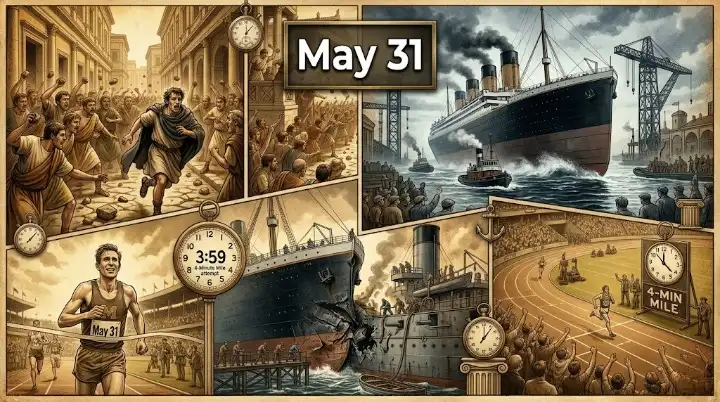
Angry citizens chased Emperor Petronius Maximus through the streets of Rome, corners turning into traps as stones flew from the crowd. The ruler of the Western Roman Empire met his end not on a battlefield, but in the dirt under a hail of rocks thrown by his own people. Moments like this define May 31, a date packed with high-stakes human drama. Learning about what happened on May 31 in history helps us see how fast fortunes can turn.
👶 Quick Facts — May 31 in History
| 📌 Category | 📖 Event / Detail |
|---|---|
| 🌟 Most Significant Event | Launch of the RMS Titanic (1911) |
| 🏆 Top 10 Key Events | • Stoning of Petronius Maximus (455) • Fall of Zhongdu to Genghis Khan (1215) • Last entry of Samuel Pepys’ diary (1669) • Opening of Madison Square Garden (1879) • Johnstown Flood disaster (1889) • Treaty of Vereeniging ends Boer War (1902) • Assassination attempt on King Alfonso XIII (1906) • Titanic Launch (1911) • Tulsa race massacre (1921) • Quetta Earthquake (1935) |
| ⚔️ Key Battles | Battle of Zhongdu (1215), Battle of the Kalka River (1223), Battle of Seven Pines/Seven Pines (1862), Battle of Cold Harbor (1864), Battle of Jutland (1916) |
| 👤 Key Figures | Genghis Khan, Samuel Pepys, Usain Bolt, Mark Felt |
| 🌍 Observances | World No Tobacco Day, Kaamatan (Malaysia), Borobi Day (Australia), Anniversary of Royal Brunei Malay Regiment |
Story of the Day: The Launch of a Titan
A massive hull of steel slipped into the waters of Belfast Lough as thousands of spectators cheered from the docks of Harland and Wolff. Workers knocked loose the wooden triggering blocks, freeing the forty-six thousand ton luxury liner to meet the sea for the very first time. White Star Line officials smiled as the pride of their fleet floated perfectly on her lines, seemingly validating her reputation as a triumph of modern industrial engineering. Nobody standing on the Northern Irish shore that morning could foresee the icy disaster waiting in the North Atlantic less than a year away. This single morning represented the high-water mark of Edwardian confidence before reality fractured the illusion.
Important Events That Happened On May 31 In History
455 – The Death of Petronius Maximus
Petronius Maximus gathered his robes and sprinted toward the city gates as Vandals neared the walls of Rome. Terrified citizens spotted their fleeing emperor and abandoned all remaining respect for imperial authority, transforming into an execution squad. Rocks sailed through the summer air, striking down the ruler before his guards could secure an escape route. The leaderless city lay completely defenseless, paving the way for a brutal three-week sack that shattered the remains of the Western Empire.
1215 – The Fall of Zhongdu
Genghis Khan stood outside the massive fortifications of Zhongdu, watching his Mongol warriors finally breach the defenses of the Jin Dynasty. Starvation and disease had broken the will of the defenders after a grueling months-long siege. Fire consumed the palace quarters as nomadic horsemen flooded the streets, seizing control of the strategic northern capital. This brutal victory established Mongol dominance over Northern China, shifting the balance of Asian power for centuries.
1223 – Disaster at the Kalka River
Subutai maneuvered his cavalry units along the banks of the Kalka River, executing a classic feigned retreat that lured his enemies into a deadly trap. Combined forces of Kievan Rus’ and Cuman fighters rushed forward blindly, breaking their own defensive formations in the pursuit. Mongol horse archers wheeled around suddenly, surrounding the disorganized allied armies and cutting them down with terrifying mechanical efficiency. The utter annihilation of the Rus’ leadership left the Slavic principalities vulnerable to full Mongol conquest decades later.
1293 – Mongol Retreat from Java
Raden Wijaya watched the sails of the Mongol fleet disappear over the horizon, celebrating a masterful betrayal that saved his island kingdom. The Javanese prince had used Genghis Khan’s grandchildren to destroy his local rivals before turning his weapons on his unsuspecting allies. Baffled and battered by jungle warfare and unexpected treachery, the expeditionary force chose to abandon their campaign entirely. This defensive triumph cleared the path for Wijaya to establish the Majapahit Empire, the greatest maritime power in Indonesian history.
1578 – The First Stone of Pont Neuf
King Henry III dipped his hands into mortar to lay the ceremonial foundation stone of the Pont Neuf across the Seine. Paris desperately needed a modern transit link, yet religious wars delayed construction for decades. Engineers designed the structure without traditional medieval houses built on top, a choice that shocked locals but offered clear views of the river. Today, this monument stands as the oldest bridge in the French capital, outlasting the monarchy that birthed it.
1610 – London’s Love to Prince Henry
Flutes and drums echoed across the River Thames as a grand aquatic pageant floated past the crowded banks of London. City authorities spared no expense, staging elaborate theatrical battles on the water to celebrate young Prince Henry’s investment as Prince of Wales. Citizens cheered for the charismatic teenager, viewing him as the bright future of the Stuart dynasty. His sudden death from typhoid fever just two years later crushed those national hopes, leaving his tragic brother Charles to inherit the throne.
1669 – The Final Entry of Samuel Pepys
Samuel Pepys dipped his quill into ink for the last time, recording his deep despair over his failing eyesight. The naval administrator spent a decade chronicling the Great Plague, the Great Fire of London, and the intimate secrets of the Restoration court in private shorthand. Fearing total blindness, he chose to close the leather-bound book rather than risk ruining his remaining vision under candlelight. He never actually lost his sight, but his sudden stoppage left historians without their most vivid window into seventeenth-century life.
1775 – The Mecklenburg Resolves
Militia leaders gathered in a small North Carolina courthouse to sign the Mecklenburg Resolves, stripping royal officials of all legal power. News of the bloody clashes at Lexington and Concord had reached the southern colony, igniting fierce anti-British sentiment. The delegates declared all laws originating from the King or Parliament completely null and void until further notice. This radical document pushed the American colonies a massive step closer to open, irreversible revolution.
1790 – Quimper Enters Juan de Fuca
Manuel Quimper guided his exploration sloop through the heavy mists of the Strait of Juan de Fuca, mapping uncharted waters for the Spanish Crown. The naval officer claimed the Pacific Northwest territory for King Charles IV, naming every bay and point he encountered. Native tribes watched from the rugged shorelines as foreign sails disrupted their traditional trade routes. Spain eventually abandoned these claims, but Quimper’s detailed sea charts guided generations of future mariners.
1790 – The First US Copyright Act
President George Washington signed the Copyright Act of 1790 into law, creating America’s very first legal protection for authors and mapmakers. Creative minds could now secure exclusive printing rights for fourteen years, keeping pirates from stealing their hard work. Early publishers rushed to federal courts to register their books under the new system. This single piece of legislation built the foundation of the modern American creative economy.
1795 – Suppression of the Revolutionary Tribunal
Judges packed up their papers as the French National Convention officially abolished the dreaded Revolutionary Tribunal of Paris. This legal body had sent thousands of citizens, including Marie Antoinette, to the guillotine during the Reign of Terror. Public disgust finally boiled over after the fall of Robespierre, prompting a total dismantling of the emergency courts. The end of these trials signaled a desperate national retreat from radical violence back toward constitutional order.
1805 – The Assault on Diamond Rock
French and Spanish warships unleashed a thunderous cannonade against the sheer cliffs of Diamond Rock off Martinique. British sailors had turned the barren volcanic island into an unsinkable stone fortress, harassing regional trade routes for months. Troops scrambled up the steep crags under heavy fire to dislodge the stubborn defenders from their caves. This fierce naval engagement showed just how desperate France was to protect its valuable sugar colonies.
1813 – Crossing the Blue Mountains
William Lawson, Gregory Blaxland, and William Wentworth stood atop Mount Blaxland, gazing out at the vast, fertile plains of interior Australia. The three explorers had spent weeks hacking their way through thick brush and scaling sheer sandstone cliffs that blocked westward expansion for decades. Skeptical colonial officials back in Sydney finally had proof that a path existed through the treacherous mountain barrier. This breakthrough triggered a massive pastoral boom that transformed the economy of New South Wales.
1847 – The Second Treaty of Erzurum
Persian and Ottoman diplomats signed the second Treaty of Erzurum, drawing an international boundary line through disputed borderlands. Decades of border raids and tribal conflicts had pushed the two Islamic empires to the brink of total war. The negotiators bartered territorial control over strategic deltas and tribal pastures to secure an uneasy peace. This arbitrary frontier line laid the groundwork for modern borders that still shape the Middle East.
1859 – Big Ben Begins Ticking
Engineers in the Elizabeth Tower released the massive pendulum, allowing the Great Clock of Westminster to begin keeping official time. Structural flaws and political arguments had delayed the massive horological project for over a decade. The deep, resonance of the thirteen-ton bell soon echoed across London, setting a new standard for mechanical accuracy. The steady ticking became a global auditory anchor, enduring through blitzes and social revolutions.
1862 – The Battle of Seven Pines
Confederate General Joseph E. Johnston launched a massive, uncoordinated attack against Union lines just outside Richmond, Virginia. Rising waters from the Chickahominy River had isolated a portion of the northern army, creating a temporary tactical advantage. The bloody, chaotic fighting yielded no clear winner but left thousands of young men dead or mangled in the swamps. The most critical outcome came when Johnston suffered a severe wound, forcing Jefferson Davis to replace him with Robert E. Lee.
1864 – The Carnage of Cold Harbor
Union General Ulysses S. Grant ordered his men to dig defensive trenches near a dusty Virginia crossroads known as Cold Harbor. Confederate troops under Robert E. Lee had already fortified the opposite ridge, creating a deadly kill zone. Private soldiers pinned pieces of paper with their names to their uniforms, knowing the next day’s assault would likely end their lives. This quiet evening preceded one of the most lopsided slaughters of the American Civil War.
1879 – Madison Square Garden Opens
William Henry Vanderbilt officially changed the name of Gilmore’s Garden to Madison Square Garden, opening the doors to a massive public arena. The open-air venue featured a roofless arena floor perfect for sporting matches, track races, and popular concerts. Wealthy New Yorkers and working-class immigrants filled the seats on 26th Street to enjoy diverse urban entertainment. This grand opening created a cultural icon that would undergo multiple redesigns while remaining the world’s most famous arena.
1884 – King Tāwhiao Reaches Plymouth
King Tāwhiao stepped off a steamship onto the docks of Plymouth, determined to present a petition directly to Queen Victoria. The Maori sovereign had traveled thousands of miles from New Zealand to protest British violations of the Treaty of Waitangi. Imperial land confiscations had stripped his people of their ancestral territory, leaving them impoverished and desperate. British politicians politely ignored his appeals, forcing the Maori king to return home and look for internal paths to sovereignty.
1889 – The Johnstown Flood
A towering sixty-foot wall of water smashed through the mountain town of Johnstown, Pennsylvania, destroying everything in its path. Upstream, a poorly maintained earthen dam owned by an elite hunting club had collapsed after days of torrential rain. Over twenty-two hundred people perished in minutes as rolling debris and heavy locomotives crushed entire neighborhoods. The disaster triggered an unprecedented global relief effort and sparked deep national anger over corporate negligence.
1902 – The Treaty of Vereeniging
Boer generals sat down with British officers to sign the Treaty of Vereeniging, ending three years of brutal warfare in South Africa. The conflict had devastated the veldt, leaving thousands of women and children dead in early British concentration camps. Afrikaner republics surrendered their independence in exchange for millions of pounds in reconstruction aid and a promise of future self-government. This fragile peace treaty set the stage for the systematic exclusion of the Black majority from political power.
1906 – An Assassination Attempt in Madrid
Mateo Morral threw a bomb hidden inside a bouquet of flowers from a balcony as the royal carriage passed below on Calle Mayor. King Alfonso XIII and his new bride, Queen Victoria Eugenie, were returning from their wedding ceremony when the explosion ripped through the crowd. The steel sides of the royal coach protected the monarchs, but the blast killed twenty-four innocent bystanders and guards. This radical anarchist attack shocked Europe, highlighting the deadly political tensions bubbling under the surface of the Spanish monarchy.
1909 – The National Negro Committee Convenes
Activists and intellectuals crowded into a New York assembly hall to hold the very first meeting of the National Negro Committee. Outraged by a recent race riot in Illinois, Black leaders like W.E.B. Du Bois joined forces with white reformers to demand basic civil rights. The delegates organized a permanent campaign against lynching, disenfranchisement, and racial segregation. This initial gathering birthed the NAACP, the legal powerhouse that dismantled Jim Crow laws.
1910 – The Union of South Africa Forms
British colonies and defeated Boer republics officially merged to create the Union of South Africa under a single dominion government. The new constitution centralized administrative power while explicitly denying black citizens the right to vote in most provinces. Stripped of their political voice, indigenous leaders organized peaceful protests that went entirely unheeded by the white-minority parliament. This administrative merger served as the institutional foundation for the apartheid regime.
1911 – Porfirio Díaz Flees Mexico
Deposed dictator Porfirio Díaz boarded the German steamship Ypiranga at Veracruz, heading into lifelong European exile. Popular uprisings led by Francisco Madero had broken his thirty-five-year grip on national power during the early stages of the Mexican Revolution. The aging ruler looked back at the receding shoreline and warned that his departure would unleash a tiger he could not control. His prediction proved accurate, as Mexico plunged into a decade of bloody civil war that reshaped the nation.
1916 – The Battle of Jutland
Admiral John Jellicoe guided the British Grand Fleet into the North Sea, colliding with the German High Seas Fleet in the largest naval clash of World War I. Two hundred and fifty warships traded thunderous salvos, filling the gray horizon with thick smoke and exploding metal. Britain lost more ships and sailors, but the German fleet retreated to port and largely remained trapped there for the rest of the war. This colossal battle left British control over global sea lanes completely unbroken.
1921 – The Tulsa Race Massacre
Armed white mobs marched into the prosperous Black neighborhood of Greenwood in Tulsa, Oklahoma, burning homes and businesses to the ground. A false newspaper report about an assault had triggered a wave of racial fury that local authorities refused to stop. Modern estimates suggest up to three hundred people died during the chaos, while thousands of survivors lost everything they owned. The destruction of “Black Wall Street” remained actively suppressed in local history for decades.
1924 – The Hope Development School Fire
Thick black smoke poured from the windows of the Hope Development School in Ohio as a sudden fire tore through the wooden structure. Staff members scrambled to rescue the residents, but the fast-moving flames cut off the main exit stairwells. Twenty-four people, mostly disabled children, lost their lives in the tragic inferno. The horrific disaster prompted national demands for stricter fire safety building codes in state-run residential institutions.
1935 – The Quetta Earthquake
A violent seven-point-seven magnitude earthquake struck Quetta, reducing the bustling colonial city to a vast field of rubble in under a minute. The pre-dawn tremor caught thousands of families asleep inside their fragile mud-brick homes. Landslides blocked mountain passes, preventing immediate rescue teams from reaching the isolated survivors. Over forty0,000 people perished, making it one of the deadliest seismic disasters in the history of South Asia.
1941 – The Re-occupation of Iraq
British infantry units marched into Baghdad, completing a swift military campaign to restore a pro-British regent to the Iraqi throne. A nationalist coup led by Rashid Ali had threatened vital oil pipelines and British communication lines across the Middle East. The rebel leaders fled into exile as imperial troops re-established their strategic grip on the region. This swift intervention secured the western flank of Britain’s war effort against Nazi Germany.
1942 – Midget Submarines Attack Sydney
Imperial Japanese Navy crews launched three midget submarines into Sydney Harbour, catching Australian coastal defenses completely off guard. One vessel fired torpedoes that missed an American cruiser but sank a converted ferry boat, killing twenty-one sailors sleeping on board. Searchlights cut through the dark night as patrol boats dropped depth charges to destroy the stealthy raiders. The daring attack brought the immediate reality of World War II right to Australia’s largest city.
1947 – The Resignation of Ferenc Nagy
Prime Minister Ferenc Nagy signed a forced resignation letter from his exile in Switzerland, surrendering democratic control of Hungary. Soviet-backed secret police had blackmailed the popular leader by threatening to execute his young son on trumped-up treason charges. With Nagy removed, Hungarian Communists seized total control of the state apparatus without firing a single shot. This bloodless coup pulled another Eastern European nation behind the rising Iron Curtain.
1951 – The Uniform Code of Military Justice
The United States military officially put the Uniform Code of Military Justice into effect, standardizing legal procedures across all branches of the armed forces. Prior to this, soldiers and sailors faced completely different court-martial rules depending on their specific service. The new federal code guaranteed basic legal rights to accused personnel, including a right to professional counsel. This legal overhaul modernized military justice for the Cold War era.
1955 – Brown II Orders Desegregation
Chief Justice Earl Warren read aloud the Supreme Court’s second Brown v. Board of Education ruling, commanding local school districts to desegregate “with all deliberate speed.” The court recognized that many southern states were intentionally delaying the integration of black and white students. This vague phrasing allowed segregationists to exploit legal loopholes and stall progress for another decade. The decision triggered a protracted legal battle that defined the civil rights era.
1961 – South Africa Becomes a Republic
Prime Minister Hendrik Verwoerd celebrated the official creation of the Republic of South Africa, cutting all remaining constitutional ties to the British Crown. The white-minority government had voted to leave the Commonwealth of Nations to protect its strict policy of racial apartheid from international criticism. Black activists burned identity passes in the streets, anticipating the dark era of state oppression that followed. The new republic isolated itself globally to maintain internal white supremacy.
1961 – The Rokotov–Faibishenko Trial
Prosecutors opened the notorious Rokotov-Faibishenko show trial in Moscow, targeting underground currency traders who operated in the Soviet black market. Premier Nikita Khrushchev personally demanded the death penalty for the defendants to deter growing capitalist activity among youth. Soviet authorities retroactively changed criminal laws to ensure the men could be executed by firing squad. This harsh trial signaled a sharp limit to the post-Stalin cultural thaw.
1962 – The West Indies Federation Dissolves
Political leaders in Port of Spain formally dissolved the West Indies Federation, ending a short-lived attempt to unite ten British Caribbean territories into a single state. Deep rivalries between Jamaica and Trinidad over tax revenue and parliamentary seats broke the union apart. Each island nation chose to pursue its own path toward independent statehood instead. The collapse reshaped the modern geopolitical landscape of the Caribbean.
1970 – The Ancash Earthquake
A massive seven-point-nine magnitude earthquake rocked the coast of Peru, shaking loose a colossal wall of ice and rock from Mount Huascarán. The massive avalanche sped down the valley at two hundred miles per hour, burying the entire town of Yungay in seconds. Over sixty thousand people died across the region, making it the worst natural disaster in Peruvian history. The catastrophe triggered a complete overhaul of global alpine disaster monitoring systems.
1971 – The First Monday Memorial Day
Millions of Americans celebrated Memorial Day on the last Monday of May for the very first time, enjoying a newly created three-day weekend. The Uniform Monday Holiday Act passed by Congress shifted several federal holidays from their traditional fixed dates to maximize leisure time. Traditionalist veterans group protested the change, arguing that moving the date from May 30 cheapened the solemn meaning of the occasion. The transition permanently shifted the day from a quiet ritual of remembrance into the official start of the summer season.
1973 – Senate Cuts Cambodia Bombing
The United States Senate voted overwhelmingly to cut off all federal funding for military bombing campaigns inside Cambodia. President Richard Nixon argued that the air strikes were necessary to disrupt Khmer Rouge supply lines and protect American troops leaving Vietnam. Lawmakers refused to back down, asserting their constitutional control over the national budget to halt an unauthorized expansion of the war. This decisive vote marked a significant retreat of American military power from Southeast Asia.
1973 – Indian Airlines Flight 440 Crashes
Indian Airlines Flight 440 struck high-voltage power lines and crashed into the dirt near New Delhi’s Palam Airport during a heavy monsoon storm. The twin-engine Boeing 737 broke apart on impact, killing forty-eight people on board including a prominent government minister. Miraculously, seventeen passengers crawled out of the burning wreckage alive. Investigators later blamed the disaster on pilot error during an instrument approach in poor visibility.
1977 – The Trans-Alaska Pipeline Completed
Welded steel pipelines joined together at Prudhoe Bay, marking the official completion of the historic Trans-Alaska Pipeline System. Engineers had spent three grueling years overcoming subzero temperatures, mountain ranges, and fragile permafrost to build the eight-hundred-mile line. Environmental groups fought the project in court for years, fearing a devastating oil spill in the pristine Arctic wilderness. The completion allowed billions of barrels of domestic crude oil to begin flowing south toward energy-hungry American markets.
1985 – The United States-Canada Tornado Outbreak
Black funnel clouds touched down across Ohio, Pennsylvania, New York, and Ontario, unleashing forty-one violent tornadoes in a single afternoon. The unprecedented severe weather system flattened entire towns, stripped bark from trees, and tossed vehicles like toys. Seventy-six people lost their lives during the historic outbreak, while thousands more suffered injuries or lost their homes. The devastation prompted meteorologists to completely modernize regional radar warning networks.
1986 – The Maiden Flight of Ariane 2 Fails
The Ariane 2 rocket ignited its main engines and lifted off from its pad in French Guiana, carrying a valuable communications satellite into space. Minutes into the flight, the third-stage engine failed to ignite properly, causing the vehicle to lose vital altitude. Mission controllers pushed the self-destruct button, destroying the rocket over the Atlantic Ocean. The costly failure halted Europe’s commercial satellite launch program for months while engineers fixed the ignition system.
1991 – The Bicesse Accords signed
Angolan President José Eduardo dos Santos and rebel leader Jonas Savimbi shook hands after signing the Bicesse Accords in Lisbon. The historic treaty aimed to end sixteen years of bloody civil war by merging rival armies and scheduling multi-party democratic elections. United Nations peacekeepers arrived to supervise the fragile transition. The peace proved tragicly short-lived, as the country plunged back into violence following a disputed election result the following year.
1997 – The Confederation Bridge Opens
A massive convoy of pedestrians walked across the newly completed Confederation Bridge, celebrating the official link between Prince Edward Island and mainland New Brunswick. The eight-mile engineering marvel took four years to construct over ice-choked waters, replacing a historic ferry system that had operated for generations. Island traditionalists worried that easy access would ruin their quiet, rural way of life. The bridge permanently integrated the isolated province into the Canadian transportation network.
2003 – Air France Retires the Concorde
Air France Flight 001 touched down at Charles de Gaulle Airport, completing the airline’s final commercial supersonic flight from New York. High maintenance costs, declining passenger numbers, and a tragic crash in 2000 had made the iconic delta-wing jets unprofitable to operate. Wealthy travelers said goodbye to an era where they could cross the Atlantic Ocean in under four hours. The retirement marked a rare moment where commercial aviation chose to move backward in speed.
2005 – Mark Felt Revealed as Deep Throat
Vanity Fair magazine hit newsstands with a shocking cover story, revealing that ninety-one-year-old Mark Felt was the legendary secret informant known as “Deep Throat.” The former Associate Director of the FBI had spent decades hiding the fact that he leaked critical secrets to reporters during the Watergate scandal. His leaks ultimately forced President Richard Nixon to resign from office in 1974. The stunning revelation ended one of the greatest mysteries in American political history.
2008 – Usain Bolt Breaks the 100m Record
Usain Bolt exploded out of the starting blocks at the Reebok Grand Prix in New York City, sprinting down the track with effortless power. The Jamaican athlete crossed the finish line in a blistering nine-point-seven-two seconds, shaving two-hundredths of a second off the previous world record. Spectators watched in awe as the towering runner celebrated before he even crossed the line. This race signaled the start of Bolt’s total dominance over global sprinting.
2008 – Discovery Launches on STS-124
The Space Shuttle Discovery roared off Pad 39A at the Kennedy Space Center, carrying the massive Japanese Kibō laboratory module into orbit. Seven astronauts buckled into their seats, riding a pillar of fire into the afternoon sky to continue construction on the International Space Station. The mission required complex robotic arm maneuvers to install the bus-sized component. The successful launch represented a major milestone for international cooperation in space exploration.
2010 – The Gaza Flotilla Raid
Israeli naval commandos boarded the Gaza Freedom Flotilla from helicopters in international waters, sparking a violent struggle on the deck of the MV Mavi Marmara. The pro-Palestinian activists were attempting to break a naval blockade to deliver humanitarian aid directly to the Gaza Strip. The confrontation left nine Turkish citizens dead and dozens of soldiers injured, triggering an immediate global diplomatic crisis. The raid severely strained relations between Israel and Turkey for years.
2013 – Asteroid 1998 QE2 Flies Past Earth
Astronomers tracked the massive asteroid 1998 QE2 as it made its closest approach to Earth, passing safely at a distance of three and a half million miles. The space rock carried its own small moon, a surprise discovery that scientists made using deep-space radar imaging. The flyby allowed researchers to study the composition of early solar system remnants without launching an expensive space probe. The asteroid will not pass this close to Earth again for another two centuries.
2013 – The El Reno Tornado
A colossal two-and-a-half-mile-wide tornado touched down near El Reno, Oklahoma, becoming the widest twister ever recorded in meteorological history. The massive storm system caught veteran weather researchers off guard by rapidly changing direction and expanding in size. Eight people lost their lives, including three professional storm chasers whose vehicle was caught by the shifting winds. This extreme event forced scientists to rethink everything they knew about tornadic behavior.
2016 – The Manbij Offensive Launches
Syrian Democratic Forces infantry units pushed across the Euphrates River, launching a major offensive to capture the strategic city of Manbij from ISIS militants. Heavy coalition air strikes cleared the path through defensive minefields and fortified villages. The military campaign aimed to cut off the terror group’s last remaining supply route to the Turkish border. The fierce urban fighting lasted for months, displacing thousands of local civilians.
2017 – The Kabul Embassy Bombing
A sewage tanker packed with explosives detonated at a busy intersection near the German embassy in Kabul during the morning rush hour. The colossal blast shattered windows blocks away, dug a massive crater into the pavement, and killed over ninety people. Terrified commuters scrambled through thick smoke and falling glass to rescue bleeding survivors from crushed vehicles. This horrific attack highlighted the severe security failures plagues the Afghan capital.
2019 – The Virginia Beach Shooting
A disgruntled municipal employee walked into a Virginia Beach government building, using a suppressed handgun to open fire on his coworkers. Terrified office workers locked doors and hid beneath desks as gunshots echoed down the narrow hallways. Police officers rushed into the structure, engaging the gunman in a prolonged shootout that ended with his death. The senseless tragedy left thirteen people dead, plunging the tight-knit coastal community into deep mourning.
2026 – The TNLA Base Explosion
A sudden, violent explosion ripped through a Ta’ang National Liberation Army base in northern Myanmar, killing forty-six people instantly. Initial reports suggested that a fire in an ammunition storage facility triggered the catastrophic blast. Rebel forces immediately cordoned off the smoking ruins to investigate potential sabotage by military junta forces. The massive loss of life dealt a significant blow to the regional ethnic armed coalition.
Revisit our recent historical highlights by clicking here.
Famous People Born On May 31
| Name | Description | Date |
|---|---|---|
| Fyodor I | Tsar of Russia (1584–98), last of Rurik dynasty | May 31, 1557 – January 17, 1598 |
| John George II | Elector of Saxony (1657–80), Dresden as musical centre | May 31, 1613 – August 22, 1680 |
| Dosítheos | Patriarch of Jerusalem, Eastern Orthodox theologian | May 31, 1641 – February 8, 1707 |
| Karl August von Hardenberg | Prussian statesman, reformer of Prussian state | May 31, 1750 – November 26, 1822 |
| Pierre-Victurnien Vergniaud | French Girondin statesman | May 31, 1753 – October 31, 1793 |
| Dominique-Catherine, marquis de Pérignon | Marshal of France, Revolutionary and Napoleonic wars | May 31, 1754 – December 25, 1818 |
| John Albion Andrew | Governor of Massachusetts, Civil War “war governor” | May 31, 1818 – October 30, 1867 |
| Jessie Ann Benton Frémont | American writer | May 31, 1824 – December 27, 1902 |
| John William DeForest | American realistic novelist, Miss Ravenel’s Conversion | May 31, 1826 – July 17, 1906 |
| Jules Chéret | French poster illustrator, “father of the modern poster” | May 31, 1836 – September 23, 1933 |
| William Rockefeller | American industrialist, co-founder of Standard Oil | May 31, 1841 – June 24, 1922 |
| Rookes Evelyn Bell Crompton | British inventor, electrical development pioneer | May 31, 1845 – February 15, 1940 |
| William James Pirrie, Viscount Pirrie | Irish shipbuilder, builder of the Titanic | May 31, 1847 – June 7, 1924 |
| Graham Wallas | British political scientist, empirical approach to human behaviour | May 31, 1858 – August 10, 1932 |
| Walter Richard Sickert | British painter and printmaker, pivotal figure in British avant-garde | May 31, 1860 – January 22, 1942 |
| Sir Francis Edward Younghusband | British army officer and explorer of Tibet | May 31, 1863 – July 31, 1942 |
| William Heath Robinson | British cartoonist, fantastic machinery illustrations | May 31, 1872 – September 13, 1944 |
| Charles Greeley Abbot | American astrophysicist, Smithsonian director | May 31, 1872 – December 17, 1973 |
| Italo Montemezzi | Italian opera composer, The Love of Three Kings | May 31, 1875 – May 15, 1952 |
| Saint-John Perse | French poet, Nobel Prize in Literature (1960) | May 31, 1887 – September 20, 1975 |
| Gregor Strasser | German Nazi political activist, opposition to Hitler | May 31, 1892 – June 30, 1934 |
| Konstantin Georgiyevich Paustovsky | Soviet fiction writer | May 31, 1892 – July 14, 1968 |
| Fred Allen | American comedian, radio humorist | May 31, 1894 – March 17, 1956 |
| Olle Hedberg | Swedish novelist, satirist of middle classes | May 31, 1899 – 1974 |
| Leonid Maksimovich Leonov | Russian novelist and playwright | May 31, 1899 – August 8, 1994 |
| John Kemeny | Hungarian-born mathematician, co-developer of BASIC | May 31, 1926 – December 26, 1992 |
| Elihu Katz | American sociologist, mass communication studies | May 31, 1926 – December 31, 2021 |
| Louis Ignarro | American pharmacologist, Nobel Prize (1998) | May 31, 1941 – Present |
| Viktor Orbán | Prime minister of Hungary (1998–2002; 2010–26) | May 31, 1963 – Present |
| Colin Farrell | Irish actor | May 31, 1976 – Present |
Famous People Died On May 31
| Name | Description | Date |
|---|---|---|
| Waltheof | Earl of Northumbria | – May 31, 1076 |
| Birger Magnusson | King of Sweden (1290–1318) | 1280 – May 31, 1321 |
| Albertino Mussato | Italian statesman and writer | 1261 – May 31, 1329 |
| Martin | King of Aragon (1395–1410) and Sicily | 1356 – May 31, 1410 |
| Ashikaga Yoshimitsu | Japanese shogun, Ashikaga shogunate stabilizer | September 25, 1358 – May 31, 1408 |
| Władysław II Jagiełło | King of Poland and grand duke of Lithuania | c.1351 – May 31, 1434 |
| Petronius Maximus | Western Roman emperor (March–May 455) | 396 – May 31, 455 |
| Rodrigo Gil de Hontañón | Spanish Plateresque architect | c.1500 – May 31, 1577 |
| John Leslie | Scottish Roman Catholic bishop and historian | September 29, 1527 – May 31, 1596 |
| Andrey Ivanovich, Count Osterman | Russian statesman, dominated foreign affairs (1725–40) | June 9, 1686 – May 31, 1747 |
| Frederick William I | King of Prussia (1713–40), transformed Prussia into efficient state | August 14, 1688 – May 31, 1740 |
| Sir Samuel Bentham | British engineer and naval architect | January 11, 1757 – May 31, 1831 |
| Jean Lannes, duc de Montebello | French marshal, one of Napoleon’s greatest generals | April 10, 1769 – May 31, 1809 |
| Pierre-Louis Prieur | French Revolutionary, member of Committee of Public Safety | August 1, 1756 – May 31, 1827 |
| Peter Vivian Daniel | Associate justice of U.S. Supreme Court (1841–60) | April 24, 1784 – May 31, 1860 |
| Sir Antoine-Aimé Dorion | Canadian statesman, joint premier of Province of Canada | January 17, 1818 – May 31, 1891 |
| Michael Davitt | Irish nationalist, founder of Irish Land League | March 25, 1846 – May 31, 1906 |
| Sir John Evans | British antiquarian and archaeologist | November 17, 1823 – May 31, 1908 |
| Thomas Price | Australian Labor premier of South Australia | January 19, 1852 – May 31, 1909 |
| Thomas Spencer Baynes | British scholar, editor of 9th edition of Encyclopædia Britannica | March 24, 1823 – May 31, 1887 |
| James T. Rapier | Black U.S. congressman from Alabama, Reconstruction | November 13, 1837 – May 31, 1883 |
| Vladimir Tatlin | Ukrainian painter, constructivist, “Monument to Third International” | December 28, 1885 – May 31, 1953 |
| Diedrich Westermann | German scholar of African languages | June 24, 1875 – May 31, 1956 |
| Leopold Staff | Polish poet, Young Poland movement | November 14, 1878 – May 31, 1957 |
| Walther Funk | German Nazi economics minister, Reichsbank president | August 18, 1890 – May 31, 1960 |
| Edith Hamilton | American classicist and popularizer of classical literature | August 12, 1867 – May 31, 1963 |
| Billy Strayhorn | American pianist and composer, collaborator with Duke Ellington | November 29, 1915 – May 31, 1967 |
| Erik Lindegren | Swedish modernist poet | August 5, 1910 – May 31, 1968 |
| Terry Sawchuk | Canadian ice hockey goalie | December 28, 1929 – May 31, 1970 |
| Hannah Höch | German Dada artist, photomontage pioneer | November 1, 1889 – May 31, 1978 |
Observances on May 31
World No Tobacco Day
The World Health Organization coordinates global campaigns on May 31 to educate communities about the severe health dangers of tobacco use. Health workers organize public events to help smokers quit and push for stronger international laws to restrict cigarette advertising.
Kaamatan Harvest Festival
Families across Sabah and Labuan in Malaysia gather to celebrate the traditional harvest festival, honoring the rice spirits for a bountiful crop. Communities perform traditional dances, share home-brewed rice wines, and enjoy cultural games that preserve indigenous heritage.
Anniversary of the Royal Brunei Malay Regiment
Brunei holds large military parades and public exhibitions on May 31 to honor the founding of its national armed forces. Soldiers display modern defense equipment and perform precision drills to demonstrate national readiness.
Borobi Day
Schools and community groups across Australia celebrate Borobi Day, using the popular blue koala mascot to promote indigenous language education and youth sports programs. Children participate in cultural storytelling workshops designed to build regional pride.
🚢 Frequently Asked Questions — May 31 in History
The RMS Titanic was officially launched into the waters of Belfast Lough on this date, marking a major milestone in her construction. Thousands of spectators cheered as the massive steel hull floated for the first time. Less than a year later, the ship sank on her maiden voyage after striking an iceberg.
The launch of the RMS Titanic in 1911 stands out due to its profound impact on global maritime laws and cultural memory. Another highly significant and tragic event occurred in 1921 with the onset of the Tulsa race massacre, which destroyed America’s most prosperous Black neighborhood.
Legendary American actor and director Clint Eastwood was born on this date in 1930, going on to shape the Western and crime film genres for decades. Walt Whitman, one of America’s most influential poets, was also born on this date back in 1819.
The British Grand Fleet clashed with the German High Seas Fleet at the Battle of Jutland in 1916, marking the largest naval engagement of World War I. The massive confrontation involved two hundred and fifty warships and left thousands of sailors dead in the North Sea.
Established by the World Health Organization in 1987, this day draws global attention to the preventable health crises caused by tobacco use. It encourages nations to adopt strict public smoking bans and helps individuals access resources to quit smoking.
An ammunition storage explosion at a Ta’ang National Liberation Army base in Myanmar killed forty-six people in 2026. Back in 2019, a tragic mass shooting at a municipal building in Virginia Beach resulted in thirteen fatalities.