📅 Quick Facts — June 28 in History
| 📌 Category | 📖 Event / Detail |
|---|---|
| 🌟 Most Significant Event | The assassination of Archduke Franz Ferdinand in Sarajevo (1914) |
| 🏆 Top 10 Key Events | • First Crusade victory at Antioch (1098) • Coronation of Edward IV (1461) • Battle of Nagashino (1575) • Coronation of Queen Victoria (1838) • Capture of Ned Kelly (1880) • Treaty of Versailles signed (1919) • Merger forming Mercedes-Benz (1926) • Hangang Bridge bombing (1950) • Stonewall riots begin (1969) • Tyson bites Holyfield’s ear (1997) |
| ⚔️ Key Battles | Battle of Antioch, Battle of Seminara, Battle of Nagashino, Battle of Berestechko, Battle of Sullivan’s Island, Battle of Monmouth Courthouse, Battle of Kosovo (commemorated) |
| 👤 Key Figures | Gavrilo Princip, Queen Victoria, Ned Kelly, Slobodan Milošević, Mike Tyson |
| 🌍 Observances | International LGBTQ Pride Day, Vidovdan (Serbia), Constitution Day (Ukraine), Poznań Remembrance Day (Poland), Tau Day |
Story of the Day: The Shot Heard Across Europe
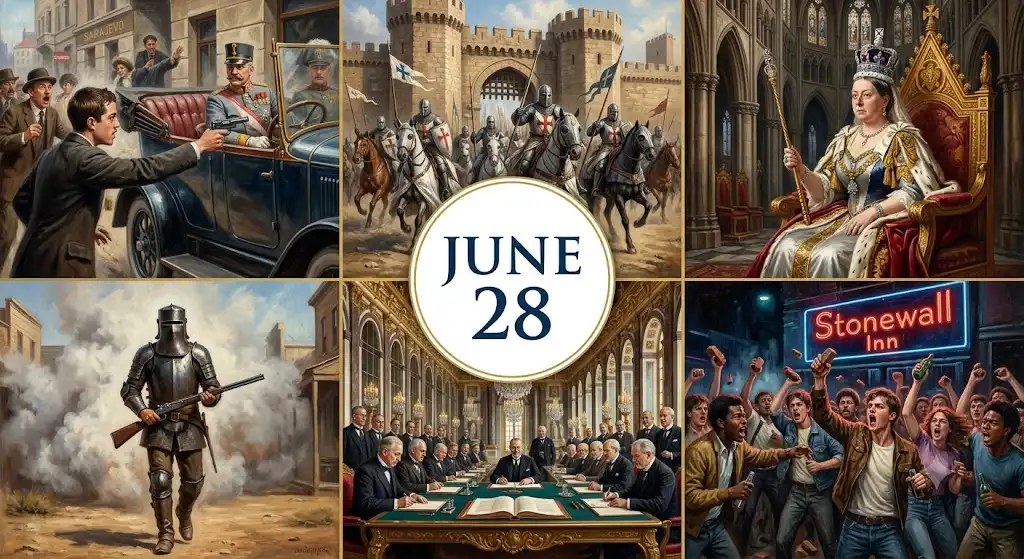
Gavrilo Princip did not expect a second chance when the initial bomb plot failed on the streets of Sarajevo. Yet, a wrong turn by the Archduke’s driver brought the royal open-top car to a halt exactly where the nineteen-year-old Serbian nationalist stood waiting. Princip fired twice, hitting Franz Ferdinand in the neck and his wife Sophie in the abdomen. As the royal couple bled to death, the Austro-Hungarian Empire prepared a devastating ultimatum against Serbia. Within weeks, millions of soldiers marched toward the trenches, starting World War I and ending a century of relative European stability.
Important Events That Happened On June 28 In History
1098 – Crusaders Break the Siege of Antioch
L starvation and disease inside the walls, European knights charged out of the city gates to face the massive Muslim army of Kerbogha. Norman commander Bohemond of Taranto organized the desperate sally using strict cavalry tactics that caught the overconfident Turkish forces by surprise. The sudden assault broke the enemy lines, forcing a chaotic retreat and securing the road to Jerusalem. This unexpected victory kept the entire First Crusade from failing on the Syrian border.
1360 – Muhammed VI Seizes the Throne of Granada
Muhammed stepped out of the shadows of the Alhambra palace after his conspirators successfully cornered and killed his brother-in-law, Ismail II. The bloody palace coup gave him absolute control over the Nasrid Kingdom, the last Muslim stronghold on the Iberian peninsula. His reign lasted less than two years before his political rivals drove him out of power. The internal betrayal weakened the royal family just as neighboring Christian kingdoms expanded their territories.
1461 – Edward IV Claims the English Crown
Edward, Earl of March, walked into Westminster Abbey to be officially crowned as the first Yorkist King of England during the brutal Wars of the Roses. The nineteen-year-old commander had won the throne by crushing the Lancastrian armies at the bloody Battle of Towton months earlier. His coronation displaced the mentally unstable King Henry VI and established temporary stability in London. The ceremony marked a massive power shift that redefined English royal bloodlines for a generation.
1495 – French Artillery Smashes the Spanish at Seminara
King Charles VIII directed his French heavy cavalry and Swiss pikemen down the hillsides of Calabria to rout a combined Spanish and Neapolitan force. The traditional Spanish infantry crumbled under the coordinated charge, forcing general Gonzalo de Córdoba to flee the field. This humiliating defeat forced Córdoba to completely rethink European warfare, discarding old medieval formations. His subsequent restructuring led straight to the creation of the legendary Tercios, formations that dominated fields for over a century.
1519 – Charles V Becomes Holy Roman Emperor
German prince-electors gathered in Frankfurt and accepted massive financial bribes from the House of Habsburg to elect young Charles V as their ruler. The decision united Spain, the Netherlands, southern Italy, and German lands under one single crown. Charles inherited a sprawling empire facing both an expanding Ottoman military threat and Martin Luther’s growing Protestant Reformation. His election triggered decades of continent-wide religious and political warfare.
1575 – Firepower Triumphs at the Battle of Nagashino
Oda Nobunaga ordered three thousand arquebusiers behind wooden palisades to open fire on the charging elite cavalry of the Takeda clan. The disciplined, rolling volleys of early firearms tore through the legendary samurai ranks, killing thousands of warriors in hours. This crushing victory secured the rise of both Nobunaga and his ally Tokugawa Ieyasu. The engagement fundamentally proved that industrial weaponry had replaced traditional blade combat in Japanese warfare.
1635 – Guadeloupe Declares French Colonial Rule
French settlers under Leonard de L’Olive and Jean Duplessis landed on the Caribbean shores to officially claim the island for France. The arrivals quickly built permanent fortifications and began clearing native lands for lucrative tobacco and sugar plantations. This colonization led to decades of brutal warfare against the indigenous Carib population, who fought to defend their home. The island became a critical engine for the expanding transatlantic slave economy.
1651 – The Battle of Berestechko Begins
King John II Casimir of Poland led a massive army of over one hundred thousand soldiers to confront combined Ukrainian Cossack and Crimean Tatar forces. The opening skirmishes across the marshy plains of Volhynia started the largest land battle of the entire seventeenth century. The conflict arose from the massive Khmelnytsky Uprising against Polish noble rule over Ukrainian lands. The resulting slaughter devastated the region and altered the balance of power in Eastern Europe.
1745 – New England Colonists Capture Louisbourg
British colonial militiamen from New England forced the surrender of the massive French fortress on Cape Breton Island after a grueling six-week siege. Supported by a British naval blockade, the amateur colonial soldiers dragged heavy artillery through swamps to shatter the stone ramparts. The fall of this strategic bastion shocked Paris and gave New Englanders a new sense of military independence. London later returned the fort to France during peace talks, infuriating the American colonists.
1776 – Sullivan’s Island Garrison Repels the British Fleet
Colonel William Moultrie directed his South Carolina defenders to fire their cannon from an unfinished fort built of spongy palmetto logs. British warships fired thousands of heavy iron shells into the walls, but the soft wood absorbed the impacts without shattering. The accurate American return fire heavily damaged the British flagship, forcing a full naval withdrawal from Charleston. The victory kept the southern colonies free from British occupation for three crucial years.
1776 – Washington’s Bodyguard Hanged for Mutiny
Thomas Hickey stood before a crowd of twenty thousand spectators in a Manhattan field as the executioner adjusted the noose around his neck. The Continental Army private had joined a secret Loyalist conspiracy to kidnap or assassinate General George Washington. Continental authorities uncovered the plot just as British warships arrived in New York harbor. His public execution sent a stern warning against treason throughout the revolutionary ranks.
1778 – Heat and Chaos Rule Monmouth Courthouse
General George Washington rallied his retreating vanguard to hold the line against a furious British counter-attack in the blistering New Jersey heat. The arrival of the main American army forced a brutal artillery duel that lasted until dusk, resulting in a tactical stalemate. British forces used the cover of darkness to quietly withdraw toward New York City, avoiding total destruction. The battle proved that the trained American troops could stand toe-to-toe with British regulars.
1797 – French Troops Disembark in Corfu
General Napoleon Bonaparte sent his vanguard ashore to occupy the strategic Ionian Islands following the sudden collapse of the Republic of Venice. The arrival of the French soldiers ended centuries of Venetian administration over the local Greek populations. The new regime quickly introduced revolutionary ideas, printing the first local newspaper and burning aristocratic titles. This occupation brought French military power dangerously close to the borders of the Ottoman Empire.
1807 – British Invaders Face Defeat at Ensenada
General John Whitelocke ordered thousands of British troops ashore at Ensenada, launching an ambitious campaign to capture the wealthy city of Buenos Aires. The invasion forces marched straight into a trap, facing fierce guerrilla resistance from local Spanish colonists and militia units. The local defenders used urban ambushes to completely stall the professional British regiments. The humiliating British surrender cemented a growing sense of independent national pride among the South American populace.
1838 – Queen Victoria Crowned at Westminster Abbey
Eighteen-year-old Victoria walked down the grand aisle of the abbey to receive the St. Edward’s Crown amidst cheering London crowds. The five-hour ceremony was poorly rehearsed, leading to numerous chaotic mistakes, including a bishop forcing a ring onto the wrong finger. Despite the logistical blunders, the public celebrated the dawn of a fresh era following decades of unpopular kings. Her coronation launched a sixty-three-year reign that redefined global industrial and imperial power.
1841 – Giselle Premieres in Paris
Ballerina Carlotta Grisi stepped onto the stage of the Salle Le Peletier for the absolute first performance of the romantic ballet Giselle. The tragic story of love, betrayal, and vengeful spirits captured the imagination of the French elite. The production revolutionized classical dance by using technical pointe work to make dancers appear weightless. It quickly became the definitive masterpiece of the Romantic era, performed worldwide for centuries.
1855 – Sigma Chi Fraternity Founded in Ohio
Seven college students at Miami University in Oxford, Ohio, formally established the Sigma Chi fraternity after a bitter disagreement inside another campus society. The founders sought an organization based on high personal character rather than forced conformity of opinion. They drafted a constitution and designed a white cross emblem that came to symbolize their shared academic values. The group expanded across North America, becoming one of the largest collegiate organizations.
1859 – The First Conformation Dog Show Opens
English sportsmen gathered sixty purebred pointers and setters in Newcastle upon Tyne to compete in the world’s very first formal dog show. Judges evaluated each animal based on how closely their physical structure matched ideal working standards. The local event proved immensely popular, quickly transforming dog ownership from utilitarian hunting use to competitive high-society breeding. This single exhibition laid the foundation for modern kennel clubs worldwide.
1865 – The Army of the Potomac Disbands
General Ulysses S. Grant signed the final paperwork that officially dissolved the Union’s premier fighting force in the eastern theater. Following the grand review in Washington, hundreds of thousands of veteran soldiers turned in their weapons and boarded trains for home. The army had suffered horrific casualties from Bull Run to Appomattox over four long years of Civil War. Its dissolution marked the structural transition back to a peaceful, reunified nation.
1870 – Congress Establishes the First Federal Holidays
President Ulysses S. Grant signed a federal act designating New Year’s Day, Independence Day, Thanksgiving, and Christmas as official holidays for government workers. The law initially applied only to federal employees working inside the District of Columbia, protecting their pay during national celebrations. This legislation aimed to heal cultural wounds and foster unified national identity five years after the Civil War. The act set the precedent for nationwide holiday closures.
1880 – Ned Kelly Captured After the Glenrowan Siege
Australian police officers cornered the notorious bushranger inside a burning hotel after a ferocious overnight shootout. Kelly walked out of the smoke wearing ninety pounds of hand-forged iron plate armor, firing a pistol at the advancing line. Officers fired directly at his unprotected legs, causing him to collapse into the mud from blood loss. His capture ended the reign of Australia’s most famous outlaw gang, leading directly to his execution.
1881 – Secret Austro-Serbian Alliance Signed
Serbian diplomats quietly signed a clandestine treaty with the Austro-Hungarian Empire in Belgrade without informing their own public. The agreement effectively turned Serbia into a political vassal state, banning them from negotiating treaties without Austrian approval. In exchange, Vienna promised to support Serbian territorial expansion toward the south. This hidden diplomatic entanglement stoked fierce anti-Austrian resentment among radical Serbian nationalists for decades.
1882 – Anglo-French Convention Draws West African Borders
British and French officials signed a formal treaty in Paris fixing the strict territorial lines between colonial Guinea and Sierra Leone. The agreement ignored existing tribal territories and local trade routes, prioritizing European commercial access to coastal rivers instead. The arbitrary map-making secured corporate monopolies over West African palm oil and rubber resources. This boundary-drawing shaped the modern political borders of the region.
1894 – Labor Day Becomes a National Holiday
President Grover Cleveland signed an emergency bill rushing the creation of a federal holiday to honor American workers on the first Monday of September. The law passed just days into the violent Pullman railroad strike, an effort to appease angry working-class voters. Cleveland used federal troops to crush the striking laborers, leaving a bitter legacy around the legislation. The day became a permanent cornerstone of the American calendar.
1895 – The “Barony of Arizona” Exposed as Fraud
The United States Court of Private Land Claims ruled that James Reavis’s ancient Spanish land grant covering twelve million acres was entirely counterfeit. Reavis had spent years forging documents in Spanish archives, collecting millions in rent from western railroads and mining companies. Federal investigators used advanced ink testing to prove his papers were written with modern steel pens. The mastermind went from being a multi-millionaire land baron to a convicted federal prisoner.
1896 – Twin Shaft Mine Explosion Kills 58 Miners
A massive pocket of firedamp gas ignited inside the Newton Coal Company’s pit in Pittston, Pennsylvania, triggering a catastrophic roof collapse. The sudden cave-in trapped dozens of Irish and Lithuanian immigrant workers hundreds of feet beneath the surface. Rescue teams dug through shifting slate for weeks but failed to recover any survivors from the deep tunnels. The tragedy forced state authorities to implement stricter regulations regarding mine ventilation and secondary exits.
1902 – Spooner Act Authorizes the Panama Canal
The U.S. Congress passed legislation empowering President Theodore Roosevelt to purchase the defunct French canal company’s assets for forty million dollars. The act required Roosevelt to secure a permanent strip of land from Colombia to build an interoceanic shipping route. When Colombia rejected the financial terms, Roosevelt backed a local Panamanian revolution to secure the territory. This law initiated one of the largest engineering projects in human history.
1904 – SS Norge Sinks in the Atlantic
The Danish passenger liner ran hard aground on the jagged rocks of Hasselwood Rock during a heavy North Atlantic fog. The vessel carried over seven hundred emigrants from Norway, Sweden, and Russia bound for New York City. Insufficient lifeboats and rough seas caused the ship to slide into the deep water within twenty minutes, drowning 635 people. The catastrophe remained the deadliest civilian maritime disaster in the Atlantic until the Titanic.
1911 – Martian Meteorite Falls in Egypt
A brilliant fireball streaked across the sky before exploding into pieces near the village of Nakhla, terrifying local farmers. Scientists collected forty pounds of the dark rock, realizing decades later that the fragments came directly from the surface of Mars. The stones contained unique mineral traits proving that liquid water once existed on the red planet billions of years ago. It remains one of the most studied geological specimens in scientific history.
1917 – Greece Joins the Allied Powers
Prime Minister Eleftherios Venizelos officially declared war on the Central Powers, ending years of bitter political division within the Greek government. The mobilization added hundreds of thousands of fresh troops to the Macedonian front, tipping the balance against Bulgarian forces. This entry secured vital Allied naval access to Mediterranean ports during a critical phase of shipping warfare. The decision guaranteed Greece a seat at the post-war peace conferences.
1919 – Germany Signs the Treaty of Versailles
German delegates walked into the Hall of Mirrors exactly five years after the Sarajevo assassination to sign the peace treaty ending World War I. The harsh terms stripped Germany of territory, dismantled its military, and forced the nation to accept full blame for the conflict. The massive financial reparations crippled the Weimar Republic’s economy, fueling deep public resentment. This treaty inadvertently laid the ideological groundwork for the rise of Adolf Hitler.
1921 – Yugoslavia Adopts the Vidovdan Constitution
King Alexander I took an oath to uphold a new, highly centralized constitution for the Kingdom of Serbs, Croats, and Slovenes. The document concentrated absolute power within the Serbian royal dynasty in Belgrade, ignoring regional requests for ethnic autonomy. This political imbalance deeply angered Croatian and Slovenian leaders, causing immediate parliamentary boycotts. The resulting ethnic tension eventually fractured the Balkan state into decades of internal violence.
1922 – Shelling of the Four Courts Starts the Irish Civil War
Provisional Government forces opened fire with borrowed British artillery on the historic Dublin legal complex held by anti-treaty republicans. The thunderous bombardment marked the tragic breakdown of the Irish revolutionary alliance following the Anglo-Irish Treaty. The intense fighting raged through urban streets, destroying centuries of irreplaceable historical records stored in the Public Record Office. The battle initiated a bitter civil war that split families apart.
1926 – Mercedes-Benz is Officially Formed
Gottlieb Daimler and Karl Benz completed a massive corporate merger of their respective automotive companies to survive the economic crisis of post-war Germany. The new company combined Daimler’s engineering power with Benz’s innovative chassis designs, establishing a brand focused on luxury and safety. They unveiled the iconic three-pointed star logo, symbolizing dominance over land, sea, and air travel. The merger created an industrial powerhouse that revolutionized global vehicle production.
1936 – Japan Establishes the Puppet State of Mengjiang
Japanese military authorities forced Inner Mongolian leaders to declare formal autonomy under the leadership of Prince Demchugdongrub. The newly formed state allowed the Imperial Japanese Army to control vital coal fields and iron deposits near the Chinese border. The puppet regime served as a strategic military buffer zone against Soviet influence in East Asia. The occupation subjected the local population to brutal resource exploitation until the end of World War II.
1940 – Soviet Troops Enforce the Annexation of Bessarabia
Red Army tanks crossed the Dniester River to occupy Bessarabia and Northern Bukovina after Moscow issued a sudden ultimatum to Romania. Lacking foreign military support, King Carol II ordered his troops to withdraw without firing a shot, ceding vast agricultural lands. The sudden occupation displaced over three million people and shifted Balkan borders overnight. The territorial loss forced Romania into a direct wartime alliance with Nazi Germany.
1942 – Nazi Germany Launches Operation Case Blue
General Fedor von Bock ordered thousands of tanks and infantry units to advance eastward across the vast southern steppes of the Soviet Union. The massive summer offensive aimed to capture the rich oil fields of the Caucasus and sever Soviet transport along the Volga River. The strategic push drove German forces deep into Soviet territory, leading straight to the catastrophic battle of Stalingrad. This campaign stretched German supply lines to a fatal breaking point.
1945 – Poland Forms the Soviet-Backed Provisional Government
Polish politicians in Warsaw established a new coalition government dominated by local communists, answerable directly to Joseph Stalin. The political maneuver sidelined the legitimate Polish government-in-exile that had operated out of London throughout World War II. Western allies recognized the new administration in an effort to maintain post-war peace with Moscow. The decision effectively trapped Poland behind the emerging Iron Curtain for forty-five years.
1948 – The Tito-Stalin Split Fractures the Communist Bloc
The Cominform officially expelled Yugoslavia from its ranks following a bitter ideological dispute between Josip Broz Tito and Joseph Stalin. Tito refused to allow Soviet agents to control Yugoslavian domestic policies and industrial resources. Stalin expected the local regime to collapse, but Tito secured independent financial aid from Western nations instead. This split created the first major crack in the unified Soviet sphere of influence.
1948 – Dick Turpin Breaks the British Boxing Barrier
Turpin out-pointed Vince Hawkins over fifteen exhausting rounds at Villa Park in Birmingham to win the British middleweight title. His victory came just weeks after British boxing authorities officially removed the notorious color bar that banned non-white fighters from competing for titles. The triumph made him the first black British boxing champion of the modern era. His historic win cleared the path for his younger brother, Randy Turpin, to claim global fame.
1950 – The Bodo League Massacre Devastates South Korea
South Korean military police and right-wing youth groups began the systematic execution of tens of thousands of suspected communist sympathizers. The mass killings took place across trenches and valleys to prevent prisoners from aiding the advancing North Korean army. Armed forces executed teachers, farmers, and factory workers without any formal trials. The state covered up the horrific slaughter for decades until government archives opened.
1950 – South Korean Forces Blow Up the Hangang Bridge
Military engineers detonated heavy explosives on the crowded iron bridge spanning the river in Seoul to stall the North Korean tank advance. The premature blast tore through hundreds of civilian refugees walking across the structure, killing them instantly. The destruction also trapped the entire South Korean 5th Division on the wrong side of the river without heavy weapons. Seoul fell to North Korean forces later that evening.
1950 – SNU Hospital Massacre Terrifies Seoul
North Korean soldiers stormed the medical wards of Seoul National University Hospital shortly after capturing the city. The troops systematically slaughtered nearly one thousand helpless individuals, including wounded South Korean soldiers, nurses, and civilian patients. Anyone attempting to resist or hide was shot or bayoneted inside the rooms. The horrific incident marked one of the darkest early atrocities of the escalating Korean War.
1956 – Poznań Workers Strike Against Communist Rule
Thousands of desperate laborers from the HCP factory marched into the streets of Poznań to demand better working conditions, lower prices, and political freedom. The peaceful protest escalated rapidly as demonstrators stormed the local secret police headquarters to release prisoners. The Polish communist government responded by sending hundreds of tanks and thousands of soldiers to violently crush the uprising. The military crackdown killed over fifty civilian protesters.
1964 – Malcolm X Founds the OAAU
Malcolm X stood before a crowded audience at the Audubon Ballroom in New York City to formally launch the Organization of Afro-American Unity. The new non-religious group aimed to unify African Americans and link their civil rights struggle with human rights movements across Africa. He advocated for economic independence and community self-defense outside the traditional integrationist framework. The organization’s development ended abruptly when Malcolm was assassinated eight months later.
1969 – Stonewall Riots Erupt in Greenwich Village
New York City police officers conducted a sudden post-midnight raid on the Stonewall Inn, a popular gay bar on Christopher Street. Instead of dispersing, the patrons and local residents stood their ground, throwing coins, bottles, and bricks at the retreating police. The spontaneous protest sparked six days of intense clashes and street demonstrations across Manhattan. This defiant uprising transformed local activist groups into the modern global LGBTQ rights movement.
1973 – Northern Ireland Votes for Power-Sharing
Voters across the province cast ballots in a historic election to establish a new Northern Ireland Assembly designed to end absolute unionist dominance. The new system required unionist and nationalist politicians to share executive power for the first time since partition. The political experiment aimed to stop the escalating violence of the Troubles through democratic cooperation. However, intense extremist opposition eventually collapsed the agreement within months.
1976 – Angolan Court Sentences Mercenaries in Luanda
A revolutionary tribunal sentenced three British citizens and one American mercenary to death by firing squad for their roles in the civil war. The defendants had been captured while fighting for the Western-backed FNLA against the Soviet-allied MPLA government. The high-profile trial aimed to deter foreign intervention in African conflicts by punishing corporate soldiers. The executions took place despite intense diplomatic appeals from London and Washington.
1978 – Supreme Court Outlaws Striking Race Quotas
The United States Supreme Court ruled in the Bakke case that university admissions departments could not use specific numerical quotas based on race. Allan Bakke, a white applicant, had sued after being rejected by a California medical school that reserved slots for minority students. The landmark decision allowed universities to consider race as one factor among many to foster diversity, but banned rigid racial carve-outs. The ruling reshaped affirmative action policy for decades.
1981 – Tehran Bombing Kills 73 Iranian Officials
A powerful suitcase bomb obliterated the headquarters of the Islamic Republican Party during a crowded leadership meeting in Tehran. The massive explosion killed Chief Justice Ayatollah Mohammad Beheshti along with dozens of cabinet ministers and members of parliament. Iranian authorities blamed the militant Mujahedin-e Khalq for the devastating security breach. The regime responded by launching a wave of mass arrests and executions across the country.
1982 – Aeroflot Flight 8641 Crashes in Belarus
A Soviet Yak-42 jetliner disintegrated in mid-air at thirty thousand feet while flying from Leningrad to Kiev, killing all 132 people on board. Investigators discovered that a massive mechanical design flaw caused the tail trim jackscrew to fail completely, forcing the plane into a fatal dive. The catastrophic structural failure prompted Soviet authorities to temporarily ground the entire fleet of Yak-42 aircraft for structural modifications.
1887 – Iraqi Warplanes Drop Chemical Weapons on Sardasht
Iraqi fighter jets dropped deadly mustard gas canisters directly onto residential neighborhoods in the Iranian border town of Sardasht. The toxic clouds rolled through streets, blinding, blistering, and suffocating thousands of unsuspecting civilians in their homes. It marked the first time in military history that an entire urban civilian population was targeted for chemical attack. The international community remained largely silent due to geopolitical alliances against Iran.
1989 – Milošević Delivers the Gazimestan Speech
Slobodan Milošević addressed a crowd of over one million Serbs gathered at the historic battlefield site on the 600th anniversary of the Battle of Kosovo. His fiery words stoked intense Serbian nationalist pride, warning that the nation faced new political battles within Yugoslavia. The provocative speech fractured the delicate balance between the various Yugoslav republics. The rising ethnic tension led straight to the bloody breakup of the country two years later.
1997 – Mike Tyson Biting Disqualification in Las Vegas
Referee Mills Lane disqualified Tyson in the third round of the heavyweight championship bout after Tyson bit off a portion of Evander Holyfield’s right ear. The packed arena at the MGM Grand fell into total chaos as security guards rushed the ring to separate the fighters. The Nevada State Athletic Commission subsequently revoked Tyson’s boxing license and fined him three million dollars. The bizarre incident became one of the most notorious moments in sports history.
2001 – Slobodan Milošević Extradited to The Hague
Serbian authorities quietly transferred the former president from a Belgrade prison cell to the United Nations war crimes tribunal in the Netherlands. Milošević became the first former head of state to face international trial for genocide and crimes against humanity regarding the Balkan wars. His sudden transfer split local politicians but secured vital Western financial aid for the struggling Serbian economy. He died in his prison cell before a final verdict could be reached.
2004 – United States Hands Sovereign Power Back to Iraq
Ambassador L. Paul Bremer handed legal authority over to interim Prime Minister Iyad Allawi during a secret ceremony inside Baghdad’s Green Zone. The low-profile event officially dissolved the Coalition Provisional Authority, ending fourteen months of direct American administration following the invasion. The transition aimed to legitimize the local government ahead of national elections. However, intense insurgent violence continued to destabilize the country for years.
2009 – Honduran Military Ousts President Zelaya
Honduran soldiers stormed the presidential palace in Tegucigalpa early in the morning, arresting President Manuel Zelaya in his pajamas and forcing him onto a plane to Costa Rica. The military coup occurred after Zelaya attempted to hold a non-binding referendum to alter the national constitution. The Supreme Court backed the army’s actions, but international leaders condemned the ouster as an illegal assault on democracy. The crisis triggered months of intense street protests.
2012 – Supreme Court Upholds the Affordable Care Act
Chief Justice John Roberts delivered the majority opinion confirming the constitutionality of the landmark healthcare law’s individual mandate. The court ruled that the federal government lacked power to force people to buy insurance under the commerce clause, but could legally collect a financial penalty as a tax. The dramatic decision preserved the signature domestic policy achievement of the Obama administration. The ruling ended years of intense legal challenges from conservative states.
2016 – Suicide Bombers Attack Istanbul’s Atatürk Airport
Three heavily armed attackers opened fire on passengers before detonating explosive vests inside the international terminal of Turkey’s premier airport. The coordinated assault killed forty-two people and injured over two hundred others traveling through the busy aviation hub. Turkish intelligence attributed the strike to ISIS operatives aiming to disrupt the country’s tourism industry. The tragedy forced international airports worldwide to drastically upgrade their perimeter security.
Catch up on the historical tales you missed yesterday.
🎂 Famous People Born on June 28
| Name | Role / Description | Birth – Death |
|---|---|---|
| Henry VIII | King of England, founder of the Church of England | 1491–1547 |
| Peter Paul Rubens | Flemish Baroque painter and diplomat | 1577–1640 |
| John Wesley | English theologian, founder of Methodism | 1703–1791 |
| Jean-Jacques Rousseau | Swiss philosopher and political thinker | 1712–1778 |
| Paul Broca | French physician and neuroscientist | 1824–1880 |
| Emil Erlenmeyer | German chemist, creator of the Erlenmeyer flask | 1825–1909 |
| Joseph Joachim | Austro-Hungarian violinist and composer | 1831–1907 |
| Luigi Pirandello | Italian playwright, Nobel Prize laureate | 1867–1936 |
| Alexis Carrel | French surgeon, Nobel Prize laureate | 1873–1944 |
| Henri Lebesgue | French mathematician | 1875–1941 |
| Richard Rodgers | American composer of Broadway musicals | 1902–1979 |
| Maria Goeppert Mayer | German-American physicist, Nobel Prize laureate | 1906–1972 |
| P. V. Narasimha Rao | 9th Prime Minister of India | 1921–2004 |
| Mel Brooks | American filmmaker, comedian and actor | 1926–Present |
| Hans Blix | Swedish diplomat and UN weapons inspector | 1928–Present |
| Muhammad Yunus | Bangladeshi economist, Nobel Peace Prize laureate | 1940–Present |
| Frank Zane | American professional bodybuilder | 1942–Present |
| Kathy Bates | American Academy Award-winning actress | 1948–Present |
| John Elway | American NFL quarterback and executive | 1960–Present |
| John Cusack | American actor and filmmaker | 1966–Present |
| Chayanne | Puerto Rican singer and actor | 1968–Present |
| Mushtaq Ahmed | Pakistani cricketer and coach | 1970–Present |
| Elon Musk | Entrepreneur, CEO of Tesla and SpaceX | 1971–Present |
| Fabien Barthez | French World Cup-winning football goalkeeper | 1971–Present |
| Rob Dyrdek | American skateboarder and television personality | 1974–Present |
| Felicia Day | American actress and writer | 1979–Present |
| Markiplier | American YouTuber and internet personality | 1989–Present |
| Kevin De Bruyne | Belgian footballer | 1991–Present |
| Bradley Beal | American NBA basketball player | 1993–Present |
| Donna Vekić | Croatian tennis player | 1996–Present |
🕊️ Famous People Who Died on June 28
| Name | Role / Description | Birth – Death |
|---|---|---|
| James Madison | 4th President of the United States | 1751–1836 |
| Franz Ferdinand | Archduke of Austria; assassination triggered World War I | 1863–1914 |
| Sophie, Duchess of Hohenberg | Wife of Franz Ferdinand | 1868–1914 |
| Victor Trumper | Legendary Australian cricketer | 1877–1915 |
| Alexander Berkman | Russian-American anarchist and writer | 1870–1936 |
| Italo Balbo | Italian aviator and Fascist leader | 1896–1940 |
| Mickey Cochrane | American Baseball Hall of Fame catcher | 1903–1962 |
| Mehmet Fuat Köprülü | Turkish historian and politician | 1890–1966 |
| Franz Stangl | Austrian Nazi SS officer | 1908–1971 |
| Vannevar Bush | American engineer and science administrator | 1890–1974 |
| Rod Serling | Creator of The Twilight Zone | 1924–1975 |
| José Iturbi | Spanish pianist and conductor | 1895–1980 |
| Terry Fox | Canadian athlete and cancer research activist | 1958–1981 |
| Yigael Yadin | Israeli archaeologist and military leader | 1917–1984 |
| Joris Ivens | Dutch documentary filmmaker | 1898–1989 |
| Mikhail Tal | Latvian World Chess Champion | 1936–1992 |
| Mortimer J. Adler | American philosopher and educator | 1902–2001 |
| Anthony Buckeridge | English author | 1912–2004 |
| Michael P. Murphy | U.S. Navy SEAL, Medal of Honor recipient | 1976–2005 |
| Jim Baen | American publisher, founder of Baen Books | 1943–2006 |
| Eugene B. Fluckey | U.S. Navy admiral, Medal of Honor recipient | 1913–2007 |
| Kiichi Miyazawa | Prime Minister of Japan | 1919–2007 |
| Billy Mays | American television pitchman | 1958–2009 |
| Robert Byrd | Long-serving U.S. Senator | 1917–2010 |
| Meshach Taylor | American actor | 1947–2014 |
| Scotty Moore | Guitarist who played with Elvis Presley | 1931–2016 |
| Pat Summitt | Legendary American basketball coach | 1952–2016 |
| Buddy Ryan | American NFL coach | 1931–2016 |
| Harlan Ellison | American science fiction writer | 1934–2018 |
| Orlando Cepeda | Puerto Rican Baseball Hall of Famer | 1937–2024 |
Observances on June 28
International LGBTQ Pride Day
This global day of visibility marks the exact anniversary of the 1969 Stonewall riots in New York City. Communities worldwide organize parades, rallies, and educational events to honor early activists who fought against police harassment. The day highlights the ongoing struggle for civil rights, legal recognition, and safety across different continents.
Vidovdan (Serbia)
Serbians observe this sacred national and religious holiday to commemorate Saint Vitus and the historic 1389 Battle of Kosovo against the Ottoman Empire. The date holds immense cultural weight, linking numerous historical milestones including the 1914 assassination and the 2001 extradition of Milošević. It serves as a day of deep historical reflection on national identity and sacrifice.
Constitution Day (Ukraine)
Ukrainians celebrate the adoption of their first independent post-Soviet constitution by the parliament in 1996. Citizens enjoy a national holiday with public concerts, flag ceremonies, and historical exhibitions honoring the country’s legal foundation. The day emphasizes national sovereignty, democratic values, and independent identity.
Poznań Remembrance Day (Poland)
This solemn civic holiday honors the brave factory workers who rose up against the oppressive Polish communist regime during the 1956 Poznań protests. Local authorities and families gather at monuments to lay wreaths and light candles for the victims crushed by state tanks. It remains a powerful symbol of Polish resistance against totalitarian rule.
Tau Day
Math enthusiasts celebrate this modern holiday to honor the mathematical constant tau ($2\pi \approx 6.28$). Proponents argue that using tau makes complex geometric and trigonometric equations significantly simpler to understand than traditional pi ($\pi$). Celebrants write papers, host academic discussions, and eat entire pies to mark the day.
👑 Frequently Asked Questions — June 28 in History
Gavrilo Princip shot and killed Archduke Franz Ferdinand and his wife Sophie in the streets of Sarajevo. The double assassination triggered the July Crisis, causing European powers to mobilize their armies within weeks. This single event served as the direct catalyst for World War I.
The assassination of Archduke Franz Ferdinand stands as the most critical moment on this date because it directly launched World War I. The resulting global conflict destroyed four empires, killed twenty million people, and reshaped the political landscape of modern civilization.
Flemish Baroque painter Peter Paul Rubens was born on this day in 1577, going on to dominate European art with his extravagant, muscular style. English monarch King Henry VIII was also born on this date in 1491, eventually altering British history by breaking away from the Catholic Church.
The American Continentals fought British forces to a blistering standstill at the Battle of Monmouth Courthouse during the Revolutionary War in 1778. Meanwhile, across the globe in 1942, Nazi Germany launched Operation Case Blue, a massive summer offensive targeting Soviet oil fields.
This day marks the anniversary of the 1969 Stonewall riots, when patrons of a New York gay bar fought back against a violent police raid. The local rebellion transformed scattered activist groups into an organized, global civil rights movement. It is celebrated worldwide to promote equality and honor those early fighters.
Three coordinated suicide bombers attacked Istanbul’s Atatürk Airport in 2016, killing forty-two people and wounding hundreds inside the terminal. In 2012, the United States Supreme Court issued a landmark ruling upholding the core individual mandate of the Affordable Care Act.