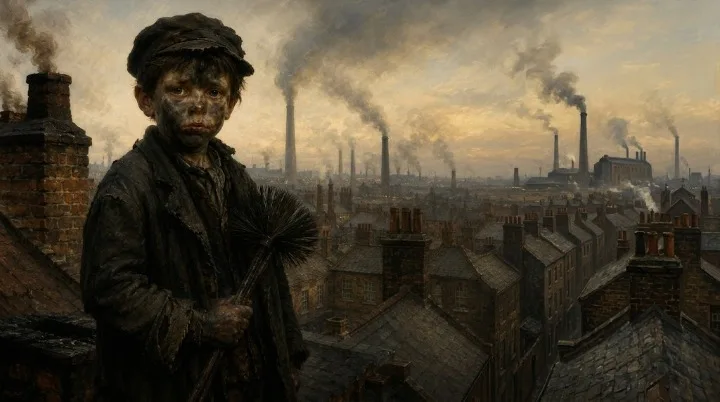
Picture a boy no older than six, squeezed into a chimney flue barely wider than his shoulders, soot filling his lungs while a man below shouts at him to climb faster. Now compare that to a six-year-old today, worrying about nothing more than a spelling test. The gap between those two childhoods is almost impossible to imagine. So what exactly did Victorian children do all day, and how did entire families come to depend on the tiny wages their kids brought home? The truth is grimmer and more varied than most people realise.
Chimney Sweeping: The Deadliest Job for the Smallest Bodies
Nothing captures Victorian child labour quite like the image of a climbing boy disappearing up a chimney. Master sweeps deliberately hired children as young as four or five because their small frames could navigate narrow flues that adults simply couldn’t fit through.
The work was brutal. Boys climbed using their elbows and knees, breathing in thick soot the entire way, and many developed a cancer of the scrotum now known to have been caused by chronic soot exposure — first documented by surgeon Percivall Pott in 1775.
Some sweeps lit small fires beneath boys who hesitated, forcing them upward through fear rather than kindness. Falls, suffocation, and getting permanently stuck in narrow flues were constant dangers.
Reform came slowly. An 1840 law banned employing anyone under 21 as a climbing sweep, but enforcement was weak, and it took the Chimney Sweepers Act of 1875 — pushed hard by reformer George Smith — to finally end the practice through strict licensing. Even then, change crept in far slower than the law suggested.
Factory Work: The Deafening World of Cotton Mills
Step inside a Lancashire cotton mill in the 1830s and the noise alone would knock the breath out of you. Thousands of spinning machines roared at once, and small children moved between them constantly, because their nimble fingers were perfect for one grim task: crawling under moving machinery to gather loose cotton, all while the equipment kept running.
These “scavengers” worked twelve-to-fourteen-hour shifts, and exhausted children frequently lost fingers, hands, or worse when they nodded off near the machines.
The Factory Act of 1833 was a turning point. It banned children under nine from textile mills, limited those aged nine to thirteen to nine hours a day, and — remarkably for the time — required two hours of daily schooling. Inspectors were appointed to check compliance, though only four covered the entire country.
Wages were pitiful. A child might earn a few shillings a week, a fraction of an adult’s pay for equally exhausting hours. Still, for many families, that small amount meant the difference between eating and going hungry, which is exactly why parents so often sent children to work despite the dangers waiting inside.
Coal Mines: Trappers, Hurriers, and Total Darkness
Here’s the part that surprises most people: some of the youngest mine workers weren’t shovelling coal at all — they were sitting alone in pitch darkness for twelve hours straight.
These were the trapper children, some as young as five, whose entire job was opening and closing wooden ventilation doors whenever a coal cart approached. They sat in silence and total blackness for their whole shift, often without so much as a candle, because candles cost money.
Older children became hurriers, harnessed to coal carts like pack animals and dragging them through tunnels sometimes less than three feet high. Girls did this work alongside boys well into their teens.
The Mines Act of 1842 banned women and boys under ten from working underground entirely, passed after a Royal Commission report shocked the public with testimony from child miners themselves. Yet demand for cheap labour meant the practice lingered in some regions for years afterward, hidden from inspectors who rarely made it deep enough underground to see the truth.
Matchstick Girls and the Horror of “Phossy Jaw”
A row of teenage girls sits hunched over a factory table, dipping matchsticks into a chemical mixture, unaware that the fumes rising off their hands are slowly poisoning their bones. That was daily life inside London’s match factories.
The culprit was white phosphorus, used to make matches strike easily. Prolonged exposure caused a horrifying condition called “phossy jaw,” where the jawbone literally began to rot and glow faintly green in the dark. Some sufferers required disfiguring surgery just to survive.
In 1888, roughly 1,400 women and girls at the Bryant and May match factory in East London walked out on strike, protesting not just the health risks but also unfair fines and dismal pay. Their action, organised with help from reformer Annie Besant, is now considered one of the earliest successful strikes by women workers in Britain.
Public pressure eventually pushed manufacturers toward safer red phosphorus, though full change took decades. For the girls living through it, courage came long before comfort.
Domestic Service: Invisible Labour Behind Closed Doors
Not every working child faced machinery or coal dust — some spent their days scrubbing floors before sunrise in houses far grander than their own. Domestic service was one of the most common jobs for Victorian girls, particularly those from poor rural families sent to work in wealthier households.
A scullery maid might start her day at 5am, lighting fires, hauling water, and blacking stoves, often not finishing until well past midnight. Many were barely twelve years old, living in cramped attic rooms and rarely seeing their own families for months at a time.
Unlike factory work, domestic service had no regulating laws at all. There were no hour limits, no minimum age, and no inspectors checking conditions, because it happened entirely inside private homes, invisible to reformers and the public alike.
Wealthier Victorian children, meanwhile, lived an entirely different existence — educated by governesses, dressed in fine clothes, and shielded from labour altogether. The contrast between a mistress’s own daughter and her child servant, sometimes only a year or two apart in age, shows just how sharply Victorian Britain divided childhood along class lines.
Street Trading and Mudlarking Along the Thames
Along the muddy banks of the River Thames, children waded barefoot through freezing sludge at low tide, searching for anything sellable — old rope, scraps of coal, dropped coins, even bones. These children were called mudlarks, and journalist Henry Mayhew documented their desperate scavenging in his 1851 survey of London’s working poor.
Other children worked the streets more directly, selling matches, flowers, watercress, or newspapers from dawn until dark. A costermonger’s child might push a barrow of vegetables through crowded markets, shouting prices to passersby from the age of seven or eight.
This work paid almost nothing, sometimes just enough for a single meal. Yet it offered something factory work didn’t: a strange kind of independence, since street traders answered to no foreman and set their own small routes through the city.
Mayhew’s interviews reveal children who spoke with startling maturity about hunger, theft, and survival — voices that make Victorian poverty feel far less distant than the era itself suggests.
Agricultural Labour: The Countryside’s Hidden Workforce
While cities get most of the attention, plenty of Victorian children worked far from any factory, out in open fields under a different kind of exhaustion. Rural children scared birds away from crops, picked stones from freshly ploughed soil, and helped with harvests from an age that would astonish parents today.
Gangs of child labourers, sometimes organised by a “gangmaster,” moved between farms in eastern England, working long hours for low wages under minimal supervision. An 1867 report on agricultural gangs revealed troubling conditions, including very young children walking miles before dawn just to reach the fields.
Unlike factory reform, agricultural child labour attracted less political attention for decades, partly because farming was seen as wholesome compared to industrial grime. That assumption ignored the same exhaustion, injury risk, and stolen childhood happening in a green field instead of a smoke-filled mill.
🏭 Child Labor In Different Eras
| 💼 Job Role | ⏳ Typical Starting Age | ⚠️ Key Danger | 📜 Major Legislative Reform |
|---|---|---|---|
| Chimney Sweeping | 4–7 years | Suffocation, chimney sweep’s cancer | Chimney Sweepers Act, 1875 |
| Cotton Mill Work | 9 years | Severe machinery injury, lung disease | Factory Act, 1833 |
| Coal Mining (Trapper) | 5–8 years | Extreme isolation, mine collapse, toxic gas | Mines Act, 1842 |
| Match Making | 13–16 years | Phosphorus poisoning (“Phossy Jaw”) | Match Girls’ Strike, 1888 |
| Domestic Service | 10–12 years | Severe overwork, emotional isolation | No specific law enacted |
🏭 Frequently Asked Questions — Victorian Child Labour
Many children began working between the ages of five and nine, particularly in mining and chimney sweeping. Reforms gradually raised the minimum working age throughout the nineteenth century, though enforcement often lagged behind the law.
No. Wealthy and middle-class children typically didn’t work at all and were often educated at home or in private schools. Child labour was overwhelmingly a feature of poor and working-class life.
There was no single law banning it outright. Instead, a series of acts — including the Factory Act of 1833, the Mines Act of 1842, and the Chimney Sweepers Act of 1875 — restricted it industry by industry over several decades.
Wages varied enormously but were always far below adult pay for similar hours. A factory child might earn a few shillings weekly, while street traders sometimes earned barely enough for a single meal a day.
It helped significantly. The Elementary Education Act of 1880 made school attendance compulsory for children up to age ten, gradually reducing the pool of children available for full-time work, though many still worked part-time around school hours.
The Childhood the Victorians Almost Forgot
Reading through these jobs, one thing becomes impossible to ignore: Victorian childhood wasn’t one experience, it was two entirely different worlds sitting side by side. A wealthy child grew up surrounded by lessons and leisure, while a poor child grew up surrounded by soot, coal dust, or chemical fumes, often before they’d lost their milk teeth.
What changed things wasn’t sudden kindness from the top. It was public pressure, brave testimony from workers themselves, and reformers willing to drag uncomfortable truths into daylight. Progress arrived unevenly, law by law, decade by decade.
If this glimpse into Victorian daily life left you curious, you might also enjoy reading about What Did People Drink Before Clean Water? or What Did People Eat in the 1800s? A Complete Guide