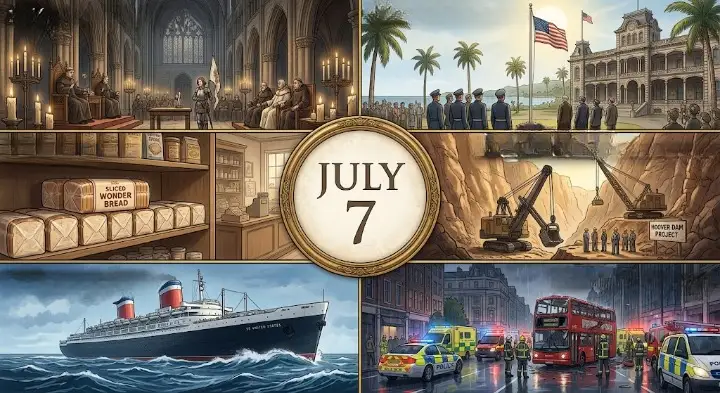
Seven suicide bombers boarded London’s transit system on a rainy morning, carrying backpacks stuffed with homemade explosives that ripped through three subway trains and a double-decker bus. The 2005 coordinated strike stunned the globe, bringing Britain’s capital to a complete standstill and claiming dozens of innocent lives. July 7 has repeatedly served as a stage for human breakthroughs, political upheavals, and sudden tragedies. From ancient sieges to modern political downfalls, the dates on our calendar carry echoes of choices that continually reshape the world we live in today.
📅 Quick Facts — July 7 in History
| 📌 Category | 📖 Event / Detail |
|---|---|
| 🌟 Most Significant Event | The 7/7 coordinated suicide bombings target London’s public transit system during the morning rush hour (2005) |
| 🏆 Top 10 Key Events | • Joan of Arc is officially acquitted of heresy in a posthumous retrial ordered by Pope Callixtus III (1456) • Hernán Cortés and Aztec forces clash at the desperate Battle of Otumba during the Spanish conquest (1520) • The United States officially annexes the Hawaiian Islands via the Newlands Resolution (1898) • Sliced bread goes on commercial sale for the first time by the Chillicothe Baking Company (1928) • Construction officially begins on the Boulder Dam, later renamed the Hoover Dam (1930) • The Marco Polo Bridge Incident near Beijing triggers the Second Sino-Japanese War (1937) • The luxury ocean liner SS United States captures the Blue Riband by breaking the transatlantic speed record (1952) • President Ronald Reagan nominates Sandra Day O’Connor to become the first female Supreme Court Justice (1981) • Unseeded 17-year-old Boris Becker becomes the youngest male player to win a Wimbledon singles title (1985) • British Prime Minister Boris Johnson announces his resignation following a succession of political scandals (2022) |
| ⚔️ Key Battles | Siege of Tyre (1124), Battle of Otumba (1520), Raid of the Redeswire (1575), Battle of Larga (1770), Battle of Chesma (1770), Battle of Hubbardton (1777), First Battle of the Isonzo concludes (1915), Mass Saipan Banzai charge takes place (1944) |
| 👤 Key Figures | Joan of Arc, Jacques Cartier, Henry J. Kaiser, Sandra Day O’Connor, Boris Becker, Jovenel Moïse (who was assassinated on this day in 2021), Boris Johnson |
| 🌍 Observances | Saba Saba Day (Tanzania), Independence Day (Solomon Islands), Ivan Kupala Day (Eastern Europe), Tanabata Star Festival (Japan), World Chocolate Day |
Story of the Day: The Day Joan of Arc Was Finally Cleared
A solemn assembly gathered at Notre Dame Cathedral on July 7, 1456, to hear a final verdict that arrived twenty-five years too late for the young woman it vindicated. Cardinal Guillaume d’Estouteville presided over a formal retrial that systematically dismantled the original heresy charges brought against Joan of Arc by a pro-English court. The new investigation analyzed testimonies from over a hundred witnesses, exposing the political corruption that had sent the nineteen-year-old military heroine to the stake in 1431.
The court declared her previous trial invalid, stained with deceit, and officially proclaimed her innocence. This dramatic reversal restored honor to her family name and solidified her status as the ultimate symbol of French identity, setting a path toward her eventual canonization.
Important Events That Happened On July 7 In History
1124 – The Fall of Tyre
Venetian crusaders breached the massive defensive walls of Tyre after a brutal nineteen-week siege that cut off all incoming supplies. The wealthy Phoenician port city finally surrendered when its defending garrison ran out of food and arrows. Islamic control over the Mediterranean coast took a severe hit, leaving the Kingdom of Jerusalem with secure access to vital maritime trade routes. This victory marked the peak of early crusader expansion before Muslim forces began reclaiming territory.
1456 – Joan of Arc Exonerated
French church officials formally overturned the heresy conviction of Joan of Arc during a dramatic review ordered by Pope Callixtus III. The new court analyzed old testimonies and declared the original trial fraudulent, completely clearing her name twenty-five years after she burned at the stake. This verdict transformed the dead teenager from a condemned heretic into an official martyr for France. Her legacy grew from a controversial peasant rebel into a permanent pillar of French national pride.
1520 – The Battle of Otumba
Hernán Cortés and his exhausted Spanish conquistadores turned to face an overwhelming Aztec army on the plains of Otumba during a desperate retreat. The outnumbered Europeans launched a direct cavalry charge that targeted and killed the Aztec commander, causing the imperial forces to panic and break formation. This unlikely victory saved the remnants of the Spanish expeditionary force from total annihilation. Within a year, Cortés used this momentum to regroup, recruit indigenous allies, and permanently conquer the Aztec capital.
1534 – Jacques Cartier’s First Contact
French navigator Jacques Cartier dropped anchor in Chaleur Bay and initiated trade with the local Mi’kmaq people, marking his first interaction with indigenous Canadians. The exchange of fur pelts for European iron goods created an immediate economic bond based on mutual curiosity. This encounter established the foundational framework for France’s subsequent colonial claims along the St. Lawrence River. The trade relationship defined the early economic landscape of North American exploration for the next two centuries.
1548 – The Treaty of Haddington
Scottish and French diplomats signed a strategic alliance at Haddington to protect Scotland from aggressive English military incursions. The agreement arranged the future marriage of five-year-old Mary, Queen of Scots, to the young French Dauphin, ensuring her immediate evacuation to Paris for safety. This royal pact tied the geopolitical fates of France and Scotland together against their shared English enemy. The move delayed English dominance over the Scottish crown, fueling decades of bitter border conflicts.
1575 – The Raid of the Redeswire
English and Scottish border wardens engaged in a sudden, violent skirmish at a meeting point in the Cheviot Hills over a dispute regarding a notorious prisoner. What began as a peaceful truce meeting turned into a chaotic battle as reinforcements from nearby Jedburgh arrived to drive the English forces away. This clash went down as the last major open battle fought between the kingdoms of England and Scotland before the crowns united. The incident forced both nations to reform their volatile border security systems permanently.
1585 – The Treaty of Nemours
King Henri III of France signed a sweeping royal edict that fully abolished religious tolerance for Protestants across the realm. The decree stripped French Huguenots of all their hard-won civil rights, forced their ministers into exile, and banned their worship under pain of death. This radical concession to the Catholic League triggered the War of the Three Henries, one of the bloodiest phases of the French Wars of Religion. The decision fractured French society for over a decade until the Edict of Nantes restored peace.
1667 – Disaster at Fort St Pierre
English warships cornered and thoroughly destroyed a large French merchant fleet anchored off Fort St Pierre in Martinique. The relentless bombardment sank or burned dozens of vessels, crippling French maritime trading power in the Caribbean during the Second Anglo-Dutch War. This decisive naval strike secured English dominance over the region’s valuable colonial shipping lanes. The loss forced France to accept less favorable terms during the upcoming peace negotiations at Breda.
1770 – The Battle of Larga
Russian commander Pyotr Rumyantsev led his imperial troops into a fierce confrontation against a much larger Ottoman-Crimean force along the Larga River. The disciplined Russian infantry used advanced square formations and superior artillery placement to completely rout the opposing army. This victory broke the Ottoman defensive line in the region and paved the way for deeper Russian advancement into the Balkans. The outcome signaled a permanent shift in military dominance along the northern Black Sea coast.
1770 – The Battle of Chesma
Russian naval squadrons trapped the main Ottoman fleet inside Chesma Bay and launched a devastating midnight raid using explosive fireships. The resulting conflagration lit up the night sky, obliterating nearly the entire Ottoman navy in their worst maritime defeat since Lepanto. This catastrophic blow gave Russia absolute control over the Aegean Sea for the remainder of the war. The victory established the Russian Empire as a major naval superpower capable of threatening Constantinople directly.
1777 – The Battle of Hubbardton
British green-coated regulars caught up with the retreating rearguard of the American Continental Army in the green hills of Hubbardton, Vermont. The fierce wilderness firefight ended in a tactical British victory as the Americans were forced to scatter into the woods. The stubborn American resistance managed to slow the British pursuit enough to save the main army from capture. This crucial delay allowed the American forces to regroup farther south, setting the stage for their historic victory at Saratoga.
1798 – Congress Rescinds the French Alliance
The United States Congress voted to formally cancel the 1778 Treaty of Alliance with France after French privateers repeatedly attacked American merchant shipping. The legislative move effectively launched the Quasi-War, an undeclared naval conflict fought entirely on the high seas. This decision marked the official end of the historic alliance that had helped America win its independence from Great Britain. The split pushed the young republic toward a policy of strict neutrality in European affairs.
1807 – The First Treaty of Tilsit
Napoleon Bonaparte and Tsar Alexander I met on a floating raft in the Niemen River to sign a historic peace agreement that ended the War of the Fourth Coalition. The pact forced Russia to become an ally of France, partition Prussian territory, and join the Continental System blockade against Great Britain. This geopolitical realignment left Napoleon as the undisputed master of Western and Central Europe. The fragile peace lasted only five years before French armies marched toward Moscow.
1834 – Anti-Abolitionist Riots in New York
Angry mobs of anti-abolitionist rioters filled the streets of New York City, launching four nights of coordinated attacks against Black residents and white anti-slavery activists. The rioters targeted homes, churches, and businesses, burning properties to the ground before the military stepped in to restore order. This explosion of violence exposed the deep, volatile racial tensions running through northern cities long before the Civil War. The events forced abolitionist leaders to bolster their security and organize more resilient networks.
1846 – The Occupation of Monterey
Commodore John D. Sloat ordered American marines to land at Monterey, raising the United States flag over the custom house to claim California. The bloodless takeover marked the official beginning of the American military conquest of the Mexican territory. This operation pre-empted potential British designs on the region and secured a crucial deep-water port for the US Navy. The landing set off a chain of events that permanently altered the map of North America.
1863 – The First US Military Draft
The United States government enacted its first nationwide wartime draft to replenish the depleted ranks of the Union Army during the Civil War. A controversial clause allowed wealthy citizens to avoid service entirely by paying a $300 exemption fee or hiring a substitute. This provision sparked immediate outrage among working-class communities who could not afford to buy their way out. The simmering anger boiled over days later, triggering the deadly New York City draft riots.
1865 – Lincoln Conspirators Hanged
Executioners dropped the gallows traps at the Old Arsenal Penitentiary in Washington, hanging four convicted conspirators involved in the assassination of Abraham Lincoln. Mary Surratt, Lewis Powell, David Herold, and George Atzerodt died before a crowd of military officers and civilian onlookers. This swift execution concluded the chaotic manhunt and trial that followed the President’s death at Ford’s Theatre. Mary Surratt’s death marked the first time the United States federal government executed a woman.
1892 – Founding of the Katipunan
Anti-Spanish revolutionary Andrés Bonifacio gathered a small group of patriots in a darkened Manila house to establish the secret society known as the Katipunan. The members signed their oaths in blood, pledging to secure total Philippine independence through armed revolt. The subsequent discovery of this underground network by Spanish authorities forced the group to launch their rebellion ahead of schedule. This organization served as the primary driving force behind the historic Philippine Revolution.
1898 – The Annexation of Hawaii
President William McKinley signed the Newlands Resolution into law, officially annexing the islands of Hawaii as a United States territory. The legislative maneuver bypassed the traditional treaty process, which had failed to gain enough votes in the Senate due to anti-imperialist opposition. This political move solidified American control over vital sugar plantations and secured a strategic naval outpost at Pearl Harbor. The annexation permanently dismantled the sovereignty of the native Hawaiian Kingdom.
1900 – The Sinking of the Idler
The luxury racing yacht Idler encountered a violent summer storm on Lake Erie, capsizing and sinking into the dark waters off the Ohio coast. Six passengers, all members of the prominent Cleveland industrialist James C. Corrigan’s family, drowned before rescue boats could reach the scene. The sudden tragedy shocked Midwest high society and filled national newspapers with grim accounts of the disaster. The event led to stricter safety regulations for private recreational vessels operating on the Great Lakes.
1907 – The First Ziegfeld Follies
Producer Florenz Ziegfeld Jr. debuted his very first Follies revue on the open-air roof garden of the New York Theater, changing American musical theater forever. The elaborate production featured lavish costumes, synchronized dance routines, and top-tier comedic acts designed to entertain high-society crowds. This opening performance established a high-standard blend of spectacle and showmanship that came to define Broadway for decades. The show launched the careers of numerous legendary entertainers and musicians.
1911 – The North Pacific Fur Seal Convention
Diplomats from the United States, Great Britain, Japan, and Russia signed a historic environmental pact to completely ban open-water seal hunting in the Pacific. The agreement represented the first time international governments collaborated to save an endangered animal species from commercial extinction. This treaty successfully managed to restore the collapsing fur seal population over the following decades. The framework served as the direct template for modern international wildlife preservation laws.
1915 – The First Battle of the Isonzo Ends
The Austro-Hungarian army successfully halted a massive Italian offensive along the rugged banks of the Isonzo River after two weeks of brutal combat. The Italian troops suffered heavy casualties while failing to breach the reinforced alpine defensive lines of their opponents. This bloody stalemate set the tone for the agonizing trench warfare that defined the Italian Front for the rest of World War I. The region saw eleven more identical battles fought over the exact same rocky terrain.
1915 – The Execution of Henry Pedris
British colonial authorities in Ceylon executed military officer Henry Pedris by firing squad during a period of intense communal unrest. The administration wrongly accused the prominent young officer of inciting anti-Muslim riots, carrying out the death sentence in a bid to intimidate local nationalists. This controversial execution sparked immediate fury across the island, turning Pedris into a powerful martyr for the anti-colonial movement. The tragedy accelerated the political drive toward Sri Lankan independence.
1916 – The New Zealand Labour Party Founded
Trade union delegates gathered in a crowded Wellington hall to merge several left-wing political factions into the New Zealand Labour Party. The founders created the organization to give working-class citizens a unified voice against conservative business interests. This political unification altered the country’s legislative landscape, eventually leading to the creation of the modern welfare state in the 1930s. The party remains one of the two dominant political forces in New Zealand today.
1928 – Sliced Bread Hits the Market
The Chillicothe Baking Company of Missouri put the world’s first commercially sliced bread on grocery shelves, utilizing an automated machine invented by Otto Rohwedder. Skeptical shoppers embraced the uniform slices, causing sales to skyrocket within days as households abandoned their traditional bread knives. The innovation revolutionized the commercial baking industry and changed morning routines across the United States. The product gave rise to the iconic American idiom “the greatest thing since sliced bread.”
1930 – Construction Begins on Boulder Dam
Industrialist Henry J. Kaiser directed the first work crews to begin clearing canyon walls for the construction of the massive Boulder Dam along the Colorado River. The multi-million-dollar engineering project required thousands of laborers to work in extreme desert heat during the height of the Great Depression. The completed structure tamed a volatile river, provided hydroelectric power to the Southwest, and created Lake Mead. The marvel was later renamed Hoover Dam to honor the sitting President.
1930 – The Lapua Peasant March
Over twelve thousand far-right activists belonging to the Lapua Movement marched through the streets of Helsinki to demand the total suppression of communism in Finland. The massive show of force pressured the Finnish government into passing strict anti-communist laws that banned left-wing newspapers and organizations. This aggressive demonstration marked the peak political influence of the radical nationalist movement within the country. The event highlighted the deep political fractures dividing European democracies during the interwar years.
1937 – The Marco Polo Bridge Incident
Japanese and Chinese troops exchanged heavy gunfire near the historic Marco Polo Bridge outside Beijing after a Japanese soldier went missing during unauthorized night maneuvers. The minor skirmish quickly escalated as military commanders on both sides refused to back down or withdraw their forces. The Japanese imperial command used this clash as the ultimate pretext to launch a full-scale invasion of China. This localized event marked the official start of the Second Sino-Japanese War.
1937 – The Peel Commission Report
The British government published the Peel Commission Report, offering the first official recommendation to partition Palestine into separate Jewish and Arab states. The document concluded that the mandate had become unworkable due to irreconcilable national aspirations between the two communities. While some Zionist leaders cautiously accepted the concept, Arab leadership rejected the division out of hand, sparking renewed civil unrest. The proposal established the basic blueprint for partition plans that persisted for decades.
1941 – US Troops Occupy Iceland
American marines landed at Reykjavik to take over defensive duties from the British forces that had occupied the strategic island nation a year prior. The deployment aimed to protect crucial North Atlantic shipping lanes from German U-boat attacks while keeping the US technically out of World War II. This move marked a significant escalation in America’s involvement in the European theater before Pearl Harbor. The operation ensured Iceland remained a vital Allied base for the remainder of the war.
1944 – The Saipan Banzai Charge
Over four thousand desperate Japanese soldiers launched the largest kamikaze-style infantry charge of the Pacific War against American lines on Saipan. The relentless nighttime assault overran several frontline U.S. army battalions before superior firepower finally crushed the offensive. The suicidal charge resulted in the near-total destruction of the remaining Japanese garrison on the strategic island. The fall of Saipan put American B-29 bombers within direct striking distance of mainland Japan.
1946 – Canonization of Mother Cabrini
Pope Pius XII canonized Francesca Saverio Cabrini in a grand ceremony at the Vatican, making her the very first United States citizen to be declared a saint. The Italian-born nun had spent her adult life founding schools, hospitals, and orphanages to aid impoverished immigrants across America. Her elevation to sainthood provided an immense source of pride for millions of Catholic immigrants facing discrimination in the United States. She was later named the patron saint of all immigrants.
1946 – Howard Hughes Survives Crash
Aviation mogul Howard Hughes suffered catastrophic injuries when his experimental XF-11 reconnaissance aircraft prototype lost oil pressure and crashed into a Beverly Hills neighborhood. The plane sliced through several homes before erupting into a fiery inferno that left Hughes with crushed lungs and severe burns. His miraculous survival followed a daring rescue by a bystander who pulled him from the burning cockpit. The near-fatal accident altered Hughes’s physical health and accelerated his reclusive lifestyle.
1952 – SS United States Breaks Speed Record
The luxury ocean liner SS United States sailed past Bishop Rock on her maiden voyage, capturing the prestigious Blue Riband for the fastest transatlantic crossing in history. The vessel completed the journey from New York to England in just three days, ten hours, and forty minutes, beating the previous record by several hours. The ship’s specialized aluminum construction and secret military-grade engines showcased American post-war engineering supremacy. The speed record for conventional passenger liners remains unbroken to this day.
1953 – Che Guevara’s Latin American Journey
Ernesto “Che” Guevara boarded a train out of Buenos Aires, embarking on a formative journey through Bolivia, Peru, Ecuador, and Central America. The young doctor spent months observing firsthand the deep poverty, exploitation, and political instability affecting indigenous workers and miners. These intense experiences transformed him from a middle-class intellectual into a radical Marxist revolutionary. The trip set him on a direct path to Guatemala, where he later met the Cuban revolutionaries who changed his life.
1958 – The Alaska Statehood Act
President Dwight D. Eisenhower signed the Alaska Statehood Act into law, officially clearing the path for the massive northern territory to enter the Union. The legislation concluded a decades-long political battle fought by local residents who demanded full voting representation in the United States government. The move secured a vast wilderness rich in oil, gold, and timber for the nation during the height of the Cold War. Alaska officially became the 49th state early the following year.
1959 – Venus Occults Regulus
Astronomers worldwide trained their telescopes on the night sky as the planet Venus passed directly in front of the bright star Regulus. This rare celestial alignment allowed scientists to accurately measure the depth and density of the Venusian atmosphere for the first time by observing how the star’s light faded. The collected data shattered several old theories and provided vital information for planning the first robotic space probes sent to Venus. The event will not happen again until the year 2044.
1962 – Alitalia Flight 771 Crashes
An Alitalia Douglas DC-8 jetliner slammed into a fog-shrouded hill near Junnar, India, during its final approach to the Bombay airport. The high-speed impact completely destroyed the aircraft and killed all ninety-four passengers and crew members on board instantly. Investigators later blamed the disaster on navigational errors made by the pilots, who had misjudged their altitude in the heavy monsoon rains. The tragedy prompted major upgrades to the radar and warning systems at regional Indian airports.
1963 – Attack on American Journalists
South Vietnamese plainclothes police officers attacked a group of American reporters covering a Buddhist protest in Saigon on the orders of political adviser Ngô Đình Nhu. The officers threw Peter Arnett to the ground and smashed cameras belonging to other journalists who attempted to document the heavy-handed religious crackdown. The assault backfired completely, causing an international uproar that severely strained relations between Washington and the Diem regime. The incident highlighted the growing instability that eventually led to a military coup.
1978 – Solomon Islands Independence
The Solomon Islands officially severed its colonial ties with Great Britain, raising its new national flag in the capital city of Honiara to celebrate full independence. The new nation joined the Commonwealth as a constitutional monarchy, ending nearly a century of British administrative control over the Pacific archipelago. The transition marked a major milestone in the post-war decolonization of the South Pacific region. The date remains the country’s premier national holiday, celebrated with traditional dances and feasts.
1980 – Sharia Law Implemented in Iran
The revolutionary government of Ayatollah Khomeini officially enacted Sharia law across Iran, transforming the nation into a strict Islamic republic. The new legal code replaced secular courts with religious tribunals, enforced strict dress codes for women, and banned Western music and movies. This institutional shift marked the complete consolidation of power by the clerical leadership following the overthrow of the Shah. The transformation altered the political and cultural landscape of the modern Middle East.
1980 – The Safra Massacre
Phalangist gunmen launched a surprise assault on the headquarters of the rival Tiger Militant group in the Lebanese coastal resort town of Safra. The ruthless assault claimed the lives of eighty-three Tiger fighters and civilians during a day of intense, close-quarters gun battles. The massacre allowed warlord Bashir Gemayel to eliminate his main Christian political rivals and unite all right-wing militias under his command. This consolidation of power dramatically shifted the dynamics of the ongoing Lebanese Civil War.
1981 – Sandra Day O’Connor Nominated
President Ronald Reagan made history by nominating Arizona appeals court judge Sandra Day O’Connor to fill a vacancy on the Supreme Court of the United States. The announcement fulfilled a high-profile campaign promise to break the gender barrier on the nation’s highest judicial bench. O’Connor faced intense scrutiny from both political sides before winning unanimous confirmation from the Senate weeks later. Her appointment ended nearly two centuries of exclusive male dominance over the American federal judiciary.
1983 – Samantha Smith Visits the USSR
Ten-year-old American schoolgirl Samantha Smith landed in Moscow to begin a high-profile peace tour at the personal invitation of Soviet leader Yuri Andropov. Smith had written a letter to Andropov asking if the Soviet Union was going to vote for a nuclear war, prompting the leader to invite her to see his country firsthand. The journey captured the imagination of the global media, offering a rare moment of human warmth during the darkest years of the Cold War. Her visit helped humanize the enemy for millions of citizens on both sides.
1985 – Boris Becker Wins Wimbledon
Seventeen-year-old unseeded German tennis prodigy Boris Becker defeated Kevin Curren on the historic grass courts of Centre Court to win the Wimbledon men’s singles title. His powerful diving volleys and booming serves captivated the crowd, making him the youngest male Grand Slam champion in tennis history. The historic victory sparked a massive tennis boom across Germany and turned the teenager into an overnight global superstar. His record as the youngest male Wimbledon winner stands intact today.
1991 – The Brioni Agreement
Diplomats representing Slovenia, Croatia, and the Yugoslav federation signed the Brioni Agreement to bring a peaceful end to the brief Ten-Day War. The accord forced Slovenia to place its independence declaration on hold for three months in exchange for the complete withdrawal of the Yugoslav army from its territory. This treaty marked the official collapse of the central Yugoslav state’s control over its northernmost republic. The peaceful resolution allowed Slovenia to transition cleanly into a sovereign European democracy.
1992 – Topless Rights for Women in New York
The New York Court of Appeals issued a historic ruling declaring that women possess the exact same legal right as men to go topless in public places. The judges threw out old public indecency convictions against activists who had challenged the state’s gender-biased public nudity laws. The landmark decision established a powerful legal precedent for gender equality and bodily autonomy within the state. The ruling sparked widespread debate regarding public decency standards across the country.
1997 – Turkish Forces Withdraw from Iraq
The Turkish military concluded a large-scale cross-border offensive, pulling its troops out of northern Iraq after weeks of heavy combat against Kurdish separatists. The operation succeeded in destroying numerous hidden training camps and supply depots used by the PKK guerrilla movement. Turkish commanders accomplished their mission by partnering with the Kurdistan Democratic Party during the complex Iraqi Kurdish Civil War. The withdrawal did not stop the region from remaining a volatile flashpoint for border security.
2003 – Launch of the Opportunity Rover
NASA technicians successfully launched the Opportunity rover into orbit aboard a Delta II rocket from the Cape Canaveral Air Force Station. The robotic explorer began a six-month journey through space toward Mars to search for geological evidence of ancient water on the red planet. While engineers expected the rover to survive for only ninety days, Opportunity operated for nearly fifteen years, sending back thousands of images. The mission transformed our scientific understanding of the history of Mars.
2005 – The London Transit Bombings
Four suicide bombers detonated homemade explosives inside three crowded London Underground trains and a double-decker bus during the morning rush hour. The coordinated terrorist strikes killed fifty-six people and injured more than seven hundred others, marking the worst attack on British soil since World War II. The tragedy brought the entire capital city to a standstill and triggered a massive international counter-terrorism investigation. The event forced public transit networks worldwide to implement permanent security upgrades.
2006 – The Spiritwood Shootout
A lone gunman ambushed a team of Royal Canadian Mounted Police officers outside a rural property in Spiritwood, Saskatchewan, sparking a deadly shootout. The heavy exchange of gunfire killed two officers and left a third severely wounded before the suspect fled into the surrounding woods. A massive manhunt involving hundreds of tactical officers ended days later with the shooter’s arrest. The tragedy shocked the nation and led to calls for upgrading the body armor and firearms issued to rural officers.
2007 – The First Live Earth Concerts
Musicians and environmental activists staged the first Live Earth benefit concerts, holding eleven massive performances across all seven continents within a single twenty-four-hour period. The global musical event aimed to raise awareness regarding climate change, drawing over two billion viewers via television and online broadcasts. Top international artists performed on stages from Sydney to London, making it one of the largest media events in human history. The concerts triggered widespread public dialogue concerning renewable energy investments.
2011 – Grand Rapids Killing Spree
A heavily armed man went on a violent rampage across two neighborhoods in Grand Rapids, Michigan, shooting and killing seven people, including his own daughter. The shooter then fled into a nearby home, taking hostages and engaging in a tense standoff with police negotiators for several hours before turning the gun on himself. The senseless tragedy devastated the local community and stands as the deadliest mass shooting in the city’s history. The event renewed debate regarding local domestic violence intervention programs.
2012 – Krasnodar Krai Flash Floods
A series of torrential downpours dropped months of rain in a single night over the Krasnodar Krai region of southern Russia, triggering devastating flash floods. The raging waters overwhelmed local riverbeds and slammed into homes while residents slept, trapping families and killing at least 172 people. The disaster completely destroyed thousands of properties and washed out vital transportation infrastructure across the region. The tragedy exposed severe flaws in the local emergency broadcast and flood warning systems.
2013 – Soldotna Air Taxi Crash
A De Havilland Otter floatplane carrying two families on a summer vacation stalled and crashed into the ground immediately after takeoff from the Soldotna Airport in Alaska. The impact and subsequent fire killed all ten passengers and the pilot on board before rescue crews could reach the remote runway. Federal investigators later blamed the fatal accident on improper baggage loading that threw off the plane’s center of gravity. The disaster led to stricter weight verification rules for regional air taxi operators.
2016 – Dallas Police Ambush
A heavily armed sniper ambushed a group of law enforcement officers at the conclusion of a peaceful protest in downtown Dallas, Texas. The shooter killed five officers and wounded nine others before retreating into a nearby college building, where he was killed by a remote-controlled bomb delivery robot. The tragic attack marked the deadliest single day for American law enforcement since the September 11 attacks. The event heightened national conversations regarding police community relations and tactical technology.
2017 – Nuclear Weapons Prohibition Treaty
Delegates from 122 nations gathered at the United Nations headquarters to officially adopt the Treaty on the Prohibition of Nuclear Weapons, marking a historic milestone for global disarmament. The international accord established a comprehensive ban on developing, testing, producing, and possessing nuclear weapons. While non-nuclear states celebrated the vote, all nine nuclear-armed powers boycotted the negotiations, refusing to sign the document. The treaty highlighted the deep diplomatic divide regarding global security strategies.
2019 – US Wins Women’s World Cup
The United States women’s national soccer team defeated the Netherlands 2–0 in a thrilling final match in Lyon, France, to capture their second consecutive FIFA World Cup title. Second-half goals from Megan Rapinoe and Rose Lavelle secured the victory before a sold-out stadium of roaring fans. The triumph capped off a dominant tournament run that set new records for total goals scored in a single World Cup. The championship victory amplified the team’s ongoing legal fight for equal pay in professional sports.
2021 – Assassination of Jovenel Moïse
A group of heavily armed foreign mercenaries stormed the private residence of Haitian President Jovenel Moïse in Port-au-Prince, shooting and killing him in his bedroom. The daring midnight raid left the first lady severely wounded and plunged the Caribbean nation into a profound constitutional crisis. The sudden death of the leader sparked widespread civil unrest, crippled local government institutions, and led to an escalation in gang violence across the capital. The assassination remains a central flashpoint in the ongoing Haitian crisis.
2022 – Resignation of Boris Johnson
British Prime Minister Boris Johnson stood before the doors of 10 Downing Street to officially announce his resignation as leader of the Conservative Party. His statement followed a chaotic three-day government crisis that saw dozens of his own ministers and members of parliament resign in protest over his handling of political scandals. The mass departures effectively paralyzed the executive branch, forcing Johnson to step down after months of resisting pressure. His exit triggered a leadership contest that reshaped British politics.
Explore our archive of past daily historical facts.
Famous People Born on July 7
| Name | Description | Date |
|---|---|---|
| Elizabeth of Hungary | Hungarian princess and Catholic saint | 1207–1231 |
| Joseph Marie Jacquard | French inventor of the Jacquard loom | 1752–1834 |
| Camillo Golgi | Italian physician, Nobel Prize-winning scientist | 1843–1926 |
| Gustav Mahler | Austrian composer and conductor | 1860–1911 |
| Nettie Stevens | American geneticist who discovered sex chromosomes | 1861–1912 |
| Lion Feuchtwanger | German novelist and playwright | 1884–1958 |
| Tadamichi Kuribayashi | Japanese general of World War II | 1891–1945 |
| George Cukor | American Academy Award-winning film director | 1899–1983 |
| Vittorio De Sica | Italian actor and Oscar-winning director | 1901–1974 |
| Eiji Tsuburaya | Japanese special-effects pioneer and creator of Ultraman | 1901–1970 |
| Satchel Paige | Legendary American baseball pitcher | 1906–1982 |
| Robert A. Heinlein | Influential American science fiction author | 1907–1988 |
| Gian Carlo Menotti | Italian-American Pulitzer Prize-winning composer | 1911–2007 |
| Ezzard Charles | American world heavyweight boxing champion | 1921–1975 |
| Doc Severinsen | American trumpet virtuoso and bandleader | 1927–Present |
| David McCullough | Pulitzer Prize-winning American historian | 1933–2022 |
| Tung Chee-hwa | First Chief Executive of Hong Kong | 1937–Present |
| Ringo Starr | English drummer and member of The Beatles | 1940–Present |
| Bill Oddie | English comedian, actor, and television presenter | 1941–Present |
| Tony Jacklin | English major championship-winning golfer | 1944–Present |
| Gyanendra | Former King of Nepal | 1947–Present |
| Shelley Duvall | American actress and producer | 1949–2024 |
| Ralph Sampson | American Basketball Hall of Fame player | 1960–Present |
| Jim Gaffigan | American comedian and actor | 1966–Present |
| Joe Sakic | Canadian Hockey Hall of Fame player | 1969–Present |
| Lisa Leslie | American Basketball Hall of Fame player | 1972–Present |
| Michelle Kwan | American Olympic figure skater | 1980–Present |
| Mahendra Singh Dhoni | Indian World Cup-winning cricketer | 1981–Present |
| Alesso | Swedish DJ and music producer | 1991–Present |
| Moussa Diaby | French international footballer | 1999–Present |
Famous People Who Died on July 7
| Name | Description | Date |
|---|---|---|
| Edward I of England | King of England | 1239–1307 |
| Thomas Hooker | Founder of the Colony of Connecticut | 1586–1647 |
| Richard Brinsley Sheridan | Irish playwright and politician | 1751–1816 |
| Henri Nestlé | Founder of Nestlé | 1814–1890 |
| Johanna Spyri | Swiss author of Heidi | 1827–1901 |
| Arthur Conan Doyle | British author, creator of Sherlock Holmes | 1859–1930 |
| Moshe Sharett | Second Prime Minister of Israel | 1894–1965 |
| Veronica Lake | American film actress | 1922–1973 |
| Bill Cullen | American television game show host | 1920–1990 |
| Cazuza | Brazilian singer-songwriter | 1958–1990 |
| Moshood Abiola | Nigerian businessman and politician | 1937–1998 |
| Vikram Batra | Indian Army officer and Param Vir Chakra recipient | 1974–1999 |
| Syd Barrett | English musician and founding member of Pink Floyd | 1946–2006 |
| Anne McLaren | British developmental biologist | 1927–2007 |
| Donald Michie | British artificial intelligence researcher | 1923–2007 |
| Alfredo Di Stéfano | Argentine-Spanish football legend | 1926–2014 |
| Eduard Shevardnadze | Former President of Georgia | 1928–2014 |
| Maria Barroso | Portuguese actress and First Lady | 1925–2015 |
| Robert Downey Sr. | American filmmaker and actor | 1936–2021 |
| Dilip Kumar | Legendary Indian film actor | 1922–2021 |
| Jovenel Moïse | President of Haiti | 1968–2021 |
| Jane McAlevey | American labor organizer and author | 1964–2024 |
| Wayne Dobson | English magician and television performer | 1957–2025 |
Observances on July 7
Saba Saba Day (Tanzania): Tanzanians celebrate Saba Saba Day every July 7 to mark the 1954 founding of the Tanganyika African National Union, the political party that successfully led the nation to independence. The holiday centers around the Dar es Salaam International Trade Fair, drawing businesses from across East Africa.
Independence Day (Solomon Islands): This national holiday commemorates the Solomon Islands gaining full sovereignty from Great Britain on this day in 1978. Communities across the islands mark the occasion with flag-raising ceremonies, traditional music, and sporting events.
Ivan Kupala Day (Eastern Europe): People across Poland, Russia, Ukraine, and Belarus celebrate this ancient Slavic feast linked to the summer solstice. Traditional rituals include leaping over bonfires, weaving floral wreaths, and swimming in rivers to bring good luck.
Tanabata (Japan): Also known as the Star Festival, Tanabata celebrates the annual celestial meeting of the deities Orihime and Hikoboshi, represented by the stars Vega and Altair. People celebrate by writing personal wishes on colorful paper strips and hanging them on bamboo branches.
World Chocolate Day: This global celebration marks the traditional anniversary of the introduction of chocolate to Europe in 1550. Chocolate lovers celebrate by indulging in their favorite sweet treats and exploring artisanal cocoa creations.
Frequently Asked Questions — July 7 in History
Four suicide bombers detonated homemade explosives inside London’s transit system during the morning rush hour. The coordinated strikes hit three underground subway trains and a double-decker bus, killing fifty-six people and injuring more than seven hundred others.
The 2005 London transit bombings stand as the most significant event on this date due to their massive impact on international counter-terrorism policies and global public transit security. Another major event was the 1456 retrial that posthumously cleared Joan of Arc of heresy charges.
Otto Rohwedder, the American engineer who invented the world’s first automated commercial bread-slicing machine, was born on this day in 1880. His invention allowed the Chillicothe Baking Company to sell the first sliced bread on his 48th birthday in 1928.
Japanese and Chinese troops clashed near the Marco Polo Bridge outside Beijing in 1937, providing the pretext for the Second Sino-Japanese War. Additionally, in 1944, Japanese forces launched the largest Banzai charge of the Pacific War against American lines during the Battle of Saipan.
Tanabata is a traditional Japanese festival celebrating the legendary annual reunion of two star-crossed lovers, represented by the stars Vega and Altair, who are separated by the Milky Way. People celebrate by writing wishes on small paper strips and tying them to bamboo trees.
British Prime Minister Boris Johnson announced his resignation as leader of the Conservative Party in 2022 following a severe cabinet crisis. A year earlier, in 2021, Haitian President Jovenel Moïse was assassinated in his private residence by a group of armed mercenaries.