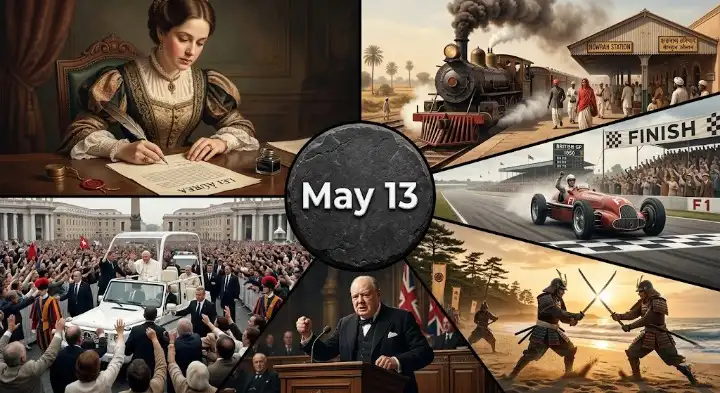
On the morning of May 13, 1988, Princess Isabel of Brazil signed a document that instantly transformed the lives of over seven hundred thousand human beings. With a stroke of her pen, the Lei Áurea shattered the legal chains of bondage in the Western Hemisphere’s largest slave-owning nation. This date holds some of humanity’s most high-stakes moments, from desperate duels to political declarations. Discover what happened on May 13 in history through the stories that shaped our world.
👶 Quick Facts — May 13 in History
| 📌 Category | 📖 Event / Detail |
|---|---|
| 🌟 Most Significant Event | Brazil abolishes slavery with the Golden Law (1888) |
| 🏆 Top 10 Key Events | • Pope Agapetus I elected (535) • Fall of Beirut (1110) • Battle of Langside (1568) • Musashi duel (1612) • First UK railway opens (1861) • Robert Smalls’ daring escape (1862) • First Giro d’Italia begins (1909) • Winston Churchill’s “Blood, Toil, Tears and Sweat” speech (1940) • Pope John Paul II survives assassination attempt (1981) • Tiananmen Square hunger strike begins (1989) |
| ⚔️ Key Battles | Battle of Pallene (1344), Battle of Langside (1568), Battle of Arakere (1791), Battle of Grahovac (1858) |
| 👤 Key Figures | Princess Isabel of Brazil, Winston Churchill, Pope John Paul II, Robert Smalls |
| 🌍 Observances | Abbotsbury Garland Day, Rotuma Day |
Story of the Day: The Miracle of Robert Smalls
Under the cover of a pitch-black midnight, Robert Smalls quietly slipped the Confederate transport steamer Planter away from a Charleston dock. Wearing the captain’s straw hat to deceive harbor guards, the enslaved crewman navigated past five heavily armed forts. He knew a single mistake meant instant execution for himself, his wife, and their young children hiding below deck.
Smalls successfully delivered the military vessel directly into the hands of an astonished Union blockade squadron. The daring escape earned him national fame, a personal meeting with Abraham Lincoln, and a commission as the first Black captain in naval history.
Important Events That Happened On May 13 In History
535 – Election of Pope Agapetus I
Archdeacon Agapetus walked into the Basilica of San Stefano surrounded by anxious Roman clergy who needed a leader after the sudden death of John II. The new pope faced immediate pressure from King Theodahad of the Ostrogoths to halt the Byzantine advance into Italy. He pawned sacred church vessels to finance an urgent peace mission to Constantinople. His brief eleven-month reign failed to stop the looming Gothic War, leaving Rome vulnerable to decades of brutal siege.
1110 – Baldwin I Captures Beirut
King Baldwin I stood on the decks of a formidable Genoese fleet as it blockaded the prosperous port city of Beirut. Christian siege towers rolled toward the ancient stone walls while Fatimid defenders rained down Greek fire from above. The bloody breach ended in a merciless sack that left thousands of citizens dead or enslaved. Securing this vital harbor allowed the Kingdom of Jerusalem to lock down the Levantine coast and ensure a steady flow of Western crusaders.
1344 – Battle of Pallene
Captains of the Christian League raised their banners off the coast of the Kassandra peninsula as a massive Turkish raiding fleet advanced. The combined galleys of Venice, the Knights Hospitaller, and the Kingdom of Cyprus smashed into the enemy vessels with devastating ramming speed. Over fifty Turkish ships burned down to the waterline during the chaotic melee. This decisive naval victory temporarily broke the regional piracy networks and protected vulnerable Aegean islands from imminent invasion.
1373 – Visions of Julian of Norwich
Thirty-year-old Julian lay paralyzed in her small Norwich bedroom, receiving the last rites as her family watched her breathe her final shallow breaths. As the local priest held a crucifix above her face, the physical pain vanished and a sequence of intense spiritual revelations began. She survived the mysterious illness and spent the next twenty years writing down these experiences in Revelations of Divine Love. Her work stands as the earliest surviving English-language book authored by a woman.
1501 – Amerigo Vespucci Sails West
Amerigo Vespucci watched the Lisbon shoreline fade into the horizon as three Portuguese caravels caught the Atlantic trade winds. Commissioned by King Manuel I, the Italian navigator aimed to find a passage to the rich spice markets of the Indian Ocean. Instead of finding Asia, his charts mapped the massive, continuous coastline of modern-day Brazil. His subsequent letters convinced European mapmakers that they were looking at a completely distinct landmass, which they named America in his honor.
1568 – Battle of Langside
Mary, Queen of Scots, watched from a distant hillside as her cavalry charged the disciplined lines of her Protestant half-brother, the Earl of Moray. Within sixty minutes, her vanguard collapsed under a hail of hagbut musketry in the narrow lanes of Langside village. The catastrophic defeat shattered Mary’s final campaign to reclaim her stolen Scottish crown. Fleeing south across the border, she threw herself on the mercy of Queen Elizabeth I, beginning nineteen years of captivity.
1612 – Musashi Duels Kojiro
Miyamoto Musashi stepped off a wooden rowboat onto the remote beach of Ganryū Island, intentionally arriving hours late to unnerve his rival. Sasaki Kojiro drew his famous longsword, shouting in fury at the disrespect, while Musashi calmly raised an oar he had carved into a weapon. Kojiro swung first, cutting Musashi’s headband, but Musashi’s heavy wooden blow cracked his opponent’s skull open in an instant. The legendary duel cemented Musashi’s status as the greatest swordsman in Japanese history.
1619 – Execution of Johan van Oldenbarnevelt
Seventy-one-year-old statesman Johan van Oldenbarnevelt walked onto a wooden scaffold in the Binnenhof courtyard under the watchful eyes of his rival, Prince Maurice. The architect of Dutch independence fell victim to a bitter political and religious schism within the young republic. A tribunal convicting him of fabricated treason sentences drew gasps from the silent, crowded square. As the executioner’s blade fell, the Dutch Golden Age lost its primary diplomatic mastermind.
1654 – Naval Battle of the Dardanelles
Admiral Cort Adeler ordered the sails of his Venetian flagship squared as a line of Ottoman galleys blocked the exit of the Dardanelles strait. The Danish-born commander steered straight into the Turkish center, shattering their formation with heavy broadside cannons. Adeler personally boarded the Ottoman flagship, killing the Turkish admiral in hand-to-hand combat and capturing the imperial banner. The stunning breakthrough broken the blockade, allowing the Venetian fleet to dominate the eastern Mediterranean.
1779 – Treaty of Teschen
Russian and French diplomats gathered at the Congress of Teschen to sign an agreement that halted a continent-wide conflict before it truly began. The diplomatic resolution ended the War of the Bavarian Succession, which had devolved into bloodless maneuvering over potato patches. Austria agreed to renounce its sweeping claims to Bavaria in exchange for a small, fertile district called the Innviertel. The pact preserved the delicate balance of power among German states for another generation.
1780 – Cumberland Compact Signed
Richard Henderson led a group of two hundred frontier settlers to the banks of the Cumberland River to sign a pioneer constitution. The document established a fragile, democratic government for the remote Fort Nashborough settlement, which later became Nashville. It created a court of twelve elected judges to manage land disputes and enforce strict frontier justice. This contract provided the essential legal structure needed to survive in a volatile, isolated territory.
1791 – Battle of Arakere
General Charles Cornwallis ordered his British regiments to launch a surprise night march through torrential rains toward the fortified island of Seringapatam. Tipu Sultan spotted the movement from the heights of Arakere and quickly deployed his Mysorean rockets and artillery. A fierce bayonet charge broke the Mysorean flank, forcing Tipu to retreat into his island fortress. Lack of supplies forced Cornwallis to abandon the immediate siege, prolonging the bloody war.
1804 – Battle of Derna
Captain William Eaton watched from the stone ramparts of Derna as a massive relief army sent by Yusuf Karamanli emerged from the desert dunes. The Tripolitan forces launched a furious counterattack to reclaim the city from its small garrison of American Marines and foreign mercenaries. Eaton’s men held the line, using captured artillery pieces to shatter the charging cavalry waves. The successful defense marked the first time American forces successfully held captured foreign territory.
1830 – Ecuador Leaves Gran Colombia
General Juan José Flores gathered a council of prominent Quito citizens to formally declare the separation of the southern departments from Simon Bolivar’s collapsing republic. The declaration birthed the independent Republic of Ecuador, named for its geographical position on the equator. Flores assumed absolute military control, facing immediate boundary wars with neighboring Colombia and Peru. The split ended Bolivar’s grand dream of a unified South American superpower.
1846 – US Declares War on Mexico
President James K. Polk signed a declaration of war against the Federal Republic of Mexico following a deadly skirmish along the disputed Rio Grande boundary. Polk told Congress that Mexican forces had shed American blood on American soil, a claim fiercely disputed by anti-slavery politicians. The conflict opened massive combat fronts across California, New Mexico, and the Mexican heartland. The resulting American victory forced Mexico to cede half its national territory.
1858 – Battle of Grahovac
Grand Duke Mirko Petrović-Njegoš led a force of Montenegrin tribesmen down the steep cliffs of Grahovac, surprising a heavily armed Ottoman army. Armed with traditional swords and captured rifles, the highlanders overran the imperial artillery positions in a three-day melee. Over five thousand Ottoman soldiers fell, forcing Hussein Pasha into a chaotic retreat. The spectacular triumph secured Montenegro’s de facto independence and entered the small nation’s folk epics.
1861 – Queen Victoria’s Proclamation of Neutrality
Queen Victoria signed an official royal decree from Buckingham Palace declaring Great Britain’s strict neutrality in the American Civil War. The document infuriated Abraham Lincoln because it formally granted the Confederate States the international status of a belligerent power. This status allowed southern commerce raiders to legally use neutral ports and purchase vital British industrial supplies. The move nearly dragged Britain into an open war with the United States.
1861 – Discovery of the Great Comet
Astronomer John Tebbutt looked through his modest telescope in Windsor, New South Wales, and spotted a faint, blurry object near the constellation Eridanus. Within weeks, the space rock grew into the historic “Great Comet of 1861,” sporting a tail that stretched across a hundred degrees of the night sky. The Earth actually passed directly through the comet’s gas tail, causing an eerie, luminous twilight that fascinated millions worldwide. It remains one of the most spectacular astronomical events on record.
1861 – Pakistan’s First Railway Opens
Engineers gave the signal as the first steam locomotive roared out of Karachi City Station, heading toward the river port of Kotri. The hundred-mile line marked the birth of the railway system in what is now modern Pakistan. Constructed by the Indus Valley Railway, it connected the deepwater seaport to the interior agricultural hubs of the subcontinent. This connection revolutionized regional trade and accelerated the transport of British colonial troops.
1888 – Brazil Abolishes Slavery
Princess Isabel sat at a desk in Rio de Janeiro, signing the Lei Áurea while cheering crowds gathered in the streets outside the palace. The brief, two-paragraph law immediately emancipated every remaining slave in Brazil without financial compensation for their owners. The historic decree ended over three centuries of state-sanctioned human trafficking in the country. The furious plantation elite retaliated by backing a military coup that overthrew the monarchy a year later.
1909 – First Giro d’Italia Begins
Luigi Ganna pedaled his heavy steel bicycle out of Milan’s Loreto square alongside 126 riders at the launch of the inaugural Giro d’Italia. Organized by a local sports newspaper to boost circulation, the grueling eight-stage race covered nearly two and a half thousand kilometers of unpaved roads. Competitors endured freezing alpine passes and frequent mechanical failures without team support. Ganna won the historic race, taking home a cash prize equal to several years of factory wages.
1912 – Royal Flying Corps Founded
King George V signed a royal warrant establishing the Royal Flying Corps to take control of Britain’s military aviation efforts. The new force started with just a handful of fragile, canvas-and-wood biplanes and hot-air reconnaissance balloons. Pilots trained at Upavon quickly learned how to map enemy trenches and spot artillery targets from the sky. This pioneering organization fought through the skies of the Western Front before evolving into the modern Royal Air Force.
1917 – Apparitions of Fátima
Three young shepherd children — Lúcia, Francisco, and Jacinta — watched a blinding flash of light illuminate the sky over the Cova da Iria pastures in Portugal. Looking toward a small holm oak tree, they saw a woman dressed entirely in white, glowing brighter than the sun. The figure told them to return to the same spot on the thirteenth day of each consecutive month. The event attracted thousands of pilgrims, culminating in the famous “Miracle of the Sun” that autumn.
1940 – Churchill’s “Blood, Toil, Tears, and Sweat” Speech
Winston Churchill stood before a somber House of Commons, speaking as Prime Minister for the first time as Nazi panzers breached the French border. He offered the British public nothing but blood, toil, tears, and sweat in the desperate struggle against the Axis powers. His defiance electrified a parliament that had been deeply divided over the conduct of the war. The legendary speech set the unyielding tone for Britain’s isolation during the darkest months of World War II.
1943 – Axis Surrender in Tunisia
General Hans-Jürgen von Arnim signed the surrender documents in Tunis, ending all organized Axis resistance across North Africa. Allied forces under Operation Strike captured over two hundred and fifty thousand battle-hardened German and Italian troops. The collapse of the African front reopened vital Mediterranean shipping lanes to Allied convoys. This triumph cleared the way for the imminent invasion of Sicily and the eventual liberation of Italy.
1945 – Raising a Flag over the Reichstag Published
Editors of the Soviet magazine Ogonyok ran photographer Yevgeny Khaldei’s image showing Red Army soldiers raising a hammer-and-sickle banner over a ruined Berlin. Khaldei had staged the photo three days earlier, using a tablecloth stitched together by his uncle for the flag. Before publication, editors used a needle to scratch out a second watch on an officer’s wrist to hide evidence of looting. The modified picture became the definitive visual icon of Soviet victory in Europe.
1948 – Kfar Etzion Massacre
Arab irregulars breached the perimeter defenses of the isolated Kfar Etzion kibbutz after a desperate two-day siege by the Arab Legion. Over a hundred Jewish defenders laid down their weapons and gathered to surrender, posing for a final group photograph. Gunmen opened fire on the unarmed crowd with automatic weapons, leaving only four survivors alive. The tragedy occurred just twenty-four hours before David Ben-Gurion read the Israeli Declaration of Independence.
1949 – Novosibirsk Aeroflot Crash
Pilots of an Aeroflot Ilyushin Il-12 struggled through a blinding thunderstorm as they approached Severny Airport in Siberia. Severe turbulence ripped into the aircraft’s control surfaces, causing it to plunge into a dense forest short of the runway. All twenty-five passengers and crew members died instantly in the wreckage. Soviet authorities kept the details of the crash hidden from the public, a standard practice for domestic aviation disasters during the Cold War.
1950 – First Formula One Championship Race
King George VI waved to a crowd of two hundred thousand spectators at Silverstone Circuit for the launch of the inaugural Formula One World Championship. Italian veteran Giuseppe Farina dominated the race, driving his supercharged Alfa Romeo 158 through seventy laps around the former military airfield. He averaged over ninety miles per hour, beating his teammates to take the checkered flag. Farina used this opening victory to capture the first official world driver’s title.
1951 – Estadio Nacional Opens
President Manuel A. Odría cut the ceremonial ribbon to open Lima’s massive new Estadio Nacional during the four-hundredth anniversary of the National University of San Marcos. Over forty-five thousand fans packed the modern concrete grandstands to watch a festive track and field exhibition. The state-of-the-art venue became the premier home for Peruvian football and major international tournaments. It later saw the tragic 1964 stadium riot, the deadliest disaster in football history.
1952 – Rajya Sabha Holds First Sitting
Chairman Sarvepalli Radhakrishnan called the Rajya Sabha to order in New Delhi, marking the first sitting of India’s upper house of parliament. The newly elected body represented the diverse states of the young, independent republic. Lawmakers gathered to establish the parliamentary procedures needed to govern a nation of hundreds of millions. The session completed the legislative framework required to transition India into a fully functioning sovereign democracy.
1954 – Anti-National Service Riots
Over half a thousand Chinese middle school students filled the streets of Singapore to protest British colonial conscription laws. When police blocked their march toward Government House, a violent riot erupted in the central district. Protesters fought with stones and sticks, leaving dozens of police officers and civilians injured. The unrest galvanized the local anti-colonial movement and propelled a young lawyer named Lee Kuan Yew into political prominence.
1958 – Richard Nixon’s Car Attacked
Anti-American protesters swarmed Vice President Richard Nixon’s motorcade as it rolled through downtown Caracas, Venezuela. Crowds shattered the windows of his armored limousine with rocks and pipes, forcing the secret service to draw their weapons. Nixon remained calm inside the battered vehicle until his driver managed to accelerate through the hostile mob. The terrifying encounter highlighted the intense, Cold War-era resentment toward US foreign policy in Latin America.
1958 – May 1958 Crisis in Algiers
General Jacques Massu led a junta of French military officers in a coup across Algiers, seizing government buildings and demanding political change. The mutineers feared the civilian government in Paris was preparing to abandon French control of Algeria. They demanded that wartime hero Charles de Gaulle take absolute power to preserve the empire. The crisis brought France to the brink of civil war and collapsed the Fourth French Republic.
1958 – Ben Carlin Completes Circumnavigation
Ben Carlin steered his heavily modified amphibious jeep Half-Safe into Montreal’s harbor, finishing a ten-year journey around the globe. The Australian adventurer had traveled over eleven thousand kilometers across treacherous oceans and sixty-two thousand kilometers over rough terrain. He survived Atlantic hurricanes, malaria, and severe carbon monoxide poisoning inside the cramped steel hull. Carlin remains the only person in history to circumnavigate the earth using an amphibious vehicle.
1960 – Berkeley HUAC Protest
Hundreds of University of California, Berkeley students gathered outside San Francisco City Hall to protest hearings held by the House Committee on Un-American Activities. When officials denied them entry to the courtroom, the students began chanting and singing in the corridors. Police turned high-pressure fire hoses on the crowd, washing protesters down the wet marble steps before arresting dozens. The clash marked the birth of the Free Speech Movement.
1967 – Dr. Zakir Husain Elected President
Dr. Zakir Husain took the oath of office in New Delhi, becoming the third President of India and the first Muslim to hold the position. A distinguished educator and close ally of Mahatma Gandhi, his election validated the secular foundations of the Indian constitution. Husain used his platform to advocate for sweeping national education reforms until his sudden death in office two years later. His presidency proved that minority leaders could achieve the nation’s highest office.
1969 – May 13 Incident in Malaysia
Fierce ethnic riots erupted in the streets of Kuala Lumpur following a tense, polarizing national election. Armed mobs set fire to hundreds of homes and businesses in Chinese and Malay neighborhoods across the capital city. The government declared a state of emergency, suspended parliament, and deployed military forces to enforce a strict curfew. The violence left hundreds dead and fundamentally altered Malaysia’s economic and racial policies for decades.
1972 – Sennichi Department Store Fire
A small fire started in a vacant lounge on the third floor of Osaka’s bustling Sennichi Department Store during a busy Saturday night. Thick, toxic smoke quickly filled the upper floors, where hundreds of patrons were visiting a popular top-floor cabaret. Panic erupted as guests found fire exits locked and elevators completely out of service. 118 people died from smoke inhalation or from leaping off the building to escape the flames.
1972 – Kelly’s Bar Bombing
A powerful car bomb exploded without warning outside Kelly’s Bar in a Catholic district of Belfast, killing an innocent civilian. The blast triggered a ferocious, two-day gun battle involving the Provisional IRA, Ulster loyalist paramilitaries, and British troops. Over a thousand rounds tore through the local streets as gunmen targeted each other from behind barricaded buildings. The chaotic engagement left seven people dead and dozens wounded during the bloodiest year of The Troubles.
1980 – Kalamazoo Tornado
A massive F3 tornado ripped through the heart of downtown Kalamazoo, Michigan, tearing roofs off buildings and flipping city buses. The path of destruction cut a fifteen-mile scar across the county, leaving five people dead and hundreds injured. President Jimmy Carter declared the region a federal disaster area to rush emergency recovery funds to the city. The storm caused tens of millions of dollars in property damage and reshaped the local skyline.
1981 – Assassination Attempt on Pope John Paul II
Mehmet Ali Ağca pulled a 9mm pistol from his pocket and fired four shots at Pope John Paul II in a crowded St. Peter’s Square. Two bullets hit the pontiff in the abdomen, causing massive blood loss as his open-top vehicle rushed out of the plaza. Surgeons at the Gemelli Polyclinic operated for over five hours to save his life. The Pope survived the attack and later visited Ağca in prison to offer his personal forgiveness.
1985 – MOVE Bombing in Philadelphia
A Philadelphia police helicopter dropped a satchel charge onto the roof of a rowhouse occupied by the Black liberation group MOVE. The resulting explosion ignited a massive fire that city officials intentionally allowed to burn for several hours. The inferno killed eleven people, including five children, and incinerated over sixty surrounding suburban homes. The controversial operation left two hundred and fifty citizens homeless and remains a dark chapter in urban policing.
1989 – Tiananmen Square Hunger Strike
Hundreds of student leaders gathered in the center of Beijing’s Tiananmen Square to launch a mass hunger strike just days before a historic visit by Soviet leader Mikhail Gorbachev. Their protest demanded that the Chinese Communist Party recognize their movement and begin real democratic reforms. The dramatic strike won immense public sympathy, drawing over a million citizens into the streets to back the students. The occupation continued until the military crackdown on June 4.
1990 – Maksimir Stadium Riot
Furious clashes erupted at Zagreb’s Maksimir Stadium between the Bad Blue Boys of Dinamo Zagreb and the Delije fans of Red Star Belgrade. Fans tore down stadium fences, using broken plastic seats and iron bars as weapons in a massive pitch invasion. The riot mirrored the explosive ethnic tensions pulling Yugoslavia apart, highlighted when Dinamo player Zvonimir Boban kicked a police officer to defend a fan. Many historians view the event as the symbolic start of the Croatian War of Independence.
1992 – First Public Falun Gong Lecture
Li Hongzhi stood before a small audience in a rented lecture hall in Changchun, China, to introduce his new spiritual practice, Falun Gong. He demonstrated a series of slow-motion qigong exercises combined with moral philosophy focused on truthfulness, compassion, and forbearance. The movement grew with astonishing speed, attracting tens of millions of practitioners across China over the next seven years. This rapid expansion eventually triggered a severe crack down by the Chinese government.
1995 – Alison Hargreaves Scales Everest
Thirty-three-year-old British climber Alison Hargreaves stepped onto the summit of Mount Everest into a freezing, thin atmosphere. She completed the dangerous ascent entirely alone, without using supplemental oxygen or the assistance of Sherpa guides. Her triumph shattered long-standing stereotypes about the physical limits of female mountaineers in high-altitude environments. Tragically, Hargreaves died just three months later while descending from the summit of K2 during a violent storm.
1996 – Bangladesh Tornado
A massive, multi-vortex tornado tore through the fertile Jamalpur and Tangail districts of northern Bangladesh in minutes. The violent winds leveled eighty villages, stripping trees bare and lifting tin-roofed houses directly into the sky. Over six hundred people died in the path of the storm, and tens of thousands sustained severe injuries from flying debris. The disaster stands as one of the deadliest single tornado events in human history.
1998 – Jakarta Race Riots
Armed mobs filled the streets of Jakarta, targeting commercial properties and residences owned by Indonesians of Chinese descent. Attackers looted hundreds of shops, set buildings on fire, and committed horrific acts of violence against minority women while security forces stood by. The immediate chaos followed the shooting of four university students during protests against President Suharto’s economic policies. The violence forced thousands of ethnic Chinese families to flee the country.
1998 – India’s Pokhran-II Nuclear Tests
Prime Minister Atal Bihari Vajpayee announced that India had detonated two additional nuclear devices at the remote Pokhran underground test site. The blasts followed three initial explosions conducted two days earlier, completing the nation’s weapons test series. The tests sparked an international uproar, leading the United States and Japan to impose immediate, severe economic sanctions. The move solidified India’s status as a fully armed nuclear power.
1999 – Koriša Bombing
NATO warplanes released laser-guided bombs onto a crowded compound in the village of Koriša during the height of the Kosovo War. The airstrike hit a column of ethnic Albanian refugees who were using the site as a temporary shelter. At least eighty-seven civilians died in the explosions, and dozens more suffered catastrophic burn injuries. NATO officials expressed deep regret, stating that military intelligence had mistakenly identified the compound as a Serbian military command post.
2000 – Enschede Fireworks Disaster
A fire broke out inside the SE Fireworks depot located in a densely populated residential neighborhood of Enschede, Netherlands. The flames reached 177 tons of stored explosives, triggering a blast that felt like a localized earthquake. The explosion obliterated an entire fifteen-block area, destroying four hundred homes and killing twenty-three people, including four firefighters. The disaster led to a massive overhaul of European safety regulations regarding fireworks storage.
2005 – Andijan Massacre
Uzbek security forces opened fire on thousands of peaceful protesters packing the central square of Andijan. The demonstration began as a protest against the trial of local businessmen but quickly turned into an open critique of President Islam Karimov’s authoritarian regime. Armored vehicles blocked every exit while troops fired automatic weapons directly into the dense crowd. Government tallies claimed 187 died, but independent human rights groups estimate that over seven hundred people were killed.
2006 – São Paulo Prison Rebellions
Inmates across seventy-three prisons in São Paulo launched a synchronized rebellion, taking dozens of guards hostage within minutes. Ordered by leaders of the Primeiro Comando da Capital criminal syndicate, the prison riots coincided with waves of armed attacks against police stations on the outside. Days of intense urban warfare and prison standoffs left over a hundred people dead across the state. The crisis exposed the immense power wielded by organized crime networks within Brazil’s correctional system.
2011 – Charsadda Bombings
Two suicide bombers detonated explosive vests at a paramilitary training center in the Charsadda District of northwest Pakistan. The blasts targeted young Frontier Constabulary recruits who were boarding buses for a brief period of leave. Ninety-eight people died in the explosions, which ripped through the crowded market area outside the facility. The Pakistani Taliban claimed responsibility, calling the attack retaliation for the death of Osama bin Laden.
2012 – Highway 40 Mass Grave
Mexican police officers made a horrific discovery along Mexican Federal Highway 40 near the town of San Juan, finding forty-nine dismembered bodies packed into plastic bags. The victims had been dumped along the roadside near the industrial city of Monterrey. A message left at the scene linked the mass killing to a turf war between the Los Zetas and Sinaloa drug cartels. The discovery highlighted the extreme violence of the Mexican Drug War.
2013 – Kermit Gosnell Conviction
A Philadelphia jury found physician Kermit Gosnell guilty of three counts of first-degree murder for killing infants born alive at his clinic. The high-profile trial exposed horrific, unsanitary conditions inside his facility, where Gosnell routinely used scissors to sever the spinal cords of viable fetuses. He received a sentence of life in prison without the possibility of parole, avoiding the death penalty through a judicial agreement.
2014 – Soma Mine Disaster
A catastrophic underground explosion ripped through a coal mine in Soma, Turkey, cutting off electricity and disabling the facility’s escape elevators. Carbon monoxide gas quickly flooded the shafts, suffocating hundreds of miners trapped nearly two kilometers below the surface. Rescue teams worked for several days, eventually recovering 301 bodies from the toxic tunnels. The tragedy stands as the worst industrial disaster in modern Turkish history, sparking massive anti-government protests.
Ready for more historical context? Visit our previous posts.
Famous People Born On May 13
| Name | Description | Date |
|---|---|---|
| Hōnen | Buddhist priest, founder of Pure Land (Jōdo) sect in Japan | May 13, 1133 – February 29, 1212 |
| J.H.E., count von Bernstorff | Danish statesman, preserved neutrality during Seven Years’ War | May 13, 1712 – February 18, 1772 |
| Henry William Stiegel | German-American glassmaker, renowned for quality glass | May 13, 1729 – January 10, 1785 |
| Manasseh Cutler | American Congregational minister, Ohio Company leader | May 13, 1742 – July 28, 1823 |
| Lazare Carnot | French military engineer and statesman, “Organizer of Victory” | May 13, 1753 – August 2, 1823 |
| John VI | King of Portugal (1816–26) | May 13, 1767 – March 10, 1826 |
| Henry Crabb Robinson | English diarist, chronicler of Romantic literary life | May 13, 1775 – February 5, 1867 |
| Hans Karl von Diebitsch | Russian military officer, Russo-Turkish War (1828–29) | May 13, 1785 – June 10, 1831 |
| Friedrich Dahlmann | German liberal historian, unification advocate | May 13, 1785 – December 5, 1860 |
| Pavel Josef Šafařík | Czech philologist, pioneer of Slavonic studies | May 13, 1795 – June 26, 1861 |
| Aleksey Stepanovich Khomyakov | Russian poet, founder of Slavophile movement | May 13, 1804 – October 5, 1860 |
| Giuseppe Giusti | Italian poet and satirist, Risorgimento critic | May 13, 1809 – March 31, 1850 |
| Zebulon B. Vance | North Carolina governor and senator during Civil War | May 13, 1830 – April 14, 1894 |
| Peter Henry Emerson | British photographer, naturalistic photography theorist | May 13, 1856 – May 12, 1936 |
| Sir Ronald Ross | British doctor, Nobel Prize for malaria research | May 13, 1857 – September 16, 1932 |
| Frederick William Sanderson | English educator, Oundle School reformer | May 13, 1857 – June 15, 1922 |
| Vesta Tilley | English music-hall male impersonator | May 13, 1864 – September 16, 1952 |
| Lima Barreto | Brazilian novelist and social critic | May 13, 1881 – November 1, 1922 |
| Hendricus Sneevliet | Dutch communist politician, Indonesian nationalist catalyst | May 13, 1883 – April 13, 1942 |
| Henry Murray | American psychologist, personality theory | May 13, 1893 – June 23, 1988 |
| Charles Ferdinand Pahud de Mortanges | Dutch equestrian, four Olympic gold medals | May 13, 1896 – April 7, 1971 |
| Fridrikh Markovich Ermler | Russian film director | May 13, 1898 – July 12, 1967 |
| Murilo Mendes | Brazilian Modernist poet | May 13, 1901 – August 14, 1975 |
| Earle Birney | Canadian poet and educator | May 13, 1904 – September 3, 1995 |
| T. Balasaraswati | Indian bharata natyam dancer and singer | May 13, 1918 – February 9, 1984 |
| Herbert Ross | American dancer and film director | May 13, 1927 – October 9, 2001 |
| Jim Jones | American cult leader, Peoples Temple | May 13, 1931 – November 18, 1978 |
| Giuliano Amato | Italian politician, twice prime minister | May 13, 1938 – Present |
| Harvey Keitel | American film actor | May 13, 1939 – Present |
| Bruce Chatwin | British travel writer and novelist | May 13, 1940 – January 18, 1989 |
Famous People Died On May 13
| Name | Description | Date |
|---|---|---|
| Theodore I | Pope (642–49) | Unknown – May 13, 649 |
| Johan van Oldenbarnevelt | Dutch statesman, second founding father of Netherlands | September 14, 1547 – May 13, 1619 |
| Takeda Shingen | Japanese daimyo, famous military leader of Sengoku period | December 1, 1521 – May 13, 1573 |
| William Faithorne | English engraver and portrait draftsman | c.1616 – May 13, 1691 |
| Louis Bourdaloue | French Jesuit preacher, greatest court preacher of 17th century | August 20, 1632 – May 13, 1704 |
| Sir James Thornhill | English Baroque historical painter | July 25, 1675 – May 13, 1734 |
| Louis-Joseph, 8th prince de Condé | French prince, émigré leader during Revolution | August 9, 1736 – May 13, 1818 |
| Isaiah ben Judah Loeb Berlin | Jewish Talmudic scholar | October 1725 – May 13, 1799 |
| George Dollond | British optician, precision instruments | January 25, 1774 – May 13, 1852 |
| Joseph Fesch | French cardinal, Napoleon’s ambassador to Vatican | January 3, 1763 – May 13, 1839 |
| Hugues-Bernard Maret, duke de Bassano | French diplomat and statesman of Napoleonic era | May 1, 1763 – May 13, 1839 |
| Friedrich Gustav Jacob Henle | German pathologist, Henle’s loop | July 19, 1809 – May 13, 1885 |
| Joseph Henry | American physicist, self-induction discovery | December 17, 1797 – May 13, 1878 |
| Alexander Buchan | British meteorologist, “Buchan spells” | April 11, 1829 – May 13, 1907 |
| Theódoros Dhiliyiánnis | Greek prime minister (five terms) | April 1826 – May 13, 1905 |
| Sholem Aleichem | Yiddish author, inspiration for Fiddler on the Roof | February 18, 1859 – May 13, 1916 |
| Jean Aicard | French poet of Provence | February 4, 1848 – May 13, 1921 |
| Alfred Milner, Viscount Milner | British high commissioner in South Africa | March 23, 1854 – May 13, 1925 |
| Tayama Katai | Japanese novelist, naturalist school leader | January 22, 1872 – May 13, 1930 |
| Paul Ernst | German writer and short-story author | March 7, 1866 – May 13, 1933 |
| Hermann Collitz | German-born U.S. linguist, Indo-European studies | February 4, 1855 – May 13, 1935 |
| Stanisław Leśniewski | Polish logician, Warsaw school of logic | March 30, 1886 – May 13, 1939 |
| Frank E. Compton | American publisher, Compton’s Encyclopedia | August 7, 1874 – May 13, 1950 |
| Aleksandr Aleksandrovich Fadeyev | Russian novelist, proletarian literature exponent | December 24, 1901 – May 13, 1956 |
| Gary Cooper | American film actor, Hollywood icon | May 7, 1901 – May 13, 1961 |
| Franz Kline | American Abstract Expressionist painter | May 23, 1910 – May 13, 1962 |
| Jaime Torres Bodet | Mexican poet and statesman | April 17, 1902 – May 13, 1974 |
| Bob Wills | American western swing bandleader | March 6, 1905 – May 13, 1975 |
| Laurie Lee | English poet and memoirist, Cider with Rosie | June 26, 1914 – May 13, 1997 |
| Gene Sarazen | American golfer, Masters double eagle (1935) | February 27, 1902 – May 13, 1999 |
Observances on May 13
Abbotsbury Garland Day
Residents of the Dorset fishing village of Abbotsbury gather to carry elaborate, hand-woven flower garlands through the local streets to mark an ancient seasonal tradition. Historically, fishermen blessed these floral displays before casting them into the English Channel to ensure a safe and prosperous fishing season. Today, local children keep the custom alive, collecting small donations as they display their garlands before a final ceremony at the village church.
Rotuma Day
People across the island of Rotuma celebrate their cultural heritage to mark the anniversary of their official cession to Great Britain in 1881. The annual festival features traditional Polynesian dances, authentic feasts, and competitive agricultural exhibitions showcasing the island’s unique customs. Though politically part of Fiji, the celebration allows the community to preserve their distinct language and indigenous identity.
📅 Frequently Asked Questions — May 13 in History
Winston Churchill delivered his iconic “blood, toil, tears, and sweat” speech to the House of Commons, speaking as Prime Minister for the first time. On the exact same day, Nazi panzer divisions successfully breached the French defenses at the Meuse River, launching the conquest of France.
The most significant event is Brazil’s passage of the Lei Áurea (Golden Law) in 1888. This historic decree officially abolished slavery across the country, liberating over seven hundred thousand enslaved people and ending legal human bondage in the Western Hemisphere.
French novelist Alphonse Daudet, famous for his vivid stories of provincial life, was born in Nîmes on May 13, 1840. On this same date in 1950, iconic American musician Stevie Wonder was born in Saginaw, Michigan, going on to revolutionize rhythm and blues music.
The United States officially declared war on the Federal Republic of Mexico in 1846, opening combat fronts across North America. In 1943, Allied forces forced the unconditional surrender of the remaining quarter-million Axis troops in Tunisia, ending the war in North Africa.
Abbotsbury Garland Day is an old English maritime custom celebrated in a Dorset fishing village to welcome the arrival of spring. It is remembered to honor the local fishing heritage, where floral decorations were once cast into the sea to protect sailors from shipwrecks.
In 2014, a massive explosion and fire at an underground coal mine in Soma, Turkey, killed 301 workers due to carbon monoxide poisoning. The tragedy remains the deadliest industrial accident in Turkish history and led to major national strikes over workplace safety.