
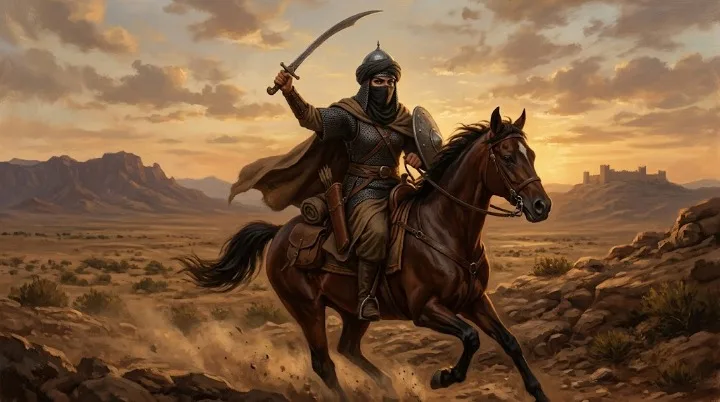
Khawla bint al Azwar was a 7th-century Arab woman celebrated in early Islamic historical tradition as a skilled warrior who fought in disguise alongside male soldiers during the Muslim conquest of Syria (Bilad al-Sham) in the 630s CE. According to traditional accounts, she is best known for her role at the Battle of Yarmouk and for reportedly leading a rescue of captured Muslim women, including her sister-in-law, from Byzantine custody.
She is remembered in folk tradition as a symbol of female courage in early Islamic military history, though modern historians note that many details of her life come from later narrative and semi-legendary sources rather than the earliest primary chronicles.
⚔️ Quick Facts — Khawla bint al-Azwar
| 📌 Field | 📖 Historical Detail |
|---|---|
| 👤 Full Name | Khawla bint al-Azwar al-Kindiyya |
| 📅 Era | 7th century CE (early Islamic period) |
| 🛡️ Known For | Fighting disguised as a male soldier to rescue her brother and defend her companions during the Muslim conquest of Syria |
| ⚔️ Key Battle | The Battle of Yarmouk (636 CE) |
| 👥 Family | Sister of Dirar ibn al-Azwar, a highly celebrated and formidable military commander of the early Muslim forces |
| 🌍 Region | Arabia and the Levant (historically Bilad al-Sham) |
| 📖 Primary Sources | Later Islamic historical narratives and akhbar (semi-legendary or folk-historical accounts); she is not extensively documented in the earliest surviving official military chronicles |
| 🌟 Legacy | Frequently referenced and celebrated in Arab and Islamic folk tradition as an enduring symbol of courage and female participation in early military history |
Who Was Khawla bint al Azwar?
Khawla bint al-Azwar was the sister of Dirar ibn al-Azwar, a well-documented commander in the armies of the Rashidun Caliphate during the conquests that followed the death of the Prophet Muhammad. Her family belonged to the Banu Kinda, an Arab tribal group with a strong warrior tradition, and later narrative sources describe her as having been trained in horsemanship and combat from a young age — skills that were unusual, though not unheard of, for women of her era and background.
Most accounts of Khawla’s life center on the campaigns in Syria during the 630s CE, when Muslim forces confronted the Byzantine Empire for control of the Levant. It is worth noting upfront, for accuracy, that Khawla does not appear prominently in the earliest and most rigorously verified Islamic historical chronicles (such as al-Tabari’s annals) in the same way her brother Dirar does. Much of her story survives instead through later semi-legendary military narratives (akhbar and futuh literature) that blended historical memory with heroic storytelling — a common feature of how early Islamic history was transmitted and popularized. This doesn’t mean she didn’t exist; it means the specific details of her exploits should be read as traditional narrative rather than as settled historical fact in every particular.
The Battle of Yarmouk and Her Role in Combat
The Battle of Yarmouk (636 CE) was a decisive confrontation between Rashidun Muslim forces and the Byzantine army, and it marked the effective end of Byzantine control over Syria. Traditional accounts describe Khawla as present at or near this campaign, fighting in armor that concealed her identity, alongside other soldiers.
A recurring episode in these traditional narratives describes an incident in which a group of Muslim women, including Khawla’s sister-in-law, were captured by Byzantine forces during the fighting. According to the story, Khawla organized and led a group of women to fight their way free rather than wait for rescue, using improvised weapons such as tent poles when conventional arms weren’t available. Whether this specific episode is historically precise in every detail or represents a compressed, symbolic retelling of women’s participation in the defense of the camp is a point historians continue to discuss — but the story has remained a fixture of popular retellings for centuries because it captures a broader truth: women were present in and around these campaigns in more active roles than is often assumed.
Fact vs. Legend: What Do We Actually Know?
| Claim | Historical Status |
|---|---|
| Khawla was the sister of Dirar ibn al-Azwar | Well-supported; Dirar is documented in early sources |
| She fought disguised as a man in the Syrian campaigns | Traditional/narrative sources describe this; not in the earliest chronicles |
| She led a rescue of captured women at Yarmouk | Recurring episode in later akhbar literature; treated as legend by some historians |
| She personally killed named Byzantine commanders in single combat | Found only in popularized/folk retellings, not primary sources |
| She was trained in combat and horsemanship from youth | Consistent across traditional biographical accounts |
This table matters because most online content about Khawla either treats every detail as confirmed fact or dismisses her as pure legend — neither is accurate. The honest picture is: a historically plausible figure whose core existence and family background are reasonably well-attested, wrapped in a body of heroic narrative that grew in the retelling.
Why Her Story Endures
Khawla bint al-Azwar occupies a distinctive place in Islamic historical memory because she represents an early example of women’s active participation in military life at a time when such roles were rare in the historical record — rare in documentation, though not necessarily rare in practice. Her story has been retold in Arabic literature, popular history, and more recently in social media and short-form video content, often framed alongside other historical women such as Nusaybah bint Ka’ab, another woman associated with early Islamic military engagements.
⚔️ Frequently Asked Questions — Khawla bint al-Azwar
She is known in Islamic historical tradition for fighting disguised as a male soldier during the 7th-century Muslim conquest of Syria, and for a widely told story in which she helped free captured Muslim women during the Battle of Yarmouk.
Khawla bint al-Azwar is not mentioned in the Quran. This is a common search misconception — the Quran does not name specific female warriors from the early Islamic conquests. Her story comes from later historical and narrative literature (akhbar and futuh accounts), not scripture.
According to traditional accounts, Khawla fought in disguise alongside Muslim forces in Syria and, during the Battle of Yarmouk, organized a group of women to fight free after being captured by Byzantine forces, reportedly using tent poles as makeshift weapons when other arms weren’t available.
No. She is a historical/legendary figure from the early Islamic conquest period, not a Quranic figure. Her story is preserved in later Islamic historical and literary traditions rather than in the Quran itself.
She was the sister of Dirar ibn al-Azwar, a documented commander in the Rashidun army during the conquests of Syria.
Sources
- Tabari, Tarikh al-Rusul wa’l-Muluk (History of the Prophets and Kings) — for the documented role of Dirar ibn al-Azwar
- Encyclopaedia of Islam, entries on the conquest of Syria and the Battle of Yarmouk
- Fred Donner, The Early Islamic Conquests (Princeton University Press) — for scholarly context on the historicity of conquest-era narratives
- Various futuh/akhbar literature compilations — for the traditional narrative episodes involving Khawla