| Event Category | Key Historical Details |
|---|---|
| Most Significant Event | The world’s first competitive motor race takes place between Paris and Rouen (1894) |
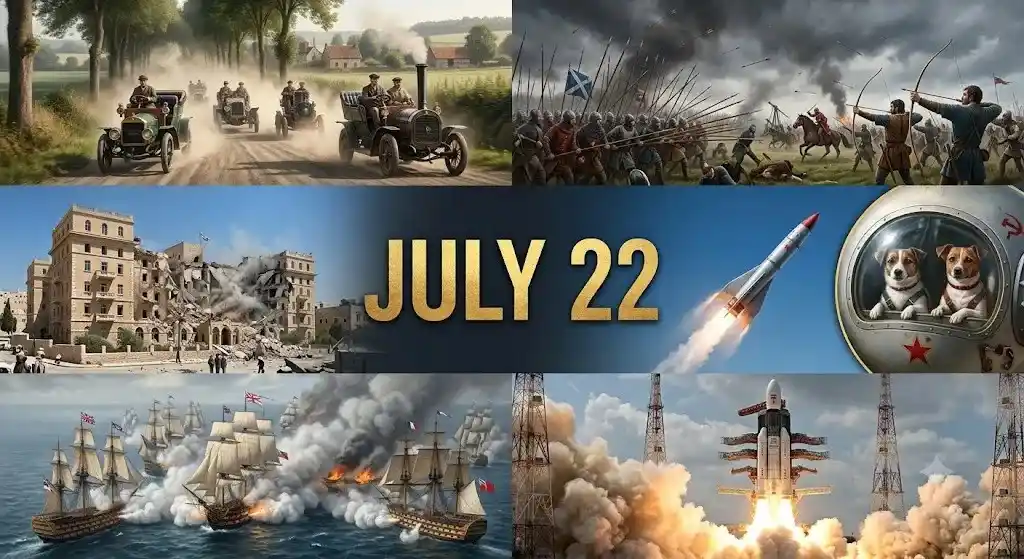
| Top 10 Key Events | Battle of Falkirk (1298) • First Motor Race in France (1894) • Battle of Salamanca (1812) • Battle of Atlanta (1864) • King David Hotel Bombing (1946) • Soviet Space Dogs Dezik and Tsygan Flight (1951) • Wiley Post Completes Solo World Flight (1933) • Pablo Escobar Escapes La Catedral (1992) • Death of Uday and Qusay Hussein (2003) • Launch of Chandrayaan-2 (2019) |
| Key Battles That Day | Battle of Anzen, Battle of Bornhöved, Battle of Falkirk, Battle of Dornach, Battle of Santa Cruz de Tenerife, Battle of Salamanca, Battle of Atlanta |
| Key Figures Today | Edward I, William Wallace, Arthur Wellesley, Wiley Post, Deng Xiaoping |
| Observances | Sarawak Independence Day Feast of Saint Mary Magdalene Saint Abd-al-Masih Day |
Story of the Day: The Longbows at Falkirk
King Edward I rode onto the field near Falkirk in 1298, determined to crush the Scottish rebellion once and for all. William Wallace had set his men in immovable wall-like formations called schiltrons, their long spears pointing outward to impale incoming English horses. Seeing his cavalry repelled, Edward ordered his Welsh archers forward to rain hundreds of longbow arrows directly into the tightly packed Scottish ranks. The defensive walls shattered under the lethal hail, opening gaps for heavy cavalry to charge through. Wallace was forced to flee into the forest, his rebel army destroyed and his political power broken.
Important Events That Happened On July 22 In History
259 – Pope Dionysius Elected
Dionysius stepped into the dangerous papal office while the Roman imperial guards were still wiping blood from their swords. Former Emperor Valerian had executed the previous pope, leaving Christian believers scattered across the empire in hiding. Dionysius quickly restored local churches, sent financial relief to ransomed captives, and stabilized the fragmented network. His election proved that the underground faith could survive the empire’s worst efforts to wipe it out.
838 – Battle of Anzen
Emperor Theophilos rode into the hills of Anatolia to stop an invading Abbasid army led by commander Afshin. A sudden Turkish horse-archership assault surrounded the Byzantine forces, turning the tactical defense into a total rout. Theophilos barely escaped with his life under cover of night as his imperial guard collapsed around him. The disastrous defeat cleared a path for Islamic forces to march deep into Byzantine territory and sack the fortress of Amorium.
1099 – Defense of the Holy Sepulchre
Godfrey of Bouillon stood in the shadow of newly captured Jerusalem, refusing to wear a golden crown where Christ had worn thorns. Crusader lords named him the first Defender of the Holy Sepulchre to lead their fragile new kingdom. Surrounded by hostile territories, Godfrey organized military garrisons to hold the city’s perimeter. His decision set up the administrative structure that would govern the Outremer states for generations.
1209 – Massacre at Béziers
French crusaders pounded on the wooden gates of Béziers, demanding the surrender of suspected Cathar heretics hiding inside. When townspeople mounted a panicked counter-attack, crusader mercenaries rushed through the open city gates in retaliation. Over twenty thousand citizens were put to the sword without distinction as fires swept through every neighborhood. The brutal destruction served as a terrifying opening warning to all cities in the path of the Albigensian Crusade.
1227 – Battle of Bornhöved
King Valdemar II brought his Danish forces south to crush a rising alliance of north-German towns and princes. The battle raged fiercely across marshy fields until hired Lübeck forces switched sides mid-fight and attacked Danish positions from behind. Valdemar lost an eye, suffered heavy casualties, and was chased back to his northern stronghold. The defeat instantly ended centuries of Danish imperial dominance over the Baltic coastline.
1298 – Battle of Falkirk
William Wallace grouped his Scottish infantry into impenetrable ringed spearmen formations on the grassy slopes outside Falkirk. King Edward I ordered his longbowmen to unleash volley after volley over the heads of his cavalry directly into the static schiltrons. Gaps tore through the Scottish lines, allowing heavy English warhorses to smash inside and slaughter the infantry. Wallace escaped the field, but his military campaign to liberate Scotland collapsed on the spot.
1342 – St. Mary Magdalene’s Flood
Relentless heavy rains burst open riverbanks across Central Europe, causing the most destructive river flood in recorded continental history. The Danube, Rhine, and Elbe rivers swelled into massive inland seas, sweeping away stone bridges and whole farming villages. Thousands drowned as rushing waters eroded topsoil and ruined the year’s agricultural harvest. The surviving populations suffered through years of severe famine and economic chaos afterward.
1443 – Battle of St. Jakob an der Sihl
Zurich troops clashed with confederate Swiss forces outside the city walls during the Old Zürich War. Mayor Rudolf Stüssi personally held a wooden bridge to buy time for his retreating soldiers to reach safety inside the city gates. Stüssi was cut down by enemy pikemen on the narrow footbridge before his men pulled back. The defeat pushed Zurich further into reliance on Habsburg military protection.
1456 – Siege of Belgrade
Sultan Mehmet II massed hundreds of cannons against Belgrade, eager to sweep past Hungary and deep into Europe. Regent John Hunyadi led a desperate midnight counter-strike, charging directly into Ottoman siege trenches with local peasant militias. The surprise assault broke the Turkish lines, destroyed heavy artillery pieces, and wounded Mehmet himself. The stunning Hungarian victory halted Ottoman advances into Central Europe for over seventy years.
1484 – Battle of Lochmaben Fair
Alexander Stewart and James Douglas led a five-hundred-man raiding force over the Scottish border to reclaim lost lands. Loyal Scottish troops loyal to King James III ambushed the intruders in the middle of a crowded county fairground. The royal forces quickly overwhelmed the raiders, capturing the Earl of Douglas and killing dozens of his mercenaries. The failure ruined Stewart’s treasonous plot to overthrow his brother’s crown.
1499 – Battle of Dornach
Maximilian I marched thousands of Imperial soldiers toward Dornach to break Swiss resistance once and for all. Swiss pike squares rushed out from nearby woods, smashing into the Imperial infantry while their guns were still unlimbered. The surprise assault turned into a full slaughter, forcing the emperor’s forces to abandon their camp and flee. The victory forced the Holy Roman Empire to recognize full Swiss independence in the resulting peace treaty.
1587 – Arrival at Roanoke Island
Governor John White stepped ashore on Roanoke Island alongside a hundred English men, women, and children hoping to build new lives. They found the original military outpost abandoned and human bones scattered near overgrown wooden cabins. Despite the grim discovery, White landed the colony’s supply crates and began rebuilding the fortified settlement. Within three years, every single settler mysteriously vanished without leaving a clear trace.
1594 – Siege of Groningen
Maurice of Orange trapped Spanish defenders inside Groningen, cutting off supply lines with heavy artillery and siege trenches. English and Dutch troops slowly sapped under the medieval city walls, threatening to blow open the masonry. Recognizing that relief armies would never arrive, the Spanish commander surrendered the key northern stronghold. The fall of Groningen secured the northern borders of the young Dutch Republic.
1598 – Merchant of Venice Registered
Stationer’s Register clerks in London recorded William Shakespeare’s new play, The Merchant of Venice, securing royal copyright protection. Queen Elizabeth’s strict censorship laws required all printed books and play scripts to pass government inspection first. The official registration granted legal printing rights to publisher James Roberts, preventing rival acting troupes from stealing the text. It preserved one of Shakespeare’s most famous courtroom dramas for future generations.
1686 – Albany Charter Granted
Governor Thomas Dongan signed the formal royal charter transforming the fur-trading outpost of Albany into an official city. Dutch and English merchants gained self-governing power, trading monopolies, and clear property rights along the Hudson River corridor. The legal document established a structured municipal government that remains active today. Albany became a central diplomatic hub for fur trading with Native American tribes.
1706 – Acts of Union Agreed
Commissioners from England and Scotland met in London to sign agreed terms merging their two independent kingdoms. Financial debts, trade access, and parliamentary seats were settled to create a single Protestant unified state. Both national parliaments ratified the document months later, officially creating the Kingdom of Great Britain. The historical agreement merged economic powers into what became the world’s largest empire.
1793 – Mackenzie Reaches the Pacific
Alexander Mackenzie sliced his wooden canoe through coastal Canadian waters, coming face-to-face with the roaring Pacific Ocean. He had spent months traveling through unexplored river networks, snow-capped mountains, and thick wilderness trails. Painting his name on a coastal rock face using red grease, he logged the first recorded overland crossing of North America. His journey proved an overland trade route to the west coast was possible.
1796 – Cleveland Founded
Moses Cleaveland walked through dense wilderness along the shores of Lake Erie to survey land for the Connecticut Land Company. He laid out a public square, clear streets, and commercial lots near the mouth of the Cuyahoga River. His team named the small surveying camp Cleveland in honor of their expedition leader. The settlement grew from a tiny outpost into a major American industrial city.
1797 – Battle of Santa Cruz de Tenerife
Rear-Admiral Horatio Nelson led a night boat assault against heavily fortified Spanish sea walls in the Canary Islands. Spanish artillery batteries lit up the dark harbor, catching the British landing crafts in a deadly crossfire. A flying piece of grapeshot shattered Nelson’s right arm, forcing officers to row him back for immediate amputation. The British fleet suffered a total defeat, failing to seize the treasure ships anchored inside.
1802 – Gia Long Unifies Vietnam
Emperor Gia Long marched his victorious troops into Hanoi, ending centuries of feudal division between northern and southern war clans. He brought regional rulers under a single administrative crown and established Hue as his capital city. His coronation marked the founding of the Nguyen dynasty, the last ruling imperial family of Vietnam. The event created the territorial borders of modern Vietnam.
1805 – Battle of Cape Finisterre
Admiral Robert Calder spotted a combined French and Spanish fleet emerging from fog off the coast of Spain. British ships opened fire through heavy mist, battling for hours in confused ship-to-ship broadside combat. Calder captured two enemy warships before heavy weather forced both fleets to pull away from the action. The inconclusive battle prevented French Admiral Villeneuve from reaching the English Channel to support Napoleon’s planned invasion.
1812 – Battle of Salamanca
Arthur Wellesley spotted a fatal gap in French lines when the enemy army stretched out too far along Spanish hills. He ordered a broad bayonet charge, smashing through French divisions before they could assemble into defensive squares. British and Portuguese troops routed the enemy in under two hours, taking thousands of prisoners. The brilliant victory shattered French control over central Spain and forced their armies out of Madrid.
1833 – Slavery Abolition Act Passed
British lawmakers voted inside the House of Commons to pass historic legislation abolishing human slavery across the empire. The act created a gradual emancipation system and set aside twenty million pounds to compensate plantation owners. Over eight hundred thousand enslaved Africans across Caribbean sugar plantations gained legal freedom over the following years. The law marked a major victory for the global abolitionist movement.
1864 – Battle of Atlanta
Confederate General John Bell Hood hurled his troops against Union positions defending Bald Hill outside Atlanta. General William T. Sherman held his ground through hours of desperate hand-to-hand fighting, inflicting heavy casualties on the attackers. Hood lost thousands of veteran soldiers without breaking Union lines or saving the rail hub. The failed assault doomed the Confederate fortress city of Atlanta to eventual capture.
1880 – Abdur Rahman Proclaimed Emir
Abdur Rahman Khan rode into Kabul to claim the throne after British forces recognized him as the legitimate ruler of Afghanistan. Years of brutal warfare ended as British troops agreed to withdraw in exchange for control over foreign diplomacy. Abdur Rahman consolidated power, centralized the government, and brutally suppressed regional tribal revolts. His long reign earned him the title of the Iron Emir for unifying the modern Afghan state.
1893 – America the Beautiful Written
Katharine Lee Bates stood on the windy summit of Pikes Peak, looking out across sweeping Colorado plains and Rocky Mountain peaks. Inspired by the vast landscape and golden wheat fields below, she quickly wrote down the lines of a poem in her notebook. Her words were later set to music, creating the beloved anthem “America the Beautiful.” The song captured the spirit of American natural landscape and cultural optimism.
1894 – First Motor Race
Twenty-one experimental vehicles rattled away from Paris, racing toward Rouen in the world’s first public competitive motor event. Steam cars, petrol buggies, and electric carriages struggled over seventy miles of unpaved country roads. Comte Jules-Albert de Dion crossed the finish line fastest, but judges awarded the official grand prize to Albert Lemaître’s Peugeot. The event proved that gasoline automobiles were practical machines for daily travel.
1916 – Preparedness Day Bombing
A heavy suitcase bomb exploded on Market Street in San Francisco during a massive patriotic military parade. The explosion sent shrapnel ripping through crowd barriers, killing ten spectators and injuring forty others. Police launched a sensational hunt that led to the wrongful conviction of labor activists Thomas Mooney and Warren Billings. The unsolved bombing sparked decades of legal fights and national civil liberties protests.
1921 – Disaster at Annual
Berber tribesmen led by Abd el-Krim ambushed poorly managed Spanish army positions in the dry mountains of northern Morocco. Spanish defense lines collapsed into panic as thousands of soldiers fled toward coastal bases under constant fire. Over ten thousand Spanish soldiers died during the chaotic retreat, marking Spain’s worst military disaster of the modern era. The collapse brought down the government in Madrid and sparked major political shifts.
1933 – Wiley Post’s Solo World Flight
Aviator Wiley Post touched his purple monoplane Winnie Mae down at Floyd Bennett Field after flying solo around the northern hemisphere. Equipping his aircraft with an early autopilot system, he completed the trip in under eight days. Throngs of cheering fans surged onto the tarmac to greet the eye-patched pilot after his dangerous solo journey. His flight set a record and demonstrated the potential of long-distance navigation instruments.
1936 – Popular Executive Committee Takes Power
Antifascist union leaders and republican politicians formed the Popular Executive Committee of Valencia during the opening days of the Spanish Civil War. The regional committee seized control of local factories, militia training camps, and food distribution centers across the region. They effectively replaced the collapsing central government’s authority in eastern Spain to resist military rebels. Their control turned Valencia into a central stronghold for the Spanish Republic.
1937 – FDR Court-Packing Bill Defeated
United States Senators voted overwhelmingly against President Franklin D. Roosevelt’s controversial plan to expand the Supreme Court. Roosevelt had sought power to appoint extra justices to protect his New Deal social programs from conservative legal rejections. Members of his own Democratic Party joined Republicans to strike down the bill as an overreach of executive authority. The rare legislative defeat marked a check on presidential power.
1942 – Gasoline Rationing Begins
American drivers lined up at federal offices to collect personalized wartime gasoline coupon booklets from government officials. The United States government enforced nationwide rationing to save fuel, rubber tires, and vital transport vehicles for military deployment. A-stickers limited civilian drivers to just three gallons of gas per week. The sacrifices changed everyday life on the American home front during World War II.
1942 – Grossaktion Warsaw Begins
SS troops and Ukrainian guards cordoned off the Warsaw Ghetto to begin mass deportations of Jewish families to death camps. SS officers told residents they were being resettled in eastern labor camps, forcing thousands onto crowded cattle trains bound for Treblinka. Over two hundred thousand Jewish men, women, and children were murdered during two months of systematic transport. The atrocity wiped out the largest Jewish community in Europe.
1943 – Allies Capture Palermo
General George S. Patton drove his Seventh Army armored columns into Palermo, liberating the strategic capital city of Sicily. Sicilian civilians crowded public squares to throw flowers and cheer the arriving American tanks. The capture of the port cut off Italian defenders in the west and gave Allied forces a base for further operations. The loss of Sicily brought down Benito Mussolini’s fascist government days later.
1943 – Athens Protest Massacre
Thousands of Greek factory workers and students marched through occupied Athens to protest German plans to draft locals for slave labor. Axis occupation forces opened fire with machine guns into dense crowds of peaceful marchers, killing twenty-two people on the streets. The civilian deaths sparked widespread strikes and furious resistance across Greece. The outrage forced Axis commanders to abandon their forced labor draft program.
1944 – Lublin Manifesto Issued
The Polish Committee of National Liberation published its manifesto in the liberated city of Chełm, setting up a Soviet-backed government. The proclamation declared the exiled Polish government in London illegal and announced sweeping land distribution reforms. Soviet military backing allowed the committee to take control of Polish administrative institutions. The moment marked the beginning of forty-five years of communist rule in Poland.
1946 – King David Hotel Bombing
Militants from the Zionist underground group Irgun detonated hundreds of pounds of explosives hidden inside milk cans at Jerusalem’s King David Hotel. The massive blast collapsed the entire southern wing of the building, which housed British military and administrative headquarters. Ninety-one British, Arab, and Jewish staff members died under tons of falling stone rubble. The attack accelerated Britain’s decision to end its administrative mandate over Palestine.
1951 – First Dogs in Space
Soviet engineers launched two stray street dogs, Dezik and Tsygan, aboard a sub-orbital R-1 rocket from Kapustin Yar. The capsule reached an altitude of sixty miles before detaching and deploying its parachute system into the desert below. Both dogs landed safely without injury, becoming the first living mammals to survive high-altitude spaceflight. Their safe return proved that pressurized environmental systems could keep crew members alive in space.
1962 – Mariner 1 Destroyed
Engineers at Cape Canaveral sent an abort code to destroy the Mariner 1 spacecraft four minutes after launch toward Venus. A single missing hyphen in the flight guidance software code caused the rocket to veer off course toward shipping lanes. The rocket exploded into glowing debris over the Atlantic Ocean, destroying millions of dollars of scientific equipment. NASA fixed the code error and launched Mariner 2 weeks later.
1963 – Sarawak Self-Governance
British colonial officials handed over administrative power to the people of Sarawak, granting self-governance to the South Asian nation. Stephen Kalong Ningkan was appointed as the first Chief Minister to lead the new cabinet. The milestone set the stage for Sarawak to join Sabah, Singapore, and Malaya in forming the Federation of Malaysia weeks later. It marked the end of century-long Brooke family and British colonial rule.
1973 – Pan Am Flight 816 Crash
A Pan Am Boeing 707 jetliner lost engine control seconds after lifting off from Faa’a International Airport in Tahiti. The aircraft banked hard and plunged into dark ocean waters just off the runway, killing seventy-eight passengers and crew members. Search teams recovered only one survivor from the floating ocean wreck. The tragic accident remains the worst aviation disaster in French Polynesian history.
1976 – Japan Finishes Reparations
Japanese diplomats signed formal documentation in Manila, completing their final war reparation payments to the Philippines. Tokyo had paid hundreds of millions of dollars over twenty years in goods, industrial machinery, and low-interest infrastructure loans. The payments compensated for widespread physical destruction and crimes committed during Japan’s wartime occupation. The milestone allowed full diplomatic and trade relations to normalize between both nations.
1977 – Deng Xiaoping Restored
Communist Party leaders officially restored Deng Xiaoping to his top political positions during a meeting in Beijing. Deng had been purged twice during the turmoil of the Cultural Revolution by political rivals. His return to power allowed him to launch economic reforms that opened China to international trade and foreign investment. His policies set off decades of economic growth across modern China.
1981 – Springbok Rugby Tour Begins
Protesters clashed with police officers outside a sports stadium in Gisborne as the South African rugby team played its opening match in New Zealand. Demonstrators organized massive street blockades to condemn South Africa’s racial apartheid system. The tour divided New Zealand society, triggering riots, barbed-wire security fencing around fields, and cancelled games. It focused international attention on the struggle against apartheid.
1983 – Polish Martial Law Lifted
General Wojciech Jaruzelski appeared on national television to declare an end to nineteen months of harsh martial law across Poland. The government released thousands of political prisoners and restored basic civil rights, though strict security laws remained active. The decision followed public protests and economic pressure from Western nations. The end of martial law opened doors for the Solidarność trade union to push for democratic elections.
1984 – First Baby Born from Frozen Embryo
Doctors at Monash University in Melbourne announced the birth of Zoe Leyland, the world’s first baby born from a frozen embryo. Medical researchers had safely thawed the embryo before transferring it into her mother’s womb nine months earlier. The landmark breakthrough revolutionized fertility treatments worldwide, giving hopeful parents new options for family planning. The procedure quickly became a standard medical practice globally.
1990 – Greg LeMond Wins Tour de France
American cyclist Greg LeMond rode onto the Champs-Élysées in Paris to secure his third career Tour de France championship. LeMond defended his yellow jersey through grueling mountain stages in the Alps and Pyrenees without the backing of a strong team. His victory marked his second consecutive Tour de France win following a near-fatal hunting accident years prior. He solidified his spot as one of cycling’s legendary riders.
1992 – Pablo Escobar Escapes
Drug kingpin Pablo Escobar walked out of his luxury custom prison, La Catedral, alongside armed bodyguards in Colombia. Escobar fled into the surrounding mountain fog after learning government soldiers planned to transfer him to a secure federal prison. His escape touched off a massive manhunt involving Colombian police squads and United States special forces units. The hunt ended months later when Escobar was tracked down on a rooftop in Medellín.
1993 – Kaskaskia Levee Ruptures
Swollen Mississippi River waters burst through earthen levees near Kaskaskia, Illinois, during the Great Flood of 1993. Roaring river currents flooded the historic island town, forcing residents to abandon their homes aboard Army Corps of Engineers barges. The floodwaters submerged historical sites and destroyed farming land across the region. Kaskaskia remained isolated under water for months, forcing permanent community relocation.
1997 – Second Blue Water Bridge Opens
Engineers and international officials opened a second span of the Blue Water Bridge connecting Port Huron, Michigan, with Sarnia, Ontario. The new steel arch structure relieved heavy commercial traffic bottlenecks along one of North America’s busiest border crossings. Thousands of trucks and commuter vehicles crossed the St. Clair River during opening ceremonies. The project strengthened trade relations between the United States and Canada.
2003 – Death of Uday and Qusay Hussein
United States 101st Airborne troops surrounded a barricaded concrete mansion in Mosul after receiving a tip from an informant. A heavy four-hour shootout involved TOW missiles, heavy machine guns, and aerial strikes against the fortified hideout. The attack killed Saddam Hussein’s sons Uday and Qusay, along with Qusay’s fourteen-year-old son Mustapha. Their deaths removed two top leaders of the former Iraqi regime.
2005 – Shooting of Jean Charles de Menezes
Plainclothes counter-terrorism officers shot and killed Jean Charles de Menezes inside Stockwell tube station in London. Police had tracked the innocent Brazilian electrician, mistaking him for a suspect involved in failed suicide bombing attempts days earlier. The tragic killing sparked public outrage and inquiries into aggressive police shoot-to-kill tactics. Metropolitan Police commanders faced severe criticism for critical intelligence errors.
2011 – Norway Terrorist Attacks
A far-right extremist detonated a car bomb outside central government offices in Oslo, killing eight people and destroying streets. He then traveled to a political youth summer camp on Utøya island, killing sixty-nine people in a mass shooting spree. The combined terror attacks marked the deadliest day of violence in modern Norwegian history. The nation responded with massive public vigils supporting democracy and open society.
2012 – YPG Captures Serê Kaniyê
Kurdish People’s Protection Units (YPG) launched coordinated assaults to drive Syrian government forces out of Serê Kaniyê and Dirbêsiyê. Local fighters seized control of government security buildings, police stations, and military checkpoints across Al-Hasakah province. The victories established self-governing control over Kurdish regions during the opening phases of the Syrian Civil War. The movement created an autonomous administration in northern Syria.
2013 – Dingxi Earthquakes
A series of powerful magnitude 5.9 and 5.6 earthquakes struck the mountainous countryside of Dingxi in Gansu province, China. The shallow shocks collapsed over five thousand mud-brick homes, triggering massive landslides that buried rural roadways. At least eighty-nine people lost their lives and over five hundred suffered severe injuries across remote farming villages. Emergency rescue teams spent days searching through fallen rubble for survivors.
2019 – Chandrayaan-2 Launch
India’s Space Research Organisation launched the Chandrayaan-2 lunar exploration mission aboard a massive GSLV Mark III rocket from Sriharikota. The spacecraft carried a high-tech lunar orbiter, the Vikram lander, and the Pragyan robotic rover to study the moon’s unexplored south pole. Millions across India watched live as the rocket pierced the clouds into Earth’s orbit. The mission showcased India’s rising capabilities in deep space exploration.
Catch up on the historical tales you missed yesterday.
Famous People Born on July 22
| Name | Description | Date |
|---|---|---|
| Philip I of Castile | King of Castile and Habsburg ruler | 1478 – 1506 |
| Lawrence of Brindisi | Italian Catholic priest, saint, and Doctor of the Church | 1559 – 1619 |
| Anthony Ashley Cooper, 1st Earl of Shaftesbury | English statesman and political philosopher | 1621 – 1683 |
| Margaret Mary Alacoque | French mystic and Catholic saint | 1647 – 1690 |
| Jacques-Germain Soufflot | French architect who designed the Panthéon | 1713 – 1780 |
| Friedrich Bessel | German astronomer and mathematician | 1784 – 1846 |
| Oliver Mowat | Canadian Premier of Ontario and statesman | 1820 – 1903 |
| Emma Lazarus | American poet, author of The New Colossus | 1849 – 1887 |
| Janusz Korczak | Polish pediatrician, educator, and children’s author | 1878 – 1942 |
| Edward Hopper | Influential American realist painter | 1882 – 1967 |
| Gustav Ludwig Hertz | German Nobel Prize-winning physicist | 1887 – 1975 |
| Selman Waksman | Nobel Prize-winning microbiologist; discovered streptomycin | 1888 – 1973 |
| James Whale | English film director of Frankenstein | 1889 – 1957 |
| Rose Kennedy | American philanthropist and Kennedy family matriarch | 1890 – 1995 |
| Shaista Suhrawardy Ikramullah | Pakistani diplomat, writer, and politician | 1915 – 2000 |
| Marcel Cerdan | French world champion boxer | 1916 – 1949 |
| Bob Dole | American senator and presidential nominee | 1923 – 2021 |
| The Fabulous Moolah | Legendary American professional wrestler | 1923 – 2007 |
| Oscar de la Renta | Dominican-American fashion designer | 1932 – 2014 |
| Louise Fletcher | American Academy Award-winning actress | 1934 – 2022 |
| Alex Trebek | Canadian-American television game show host | 1940 – 2020 |
| George Clinton | American funk music pioneer | 1941 – Present |
| Danny Glover | American actor and humanitarian | 1946 – Present |
| Don Henley | American singer-songwriter; co-founder of the Eagles | 1947 – Present |
| Alan Menken | American Academy Award-winning composer | 1949 – Present |
| Willem Dafoe | American actor | 1955 – Present |
| David Spade | American comedian and actor | 1964 – Present |
| Shawn Michaels | American professional wrestling legend | 1965 – Present |
| Israel Adesanya | New Zealand mixed martial arts champion | 1989 – Present |
| Selena Gomez | American singer, actress, and producer | 1992 – Present |
Famous People Died on July 22
| Name | Description | Date |
|---|---|---|
| Charles VII of France | King of France during the Hundred Years’ War | 1403 – 1461 |
| Lawrence of Brindisi | Italian Catholic priest and saint | 1559 – 1619 |
| Pope Clement X | Head of the Catholic Church | 1590 – 1676 |
| Marie François Xavier Bichat | French anatomist and founder of histology | 1771 – 1802 |
| Giuseppe Piazzi | Italian astronomer who discovered Ceres | 1746 – 1826 |
| Napoleon II | Titular Emperor of the French | 1811 – 1832 |
| James B. McPherson | American Civil War general | 1828 – 1864 |
| John A. Roebling | Engineer who designed the Brooklyn Bridge | 1806 – 1869 |
| Randal Cremer | British Nobel Peace Prize laureate | 1828 – 1908 |
| Sandford Fleming | Engineer who introduced worldwide standard time | 1827 – 1915 |
| James Whitcomb Riley | American poet and writer | 1849 – 1916 |
| Indra Lal Roy | First Indian fighter pilot | 1898 – 1918 |
| Jōkichi Takamine | Japanese-American chemist who isolated adrenaline | 1854 – 1922 |
| Reginald Fessenden | Canadian radio pioneer and inventor | 1866 – 1932 |
| Flo Ziegfeld | American Broadway producer | 1867 – 1932 |
| John Dillinger | American gangster | 1903 – 1934 |
| William Lyon Mackenzie King | 10th Prime Minister of Canada | 1874 – 1950 |
| Carl Sandburg | American Pulitzer Prize-winning poet | 1878 – 1967 |
| Sándor Kocsis | Hungarian football legend | 1929 – 1979 |
| Floyd Gottfredson | Influential Mickey Mouse comic artist | 1905 – 1986 |
| Manuel Puig | Argentine novelist and screenwriter | 1932 – 1990 |
| Eduard Streltsov | Legendary Soviet footballer | 1937 – 1990 |
| Harold Larwood | English fast bowler; Bodyline series star | 1904 – 1995 |
| Carmen Martín Gaite | Spanish novelist and essayist | 1925 – 2000 |
| Claude Sautet | French film director and screenwriter | 1924 – 2000 |
| Indro Montanelli | Italian journalist and historian | 1909 – 2001 |
| Estelle Getty | American actress (The Golden Girls) | 1923 – 2008 |
| George A. Miller | American cognitive psychologist | 1920 – 2012 |
| Dennis Farina | American actor and former police officer | 1944 – 2013 |
| John Mayall | English blues musician and songwriter | 1933 – 2024 |
Observances on July 22
Sarawak Independence Day (Sarawak, Malaysia): Commemorates the day in 1963 when the territory gained self-governance from British colonial rule.
Feast of Saint Mary Magdalene (Christianity): Honors the biblical figure recognized as one of Jesus’s most devoted followers and the first witness to his resurrection.
🏎️ Frequently Asked Questions — July 22 in History
On July 22, 1894, the world’s first formal motor race was held between Paris and Rouen in France. Organizers tested twenty-one experimental vehicles over a seventy-mile course to judge their safety and handling. The event proved that gasoline-powered automobiles were practical for everyday travel.
The Battle of Salamanca took place on July 22, 1812, during the Peninsular War in Spain. British forces under Arthur Wellesley caught French lines out of position and routed their army in two hours. The tactical victory broke French military control over Madrid.
Friedrich Bessel, the German astronomer who first measured stellar parallax, was born on July 22, 1784. Nobel Prize-winning microbiologist Selman Waksman, who discovered the life-saving antibiotic streptomycin, was also born on July 22, in 1888. Famous figures including Alexander the Great and poet Emma Lazarus share this birth date as well.
The world’s first motor race on July 22, 1894, stands as a transformative milestone in industrial history. It shifted human transport away from horse-drawn carriages to powered automobiles, kickstarting the modern automotive age.
Sarawak Independence Day celebrates July 22, 1963, when Britain granted self-governance to the South Asian territory. Stephen Kalong Ningkan took office as its first Chief Minister, ending a century of colonial control. The holiday honors the island state’s journey toward full independence and federation.
On July 22, 2019, India launched its Chandrayaan-2 lunar exploration mission aboard a GSLV rocket. The spacecraft carried an orbiter, lander, and rover to explore the moon’s uncharted south pole region.