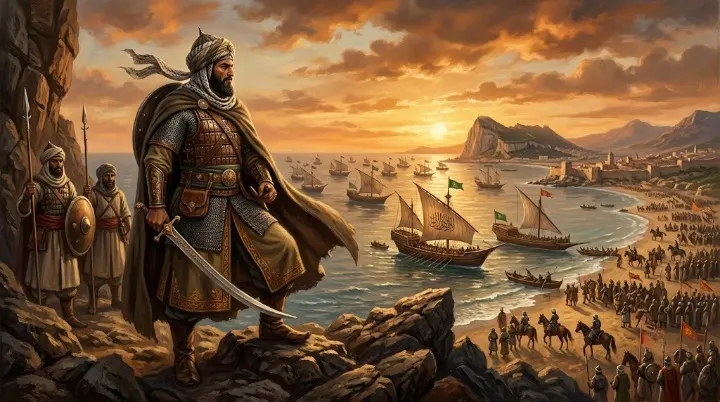
Tariq ibn Ziyad was the Berber military commander who led the Umayyad conquest of Spain in 711 CE, crossing from North Africa and defeating the Visigothic King Roderic at the Battle of Guadalete. His name lives on in the very geography of the region — Gibraltar comes from Jabal Tariq, Arabic for “Mountain of Tariq,” marking the spot where his army landed. In under a year, his campaign ended nearly three centuries of Visigothic rule and opened the door to over 700 years of Muslim presence in the Iberian Peninsula.
Quick Facts
| Category | Key Historical Details |
|---|---|
| Known For | Leading the Umayyad conquest of Spain (711 CE) |
| Ethnicity | Berber (exact origin details not fully verified) |
| Religion | Muslim |
| Superior | Musa ibn Nusayr, Umayyad governor of Ifriqiya |
| Key Battle | Battle of Guadalete (711 CE) |
| Opponent | King Roderic of the Visigoths |
| Legacy | Gibraltar is named after him (Jabal Tariq – “Mountain of Tariq”) |
| Death | Cause and location not reliably documented |
The World Tariq Was Born Into
By the early 700s, the Umayyad Caliphate had swept across North Africa faster than almost anyone in Damascus had expected. What had started as a Arab-led expansion out of the Middle East had, within a few decades, absorbed Egypt, Libya, Tunisia, and much of what’s now Algeria and Morocco. Along the way, large numbers of Berber tribes — the indigenous peoples of North Africa — were incorporated into the Umayyad military structure, some as conquered subjects, many others as converts and active participants in the empire’s further expansion.
This is the world Tariq ibn Ziyad came from. By the time he appears in the historical record, he was serving under Musa ibn Nusayr, the Umayyad governor of Ifriqiya (roughly modern Tunisia and eastern Algeria), in a North Africa that had only recently been fully brought under Umayyad control. Across the narrow strait to the north sat Visigothic Spain — a kingdom that, unlike the fast-expanding Umayyad state, was in serious internal trouble.
Where Did Tariq ibn Ziyad Come From?
Most historians describe Tariq ibn Ziyad as a Berber, likely from what is now Morocco or Algeria, though the earliest Arabic chronicles are thin on personal detail and were written well after his lifetime. Some later sources describe him as a mawla — a freedman or client — of Musa ibn Nusayr, which would mean he rose through the ranks under Musa’s patronage rather than arriving in North Africa as an outsider.
On the question of his exact ethnic background or “race,” it’s worth being direct: modern racial categories don’t map cleanly onto how 8th-century sources described people, and the historical record simply doesn’t give a clear, verified answer. Some popular accounts online claim certainty one way or the other, but reputable historians generally treat this as unresolved rather than settled.
Tariq ibn Ziyad’s Family and Early Life
Details about Tariq’s childhood, parents, and any children he may have had are not reliably documented in surviving historical sources. Unlike later, better-recorded Islamic figures, Tariq appears in the historical record almost entirely through his military career — the chronicles that survive focus on the campaign, not the man’s personal life. Any specific claims about his family circulating online should be treated with caution unless tied to a credible primary source.
Who Sent Tariq ibn Ziyad to Conquer Spain?
Tariq was sent by Musa ibn Nusayr, acting under the authority of Caliph Al-Walid I in Damascus. Musa entrusted Tariq with a relatively small force — estimates from various chronicles range widely, and exact troop numbers aren’t reliably confirmed — to cross the Strait of Gibraltar and probe the Visigothic kingdom.
The timing wasn’t an accident. Visigothic Spain in 711 was fractured by a succession dispute: King Roderic had taken the throne under contested circumstances, and rival factions within the kingdom were reportedly unhappy enough that some may have seen an outside force as an opportunity rather than purely a threat. Whether local factions actively invited Umayyad involvement, as some accounts suggest, or Tariq’s crossing was simply well-timed opportunism, historians still debate — but either way, Musa and Tariq were moving into a kingdom already destabilized from within.
The Crossing and the Battle of Guadalete
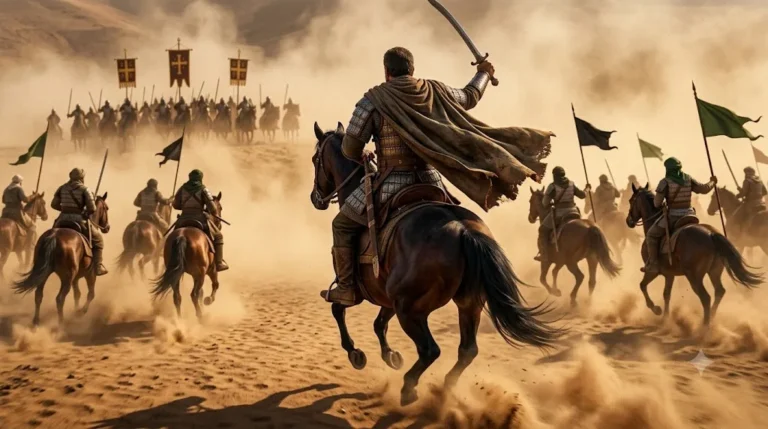
In the spring of 711, Tariq’s forces crossed the narrow strait separating North Africa from Iberia, landing near the rock that would later carry his name. It was a small, high-risk force venturing into unfamiliar territory against an established kingdom — not the kind of campaign that looked destined for success on paper.
King Roderic, when word reached him, marched south with his own army to meet the invaders. The two forces clashed at the Battle of Guadalete, likely along the Guadalete River in southern Spain, though the precise location is still debated among historians working from fragmentary and sometimes contradictory chronicle accounts.
Tariq’s Forces vs. King Roderic’s Visigothic Army at Guadalete
| Feature | Tariq ibn Ziyad’s Forces | Visigothic Forces (King Roderic) |
|---|---|---|
| Ethnic composition | Predominantly Berbers from North Africa, alongside a smaller Arab officer core | Visigoths (the Germanic ruling class) and Hispano-Roman subjects |
| Army size at Guadalete | ~7,000 men | Estimates vary widely across sources, from roughly 25,000 up to 100,000 — historians haven’t settled on a reliable figure |
| Cohesion | Unified under Tariq’s command | Reportedly fractured by internal politics — factions loyal to the previous king, Witiza, are said to have appealed to the Muslims for support against Roderic, and some may have withdrawn support during the battle |
| Outcome | Decisive victory at Guadalete | Roderic was killed or disappeared during the battle; accounts differ on the exact details |
The battle went badly for Roderic. His forces broke, and Roderic himself was killed or vanished during the fighting — accounts differ on exactly what happened, and no confirmed account of his body or fate survives. What’s clear is that Visigothic resistance, which might have been expected to regroup and counterattack, instead collapsed with striking speed. Some historians point to the succession dispute and internal Visigothic divisions as the real explanation: portions of Roderic’s own nobility may have withdrawn support or defected once the battle turned, rather than the Umayyad force alone overwhelming them through military strength.
Tariq’s age at the time of the conquest isn’t reliably recorded, so any specific number you see cited for this should be treated as speculation rather than fact.
Tariq ibn Ziyad vs. Musa ibn Nusayr
| Category | Tariq ibn Ziyad | Musa ibn Nusayr |
|---|---|---|
| Role | Field commander who led the initial crossing and invasion | Umayyad governor of Ifriqiya; Tariq’s superior |
| Force Size | ~7,000 at landing; reinforced to ~12,000 after Guadalete as the campaign expanded | Arrived separately in 712 with his own force of 18,000+ |
| Key Achievement | Victory at Guadalete with the smaller initial force; rapid advance to Toledo | Arrived a year later and, together with Tariq, occupied more than two-thirds of the Iberian Peninsula |
| Historical Reputation | Remembered as the bold, decisive general whose name marks Gibraltar | Remembered as the overall architect of the conquest, though often overshadowed by Tariq in popular memory |
| What Followed | Recalled to Damascus alongside Musa | Recalled to Damascus; reportedly disgraced later in his career |
The Push to Toledo
After Guadalete, Tariq didn’t wait. He pushed north at speed, taking major cities including Toledo, the Visigothic capital, largely before Musa arrived in Spain with a second, larger army the following year.
This is one of the more debated points among historians: some accounts frame Tariq’s speed as brilliant, decisive generalship that capitalized on a collapsing enemy before it could reorganize. Others suggest Musa was frustrated, even resentful, that Tariq had advanced so far and claimed so much without waiting for reinforcement — setting up the tension that would follow both men back to Damascus.
Timeline of the Conquest
| Date | Event |
|---|---|
| Early 711 | Tariq ibn Ziyad crosses the Strait of Gibraltar from North Africa with ~7,000 men |
| 711 | Battle of Guadalete; King Roderic is defeated |
| 711 (after Guadalete) | Tariq requests reinforcements; Musa sends ~5,000 more troops, bringing Tariq’s force to an estimated 12,000 for the expanding campaign |
| 711 | Tariq advances rapidly, capturing Toledo and other major cities |
| 712 | Musa ibn Nusayr arrives in Spain in person with his own separate force of 18,000+ |
| c. 713–714 | Both Tariq and Musa are recalled to Damascus by Caliph Al-Walid I |
Who Ruled Spain Before the Muslims?
Before 711, Spain was ruled by the Visigoths, a Germanic kingdom that had controlled the Iberian Peninsula since the 5th century, following the collapse of Roman authority in the region. By the early 8th century, the Visigothic kingdom was already politically fractured, which historians generally cite as a major factor in how quickly it fell to Tariq’s forces.
The Legend of the Burning Ships
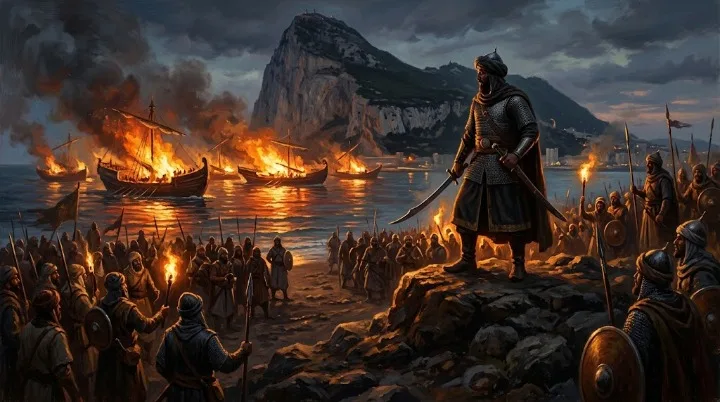
One of the most repeated stories about Tariq is that after landing in Spain, he ordered his own ships burned, removing any possibility of retreat and forcing his troops to fight with everything on the line. As the story goes, he’s said to have told his men there was nowhere left to go but forward, into the enemy or into the sea.
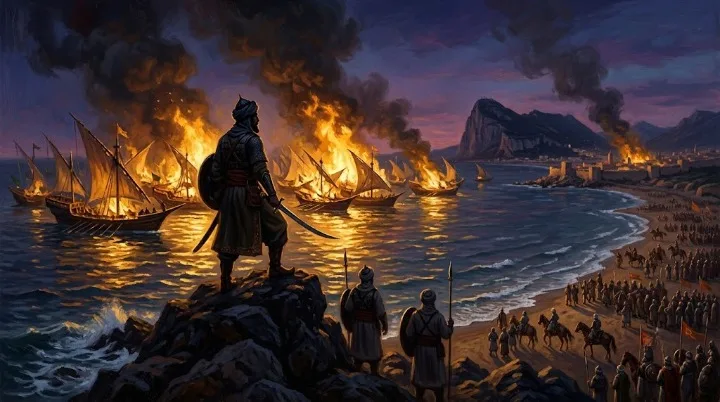
It’s a vivid, memorable image — the kind of detail that turns a military campaign into a legend. But most historians treat it as exactly that: a legend rather than a confirmed historical event. It doesn’t appear in the earliest surviving chronicle accounts of the campaign, which raises real doubt about whether it happened at all, or whether it was added to the story later to dramatize Tariq’s resolve. Similar “burned the ships” or “burned the boats” stories are attached to other conquerors and generals across history, which suggests this may be a recurring narrative motif that got attached to Tariq’s campaign rather than something unique that specifically happened at Gibraltar.
Whether or not it’s literally true, the story has outlived the documented facts of the campaign in popular memory — which says something about how legends can end up carrying more weight than the history itself.
What Happened to Tariq ibn Ziyad After the Conquest?
After Musa ibn Nusayr arrived in Spain, both he and Tariq were eventually recalled to Damascus by Caliph Al-Walid I, reportedly amid tension over credit for the conquest and disputes about the spoils of war. From this point, the historical trail becomes noticeably thinner, and the two men whose partnership had just reshaped the map of Western Europe largely fade from detailed record.
How Did Tariq ibn Ziyad Die?
This is one of the least documented parts of his story. There’s no reliably confirmed account of his cause of death, and his burial location isn’t established in credible historical sources — despite various claims circulating online. The most that can honestly be said is that after being recalled to Damascus, Tariq largely disappears from the historical record, and later chroniclers didn’t preserve firm details about his final years or death.
The Legacy of the Conquest
Whatever happened to Tariq personally, the campaign he launched reshaped Iberian history for the better part of a millennium. The territory his forces opened up became Al-Andalus, the name given to Muslim-ruled Iberia, which would go on to develop into a major center of learning, architecture, and culture over the following centuries. Muslim rule over parts of Spain, in various forms and shrinking borders, lasted until the fall of Granada in 1492 — nearly 700 years after Tariq’s crossing.
And more than 1,300 years later, his name still marks the spot where it all began. Every time someone says “Gibraltar,” they’re saying a slightly worn-down version of Jabal Tariq — the Mountain of Tariq — a rare case of a medieval general’s legacy being written directly into the map itself.
⚔️ Frequently Asked Questions — Tariq ibn Ziyad & the Conquest of Hispania
He led the 711 CE conquest that brought down the Visigothic kingdom and began over 700 years of Muslim rule in the Iberian Peninsula.
Most historians describe him as Berber, but the historical sources don’t support a confident, specific claim about his exact ethnic background beyond that.
Musa ibn Nusayr, the Umayyad governor of Ifriqiya, acting under Caliph Al-Walid I.
He was recalled to Damascus after the conquest, along with Musa ibn Nusayr, and largely disappears from reliable historical record after that.
This isn’t reliably documented in credible historical sources.
He was Muslim, serving as a commander under the Umayyad Caliphate.
Yes — beginning with Tariq’s 711 campaign, Muslim rule over parts of the Iberian Peninsula lasted in various forms until 1492.
The Visigoths, a Germanic kingdom that had controlled the region since the 5th century.
Muslim rulers, beginning with the Umayyad conquest led by Tariq ibn Ziyad in 711 CE, maintained control over parts of Spain until the fall of Granada in 1492.
Sources & Further Reading
- Encyclopaedia Britannica, “Ṭāriq ibn Ziyād”
- EBSCO Research Starters, “Tāriq ibn-Ziyād”
- Kennedy, Hugh. The Great Arab Conquests: How the Spread of Islam Changed the World We Live In. Da Capo Press, 2007.
- Collins, Roger. The Arab Conquest of Spain, 710–797. Blackwell, 1989.
- Wolf, Kenneth Baxter (trans.). Conquerors and Chroniclers of Early Medieval Spain. Translated Texts for Historians, Vol. 9. Liverpool University Press, 1990.