The story of Khawla bint al-Azwar centers on her role as a disguised warrior during the Muslim conquest of Syria in 636 CE, most famously at the Battle of Yarmouk. According to traditional Islamic narrative accounts, she fought in armor that concealed her identity as a woman, and later led a group of captured Muslim women — including her sister-in-law — in fighting their way free from Byzantine custody, using improvised weapons when conventional arms weren’t available. The story survives primarily through later akhbar and futuh literature rather than the earliest historical chronicles, and is best understood as a traditional narrative built around a historically plausible figure.
⚔️ Quick Facts — Legend of Khawla bint al-Azwar
| 📌 Field | 📖 Historical & Legendary Detail |
|---|---|
| 🌍 Setting | The Muslim conquest of Syria during the early Islamic expansion (630s CE) |
| ⚔️ Key Event | The Battle of Yarmouk (636 CE), a historic clash between the Rashidun Caliphate and the Byzantine Empire |
| 🛡️ Central Episode | The daring rescue and rebellion of captured Muslim women from a Byzantine military detention camp |
| 🪵 Weapon of Choice | A wooden tent pole, famously wielded by Khawla and her companions to fight off guards after they found themselves disarmed |
| 👥 Family Tie | Sister of the elite, legendary Rashidun commander Dirar ibn al-Azwar |
| 📖 Source Type | Traditional folk narratives, chronicled in later akhbar and futuh (conquest literature) rather than contemporary primary chronicles |
How the Story Begins: A Family of Warriors
Khawla’s story doesn’t open on the battlefield — it opens with her family. She was the sister of Dirar ibn al-Azwar, a commander whose exploits are documented in early Islamic military history with more certainty than his sister’s. Traditional biographical accounts describe the two siblings as having grown up trained in horsemanship and weapons handling, a background traditional narrators use to explain how Khawla was later able to hold her own in combat rather than treating her involvement as an isolated act of desperation.
This detail matters for how the rest of the story is read: in the traditional telling, Khawla wasn’t an untrained woman thrust into violence by circumstance — she was already a capable fighter before the events at Yarmouk took place.
The Road to Yarmouk
By 636 CE, the Rashidun Caliphate’s forces were pressing deep into Byzantine-held Syria, and the two armies met near the Yarmouk River for what would become one of the most consequential battles of the early conquests — a battle that effectively ended Byzantine control of the region.
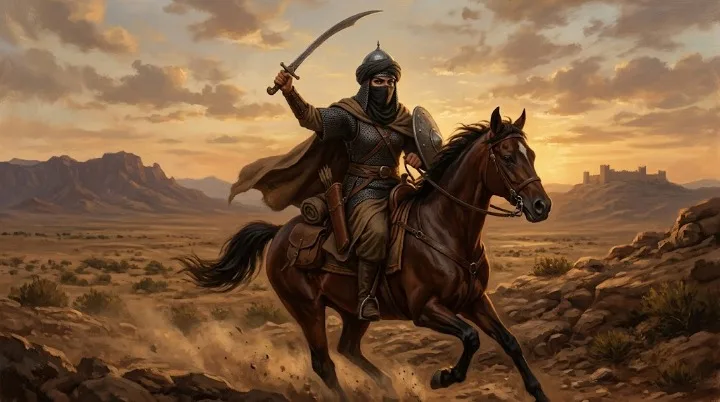
Traditional accounts place Khawla among the fighters present in or near this engagement, wearing armor and covering that obscured her identity as a woman. This detail — fighting in disguise — is a recurring motif in stories of women warriors across many historical traditions, and it serves a specific narrative function: it allows the storyteller to build toward a dramatic reveal, and it reflects the real social expectation of the time that combat was a male domain, one Khawla had to work around rather than defy openly.
The Captured Women and the Tent-Pole Stand
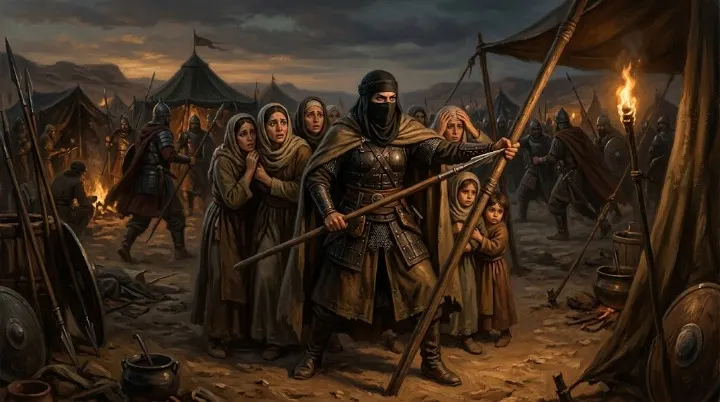
The most retold part of Khawla’s story concerns an episode during the fighting when a group of Muslim women — among them, in most versions, her own sister-in-law — were captured by Byzantine forces. Rather than waiting passively for rescue, the traditional account describes Khawla rallying the other captured women to resist.
Disarmed and without conventional weapons, she is said to have used a tent pole as an improvised weapon, leading the group in fighting their way free before Muslim forces could reach them. The image of a tent pole succeeding where swords were unavailable has become the most enduring detail of her legend — not because it is easy to verify historically, but because it captures something narrators across generations have wanted to preserve: resourcefulness and courage under the worst possible circumstances.
It’s worth being direct about the historical status of this episode: it does not appear in the earliest and most rigorously cross-checked chronicles of the conquest. It belongs instead to the akhbar and futuh tradition — narrative military histories that were compiled and popularized somewhat later, and that often incorporated symbolic or composite episodes to convey a broader truth about the era rather than a precise court record of events.
That doesn’t make the story worthless as history; it means it should be read as traditional memory of women’s participation in the conquest period, rather than as a verified battlefield report.
Why This Story Was Retold for Centuries
Stories like Khawla’s persisted not because every detail was independently verified, but because they served a purpose in Islamic historical memory: preserving evidence, however narratively shaped, that women were present and active during the foundational military campaigns of early Islam. Her story is often mentioned alongside that of Nusaybah bint Ka’ab, another woman associated with combat in the earliest Islamic period, suggesting these weren’t isolated tales but part of a broader thread of memory about women’s roles in the era.
🛡️ Frequently Asked Questions — Khawla bint al-Azwar
She is remembered for fighting in disguise during the Muslim conquest of Syria and for leading a group of captured women in fighting free from Byzantine custody at the Battle of Yarmouk, reportedly using a tent pole as a weapon.
She is known for her role as a disguised warrior in the 636 CE Syrian campaign, and specifically for the tradition that she rescued captured Muslim women, including her sister-in-law, during the Battle of Yarmouk.
Parts of her background, such as her family connection to commander Dirar ibn al-Azwar, are reasonably well-attested. The specific battlefield episodes, including the tent-pole rescue, come from later narrative literature rather than the earliest chronicles, and are best treated as traditional historical memory rather than confirmed fact in every detail.
Traditional accounts describe her organizing and leading other captured women during the rescue episode at Yarmouk, rather than acting entirely alone.
Sources
- Tabari, Tarikh al-Rusul wa’l-Muluk — for context on Dirar ibn al-Azwar and the Syrian campaign
- Encyclopaedia of Islam, entries on the Battle of Yarmouk and the conquest of Syria
- Fred Donner, The Early Islamic Conquests (Princeton University Press) — scholarly framing of conquest-era narrative sources
- Traditional futuh/akhbar compilations — for the narrative episodes discussed above