In 711 CE, Tariq ibn Ziyad crossed from North Africa into Spain with roughly 7,000 men, defeated the Visigothic King Roderic at the Battle of Guadalete, and within months had captured Toledo, the Visigothic capital. This campaign — often called the Andalus campaign, after Al-Andalus, the name given to Muslim-ruled Iberia — ended nearly 300 years of Visigothic rule and opened the door to over 700 years of Muslim presence in the peninsula, lasting until the fall of Granada in 1492.
Quick Facts: The Conquest of Spain
| Fact | Detail |
|---|---|
| Year began | 711 CE |
| Commander | Tariq ibn Ziyad, under Musa ibn Nusayr |
| Starting force | ~7,000 men, mostly Berber |
| Key battle | Battle of Guadalete |
| Opponent | King Roderic of the Visigoths |
| Capital captured | Toledo |
| Resulting territory | Al-Andalus (Muslim Iberia) |
| Duration of Muslim rule | c. 711–1492 (roughly 700 years) |
Why Spain Was Vulnerable in 711
The Visigothic kingdom that ruled Spain in the early 8th century wasn’t the stable power it might have looked like from the outside. King Roderic had taken the throne under contested circumstances, and factions loyal to the previous king, Witiza, were reportedly unhappy enough with the succession that some may have seen an outside force as an opportunity rather than purely a threat.
That instability didn’t go unnoticed. Tariq ibn Ziyad, serving under Musa ibn Nusayr, the Umayyad governor of Ifriqiya, was sent across the Strait of Gibraltar to test the kingdom’s defenses — and what he found was a fractured, distracted opponent rather than a united one.
The Crossing and the Battle of Guadalete
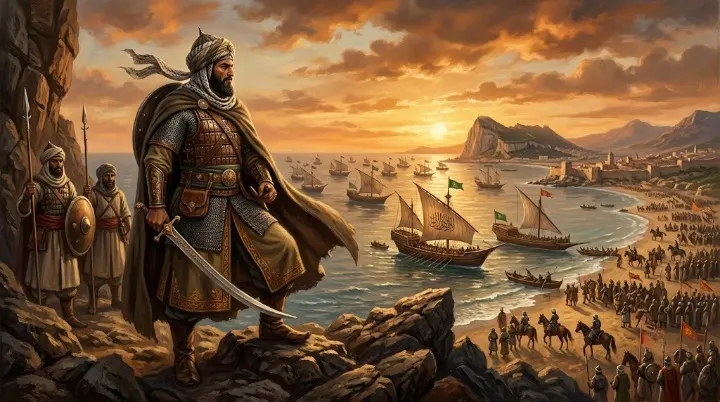
In the spring of 711, Tariq’s force crossed the narrow strait separating North Africa from Iberia, landing near the rock that would later carry his name — Gibraltar, from Jabal Tariq, “Mountain of Tariq.” It was a small, high-risk force venturing into unfamiliar territory against an established kingdom, with no clear guarantee of reinforcement if things went wrong.
Word of the landing reached Roderic while he was occupied elsewhere in his kingdom, and he marched south to meet the invaders directly rather than sending a smaller regional force — a decision that put his full royal army on the line in a single engagement. The two sides met at the Battle of Guadalete, likely along the river of the same name in southern Spain, though the precise location is still debated among historians working from fragmentary and sometimes contradictory chronicle accounts.
The battle did not go the way Roderic’s numbers might have suggested it should. His forces broke, and Roderic himself was killed or vanished during the fighting — accounts differ on exactly what happened, and no confirmed account of his body or fate survives. What’s clear is that Visigothic resistance, which might have been expected to regroup and counterattack, instead collapsed with striking speed. Several historians point to the internal Visigothic divisions as the real explanation here — portions of Roderic’s own nobility may have withdrawn support or defected once the battle turned, rather than Tariq’s smaller force alone overwhelming them through numbers.
Tariq’s Forces vs. King Roderic’s Visigothic Army at Guadalete
| Feature | Tariq ibn Ziyad’s Forces | Visigothic Forces (King Roderic) |
|---|---|---|
| Ethnic composition | Predominantly Berbers from North Africa, alongside a smaller Arab officer core | Visigoths (the Germanic ruling class) and Hispano-Roman subjects |
| Army size at Guadalete | ~7,000 men | Estimates vary widely across sources, from roughly 25,000 up to 100,000 — historians haven’t settled on a reliable figure |
| Cohesion | Unified under Tariq’s command | Reportedly fractured by internal politics — factions loyal to Witiza are said to have withdrawn support during the battle |
| Outcome | Decisive victory | Roderic killed or disappeared; resistance collapsed rapidly |
Note: Tariq was reinforced to roughly 12,000 men only after this battle, as the campaign expanded — not during Guadalete itself.
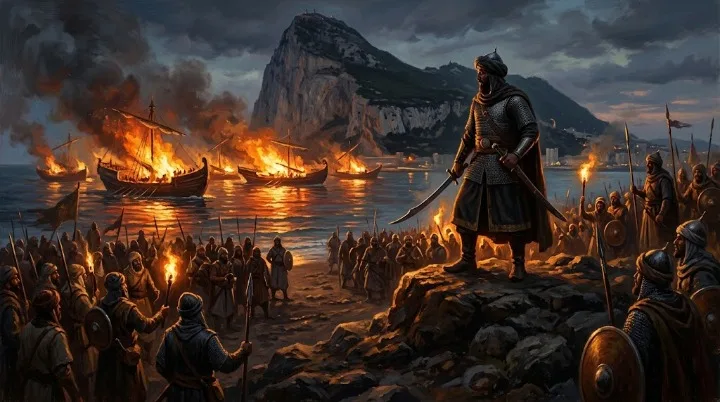
This battle is also the moment behind one of the most famous stories attached to Tariq’s name — the legend that he burned his own ships after landing, to remove any possibility of retreat. It’s a dramatic image, but most historians treat it as a later legend rather than a documented event.
The Push to Toledo
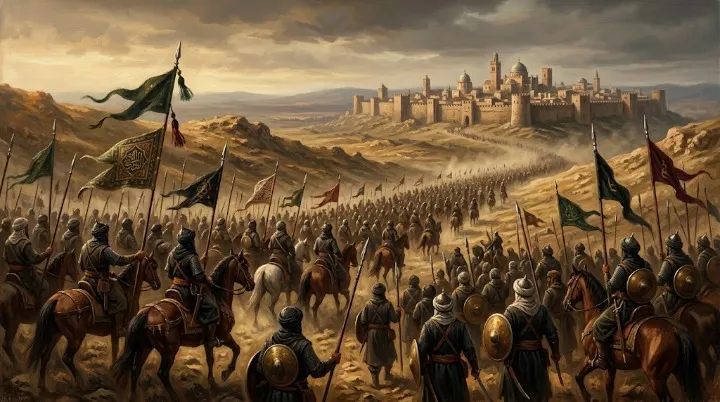
After Guadalete, Tariq didn’t wait to consolidate his position. He pushed north at speed, capturing Córdoba and eventually Toledo, the Visigothic capital, largely before Musa ibn Nusayr arrived with a second, larger army the following year. Some historians frame this speed as decisive generalship that capitalized on a collapsing enemy before it could regroup and mount a real defense of its capital. Others suggest it created real tension with Musa, who arrived in 712 to find much of the conquest already accomplished without him — a rivalry that would follow both men back to Damascus.
Timeline of the Conquest
| Date | Event |
|---|---|
| Early 711 | Tariq crosses the Strait of Gibraltar with ~7,000 men |
| 711 | Battle of Guadalete; King Roderic is defeated |
| 711 | Tariq captures Córdoba and Toledo |
| 711 (after Guadalete) | Tariq reinforced to ~12,000 men as the campaign expands |
| 712 | Musa ibn Nusayr arrives with his own separate force of 18,000+ |
| 713–714 | Both commanders are recalled to Damascus |
| 711–1492 | Muslim rule continues over parts of Iberia, known as Al-Andalus |
What Does “Al-Andalus” Actually Mean?
Al-Andalus is the Arabic name given to the parts of the Iberian Peninsula under Muslim rule following the conquest. Its exact linguistic origin is debated among scholars — some trace it to the Vandals who had earlier passed through the region, others to different roots entirely — but as a historical term, it refers to the political and cultural entity that emerged directly from Tariq’s campaign.
That entity went on to become far more than a military holding. Over the following centuries, cities like Córdoba, Seville, and Granada developed into major centers of learning, architecture, and trade, producing advances in medicine, astronomy, and philosophy that would later influence medieval Europe. The Great Mosque of Córdoba and the Alhambra in Granada — both built during this era — remain among the most visited historical sites in Spain today, standing as physical reminders of just how far the consequences of Tariq’s 711 campaign extended beyond the battlefield.
Who Ruled Spain Before the Muslims?
Before 711, Spain was ruled by the Visigoths, a Germanic kingdom that had controlled the Iberian Peninsula since the 5th century, following the collapse of Roman authority in the region. Their rule ended abruptly with the defeat at Guadalete and the rapid collapse that followed.
Did Muslims Conquer Spain?
Yes. Beginning with Tariq’s 711 campaign, Muslim forces went on to control most of the Iberian Peninsula within a few years, and some form of Muslim rule persisted in parts of Spain for roughly 700 years, ending with the fall of Granada in 1492.
How Long Did the Conquest Take, and What Came After?
The initial conquest — from the landing at Gibraltar to the capture of Toledo — took less than a year. But “conquest” and “control” aren’t the same thing: consolidating the wider peninsula, including regions in the north and west, took considerably longer, and Muslim rule over the full territory was never total or permanent. Christian kingdoms in the north persisted throughout, and the centuries-long Reconquista gradually reversed Muslim control until Granada, the last Muslim stronghold, fell in 1492.
🕌 Frequently Asked Questions
The main campaign began in 711 CE, with the Battle of Guadalete and the capture of Toledo both taking place within that year.
His 711 campaign began the conquest that created Al-Andalus, the term for Muslim-ruled territory in the Iberian Peninsula.
Yes — starting with Tariq ibn Ziyad’s 711 campaign, Muslim forces controlled significant parts of Spain for roughly 700 years.
The Visigoths, a Germanic kingdom that had governed the Iberian Peninsula since the 5th century.
Muslim rulers, beginning with Tariq ibn Ziyad’s 711 conquest, maintained control over parts of Spain until the fall of Granada in 1492.