Quick Facts — July 29 in History
| Category | Detail |
|---|---|
| Most Significant Event | Destruction of the First Temple in Jerusalem by the Neo-Babylonian Empire (587 BC) |
| Top Key Events |
|
| Key Battles | Battle of Firenzuola (923), Battle of Kleidion (1014), Battle of Vlaardingen (1018), Battle of Stiklestad (1030), Siege of Damascus (1148), Battle of Gravelines (1588), Battle of Landen (1693), Battle of Belen Pass (1832), Tipperary Revolt (1848) |
| Key Figures | Muhammad al-Mahdi, J. R. D. Tata, Alexis de Tocqueville, Benito Mussolini |
| Observances | International Tiger Day, National Anthem Day (Romania), Mohun Bagan Day (India), National Thai Language Day (Thailand), Ólavsøka / Olsok (Faroe Islands & Nordic countries) |
Story of the Day: The Spanish Armada Shattered at Gravelines
On the windy morning of July 29, 1588, Lord Charles Howard and Sir Francis Drake spotted the massive Spanish Armada off the coast of Gravelines, France. King Philip II of Spain had sent 130 warships to invade England, believing his fleet was completely invincible. Drake launched burning fireships straight into the anchored Spanish formation during the night, forcing panic-stricken captains to cut their anchors and drift into open water. English long-range cannons then battered the scattered Spanish ships in a brutal, day-long naval engagement. The catastrophic defeat permanently broke Spain’s naval dominance and established England as the rising ruler of the high seas.
Important Events That Happened On July 29 In History
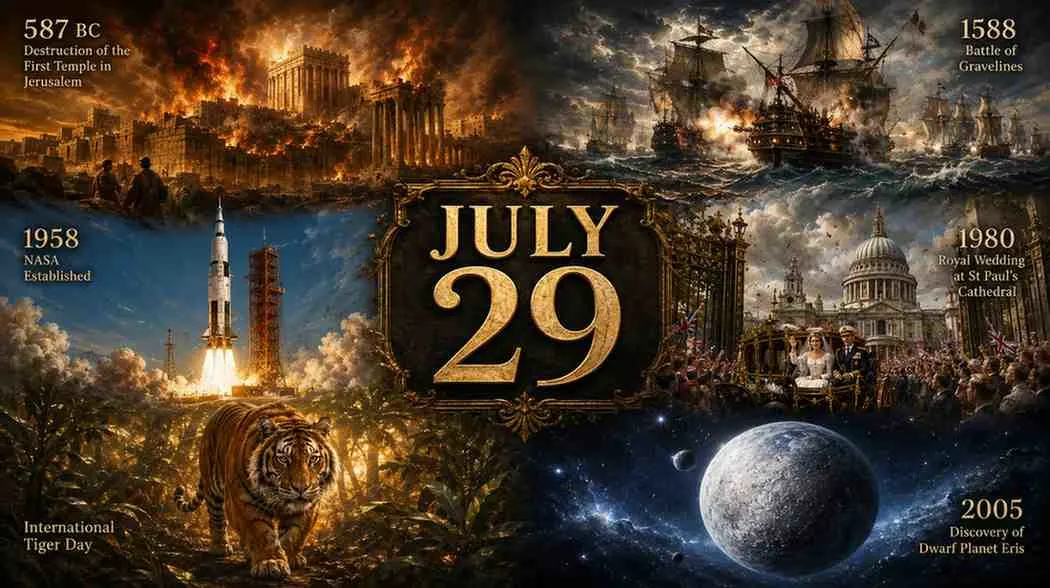
587 BC – Destruction of the First Temple in Jerusalem
King Nebuchadnezzar’s Babylonian commanders broke through the stone defenses of Jerusalem and systematically torched the holy city. Temple treasures were ripped from their foundations and marched east toward Babylon alongside thousands of captive Judeans. The horrific destruction of King Solomon’s temple erased the physical heart of ancient Jewish worship in a single day. Decades of Babylonian exile followed, permanently reshaping the theological trajectory of the ancient Near East.
238 AD – Praetorian Guard Murder Emperors Balbinus and Pupienus
Roman guards smashed their way into the imperial palace in Rome, hunting down joint emperors Balbinus and Pupienus after weeks of bitter political feuding. The elderly senators were dragged naked through the dirt streets while soldiers mocked their aristocratic heritage. Both co-rulers were brutally stabbed to death before their bloody bodies were dumped in the public thoroughfare. The guards immediately proclaimed thirteen-year-old Gordian III as the new Emperor, proving military force dictated Roman rule.
615 – K’inich Janaab’ Pakal Takes the Mayan Throne
Twelve-year-old K’inich Janaab’ Pakal sat upon the ceremonial bench at Palenque as sacred royal jade was fastened around his chest. His mother, Queen Sak K’uk’, handed over political control of a city-state battered by rival Mayan military raids. The young ruler immediately ordered massive architectural expansion programs that produced sprawling stone palaces and soaring pyramids. His sixty-eight-year reign transformed Palenque into the grandest cultural jewel of the entire Mayan world.
904 – Saracen Raiders Sack Byzantine Thessalonica
Leo of Tripoli led hundreds of Saracen pirate vessels directly into the harbor of Thessalonica, Byzantine Europe’s second city. Arab raiders scaled the weak coastal ramparts after a short three-day siege, overwhelming the panicked Greek defenders. Ships left the burning harbor loaded with gold, sacred Christian icons, and over twenty thousand enslaved citizens. The disastrous raid exposed severe naval vulnerabilities along the Byzantine Empire’s northern Aegean coastline.
923 – Battle of Firenzuola Shatters Italian Rule
King Rudolph II of Burgundy clashed with Emperor Berengar I on the dusty plains of Firenzuola in northern Tuscany. Adalbert of Ivrea executed a brutal cavalry flank attack that broke the Italian imperial lines after hours of bloody hand-to-hand combat. Berengar fled the battlefield disgraced, completely stripped of his royal authority over the kingdom of Lombardy. The defeat left northern Italy divided among rival warlords competing for the imperial crown.
1014 – Emperor Basil II Crushes the Bulgarian Army at Kleidion
Byzantine Emperor Basil II trapped fifteen thousand Bulgarian soldiers inside the narrow, forested gorge of Kleidion. Imperial forces slaughtered thousands on the mountain slopes before taking the remaining army captive in a massive surrender. Basil ordered every hundredth prisoner blinded in only one eye so they could lead thousands of totally blinded comrades back home. Tsar Samuil of Bulgaria collapsed and died of a heart attack upon seeing his ruined army return.
1018 – Count Dirk III Defeats the Holy Roman Empire at Vlaardingen
Imperial troops sent by Emperor Henry II marched into the swampy coastal marshes of Vlaardingen to crush an rebellious Dutch fortress. Count Dirk III ambushed the heavily armored knights in mud-soaked trenches where their horses were completely useless. The small local militia slaughtered the stranded royal army and captured high-ranking imperial noblemen for massive ransoms. Dirk secured his rights to levy lucrative river tolls, establishing the territorial roots of modern Holland.
1030 – King Olaf Haraldsson Killed at the Battle of Stiklestad
Olaf II marched into central Norway leading a battle-hardened army to reclaim his lost kingdom from Danish invaders. Pagan peasant chieftains joined forces with Danish king Cnut to block the Christian monarch’s advance at Stiklestad. Olaf fought fiercely at the front line until he took spear wounds to his leg, stomach, and throat. His dramatic death converted the pagan opposition, turning the fallen king into Saint Olaf, Norway’s patron saint.
1148 – The Siege of Damascus Collapses the Second Crusade
Crusader kings Baldwin III and Louis VII abandoned their strategic siege positions outside the mud-brick walls of Damascus. Bad tactical decisions forced the European knights into waterless orchards where Syrian archers harassed them without stopping. News of approaching Muslim reinforcements forced the shattered Christian commanders to order a chaotic, humiliating retreat toward Jerusalem. The disastrous failure completely destroyed momentum for the Second Crusade, leaving European leaders bitterly divided.
1565 – Mary, Queen of Scots Marries Lord Darnley
Queen Mary stood beside her cousin Henry Stuart, Lord Darnley, inside the private Catholic chapel of Holyrood Palace. The royal match outraged Protestant nobles and sent shockwaves toward Queen Elizabeth I’s court in London. Darnley’s highborn bloodline united two powerful Tudor claims to the English throne under one single marriage. The unstable union quickly unspooled into political murder, rebellion, and Mary’s ultimate downfall.
1567 – Infant James VI Crowned King of Scotland
Thirteen-month-old Prince James was carried into the Church of the Holy Rude at Stirling while political rebellion raged outside. Protestant lords placed the heavy Scottish crown above the baby’s head following his mother Mary’s forced abdication. John Knox preached a fiery sermon urging the new regency council to raise the young monarch in the strict Protestant faith. The infant child grew up to unite the crowns of Scotland and England as King James I.
1588 – English Navy Defeats the Spanish Armada at Gravelines
Lord Charles Howard unleashed flaming fireships into the anchored Spanish Armada during a dark night off the French coast. Spanish captains panicked, cutting their heavy iron anchors and floating helplessly into open, storm-tossed waters. Sir Francis Drake hammered the drifting warships with long-range naval artillery, sinking multiple giant galleons near the shore. The stunning English victory ended Philip II’s dreams of invading England and secured English Protestant rule.
1602 – Queen Elizabeth I Visits Harefield Place
Queen Elizabeth I rode past cheering country crowds to arrive at Sir Thomas Egerton’s estate in Hillingdon. Local actors staged elaborate open-air theatrical performances and musical pageants beneath giant oak trees to entertain the aging monarch. The three-day festival marked one of the final grand royal progresses of the Elizabethan era before her death. The aristocratic family spent a small fortune hosting the court to secure royal favor.
1693 – French Victory over Allied Forces at the Battle of Landen
Marshal Luxembourg launched eighty thousand French troops against King William III’s entrenched Allied defensive positions near Landen. French infantry stormed the reinforced dirt breastworks three separate times, suffering immense casualties before breaching the center line. Allied forces retreated across the narrow Gete River under desperate rear-guard cavalry charges that saved William from total capture. Over nineteen thousand dead soldiers littered the small field, making it one of the bloodiest clashes of the century.
1775 – Washington Establishes the U.S. Army JAG Corps
General George Washington signed an official military order appointing Harvard graduate William Tudor as Judge Advocate of the Continental Army. American forces battling British rule needed an organized legal framework to manage military discipline and court-martial proceedings. Tudor rode between military encampments surrounding Boston to draft formal legal codes for green colonial recruits. The appointment established the legal foundation for the modern United States Army Judge Advocate General’s Corps.
1818 – Augustin Fresnel Demolishes Isaac Newton’s Light Theory
French physicist Augustin Fresnel submitted his ground-breaking optical research paper to the French Academy of Sciences in Paris. His mathematical equations explained exactly how light bends around solid objects into shaded areas, defying classical physics theories. Traditional scientists who backed Isaac Newton’s long-standing particle theory were forced to admit Fresnel’s light-wave calculations were completely accurate. The breakthrough transformed physical optics and changed scientific understanding of electromagnetic radiation forever.
1832 – Egyptian Army Routes Ottomans at Belen Pass
Ibrahim Pasha led forty thousand battle-tested Egyptian soldiers into the steep, rocky mountain defiles of Belen Pass. Ottoman commanders lined up a larger force along the heights, but Egyptian artillery battered their positions with terrifying precision. Egyptian infantry charged up the high ridges, breaking the sultan’s lines and forcing a wild retreat toward Anatolia. The victory left the heart of the Ottoman Empire completely exposed to Egyptian military expansion.
1836 – Arc de Triomphe Inaugurated in Paris
Thirty years after Napoleon Bonaparte commissioned the monument, French officials unveiled the finished Arc de Triomphe in Paris. King Louis-Philippe skipped the massive grand ceremony due to constant fears of public political assassination attempts. Thousands of Parisian citizens gathered beneath the giant stone arches to inspect carved names of fallen revolutionary and imperial generals. The massive landmark instantly became a global symbol of French military pride and national identity.
1848 – Police Crush Irish Young Irelander Rebellion in Tipperary
William Smith O’Brien led a group of starving Irish nationalists against armed colonial police officers in County Tipperary. The rebels surrounded a stone farmhouse in Ballingarry where police officers locked themselves inside with local hostages. Constabulary forces fired through the glass windows, killing two young men and scattering the poorly equipped Irish crowd. The short firefight completely ended the Young Irelander Revolt during the height of the Great Famine.
1851 – Annibale de Gasparis Discovers Asteroid 15 Eunomia
Italian astronomer Annibale de Gasparis peered through his telescope at the Capodimonte Observatory overlooking Naples. He spotted a tiny faint point of light shifting position against fixed background stars in the night sky. Mathematical trackings proved he had located a massive stony asteroid floating within the asteroid belt between Mars and Jupiter. He named the giant space rock 15 Eunomia after the ancient Greek goddess of law and order.
1858 – United States and Japan Sign the Harris Treaty
Townsend Harris stood aboard a United States naval vessel in Edo Bay alongside senior Japanese shogun officials. The signed commercial treaty opened major Japanese trading ports, including Yokohama and Nagasaki, to American merchant vessels. It granted extraterritorial legal rights to foreign residents while ending centuries of Japanese diplomatic isolation under Tokugawa rule. The historic agreement accelerated rapid westernization and industrialization across feudal Japan.
1862 – Confederate Spy Belle Boyd Arrested in Virginia
Union soldiers surrounded the hotel where seventeen-year-old Confederate spy Belle Boyd was staying in Front Royal. Officers searched her private belongings and discovered hidden intelligence notes detailing Federal troop movements across the Shenandoah Valley. Federal troops escorted her under heavy military guard directly to the Old Capitol Prison in Washington, D.C. Her famous arrest turned the daring Southern courier into an international celebrity headline.
1871 – Connecticut Valley Railroad Opens Service
Engineers fired up steam locomotives to launch the first official passenger run of the Connecticut Valley Railroad. Track lines stretched from the coastal port of Old Saybrook north to the state capital of Hartford. Local farm communities along the Connecticut River gained direct daily access to booming urban manufacturing markets. The new rail link dramatically accelerated regional industrial commerce across the northeastern United States.
1899 – First Hague Convention Signed for International Peace
Diplomats from twenty-six nations gathered inside the pale walls of the Huis ten Bosch palace in the Netherlands. International delegates signed landmark treaties regulating modern warfare, banning poison gas shells, and establishing guidelines for treatment of war prisoners. The conference created the Permanent Court of Arbitration to resolve international disputes through peaceful legal channels. The historic documents formed the legal blueprint for modern human rights law and war crime prosecution.
1900 – King Umberto I of Italy Assassinated by Anarchist
Italian-American anarchist Gaetano Bresci pulled a revolver and fired four close-range shots at King Umberto I in Monza. The monarch collapsed inside his royal carriage while returning from an athletic event, dying from severe internal blood loss. Bresci claimed the bloody murder was direct vengeance for royal troops firing cannons at starving working-class protesters in Milan. The king’s thirty-one-year-old son immediately ascended the throne as King Victor Emmanuel III.
1901 – Massive Oklahoma Land Lottery Begins
Thousands of hopeful settlers crowded into El Reno and Lawton, Oklahoma, to draw wooden numbers for former Native American lands. The federal government distributed over two million acres of Kiowa, Comanche, and Apache reservation land via public lottery tickets. Desperate families camped out in canvas tent cities under scorching prairie sun hoping to win quarter-section homestead plots. The government land rush wiped away legal tribal boundaries across southwestern Oklahoma overnight.
1907 – Baden-Powell Opens First Scout Camp on Brownsea Island
Robert Baden-Powell blew a brass horn to gather twenty young boys around a campfire on Brownsea Island off southern England. The retired British army officer tested his experimental outdoor survival curriculum through practical lessons in tracking, stalking, and knot-tying. Boys from rich private schools and working-class London neighborhoods lived side-by-side inside small canvas tents. The nine-day summer experiment launched the global Scouting movement that grew to millions of members.
1910 – Slocum Massacre Begins in Deep East Texas
White mobs armed with shotguns rode through the African American community of Slocum, Texas, firing randomly on Black citizens. Local authorities falsely claimed local Black residents were planning an armed insurrection, prompting days of unchecked white vigilante violence. Dozens of Black families fled into nearby pine forests and river swamps as their homes were burned to the ground. Over one hundred innocent African Americans were murdered, making it one of the state’s worst racial massacres.
1914 – Cape Cod Canal Opens to Maritime Traffic
Engineers opened the sea-level Cape Cod Canal in Massachusetts after years of difficult steam-shovel excavation through granite and sand. The synthetic waterway connected Cape Cod Bay directly to Buzzards Bay, cutting seventy miles off dangerous ocean shipping routes around the cape. Merchant ships completely avoided treacherous offshore sandbars and thick coastal fog that had wrecked hundreds of sailing vessels. The canal instantly transformed maritime trade lines along the eastern American seaboard.
1920 – Klamath Reclamation Project Begins Link River Dam
Construction crews broke ground along the Link River in southern Oregon to construct a massive concrete flow-control dam. Government engineers designed the project to divert millions of gallons of water into dry desert valleys for commercial farming. The heavy infrastructure permanently altered natural water flows into Upper Klamath Lake, disrupting ancient salmon runs relied on by local tribes. Decades of legal battles over regional agricultural water rights began with the first shovel of earth.
1921 – Adolf Hitler Becomes Absolute Leader of Nazi Party
Adolf Hitler addressed an emergency meeting of the National Socialist German Workers’ Party inside a crowded Munich beer hall. He threatened to resign permanently unless party leadership granted him absolute, dictatorial power over organizational decisions. Party members voted overwhelmingly to abolish the executive committee and hand total control to the aggressive thirty-two-year-old orator. The internal takeover transformed the tiny fringe party into a tightly controlled fascist political weapon.
1932 – Federal Troops Attack Bonus Army in Washington
General Douglas MacArthur led armed cavalry, infantry soldiers, and six tanks down Pennsylvania Avenue toward thousands of World War I veterans. The “Bonus Army” of unemployed ex-soldiers had set up makeshift wooden shantytowns to demand early payment of wartime service certificates. Military forces deployed tear gas, bayonets, and arson torches to clear camp sites, burning veterans’ shelters to the ground. The violent military action against war heroes shocked the American public during the Great Depression.
1937 – East Hebei Army Launches Tongzhou Mutiny
Chinese soldiers of the East Hebei Army turned their weapons on Japanese military commanders and civilian officials in Tongzhou. The garrison rose up after false reports circulated that Chinese nationalist forces had destroyed Japanese headquarters in nearby Beijing. Rebel troops stormed Japanese military quarters and administrative buildings, killing hundreds of military personnel and civilians in intense urban combat. The sudden mutiny escalated total military conflict between China and Japan into full-scale war.
1945 – BBC Light Programme Station Airs First Broadcast
The British Broadcasting Corporation launched the BBC Light Programme radio station to provide mainstream musical entertainment for wartime households. Radio hosts kicked off broadcasts with light orchestral performances, comedy sketches, and popular variety show segments. The new station shifted public radio culture away from rigid educational programming toward relaxed, everyday listener entertainment. It established a permanent soundtrack for post-war British daily life across millions of living rooms.
1948 – Post-War Summer Olympics Open in London
King George VI officially declared the 1948 Summer Olympic Games open before eighty thousand spectators at Wembley Stadium in London. London hosted the competition on a tight budget using existing facilities due to heavy World War II bomb damage across the city. Over four thousand athletes from fifty-nine nations marched into the arena, marking the first Olympic gathering in twelve years. The “Austerity Games” symbolized global post-war recovery and athletic cooperation.
1950 – No Gun Ri Massacre Ends in Korean War
The four-day massacre at No Gun Ri ended as the U.S. 7th Cavalry Regiment withdrew from its defensive perimeter near a railway bridge. American soldiers had fired automatic weapons and requested airstrikes on hundreds of trapped South Korean refugees beneath concrete train arches. U.S. commanders feared North Korean military infiltrators were hiding within civilian refugee groups moving south. Hundreds of innocent Korean civilians, mostly women and children, lay dead inside the narrow stone culverts.
1957 – International Atomic Energy Agency Established
Representatives from dozens of nations officially established the International Atomic Energy Agency with headquarters in Vienna, Austria. The independent international body was designed to promote peaceful uses of nuclear energy while preventing nuclear weapons proliferation worldwide. Inspector teams gained authority to monitor nuclear reactors and research facilities across sovereign member states. The charter marked a major global effort to control nuclear materials during the height of the Cold War.
1957 – Tonight Starring Jack Paar Debuts on NBC
Host Jack Paar walked out onto the NBC stage to launch the modern late-night television talk show format. His conversational interview style, witty banter, and unscripted celebrity guest appearances captivated millions of late-night American viewers. Paar introduced regular comedic skits and open-forum political discussions that transformed late-night programming into lucrative broadcast real estate. The historic broadcast laid the permanent blueprint for modern American late-night television entertainment.
1958 – Eisenhower Signs Law Creating NASA
President Dwight D. Eisenhower signed the National Aeronautics and Space Act inside the Oval Office, officially establishing NASA. The federal legislation consolidated civilian space research programs in direct response to the Soviet Union’s successful Sputnik satellite launch. The new civilian agency took control of military rocket research facilities, human spaceflight programs, and planetary probe developments. The stroke of a pen launched America’s official entry into the high-stakes Cold War space race.
1959 – Hawaii Holds First U.S. Congressional Elections
Citizens across the Hawaiian Islands cast ballots in their first official United States federal elections as an incoming state. Voters elected Daniel Inouye to the House of Representatives, making him the first Japanese American to serve in the U.S. Congress. Territorial residents turned out in record numbers to solidify their political transition from a Pacific territory into the 50th state of the Union. The elections marked a monumental shift in American federal legislative representation.
1965 – 101st Airborne Paratroopers Touch Down in Vietnam
Four thousand paratroopers of the 101st Airborne Division walked down military transport ramps onto the sand beaches of Cam Ranh Bay. The arrival marked the largest rapid troop deployment to South Vietnam since direct American military intervention began. Combat units set up fortified perimeter bases before moving directly into dense coastal jungles to search for Viet Cong forces. The mass arrival signaled a massive escalation of ground troop combat operations in Southeast Asia.
1967 – Devastating Aircraft Fire on USS Forrestal Kills 134
An electrical power surge accidentally triggered a Zuni rocket launch across the flight deck of the aircraft carrier USS Forrestal off North Vietnam. The stray rocket struck an armed A-4 Skyhawk jet, rupturing fuel tanks and igniting thousands of gallons of burning aviation fuel. A chain-reaction of exploding heavy bombs ripped through the flight deck, destroying dozens of combat aircraft and trapping sailors below decks. Heroic firefighting efforts saved the giant carrier, but 134 crew members lost their lives.
1967 – Caracas Earthquake Kills Hundreds in Venezuela
A magnitude 6.6 earthquake struck the Caribbean coast of Venezuela during the city of Caracas’s 400th anniversary celebration week. Modern high-rise apartment towers in wealthy suburbs collapsed into piles of concrete rubble within seconds of the first tremors. Thousands of residents fled into dark streets as power lines snapped and water mains burst across the capital city. The catastrophe left over five hundred people dead and caused tens of millions of dollars in structural destruction.
1972 – Mid-Air Collision Kills 38 Over Colombia
Two Avianca Douglas DC-3 passenger airliners collided high above a mountainous region of western Colombia in clear weather conditions. Both twin-engine aircraft suffered total structural failure upon impact, plunging into dense jungle terrain below. Emergency search crews worked through thick forest growth to reach the remote crash sites, confirming no survivors among passengers and crew. The horrific crash prompted immediate structural reforms in South American regional air traffic management.
1973 – Greek Voters Abolish Monarchy via Referendum
Greek citizens went to the polls under military rule to vote on abolishing the exiled Greek monarchy. The military junta led by George Papadopoulos heavily manipulated public voting procedures to secure an official republic transition. The referendum formally ended King Constantine II’s royal authority and inaugurated the first political period of the Metapolitefsi. Democracy advocate groups used the momentum to eventually bring down the dictatorial military regime a year later.
1973 – Driver Roger Williamson Dies in Dutch Grand Prix
British racing driver Roger Williamson crashed at high speed during the opening laps of the Dutch Grand Prix at Zandvoort. A sudden tire failure pitched his March-Ford car into outer track barriers, flipping the vehicle upside down and igniting a fuel fire. Fellow driver David Purley stopped his own car and ran across the active track, desperately trying to flip Williamson’s burning car by hand. Williamson died of smoke inhalation because track marshals lacked flame-resistant suits and proper fire equipment.
1974 – Episcopal Church Ordains First Female Priests
Eleven women were ordained as Episcopal priests at the Church of the Advocate in Philadelphia. Bishops Daniel Corrigan, Robert L. DeWitt, and Edward R. Welles acted without official sanction from the General Convention, defying centuries of tradition. The “Philadelphia Eleven” drew intense backlash and media attention, sparking fierce debate over gender roles within Anglicanism. The historic service paved the way for official recognition of women’s ordination in the Episcopal Church two years later.
1976 – “Son of Sam” Begins NYC Murder Spree
David Berkowitz pulled a .44 caliber revolver and opened fire on two young women parked outside an apartment building in the Bronx. Eighteen-year-old Donna Lauria was killed instantly, while her friend suffered severe gunshot wounds in the surprise late-night attack. The shooting marked the terrifying opening salvo of a terror spree that paralyzed New York City for an entire year. Police launched a massive task force to track down the serial killer known as the “Son of Sam.”
1980 – Iran Unveils New Post-Revolution Flag
The Islamic Republic of Iran officially adopted a newly designed national flag following the overthrow of the Shah. The new design replaced the centuries-old Sun and Lion symbol with a stylized red emblem representing the Islamic phrase La ilaha illallah. Geometric script reading Allahu Akbar was repeated twenty-two times along the green and red borders to honor the revolution date. The design reflected the country’s total transition into an Islamic theological state.
1981 – Prince Charles Marries Lady Diana Spencer
Lady Diana Spencer stepped out of a glass coach onto the steps of St Paul’s Cathedral in a magnificent silk wedding gown. Seven hundred and fifty million television viewers across the globe watched the twenty-year-old kindergarten teacher marry Prince Charles, heir to the British throne. Millions of cheering crowds lined the streets of London under bright sunshine as royal carriages processed back to Buckingham Palace. The fairy-tale wedding captured the world’s imagination, creating an iconic moment in modern cultural history.
1981 – Impeached President Banisadr Flees Iran
Abolhassan Banisadr, Iran’s first elected president following the 1981 revolution, boarded a hijacked Iranian Air Force Boeing 707 at a military airfield. Shaving his mustache and wearing a military uniform, he escaped alongside rebel leader Massoud Rajavi while loyalist guards were distracted. Pilot Colonel Behzad Moezzi flew the transport jet at low altitude under radar to land safely at a military base near Paris. Banisadr established the National Council of Resistance in exile to oppose Ayatollah Khomeini’s regime.
1985 – Space Shuttle Challenger Engine Fails During Ascent
Space Shuttle Challenger roared off the launchpad at Kennedy Space Center carrying the Spacelab 2 science payload into orbit. Five minutes into flight, a center main engine prematurely shut down due to faulty temperature sensor readings, forcing a dangerous “abort-to-orbit” procedure. Commander Gordon Fullerton managed the crisis, guiding the shuttle into a lower orbital trajectory than originally planned. The crew salvaged the mission, completing crucial solar physics experiments despite the severe launch malfunction.
1987 – Thatcher and Mitterrand Sign Channel Tunnel Treaty
British Prime Minister Margaret Thatcher and French President François Mitterrand met at the castle of Paris to sign the historic Channel Tunnel accord. The international treaty established formal government frameworks for private construction of a rail tunnel directly beneath the English Channel. The ambitious engineering project promised to link Britain to continental Europe by land for the first time since the last Ice Age. Construction workers broke ground on both coastlines shortly after the ceremony ended.
1987 – India and Sri Lanka Sign Ethnic Accord
Indian Prime Minister Rajiv Gandhi and Sri Lankan President J. R. Jayewardene signed a diplomatic peace agreement in Colombo. The accord aimed to end the Sri Lankan Civil War by granting local autonomy to Tamil-majority northern provinces and deploying Indian peacekeeping troops. The signing triggered immediate violent political protests among Sinhalese nationalists across southern Sri Lanka. The military intervention dragged Indian armed forces into a long, costly jungle counter-insurgency campaign.
1993 – Israeli Supreme Court Acquits John Demjanjuk
Judges on the Supreme Court of Israel overturned the war crimes conviction of retired Ukrainian-American auto worker John Demjanjuk. Lower courts had sentenced him to death after identifying him as “Ivan the Terrible,” a notoriously cruel guard at the Treblinka extermination camp. New Soviet archival records declassified after the Cold War revealed another guard was likely the infamous camp torturer, creating reasonable doubt. Demjanjuk was released from prison and allowed to return to his home in the United States.
1996 – Communications Decency Act Struck Down by Federal Court
A three-judge federal appeals court panel in Philadelphia blocked enforcement of anti-indecency provisions within the landmark Communications Decency Act. Judges ruled that broad federal restrictions on internet content violated First Amendment free speech guarantees for American citizens. The ruling established early legal precedents treating online speech with the same constitutional protections as traditional print media. The landmark decision allowed the emerging World Wide Web to grow without government censorship.
2005 – Astronomers Discover Dwarf Planet Eris
Astronomers Mike Brown, Chad Trujillo, and David Rabinowitz analyzed high-resolution deep-space telescope images taken at the Palomar Observatory. They discovered a massive frozen object drifting through the Kuiper Belt, far beyond the orbit of Neptune. Initial size estimates showed the distant object was larger than Pluto, triggering intense international astronomical debate over the scientific definition of a planet. The discovery ultimately led to Pluto’s reclassification as a dwarf planet a year later.
2010 – Overloaded Congo Ferry Capsizes Killing 80
A commercial passenger ferry loaded with hundreds of passengers and heavy cargo lost engine power along the Kasai River. Powerful river currents flipped the wooden vessel on its side, throwing hundreds of people into deep water near Bandundu Province. Local fishermen rescued dozens of survivors, but swift currents swept away passengers trapped inside the lower deck compartments. At least eighty people drowned in one of the country’s worst inland maritime disasters.
2013 – Passenger Trains Collide in Swiss Rail Accident
Two passenger trains smashed head-on along a single-track rail line in the Swiss municipality of Granges-près-Marnand near Lausanne. One train departed the station without proper clearance, striking an oncoming regional train at high speed near a blind track curve. Emergency rescue teams worked through crumpled metal train cars for hours to free trapped passengers, leaving twenty-five people injured and one driver dead. The fatal crash prompted immediate installation of automatic train control systems across Switzerland.
2015 – MH370 Debris Discovered on Réunion Island
Beach cleaners spotted a barnacle-covered piece of metal washed ashore on the remote French island of Réunion in the Indian Ocean. Aviation experts identified the fragment as a wing flaperon belonging to Malaysia Airlines Flight 370, which vanished in March 2014. The discovery provided the first physical proof that the Boeing 777 had crashed into the southern Indian Ocean thousands of miles away. The piece helped oceanographers refine search models for the missing aircraft.
2019 – Brutal Prison Gang Riot Leaves 62 Dead in Brazil
Inmates belonging to the Command Class A drug gang stormed a rival gang’s wing inside the Altamira Regional Recovery Center. Attackers set fire to wooden mattresses, filling overcrowded concrete cellblocks with toxic smoke that suffocated dozens of trapped prisoners. Decapitated bodies were left in exercise yards as prison guards struggled to regain control of the facility over five hours. The horrific violence highlighted severe overcrowding and gang control within Brazil’s national prison system.
2021 – Russian Space Module Malfunction Spins ISS
Russia’s newly arrived Nauka research module unexpectedly fired its jet thrusters hours after docking with the International Space Station. The uncommanded thruster burn pushed the orbiting station forty-five degrees out of its normal attitude orientation, triggering emergency alarms. Flight controllers in Houston and Moscow worked quickly to fire thrusters on attached Russian supply craft to counter the rotational force. Control was restored within forty-five minutes without injury to the seven crew members aboard.
2024 – Mass Stabbing Sparks Nationwide Riots in the UK
A knife attack at a children’s dance class in Southport, England, left three young girls dead and ten others injured. Misinformation spread rapidly across social media platforms, falsely identifying the suspect as an asylum seeker who had recently arrived by boat. Armed far-right crowds targeted local mosques, police vehicles, and hotels housing asylum seekers in towns across the United Kingdom over several days. Police arrested hundreds of rioters as communities gathered to clean up damage and condemn racial violence.
Click here to jump back into yesterday’s narrative.
Famous People Born on July 29
| Name | Description | Dates |
|---|---|---|
| Muhammad al-Mahdi | Twelfth Imam in Shia Islam | 869 – 941 |
| Henry II of Jerusalem | King of Jerusalem | 1166 – 1197 |
| Alexis de Tocqueville | French historian and political philosopher | 1805 – 1859 |
| Ivan Aivazovsky | Armenian-Russian Romantic painter | 1817 – 1900 |
| Gerhard Armauer Hansen | Norwegian physician who discovered the leprosy bacterium | 1841 – 1912 |
| Booth Tarkington | American Pulitzer Prize-winning novelist | 1869 – 1946 |
| Benito Mussolini | Italian politician and Fascist leader | 1883 – 1945 |
| Theda Bara | American silent film actress | 1885 – 1955 |
| William Powell | American Academy Award-nominated actor | 1892 – 1984 |
| Isidor Isaac Rabi | American physicist and Nobel Prize winner | 1898 – 1988 |
| Eyvind Johnson | Swedish novelist and Nobel Prize winner | 1900 – 1976 |
| J. R. D. Tata | Indian industrialist and aviation pioneer | 1904 – 1993 |
| Dag Hammarskjöld | Swedish diplomat and UN Secretary-General | 1905 – 1961 |
| Charlie Christian | American jazz guitarist and music pioneer | 1916 – 1942 |
| Ted Lindsay | Canadian Hockey Hall of Fame player | 1925 – 2019 |
| Mikis Theodorakis | Greek composer and political activist | 1925 – 2021 |
| Paul Taylor | American modern dance choreographer | 1930 – 2018 |
| Elizabeth Dole | American politician and cabinet member | 1936 – Present |
| Daniel McFadden | American economist and Nobel Prize winner | 1937 – Present |
| Peter Jennings | Canadian-American television journalist | 1938 – 2005 |
| Ken Burns | American documentary filmmaker | 1953 – Present |
| Geddy Lee | Canadian musician, bassist of Rush | 1953 – Present |
| Sanjay Dutt | Indian actor and film producer | 1959 – Present |
| Carl Cox | British DJ and electronic music producer | 1962 – Present |
| Sally Gunnell | British Olympic champion hurdler | 1966 – Present |
| Martina McBride | American country music singer | 1966 – Present |
| Wil Wheaton | American actor and writer | 1972 – Present |
| Fernando Alonso | Spanish Formula One world champion | 1981 – Present |
| Dak Prescott | American NFL quarterback | 1993 – Present |
| Clayton Keller | American professional ice hockey player | 1998 – Present |
Famous People Died on July 29
| Name | Description | Dates |
|---|---|---|
| Offa of Mercia | Influential Anglo-Saxon King of Mercia | 730 – 796 |
| Olaf II of Norway | King of Norway and Christian saint | 995 – 1030 |
| Pope Urban II | Pope who launched the First Crusade | 1042 – 1099 |
| William Wilberforce | British abolitionist and politician | 1759 – 1833 |
| Franz Xaver Wolfgang Mozart | Austrian composer, son of Mozart | 1791 – 1844 |
| Robert Schumann | German Romantic composer | 1810 – 1856 |
| Vincent van Gogh | Dutch Post-Impressionist painter | 1853 – 1890 |
| Umberto I | King of Italy | 1844 – 1900 |
| Tobias Asser | Dutch jurist and Nobel Peace Prize winner | 1838 – 1913 |
| Ali Sami Yen | Founder of Galatasaray S.K. | 1886 – 1951 |
| Ronald Fisher | British statistician and geneticist | 1890 – 1962 |
| John Barbirolli | British conductor | 1899 – 1970 |
| Cass Elliot | American singer, member of The Mamas & the Papas | 1941 – 1974 |
| Erich Kästner | German author and poet | 1899 – 1974 |
| Robert Moses | American urban planner | 1888 – 1981 |
| Vladimir K. Zworykin | Russian-American television inventor | 1889 – 1982 |
| Luis Buñuel | Spanish film director | 1900 – 1983 |
| David Niven | British Academy Award-winning actor | 1910 – 1983 |
| Bruno Kreisky | Chancellor of Austria | 1911 – 1990 |
| Dorothy Hodgkin | British chemist and Nobel Prize winner | 1910 – 1994 |
| Jerome Robbins | American choreographer and director | 1918 – 1998 |
| Edward Gierek | Polish political leader | 1913 – 2001 |
| Chris Marker | French filmmaker and photographer | 1921 – 2012 |
| Christian Benítez | Ecuadorian footballer | 1986 – 2013 |
| Idris Muhammad | American jazz drummer | 1939 – 2014 |
| Peter O’Sullevan | British horse racing commentator | 1918 – 2015 |
| Oliver Dragojević | Croatian singer-songwriter | 1947 – 2018 |
| Nikolai Volkoff | Yugoslav-American professional wrestler | 1947 – 2018 |
| Tom Snyder | American television journalist and talk show host | 1936 – 2007 |
| Michel Serrault | French César Award-winning actor | 1928 – 2007 |
Observances on July 29
- International Tiger Day: Global conservation groups raise public awareness to protect endangered wild tiger populations and their natural forest habitats.
- National Anthem Day (Romania): Romanian citizens celebrate “Deșteaptă-te, române!”, their national anthem that symbolized freedom during the 1848 revolutions.
- Mohun Bagan Day (India): Football fans honor Mohun Bagan AC’s historic 1911 IFA Shield victory over an armed British military team.
- National Thai Language Day (Thailand): Educational institutions across Thailand celebrate the preservation, history, and proper cultural usage of the national Thai language.
- Ólavsøka or Olsok (Faroe Islands and Nordic countries): Islanders gather in Tórshavn for cultural festivals and the official opening session of the Faroese parliament, the Løgting.
👑 Frequently Asked Questions — July 29 in History
On July 29, 1981, Prince Charles married Lady Diana Spencer at St Paul’s Cathedral in London. Over 750 million viewers worldwide watched the lavish ceremony on live television. The historic event became one of the most famous royal weddings in modern history.
On July 29, 1588, English naval forces under Sir Francis Drake defeated the Spanish Armada at the Battle of Gravelines. English fire-ships broke the Spanish formation, forcing enemy galleons to retreat into storm-ridden northern waters. The victory established England as a dominant world naval power.
Twelfth Imam in Shia Islam Muhammad al-Mahdi was born on July 29, 869 AD, according to historical Shia traditions. Indian industrialist and aviation pioneer J. R. D. Tata was born on July 29, 1904. Many other historical figures share this summer birthday, with a full list detailed in the main timeline above.
The most significant historical event on July 29 occurred in 587 BC when Nebuchadnezzar’s Neo-Babylonian army destroyed Jerusalem and the First Temple. The fall of the city scattered the Judean population into the historical Babylonian exile. The tragic event fundamentally transformed Jewish religious identity and world history.
International Tiger Day is an annual observance celebrated every July 29 to promote a global system for protecting natural tiger habitats. It was established in 2010 at the Saint Petersburg Tiger Summit to double wild tiger populations. The day brings together conservation groups to stop illegal poaching and habitat destruction worldwide.
On July 29, 2024, a tragic mass stabbing at a dance studio in Southport, England, resulted in the deaths of three young girls. Online misinformation about the suspect triggered widespread far-right riots across the United Kingdom over the following week. Authorities arrested hundreds of people involved in the violent public unrest.