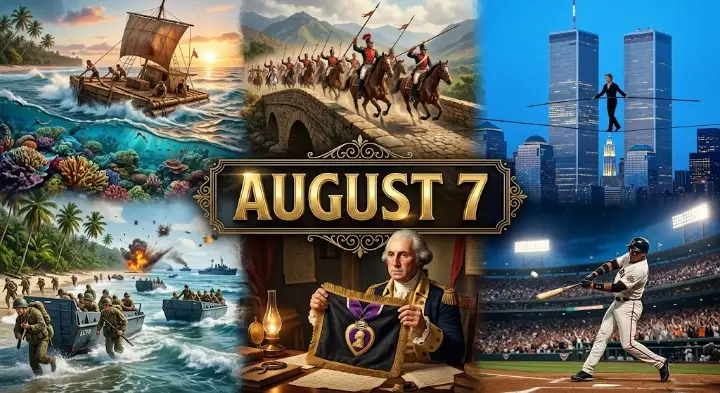
Thor Heyerdahl gripped the wooden frame of his balsa raft as massive Pacific breakers hurled the craft straight into the jagged coral reefs of Raroia. For 101 days, six men had drifted across open water to prove an ancient migration theory, and now their floating home was splintering beneath their feet. That wild 1947 crash landing highlights what happened on August 7 in history, a calendar date packed with battlefield turning points, silent protests, and bold leaps into the unknown.
Quick Facts — August 7 in History
| Category | Detail |
|---|---|
| Most Significant Event | Simón Bolívar defeats Spanish forces at the Battle of Boyacá (1819) |
| Top Key Events |
|
| Key Battles | Battle of Guinegate (1479), Battle of Gangut (1714), Battle of Boyacá (1819), Battle of Guadalcanal (1942) |
| Key Figures | Simón Bolívar, Frances Oldham Kelsey, Philippe Petit, Lynne Cox |
| Observances | Republic Day (Ivory Coast), National Purple Heart Day (United States), Battle of Boyacá Day (Colombia), Assyrian Martyrs Day |
Story of the Day: High Wire Over New York
French tightrope walker Philippe Petit stepped off the edge of the South Tower of the World Trade Center, 1,368 feet above the pavement, balancing on a quarter-inch steel cable. Without a safety net or harness, he spent 45 minutes walking, dancing, and even lying down on the wire while crowds gape from the street below. He had spent months secretly rigging the gear with a crew of friends, dodging security guards topull off the stunt. Police arrested him the moment he stepped back onto the roof, but his daring feat captured global headlines and forever changed how the public viewed the newly built Twin Towers.
Important Events That Happened On August 7 In History
461 – Roman Emperor Majorian Beheaded Flavius Julius Majorianus sat stripped of his imperial robes near the river Iria after his own general turned against him. General Ricimer arrested the ruler after a failed naval campaign and ordered his execution to retain practical power in Italy. The sudden murder severed one of the last genuine attempts to rebuild the western imperial army. Western Rome spiraled faster toward complete collapse over the next fifteen years.
610 – Sassanid Forces Capture Zenobia General Shahrbaraz led his Persian army through the dusty Syrian landscape to smash the fortified Byzantine town of Zenobia. The assault formed part of a brutal war that drained both empires to their absolute limits. Byzantine troops retreated west, leaving local border communities exposed to relentless cavalry raids. Within a few decades, both exhausted empires faced sweeping conquests by emerging Arab armies.
626 – Avars and Slavs Abandon Constantinople Avar chieftains watched their fleet burn in the Golden Horn before ordering a total retreat from the heavy stone walls of Constantinople. The imperial defenders had shattered the combined siege forces using Greek fire and relentless naval maneuvers. The sudden retreat saved the Byzantine capital from what seemed like total destruction. It shattered Avar dominance in the Balkans and secured the city for another eight centuries.
768 – Pope Stephen III Elected in Rome Stephen took the papal chair inside a chaotic Rome while rival factions fought violently for control of the church. Recognizing that Byzantine military help was never coming, he immediately dispatched messengers to king Pepin of the Franks. The new alliance traded papal legitimacy for heavy Frankish army protection against aggressive Lombard kings. It tied the future of Western Christianity directly to the rising Carolingian dynasty.
936 – Otto I Crowned King of Germany Otto sat upon the throne at Aachen Cathedral, receiving the holy holy sword and crown from German archbishops. The young king set out immediately to centralize his royal authority over rebellious regional dukes. His decisive military victories against invading Magyar armies soon solidified his control over central Europe. The grand ceremony set the groundwork for the establishment of the Holy Roman Empire.
1461 – Cao Qin Stages Beijing Coup General Cao Qin led his personal guard through the gates of Beijing in a desperate attempt to overthrow the Tianshun Emperor. Fearing imminent execution for corruption, the Ming commander set fire to the city gates during a night of heavy rain. Imperial loyalist troops quickly rallied, trapping the rebels inside the imperial city after hours of violent street fighting. Cao Qin killed himself inside his home before soldiers could take him alive.
1479 – Burgundians Win Battle of Guinegate Archduke Maximilian of Habsburg reined in his horse as Burgundian foot soldiers stood their ground against waves of charging French infantry. King Louis XI tried to annex the rich lands of Flanders, but the young archduke organized a fierce local defense. Thousands of soldiers fell on the muddy field before the French lines broke and retreated south. The victory kept the Low Countries under Habsburg control, altering European politics for centuries.
1679 – Le Griffon Sails Great Lakes Rene-Robert Cavelier, Sieur de La Salle, stood on the wooden deck as Le Griffon caught the wind and cleared the Niagara River. The 45-ton brigantine became the very first square-rigged sailing vessel to venture across the upper Great Lakes. French fur traders hoped the ship would revolutionize commerce across the North American interior. The vessel disappeared mysteriously on its return journey later that autumn, leaving behind an enduring maritime legend.
1714 – Russian Navy Wins at Gangut Tsar Peter the Great directed his small, maneuverable galley fleet through the shallow coastal waters off the Hangö Peninsula. Russian sailors boarded trapped Swedish warships in a brutal close-quarters struggle that lasted for hours. The bloody victory marked the first major naval triumph in the history of the Russian Empire. It ended Swedish dominance in the Baltic Sea and established Russia as a formidable maritime power.
1743 – Treaty of Åbo Ends War Swedish and Russian diplomats signed peace papers in the Finnish city of Åbo, ending two years of bitter regional warfare. Sweden surrendered a significant strip of land in southeastern Finland to secure the succession of Adolf Frederick to its throne. The territorial losses severely weakened Stockholm’s geopolitical influence along its eastern frontier. Russia pushed its border further west, tightening its strategic grip over Northern Europe.
1782 – Washington Creates Badge of Military Merit General George Washington sat in his Newburgh headquarters writing an order to recognize the courage of common soldiers. He created a purple cloth heart to be worn on the uniform breast of any soldier performing brave acts in battle. The award broke traditional European rules that reserved military honors exclusively for wealthy officers. The simple cloth patch evolved into the modern Purple Heart, honoring wounded and fallen American service members.
1786 – First Federal Indian Reservation Established United States officials finalized a boundary treaty with the Delaware nation, establishing the country’s first federal Indian reservation. Government agents set aside specific tracts of land in an effort to contain tribal movements and clear surrounding areas for white settlers. The treaty forced native leaders to accept reduced sovereignty over their ancestral territories. It created a legal pattern of displacement that defined American Indian policy for over a century.
1789 – Department of War Established President George Washington signed the congressional act creating the United States Department of War to manage the nation’s military forces. Henry Knox took charge as the first Secretary of War, facing the task of organizing a standing army with almost no money. The small department had to handle both naval affairs and border security for the fragile young republic. It functioned continuously until restructuring reshaped American defense agencies after World War II.
1791 – American Troops Destroy Kenapacomaqua Brigadier General James Wilkinson led hundreds of Kentucky volunteers into the Miami village of Kenapacomaqua near present-day Logansport, Indiana. Federal soldiers burned dozens of homes, destroyed surrounding cornfields, and captured native women and children. The destruction formed part of a scorched-earth campaign aimed at breaking tribal resistance during the Northwest Indian War. The attack forced many native families to flee deeper into the wilderness before winter set in.
1794 – Washington Invokes Militia Acts President George Washington issued a formal proclamation warning western Pennsylvania farmers to stop attacking federal tax collectors. Angry frontiersmen had burned down homes and ambushed officers to protest a heavy federal tax on homemade whiskey. The president assembled fifteen thousand militia troops to demonstrate that the new federal government would enforce its laws by force. It marked the first time the United States military marched against its own citizens.
1819 – Bolívar Triumphs at Boyacá Simón Bolívar watched from a hilltop as his ragtag army cut off the Spanish advance guard at a narrow bridge near Tunja. Patriot troops charged down the slopes, trapping the royalist forces between the river and steep mountain terrain. Over sixteen hundred Spanish soldiers surrendered after a short, desperate battle. The decisive victory liberated the city of Bogotá and secured the independence of New Granada.
1858 – First Australian Rules Football Match Students from Melbourne Grammar and Scotch College ran onto a muddy park field to play a brand-new style of football. Tom Wills helped organize the match to keep summer cricketers fit during the long, cold winter months. Forty players on each side chased a leather ball across an unmarked field that stretched for hundreds of yards. The chaotic match laid the foundation for modern Australian rules football.
1890 – Anna Månsdotter Executed in Sweden Anna Månsdotter walked to the scaffold inside Kristianstad Prison for her central role in the notorious Yngsjö murder. The condemned woman had murdered her daughter-in-law to cover up an incestuous relationship with her own son. Executioner Albert Gustaf Dahlman carried out the sentence using a heavy hand axe. She became the last woman executed in Sweden before the country abolished capital punishment.
1909 – First Transcontinental Women’s Auto Trip Alice Huyler Ramsey pulled her Maxwell touring car into San Francisco after fifty-nine brutal days driving across the United States. The 22-year-old driver and three female companions navigated unpaved dirt roads, changed dozens of flat tires, and crossed muddy rivers. Only 152 miles of their 3,800-mile journey consisted of paved surfaces. Their successful arrival proved that automobiles were reliable enough for everyday travelers.
1926 – First British Grand Prix Held Drivers revved their engines on the banked concrete track at Brooklands for the inaugural British Grand Prix. Robert Sénéchal and Louis Wagner shared driving duties in a Delage to win the grueling 110-lap endurance race. Smoke and heat scorched the drivers’ feet through the floorboards, forcing constant pit stops for water and shoe changes. The event established Great Britain as a premier destination for international motorsport racing.
1927 – Peace Bridge Opens to Traffic Official delegations from Canada and the United States gathered over the Niagara River to dedicate the massive steel Peace Bridge. Thousands of spectators cheered as government leaders shook hands to celebrate over a century of peaceful relations along the border. The bridge connected Buffalo, New York, directly to Fort Erie, Ontario, boosting regional trade immediately. It remains one of the busiest commercial border crossings in North America.
1930 – Shipp and Smith Lynched in Marion An angry mob of thousands battered down the doors of the Grant County Jail in Marion, Indiana. White rioters dragged Thomas Shipp and Abram Smith from their cells, beat them, and hanged them from a tree in the town square. Local authorities stood by and failed to protect the young Black men or arrest the ringleaders. The horrifying photograph of the spectacle inspired Abel Meeropol to write the famous anti-lynching song Strange Fruit.
1933 – Simele Massacre of Assyrians Iraqi army troops under General Bakr Sidqi pulled up to the northern village of Simele and opened fire on unarmed civilians. Royal forces slaughtered over three thousand Assyrian men, women, and children during a systematic campaign against the religious minority. The government celebrated the massacre with military parades through the streets of Baghdad. Assyrian communities worldwide still honor the date as a solemn day of national mourning.
1942 – Marines Land on Guadalcanal Eighteen thousand United States Marines waded ashore through tropical surf onto Guadalcanal and Tulagi in the Solomon Islands. The landings marked the first major Allied amphibious offensive against Imperial Japanese forces in the Pacific Theater. Surprised Japanese defenders retreated into the dense jungle, leaving an unfinished airfield for the Marines to capture. The brutal six-month campaign turned into a desperate battle for control of the Pacific.
1944 – Harvard Mark I Calculator Dedicated Engineers at Harvard University unveiled a 51-foot-long mechanical calculator designed by Howard Aiken and funded by IBM. The steel monster contained over 750,000 individual parts connected by five hundred miles of electrical wire. It calculated complex mathematical tables for the United States Navy using paper tape instructions. The machine became a foundational stepping stone in the development of modern electronic computers.
1946 – Soviet Union Initiates Straits Crisis Soviet diplomats delivered a stiff formal note to the Turkish foreign ministry demanding joint control over the strategic Dardanelles shipping lanes. Moscow wanted to construct military bases along the Turkish Straits to guarantee Russian warship access to the Mediterranean. Ankara rejected the demands immediately, leading to a dangerous military standoff along the border. The confrontation pushed the United States to commit troops and aid to defend Turkey during the early Cold War.
1947 – Kon-Tiki Crashes into Raroia Reef: Thor Heyerdahl held tight to his balsa wood raft as massive waves slammed the vessel onto the outer reef at Raroia. The Norwegian explorer and his five-man crew had spent 101 days drifting thousands of miles across the Pacific Ocean from Peru. They built the primitive raft using ancient techniques to prove South Americans could have settled Polynesia. All six crew members survived the wreck, carrying priceless scientific data ashore.
1947 – BEST Taken Over by Bombay Municipality City officials in Bombay formally signed administrative documents transferring ownership of the local transport system to the municipal government. The takeover unified electric tramways and public bus networks under a single public utility named BEST. City leaders aimed to modernise transit infrastructure to serve millions of commuters in newly independent India. The red buses grew into an iconic fixture of Mumbai’s urban landscape.
1959 – Explorer 6 Launches into Orbit: A Thor-Able rocket blasted off from Cape Canaveral, carrying the spherical Explorer 6 satellite into a high elliptical orbit. The paddle-wheel satellite contained complex instruments designed to scan the Earth’s radiation belts and radio transmissions. It successfully beamed back the first primitive television photograph of the planet from space days later. The mission provided scientists with vital data about the magnetosphere.
1960 – Ivory Coast Gains Independence: Félix Houphouët-Boigny stood before crowds in Abidjan to declare the Ivory Coast a fully sovereign nation, free from French colonial rule. Decades of nationalist organizing forced Paris to hand over executive power to local African leaders. The new president focused on agricultural exports and political stability to build the young West African nation. The date became the country’s national holiday, celebrated across the country every year.
1962 – Frances Kelsey Receives Distinguished Federal Award: President John F. Kennedy handed the Federal Civilian Service medal to Dr. Frances Oldham Kelsey during a ceremony at the White House. The brave Food and Drug Administration reviewer had withstood intense pressure from pharmaceutical executives to block thalidomide in the United States. Her stubborn demand for safety proof prevented thousands of severe birth defects across the nation. Her actions led directly to much tougher drug safety laws.
1964 – Congress Passes Gulf of Tonkin Resolution Lawmakers inside the United States Capitol voted overwhelmingly to grant President Lyndon B. Johnson broad military authority in Southeast Asia. The resolution followed reported torpedo attacks by North Vietnamese patrol boats against American destroyers in international waters. The vote gave the executive branch a open-ended green light to deploy military forces without a formal declaration of war. It dragged America deep into the Vietnam War.
1969 – Luis R. Bruce Appointed BIA Commissioner President Richard Nixon appointed Luis R. Bruce, a Mohawk-Oglala Sioux executive, to head the Bureau of Indian Affairs. Bruce had helped found the National Congress of American Indians to fight for indigenous land rights and tribal self-determination. He worked from inside the federal government to redirect federal funds directly to tribal leaders. His tenure marked a shift away from destructive federal termination policies.
1970 – Judge Harold Haley Killed in Courtroom Seventeen-year-old Jonathan Jackson walked into a Marin County courtroom with a bag full of firearms to free three Black prisoners. The armed group took Superior Court Judge Harold Haley and four others hostage at gunpoint, forcing them into a getaway van. Police officers opened fire on the vehicle as it attempted to exit the courthouse parking lot. The shooting left Judge Haley, Jackson, and two inmates dead in the driveway.
1976 – Viking 2 Enters Mars Orbit Mission controllers at NASA cheered as the Viking 2 spacecraft successfully fired its retrorockets and entered orbit around Mars. The uncrewed probe spent weeks photographing the dusty red surface to find a safe landing spot for its lander. It gathered thousands of high-resolution images that revealed massive volcanoes and ancient dry riverbeds. The lander touched down safely on Utopia Planitia a month later.
1978 – Carter Declares Love Canal Emergency President Jimmy Carter signed an emergency order allocating federal disaster funds to relocate hundreds of families living near Love Canal. Chemical companies had buried twenty-two thousand tons of toxic industrial waste beneath the Niagara Falls neighborhood decades earlier. Chemical sludge seeped into basements and school grounds, causing high rates of birth defects and illnesses. The environmental disaster prompted Congress to create the federal Superfund program.
1981 – Washington Star Closes After 128 Years Reporters and editors packed up their desks as the final edition of The Washington Star rolled off the printing presses. The afternoon newspaper had covered American politics and local capital news since its founding in 1852. Rising printing costs and stiff competition from morning rivals forced Time Inc. to shut down the historic publication. The closure left Washington D.C. as a single-newspaper city dominated by The Washington Post.
1985 – Japan Selects First Three Astronauts Space agency officials in Tokyo held a national press conference to introduce Takao Doi, Mamoru Mohri, and Chiaki Mukai to the public. The three scientists beat out thousands of applicants to become the first Japanese citizens chosen to fly aboard the American Space Shuttle. Their selection launched Japan’s human spaceflight program into an active era of international collaboration. Mukai later became the first Japanese woman to travel into space.
1987 – Lynne Cox Swims the Bering Strait American long-distance swimmer Lynne Cox dove into 38-degree water to swim from Little Diomede Island to Big Diomede Island. She braved freezing temperatures and heavy fog to cover the two-mile stretch separating the United States from the Soviet Union. Her swim crossed the Cold War’s political border, drawing praise from leaders in both Washington and Moscow. The daring athletic feat opened a brief window of peace between the two superpowers.
1989 – Mickey Leland Dies in Ethiopian Plane Crash Search crews discovered the burned wreckage of a Twin Otter aircraft carrying Texas Congressman Mickey Leland on a remote Ethiopian mountainside. The passionate anti-hunger activist was traveling to a isolated refugee camp to inspect international relief operations. All sixteen people aboard the flight died when the plane flew into heavy fog and crashed into terrain. His death shocked Congress, leading to expanded federal humanitarian programs.
1989 – National Cold Fusion Institute Opens Scientists gathered in Salt Lake City to celebrate the official opening of the National Cold Fusion Institute, backed by state funding. The facility aimed to commercialize clean nuclear energy based on controversial experiments reported earlier that year. The research collapsed quickly as laboratories around the world failed to replicate the initial energy output claims. The institute closed its doors two years later after burning through millions of dollars.
1990 – First American Troops Deploy to Saudi Arabia C-141 transport planes carrying thousands of American paratroopers landed on dusty runways in Saudi Arabia. President George H.W. Bush ordered the massive deployment to protect Saudi oil fields following Iraq’s invasion of neighboring Kuwait. The arrival of military forces marked the start of Operation Desert Shield, building up a coalition force along the Iraqi border. It set the stage for the outbreak of the Gulf War months later.
1993 – Ada Deer Takes Charge of BIA Menominee activist Ada Deer stood with her family as she was sworn in as head of the Bureau of Indian Affairs. She became the first Native American woman to lead the federal agency responsible for managing tribal relations. Deer had spent decades leading successful legal battles to restore federal recognition to her own tribe after previous termination policies. She used her position to strengthen sovereign self-governance across native nations.
1995 – Chile Declares Emergency in White Earthquake Chilean government leaders declared a state of emergency across the southern provinces as historic cold fronts paralyzed the region. Relentless blizzards and extreme sub-zero temperatures killed thousands of livestock and isolated remote mountain towns. Powerful winds tore roofs off homes while heavy snowfall blocked major roads and supply routes for weeks. The disaster forced the military to drop emergency food and fuel supplies from aircraft.
1997 – Space Shuttle Discovery Launches STS-85 Space Shuttle Discovery thundered off Launch Pad 39A at Kennedy Space Center, carrying a heavy payload of international scientific instruments. The crew spent twelve days in orbit deploying and retrieving a free-flying satellite designed to study Earth’s upper atmosphere. The mission gathered vital data on ozone depletion and solar radiation levels. It marked another successful flight in NASA’s long-running shuttle program.
1997 – Fine Air Flight 101 Crashes in Miami A Douglas DC-8 cargo plane stalled seconds after takeoff from Miami International Airport and slammed into a busy road. The heavy aircraft pancaked into auto parts warehouses, killing four crew members and one person on the ground. Investigators found that cargo loaders had misbalanced the freight, shifting the center of gravity dangerously backward during takeoff. The tragedy forced strict new oversight for commercial air cargo operations.
1998 – U.S. Embassies Bombed in East Africa Truck bombs detonated almost simultaneously outside the United States embassies in Nairobi, Kenya, and Dar es Salaam, Tanzania. Powerful explosions reduced buildings to rubble, killing 212 people and injuring thousands of innocent bystanders. Terrorists linked to al-Qaeda carried out the coordinated attacks, targeting American diplomatic posts in Africa. The tragedy placed the militant group at the top of international intelligence priority lists.
1999 – Islamic Brigade Invades Dagestan Hundreds of heavily armed Chechen-based militants crossed the mountain border to invade the Russian republic of Dagestan. Commander Shamil Basayev led the insurgent force in an effort to create an independent Islamic state across the North Caucasus. Russian military units responded with heavy artillery bombardments and airstrikes to push the rebels back. The border invasion sparked the brutal Second Chechen War.
2007 – Barry Bonds Breaks Home Run Record Barry Bonds launched a 435-foot shot into the right-field bleachers at AT&T Park for his 756th career home run. The San Francisco Giants slugger passed Hank Aaron’s legendary 33-year-old mark to become major league baseball’s all-time home run king. Fireworks exploded over San Francisco Bay as fans cheered his historic hit. The achievement remained controversial due to ongoing investigations into performance-enhancing drugs.
2008 – Russo-Georgian War Breaks Out Georgian artillery units began shelling the separatist capital of Tskhinvali following days of skirmishes along the border of South Ossetia. Russian armored columns rolled through the Roki Tunnel hours later, launching a full-scale military intervention against Georgian forces. Russian jets bombed military targets while troops pushed deep into undisputed territory. The five-day war reshaped security relations across Eastern Europe.
2020 – Air India Express Flight 1344 Crashes A Boeing 737 carrying 190 passengers skidded off a rain-slicked runway at Calicut International Airport in Kerala, India. The aircraft dropped thirty feet down a steep gorge at the end of the tabletop runway and split into pieces on impact. Twenty-one people, including both pilots, lost their lives in the heavy rain crash. The disaster led to major safety overhauls at Indian airports with high-tabletop runways.
Visit our archive to read about yesterday’s major turning points.
Observances on August 7
National Purple Heart Day (United States) Americans honor military service members wounded or killed while serving in the armed forces.
Republic Day (Ivory Coast) Citizens across the West African nation celebrate their 1960 independence from French colonial rule with parades and cultural festivals.
Battle of Boyacá Day (Colombia) Colombians mark the decisive 1819 victory over Spanish forces that secured national independence.
Assyrian Martyrs Day Assyrian communities worldwide gather to remember the victims of the 1933 Simele massacre and other historical persecutions.
Youth Day (Kiribati) The Pacific island nation hosts sports events and community programs focusing on empowering young citizens.
Emancipation Day (Saint Kitts and Nevis) Islanders commemorate the abolition of slavery across the former British Empire with street parades and traditional music.
🌊 Frequently Asked Questions — August 7 in History
Thor Heyerdahl’s balsa wood raft, the Kon-Tiki, crashed into the reef at Raroia after a 101-day journey across the Pacific Ocean. The crew survived and proved ancient South Americans could have navigated to Polynesia. On the same day, the Bombay Municipal Corporation took over the local electric and bus transport system.
United States Marines landed on Guadalcanal on August 7, 1942, starting the first major American offensive in the Pacific War. Simón Bolívar also defeated Spanish forces at the Battle of Boyacá in 1819, securing independence for Colombia. Decades later in 1964, the U.S. Congress passed the Gulf of Tonkin Resolution, escalating American involvement in Vietnam.
Hungarian Countess Elizabeth Báthory was born on August 7, 1560, and later became infamous as history’s most prolific female serial killer. Mughal Emperor Muhammad Shah of India was also born on this day in 1702. More historical births for this date are listed in our database above.
Simón Bolívar’s victory at the Battle of Boyacá in 1819 stands out as the day’s most consequential event because it shattered Spanish royalist power in South America. The battle freed New Granada and paved the way for the creation of Gran Colombia. It inspired liberation movements across the entire continent.
National Purple Heart Day honors American service members who were wounded or killed in combat. The observance commemorates August 7, 1782, when George Washington created the Badge of Military Merit. The simple purple cloth patch was the predecessor to the modern medal awarded to troops today.
Air India Express Flight 1344 overshot a wet tabletop runway at Calicut International Airport in 2020, resulting in twenty-one fatalities. In 2008, the Russo-Georgian War erupted over South Ossetia after days of border shellings. Back in 2007, Barry Bonds hit his 756th home run to break Hank Aaron’s career record.