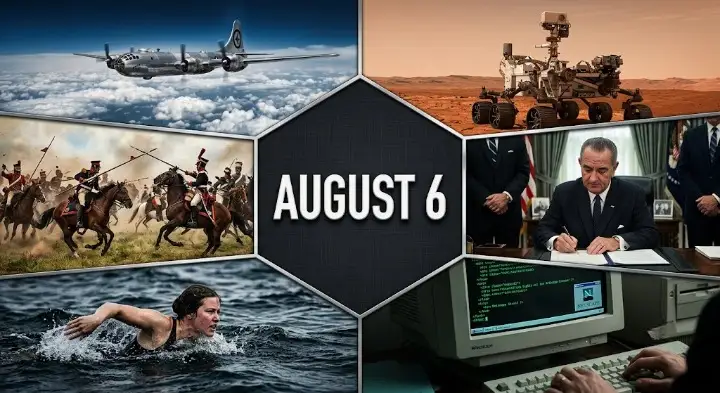
At 8:15 AM over Hiroshima, Colonel Paul Tibbets peered through the cockpit glass of the Enola Gay as a blinding white flash swallowed the horizon. In a single terrifying instant, atomic power reshaped modern warfare forever. That devastating morning is just one chapter of this day in history August 6. From ancient Mediterranean battles to revolutionary digital code, this date marks a turning point across centuries.
Quick Facts — August 6 in History
| Category | Detail |
|---|---|
| Most Significant Event | Atomic bomb dropped on Hiroshima (1945) |
| Top Key Events |
|
| Key Battles | Battle of Khazir (686), Battle of Meloria (1284), Battle of Oriskany (1777), Battle of Junín (1824), Battle of Spicheren (1870), Battle of Wörth (1870), Battle of Sari Bair (1915), Battle of Mărășești (1917) |
| Key Figures | Fakhr-al-Din II, Bafétimbi Gomis, Gertrude Ederle, Tim Berners-Lee |
| Observances | Hiroshima Peace Memorial Day, Independence Day (Bolivia), Independence Day (Jamaica), Sheikh Zayed Accession Day (UAE) |
Story of the Day: The World Wide Web Goes Live
On August 6, 1991, British computer scientist Tim Berners-Lee posted a modest summary of his project to an online newsgroup from a lab in Switzerland. He called it the World Wide Web, envisioning a connected space where documents could be linked across network servers globally. Few noticed the small announcement that day, yet it opened the doors of the internet to the public for the very first time. His simple hyperlinked interface transformed global communications, commerce, and culture, instantly setting the foundation for the modern digital age.
Important Events That Happened On August 6 In History
258 – Arrest and Execution of Pope Sixtus II
Roman soldiers burst into the catacombs of Callixtus as Pope Sixtus II sat conducting mass for his underground congregation. Emperor Valerian’s decree outlawing Christian gatherings had made the bishop a prime target for public execution. The Roman guards dragged him outside alongside several deacons and severed his head on the spot. His immediate death shocked the early church and turned him into an early symbol of religious resistance.
686 – Umayyad Forces Defeated at the Battle of Khazir
Ibrahim ibn al-Ashtar led his pro-Alid troops across the muddy banks of the Khazir River to face the Umayyad army. Seeking vengeance for the death of Husayn ibn Ali, the rebels slammed into the enemy lines with relentless force. The Umayyad commander fell in the chaotic melee, triggering a total collapse of his panicked ranks. This crushing defeat crippled Umayyad control over Iraq and shifted power toward the Alid loyalists.
768 – Antipope Constantine II Deposed and Blinded
Lombard troops led by the primicerius Christopher charged into Rome to drag Antipope Constantine II from his papal seat. Having seized the papacy through violent family backing, Constantine had no legitimate clerical authority to protect himself. The victorious faction stripped him of his robes, declared his term null, and brutally gouged out his eyes. His bloody downfall restored traditional church leadership and ended a chaotic year of rival papal claims.
1284 – Defeat of Pisa at the Battle of Meloria
Genoese warships ambushed the Pisan fleet near the rocky islet of Meloria off the coast of Tuscany. The Genoese feigned a retreat, drawing the Pisan galleys into a trap where hidden reserve ships slammed into their flanks. Thousands of Pisans were captured or drowned as their flagship sank into the Mediterranean depths. This total defeat broke the naval power of the Republic of Pisa forever, giving Genoa absolute dominance over regional trade.
1538 – Foundation of Bogotá, Colombia
Gonzalo Jiménez de Quesada planted a wooden cross in the High Andes, declaring a new settlement named Santafé de Bogotá. His weary conquistadors had marched for months through dense jungles and high mountain passes to reach the Muisca territory. They built twelve small thatched huts to honor the Apostles, claiming the vast fertile plateau for the Spanish Crown. That humble mountain camp rapidly expanded to become the sprawling capital city of modern Colombia.
1585 – Toyotomi Hideyoshi Appointed Kampaku
Toyotomi Hideyoshi knelt before the Imperial Court in Kyoto to officially receive the title of Kampaku, or Imperial Regent. Rising from humble peasant roots, his political savvy and military dominance had forced the nobility to grant him supreme civilian power. This appointment gave his warlord reign total political legitimacy across a fractured Japan. It marked a massive step toward unifying the warring provinces under a centralized military authority.
1661 – Treaty of The Hague Signed
Diplomats from Portugal and the Dutch Republic met in The Hague to seal a major territorial peace agreement. Years of bloody naval clashes in South America and Asia had left both colonial empires exhausted and eager to settle terms. Portugal agreed to pay a massive sum in money and sugar in exchange for sole control over Brazil. The signed treaty permanently reshaped global trade maps, ending Dutch territorial claims in South America.
1777 – Battle of Oriskany
General Nicholas Herkimer led a column of eight hundred American militia straight into a narrow, wooded ravine near Fort Stanwix. Loyalist troops and Native American allies ambushed the American forces, sparking a brutal hand-to-hand fight during a sudden thunderstorm. Herkimer sat propped against a tree with a shattered leg, continuing to direct fire until the attackers pulled back. The bloody ambush prevented American reinforcements from reaching the fort, making it one of the war’s deadliest days.
1787 – US Constitution Proof Sheets Delivered
Delegates at the Philadelphia State House took their seats as sixty printed proof sheets of the draft Constitution were handed out. George Washington watched over the room as the framers prepared to scrutinize every clause of the proposed federal government. The document synthesized weeks of fiery debates into a concrete blueprint for American law and power. Receiving these physical pages pushed the Constitutional Convention into its final, crucial phase of debate.
1806 – Dissolution of the Holy Roman Empire
Francis II formally abdicated his imperial crown in Vienna, declaring the ancient Holy Roman Empire officially dissolved. Napoleon’s crushing victories across Europe had shattered the empire’s remaining political alliances and military strength. Francis wisely kept his grip on power by recasting himself as the emperor of the newly formed Austrian Empire. This historic decree ended a thousand-year-old European institution that had stood since the days of Charlemagne.
1819 – Founding of Norwich University
Captain Alden Partridge opened the American Literary, Scientific, and Military Academy in the quiet town of Norwich, Vermont. Disillusioned with West Point, he designed an unheard-of curriculum combining strict military discipline with practical civil engineering. Cadets marched in uniform while mastering mathematics, agriculture, and tactics on a rigorous daily schedule. His bold experiment succeeded, creating the first private military college in the United States.
1824 – Battle of Junín
Simón Bolívar rode at the front of his patriot cavalry across the high, wind-swept plains of the Peruvian Andes. Spotting the Spanish royalist horsemen, his troops charged into battle without firing a single gunshot, relying entirely on lances and sabers. The silent, desperate cavalry clash lasted less than an hour before the royalist lines broke in terror. This decisive victory cleared the Peruvian highlands and brought South American independence within reach.
1825 – Bolivian Declaration of Independence
Congress delegates assembled in Sucre to sign the official Bolivian Declaration of Independence from Spanish rule. After sixteen grueling years of warfare, local leaders chose to name their newly liberated republic after their liberator, Simón Bolívar. The document proclaimed total sovereignty and ended centuries of oppressive colonial governance over the Andes region. Bolivians celebrated as the nation officially declared its place as an independent South American state.
1861 – British Cession of Lagos
British naval officers confronted Oba Dosunmu of Lagos, forcing him to sign the Lagos Treaty of Cession under gunboat threat. The British government wanted control of the West African port to forcefully shut down the local transatlantic slave trade. Dosunmu surrendered his territory in exchange for a yearly pension and British military protection. The agreement placed a major foothold in modern Nigeria, expanding British colonial dominance in West Africa.
1862 – Scuttling of the CSS Arkansas
Captain Henry Stevens stood on the deck of the ironclad CSS Arkansas as her mechanical engines ground to a final, dead stop. Union gunboats were closing in near Baton Rouge, and the Confederate crew had no power to maneuver or fight back. Refusing to let the prized warship fall into enemy hands, the sailors set her ablaze and cast her adrift. The ironclad drifted down the Mississippi River before her gunpowder magazine detonated in a massive fireball.
1870 – Battle of Spicheren
Prussian troops charged uphill under heavy French rifle fire to assault the steep Heights of Spicheren. General Karl von Steinmetz repeatedly hurled infantry regiments at the entrenched French positions despite taking heavy casualties. The relentless German pressure eventually forced the French army to abandon their strategic ridge and retreat westward. This bloody victory gave the German confederation momentum during the opening weeks of the Franco-Prussian War.
1870 – Battle of Wörth
Crown Prince Frederick William directed third German army units as they launched a massive assault against French positions near Wörth. French cuirassiers mounted desperate cavalry charges to save their infantry, but German artillery shredded their advancing lines. The French defensive flank shattered after hours of brutal artillery bombardments and close-quarter infantry fights. This decisive German victory forced the French army into a chaotic retreat, opening the road to Paris.
1890 – First Execution by Electric Chair
William Kemmler walked into the execution chamber at Auburn Prison, becoming the first person subjected to the electric chair. Guards strapped the convicted murderer into the heavy wooden seat, attaching copper electrodes to his head and back. The warden flipped the main switch, sending an experimental jolt of alternating current through Kemmler’s body. The flawed, horrific procedure took two attempts to kill him, sparking immediate global debate over capital punishment.
1901 – Opening of Kiowa Land in Oklahoma
Thousands of eager white settlers stood at the boundary line, waiting for their names to be drawn in a land lottery. The United States government had forcibly broken up the contiguous Kiowa, Comanche, and Apache reservation into individual plots. Clamouring homesteaders rushed forward to claim the newly opened plots of fertile Oklahoma soil. This massive land distribution effectively dissolved the sovereign tribal territory, changing native lands forever.
1914 – German U-Boats Launch First North Sea Patrol
Ten German U-boats slipped out of their naval base at Heligoland, cutting through the gray swells of the North Sea. Just two days after Britain entered World War I, Germany launched this fleet to hunt down Royal Navy warships. Submarine warfare was entirely unproven, and the crews navigated blind into hostile, heavily patrolled waters. This initial operational sweep marked the quiet start of Germany’s deadly campaign of unrestricted submarine warfare.
1914 – Declarations of War Expand World War I
Government ministers in Belgrade and Vienna issued formal declarations that expanded the emerging European conflict. Serbia officially declared war on Germany, while Austria-Hungary simultaneously declared war on the Russian Empire. The complex web of military alliances detonated, pulling millions of soldiers into a rapidly spreading continental conflict. These simultaneous filings ended all diplomatic options, committing Europe’s superpowers to total industrial war.
1915 – Battle of Sari Bair
Allied infantry surged out of their trenches at Gallipoli, launching a night attack toward the high ridges of Sari Bair. ANZAC and British troops scrambled up steep, ravine-pitted terrain while facing heavy Ottoman machine-gun fire. The offensive was designed to coincide with a fresh landing at Suvla Bay to break the bloody peninsula stalemate. Desperate Ottoman counterattacks held the heights, turning the ambitious Allied offensive into a costly, bloody failure.
1917 – Battle of Mărășești Begins
German divisions hurled themselves against Romanian positions along the Siret River, opening the Battle of Mărășești. Field Marshal von Mackensen sought to shatter the Romanian army and secure vital territory for the Central Powers. Romanian soldiers dug into the mud, defending their positions with ferocious bayonet charges and artillery fire. This brutal opening assault sparked a weeks-long struggle that stopped the German advance dead in its tracks.
1926 – Gertrude Ederle Swims the English Channel
Nineteen-year-old Gertrude Ederle dove into the icy surf at Cape Gris-Nez, France, greased in lard to fight the cold. Navigating treacherous waves, shifting tides, and thick fog, she swam relentlessly toward the distant cliffs of Dover. She waded ashore fourteen hours and thirty-nine minutes later, smashing the existing men’s speed record by nearly two hours. She became the first woman to swim the English Channel, proving female athletic endurance to the world.
1926 – First Public Vitaphone Screening
Audience members settled into Warner Theatre in New York for the premiere of the romantic drama Don Juan. While the film was silent, it featured a synchronized soundtrack played through large, experimental Vitaphone wax discs. Viewers gasped as orchestral music and sound effects matched the dramatic action on the screen perfectly. This landmark public screening revolutionized the film industry, signaling the end of the silent movie era.
1940 – Soviet Annexation of Estonia
Soviet diplomats in Moscow formally signed paperwork absorbing the Republic of Estonia into the USSR as a constituent republic. Under pressure from occupying Red Army troops, a puppet parliament had been forced to vote for Soviet integration. The decree stripped the Baltic nation of its independence, sparking decades of political suppression and forced deportations. This administrative takeover sealed the fate of the Baltic states during World War II.
1942 – Queen Wilhelmina Addresses US Congress
Queen Wilhelmina of the Netherlands stepped up to the podium, addressing a joint session of the United States Congress. Living in exile after Nazi Germany invaded her nation, she spoke with firm resolve about liberty and resistance. She was the first reigning queen in history to deliver a formal speech to American lawmakers. Her powerful address rallied international support for the Allied cause and highlighted the plight of occupied Europe.
1945 – Atomic Bomb Dropped on Hiroshima
The American B-29 bomber Enola Gay opened its bomb bay doors high above the Japanese city of Hiroshima. A single atomic bomb named Little Boy fell through the morning sky, detonating with a blinding flash over the city center. The blast and thermal wave instantly vaporized seventy thousand people, flattening miles of homes in seconds. This devastating atomic attack altered human warfare forever, hastening the final end of World War II.
1956 – DuMont Television Network Final Broadcast
Technicians at the St. Nicholas Arena in New York pulled the cameras back for the final broadcast of the DuMont Television Network. Once a pioneering third network alongside CBS and NBC, DuMont had succumbed to intense financial losses and station distribution wars. Its final broadcast aired a simple boxing match before the screens went permanently black for good. This quiet sign-off ended an early chapter of American commercial television history.
1958 – Chile Repeals the Law of Defense of Democracy
Lawmakers in the Chilean Congress voted to repeal the controversial Law of Permanent Defense of Democracy. Passed ten years prior, the harsh statute had outlawed the Communist Party and purged thousands of citizens from voter rolls. Repealing the law restored political rights to over twenty-six thousand people and reopened democratic participation. This historic vote reunited the nation’s political landscape ahead of upcoming presidential elections.
1960 – Cuba Nationalizes American Property
Fidel Castro stood before a cheering crowd in Havana, announcing the total nationalization of all US-owned property in Cuba. The decree targeted oil refineries, sugar mills, power companies, and foreign banks operating across the island nation. Castro framed the massive land and asset seizures as a necessary retaliation against American economic trade sanctions. This bold economic move shattered relations between Washington and Havana, deepening the Cold War split.
1962 – Jamaica Gains Independence
The British Union Jack was lowered at National Stadium in Kingston as the green, gold, and black Jamaican flag rose up. After three centuries of British colonial rule, Jamaica officially declared its independence as a sovereign nation. Prime Minister Alexander Bustamante took the oath of office before crowds celebrating in the streets. This historic moment marked the birth of a new nation and sparked widespread decolonization across the Caribbean.
1965 – Voting Rights Act Signed Into Law
President Lyndon B. Johnson sat at a mahogany table in the Capitol, signing the Voting Rights Act of 1965 into law. Martin Luther King Jr. and other civil rights leaders stood directly behind him as he put pen to paper. The landmark legislation outlawed discriminatory literacy tests and poll taxes that had disenfranchised Black voters for generations. This law transformed American democracy, opening voting booths to millions across the South.
1986 – Record Rainfall Floods Sydney
A violent low-pressure system off the coast of New South Wales dumped thirteen inches of rain on Sydney in twenty-four hours. Torrents of floodwater surged through suburban streets, washing away cars, destroying homes, and paralyzing transport networks. Emergency crews worked continuously as rising river waters trapped thousands of residents inside their flooded homes. The catastrophic storm set an all-time rainfall record, causing millions of dollars in structural damage.
1990 – UN Embargo Issued Against Iraq
Members of the United Nations Security Council gathered in New York to pass Resolution 661, imposing a global embargo on Iraq. The mandatory trade sanctions were designed to punish Saddam Hussein for his military invasion of neighboring Kuwait. The economic blockade halted all Iraqi oil exports and restricted international trade shipments entering the country. This unanimous vote marked a major step toward international coalition action in the Gulf War.
1991 – World Wide Web Made Public
Tim Berners-Lee uploaded code and files explaining his World Wide Web concept to an online alt.hypertext newsgroup. Working out of his CERN laboratory, he offered his revolutionary software to the public for free. His simple system allowed users to browse and link text pages across the internet for the very first time. This quiet release launched the public internet, laying the foundation for modern global digital life.
1991 – Takako Doi Made Speaker of the House
Takako Doi took her seat as Speaker of the House of Representatives in Japan’s National Diet. As the leader of the Social Democratic Party, she broke centuries of political tradition in the male-dominated parliament. Her election made her the first female speaker in the history of Japan’s legislative government. Her appointment inspired a major shift, opening doors for women across Japanese public leadership.
1996 – NASA Announces Possible Martian Life
Scientists at NASA headquarters held a live press conference to unveil findings from the ALH 84001 meteorite. Found in Antarctica, the ancient rock was confirmed to have originated from the surface of Mars billions of years ago. High-resolution electron microscopes revealed microscopic structures that resembled fossilized primitive bacterial life forms. The shocking announcement sparked global excitement, fueling new debate over the existence of extraterrestrial life.
1997 – Crash of Korean Air Flight 801
Korean Air Flight 801 descended through heavy rain and thick fog toward Antonio B. Won Pat International Airport in Guam. Navigational confusion caused the Boeing 747 to heavy-impact a grassy ridge on Nimitz Hill, miles short of the runway. The force of the impact destroyed the aircraft, taking the lives of two hundred twenty-nine passengers and crew members onboard. Emergency responders rescued twenty-five survivors from the burning wreckage against all odds.
2001 – Erwadi Fire Tragedy
A sudden fire swept through a faith-based mental health institution in the town of Erwadi, Tamil Nadu. Twenty-eight patients were trapped inside the burning structure because they were kept tied to heavy iron chains. Volunteer rescuers rushed to break the locks, but the rapid blaze overwhelmed the building in minutes. This horrific tragedy shocked India, forcing sweeping government reforms regarding mental health treatment and facility safety.
2008 – Military Coup in Mauritania
General Mohamed Ould Abdel Aziz deployed troops and military vehicles across the streets of Nouakchott to seize key government buildings. Soldiers arrested President Sidi Ould Cheikh Abdallahi, effectively overthrowing the nation’s first democratically elected government. Aziz announced the creation of a military junta to run the country, dissolving constitutional rule. This sudden coup drew swift international condemnation and suspended foreign aid to the nation.
2010 – Flash Floods Devastate Jammu and Kashmir
A series of sudden cloudbursts dropped torrential rain across the mountainous region of Jammu and Kashmir, India. Raging flash floods and mudslides ripped through seventy-one towns, crushing houses, roads, and power lines in their path. Emergency rescue teams dug through piles of mud and boulders, searching for hundreds of missing residents. The catastrophic disaster took at least two hundred fifty-five lives and left thousands homeless overnight.
2011 – US Helicopter Shot Down in Afghanistan
Taliban fighters fired a rocket-propelled grenade at a US military CH-47 Chinook helicopter over Wardak province, Afghanistan. The explosion brought down the aircraft, killing thirty American military personnel, an Afghan civilian, seven Afghan soldiers, and a military working dog. The crash dealt a devastating loss to the US special operations community during the war. It stood as the deadliest single event for American forces throughout the conflict.
2012 – Curiosity Rover Lands on Mars
Engineers at NASA’s Jet Propulsion Laboratory burst into cheers as the Curiosity rover signaled its safe landing on Mars. The complex sky-crane maneuver lowered the two-ton vehicle directly onto the floor of Gale Crater without a hitch. Curiosity immediately beamed back crisp black-and-white images of its wheels resting on the red dust. This engineering triumph launched a groundbreaking mission to study Martian geology and potential habitability.
2015 – Mosque Bombing in Abha
A suicide bomber detonated an explosive vest inside a security forces mosque in the Saudi city of Abha. The blast struck during afternoon prayers, killing at least fifteen people and injuring dozens of worshipping guards. Emergency vehicles rushed to the scene as local authorities sealed off the surrounding district to investigate. An ISIS-affiliated group claimed responsibility, marking a deadly escalation of terror attacks inside the kingdom.
Look back at yesterday’s significant moments right here.
Famous People Born on August 6
| Name | Description | Date |
|---|---|---|
| Emperor Go-Toba | Emperor of Japan | 1180 – 1239 |
| Matthew Parker | Archbishop of Canterbury and English religious leader | 1504 – 1575 |
| Fakhr-al-Din II | Druze emir and Lebanese ruler | 1572 – 1635 |
| Johann Bernoulli | Swiss mathematician | 1667 – 1748 |
| Charles VII | Holy Roman Emperor | 1697 – 1745 |
| Daniel O’Connell | Irish political leader and Catholic emancipation campaigner | 1775 – 1847 |
| William Hyde Wollaston | English chemist and physicist | 1766 – 1828 |
| Alfred, Lord Tennyson | English Poet Laureate | 1809 – 1892 |
| Susie King Taylor | American educator, writer, and first Black Army nurse | 1848 – 1912 |
| Paul Claudel | French poet and playwright | 1868 – 1955 |
| Charles Fort | American writer and paranormal researcher | 1874 – 1932 |
| Alexander Fleming | Scottish biologist who discovered penicillin, Nobel laureate | 1881 – 1955 |
| William Slim | British field marshal and Governor-General of Australia | 1891 – 1970 |
| Lucille Ball | American actress and television pioneer | 1911 – 1989 |
| Robert Mitchum | American film actor | 1917 – 1997 |
| Andy Warhol | American pop artist | 1928 – 1987 |
| Chris Bonington | British mountaineer and explorer | 1934 – Present |
| Barbara Windsor | English actress | 1937 – 2020 |
| Jon Postel | American computer scientist, internet pioneer | 1943 – 1998 |
| Michelle Yeoh | Malaysian actress and Academy Award winner | 1962 – Present |
| Kevin Mitnick | American hacker and cybersecurity consultant | 1963 – 2023 |
| David Robinson | American Basketball Hall of Fame player | 1965 – Present |
| M. Night Shyamalan | Indian-American film director | 1970 – Present |
| Geri Halliwell | English singer and Spice Girls member | 1972 – Present |
| Vera Farmiga | American actress | 1973 – Present |
| Robin van Persie | Dutch footballer | 1983 – Present |
| Bafétimbi Gomis | French footballer | 1985 – Present |
| Leslie Odom Jr. | American actor and singer | 1981 – Present |
| Hunter Greene | American baseball pitcher | 1999 – Present |
| Nessa Barrett | American singer-songwriter | 2002 – Present |
Famous People Died on August 6
| Name | Description | Date |
|---|---|---|
| Pope Sixtus II | Early Christian pope and martyr | c. 215 – 258 |
| Pope Hormisdas | Pope of the Catholic Church | 450 – 523 |
| Marwan II | Last Umayyad Caliph | 688 – 750 |
| Saint Dominic | Spanish priest, founder of the Dominican Order | 1170 – 1221 |
| Pope Callixtus III | Head of the Catholic Church | 1378 – 1458 |
| Ben Jonson | English playwright and poet | 1572 – 1637 |
| Diego Velázquez | Spanish Baroque painter | 1599 – 1660 |
| Bohdan Khmelnytsky | Ukrainian military and political leader | 1595 – 1657 |
| James Springer White | American religious leader, co-founder of the Seventh-day Adventist Church | 1821 – 1881 |
| Surendranath Banerjee | Indian nationalist leader | 1848 – 1925 |
| Gregorio Ricci-Curbastro | Italian mathematician | 1853 – 1925 |
| Bix Beiderbecke | American jazz cornetist | 1903 – 1931 |
| Richard Bong | American World War II fighter ace | 1920 – 1945 |
| Preston Sturges | American filmmaker | 1898 – 1959 |
| Theodor W. Adorno | German philosopher and sociologist | 1903 – 1969 |
| Fulgencio Batista | President of Cuba | 1901 – 1973 |
| Pope Paul VI | Pope of the Catholic Church | 1897 – 1978 |
| Edward Durell Stone | American architect | 1902 – 1978 |
| Feodor Felix Konrad Lynen | German biochemist, Nobel Prize laureate | 1911 – 1979 |
| Shapour Bakhtiar | Last Prime Minister of Iran before the revolution | 1915 – 1991 |
| Harry Reasoner | American journalist and co-founder of 60 Minutes | 1923 – 1991 |
| André Weil | French mathematician | 1906 – 1998 |
| Jorge Amado | Brazilian novelist | 1912 – 2001 |
| Edsger W. Dijkstra | Dutch computer scientist | 1930 – 2002 |
| Rick James | American singer-songwriter | 1948 – 2004 |
| Robin Cook | British politician and Foreign Secretary | 1946 – 2005 |
| Marvin Hamlisch | American composer and EGOT winner | 1944 – 2012 |
| Joël Robuchon | French chef, among the most Michelin-starred | 1945 – 2018 |
| Betty Cuthbert | Australian Olympic sprint champion | 1938 – 2017 |
| Connie Chiume | South African actress | 1952 – 2024 |
Observances on August 6
Sheikh Zayed bin Sultan Al Nahyan’s Accession Day: This national event marks the date in 1966 when Sheikh Zayed assumed power as the ruler of Abu Dhabi.
Independence Day (Bolivia): Bolivians celebrate national sovereignty on this day to commemorate their official 1825 declaration of independence from Spain.
Hiroshima Peace Memorial Ceremony: People gather annually at the Peace Memorial Park in Hiroshima to honor the victims of the 1945 atomic bombing.
Independence Day (Jamaica): Jamaicans host parades and cultural festivals to celebrate their official 1962 separation from British colonial rule.
Russian Railway Troops Day: Russia honors the service and historical contributions of its specialized military railway transport corps.
🕊️ Frequently Asked Questions — August 6 in History
On August 6, 1945, the United States dropped an atomic bomb named Little Boy on the Japanese city of Hiroshima. The blast destroyed most of the city, instantly killing approximately 70,000 people and changing the course of modern warfare.
Multiple major military actions occurred on this date, including the ancient Battle of Khazir in 686 and the Battle of Junín in 1824. Additionally, the deadliest single event for US forces in Afghanistan took place on August 6, 2011, when a military helicopter was shot down.
Prominent figures born on this day include Lebanese ruler Fakhr-al-Din II in 1572 and French professional footballer Bafétimbi Gomis in 1985. Many other notable historical figures across politics, science, and athletics share this birthdate.
The dropping of the atomic bomb on Hiroshima in 1945 is widely regarded as the most significant event on this date. It marked the first operational use of nuclear weapons and led directly to the end of World War II.
Hiroshima Peace Memorial Day is an annual observance in Japan dedicated to remembering the victims of the 1945 nuclear attack. The ceremony promotes world peace and advocates for global nuclear disarmament through public gatherings and moments of silence.
In recent history, NASA successfully landed its Curiosity rover on Mars on August 6, 2012. Additionally, a suicide bombing at a mosque in Abha, Saudi Arabia, tragically took fifteen lives on this date in 2015.