Yakov Yurovsky stepped into the dimly lit cellar of the Ipatiev House in Yekaterinburg, adjusted his pistol, and ordered the sleepy Romanov family to line up against the wall. Minutes later, three centuries of imperial Russian rule ended in a chaotic hail of gunfire, smoke, and screaming. This shocking midnight execution is just one chapter of this day in history July 17. From the coronation of French kings to high-stakes Cold War summits, July 17 has repeatedly served as a crucible for the rise and fall of global empires.
📅 Quick Facts — July 17 in History
| 📌 Category | 📖 Event / Detail |
|---|---|
| 🌟 Most Significant Event | Tsar Nicholas II, his family, and their retainers are executed by Bolshevik revolutionaries in the basement of the Ipatiev House in Yekaterinburg (1918) |
| 🏆 Top 10 Key Events | • Twelve North African Christians are executed in Carthage as the Scillitan Martyrs, yielding the earliest surviving document of Christian history in North Africa (180) • Under heavy siege during the Fourth Crusade, Byzantine Emperor Alexios III Angelos flees his capital of Constantinople into exile (1203) • The Yongle Emperor ascends the throne of the Ming dynasty in China, going on to construct the Forbidden City (1402) • Joan of Arc stands proudly by his side as Charles VII is officially crowned King of France in Reims Cathedral (1429) • The French victory at the Battle of Castillon decisively ends the Hundred Years’ War, leaving Calais as the sole English territory on the continent (1453) • George Frideric Handel premieres his legendary orchestral suite, Water Music, for King George I during a royal barge outing on the River Thames (1717) • General Lafayette and the French National Guard open fire on a crowd of Republican protestors gathered at the Champ de Mars, turning public opinion against the moderates (1791) • The landmark Potsdam Conference opens, bringing Harry S. Truman, Winston Churchill, and Joseph Stalin together to debate the post-WWII division of Europe (1945) • The historic Apollo-Soyuz Test Project reaches its peak as US and Soviet spacecraft dock in orbit, with astronauts and cosmonauts exchanging the first handshake in space (1975) • Malaysia Airlines Flight 17 is tragically shot down by a surface-to-air missile over Russian-controlled territory in eastern Ukraine, claiming 298 lives (2014) |
| ⚔️ Key Battles | The Siege of Constantinople (1203), The Battle of Castillon (1453), The Battle of Chu Dreh Pass (1954) |
| 👤 Key Figures | Shah Ismail I (founder of the Safavid Empire, born this day in 1487), Joan of Arc, Tsar Nicholas II, Queen Camilla (born this day in 1947) |
| 🌍 Observances | Gion Matsuri Yamaboko Junco parade (Japan), Constitution Day (South Korea), Independence Day (Slovakia), World Day for International Justice |
Story of the Day: The End of the Romanov Dynasty
Bolshevik guards woke Tsar Nicholas II, his wife Alexandra, their five children, and four loyal servants in the dead of night, telling them they were being moved to a safer location for their own protection. Instead, they were led into a bare basement room in Yekaterinburg, where a firing squad suddenly crowded through the door. Smoke filled the small chamber as dozens of bullets ricocheted off the jewels sewn into the grand duchesses’ corsets, which acted as temporary armor.
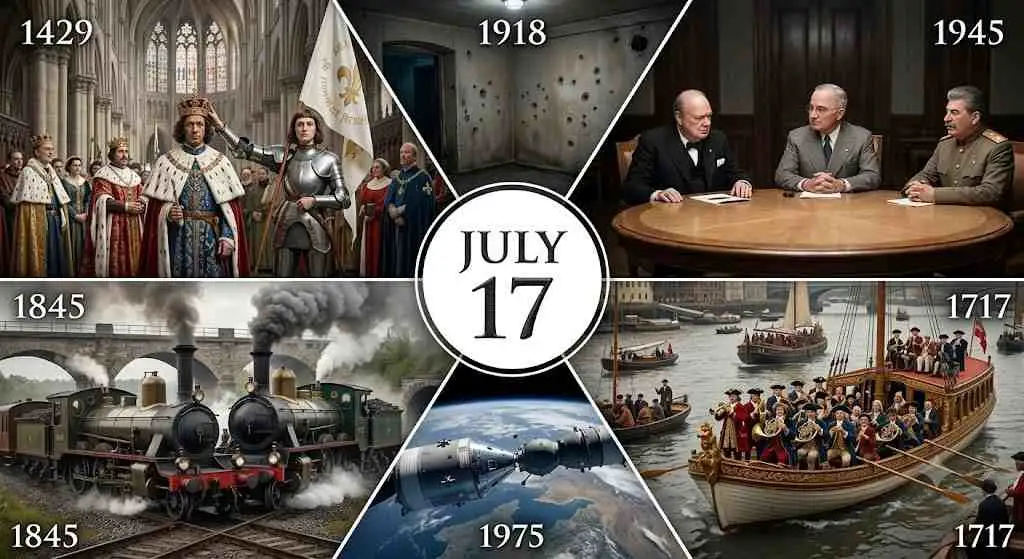
The brutal, messy execution put a violent end to the imperial Romanov dynasty and sent shockwaves across the globe. Decades of mystery surrounding survivors like Anastasia began in that blood-spattered room, cementing July 17, 1918, as a dark turning point in modern history.
Important Events That Happened On July 17 In History
180 – The Scillitan Martyrs Face Roman Justice
Vigellius Saturninus, the Roman governor of Carthage, offered twelve Christian men and women a simple chance to save their lives by swearing to the genius of Emperor Marcus Aurelius. None of them wavered, choosing instead to openly declare their faith in Jesus Christ before being led out to the sword. Their swift execution remains the earliest recorded evidence of a Christian presence in North Africa. The official trial transcript survived, giving historians an incredibly rare, authentic window into the lives and convictions of early Roman Christians.
561 – John III Becomes Pope
Roman clergy and representatives gathered in the shadow of Byzantine influence to formally consecrate John III as the new pope. Rome was still recovering from the devastation of the Gothic Wars, leaving the new pontiff to rebuild a heavily fractured city. He spent his long reign repairing war-torn basilicas and securing food supplies for a starving population. History remembers him as a protector who kept the Roman church unified as Lombard invaders began pouring into northern Italy.
1048 – Damasus II Wins a Short-Lived Papacy
Bavarian bishop Poppo arrived in Rome under the heavy military protection of Emperor Henry III to claim the papal throne as Damasus II. Local Roman factions had forced his predecessor out, making the transition of power incredibly tense and fragile. His victory turned out to be tragically hollow when he suddenly collapsed and died just twenty-three days into his reign. Historians suspect malaria took his life, though rumors of political poison plagued Rome for years afterward.
1048 – Four-Year-Old Henry IV is Crowned German King
A massive assembly of powerful bishops and restless nobles gathered at Aachen Cathedral to crown the young child Henry IV. His father, Emperor Henry III, orchestrated the early coronation to secure the family succession before any rivals could plot a rebellion. The boy’s early ascent meant his childhood was dominated by power-hungry regents vying for control of the kingdom. This crown set the stage for Henry’s adult life, which would be defined by his famous, bitter clash with the papacy.
1203 – Crusaders Breach Constantinople
Venetian galleys rammed through the harbor chains of Constantinople as Fourth Crusade knights launched a desperate, furious assault on the city’s massive sea walls. Terrified by the sudden breach, Byzantine Emperor Alexios III Angelos gathered a fortune in gold and fled into the dark night, abandoning his capital. The crusaders quickly installed their own puppet ruler, exposing deep fractures in the legendary eastern empire. This dramatic siege broke the myth of Constantinople’s invincibility, paving the way for its devastating sack a year later.
1402 – The Yongle Emperor Seizes the Ming Throne
Zhu Di rode victoriously into the imperial capital of Nanjing, his soldiers securing the city gates after a bloody, three-year civil war against his own nephew. He immediately ordered the execution of his rival’s loyal advisers and proclaimed himself the Yongle Emperor. This brutal coup marked the beginning of one of China’s most powerful, transformative imperial eras. He would go on to move the capital to Beijing, construct the legendary Forbidden City, and fund the treasure voyages of Zheng He.
1429 – Joan of Arc Triumphs at Reims Cathedral
Charles VII stood before the high altar of Reims Cathedral as holy oil was poured onto his head, officially crowning him King of France. Standing proudly beside him was seventeen-year-old Joan of Arc, holding her famous white battle banner high. Her brilliant military campaign had cleared the road through English-held territory specifically to make this sacred ceremony possible. This coronation restored French national pride, turning the tide of the war and making a French victory inevitable.
1453 – The Battle of Castillon Ends the Hundred Years’ War
French commander Jean Bureau arranged his innovative gunpowder artillery along the banks of the Dordogne River, waiting for the approaching English army. The legendary English general John Talbot led a desperate charge directly into the French cannon fire, resulting in a total slaughter that claimed Talbot’s life. This decisive French victory immediately forced England to abandon almost all of its territorial claims on French soil. It stands as the final battle of the Hundred Years’ War, proving that gunpowder had permanently replaced medieval knights on the battlefield.
1489 – Sikandar Lodi Claims the Delhi Sultanate
Sikandar Lodi stepped forward to claim the throne of Delhi, successfully outmaneuvering his brothers for the crown after his father’s death. The sultanate was heavily fractured, and provincial governors were openly defying central authority. Sikandar used swift military campaigns and strict administrative reforms to bring rebellious territories back under Delhi’s direct control. His long, stable reign revived the dying empire and laid the foundations for the modern city of Agra.
1717 – Handel’s Water Music Premieres on the River Thames
King George I boarded an open royal barge in London, flanked by dozens of wealthy aristocrats, for an evening cruise down the River Thames. Floating right alongside them was another boat packed with fifty musicians playing a brand-new composition by George Frideric Handel. The King loved the lively, horn-heavy outdoor concert so much that he ordered the musicians to repeat the entire performance three times. This public spectacle successfully boosted the unpopular German king’s public image and created one of classical music’s most famous masterpieces.
1762 – The Murder of Deposed Tsar Peter III
Deposed Russian Emperor Peter III sat under heavy armed guard at the Ropsha estate, having been overthrown by his ambitious wife just a week earlier. A group of conspirators led by Alexei Orlov entered his room, starting a violent scuffle that ended with the young tsar strangled to death. His wife was immediately proclaimed Empress Catherine II, embarking on a legendary thirty-four-year reign. Catherine publicly blamed hemorrhoidal colic for his sudden death to hide her supporters’ bloody coup.
1771 – The Bloody Falls Massacre
Chipewyan chief Matonabbee led his armed warriors in a silent midnight attack on an unsuspecting Inuit camp along the Coppermine River. Samuel Hearne, an English explorer traveling under Matonabbee’s protection, could only watch in absolute horror as the raiding party slaughtered the sleeping families. The brutal event forever stained Hearne’s overland expedition to the Arctic Ocean. It left a lasting legacy of deep distrust and trauma between northern Indigenous nations that took generations to heal.
1791 – The Champ de Mars Massacre
General Lafayette mounted his horse and ordered the French National Guard to disperse a massive crowd of radical Jacobins gathered in Paris. The protesters were demanding the removal of King Louis XVI, throwing rocks at the guardsmen as tension boiled over. Lafayette’s men suddenly opened fire on the unarmed civilians, killing dozens of men, women, and children. This violent betrayal shattered the public’s trust in moderate revolutionaries, driving the French Revolution toward its dark, radical Reign of Terror.
1794 – The Carmelite Martyrs of Compiègne Ascend the Guillotine
Sixteen quiet Carmelite nuns stood in the center of Paris, their voices rising in beautiful hymns as they waited for the blade of the guillotine. They had been condemned by the revolutionary tribunal for refusing to abandon their religious vows and secularize their convent. The crowd, usually wild and bloodthirsty, fell into an absolute, stunned silence as each sister walked calmly to her death. Their martyrdom occurred just ten days before the fall of Robespierre, marking the exhausted end of the Reign of Terror.
1821 – Spain Hands Florida to the United States
Andrew Jackson arrived in Pensacola to officially accept the keys to East and West Florida from Spanish officials. Spain was financially exhausted by European wars and could no longer afford to defend or govern its distant American colonies. The signing of the Adams-Onís Treaty officially brought the vast territory under US control. This major acquisition expanded American territory, drastically changed relations with southern Indigenous tribes, and set off a massive wave of white settlement.
1850 – Astronomers Take the First Photograph of Vega
John Adams Whipple carefully adjusted the massive, fifteen-inch refracting telescope at Harvard College Observatory, aiming it directly at the bright star Vega. Working alongside astronomer William Cranch Bond, he exposed a delicate daguerreotype plate to the starlight for nearly one hundred seconds. The experiment was a triumph, capturing the first clear image of a star other than our Sun. This single photograph proved that cameras could capture deep space, permanently transforming the field of astronomy.
1867 – Harvard Founds America’s First University Dental School
Harvard University administrators officially established the Harvard School of Dental Medicine in Boston, Massachusetts. Before this day, aspiring dentists learned the trade through unregulated apprenticeships, treating teeth as a mechanical trade rather than science. By attaching the school directly to its famous medical university, Harvard forever raised the standards of dental education. This move transformed dentistry into a respected, scientifically rigorous branch of medicine.
1899 – NEC Corporation Launches in Tokyo
Japanese entrepreneurs and American executives signed a joint venture agreement to establish the Nippon Electric Company (NEC) in Tokyo. This was the very first Japanese corporation allowed to operate with direct foreign capital, partnering closely with Western Electric. The new company quickly began manufacturing high-quality telephone equipment to modernize Japan’s communication networks. This successful venture proved that Japan could integrate Western technology while building its own powerful industrial base.
1918 – German Submarine Sinks the RMS Carpathia
German U-boat SM U-55 fired three torpedoes into the hull of the RMS Carpathia off the coast of southern Ireland. The legendary ship, famous for saving 705 survivors from the Titanic six years earlier, began taking on water rapidly. The captain successfully evacuated nearly everyone on board, losing only five crew members before the ship sank. This tragic sinking highlighted the relentless, indiscriminate nature of German submarine warfare during the final months of World War I.
1919 – Finland Adopts its Democratic Constitution
Regent Kaarlo Juho Ståhlberg signed Finland’s new constitution into law, officially establishing the nation as an independent, democratic republic. The country had just survived a brutal civil war and centuries of shifting control under Swedish and Russian rule. This document laid down a strong framework of civil rights, balanced power, and democratic governance. Finns still celebrate July 17 as Democracy Day to honor this hard-won foundation of their modern society.
1932 – Altona Bloody Sunday Sparks German Riots
Nazi SA stormtroopers marched provocatively through the communist working-class streets of Altona near Hamburg, Germany. Local communists blocked the path, sparking a chaotic gun battle that spilled out across the entire neighborhood. The local police panicked, firing indiscriminately into crowds and killing eighteen innocent bystanders. The Weimar government used the bloody riot as an excuse to seize direct control of Prussia, weakening Germany’s democracy just months before Adolf Hitler took power.
1936 – Armed Uprising Starts the Spanish Civil War
Spanish generals in North Africa launched an armed military coup against the recently elected, leftist Popular Front government. The rebellion quickly spread to mainland military garrisons, dividing the country into Nationalist and Republican factions. What was meant to be a swift coup rapidly devolved into a brutal, three-year civil war. This conflict tore families apart, devastated Spanish cities, and established Francisco Franco’s long-standing dictatorship.
1938 – Douglas Corrigan Flies the “Wrong Way” to Ireland
Douglas “Wrong Way” Corrigan took off from a Brooklyn runway in his heavily modified Curtiss Robin, ostensibly heading home to California. Aviation officials had repeatedly denied him permission to fly across the Atlantic, labeling his old plane a flying coffin. Twenty-eight hours later, he touched down in Dublin, Ireland, jokingly blaming a major compass error for his 3,000-mile mistake. The public fell in love with his rebellious attitude, turning him into an instant folk hero.
1944 – The Devastating Port Chicago Disaster
A deafening explosion ripped through the Port Chicago naval docks in California, where hundreds of active sailors were loading ammunition onto transport ships. The massive blast vaporized two cargo ships, leveled the surrounding town, and instantly killed 320 men—the majority of whom were segregated African American sailors. When survivors were ordered to return to dangerous loading conditions without training, fifty sailors refused, leading to a historic mutiny trial. This tragic disaster exposed deep racial inequality in the military, fueling the early civil rights movement.
1945 – The Potsdam Conference Begins
Winston Churchill, Harry S. Truman, and Joseph Stalin sat down around a massive oak table in Cecilienhof Palace, Germany. With Nazi Germany defeated, these Allied leaders needed to negotiate the division of post-war Europe and secure Japan’s unconditional surrender. Truman used the summit to quietly inform Stalin that the United States had just tested an incredibly powerful new weapon. The tense negotiations laid down the geopolitical borders of the Cold War, dividing Germany for decades to come.
1953 – Midshipman Casualty Flight Crash in Florida
A twin-engine transport plane carrying US Navy midshipmen lost power shortly after taking off from a military base in Florida. The aircraft crashed into a nearby pine forest, killing forty-four service members in the worst single-flight tragedy in Navy training history. The devastating loss led to immediate, sweeping reforms in military flight safety and transport regulations. It left a profound mark on the Annapolis community, which mourned the loss of an entire generation of promising young officers.
1954 – French Troops Ambushes at Chu Dreh Pass
Viet Minh fighters opened fire on a heavily armored French military column traveling through the central highlands of Vietnam. The brutal ambush at the Chu Dreh Pass completely destroyed the convoy, leaving French forces scattered and defeated. This engagement serves as the final battle of the First Indochina War. It forced France to finalize its withdrawal from Southeast Asia, splitting Vietnam along the seventeenth parallel.
1962 – The Last Atmospheric Nuclear Test in Nevada
A small, low-yield nuclear warhead exploded just above the desert floor of the Nevada National Security Site. Code-named “Little Feller I,” the test shot was designed to evaluate how infantry troops could fight on a radioactive battlefield. It remains the very last atmospheric nuclear detonation carried out by the United States. Following this test, all American nuclear weapons testing moved entirely underground to prevent dangerous radioactive fallout from spreading.
1968 – Ba’ath Party Seizes Power in Iraq
Iraqi military officers led by Ahmed Hassan al-Bakr launched a bloodless coup, successfully overthrowing President Abdul Rahman Arif. Armed soldiers seized the defense ministry, radio stations, and presidential palace within hours. This swift takeover established the Ba’ath Party as the supreme political power in Iraq. It also positioned al-Bakr’s ambitious young deputy, Saddam Hussein, to quietly consolidate his own grip on the nation.
1973 – King of Afghanistan Overthrown in a Bloodless Coup
Mohammed Daoud Khan led a swift military coup in Kabul while his cousin, King Mohammed Zahir Shah, was away in Italy recovering from eye surgery. The army took control of key government buildings without firing a single shot, ending the nation’s centuries-old monarchy. Daoud Khan immediately abolished the royal system and declared himself the first president of the newly formed Republic of Afghanistan. This sudden coup shattered decades of stability, plunging the nation into a cycle of political violence and foreign intervention.
1975 – The Historic Apollo-Soyuz Space Docking
An American Apollo module and a Soviet Soyuz capsule met high above the Atlantic, carefully aligning their docking collars to lock together. Astronaut Tom Stafford and Cosmonaut Alexei Leonov opened the hatches, shaking hands in orbit for the first time. The two crews spent two days conducting joint scientific experiments and sharing meals in space. This symbolic orbital handshake broke the ice of the Space Race, proving that the two rival superpowers could cooperate in the cosmos.
1976 – Indonesia Annexes East Timor
President Suharto signed a bill officially declaring East Timor to be Indonesia’s twenty-seventh province. The annexation followed a brutal, eight-month invasion that began shortly after the territory gained independence from Portugal. The United Nations refused to recognize the forced takeover, maintaining that East Timorese people had a right to self-determination. This annexation began a bloody, twenty-four-year occupation characterized by widespread human rights abuses and famine.
1976 – African Nations Boycott the Montreal Olympics
Twenty-five African nations walked out of the Montreal Summer Olympics just hours before the opening ceremony was set to begin. The massive boycott was organized to protest the International Olympic Committee’s refusal to ban New Zealand, whose national rugby team had toured South Africa during apartheid. By leaving the games, these nations took a brave, public stand against institutionalized racism on the world stage. The protest drew global attention to the anti-apartheid movement, changing the politics of international sports forever.
1981 – The Hyatt Regency Walkway Collapse
A crowded dance party in the lobby of the Kansas City Hyatt Regency turned into a scene of absolute horror when two suspended concrete walkways suddenly snapped. The massive structures collapsed onto the crowded dance floor below, killing 114 people and injuring over two hundred others. Investigators discovered that a late change in the hanger rod design had doubled the load on the connection, making the walkway highly unstable. This tragic disaster led to a massive overhaul of engineering ethics and construction safety regulations across the United States.
1994 – Brazil Wins the World Cup in a Penalty Shootout
Brazilian striker Romário watched as Italian star Roberto Baggio kicked his penalty shot high over the crossbar, ending a grueling, scoreless match in Pasadena. The dramatic miss gave Brazil a 3-2 victory in the first-ever World Cup final decided by a penalty shootout. Millions of fans poured into the streets of Rio de Janeiro to celebrate the nation’s historic fourth World Cup title. The victory solidified Brazil’s legendary status as the undisputed giants of global soccer.
1996 – The Tragic Explosion of TWA Flight 800
TWA Flight 800, a Boeing 747 heading to Paris, exploded in mid-air just twelve minutes after taking off from New York. The aircraft broke apart and plunged into the Atlantic Ocean off the coast of Long Island, killing all 230 people on board. A four-year safety investigation concluded that a short circuit had ignited flammable fuel vapors inside the center wing tank. This tragedy led to major, industry-wide design changes to prevent fuel tank explosions on commercial flights.
1997 – Sempati Air Flight 304 Crashes in Bandung
An Antonov passenger plane operating as Sempati Air Flight 304 suffered a sudden engine failure immediately after taking off from Bandung, Indonesia. The pilots tried to turn back to the airport, but the plane lost altitude and crashed directly into a residential neighborhood. The devastating impact killed twenty-eight passengers and people on the ground, leaving dozens of others severely injured. This crash exposed deep safety concerns within Indonesia’s rapidly expanding, underregulated domestic aviation sector.
1998 – Giant Tsunami Devastates Papua New Guinea
A powerful, 7.0-magnitude earthquake struck off the coast of Papua New Guinea, triggering an enormous undersea landslide. Minutes later, a series of three massive tsunami waves slammed into the coastline, completely destroying ten coastal villages. The catastrophic wall of water killed over 2,100 people and left thousands of families homeless. This tragedy highlighted the extreme vulnerability of isolated Pacific island communities to sudden, earthquake-triggered tsunamis.
1998 – The Rome Statute Establishes the International Criminal Court
Delegates from over one hundred countries gathered in Rome to formally adopt the Rome Statute, creating the first permanent International Criminal Court (ICC). The court was designed to prosecute individuals responsible for genocide, war crimes, and crimes against humanity. By establishing a permanent venue for international justice, the treaty aimed to end the era of impunity for brutal dictators and warlords. It remains a historic milestone in the long, difficult global fight for human rights and accountability.
2000 – Alliance Air Flight 7412 Crashes in Patna
An Alliance Air Boeing 737 entered a sudden, uncontrollable stall while attempting to land at Lok Nayak Jayaprakash Airport in Patna, India. The aircraft clipped several houses before crashing into a government residential colony, erupting into a massive fireball. The crash claimed the lives of sixty people, including several residents on the ground. Investigators blamed pilot error for the tragedy, prompting Indian airlines to adopt far stricter pilot training standards.
2006 – Java Hit by the Devastating Pangandaran Tsunami
An intense, 7.7-magnitude earthquake struck deep beneath the Indian Ocean, sending a massive tsunami racing toward the southern coast of Java, Indonesia. The giant waves slammed into popular resort towns without warning, sweeping away buildings and tourist beaches. The disaster killed 668 people, injured over nine thousand, and left local communities completely devastated. The tragedy exposed critical gaps in Indonesia’s tsunami warning systems, leading to a massive push to install coastal sirens.
2007 – TAM Airlines Flight 3054 Overruns the Runway in São Paulo
An Airbus A320 operating as TAM Airlines Flight 3054 touched down on a rain-slicked runway at São Paulo’s Congonhas Airport. The plane was unable to slow down, overshooting the runway at high speed and crashing directly into an airport warehouse. The horrific impact and subsequent fire killed 199 people, making it the deadliest aviation disaster in South American history. This tragedy led to immediate flight restrictions and major runway renovations at the congested city-center airport.
2014 – Malaysia Airlines Flight 17 Shot Down Over Ukraine
Malaysia Airlines Flight 17 was flying at 33,000 feet over eastern Ukraine when a Russian-made Buk missile exploded just feet from its cockpit. The commercial airliner broke apart in mid-air, scattering debris across miles of farmland and killing all 298 passengers and crew on board. International investigators eventually traced the missile system back to a Russian military brigade. This shocking attack sparked intense international outrage, resulting in heavy economic sanctions and deepening global political tensions.
2014 – High-Speed Train Collision in Denguin
A French regional passenger train traveling along the Pau-Bayonne line suddenly collided with an empty high-speed TGV train near Denguin. The impact derailed several cars, injuring at least twenty-five passengers, including several who were hospitalized in serious condition. An investigation later revealed a signaling fault caused by a rodent chewing through electrical cables. This incident forced French national railways to carry out an immediate safety audit of its signal boxes.
2014 – The Killing of Eric Garner
Police officer Daniel Pantaleo placed forty-three-year-old Eric Garner in a prohibited chokehold during an arrest for selling loose cigarettes in Staten Island. Garner’s repeated, desperate plea of “I can’t breathe” was captured on video by a bystander before he went limp. His death was ruled a homicide, but a grand jury’s decision not to indict the officer sparked massive protests across the nation. This tragic event galvanized the Black Lives Matter movement, leading to nationwide demands for police reform and body cameras.
2015 – Deadly Suicide Bombing in Diyala Governorate
An ISIS suicide bomber detonated a truck packed with explosives in a crowded marketplace in the Iraqi province of Diyala. The massive blast ripped through families gathered to celebrate the end of Ramadan, killing at least 120 people and leveling several buildings. It stands as one of the deadliest single attacks carried out by the terror group during its campaign in Iraq. The tragedy highlighted the immense challenges Iraqi security forces faced in protecting civilian areas from insurgent violence.
Don’t let yesterday’s history go untold—read it here.
Famous People Born on July 17
| Name | Description | Date |
|---|---|---|
| Ismail I | Founder and first Shah of the Safavid Empire of Iran | 1487 – 1524 |
| Isaac Watts | English hymn writer, theologian, and poet | 1674 – 1748 |
| Elbridge Gerry | 5th Vice President of the United States | 1744 – 1814 |
| John Jacob Astor | German-American businessman and America’s first multimillionaire | 1763 – 1848 |
| Paul Delaroche | Influential French historical painter | 1797 – 1856 |
| Shmuel Yosef Agnon | Israeli Nobel Prize-winning author | 1888 – 1970 |
| Erle Stanley Gardner | American novelist, creator of Perry Mason | 1889 – 1970 |
| Georges Lemaître | Belgian physicist who proposed the Big Bang theory | 1894 – 1966 |
| Berenice Abbott | American pioneering photographer | 1898 – 1991 |
| James Cagney | Academy Award-winning American actor | 1899 – 1986 |
| Art Linkletter | Canadian-American television and radio host | 1912 – 2010 |
| Phyllis Diller | American comedian and actress | 1917 – 2012 |
| Juan Antonio Samaranch | President of the International Olympic Committee | 1920 – 2010 |
| John Cooper | British racing car designer and co-founder of Cooper Cars | 1923 – 2000 |
| Vince Guaraldi | American jazz pianist and composer | 1928 – 1976 |
| Arthur Frommer | American travel writer and publisher | 1929 – 2024 |
| Quino | Argentine cartoonist, creator of Mafalda | 1932 – 2020 |
| Lucio Tan | Filipino billionaire businessman | 1934 – Present |
| Diahann Carroll | American actress and singer | 1935 – 2019 |
| Donald Sutherland | Canadian film and television actor | 1935 – 2024 |
| Carlos Alberto Torres | Brazilian football legend and World Cup-winning captain | 1944 – 2016 |
| Queen Camilla | Queen of the United Kingdom | 1947 – Present |
| Geezer Butler | Bassist and founding member of Black Sabbath | 1949 – Present |
| David Hasselhoff | American actor and singer | 1952 – Present |
| Angela Merkel | Chancellor of Germany (2005–2021) | 1954 – Present |
| Wong Kar-wai | Hong Kong film director and screenwriter | 1958 – Present |
| Terence Tao | Australian-American mathematician and Fields Medal winner | 1975 – Present |
| Luke Bryan | American country music singer | 1976 – Present |
| Kali Uchis | American singer-songwriter | 1994 – Present |
| Connor Bedard | Canadian professional ice hockey player | 2005 – Present |
Famous People Died on July 17
| Name | Description | Date |
|---|---|---|
| Leo IV | Pope of the Catholic Church | 790 – 855 |
| John Talbot | English military commander in the Hundred Years’ War | 1387 – 1453 |
| Mimar Sinan | Greatest architect of the Ottoman Empire | 1489 – 1588 |
| Peter III of Russia | Emperor of Russia | 1728 – 1762 |
| Adam Smith | Scottish economist, author of The Wealth of Nations | 1723 – 1790 |
| Charles Grey, 2nd Earl Grey | British Prime Minister | 1764 – 1845 |
| Jim Bridger | Legendary American explorer and mountain man | 1804 – 1881 |
| Henri Poincaré | French mathematician and theoretical physicist | 1854 – 1912 |
| Nicholas II | Last Emperor of Russia | 1868 – 1918 |
| Álvaro Obregón | President of Mexico | 1880 – 1928 |
| William James Sidis | American mathematical prodigy | 1898 – 1944 |
| Billie Holiday | Legendary American jazz singer | 1915 – 1959 |
| Ty Cobb | Baseball Hall of Fame player | 1886 – 1961 |
| John Coltrane | Influential American jazz saxophonist | 1926 – 1967 |
| Dizzy Dean | Baseball Hall of Fame pitcher | 1910 – 1974 |
| Juan Manuel Fangio | Five-time Formula One World Champion | 1911 – 1995 |
| Chas Chandler | Musician and producer of The Animals and Jimi Hendrix | 1938 – 1996 |
| Katharine Graham | American newspaper publisher of The Washington Post | 1917 – 2001 |
| David Kelly | British weapons expert and scientist | 1944 – 2003 |
| Geraldine Fitzgerald | Irish-American actress | 1913 – 2005 |
| Edward Heath | Former Prime Minister of the United Kingdom | 1916 – 2005 |
| Mickey Spillane | American crime novelist | 1918 – 2006 |
| Walter Cronkite | Iconic American television journalist | 1916 – 2009 |
| Elaine Stritch | American actress and singer | 1925 – 2014 |
| Jules Bianchi | French Formula One racing driver | 1989 – 2015 |
| John Lewis | American civil rights leader and politician | 1940 – 2020 |
| Cheng Pei-pei | Chinese martial arts film actress | 1946 – 2024 |
| Bernice Johnson Reagon | American singer, scholar, and civil rights activist | 1942 – 2024 |
| Felix Baumgartner | Austrian skydiver and extreme sports pioneer | 1969 – 2025 |
| Alan Bergman | Academy Award-winning American lyricist | 1925 – 2025 |
Observances on July 17
- Gion Matsuri (Japan): The famous Yamaboko Junco parade takes place on the streets of Kyoto, featuring massive, beautifully decorated traditional wooden floats.
- Constitution Day (South Korea): Citizens raise national flags to celebrate the adoption of the country’s democratic constitution in 1948.
- Independence Day (Slovakia): Slovaks celebrate the historic 1992 declaration of sovereignty that led to the peaceful creation of their independent republic.
- King’s Birthday (Lesotho): The nation enjoys a public holiday to celebrate the birth of King Letsie III with traditional music and military parades.
- U Tirot Sing Day (Meghalaya, India): Local communities pay tribute to the legendary Khasi chief who led a heroic armed rebellion against British colonial forces.
- International Firgun Day: People around the world practice “firgun”—a Hebrew term for sharing unselfish, generous joy in another person’s accomplishments.
- World Day for International Justice: Activists and lawyers gather to promote international criminal justice and support the vital work of the International Criminal Court.
- World Emoji Day: Tech companies and social media users celebrate the fun, modern language of emojis, sharing their favorite digital icons online.
👑 Frequently Asked Questions — July 17 in History
Bolshevik guards led Tsar Nicholas II, his family, and their staff into a basement room in Yekaterinburg and executed them in a chaotic firefight. This brutal killing ended more than three hundred years of Romanov rule and forever changed the course of Russian history.
The Battle of Castillon occurred on this day in 1453, ending the Hundred Years’ War as French artillery routed the English army. This decisive clash proved that gunpowder weapons had permanently replaced knights on European battlefields.
Shah Ismail I, the visionary founder and first shah of the Safavid Empire of Iran, was born on this day in 1487. This date also marks the birthday of Queen Camilla, Queen of the United Kingdom, who was born in London in 1947.
The execution of the Romanov family in 1918 remains the most historically significant event on this date. The shocking killings destroyed the Russian monarchy, secured the Bolshevik revolution, and inspired decades of haunting mysteries.
Gion Matsuri is a historic festival held at Yasaka Shrine in Kyoto, Japan, dating back to the ninth century. It was originally established to pray for protection against a devastating plague, and it is remembered today with massive parades of traditional wooden floats.
In 2014, Malaysia Airlines Flight 17 was shot down by a Russian-made surface-to-air missile over eastern Ukraine, killing all 298 people on board. This tragic event caused intense global outrage and heavily deepened diplomatic tensions between Russia and Western nations.