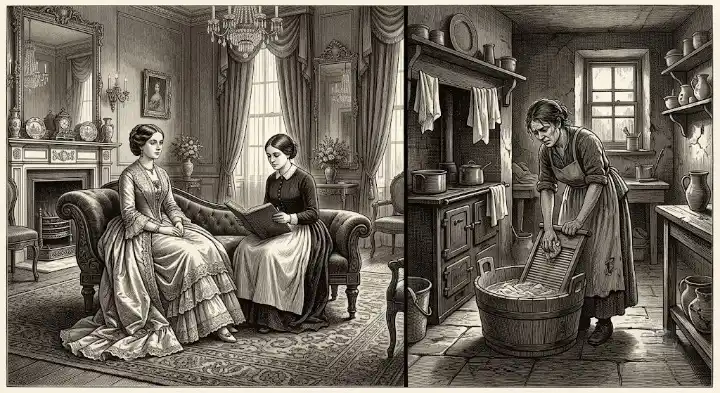
Two girls were born in London on the same spring morning in 1850. One arrived in a townhouse in Belgravia, greeted by a monthly nurse, a christening gown, and a nursery already stocked with toys. The other arrived in a single room in Bethnal Green, and was back in her mother’s arms at the washtub within the week, because rent didn’t wait for anyone. Same city, same year, same sex — and almost nothing else in common. That gap, between rich and poor women in Victorian Britain, shaped everything from the moment they were born to the moment they died. Here’s what it actually looked like, on both sides.
What Was the Real Difference Between Rich and Poor Women in Victorian Britain?
In one line: a rich Victorian woman’s life was organised around appearance — marrying well, running a household of servants, and never being seen to work — while a poor Victorian woman’s life was organised around survival, through paid labour, domestic drudgery, and near-total legal powerlessness. Both were bound by the same laws and the same assumptions about what a woman was for. Money decided how those assumptions actually played out.
That’s the short version. The long version is messier, and more interesting.
Girlhood: A Nursery Full of Toys, or a Baby on Your Hip
Wealthy Victorian girls were raised almost entirely out of their parents’ sight. A nanny took charge from birth, then a nursemaid, then a governess, in a slow relay that kept a child fed, dressed, and quiet somewhere upstairs. Parents appeared for an hour before bedtime, if that. A girl might not have a real conversation with her own father until she was old enough to be presented at a dinner table.
Poor girls had no such buffer. By six or seven, a working-class daughter was already useful — minding younger siblings, fetching water, running errands, learning to sew because the family’s clothes depended on it. Girlhood, in the sense of a protected, extended childhood, was largely a luxury good. The poorer the family, the sooner it ended.
Both girls were shaped by the same Victorian belief that women existed to serve others. One was simply trained to serve a household of six with three staff to help her; the other was trained to serve a household of six with no help at all.
Marriage: A Business Merger for the Rich, Survival for the Poor
For a wealthy family, a daughter’s marriage was a transaction, and everyone involved knew it. Suitors were vetted for income, land, and connections before anyone checked whether the couple actually liked each other. A “good match” meant a rise in status for both families; a bad one could sink a woman socially for the rest of her life. Courtship happened under constant chaperonage — a young woman of good family was almost never alone with a man who wasn’t her relative.
For a working-class woman, marriage was less about status and more about arithmetic. Two incomes, however small, went further than one. A husband’s wages plus her own earnings from laundry, charring, or piecework might just cover rent and food. Courtship was shorter, chaperonage was a fantasy nobody could afford to enforce, and the wedding itself might be a plain register-office affair squeezed in on a Saturday off work.
What both women shared, whatever their income, was the law of coverture. Once married, a woman’s legal identity was absorbed into her husband’s — she generally couldn’t own property, sign contracts, or keep her own wages in her own name. The Married Women’s Property Act of 1870, and the far stronger act that followed it in 1882, slowly began to change that, letting married women keep control of their own earnings and inheritance. But for most of the Victorian era, marriage meant legal disappearance for rich and poor women alike — the rich woman just had more property to lose control of.
Education: French, Piano, and Watercolours — If You Were Lucky Enough to Be Poor
A wealthy Victorian girl’s education was designed to make her marriageable, not employable. A governess taught French, a little Italian, piano, drawing, and enough history and geography to hold a dinner conversation. Deep learning wasn’t the point, and being visibly too clever was often seen as a social liability rather than an achievement. Some families sent daughters to a finishing school for a final polish before their debut into society.
A poor girl’s schooling, where it existed at all, was far more basic — and far more interrupted. Board schools after the Elementary Education Act of 1870 offered reading, writing, and basic arithmetic, but a daughter was frequently pulled out early to work or help at home. Many working-class women reached adulthood only partly literate, not for lack of ability but for lack of time anyone could spare.
The strange twist is that poor women, ill-schooled as they often were, generally understood money, work, and the practical running of a household better than their wealthy counterparts ever needed to. Wealthy women were educated to be decorative; poor women were educated, if at all, to be useful.
Work: The Woman Who Never Worked vs. the Woman Who Never Stopped
Here’s the sharpest divide of all. A wealthy Victorian woman was, by design, not supposed to work for money. Paid labour was seen as beneath her class — a mark that the family’s men had failed to provide. Her days were filled instead with unpaid but demanding work: managing servants, paying calls, arranging menus, overseeing her children’s upbringing, and maintaining the social connections that kept the family’s standing intact. It was labour, just never called that.
A poor woman had no such luxury, and domestic service was where most of them ended up. By 1891, around 41% of all employed women in Britain were working as domestic servants — cooks, housemaids, scullery maids, nursemaids — inside someone else’s home, often living in, on call from dawn until the family went to bed. Others took in washing, did piecework sewing, sold goods in the street, or worked in the mills and factories the era is famous for. Some of the very poorest, especially widows or single mothers with nowhere else to turn, ended up in the workhouse system — a fate we cover in full in Life in a Victorian Workhouse.
It’s worth remembering, too, that plenty of working-class mothers had children in the workforce alongside them. Family survival often depended on every pair of hands old enough to earn — a reality laid out in our piece on why children worked in Victorian times.
A Day in Two Lives: Lady and Laundress Side by Side
| Time | 👒 A Wealthy Woman’s Day | 🧺 A Poor Woman’s Day |
|---|---|---|
| 6:00 am | Still asleep | Rises, lights the fire, and starts breakfast. |
| 8:00 am | Breakfast brought up by a maid. | Sends children to school or work and begins household chores. |
| 10:00 am | Writes letters and plans the day’s menu with the cook. | Washing, scrubbing, or leaving for a factory shift. |
| 1:00 pm | Pays social calls and receives visitors. | Continues labour with a brief break for bread and tea. |
| 4:00 pm | Dresses for the afternoon, embroidery, or piano practice. | Collects children, mends clothes, and prepares supper. |
| 7:00 pm | Formal dinner, often followed by a social engagement. | Feeds the family and puts the children to bed. |
| 10:00 pm | Retires for the night while a maid helps her undress. | Finally rests, ready to begin the same routine at dawn. |
Health and the Body: Corsets, Confinement, and Constant Danger
Both women lived inside the same fashionable silhouette — the corset was near-universal across classes, though wealthy women’s were finer and more restrictive, while working women often loosened or abandoned theirs simply to get through a physical day’s labour. Childbirth was dangerous for everyone; puerperal fever didn’t check a woman’s bank balance before it killed her.
Where the classes diverged sharply was in everything surrounding that danger. A wealthy woman gave birth attended by a private doctor or a trained midwife, in a warm, private room, with weeks of “confinement” afterward to recover, fully supported by servants. A poor woman might give birth in a single shared room with no real rest afterward, because the washing and the children and the work didn’t pause for anyone. Malnutrition, overcrowded housing, and unsafe workplaces meant poorer women faced dramatically higher rates of illness and early death than their wealthy counterparts, even though both were, technically, living through the same “Victorian era.”
What They Actually Had in Common
For all that divided them, rich and poor Victorian women shared one thing absolutely: neither could vote, sit on a jury, or stand for Parliament. Neither had full legal standing independent of a father or husband for most of the era. Both were expected, from birth, to organise their entire lives around men and children rather than their own ambitions.
That shared powerlessness is exactly why the suffrage movement, when it finally gathered force in the late nineteenth century, managed to pull in women from wildly different backgrounds — mill workers alongside duchesses, all pushing at the same locked door from different sides of it. However different their daily lives looked, both a countess and a charwoman needed the law to change before either of them counted as a full legal person in her own right.
🏛️ Frequently Asked Questions — Rich and Poor Women in Victorian Britain
The clearest difference was work. Wealthy women were expected not to earn money at all, filling their days with unpaid household management and social duties, while poor women almost always worked for pay — as servants, in factories, or through piecework — simply to keep their families fed.
Generally yes, far more freely than wealthy women did. Working-class courtship had little of the formal chaperonage and family vetting that governed upper-class marriage, mainly because there was no fortune or title at stake to protect.
Some could, especially after board schools became widespread following the Elementary Education Act of 1870. But many working-class girls were pulled out early to work or help at home, so their schooling was often basic and frequently cut short.
Domestic service was by far the largest employer of women in Victorian Britain — cooking, cleaning, and childcare inside someone else’s home. Others worked in textile mills, took in laundry, or did piecework sewing from home.
Broadly, yes — and both had very few. Neither could vote or hold most legal rights independently of a husband for most of the era. Wealthy women simply had more property and status to lose under those restrictions than poor women did.
Two Women, One Century
Strip away the silk and the soot, and both women were shaped by the same Victorian idea: that a woman’s worth was measured by how well she served someone else’s household. One was simply given servants to help her do it, and the other was one of the servants. The gap between a countess and a charwoman wasn’t really about character or ability. It was about the accident of which side of that gap you happened to be born on — and how long it would take Britain to decide that gap shouldn’t decide everything.
Sources
- UK Parliament, Women’s Lives — parliament.uk (living heritage collection on 19th-century women’s legal status)
- History & Policy, domestic workers and employment rights — historyandpolicy.org
- Northumberland Archives, Women in Domestic Service — northumberlandarchives.com
- Legislation.gov.uk, Married Women’s Property Act 1870 and 1882 — legislation.gov.uk