Quick Facts — August 4 in History
| Category | Detail |
|---|---|
| Most Significant Event | The Gestapo discovers and arrests Anne Frank and her family in Amsterdam (1944) |
| Top Key Events |
|
| Key Battles | Battle of Evesham (1265), Battle of Al Kasr al Kebir (1578), Battle of Lonato (1796), Operation Storm (1995) |
| Key Figures | Queen Elizabeth The Queen Mother (born 1900), Kishore Kumar (born 1929), Anne Frank, Marcus Tullius Cicero, Thomas Sankara |
| Observances | Barack Obama Day (Illinois, USA), Coast Guard Day (United States), Matica Slovenská Day (Slovakia), Constitution Day (Cook Islands), 2020 Beirut Explosion Commemoration Day (Lebanon) |
Story of the Day: The Raid on the Secret Annex
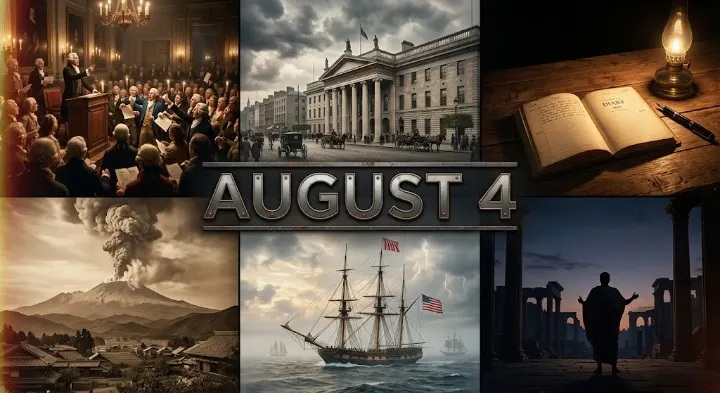
A sudden knock shattered the morning quiet of August 4, 1944, at 263 Prinsengracht in Amsterdam. Acting on an anonymous tip, SS-Oberscharführer Karl Silberbauer and Dutch police officer collaborators stormed into the rear warehouse. They pushed past a hidden bookcase, stepping into the cramped quarters where eight Jewish people had spent 761 days living in absolute silence. Fifteen-year-old Anne Frank watched as her red-checkered diary fell to the floor while Nazi officers confiscated their belongings. Within hours, the inhabitants were sent to transit camps, ending one of history’s most poignant personal records of resistance and fear.
Important Events That Happened On August 4 In History
70 BC – Trial of Gaius Verres Begins
Marcus Tullius Cicero stepped into the Roman forum to begin his prosecution of the former governor Gaius Verres for massive corruption. Verres hired Rome’s top lawyer, Quintus Hortensius, expecting an easy political victory. Cicero delivered evidence so overwhelming that Verres fled into voluntary exile before the defense could even respond. The victory established Cicero as the premier orator of the Roman Republic.
598 – Goguryeo-Sui War Commences
Emperor Wéndi of Sui ordered his son Yang Liang to march a massive Chinese army and navy into Goguryeo territory during the torrential Manchurian rainy season. The invasion aimed to crush Korean border raids into Liaoxi but met fierce military resistance and brutal weather. Mud, disease, and military ambushes wiped out over ninety percent of the invading Chinese force. The disaster marked the beginning of a costly conflict that ultimately brought down the Sui Dynasty.
1265 – Battle of Evesham
Prince Edward caught the rebel baron Simon de Montfort in a tight river bend near Evesham while a summer thunderstorm darkened the sky. Edward’s royalist forces showed no mercy, refusing to take high-status prisoners and hacking de Montfort to pieces on the field. The brutal victory restored King Henry III to full power and crushed the baronial revolt. De Montfort’s death ended a major early attempt to limit royal authority through parliamentary rule.
1320 – The Black Parliament Convenes at Scone
Scottish nobles gathered at Scone under King Robert the Bruce to hold a high-stakes treason trial against William II de Soules and his conspirators. The plotters had intended to overthrow Robert and seize the Scottish crown for themselves. The parliament found the ringleaders guilty of conspiratorial treason, sentencing several to brutal executions. The trial solidified King Robert’s absolute authority over a unified Scotland.
1327 – James Douglas Raids Weardale
Sir James “the Good” Douglas led a nighttime cavalry strike deep into the English camp at Weardale during the First War of Scottish Independence. Douglas rode directly to the royal tent and slashed the ropes, nearly capturing the teenage King Edward III of England. The daring raid panicked the entire English army and forced them to retreat in disarray. The humiliation pressured the English crown to negotiate formal Scottish sovereignty.
1578 – Battle of Al Kasr al Kebir
King Sebastian of Portugal led his forces onto Moroccan soil, clashing directly with Sultan Abd al-Malik in a clash known as the Battle of the Three Kings. Moroccan troops completely encircled the Portuguese invaders, inflicting a total defeat during hours of heavy combat. Both King Sebastian and Sultan Abd al-Malik died during the fight, along with former sultan Ahmad al-Mutawakkil. Sebastian’s death without an heir triggered a massive succession crisis that handed Portugal to the Spanish crown.
1693 – Dom Pérignon Tradition Established
Benedictine monk Dom Pérignon worked meticulously in the wine cellars of Hautvillers Abbey, refining methods to stop unwanted double fermentation. Legend claims he declared he was “tasting the stars” on this day while perfecting clear, sparkling wines. While he did not invent champagne outright, his techniques in glass strength and blending laid the foundation for modern winemaking. His work transformed regional French wine into a global luxury standard.
1701 – Great Peace of Montreal Signed
Governor Hector de Callière met with leaders from thirty-nine First Nations tribes to sign a landmark peace agreement in New France. Hundreds of indigenous representatives placed their pictographic marks on the document, ending nearly a century of devastating Iroquois Wars. The treaty established trade neutrality and fundamentally reshaped North American diplomacy. It allowed New France to expand its fur trade across the interior continent without constant conflict.
1704 – Capture of Gibraltar
Admiral Sir George Rooke directed an Anglo-Dutch fleet in a heavy naval bombardment against the strategic fortress of Gibraltar. Allied marines stormed the shores, forcing the Spanish governor to surrender after minimal resistance. The territory was claimed for Archduke Charles of Austria during the War of the Spanish Succession. The capture gave Great Britain permanent control over the entrance to the Mediterranean Sea.
1781 – East India Company Raids Sumatra
Six armed ships belonging to the British East India Company departed Fort Marlborough to attack Dutch trade outposts along the West Coast of Sumatra. The naval force targeted the major Dutch VOC port at Padang during the Fourth Anglo-Dutch War. British commanders successfully captured the valuable trading hubs, stripping the Dutch of lucrative spices and goods. The offensive crippled Dutch commercial dominance across the East Indies region.
1783 – Mount Asama Erupts in Japan
Mount Asama detonated with explosive force in central Japan, sending vast clouds of toxic ash and mudflows through surrounding villages. The direct blast and lava flows killed over 1,400 residents immediately across the countryside. The heavy fallout destroyed crops across the region, triggering the devastating Tenmei Famine that killed 20,000 more people. The disaster forced major agricultural and economic shifts during the Tokugawa shogunate.
1789 – Abolition of Feudalism in France
Members of the National Constituent Assembly stood up in Paris and surrendered their ancient aristocratic privileges during a dramatic night session. Nobles and clergy voluntarily gave up tithes, seigneurial rights, and personal feudal dues to calm peasant uprisings across the country. The historic decree erased centuries of rigid social hierarchy in a single evening. The act established legal equality as a cornerstone of the French Revolution.
1790 – Revenue Cutter Service Established
President George Washington signed a new tariff act establishing a fleet of ten armed boats to combat maritime smuggling. Treasury Secretary Alexander Hamilton organized the service to enforce customs laws and protect federal revenue along the American coastline. The small fleet served as the young nation’s only armed force at sea for several years. The agency eventually evolved into the modern United States Coast Guard.
1791 – Treaty of Sistova Signed
Ottoman and Habsburg diplomats finalized the Treaty of Sistova, ending the brutal Ottoman-Habsburg War. The agreement returned borders to their pre-war positions, with the Habsburgs gaining only minor border towns in Bosnia. Both empires were eager to end hostilities as revolutionary turmoil in France threatened European stability. The peace effectively brought an end to centuries of direct military conflicts between the two powers.
1796 – Battle of Lonato
Napoleon Bonaparte maneuvered his Army of Italy to isolate and crush several Austrian columns near Lake Garda. French troops executed swift attacks, forcing individual Austrian units to surrender in rapid succession. The tactical victory broke the Austrian attempt to relieve the besieged garrison at Mantua. The triumph proved Napoleon’s ability to divide and destroy larger enemy forces through superior speed.
1814 – Siege of Fort Erie Begins
British forces under Lieutenant General Gordon Drummond opened fire on American positions at Fort Erie, Upper Canada. British troops launched heavy artillery bombardments and night assaults to recapture the strategic fort and clear Americans from the region. American defenders held their ground through weeks of bloody close-quarters fighting and severe weather. The costly siege ended in British failure, leaving American forces in temporary control of the Niagara frontier.
1821 – Saturday Evening Post Debuts
Printers in Philadelphia published the very first issue of The Saturday Evening Post as a four-page weekly newspaper. The publication offered readers a mix of local news, short stories, political essays, and poetry for two dollars a year. It quickly expanded its subscriber base across the expanding United States over the next several decades. The paper later grew into one of the most influential magazines in American cultural history.
1854 – Hinomaru Adopted for Japanese Ships
The Tokugawa shogunate issued an official decree making the Hinomaru—a red sun disc on a white field—the flag for all Japanese merchant vessels. Japanese officials wanted a clear national symbol to distinguish their ships from incoming Western powers entering Asian ports. The flag became a universally recognized representation of Japan during its rapid modernization era. The design eventually became the official national flag of Japan.
1863 – Matica Slovenská Established
Slovak scholars and political leaders gathered in the town of Martin to found Matica Slovenská, a public cultural and scientific institution. The organization focused on preserving Slovak language, publishing literature, and fostering national identity within the Austro-Hungarian Empire. Imperial authorities initially viewed the cultural movement with heavy suspicion. The institution remains a central pillar of Slovakian national heritage today.
1873 – Custer Clashes with Lakota at Tongue River
Lieutenant Colonel George Armstrong Custer led elements of the U.S. 7th Cavalry alongside a railroad survey party in Montana Territory. Sitting Bull and Crazy Horse led Cheyenne and Lakota warriors in a sudden engagement against the military escort near the Tongue River. The brief fight resulted in only one casualty on each side before the native warriors withdrew into the hills. The skirmish marked the first direct confrontation between Custer and the tribes that would later defeat him at the Little Bighorn.
1887 – Granny the Sea Anemone Passes Away
Biologists in Edinburgh recorded the death of Granny, a sea anemone that lived for nearly sixty years in human captivity. Collected from the ocean in 1828, she survived inside glass tanks while witnessing decades of scientific developments. Major international newspapers, including The Scotsman and The New York Times, published her obituary as a scientific curiosity. Her long life provided early researchers with rare data on the longevity of simple marine organisms.
1889 – Great Fire of Spokane
A sudden blaze broke out in a downtown commercial building and quickly consumed thirty-two square blocks of Spokane, Washington. Volunteer firefighters were hampered by low water pressure, forcing residents to flee as the fire destroyed the entire business district. The disaster caused millions of dollars in property damage but miraculously resulted in few direct fatalities. City leaders immediately launched a massive, modern rebuilding campaign using brick and stone.
1989 – Lizzie Borden Murders Occur
Andrew Borden and his wife Abby were hacked to death with a heavy hatchet inside their Fall River, Massachusetts home. Police arrested Andrew’s daughter, Lizzie Borden, charging her with the double homicide after finding conflicting statements and burned clothing. A high-profile jury trial acquitted her the following year due to a lack of direct physical evidence. The gruesome, unsolved murders became one of America’s most enduring true-crime mysteries.
1914 – Britain Declares War on Germany
German troops crossed the border into neutral Belgium, triggering the terms of the 1839 Treaty of London. In response, the British Empire declared war on Germany, pulling millions of colonial subjects into the conflict. Across the Atlantic, President Woodrow Wilson issued a proclamation declaring the absolute neutrality of the United States. The diplomatic cascade locked European powers into the devastating opening battles of World War I.
1915 – German Forces Occupy Warsaw
The German 12th Army marched into Warsaw, seizing the city from retreating Imperial Russian forces during the Gorlice–Tarnów Offensive. Russian commanders ordered a scorched-earth policy, destroying bridges and infrastructure as hundreds of thousands of civilians fled eastward. The capture marked the end of over a century of direct Russian rule in the city. The loss dealt a severe military and psychological blow to the Russian Empire.
1921 – Victory Over Makhnovshchina Declared
Bolshevik commander Mikhail Frunze announced the final military defeat of the Makhnovist anarchist forces in Ukraine. Red Army units hunted down the remaining peasant guerrillas who had fought against both Imperial and Bolshevik forces. Anarchist leader Nestor Makhno fled across the border into Romania with a small group of followers to escape execution. The victory consolidated single-party Bolshevik control across the Ukrainian territory.
1922 – Death of Enver Pasha
Enver Pasha, a former leader of the Ottoman Young Turks, died during a cavalry charge against Bolshevik Red Army troops in Tajikistan. Enver had defected to lead anti-Bolshevik Basmachi rebels in their fight for an independent Turkic state across Central Asia. A Red Army unit ambushed his headquarters, killing him in the brief combat that followed. His death shattered the leadership of the Basmachi movement in the region.
1924 – Mexico Establishes Soviet Relations
Diplomats from Mexico and the Soviet Union formally established full diplomatic relations between their respective nations. Mexico became the first country in the Western Hemisphere to officially recognize the newly formed communist government in Moscow. The diplomatic tie created a strategic base for Soviet interests in Latin America during the interwar period. The move reflected Mexico’s post-revolutionary, independent foreign policy platform.
1936 – Metaxas Establishes 4th of August Regime
Prime Minister Ioannis Metaxas persuaded King George II to suspend key articles of the Greek Constitution and dissolve parliament. Metaxas cited widespread labor strikes and communist threats as justification for establishing authoritarian rule across Greece. The resulting 4th of August Regime banned political parties, censored the press, and arrested political opponents. The dictatorship governed Greece until the Axis invasion during World War II.
1944 – Anne Frank and Family Arrested
A squad of Gestapo officers raided a sealed-off warehouse annex in Amsterdam following a tip from a Dutch informer. Officers discovered eight Jewish people, including young diarist Anne Frank, who had been hiding behind a movable bookcase for over two years. The group was processed through Westerbork transit camp before transport to Auschwitz and Bergen-Belsen. Anne died in early 1945, leaving behind her personal diary that became a world-renowned historical record.
1944 – Mannerheim Elected President of Finland
The Finnish Parliament passed emergency legislation electing Marshal C. G. E. Mannerheim as President of Finland following the resignation of Risto Ryti. Leaders needed Mannerheim’s supreme military authority to negotiate a separate peace treaty with the Soviet Union and exit World War II. Mannerheim immediately prepared the nation for diplomatic breakups with Nazi Germany. His leadership saved Finland from complete military occupation by Soviet forces.
1946 – Northern Dominican Republic Earthquake
A massive 8.0 magnitude earthquake struck off the northern coast of the Dominican Republic, triggering destructive tsunamis across coastal towns. The violent tremors collapsed thousands of structures, killing over one hundred people and leaving 20,000 residents homeless. Tsunami waves swept inland, destroying entire fishing villages within minutes. The disaster prompted a major international relief effort to rebuild the devastated region.
1947 – Supreme Court of Japan Founded
Japan established its brand-new Supreme Court under the provisions of its post-World War II democratic constitution. The court was granted explicit judicial review powers to strike down unconstitutional laws passed by the Diet. Judges took their seats as part of sweeping American-led political reforms aimed at preventing a return to militarism. The judicial body became the highest legal authority in modern Japan.
1964 – Civil Rights Workers Found Dead
FBI agents unearthed the bodies of civil rights activists Michael Schwerner, Andrew Goodman, and James Chaney from an earthen dam in Neshoba County, Mississippi. The three young men had disappeared six weeks earlier after investigating a black church burning in the area. Local Ku Klux Klan members, aided by local law enforcement officers, had ambushed and murdered the men. The discoveries outraged the American public and accelerated the passage of landmark civil rights legislation.
1964 – Second Gulf of Tonkin Incident
U.S. Navy destroyers USS Maddox and USS Turner Joy radioed reports of coming under attack by North Vietnamese torpedo boats in the Gulf of Tonkin. Navy sonar operators detected phantom targets in stormy weather, leading to highly confused radar readings. Intelligence later confirmed that no enemy ships actually attacked the American destroyers that night. President Lyndon B. Johnson used the questionable reports to secure congressional authorization for expanded military action in Vietnam.
1965 – Cook Islands Attains Self-Government
The Constitution of the Cook Islands officially entered into force, granting the South Pacific territory self-governing status in free association with New Zealand. The new legal status allowed islanders to manage their internal affairs while retaining New Zealand citizenship and defense guarantees. Albert Henry took office as the nation’s very first Prime Minister. The event marked a crucial step in South Pacific decolonization efforts.
1969 – Secret Paris Peace Talks Begin
National Security Advisor Henry Kissinger met secretly with North Vietnamese diplomat Xuân Thuỷ at an apartment in Paris. The meeting aimed to open direct, unpublicized channels to end the escalating military involvement in the Vietnam War. Early negotiations faltered as both sides refused to compromise on core troop withdrawal demands. The clandestine meetings continued for years before producing a formal peace agreement.
1972 – Idi Amin Expels Ugandan Asians
Ugandan President Idi Amin issued an order declaring that Britain must take responsibility for its subjects of Asian origin living in Uganda. Amin gave over 50,000 British Asians ninety days to liquidate their assets and leave the country completely. The military regime confiscated businesses and properties, distributing them to political allies. The mass expulsion devastated the Ugandan economy and triggered an international humanitarian crisis.
1974 – Italicus Express Train Bombing
A high-explosive bomb detonated inside a passenger car of the Italicus Express train as it exited a tunnel near San Benedetto Val di Sambro, Italy. The blast killed twelve passengers and injured twenty-two others during the height of the Italian “Years of Lead” political violence. Neo-fascist terrorist group Ordine Nero claimed responsibility for placing the explosive device. The attack remains one of Italy’s deadliest domestic political bombings.
1975 – AIA Building Hostage Crisis
Five armed members of the Japanese Red Army stormed the AIA Building in Kuala Lumpur, taking over fifty hostages, including American and Swedish diplomats. The gunmen demanded the release of five imprisoned comrades held in Japan, threatening to execute the hostages if demands were not met. The Japanese government conceded, flying the released prisoners into Kuala Lumpur to swap for the hostages. The entire group then flew to safety in Libya on a provided aircraft.
1977 – Department of Energy Created
President Jimmy Carter signed the Department of Energy Organization Act into federal law, consolidating dozens of separate energy agencies under a single executive department. The move came in direct response to national energy crises and rising oil prices during the 1970s. The new cabinet agency assumed control over national nuclear weapons programs, energy research, and oil reserves. James R. Schlesinger was appointed as its first secretary.
1983 – Thomas Sankara Takes Power
Captain Thomas Sankara led a military coup in Upper Volta, overthrowing President Jean-Baptiste Ouédraogo with popular public support. The charismatic thirty-three-year-old officer launched a Marxist-pan-Africanist revolution aimed at ending government corruption and foreign dependency. Sankara prioritized national literacy drives, public health initiatives, and women’s rights across the West African nation. His rise fundamentally altered the political landscape of the region.
1984 – Upper Volta Renamed Burkina Faso
President Thomas Sankara officially changed his nation’s colonial name from Upper Volta to Burkina Faso, meaning “Land of Incorruptible People.” The government adopted a brand-new national flag and composed a new national anthem to break away from French colonial history. The change signaled a cultural revival centered on self-reliance and national pride. The new identity remains a proud symbol for the West African republic today.
1984 – Maiden Flight of Ariane 3
European space agency officials launched the Ariane 3 rocket from its launchpad in Kourou, French Guiana. The new three-stage rocket carried two commercial communications satellites, Eutelsat I F-2 and Télécom 1A, into geosynchronous transfer orbit. The successful debut mission proved Europe’s capacity to compete in the commercial satellite launch market. It solidified the Ariane program as a reliable space transport option.
1987 – FCC Rescinds Fairness Doctrine
The Federal Communications Commission voted unanimously to abolish the Fairness Doctrine, an administrative rule created in 1949. The policy had required broadcast radio and television stations to cover controversial issues and present contrasting viewpoints. Officials argued the doctrine restricted free speech rights and was unnecessary due to expanding media choices. The decision paved the way for the explosive growth of partisan talk radio and modern opinion-based news programs.
1995 – Operation Storm Begins
Croatian forces launched Operation Storm, unleashing a massive military offensive against the self-proclaimed Republic of Serbian Krajina. Over 100,000 Croatian troops swept across a long battle line, breaking Serbian defensive positions within forty-eight hours. The operation restored Croatian government control over large swathes of territory and effectively ended the Croatian War of Independence. The offensive resulted in a massive displacement of ethnic Serb civilians from the region.
2006 – Action Against Hunger Massacre
Sri Lankan military personnel executed seventeen local employees of the French international humanitarian agency Action Against Hunger in Muttur. The aid workers were discovered shot at close range inside their office compound following heavy fighting in the area. Human rights organizations condemned the massacre as a severe war crime committed during the Sri Lankan Civil War. The incident forced many international aid agencies to withdraw their operations from the country.
2007 – Phoenix Mars Lander Launches
NASA launched the Phoenix Mars Lander aboard a Delta II rocket from Cape Canaveral Air Force Station. The robotic spacecraft embarked on a nine-month journey targeting the ice-rich northern polar region of Mars. Phoenix successfully landed the following year, digging into the Martian soil to analyze subsurface water ice and soil chemistry. The mission confirmed the presence of frozen water beneath the red planet’s surface.
2018 – SDF Secures Iraq-Syria Border
Syrian Democratic Forces, backed by international coalition airstrikes, completely cleared the final pockets of ISIL fighters from the border region with Iraq. The military victory concluded the second major phase of the extensive Deir ez-Zor campaign. Clearing the border severed critical supply routes used by insurgent forces between both nations. The operation represented a major milestone in destroying the territorial footprint of the terror group.
2018 – Drone Explosions in Caracas
Two explosive-laden drones detonated in the air near Avenida Bolívar in Caracas while President Nicolás Maduro delivered a live speech to the Venezuelan National Guard. Television cameras captured the moment military formations broke rank and fled as security personnel rushed to shield the president. Seven military personnel sustained injuries in the blast, though Maduro escaped unharmed. The Venezuelan government blamed political opposition figures for orchestrating the assassination attempt.
2019 – Dayton Ohio Mass Shooting
A gunman opened fire outside a crowded bar in the Oregon Historic District of Dayton, Ohio, killing nine people and injuring twenty-six others. Responding police officers engaged the shooter and killed him within thirty-two seconds of the first shot. The tragedy occurred just thirteen hours after another mass shooting in El Paso, Texas, left twenty-three people dead. The double tragedy reignited intense national debates over gun control laws across the United States.
2020 – Beirut Port Explosion
Thousands of tons of poorly stored ammonium nitrate detonated inside a warehouse at the Port of Beirut, Lebanon. The catastrophic blast sent a massive shockwave across the city, killing over 220 people, injuring 5,000, and leaving 300,000 residents homeless. The explosion destroyed the port facilities, flattened surrounding neighborhoods, and caused billions of dollars in structural damage. The tragedy triggered widespread civil protests against government negligence and corruption.
Uncover the forgotten moments of the day before—read more here.
Famous People Born on August 4
| Name | Description | Date |
|---|---|---|
| Richard de Clare | English nobleman and military commander | 1222–1262 |
| Külüg Khan (Emperor Wuzong of Yuan) | Emperor of the Yuan dynasty | 1281–1311 |
| Pope Urban VII | Shortest-reigning pope in history | 1521–1590 |
| Udai Singh II | King of Mewar and founder of Udaipur | 1522–1572 |
| Percy Bysshe Shelley | English Romantic poet | 1792–1822 |
| William Rowan Hamilton | Irish mathematician and physicist | 1805–1865 |
| Louis Vuitton | French fashion designer and founder of Louis Vuitton | 1821–1892 |
| John Venn | English mathematician, creator of Venn diagrams | 1834–1923 |
| Knut Hamsun | Norwegian Nobel Prize-winning novelist | 1859–1952 |
| Queen Elizabeth The Queen Mother | British Queen Consort | 1900–2002 |
| Louis Armstrong | American jazz trumpeter and singer | 1901–1971 |
| Raoul Wallenberg | Swedish diplomat who saved thousands during the Holocaust | 1912–c.1947 |
| Warren Avis | Founder of Avis Rent a Car | 1915–2007 |
| Kishore Kumar | Indian playback singer, actor, and composer | 1929–1987 |
| Ali al-Sistani | Iraqi Shia Muslim religious leader | 1930–Present |
| Frances E. Allen | American computer scientist and Turing Award winner | 1932–2020 |
| David Lange | 32nd Prime Minister of New Zealand | 1942–2005 |
| Billy Bob Thornton | American actor, filmmaker, and musician | 1955–Present |
| Barack Obama | 44th President of the United States | 1961–Present |
| Vishal Bhardwaj | Indian film director, composer, and screenwriter | 1965–Present |
| Daniel Dae Kim | Korean-American actor and producer | 1968–Present |
| Jeff Gordon | American NASCAR racing champion | 1971–Present |
| Kurt Busch | American NASCAR driver | 1978–Present |
| Meghan, Duchess of Sussex | American actress and member of the British royal family | 1981–Present |
| Greta Gerwig | American filmmaker and actress | 1983–Present |
| Antonio Valencia | Ecuadorian footballer | 1985–Present |
| Jessica Mauboy | Australian singer and actress | 1989–Present |
| Cole Sprouse | American actor | 1992–Present |
| Dylan Sprouse | American actor | 1992–Present |
| Lil Skies | American rapper | 1998–Present |
Famous People Died on August 4
| Name | Description | Date |
|---|---|---|
| Lady Zhen | Chinese empress of the Cao Wei state | 183–221 |
| Henry I of France | King of France | 1008–1060 |
| Simon de Montfort, 6th Earl of Leicester | English statesman and military leader | 1208–1265 |
| Juan Sebastián Elcano | Spanish explorer; completed first circumnavigation | 1476–1526 |
| Sebastian of Portugal | King of Portugal | 1554–1578 |
| William Cecil, 1st Baron Burghley | Chief adviser to Queen Elizabeth I | 1520–1598 |
| John Vianney | French Catholic priest and saint | 1786–1859 |
| Hans Christian Andersen | Danish fairy tale author | 1805–1875 |
| Samuel J. Tilden | American politician and New York governor | 1814–1886 |
| Isaac Levitan | Russian landscape painter | 1860–1900 |
| Enver Pasha | Ottoman military leader and politician | 1881–1922 |
| Marilyn Monroe | American actress and cultural icon | 1926–1962 |
| Roy Thomson | Canadian-British newspaper publisher | 1894–1976 |
| Edgar Adrian | British Nobel Prize-winning physiologist | 1889–1977 |
| Bruce Goff | American architect | 1904–1982 |
| Seichō Matsumoto | Japanese mystery novelist | 1909–1992 |
| Jeanne Calment | World’s longest verified-lived person | 1875–1997 |
| Victor Mature | American film actor | 1913–1999 |
| Frederick Chapman Robbins | American Nobel Prize-winning virologist | 1916–2003 |
| Mary Sherman Morgan | American rocket propulsion chemist | 1921–2004 |
| Hossein Panahi | Iranian poet and actor | 1956–2004 |
| Lee Hazlewood | American singer-songwriter and producer | 1929–2007 |
| Raul Hilberg | Austrian-American Holocaust historian | 1926–2007 |
| Blake Snyder | American screenwriter and author | 1957–2009 |
| James Brady | American White House Press Secretary | 1940–2014 |
| Billy Sherrill | American country music producer | 1936–2015 |
| Nuon Chea | Senior leader of the Khmer Rouge | 1926–2019 |
| Charles Cyphers | American actor | 1939–2024 |
| Tsung-Dao Lee | Chinese-American Nobel Prize-winning physicist | 1926–2024 |
| Duane Thomas | American football player | 1947–2024 |
Observances on August 4
- Barack Obama Day (Illinois, USA): State holiday honoring the 44th U.S. President who began his political career as an Illinois state senator.
- Coast Guard Day (United States): Annual celebration commemorating the creation of the Revenue Cutter Service on August 4, 1790.
- Matica Slovenská Day (Slovakia): National cultural holiday celebrating the 1863 founding of the nation’s premier scientific and cultural institution.
- Constitution Day (Cook Islands): Public holiday marking the date the island nation gained self-governing status in 1965.
- 2020 Beirut Explosion Commemoration Day (Lebanon): National day of mourning honoring victims of the tragic ammonium nitrate explosion at the port.
📖 Frequently Asked Questions — August 4 in History
On August 4, 1944, German Gestapo officers raided the Secret Annex in Amsterdam after receiving an anonymous tip. They arrested Anne Frank, her family, and four others who had been hiding from Nazi persecution for over two years. The group was sent to concentration camps, where Anne kept her famous diary before her death in early 1945.
Great Britain declared war on Germany on August 4, 1914, officially entering World War I after German forces invaded neutral Belgium. The decision brought the vast resources of the British Empire into the conflict and set off a global military confrontation.
Queen Elizabeth The Queen Mother was born on August 4, 1900, serving as the British Queen Consort during World War II. Renowned Indian playback singer, actor, and composer Kishore Kumar was also born on this day in 1929, with many more notable figures born on August 4 listed above.
The most significant historical event on August 4 is the arrest of Anne Frank and her family in 1944. Her surviving diary became one of the most widely read books in human history, serving as an enduring symbol of human resilience during the Holocaust.
Coast Guard Day honors the establishment of the Revenue Cutter Service by Alexander Hamilton on August 4, 1790. It celebrates the military personnel who safeguard maritime borders, conduct search-and-rescue operations, and enforce federal marine laws.
On August 4, 2020, a massive explosion caused by 2,700 tons of ammonium nitrate devastated the port and city of Beirut, Lebanon. The blast killed over 220 people, injured thousands, and destroyed vast sections of the capital city.