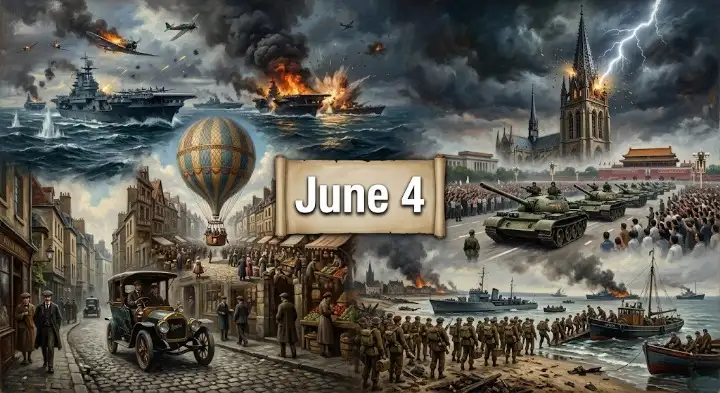
Winston Churchill stood before a hushed House of Commons on June 4, 1940, knowing his nation faced total annihilation. British troops had just pulled off a miraculous escape from the beaches of France, but the air was thick with dread. Churchill did not offer easy comfort. Instead, he promised to fight on beaches, landing grounds, fields, and streets. This day in history June 4 reminds us that human liberty is constantly bought with courage, often at an agonizing price.
Story of the Day: The Battle of Midway Begins
Admiral Chūichi Nagumo stood on the deck of the Japanese aircraft carrier Akagi, confident that his fleet was about to deliver a fatal blow to the United States Navy. His bombers roared into the sky to strike the tiny American outpost at Midway Island, unaware that American codebreakers had intercepted his plans. Three US aircraft carriers were already waiting in the darkness nearby. Within hours, the skies over the Pacific turned into a swirling inferno of anti-aircraft fire and burning planes. This surprise encounter flipped the script of World War II, shattering Japan’s naval supremacy in a single morning.
Important Events That Happened On June 4 In History
713 – Anastasius II Seizes the Byzantine Throne
Artemius, a high-ranking imperial official, accepted the crown from conspirators a single day after his predecessor, Philippicus, was brutally blinded. Taking the regnal name Anastasius II, the new emperor immediately faced a fractured empire teetering on religious collapse. He stabilized the state by enforcing Chalcedonian Christianity and rebuilding the walls of Constantinople against Arab invasion. His rapid rise showed how quickly absolute power changed hands in the bloody corridors of Byzantine politics.
1411 – King Charles VI Grants Roquefort Monopoly
King Charles VI signed a royal decree granting a strict cheese-ripening monopoly to the citizens of Roquefort-sur-Soulzon. Local cave-dwellers had been aging sheep’s milk cheese in the damp, drafty Combalou caves for centuries before the French crown intervened. The law made it illegal for anyone outside the village to sell cheese under the Roquefort name, creating the world’s first protected culinary designation. Today, the same ancient molds still give the famous blue cheese its sharp, unmistakable bite.
1525 – Bayham Abbey Riot Escalates
Furious villagers from Kent and Sussex broke through the heavy wooden doors of Bayham Old Abbey and occupied the holy grounds for a week. Cardinal Thomas Wolsey had ordered the monastery suppressed to seize its wealth and fund his ambitious new university colleges in Oxford and Ipswich. The local tenants refused to let their spiritual center be stripped by a distant church bureaucrat, holding the grounds until royal troops arrived. This brief, violent standoff foreshadowed the massive religious upheavals that would soon tear Tudor England apart.
1561 – Lightning Destroys St Paul’s Steeple
A sudden, violent summer thunderstorm rolled over London and unleashed a massive lightning bolt directly into the wooden steeple of medieval St Paul’s Cathedral. Neighbors watched in horror as fire consumed the grand spire, sending molten lead pouring onto the church roof and filling the streets with choking black smoke. The catastrophic blaze permanently altered the city’s skyline because cash-strapped citizens and royal authorities never rebuilt the iconic structure. Londoners viewed the destruction as a terrifying omen of divine anger during an era of intense religious uncertainty.
1615 – Tokugawa Forces Breach Osaka Castle
Samurai under the command of Tokugawa Ieyasu breached the massive stone defenses of Osaka Castle, turning the fortress into a roaring furnace. Toyotomi Hideyori, the last great rival to Tokugawa rule, watched his ambitions crumble before committing ritual suicide alongside his mother inside the burning keep. The brutal slaughter of the defenders brought a decisive end to the bloody Sengoku period that had fractured Japan for over a century. A new era of total Tokugawa isolation and peace began, sealing the nation’s borders for the next 250 years.
1745 – Frederick the Great Triumphs at Hohenfriedberg
Frederick the Great led his highly disciplined Prussian infantry through a daring night march to surprise a confident Austrian army under Prince Charles Alexander. The Prussians struck with mechanical precision at dawn, shattering the enemy lines during the War of the Austrian Succession. This stunning tactical victory saved Prussia from partition and earned Frederick his legendary historical moniker. The triumph proved that Prussia was now a dominant, feared military powerhouse in Central Europe.
1760 – New England Planters Claim Acadian Lands
Fleet ships carrying anxious New England planters dropped anchor in the harbors of Nova Scotia, Canada, to claim thousands of acres of cleared farmland. British authorities offered these coastal tracts for free after brutally expelling the original French-speaking Acadian populations years earlier. The arriving families stepped onto lands where crops had once grown under different hands, establishing permanent English-speaking settlements in the region. This migration fundamentally remade the cultural, linguistic, and political landscape of modern maritime Canada.
1783 – Montgolfier Brothers Launch First Hot Air Balloon
Joseph and Étienne Montgolfier ignited a massive fire of straw and wool in the marketplace of Annonay, filling a giant linen bag with hot air. The bewildered crowd gasped as the enormous, colorful craft lifted off the ground without any mechanical propulsion, rising high into the sky. The unmanned balloon drifted safely for ten minutes before touching down in a nearby field. This successful public demonstration proved that human flight was possible, igniting an international craze for aerial exploration.
1784 – Élisabeth Thible Becomes First Female Aeronaut
Élisabeth Thible climbed into the basket of an untethered hot air balloon in Lyon, dressed in an elegant gown, as Gustav III of Sweden watched from below. The balloon soared to an astonishing altitude of 1,500 meters, carrying Thible and her pilot across four kilometers of French countryside in 45 minutes. She sang operatic duets to pass the time while feeding the onboard furnace with wood to keep the craft airborne. Her daring voyage broke societal barriers, proving women could endure the terrifying, unknown dangers of early aviation.
1792 – George Vancouver Claims Puget Sound
Captain George Vancouver stepped ashore near modern-day Washington State and claimed the vast waters of Puget Sound for the Kingdom of Great Britain. The British explorer named the sweeping waterway after his lieutenant, Peter Puget, who had painstakingly mapped the complex, forested shoreline. This sweeping imperial declaration ignored the thousands of Indigenous people who had fished and lived along those coasts for millennia. The claim intensified a long-running colonial rivalry between Britain, Spain, and the United States over control of the Pacific Northwest.
1796 – Napoleon Begins the Siege of Mantua
Napoleon Bonaparte deployed his battle-weary French troops around the massive, swamp-ringed fortress of Mantua, the last Austrian stronghold in Northern Italy. The young general knew that breaking this heavily fortified city was the absolute key to driving the Austrian empire out of the Italian peninsula. For eight agonizing months, both sides endured brutal artillery duels, starvation, and rampant disease before the Austrian garrison finally surrendered. This exhausting victory solidified Napoleon’s reputation as a brilliant strategist and gave him total control over Northern Italy.
1802 – King Charles Emmanuel IV Abdicates
King Charles Emmanuel IV of Sardinia sat in his palace, broken by the sudden death of his beloved wife and years of exhausting warfare against Revolutionary France. He signed a formal decree of abdication, surrendering his crown and royal titles to his younger brother, Victor Emmanuel. The former ruler walked away from the throne entirely, eventually joining the Society of Jesus to live out his remaining years in quiet religious contemplation. His departure left a fractured kingdom to navigate the aggressive, expanding empire of Napoleon Bonaparte.
1812 – Missouri Territory Created by Congress
United States lawmakers officially changed the name of the vast Louisiana Territory to the Missouri Territory to avoid confusion with the newly admitted state of Louisiana. This massive administrative region stretched from the Mississippi River all the way to the Rocky Mountains, serving as the wild gateway to the American West. The restructuring created a new territorial government that oversaw the rapid, often violent influx of white settlers and fur traders. This legislative reshuffle set the stage for explosive national debates over the legal expansion of slavery into western lands.
1825 – General Lafayette Inspires Buffalo Residents
General Lafayette stood before an eager, packed crowd in an open clearing that would later become Lafayette Square in Buffalo, New York. The aging French hero of the American Revolutionary War was conducting a celebratory tour of the young United States, reconnecting with the nation he helped liberate. His emotional speech praised the rapid growth of the frontier town, which was about to become a major trade hub via the new Erie Canal. His visit rekindled a deep sense of national pride and unity among a new generation of Americans.
1855 – USS Supply Departs for Camel Procurement
Major Henry C. Wayne ordered the USS Supply to weigh anchor and depart from New York harbor on a bizarre military mission to the Middle East. The United States War Department sent the vessel to purchase dozens of camels to establish an experimental U.S. Camel Corps in the desert Southwest. Politicians believed these hardy animals could carry heavy military cargo across the arid, roadless territories better than traditional horses or mules. The outbreak of the American Civil War eventually ruined the experiment, leaving the camels to wander the Texas plains.
1859 – French Forces Triumph at Magenta
Louis-Napoleon watched from his command post as French and Sardinian soldiers launched a ferocious bayonet charge against Austrian lines near the Italian town of Magenta. The brutal infantry clashes left the muddy fields soaked in blood, forcing the Austrian army into a chaotic, desperate retreat. This costly victory allowed the allied forces to capture Milan and boosted the cause of Italian unification. The battle was so famously bloody that chemists named a newly invented, deep purplish-red dye “magenta” to honor the sacrifice.
1862 – Confederates Evacuate Fort Pillow
Confederate commanders ordered their troops to spike their heavy cannons and slip away from Fort Pillow under the cover of darkness. The sudden retreat along the Mississippi River left the defensive works completely empty, removing the last major obstacle blocking Union gunboats from advancing south. Federal forces marched into the abandoned fort the next morning, securing a vital foothold just upstream from Memphis, Tennessee. The fall of the fort broke the Confederate grip on the mighty river, splitting their western communication lines.
1876 – Transcontinental Express Reaches San Francisco
A sleek steam locomotive puffed to a halt in San Francisco, its whistle blowing loudly to mark the arrival of the Transcontinental Express. The specialized train had departed New York City just 83 hours and 39 minutes earlier, shattering all previous cross-country travel records. This historic journey proved that the newly completed transcontinental railroad could bind the vast American continent together in less than four days. The speed of the trip revolutionized national commerce, communication, and westward migration overnight.
1878 – Ottoman Empire Cedes Cyprus to Britain
Sultan Abdul Hamid II signed the secret Cyprus Convention, handing total administrative control of the strategic Mediterranean island over to the United Kingdom. The Ottoman Empire surrendered the territory in exchange for British military support against the aggressive, expanding Russian Empire in the Balkans. While the Sultan retained nominal sovereignty over the island, British troops moved in immediately to establish a crucial naval base guarding the route to the Suez Canal. This imperial trade reshaped the geopolitical balance of power in the Middle East for a century.
1896 – Henry Ford Tests the Quadricycle
Henry Ford rolled his hand-built Quadricycle out of a small brick shed on Bagley Avenue in Detroit, shivering in the damp, early morning air. He twisted the valve on the two-cylinder, gasoline-powered engine, hopped onto the bicycle-seat frame, and drove through the quiet city streets at twenty miles per hour. The successful test run of his primitive automobile validated years of lonely, late-night mechanical experimentation. This short drive convinced Ford that affordable, mass-produced vehicles were the future, laying the groundwork for the modern global automotive industry.
1912 – Massachusetts Enacts First Minimum Wage Law
Governor Eugene Foss signed a historic piece of legislation making Massachusetts the very first state in the United States to establish a legal minimum wage. The groundbreaking law focused specifically on protecting women and minors, who were routinely exploited for pennies a day in crowded textile mills. Factory owners fought the measure fiercely, claiming it would destroy businesses and disrupt the free market. The law survived legal challenges and sparked a massive national movement that eventually forced the federal government to protect american workers.
1913 – Emily Davison Trampled at the Epsom Derby
Suffragette Emily Davison ducked under the track railings at the Epsom Derby and ran directly into the path of Anmer, a racing horse owned by King George V. The speeding thoroughbred collided with Davison at full force, fracturing her skull and throwing her unconscious onto the turf while the horrified royal crowd watched. Davison died in a hospital four days later, never regaining consciousness to explain her ultimate goal. Her tragic death gave the women’s suffrage movement a powerful, unforgettable martyr who proved activists would die for the vote.
1916 – Russia Launches the Brusilov Offensive
General Aleksei Brusilov unleashed a massive, unexpected artillery barrage along a wide front against Austro-Hungarian lines in Galicia. The innovative tactical assault skipped traditional weeks-long bombardments in favor of short, accurate strikes followed by elite shock infantry units. The Russian army broke through the enemy defenses, capturing hundreds of thousands of Austro-Hungarian soldiers and forcing Germany to divert troops from Verdun. The offensive became the most successful Russian campaign of World War I, though it cost nearly a million lives.
1917 – First Pulitzer Prizes Awarded
Columbia University officials announced the winners of the very first Pulitzer Prizes, establishing a new pinnacle of American intellectual achievement. Laura E. Richards, Maude H. Elliott, and Florence Hall received the inaugural biography award for their detailed life of Julia Ward Howe, while Jean Jules Jusserand won for history. Journalist Herbert B. Swope took home the reporting prize for his gripping inside look at the German Empire for the New York World. These awards elevated american literature and investigative journalism to a respected global standard.
1919 – Congress Approves the Nineteenth Amendment
The United States Senate voted heavily in favor of the Nineteenth Amendment, finally sending the women’s suffrage measure to individual states for ratification. Suffragists cheered from the gallery after decades of picketing, arrests, hunger strikes, and brutal force-feedings in federal prisons. The resolution declared that the right to vote could never be denied or abridged on account of sex. This legislative milestone kicked off an intense, state-by-state political battle that would soon grant 26 million American women full access to the ballot box.
1919 – Leon Trotsky Bans Peasant Congress
Leon Trotsky issued a strict military decree banning a planned peasant and worker congress organized by anarchist leader Nestor Makhno in Ukraine. The Red Army commander viewed the independent gathering as a direct threat to centralized Bolshevik authority during the chaotic Russian Civil War. Trotsky ordered the immediate arrest of anyone who attended, branding the organizers as counter-revolutionary traitors to the state. This harsh crackdown signaled that the new Soviet regime would tolerate no political opposition, even from fellow anti-tsarist revolutionaries.
1920 – Hungary Signs the Treaty of Trianon
Hungarian diplomats sat grimly in the Grand Trianon palace in Paris and signed a peace treaty that officially ended their involvement in World War I. The harsh document stripped Hungary of 71% of its historic territory and 63% of its total population, transferring millions of citizens to neighboring nations. The massive reduction left the country landlocked, economically shattered, and deeply traumatized by the sudden loss of its imperial status. The bitter anger over these stolen borders fueled a powerful wave of nationalism that shaped Eastern European politics for decades.
1928 – Japanese Agents Assassinate Zhang Zuolin
A massive bomb exploded beneath the private train of Chinese warlord Zhang Zuolin as it crossed a railway bridge near Shenyang. Japanese army officers orchestrated the covert assassination, hoping the leader’s death would trigger an administrative collapse and justify a full Japanese military takeover of Manchuria. Zhang died of his horrific wounds hours later, but his son quickly took command and pledged loyalty to the central Chinese government instead. This violent plot accelerated the regional instability that exploded into World War II in Asia.
1932 – Military Coup Establishes Socialist Republic of Chile
Commodore Marmaduke Grove led a group of armed military officers into the presidential palace in Santiago, forcing President Juan Esteban Montero to resign. The coup leaders immediately declared the formation of the short-lived Socialist Republic of Chile, promising to nationalize key industries and relieve the crushing poverty of the Great Depression. The radical new regime lasted only twelve chaotic days before a rival military faction overthrew them in turn. This brief experiment highlighted the deep social fractures and political volatility plaguing South America during the global economic collapse.
1939 – MS St. Louis Denied Entry to Florida
The ocean liner MS St. Louis drifted slowly along the coast of Miami, Florida, its passengers staring at the city lights while US Coast Guard cutters blocked the vessel from docking. The ship carried 973 German Jewish refugees who had already been turned away from Cuba after their landing certificates were abruptly canceled. President Franklin D. Roosevelt ignored desperate telegrams from the passengers, forcing the captain to turn the ship back toward Europe. More than 200 of those refugees later perished in Nazi concentration camps after the West closed its doors.
1940 – Dunkirk Evacuation Ends as Churchill Speaks
The final allied warships slipped away from the burning docks of Dunkirk, completing the miraculous rescue of 338,000 British and French soldiers from the advancing German army. Winston Churchill walked down to the House of Commons that afternoon to deliver his iconic “We shall fight on the beaches” speech to rally a terrified nation. He warned the public that evacuations do not win wars, preparing citizens for an imminent German invasion of Britain. The successful rescue saved the core of the British Army, keeping the fight against Nazi Germany alive.
1942 – Surprise Strikes Open the Battle of Midway
Japanese carrier-based bombers launched a devastating air assault on the American base at Midway Island, turning wooden barracks and fuel tanks into pillars of black smoke. American fighter pilots scrambled into the sky to meet the attack, taking heavy losses against the superior Japanese Zero fighters. Admiral Chūichi Nagumo ordered his remaining planes to prepare a second strike, completely unaware that three US carriers were closing in fast. This tactical decision opened a window for American dive-bombers to launch a devastating counterattack.
1942 – Hitler Makes Surprise Visit to Mannerheim
Adolf Hitler’s personal transport plane touched down unexpectedly on a remote airfield in Immola to honor Finnish Commander-in-Chief Gustaf Mannerheim on his 75th birthday. The German dictator arrived without an official invitation, desperate to keep Finland committed to their shared war against the Soviet Union on the Eastern Front. Mannerheim, who disliked Hitler, insisted on meeting in a secluded railway carriage rather than military headquarters to maintain a diplomatic distance. This tense, recorded conversation remains one of the few private recordings of Hitler’s natural speaking voice.
1943 – Military Coup Ousts Argentine President
General Arturo Rawson led an armed column of 8,000 soldiers into the Plaza de Mayo in Buenos Aires, forcing President Ramón Castillo to flee aboard a navy ship. The sudden military coup ended a decade of corrupt rule known as the Infamous Decade, which was defined by systemic electoral fraud and economic stagnation. The new military regime promised to restore national order and maintain neutrality during the height of World War II. This sudden takeover altered the nation’s political trajectory, opening the door for the rise of Juan Domingo Perón.
1944 – US Navy Captures German Submarine U-505
A specialized hunter-killer group led by the escort carrier USS Guadalcanal surrounded and boarded the damaged German submarine U-505 off the coast of West Africa. American sailors scrambled onto the listing sub, disarming scuttling charges and seizing top-secret Enigma codebooks before the vessel could sink. This daring exploit marked the first time a United States Navy vessel had captured an enemy warship at sea since 1815. The captured intelligence allowed allied codebreakers to track German U-boat movements across the Atlantic for the remainder of the war.
1944 – Allied Troops Liberate Rome
The United States Fifth Army, commanded by General Mark Clark, rolled triumphantly into the historic streets of Rome as cheering Italian citizens showered the tanks with flowers. The retreating German Fourteenth Army abandoned the city without a fight, preserving its ancient monuments and Vatican City from destructive street fighting. Clark ignored his orders to trap the fleeing enemy forces, choosing instead to secure the prestige of capturing the first European axis capital. The historic liberation dominated global headlines for exactly one day before the D-Day landings in Normandy overshadowed it.
1946 – Juan Perón Assumes Argentine Presidency
Juan Domingo Perón walked onto the balcony of the Casa Rosada to take the oath of office as the newly elected President of Argentina. Thousands of working-class citizens packed the plaza below, roaring their approval for the charismatic former labor minister and his influential wife, Evita. Perón won the election by promising radical social justice, higher wages, and complete economic independence from foreign corporate powers. His inauguration launched a powerful political movement that would dominate Argentine politics and social policy for generations.
1961 – Khrushchev Sparks the Berlin Crisis
Soviet Premier Nikita Khrushchev met with US President John F. Kennedy at the Vienna Summit and delivered a terrifying ultimatum regarding the divided city of Berlin. Khrushchev threatened to sign a separate peace treaty with East Germany that would completely cut off Western military access to West Berlin within six months. The tense confrontation deeply rattled the young American president, who refused to back down or abandon the democratic enclave. This diplomatic standoff escalated rapidly, leading directly to the construction of the Berlin Wall two months later.
1967 – Stockport Air Disaster Kills Seventy-Two
A Canadair C-4 Argonaut passenger plane carrying British holidaymakers home from Spain suffered a sudden, dual-engine failure due to a hidden fuel system design flaw. The pilot fought the controls to avoid a crowded housing estate, crashing instead into a small vacant area near the center of Stockport. The impact and subsequent fuel fire killed seventy-two passengers and crew members, making it one of the worst aviation disasters in British history. The tragedy forced aviation authorities to completely overhaul aircraft fuel valve designs to prevent future starvation failures.
1970 – Tonga Gains Total Independence
King George Tupou V stood before a jubilant crowd in Nukuʻalofa to celebrate Tonga’s complete independence from British colonial protection. The peaceful transition ended seventy years as a British protectorate, allowing the tiny Pacific island nation to reclaim full control over its foreign affairs and domestic laws. British officials attended the historic ceremony to hand over authority, marking the friendly dissolution of imperial rule in Polynesia. Tonga immediately joined the Commonwealth of Nations as an equal sovereign state, charting its own modern path.
1975 – California Grants Collective Bargaining to Farmworkers
Governor Jerry Brown signed the historic California Agricultural Labor Relations Act into law, changing agricultural labor history forever. The groundbreaking legislation gave farmworkers the legal right to vote in secret-ballot union elections and bargain collectively for better wages and working conditions. César Chávez and the United Farm Workers union had fought for decades through strikes, boycotts, and hunger strikes to secure these basic legal protections. The law broke the absolute power of wealthy growers, transforming the state’s massive agricultural industry.
1977 – JVC Formally Introduces the VHS Format
Executives from the Victor Company of Japan unveiled their new Video Home System videotape player at the Consumer Electronics Show in Chicago. JVC chose to share their technology openly with other electronics manufacturers, directly challenging Sony’s closed, technically superior Betamax system. This calculated business strategy sparked a brutal corporate format war that raged across global retail markets for a decade. The affordable, longer-recording VHS tapes eventually won the war, becoming the dominant medium for home movie entertainment worldwide.
1979 – Jerry Rawlings Seizes Power in Ghana
Flight Lieutenant Jerry Rawlings led a bloody military coup in Accra, overthrowing the corrupt regime of General Fred Akuffo just weeks before scheduled democratic elections. The young air force officer established the Armed Forces Revolutionary Council, promising to purge the nation’s military and political elite of systemic bribery and hoarding. Rawlings ordered the public execution of several former military rulers to satisfy public anger over rampant inflation and food shortages. This violent takeover initiated a tumultuous political transformation that eventually led to stable democracy.
1983 – Fugitive Gordon Kahl Killed in Shootout
Federal marshals and local police surrounded a remote farmhouse in Smithville, Arkansas, tracking radical tax protester Gordon Kahl after a four-month national manhunt. Kahl had been on the run since killing two US Marshals during a violent roadside shootout in North Dakota earlier that year. A ferocious gunbattle erupted when authorities breached the home, resulting in the immediate deaths of both Kahl and a local county sheriff. The violent standoff highlighted the rising threat of extremist anti-government movements in the American heartland.
1986 – Jonathan Pollard Pleads Guilty to Espionage
Former US Navy intelligence analyst Jonathan Pollard stood in a Washington federal courtroom and pleaded guilty to selling classified military secrets to Israel. Pollard had smuggled thousands of pages of top-secret documents out of his office, delivering them to Israeli handlers in exchange for cash and expensive jewelry. The shocking revelation that a close ally was running an active spy operation inside the American government strained diplomatic relations between Washington and Tel Aviv for years. Pollard received a life sentence, becoming a deeply divisive political figure.
1988 – Hexogen Train Explosion Kills Ninety-One
Three freight cars carrying tons of highly explosive hexogen powder detonated without warning as a train entered the railway station in Arzamas, USSR. The massive blast obliterated the station, leveled nearby residential neighborhoods, and left an enormous crater in the tracks, killing ninety-one people and injuring over 1,500 others. Soviet authorities blamed the disaster on a gas leak that ignited from sparks thrown by the train’s brakes, though rumors of sabotage persisted. The tragedy highlighted the decaying state of industrial safety infrastructure in the late Soviet era.
1989 – Ali Khamenei Elected Supreme Leader of Iran
Iran’s Assembly of Experts gathered in a tense emergency session following the death and massive public funeral of Ayatollah Ruhollah Khomeini. The council voted to elevate President Ali Khamenei to the lifetime position of Supreme Leader, despite his lack of traditional high-ranking clerical credentials. This rapid political promotion required a sudden amendment to the national constitution to validate his authority over the Islamic Republic. Khamenei took control of the nation’s military and religious institutions, steering Iran along a strict anti-Western path.
1989 – Tanks Crush Tiananmen Square Protests
The Chinese People’s Liberation Army rolled heavy tanks and thousands of armed troops into Beijing’s Tiananmen Square under the cover of darkness, opening fire on crowds of unarmed student demonstrators. For weeks, millions of citizens had occupied the square to demand free speech, government accountability, and democratic reforms. The brutal military assault crushed the peaceful uprising, leaving hundreds, possibly thousands, of civilians dead in the surrounding streets. The Chinese government immediately banned all public memory of the massacre, enforcing total political silence across the nation.
1989 – Solidarity Triumphs in Polish Elections
Polish citizens queued outside polling stations in historic numbers, casting ballots in the nation’s first partially free legislative elections since World War II. The independent trade union Solidarity, led by Lech Wałęsa, won an astonishing 99 out of 100 available seats in the newly created Senate, utterly humiliating the ruling Communist Party. The overwhelming democratic victory forced the communists to abandon their historic monopoly on political power. This stunning electoral upset triggered a peaceful wave of anti-communist revolutions across Eastern Europe.
1989 – Pipeline Explosion Causes Ufa Train Disaster
A massive natural gas pipeline leak filled a low-lying valley near Ufa, Russia, with an invisible, highly flammable cloud of hydrocarbon vapor. As two passenger trains carrying hundreds of children home from holiday resorts passed each other, wheel friction threw sparks into the air, triggering a colossal thermobaric explosion. The apocalyptic blast incinerated both trains and destroyed kilometers of forest, killing 575 passengers and leaving hundreds more with horrific burns. The disaster remains the deadliest rail accident in Soviet history, caused by systemic maintenance neglect.
1996 – Maiden Flight of Ariane 5 Explodes
The European Space Agency’s brand-new Ariane 5 rocket lifted off from its pad in Kourou, French Guiana, roaring into the sky on its highly anticipated maiden flight. Just thirty-seven seconds into the launch, the rocket suddenly veered off course and self-destructed in a massive fireball over the Atlantic Ocean. Investigation revealed that a simple software coding error had caused the main computer to overflow its memory and miscalculate the rocket’s true position. The costly failure destroyed four expensive scientific satellites, delaying Europe’s space exploration program.
2005 – Romanian Civic Forum Founded in Central Counties
Community leaders and activists gathered in the central region of Romania to officially establish the Civic Forum of the Romanians of Covasna, Harghita, and Mureș. The new non-governmental organization aimed to protect the cultural identity and civil rights of ethnic Romanians living as minorities within Hungarian-majority counties. The founders organized cultural festivals, funded local schools, and lobbied the national government for fair infrastructure investment. The forum’s creation added a structural element to ongoing ethnic cohabitation and political debates in Transylvania.
2010 – SpaceX Launches First Falcon 9 Rocket
The first Falcon 9 rocket ignited its nine Merlin engines and soared away from Cape Canaveral Space Launch Complex 40, punching through the Florida clouds. The successful orbital flight validated Elon Musk’s ambitious gamble on private commercial space travel, proving a private company could build a reliable, heavy-lift rocket. The vehicle achieved its exact target orbit, carrying a dummy payload safely into space before shutting down its engines. This milestone launch fundamentally transformed the global aerospace industry, initiating a new era of affordable, commercial space access.
2020 – Giovanni López Protests Erupt in Mexico
Furious demonstrators marched through the streets of Jalisco, setting police vehicles on fire and clashing with riot squads outside government buildings. The violent protests erupted after a cell phone video went viral on social media showing the brutal police arrest of Giovanni López Ramírez, who later died in custody. Inspired by the global George Floyd movement, Mexican citizens demanded an immediate end to systemic police brutality and judicial corruption. The spreading civil unrest forced federal authorities to arrest the local officers involved in the beating.
2023 – Massive Protests Shake Polish Government
Hundreds of thousands of citizens packed the historic streets of Warsaw, waving red and white national flags in the largest political demonstration since the fall of communism. The massive protest march, organized by opposition leader Donald Tusk, targeted the ruling Law and Justice party’s controversial judicial laws and media crackdowns. Demonstrators marched past government offices, chanting slogans demanding democratic transparency, free elections, and a return to European Union standards. The massive turnout signaled a powerful shift in the nation’s political landscape ahead of crucial elections.
2023 – Cessna Citation Crashes into Virginia Mountain
A Cessna Citation V private jet suddenly drifted off course over Washington D.C., prompting the military to scramble F-16 fighter jets to intercept the unresponsive aircraft. The sonic booms rattled residents across the capital city before the private plane plunged at a near-vertical angle into Mine Bank Mountain in Augusta County, Virginia. All four people on board, including a prominent family and their young child, perished instantly in the catastrophic impact. Air crash investigators later determined that sudden cabin depressurization had knocked the pilot unconscious long before the crash.
2025 – Fatal Crowd Crush in Bengaluru Stadium
Eleven cricket fans lost their lives and fifty-six others suffered severe injuries during a chaotic crowd crush outside M. Chinnaswamy Stadium in Bengaluru, India. Thousands of ecstatic supporters had packed the narrow streets around the stadium to celebrate Royal Challengers Bengaluru’s historic Indian Premier League victory parade. Poor gate management and a sudden surge of people trying to glimpse the players trapped hundreds against the concrete security barricades. The tragic incident prompted national sports authorities to completely overhaul urban stadium security and parade safety protocols.
Need a history fix? Click here for our previous tales.
Famous People Born On June 4
| Name | Description | Date |
|---|---|---|
| François Quesnay | French economist, leader of physiocrats | June 4, 1694 – December 16, 1774 |
| Jacob Israel Emden | Danish rabbi and Talmudic scholar | June 4, 1697 – April 19, 1776 |
| Benjamin Huntsman | English inventor of crucible steel | June 4, 1704 – June 20, 1776 |
| George III | King of Great Britain and Ireland (1760–1820) | June 4, 1738 – January 29, 1820 |
| John Scott, 1st earl of Eldon | British lord chancellor (1801–27) | June 4, 1751 – January 13, 1838 |
| Mary Hannah Hanchett Hunt | American temperance leader | June 4, 1830 – April 24, 1906 |
| Garnet Wolseley, 1st Viscount Wolseley | British field marshal, modernized British army | June 4, 1833 – March 26, 1913 |
| Carl Gustaf Mannerheim | Finnish military leader and president | June 4, 1867 – January 27, 1951 |
| Constance M.K. Applebee | British athlete, introduced field hockey to U.S. | June 4, 1873 – January 26, 1981 |
| Heinrich Otto Wieland | German chemist, Nobel Prize (1927) | June 4, 1877 – August 5, 1957 |
| Natalya Goncharova | Russian avant-garde painter and stage designer | June 4, 1881 – October 17, 1962 |
| Beno Gutenberg | American seismologist, Earth’s interior analysis | June 4, 1889 – January 25, 1960 |
| Dino Grandi, conte di Mordano | Italian Fascist official, helped overthrow Mussolini | June 4, 1895 – May 21, 1988 |
| Harry Crosby | American poet and publisher, Black Sun Press | June 4, 1898 – December 10, 1929 |
| Carlton E. Morse | American radio writer and producer | June 4, 1901 – May 24, 1993 |
| Rosalind Russell | American actress | June 4, 1907 – November 28, 1976 |
| Sir Christopher Cockerell | British inventor of the Hovercraft | June 4, 1910 – June 1, 1999 |
| Modibo Keita | First president of Mali (1960–68) | June 4, 1915 – May 16, 1977 |
| Robert F. Furchgott | American pharmacologist, Nobel Prize (1998) | June 4, 1916 – May 19, 2009 |
| Russell E. Train | American conservationist | June 4, 1920 – September 17, 2012 |
| Elizabeth Jolley | Australian novelist and short-story writer | June 4, 1923 – February 13, 2007 |
| Alfredo Di Stéfano | Argentine-born footballer, Real Madrid legend | June 4, 1926 – Present |
| Judith Malina | American theatre director, co-founder of Living Theatre | June 4, 1926 – April 10, 2015 |
| Ruth Westheimer | German-American sex therapist, “Dr. Ruth” | June 4, 1928 – July 12, 2024 |
| Viktor Vasilyevich Tikhonov | Soviet ice hockey coach | June 4, 1930 – November 24, 2014 |
| Maurice Shadbolt | New Zealand author | June 4, 1932 – October 10, 2004 |
| Joyce Meyer | American televangelist and author | June 4, 1943 – Present |
| Anthony Braxton | American free jazz composer and improviser | June 4, 1945 – Present |
| Jim Wallis | American Evangelical pastor and social activist | June 4, 1948 – Present |
| Bronisław Komorowski | President of Poland (2010–15) | June 4, 1952 – Present |
Famous People Died On June 4
| Name | Description | Date |
|---|---|---|
| Conrad II | Holy Roman emperor (1027–39), founder of Salian dynasty | c.990 – June 4, 1039 |
| Jacques Lemercier | French architect, introduced classical elements | 1585 – June 4, 1654 |
| William Juxon | Archbishop of Canterbury, minister to Charles I | 1582 – June 4, 1663 |
| Toyotomi Hideyori | Japanese ruler, son of Toyotomi Hideyoshi | August 29, 1593 – June 4, 1615 |
| Daniel Marot | French-born Dutch architect and designer | 1661 – June 4, 1752 |
| John Burgoyne | British general, defeated at Saratoga (1777) | 1722 – June 4, 1792 |
| Giacomo Casanova | Italian adventurer and libertine | April 2, 1725 – June 4, 1798 |
| Nicolai Abraham Abildgaard | Danish Neoclassical painter | September 11, 1743 – June 4, 1809 |
| Henry Grattan | Anglo-Irish statesman, secured Irish legislative independence | July 3, 1746 – June 4, 1820 |
| Lord Edward Fitzgerald | Irish rebel leader in 1798 uprising | October 15, 1763 – June 4, 1798 |
| Marguerite Gardiner, countess of Blessington | Irish writer, salonnière | September 1, 1789 – June 4, 1849 |
| Nassau William Senior | British classical economist | September 26, 1790 – June 4, 1864 |
| Eduard Friedrich Mörike | German lyric poet | September 8, 1804 – June 4, 1875 |
| Abdülaziz | Ottoman sultan (1861–76) | February 9, 1830 – June 4, 1876 |
| William A. Wheeler | 19th vice president of the United States (1877–81) | June 30, 1819 – June 4, 1887 |
| Abu Bakar | Sultan of Johore (1885–95) | c.1830? – June 4, 1895 |
| Johannes von Mikulicz-Radecki | Polish surgeon, invented gauze mask | May 16, 1850 – June 4, 1905 |
| Charles Warren Fairbanks | 26th vice president of the United States (1905–09) | May 11, 1852 – June 4, 1918 |
| W. H. R. Rivers | English anthropologist and psychologist | March 12, 1864 – June 4, 1922 |
| Pierre Louÿs | French novelist and poet | December 10, 1870 – June 4, 1925 |
| Zhang Zuolin | Chinese warlord, dominated Manchuria | March 19, 1875 – June 4, 1928 |
| Ahmed Haşim | Turkish Symbolist poet | 1884 – June 4, 1933 |
| Fernand Cabrol | Benedictine monk, historian of Christian worship | December 11, 1855 – June 4, 1937 |
| John J. Flanagan | Irish-American Olympic hammer throw champion | January 9, 1873 – June 4, 1938 |
| Wilhelm II | German emperor (1888–1918) | January 27, 1859 – June 4, 1941 |
| Reinhard Heydrich | Nazi SS official, architect of Holocaust | March 7, 1904 – June 4, 1942 |
| Georg Kaiser | German Expressionist dramatist | November 25, 1878 – June 4, 1945 |
| Helen Gardner | American art historian | March 17, 1878 – June 4, 1946 |
| Maurice Blondel | French philosopher, “philosophy of action” | November 2, 1861 – June 4, 1949 |
| Kazys Grinius | Lithuanian statesman, president (1926) | December 17, 1866 – June 4, 1950 |
Observances on June 4
International Day of Innocent Children Victims of Aggression
Established by the United Nations in 1982, this solemn day honors children worldwide who suffer physical, mental, and emotional abuse from war and military conflict. The day emphasizes the global responsibility to protect vulnerable youth trapped in conflict zones.
Tiananmen Square Memorials
Human rights activists and ordinary citizens gather worldwide to hold candlelight vigils honoring the hundreds of students killed during the 1989 military crackdown in Beijing. The annual observances keep the memory of the suppressed Chinese democracy movement alive.
Trianon Treaty Day (Romania)
This national day marks the 1920 signing of the Treaty of Trianon, which officially recognized the unification of Transylvania with Romania following World War I. Romanians celebrate the date with historical lectures, flag ceremonies, and public cultural events.
Flag Day of the Finnish Defence Forces
Finland celebrates this official military holiday to honor the birthday of Marshal Gustaf Mannerheim, the legendary commander who led the nation’s army through World War II. The day features national military parades, promotions, and public medal ceremonies.
Emancipation Day (Tonga)
Tonga honors King George Tupou’s 1862 abolition of feudal serfdom and the nation’s subsequent 1970 liberation from British colonial protection on this public holiday. Communities celebrate across the islands with traditional dances, family feasts, and church services.
🕊️ Frequently Asked Questions — June 4 in History
The Chinese military brutally suppressed peaceful democracy protests in Beijing’s Tiananmen Square by sending in heavy tanks and armed troops. Meanwhile, across the globe, Polish citizens voted overwhelmingly for the Solidarity movement in partially free elections, triggering the historic collapse of communism across Eastern Europe.
The military crackdown at Tiananmen Square in 1989 stands out because it altered China’s political path and showed how far the regime would go to stay in power. The event remains a global symbol of the struggle for free speech and human rights against authoritarian control.
King George III of Great Britain was born on this day in 1738, later leading his empire through the global upheavals of the American Revolutionary War. Hollywood actress Angelina Jolie was also born on this day in 1975, achieving global fame for her film career and international humanitarian work.
The pivotal Battle of Midway began in the Pacific theater of World War II in 1942 as Japanese forces launched a heavy air assault on the American island outpost. The encounter quickly escalated into a massive naval battle that permanently shifted the balance of power in the Pacific war.
The United Nations established this global observance to focus international attention on the millions of children who suffer from the horrors of war and military occupation. The day serves as a global call to action for countries to protect children’s rights and end violence in conflict zones.
A tragic crowd crush outside M. Chinnaswamy Stadium in Bengaluru, India killed eleven ecstatic cricket fans during an Indian Premier League victory celebration in 2025. The incident led to immediate national demands for stricter crowd control measures at major sporting events across the country.