| Event Category | Key Historical Details |
|---|---|
| Most Significant Event | Apollo 11 splashes down safely in the Pacific Ocean (1969) |
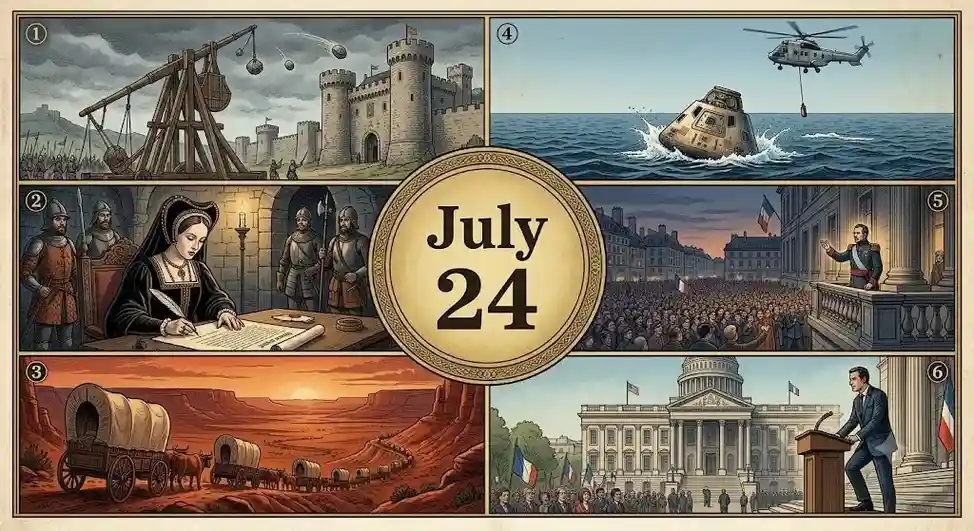
| Top 10 Key Events | Fall of Stirling Castle (1304) • Mary Queen of Scots forced to abdicate (1567) • Founding of Detroit (1701) • Brigham Young enters Salt Lake Valley (1847) • Kellogg–Briand Pact takes effect (1929) • Operation Gomorrah begins (1943) • “Kitchen Debate” (1959) • “Vive le Québec libre!” (1967) • Apollo 11 splashdown (1969) • Boris Johnson becomes UK Prime Minister (2019) |
| Key Battles That Day | Battle of Nocera (1132), Fall of Stirling Castle (1304), Battle of Harlaw (1411), Battle of Denain (1712), Battle of Kernstown (1864) |
| Key Figures Today | Mary, Queen of Scots; Brigham Young; the crew of Apollo 11; Charles de Gaulle; Boris Johnson |
| Observances | Police Day (Poland) Pioneer Day (Utah) Navy Day (Venezuela) Simón Bolívar Day (Ecuador, Venezuela, Colombia, Bolivia) |
Story of the Day: Apollo 11 Comes Home
Three men who’d just walked on the Moon were floating in a capsule the size of a car, falling through the atmosphere at 25,000 miles an hour. Parachutes opened over the Pacific. Splashdown. Navy divers swam out to the bobbing command module and helped Armstrong, Aldrin and Collins into inflatable rafts, then straight into biological isolation suits — nobody yet knew if they’d brought lunar germs home. The USS Hornet hauled them aboard. Eight days after launch, humanity’s first Moon landing ended not with fanfare but with three exhausted astronauts quarantined in a converted Airstream trailer.
Important Events That Happened On July 24 In History
1132 – Battle of Nocera
South of Naples, two rival Norman lords bring their armies face to face near Nocera. Ranulf II of Alife challenges Roger II of Sicily for control of the mainland south. The fighting is brutal and inconclusive on the ground, but it cements Roger’s reputation as the man to beat. Within a year, Roger pushes on to unify Sicily and southern Italy under one crown.
1148 – Louis VII Besieges Damascus
Crusader tents ring the walls of Damascus as King Louis VII of France presses the siege during the ill-fated Second Crusade. The city’s gardens and orchards, thick with cover, slow the attackers at every turn. After only four days, disagreements among the Crusader leaders and fierce local resistance force a retreat. The failed siege becomes one of the clearest signs the Second Crusade is falling apart.
1304 – Fall of Stirling Castle
Stones the size of boulders crash into Stirling’s walls, hurled by a brand-new siege engine King Edward I of England has nicknamed the “War Wolf.” He’s so proud of it he reportedly refuses the garrison’s surrender until his new toy gets to fire. The castle falls, giving England command of a key crossing point in Scotland. It’s a rare high point for Edward in a war that Scotland will ultimately win.
1411 – Battle of Harlaw
Highland clansmen under Donald, Lord of the Isles, clash with lowland forces near Aberdeen in a fight so vicious it earns the nickname “Red Harlaw.” Neither side can claim a clean victory, and both walk away having lost enormous numbers of men. It becomes remembered as one of the bloodiest single days in Scottish history. Centuries of ballads and folk memory keep the slaughter alive long after the political dispute behind it fades.
1412 – Behnam Hadloyo Becomes Patriarch of Mardin
In the hill city of Mardin, church leaders confirm Behnam Hadloyo as Syriac Orthodox Patriarch. The appointment strengthens a Christian community already squeezed by shifting regional power. His leadership steadies the patriarchate through a genuinely precarious period. The office he holds still exists today, tracing its line back through moments exactly like this one.
1487 – Leeuwarden’s Beer Strike
Citizens of Leeuwarden in the Netherlands refuse to accept a new ban on foreign beer, and they make their anger public. It’s a small dispute on paper, but it taps into deep resentment over local authorities controlling everyday trade. The strike forces officials to reckon with how fiercely ordinary people will defend their daily pint. It’s an early, oddly relatable example of consumer pushback against protectionist policy.
1534 – Cartier Claims the Gaspé Peninsula
French explorer Jacques Cartier plants a wooden cross on the Gaspé Peninsula, claiming the land for King Francis I. Local Iroquoian people who greet his expedition have no idea a European crown now considers this territory theirs. The moment marks France’s first real foothold in what will become Canada. It sets off more than two centuries of French colonial presence in North America.
1567 – Mary, Queen of Scots, Forced to Abdicate
Held at Lochleven Castle under armed guard, Mary signs away her crown rather than risk worse. Her one-year-old son is proclaimed King James VI in her place. It’s a stunning fall for a queen who once ruled in her own right. Mary’s later escape, exile, and execution in England all trace back to this single forced signature.
1701 – Detroit Is Founded
Antoine de la Mothe Cadillac steps ashore on the Detroit River and orders a fort built, naming it Fort Pontchartrain. The site is chosen deliberately to control the fur trade route between Lake Erie and Lake Huron. A trading post takes root and slowly grows around the fort’s walls. Three centuries later that outpost is the city of Detroit.
1712 – Battle of Denain
Marshal Villars leads French troops in a surprise attack against Eugene of Savoy’s forces at Denain during the War of the Spanish Succession. The French win decisively, reversing years of battlefield losses in a single afternoon. The victory gives France real leverage at the negotiating table. It helps push the war toward the peace settlement that follows within a year.
1847 – Brigham Young Reaches Salt Lake Valley
After 17 grueling months on the trail, Brigham Young looks out over the Salt Lake Valley and tells his exhausted followers this is the place. He leads 148 Mormon pioneers down into a barren, unclaimed basin nobody else wanted. They break ground within days, refusing to wait for a better sign. The settlement they build becomes Salt Lake City, the heart of a religious migration still commemorated every year.
1847 – Richard Hoe Patents the Rotary Printing Press
In his New York workshop, inventor Richard March Hoe secures a patent for a rotary-type printing press. The design lets paper feed continuously around a rotating cylinder instead of one sheet at a time. Print runs that once took days suddenly take hours. Newspapers scale up almost overnight, reshaping how fast information can travel to the public.
1864 – Battle of Kernstown
Confederate General Jubal Early springs an attack on Union troops under General George Crook in the Shenandoah Valley. The Union line breaks and Crook’s men are pushed out of the valley entirely. It’s a sharp tactical win for the Confederacy at a point in the war when good news is increasingly rare for the South. The valley stays contested ground for the rest of the campaign season.
1866 – Tennessee Readmitted to Congress
Tennessee becomes the first former Confederate state allowed back into Congress after the Civil War. The readmission comes only after the state ratifies the 14th Amendment, granting citizenship rights to formerly enslaved people. It sets the template other Southern states will have to follow to rejoin the Union. The move marks Reconstruction’s first real test of whether the South can be reintegrated on new terms.
1901 – O. Henry Walks Free
Writer William Sydney Porter, better known as O. Henry, walks out of a Columbus, Ohio prison after three years for bank embezzlement. He’d started writing short stories behind bars, partly to send money to his young daughter. Release lets him move to New York and write full-time under his now-famous pen name. Within a decade he becomes one of America’s most beloved short story writers, twist endings and all.
1910 – Ottomans Capture Shkodër
Ottoman forces move into the city of Shkodër, crushing the Albanian Revolt of 1910. Albanian fighters had hoped the uprising would win them greater autonomy from Istanbul. Instead, the empire reasserts direct control over the region. The suppressed revolt becomes one more grievance feeding Albania’s push for full independence just two years later.
1911 – Hiram Bingham Rediscovers Machu Picchu
Guided by a local farmer, American explorer Hiram Bingham III climbs through cloud forest above the Urubamba River and finds stone walls swallowed by jungle. He’s stumbled onto Machu Picchu, the abandoned mountain city of the Inca. Bingham had actually been hunting for a different lost city entirely. His photographs turn Machu Picchu into one of the most recognizable ruins on Earth almost overnight.
1915 – SS Eastland Capsizes in Chicago
Still tied to its dock on the Chicago River, the passenger ship SS Eastland suddenly rolls onto its side, trapping hundreds below deck. The ship never even leaves port before disaster strikes. 844 passengers and crew die, making it the deadliest single shipwreck in Great Lakes history. The tragedy leads directly to tougher safety regulations for passenger vessels nationwide.
1922 – British Mandate for Palestine Confirmed
The League of Nations Council formally confirms the terms of the British Mandate for Palestine. The document hands Britain administrative control while setting the stage for a Jewish national home there. It won’t actually take effect for another year, but the framework is now locked in. Decades of regional conflict trace back to the boundaries and promises drawn up in this mandate.
1923 – Treaty of Lausanne Signed
In Switzerland, Greece, Bulgaria, Turkey, and other World War I combatants sign the Treaty of Lausanne, finally settling Turkey’s modern borders. The treaty replaces a harsher earlier settlement that Turkish nationalists had refused to accept. It recognizes the new Turkish Republic on far more favorable terms. The borders it draws remain essentially unchanged a century later.
1924 – Sofoulis Becomes Greek Prime Minister
Themistoklis Sofoulis takes office as Prime Minister of Greece during a turbulent stretch for the young Greek republic. Political instability has toppled multiple governments in rapid succession. His tenure is short, but he’ll return to the premiership more than once in later decades. Greece’s revolving-door politics of the era make even brief leadership terms historically significant.
1927 – Menin Gate Unveiled at Ypres
Crowds gather at Ypres in Belgium as the Menin Gate memorial is unveiled, its walls inscribed with the names of nearly 55,000 missing soldiers from World War I. There are so many names that thousands more still couldn’t fit and had to be listed elsewhere. Every evening since, buglers have played the Last Post beneath its arch. The tradition has continued for nearly a century, pausing only briefly during German occupation in World War II.
1929 – Kellogg–Briand Pact Takes Effect
An international agreement renouncing war as a tool of foreign policy formally comes into force, having been signed in Paris the year before by most major world powers. On paper it outlaws aggressive war entirely. It carries no real enforcement mechanism, and history quickly proves its limits. Even so, the pact’s language later helps define what counts as a war crime at the Nuremberg trials.
1935 – Dust Bowl Heat Wave Peaks
Temperatures rocket to 109°F in Chicago and 104°F in Milwaukee as the Dust Bowl’s brutal heat wave reaches its worst point. Crops that survived the drought wither outright in the extreme heat. Cities record some of the highest temperatures in their history. The heat wave becomes one more entry in a decade already defined by ecological and economic disaster.
1943 – Operation Gomorrah Begins
British and Canadian bombers strike Hamburg by night while American planes hit the city by day, launching one of the most devastating bombing campaigns of World War II. Firestorms tear through residential districts, generating winds strong enough to uproot trees. By the time the operation ends in November, roughly 9,000 tons of explosives have killed more than 30,000 people and destroyed 280,000 buildings. It becomes a grim preview of the strategic bombing campaigns still to come against Germany and Japan.
1950 – Cape Canaveral Begins Operations
A Bumper rocket lifts off from a stretch of Florida coastline that had been little more than scrub and sand. It’s the very first launch from what will become Cape Canaveral Air Force Station. Nobody watching realizes they’ve just witnessed the birth of America’s spaceport. Within two decades, the same stretch of coast sends astronauts to the Moon.
1959 – The “Kitchen Debate”
Standing in front of a model American kitchen at the U.S. exhibition in Moscow, Vice President Richard Nixon and Soviet Premier Nikita Khrushchev trade sharp jabs about capitalism versus communism. Neither backs down, gesturing at appliances while arguing about whose system actually delivers for ordinary people. Reporters capture every heated exchange. The unscripted clash becomes one of the most quoted Cold War exchanges between American and Soviet leaders.
1963 – Bluenose II Launched
In Lunenburg, Nova Scotia, shipbuilders launch the schooner Bluenose II, a faithful recreation of the legendary racing ship Bluenose. The original had been a source of immense national pride, appearing on Canadian currency and stamps. The new vessel is built specifically to keep that legacy alive on the water. It still sails today as one of Canada’s most recognized maritime symbols.
1966 – First BASE Jump From El Capitan
Michael Pelkey and Brian Schubert step off the sheer granite face of El Capitan in Yosemite with parachutes strapped to their backs, attempting something nobody has tried from a fixed cliff before. Both land hard enough to break bones. The jump still counts as the first BASE jump from El Capitan on record. Park authorities respond by banning the activity from the cliff entirely.
1967 – “Vive le Québec Libre!”
From a balcony in Montreal, French President Charles de Gaulle looks out over a crowd of more than 100,000 and declares “Long live free Quebec!” The line electrifies Quebec separatists and infuriates the Canadian federal government. Ottawa considers it a direct provocation from a foreign head of state. The remark ends de Gaulle’s state visit early and fuels Quebec’s independence movement for years afterward.
1969 – Apollo 11 Splashes Down
The Apollo 11 command module hits the Pacific Ocean under parachute, bringing Neil Armstrong, Buzz Aldrin, and Michael Collins home after humanity’s first Moon landing. Navy divers reach the capsule and guide the crew into quarantine suits before anyone else can touch them. The USS Hornet recovers the astronauts within the hour. It closes out arguably the single most famous week in the history of space exploration.
1974 – Supreme Court Rules Against Nixon
The U.S. Supreme Court rules unanimously that President Richard Nixon cannot withhold subpoenaed White House tapes from the Watergate special prosecutor. Nixon’s lawyers had argued executive privilege covered the recordings entirely. The court disagrees, ordering the tapes handed over immediately. Within weeks, the tapes’ contents help drive Nixon to resign rather than face impeachment.
1977 – Libyan-Egyptian War Ends
After four days of border clashes, fighting between Libya and Egypt comes to a close. The brief war had erupted out of years of tension between Muammar Gaddafi and Anwar Sadat. Neither side gains meaningful territory from the fighting. The ceasefire does little to repair a relationship that stays hostile for years afterward.
1980 – Australia Wins Historic Relay
Australia’s “Quietly Confident Quartet” touches the wall first in the men’s 4×100 meter medley relay at the Moscow Olympics. It’s a genuine upset in a race the United States had dominated at every Olympics before. American swimmers aren’t even competing due to the US boycott of the Games. It remains the only time the U.S. has failed to win that event at Olympic level.
1982 – Nagasaki Mudslide
Torrential rain triggers a mudslide in Nagasaki, Japan, powerful enough to destroy a bridge in its path. 299 people lose their lives in the disaster. The flooding overwhelms a city still associated worldwide with catastrophe from decades earlier. It prompts a major rethink of flood and landslide defenses across the region.
1983 – Black July Begins in Sri Lanka
Anti-Tamil riots erupt across Sri Lanka, killing somewhere between 400 and 3,000 people over the following days. Mobs target Tamil homes and businesses in a wave of ethnic violence. The scale of the killing shocks the international community. Black July is widely seen as the spark that ignites the Sri Lankan Civil War, a conflict that grinds on for a quarter century.
1983 – The Pine Tar Incident
George Brett drives a go-ahead home run for the Kansas City Royals against the New York Yankees, only to watch umpires nullify it. Yankees manager Billy Martin had spotted too much pine tar on Brett’s bat and demanded an inspection. Brett storms out of the dugout in a fury that becomes one of baseball’s most replayed moments. The ruling is later overturned by the American League president, and the game’s final innings are replayed weeks afterward.
1987 – SS Bridgeton Strikes a Mine
The American supertanker SS Bridgeton collides with a mine laid by Iran’s Revolutionary Guard in the Persian Gulf. The blast tears a massive dent into the tanker’s hull. Remarkably, the ship stays afloat and continues its voyage. The incident highlights just how dangerous Gulf shipping lanes have become during the Iran-Iraq tanker war.
1987 – Hulda Crooks Climbs Mount Fuji
At 91 years old, Hulda Crooks reaches the summit of Mount Fuji, Japan’s highest peak. She’d already built a reputation as a serious mountaineer well into her senior years, tackling peaks most people half her age would avoid. The climb makes her the oldest person on record to reach Fuji’s summit. Her achievement becomes a lasting example of what late-life physical ambition can look like.
1998 – Capitol Shooting
Russell Eugene Weston Jr. forces his way into the United States Capitol and opens fire, killing two Capitol Police officers who try to stop him. The attack sends lawmakers and staff scrambling for safety in the middle of a workday. Weston is eventually subdued and arrested. Courts later rule him mentally incompetent to stand trial, and the case never reaches a full verdict.
1999 – Air Fiji Flight 121 Crashes
Air Fiji Flight 121 goes down while flying toward Nadi, Fiji, killing all 17 people aboard. The crash is one of the deadliest aviation disasters in Fiji’s history. Investigators comb the wreckage for answers in the aftermath. The loss prompts scrutiny of regional aviation safety standards across the Pacific.
2001 – Bandaranaike Airport Attack
Fourteen Tamil Tiger commandos storm Sri Lanka’s main international airport, destroying aircraft and inflicting military and civilian casualties. The assault strikes at the heart of the country’s air transport and tourism industry. Security forces engage the attackers directly on the tarmac. The raid becomes one of the most damaging strikes of the long-running Sri Lankan Civil War.
2009 – Aria Air Flight 1525 Crashes
Aria Air Flight 1525 crashes at Mashhad International Airport in Iran, killing 16 people on board. The aircraft goes down during landing procedures at the airport. Investigators launch a review into the causes of the crash. It adds to a difficult stretch for Iranian domestic aviation safety in that era.
2012 – YPG Captures Girkê Legê
Kurdish YPG fighters take control of the city of Girkê Legê during the Syrian Civil War. The capture extends Kurdish-held territory in Syria’s north. It’s part of a broader pattern of Kurdish forces filling power vacuums as the Syrian state loses its grip on outlying regions. The gains here help lay groundwork for the semi-autonomous Kurdish administration that follows.
2013 – Santiago de Compostela Derailment
A high-speed train rounds a curve in Spain at 120 mph where the limit is just 50, hurtling off the tracks near Santiago de Compostela. 78 passengers die in the wreck, making it one of Europe’s deadliest rail disasters in decades. Investigators quickly focus on driver error and inadequate speed-warning systems. The crash forces a major overhaul of safety systems on Spain’s high-speed rail network.
2014 – Air Algérie Flight 5017 Crashes
Air Algérie Flight 5017 loses contact with air traffic control 50 minutes after leaving Ouagadougou, Burkina Faso, bound for Algiers. Search teams eventually locate the wreckage deep in Mali. All 116 people aboard are killed. The crash is later linked to a mix of severe weather and a technical fault.
2019 – Boris Johnson Becomes UK Prime Minister
Boris Johnson defeats Jeremy Hunt in the Conservative Party leadership contest and takes over as UK Prime Minister, succeeding Theresa May. He inherits a government paralyzed by Brexit gridlock and a razor-thin parliamentary majority. His premiership immediately plunges into fresh confrontations with Parliament over the exit deal. His time in office goes on to reshape British politics for years afterward.
2024 – Saurya Airlines Crash in Kathmandu
A Saurya Airlines Bombardier CRJ200 crashes during takeoff from Tribhuvan International Airport in Kathmandu, Nepal, killing 18 people. The aircraft goes down almost immediately after leaving the runway. Rescue crews reach the wreckage within minutes of the crash. It reignites long-standing concerns about aviation safety in Nepal’s mountainous, weather-challenged airspace.
2025 – Angara Airlines Flight 2311 Crashes
Angara Airlines Flight 2311 crashes while approaching Tynda Airport in Russia’s Far East, killing all 48 people on board. The aircraft goes down in a remote, heavily forested region during the final stage of its approach. Recovery crews face difficult terrain reaching the crash site. The disaster becomes one of the deadliest Russian domestic aviation incidents of the decade.
Ready for more? Discover what happened on the previous day.
Famous People Born on July 24
| Name | Description | Dates |
|---|---|---|
| John Newton | English abolitionist, Anglican priest, and author of Amazing Grace | 1725–1807 |
| Simón Bolívar | Venezuelan military leader who liberated much of South America | 1783–1830 |
| Alexandre Dumas | French novelist, author of The Three Musketeers | 1802–1870 |
| Adolphe Adam | French composer of the ballet Giselle | 1803–1856 |
| Henrik Pontoppidan | Danish novelist and Nobel Prize-winning author | 1857–1943 |
| Alphonse Mucha | Czech Art Nouveau painter and illustrator | 1860–1939 |
| Jun’ichirō Tanizaki | Influential Japanese novelist | 1886–1965 |
| Robert Graves | English poet, novelist, and classical scholar | 1895–1985 |
| Amelia Earhart | American aviation pioneer and author | 1897–1937 |
| Zelda Fitzgerald | American novelist, artist, and cultural icon | 1900–1948 |
| Frances Oldham Kelsey | Canadian-American physician who blocked thalidomide in the U.S. | 1914–2015 |
| Bella Abzug | American lawyer, politician, and women’s rights advocate | 1920–1998 |
| Alex Katz | American painter associated with Pop Art | 1927–Present |
| Ermanno Olmi | Italian film director and screenwriter | 1931–2018 |
| Azim Premji | Indian billionaire businessman and philanthropist | 1945–Present |
| Zaheer Abbas | Pakistani cricket legend | 1947–Present |
| Michael Richards | American actor and comedian | 1949–Present |
| Lynda Carter | American actress, best known as Wonder Woman | 1951–Present |
| Gus Van Sant | American film director and screenwriter | 1952–Present |
| Jorge Jesus | Portuguese football manager | 1954–Present |
| Karl Malone | American Basketball Hall of Famer | 1963–Present |
| Barry Bonds | American baseball legend | 1964–Present |
| Jennifer Lopez | American singer, actress, and entertainer | 1969–Present |
| Patty Jenkins | American film director (Wonder Woman) | 1971–Present |
| Rashida Tlaib | American politician and U.S. Representative | 1976–Present |
| Rose Byrne | Australian actress | 1979–Present |
| Nayib Bukele | President of El Salvador | 1981–Present |
| Elisabeth Moss | American actress and producer | 1982–Present |
| Anna Paquin | Academy Award-winning Canadian-New Zealand actress | 1982–Present |
| Bindi Irwin | Australian conservationist, television personality, and zookeeper | 1998–Present |
Famous People Who Died on July 24
| Name | Description | Dates |
|---|---|---|
| Matilda of Tuscany | Powerful Italian noblewoman and military leader | 1046–1115 |
| Martin Van Buren | 8th President of the United States | 1782–1862 |
| Ryūnosuke Akutagawa | Japanese author, regarded as the father of the modern Japanese short story | 1892–1927 |
| James Chadwick | English physicist who discovered the neutron; Nobel laureate | 1891–1974 |
| Peter Sellers | Legendary English actor and comedian | 1925–1980 |
| Fritz Lipmann | German-American biochemist and Nobel Prize winner | 1899–1986 |
| Qudrat Ullah Shahab | Pakistani civil servant and celebrated Urdu author | 1917–1986 |
| Isaac Bashevis Singer | Polish-American Nobel Prize-winning novelist | 1902–1991 |
| William J. Brennan Jr. | Associate Justice of the U.S. Supreme Court | 1906–1997 |
| Ahmad Shamloo | Influential Iranian poet and journalist | 1925–2000 |
| Richard Doll | British physician who proved the link between smoking and lung cancer | 1912–2005 |
| Albert Ellis | American psychologist, creator of Rational Emotive Behavior Therapy | 1913–2007 |
| Alex Higgins | Northern Irish world snooker champion | 1949–2010 |
| David Servan-Schreiber | French physician, neuroscientist, and author | 1961–2011 |
| Sherman Hemsley | American actor best known for The Jeffersons | 1938–2012 |
| John Atta Mills | President of Ghana | 1944–2012 |
| Virginia E. Johnson | American psychologist and pioneering sexologist | 1925–2013 |
| Pius Langa | Chief Justice of South Africa | 1939–2013 |
| Marni Nixon | American singer known as Hollywood’s “ghost singer” | 1930–2016 |
| David Warner | English actor known for film, television, and stage roles | 1941–2022 |
| George Alagiah | Sri Lankan-born British journalist and BBC news presenter | 1955–2023 |
| Trevor Francis | English football legend and Britain’s first £1 million player | 1954–2023 |
| Shafin Ahmed | Bangladeshi rock singer and bassist | 1961–2024 |
| Hamzah Haz | Indonesian politician and Vice President | 1940–2024 |
| Hulk Hogan | American professional wrestling icon and actor | 1953–2025 |
| Cleo Laine | Grammy-winning English jazz singer and actress | 1927–2025 |
Observances on July 24
Police Day (Poland): Honors the dedication, history, and daily service of the Polish State Police force.
Pioneer Day (Utah): Commemorates Brigham Young and the initial Mormon pioneers’ arrival in the Salt Lake Valley in 1847.
Navy Day (Venezuela): Celebrates Venezuela’s naval forces and marks the historic 1823 Battle of Lake Maracaibo.
Simón Bolívar Day (Ecuador, Venezuela, Colombia, and Bolivia): Honors the birth and legacy of Simón Bolívar, the military and political leader who led the region’s independence from Spanish rule.
🌊 Frequently Asked Questions — July 24 in History
Apollo 11 splashed down safely in the Pacific Ocean, bringing Neil Armstrong, Buzz Aldrin, and Michael Collins home after the first Moon landing. Navy divers recovered the crew and moved them straight into quarantine. It closed out one of the most watched weeks in spaceflight history.
Several battles fall on this date, including the 1304 fall of Stirling Castle to Edward I’s forces and the bloody 1411 Battle of Harlaw in Scotland. The 1943 start of Operation Gomorrah, the Allied bombing campaign against Hamburg, is also among the most significant military events tied to July 24.
Danish novelist Henrik Pontoppidan and Indian business leader Azim Premji were both born on this date. Between them they represent two very different fields — literature and global industry — that both trace their beginnings to July 24. The full list of key figures tied to this date is covered above.
Most historians point to the 1969 Apollo 11 splashdown as the single most significant event tied to this date. It marked the successful conclusion of humanity’s first crewed Moon landing. Few other July 24 events carry the same lasting global impact.
Pioneer Day marks the 1847 arrival of Brigham Young and 148 Mormon pioneers in Utah’s Salt Lake Valley after 17 months of travel. It’s celebrated as the founding moment of Salt Lake City and the broader Mormon settlement of the American West. Utah still marks it as a major state holiday with parades and fireworks.
In 2019, Boris Johnson became UK Prime Minister after winning the Conservative leadership contest. More recently, deadly plane crashes have marked the date twice in a row — a Saurya Airlines crash in Kathmandu in 2024 and an Angara Airlines crash in Russia in 2025. Both tragedies underline how often July 24 carries weight in aviation history.